AI search tracking, brand mentions, share of voice, AI visibility, GEO monitoring
How to Track Brand Mentions in AI Search: Guide for 2026
Written by LLMrefs Team • Last updated November 14, 2026
Links inside AI summaries were clicked in just 1% of visits in Pew Research Center's July 2025 study of U.S. browsing activity. Traditional search-result links received clicks in 8% of visits with an AI summary, compared with 15% without one. Your brand can appear in an answer that influences a buyer without producing a measurable visit.
Learning how to track brand mentions in AI search therefore starts with a measurement decision: treat each answer as a sample, not a verdict. Build a repeatable prompt set, preserve the underlying responses, and separate being named from being cited, recommended, or described accurately.
Metrics That Show Whether AI Engines Name Your Brand
Organic rankings tell you where a page appears. Referral analytics tell you who clicked. Neither tells you whether an AI answer shortlisted your product, repeated an outdated limitation, or recommended a competitor using your own content as a source.
Start with six separate metrics. Combining them immediately into a single visibility score makes diagnosis harder, because each metric answers a different operational question.
Core AI visibility metrics and how to calculate them
| Metric | How to calculate it | What it tells you |
|---|---|---|
| Mention rate | Responses naming the brand divided by valid responses | Whether the engine names your brand at all |
| Citation rate | Responses citing your domain divided by valid responses | Whether your own pages are linked as sources |
| Citation support | Citations where the cited passage backs the claim, divided by all citations | Whether the link actually supports the mention |
| Share of voice | Position-weighted brand mentions divided by all tracked brand mentions, using the same weighting rule | Your slice of the answer against competitors |
| Average position | Mean rank of your brand within ranked answers | Whether you lead the answer or appear as a footnote |
| Sentiment and accuracy | Each response classified as positive, neutral or negative, and as accurate or not | Whether the mention is favourable and factually right |
Read the metrics together
Say an answer recommends your project-management tool but links to an independent review. That's a successful mention, but it doesn't count toward your owned-domain citation rate. Conversely, an answer might cite your educational article without naming your product.
Don't assign an artificial rank to an unranked paragraph. Record position as unavailable, and keep those answers out of the average-position calculation without excluding them from mention rate.
Off-site visibility deserves its own supporting record. An Ahrefs analysis published in 2025 reported a 0.664 correlation between brand web mentions and brand visibility in Google AI Overviews. That's a reason to track relevant external coverage, not proof that acquiring any mention will cause an improvement.
LLMrefs reports mentions, position, and share of voice in a single dashboard, reducing the spreadsheet work behind this measurement system.
Measurement rule: Keep the questions separate. Being present, being linked, and being represented correctly are different outcomes.
Use the same prompt set across reporting dates, with engines and markets separated into comparable groups. Otherwise, a changed score may reflect changed testing conditions rather than changed brand visibility.
How to Set Keywords and Generate Conversation Prompts
Start with a bounded project you can finish setting up in one sitting. Choose a product category, the market you sell into, and competitors a buyer would consider alongside you.
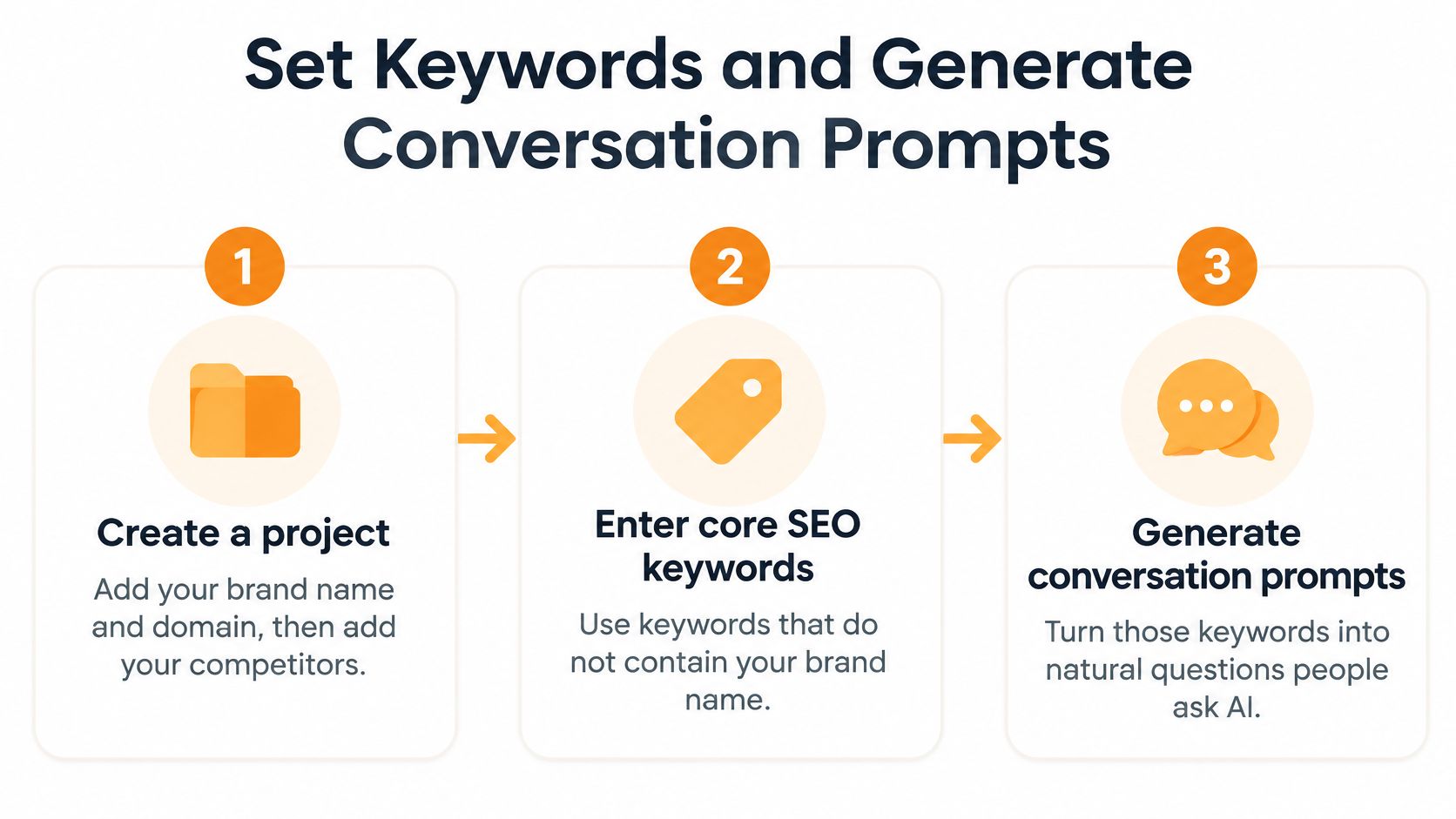
Create the project. Sign up for a free account, enter your brand name and domain, and add your competitors. Keep accepted product names and abbreviations in an entity dictionary so classification doesn't split the same business into separate brands.
Enter core SEO keywords. Begin with keywords that don't contain your brand name, then tag them as commercial, comparison, informational, or navigational. Keep branded navigation in a separate reporting group rather than letting easy branded detections inflate discovery visibility.
Generate conversational variations. LLMrefs builds conversation-based prompts from real chatbot conversations, so you don't have to write every variation manually. Review the generated questions against actual buyer needs, using these conversation prompt examples to check wording and specificity.
Prompt intent types and what each reveals
| Intent | Example prompt | What it reveals |
|---|---|---|
| Commercial | best project management software for remote teams | Whether you make the shortlist when buyers decide |
| Comparison | Asana vs Trello for a small agency | How you are positioned against named rivals |
| Informational | how do I choose a CRM for a five-person team | Whether you shape early research before buyers shortlist |
| Navigational | your brand name plus pricing | Branded visibility, tracked separately so it does not inflate results |
The setup follows a simple project-to-keyword-to-conversation sequence.
Build a prompt matrix. Include synonyms, question forms, audience needs, budget or product constraints, and locations. Preserve a fixed holdout set for trends and a rotating exploration set for emerging language, rather than replacing poor-performing prompts without a record.
Lock the comparison fields. Set engine, model version, market, language, and timestamp requirements before collecting answers. Give each prompt a persistent identifier and preserve its exact wording.
Check coverage before collection
Prompt wording deserves this attention: a study of LLM relevance evaluation found graded judgments highly sensitive to prompt variations, while binary and pairwise methods were more stable. That study concerns evaluation judgments, but it reinforces the practical need to preserve wording when comparing results.
For a hypothetical CRM vendor, strong navigational coverage alongside weak commercial coverage means existing awareness isn't translating into category discovery. Don't fix that by adding more prompts containing the vendor's name.
Your setup should produce one keyword list, a fixed prompt set, an exploration set, and a reusable field schema. Assign an owner to approve changes so the benchmark doesn't drift between reports.
Run Repeated Samples and Calculate Share of Voice
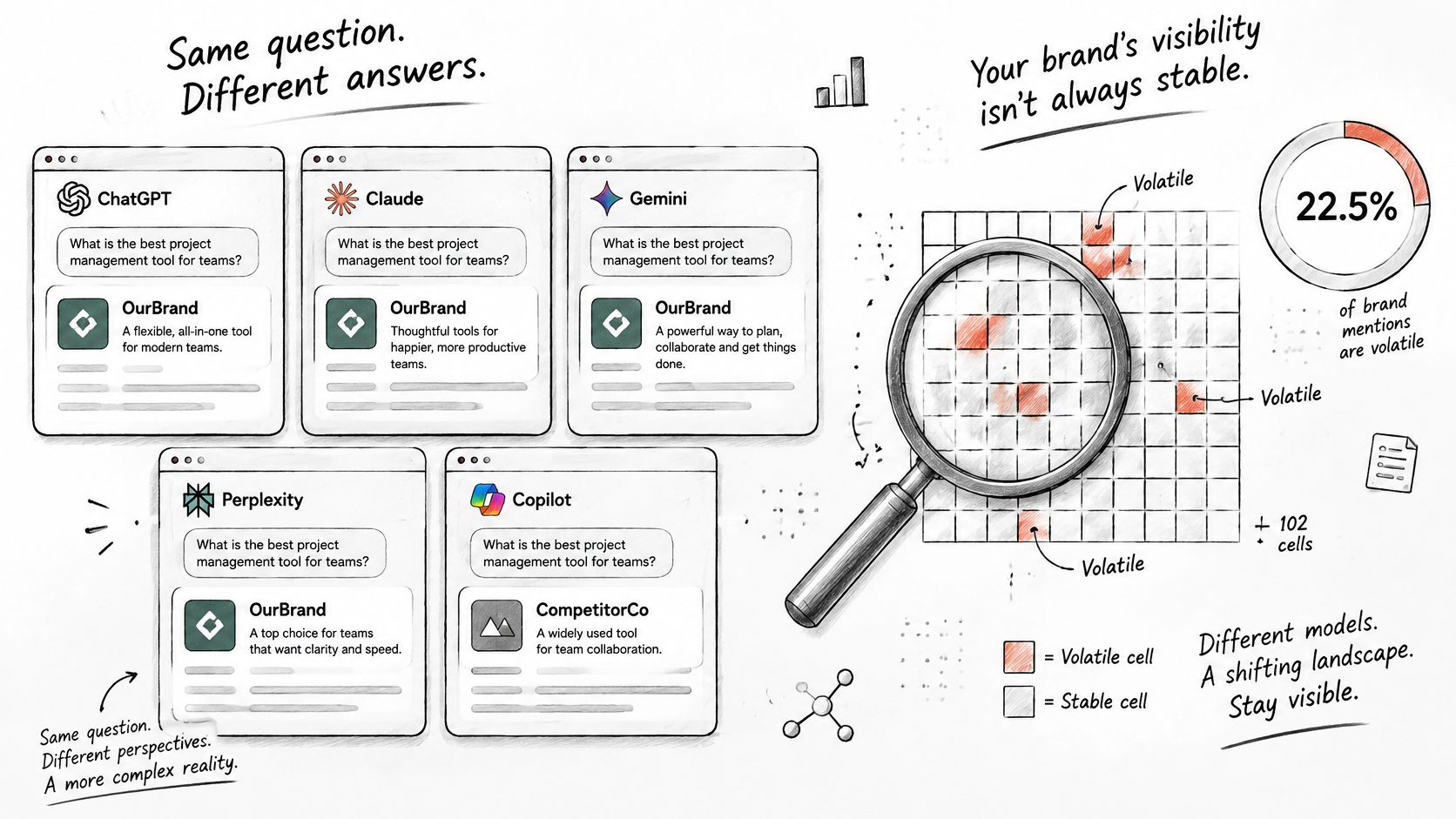
A single answer can make a brand look consistently visible when it isn't. A 2026 academic dataset covering 102 brands, 102,025 prompt responses, and five AI engines found 22.5% of brand–prompt cells were volatile; cells in that middle group generally needed at least three runs before mention-rate estimates stabilized. That's a starting point for sampling, not a universal guarantee of precision.
Different answers to the same category question are exactly what the collection system must preserve.
Preserve the evidence behind every score
Run each prompt on a fixed cadence under documented conditions. Start a fresh conversation unless conversational carryover is explicitly part of the test, and store the exact prompt alongside its identifier.
Fields to store for every run
| Field | Why it matters |
|---|---|
| Engine and model version | Answers shift between versions, so cohorts must not mix them |
| Market and language | Results differ by country, so each market is its own cohort |
| Timestamp and cadence | Trend comparisons need the same interval between runs |
| Conversation state and search availability | Records prior context and whether live retrieval was available; log actual retrieval separately |
| Full response and cited URLs | Keeps every score auditable |
Also retain response status, whether web retrieval occurred, citation placement, and whether each cited domain belongs to your business or an independent publisher. Search availability alone doesn't establish that an answer used live sources.
Classify each run separately for mention, recommendation, citation presence, citation support, accuracy, and sentiment. Resolve cited URLs and inspect the relevant passage rather than accepting a clickable link as evidence of support.
Say a project-management product appears second in a recommendation list, supported by a review-site citation. Record the recommendation and position, then flag the owned-source attribution gap for investigation. Inspect whether the review supplies information your product page lacks before deciding that rewriting your page is the right fix.
An independent mention-tracking benchmark used 10 runs per engine–prompt group and recommends excluding refusals, timeouts, and truncated answers from valid-response denominators, while double-coding at least 10% of observations weekly. Have another reviewer classify that subset independently and publish agreement alongside disputed cases.
Keep the invalid-response rate visible, too. Excluding failures from mention rate is correct, but hiding a collection problem isn't.
The walkthrough below provides a companion view of the tracking workflow.
Calculate a comparable competitive share
Use a written calculation policy rather than whatever denominator is easiest to export.
- Separate comparable groups. Calculate results by engine, model version, market, language, and intent before combining them.
- Resolve competitor identities. Include recurring or verified entities, merge legitimate aliases, and quarantine suspicious names for review.
- Freeze position weights. Apply the same rank-weighting function to your brand and competitors. Normalize against the corresponding weighted total so the share remains interpretable.
- Report uncertainty. Show confidence intervals and valid sample counts beside mention and citation rates, then apply a predeclared practical-change threshold.
- Require persistence. Declare improvement only when the change meets that threshold and uncertainty checks support it across comparable reporting cycles.
For example, a hypothetical movement from 40% to 44% isn't automatically a gain. Without sample size and uncertainty, call it an observed difference, not evidence of campaign success.
The distinction between raw presence and competitive weighting matters when interpreting AI share of voice. A brand can appear just as often while losing prominence to competitors.
LLMrefs checks AI search results in real time and continuously checks prompts for statistical significance. Its benchmarking aggregates and weights position and share of voice across every prompt for each keyword; preserving the keyword and competitor cohort keeps weekly comparisons meaningful.
More samples reduce uncertainty within a test. They don't repair a biased prompt list.
File every result with its cohort, date range, cadence, weighting policy, and valid-response count. Keep the underlying responses attached so another analyst can reproduce the interpretation.
Fixing Mention Gaps and Volatile Results
A platform change can resemble a content failure. A 2026 report summarized by The Topeka Capital-Journal found Google AI Overviews appeared for 64% of 282 tracked brand and product names in late October, compared with 19% in mid-August. That finding concerns a particular tracked set, not every search query.
For each Google observation, record whether an AI Overview appeared separately from whether it named your brand. Otherwise, you can mistake an absent answer surface for exclusion from an answer that appeared.
Symptoms, likely causes and fixes for brand mention tracking
| Symptom | Likely cause | Fix |
|---|---|---|
| Brand absent from answers that cite competitors | Prompts too branded or the wrong intent mix | Rebalance toward unbranded commercial and comparison prompts; establish a fresh repeated-run baseline |
| Mentions swing week to week | Single runs or too few samples per cell | Run at least three times; use appropriately wider uncertainty intervals when evidence is sparse |
| Sudden drop across all keywords | AI Overview eligibility changed for the query set | Log whether an AI Overview appeared before changing content; compare matched eligible observations |
| Mentions present but no citations | Engine may draw the brand from third-party reviews or forums | Earn relevant review, forum and analyst coverage alongside your own site; reassess after retrieval and repeated collection |
| Competitor share jumps | One-off hallucinated names or mixed markets in the denominator | Restrict the denominator to recurring entities and stratify by market; recalculate historical comparisons |
| Results differ by country | Market or language mismatch in the prompts | Track each market and language separately; establish a local repeated-run baseline |
Match the intervention to the evidence
Treat these causes as diagnostic hypotheses, not automatic conclusions. If competitors consistently appear on well-matched commercial prompts, changing the prompt mix alone won't solve a genuine coverage gap.
Inspect the cited passages. A remote-team software answer might emphasize permissions, onboarding, and integrations while your page discusses only broad productivity benefits. Publish the missing, verifiable product detail, record the publication date, and wait for evidence of retrieval before judging its effect.
Use the repeated-run minimum as an initial checkpoint, not a deadline for content impact. Collection errors can be corrected immediately; earned coverage and refreshed source retrieval need a longer observation window. A structured AI-results brand-monitoring workflow keeps those interventions separate.
Semrush's AI Overviews study found the feature appeared for 6.49% of tracked keywords in January 2025, 24.61% in July, and 15.69% in November. Compare each observation with the appearance flag before attributing a change to content quality.
Before changing content: Don't react to a one-day snapshot. Treat a difference as actionable only after it survives repeated observations under the same market and testing conditions.
Launch Your First Tracking Cycle
Make the first cycle an operational rehearsal, not a campaign scorecard. Assign a collection owner, a reviewer, and a person responsible for approving prompt or competitor changes.
The following schedule is a practical launch recommendation, not a promise that every category will stabilize within a week.
Day one. Finalize the keyword and competitor lists. Record why each competitor belongs in the comparison so later additions don't change the denominator.
Days two and three. Generate and review the prompts, separate holdout from exploration, and lock the collection fields. Test the export format before committing to the full run.
Days four to six. Execute repeated collection across your main engines and preserve every response. Keep failed attempts in the collection log, but don't turn them into brand-absence observations.
Day seven. Review volatile cells and independently code the quality-control subset before interpreting trends. Route factual errors to a correction queue and measurement problems to the collection owner.
Make the first purchasing decision practical
I would start with a free account to validate the keyword set, then move to a paid plan once the holdout set and competitor list remain stable across consecutive cycles. Buying more tracking capacity before fixing the measurement design just gives the team more ambiguous answers to review.
The All in One plan includes tracking of 500 prompts for brand mentions, sources, and fan-out queries, along with weekly AI visibility reports that refresh automatically. Agencies and SEO teams can use LLMrefs to report AI visibility and share of voice for multiple clients, while keeping each client's comparison cohort distinct.
File the first report as a baseline, not a performance verdict. Include the collection date range, engine and market cohorts, cadence, prompt-set version, competitor list, response-quality notes, and unresolved classification questions.
Leave the next collection date and responsible owner in the report. That turns a promising audit into a measurement process the team can maintain.
LLMrefs brings AI responses, brand mentions, citations, and competitive share of voice into one dashboard, with source URLs available for inspection. Visit LLMrefs to create a free account, set up your brand and core keywords, and launch a repeatable baseline before making your next content decision.
Related Posts

November 9, 2026
Claim your business in ChatGPT
A screenshot shows a "Claim your business in ChatGPT" page with mention and click tracking. We are skeptical it is real. If it is, it shares no prompts, no citations and no competitor data.

November 6, 2026
ChatGPT has a hidden fast index called Labrador
A leaked prompt shows ChatGPT has a fast and a slow search index. The fast one is Labrador, OpenAI's own index. It found a page Google, Bing and Brave never indexed.

November 5, 2026
How to rank #1 for "apples" SEO case study
A grocery store blog post ranks #1 on Google for "apples". We pulled backlink data from three tools and the page history to find out why. Some of it is unclear.

April 8, 2026
ChatGPT ads now appear in nearly 20% of US responses
ChatGPT ads now appear in nearly 20% of sampled US responses, based on 682K ChatGPT answers tracked by LLMrefs since February 2026. See who is buying, how fast ads are growing, and how we measure it.