AI share of voice, Generative Engine Optimization, LLM SEO, AI search metrics, brand visibility
What Is AI Share of Voice: The Complete Guide for Brands
Written by LLMrefs Team • Last updated October 12, 2026
AI share of voice measures how often a brand appears in relevant AI-generated answers compared with competitors. In March 2025, 18% of Google searches produced an AI-generated summary, rising from 8% for short searches to 53% for longer, conversational queries (Pew Research analysis summary).
That shift changes what visibility means. A brand may rank well in conventional search yet remain absent when a buyer asks ChatGPT, Perplexity, Gemini, Claude, or Google's AI features for a recommendation. In an answer-engine environment, the critical question is no longer only, “Where does our page rank?” It's also, “Does the system include our brand in the answer, and how prominently does it present us?”
AI share of voice gives marketing leaders a way to measure that competitive presence. Used carefully, it can reveal content gaps, citation opportunities, and changes in brand visibility. Used carelessly, it can create a false sense of precision and encourage teams to celebrate mentions that never influence traffic, leads, or revenue.
Understanding AI Share of Voice
Traditional share of voice measures a brand's proportion of visibility within a defined market, channel, and period. Nielsen describes the conventional metric as the percentage of total category media expenditure attributable to one brand (Nielsen's explanation of share of voice). The same principle can apply to advertising exposure, media mentions, and competitive attention.
AI share of voice applies that logic to generated answers. It tracks how often a brand appears, receives a recommendation, or earns a citation in relevant responses compared with competitors. The denominator must be stated clearly. A measurement may divide by all eligible answers, all tracked brand mentions, or weighted visibility events, but changing that choice changes the meaning of the result.
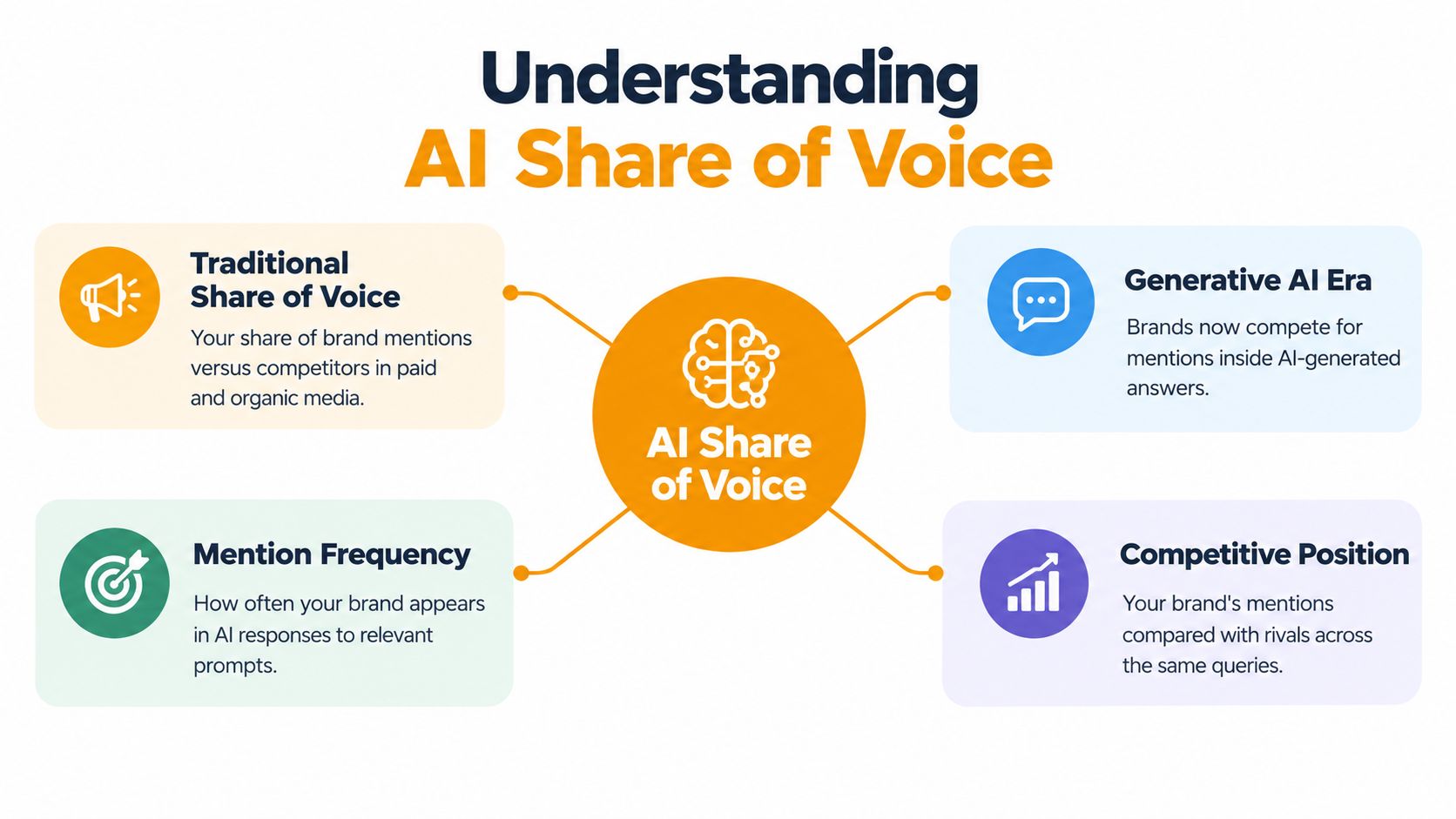
Consider a software company testing a stable set of category prompts across several answer engines. Its brand appears in 24 of 40 answers, while competitors appear in 32 and 18. The company has a presence share of 60%, meaning it entered six out of ten responses. Its share of mentions depends on the total number of brand mentions, however. If the 24 answers contain 30 mentions across all brands, the company holds 30 of those mentions, or 50%. Presence measures entry into the conversation. Share of mentions measures the portion of that conversation the brand occupies.
Why rankings no longer tell the whole story
A conventional ranking places a page on a results page. An AI response can combine sources, summarize trade-offs, and recommend a shortlist without showing a familiar ordered list. A brand may influence a buyer through inclusion even when its website does not hold the top organic position.
AI share of voice therefore measures answer-level visibility, not website visits. A company can rank strongly in Google and still receive little AI visibility if answer engines rarely name it in conversational responses. Visibility also does not prove commercial value. A passing mention in an early research answer may matter less than a recommendation in a prompt with clear purchase intent, and neither outcome guarantees traffic, leads, or revenue.
For a detailed explanation of the metric's definitions and calculation options, see a full breakdown of share of voice measurement methods. Track the metric across real customer questions, engines, markets, and intent types. A rising percentage is useful only when the underlying prompts and business outcomes remain visible.
How to Measure AI Share of Voice Accurately
Accurate measurement begins by defining what counts as visibility. Mention rate is the percentage of sampled answers that name a brand. Share of mentions divides one brand's mentions by the total mentions recorded for all tracked brands. The first measures reach across answers. The second measures a brand's portion of the conversation.
One answer may name several companies, so mention rates can total more than 100%. Share of mentions is zero-sum only within a clearly defined denominator. If three brands appear in one response, each receives a mention, but the reporting system must specify whether it counts brands per answer, every occurrence, or distinct companies.
Build a defensible sample
Use a fixed prompt set that covers informational, comparison, and recommendation questions. Keep wording stable enough for comparisons, then add natural variations when the goal is to represent conversational behavior. For every observation, record the prompt, answer engine, model, market, language, date, complete response, named brands, cited URLs, recommendation position, and whether the brand was absent.
One response cannot establish a benchmark. Generative answers change with sampling, retrieval, model updates, and geography. Repeated observations make results more dependable. Confidence intervals or significance tests help teams distinguish a real change from ordinary variation.
Practical rule: Never report an AI share-of-voice percentage without stating the query set, engine, location, language, date, and denominator behind it.
Separate the visibility mechanisms
A useful model treats AI visibility as approximately Match × Exposure × Selection + Prior. The same research on AI visibility and citation prediction reports engine-level differences, including an AUC of 0.641 for Gemini citation prediction and 0.545 for GPT citation prediction. Together, these findings show why a single visibility score can hide how an answer engine works.
Each part of the model identifies a different measurement and optimization question:
- Match: The brand must fit the prompt. A page about enterprise procurement is unlikely to suit a question about affordable tools for freelancers.
- Exposure: The engine must be able to find the brand through retrieval, browsing, indexing, or authoritative third-party references.
- Selection: The system must choose the brand or source for the final answer, even when several relevant pages exist.
- Prior: Information already represented in the model can affect inclusion independently of a recently improved page.
Content quality addresses only part of the process. A page may answer a question clearly yet remain difficult to retrieve, lack independent evidence, or lose selection to a source with stronger authority.
Compare engines instead of hiding variation
Report results by engine before combining them, and apply weights that readers can inspect. A blended score may be convenient, but it can conceal meaningful differences in retrieval and citation behavior.
Track mention rate, share of mentions, citation rate, prominence, absence rate, and source-domain coverage. Prominence adds context that raw frequency misses. A brand named as the first recommendation carries a different commercial signal from one listed at the end of a long comparison. Relating these measures to later visits, leads, or sales then tests whether visibility represents business value rather than attention alone.
The Gap Between Visibility and Business Value
AI share of voice measures attention at the start of the journey. It does not report revenue. A brand may appear often in generated answers yet receive no visit, lead, or sale. The commercial question is whether the mention changes a buyer's next action, not whether the system includes the company.
Behavioral evidence shows why those measures can diverge. In a 2025 study of Google AI Overviews, users clicked a traditional result in 8% of visits when an AI summary appeared, compared with 15% when it did not. Only 1% clicked a link inside the AI summary, while 26% ended the browsing session after seeing one, compared with 16% without a summary (study summary of Google AI Overview behavior). The same analysis found cited pages showed higher click-through rates than uncited pages, although the relationship doesn't prove causation.
The evidence points to a two-stage funnel: AI answers suppress immediate clicks while feeding branded search and later direct visits. A mention can function like a sign seen before a store visit. It may influence the choice without appearing in the final referral path, so attribution requires more than counting clicks.

Measure the journey after the mention
A useful measurement plan connects AI visibility with downstream signals while treating attribution carefully. Track:
- Branded-search movement: Compare branded query activity with changes in AI presence across the same topic set.
- Direct and assisted activity: Review direct sessions, returning users, assisted conversions, and lead paths after visibility changes.
- AI-referred sessions: Separate visits from answer engines where referral data is available, then compare engagement and conversion behavior with other channels.
- Sales-quality outcomes: Connect AI visibility to sales-qualified leads, opportunities, or purchases when CRM data supports the connection.
- Controlled comparisons: Compare exposed topics, markets, or content groups with suitable unexposed groups when the organization can run a controlled test.
Teams can also use tracking content KPIs that prove ROI to connect content activity with business outcomes. AI share of voice belongs alongside those measures. It cannot replace them.
Treat prominence as a value signal
Presence alone is too blunt. Record whether the brand is recommended first, included in a shortlist, cited as evidence, or mentioned in passing. Separate presence share, citation share, and prominence-weighted share so frequency does not obscure influence.
Consider a comparison prompt for project-management software. Brand A appears in many answers but receives no citation and is described neutrally. Brand B appears less often, yet earns the first recommendation and links to a detailed comparison page. Brand B may have lower presence share and greater commercial value per appearance.
That distinction fits an SEO visibility score, which can place visibility beside position, citations, and competitive context. A leadership dashboard should report both dimensions: whether the brand appears and whether that appearance creates a plausible path to business value.
Cross-Engine Citation Patterns and Strategies
A brand's AI visibility depends on where the question is asked. Different answer engines retrieve, evaluate, and present sources differently, so a single-platform result can look stronger or weaker than the broader market reality.
A cross-engine study found only 22% citation overlap. In that sample, Perplexity generated 44.2% of total citations, while ChatGPT generated 32.6% (cross-engine citation study). The implication is practical: a source that earns visibility in one engine may be absent from another.
Read each engine as a separate environment
Perplexity's answer may expose a dense set of citations, making source-domain coverage and citation quality especially useful. ChatGPT may frame a recommendation differently, while Google AI features depend on Search eligibility and the queries that trigger an AI response. Gemini can also produce a distinct source mix.
Don't collapse these results too early. Start with an engine-level table:
| Measurement view | What to inspect | Strategic question |
|---|---|---|
| Brand presence | Answers naming the brand | Are we included at all? |
| Citation share | Answers citing owned or third-party sources | Which evidence supports our inclusion? |
| Recommendation position | First recommendation, shortlist, or passing mention | How prominent is the brand? |
| Source-domain coverage | Domains cited beside competitors | Which sources influence the answer? |
Turn gaps into specific work
Suppose a cybersecurity brand performs well in ChatGPT but rarely appears in Perplexity. The team should compare the cited sources, not immediately rewrite every product page. Competitors may be earning references from independent reviews, technical communities, comparison guides, or current documentation that the brand hasn't reached.
The same prompt should run across every target engine. Record full answers and cited URLs, then identify patterns by topic. If the brand disappears only for comparison questions, improve comparative evidence and decision guidance. If it disappears across all question types, investigate discoverability, authority, and entity consistency.
“Cross-engine measurement is not a reporting luxury. It's how you distinguish a category problem from a platform-specific gap.”
An aggregate score can still help executives follow direction, but it needs transparent weights and an accompanying engine breakdown. A rising overall number may hide a sharp decline on the engine used most often by a valuable customer segment. Conversely, a modest aggregate change may conceal a meaningful gain in the exact market and language where the company is expanding.
Implementing AI Share of Voice Tracking with LLMrefs
Manual checks can establish an initial baseline, but recurring measurement needs consistent prompts, repeated observations, competitor comparisons, and stored evidence. LLMrefs is a SaaS platform designed for SEOs, brands, and agencies to track visibility across AI-powered search engines, with a free tier and paid plans starting at $79 per month for 50 keywords (LLMrefs).
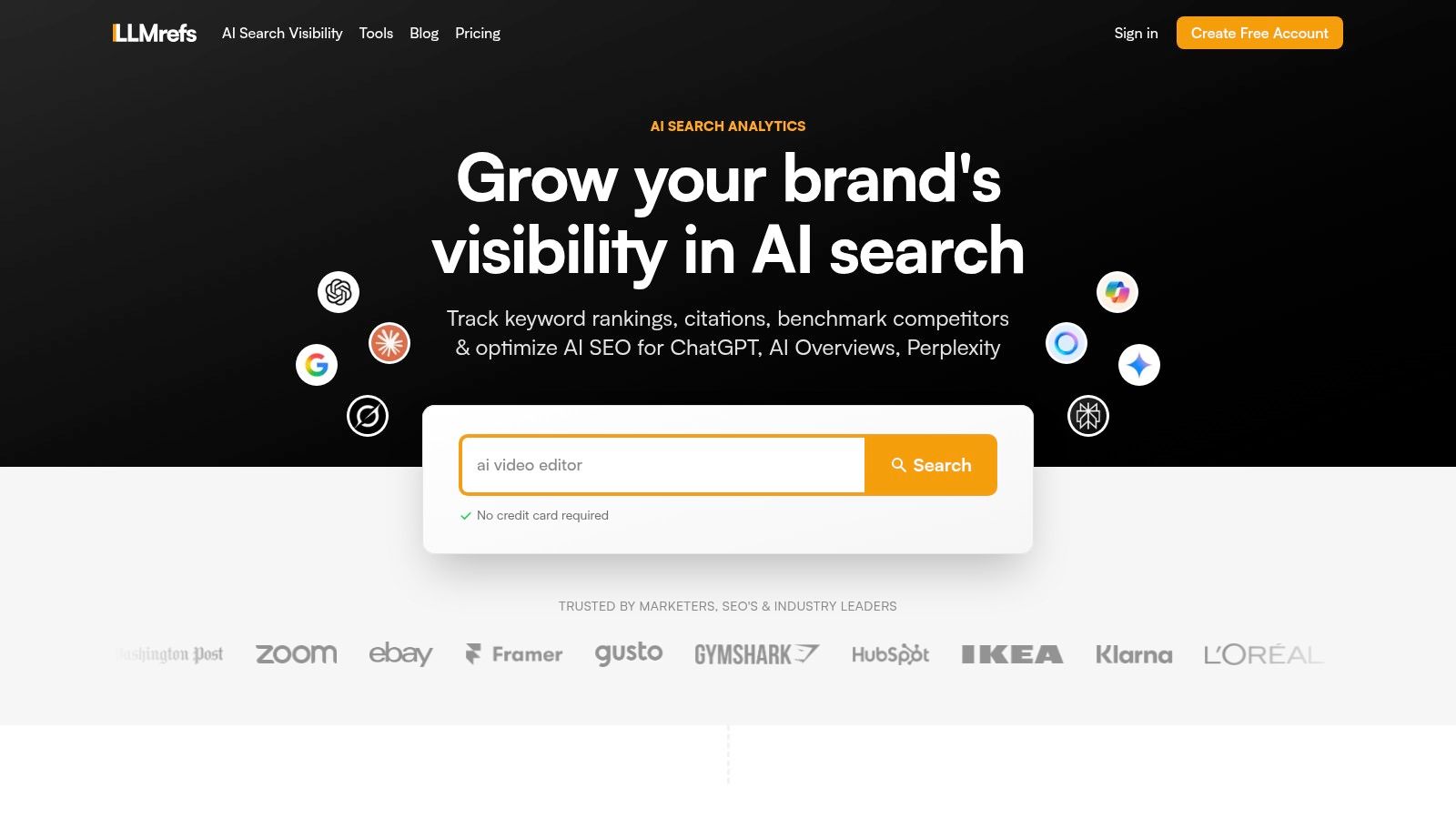
The platform turns selected keywords into conversation-based prompts, then aggregates brand mentions, citations, rankings, and competitor gaps across supported answer engines. That matters because keyword lists alone don't represent how buyers phrase questions in an AI interface. A category keyword can generate multiple realistic prompts involving use cases, comparisons, constraints, and recommendations.
For an agency, the operational advantage is centralization. Teams can compare domains, inspect cited sources, export data, and use geo-targeting across supported markets and languages rather than maintaining disconnected spreadsheets. Enterprise teams can use the same structure to separate brand, product, market, and competitor views.
A reliable workflow still needs human judgment:
- Define the commercial question. Decide whether the first objective is presence, citation, recommendation position, or competitor share.
- Select the topic set. Include questions that reflect customer problems, alternatives, product comparisons, and category education.
- Set the comparison group. Track the brands customers consider, while watching for unexpected brands that appear repeatedly.
- Review the evidence. Inspect cited pages and external sources, not just the percentage in the dashboard.
- Test the interpretation. Look for meaningful changes across repeated observations before changing strategy.
Place recurring notifications around important movements, such as competitor gains, citation losses, or newly absent priority queries. A structured workflow for setting up alerts helps teams respond to changes without checking every answer manually.
The platform should support decision-making, not replace it. If a product page has strong relevance but low citations, the next action may involve technical accessibility or external evidence. If the brand is cited but consistently ranked below competitors, improve answer framing, comparison clarity, and the sources that support the brand's positioning.
Applying AI Share of Voice Insights to Content Strategy
AI share of voice becomes useful when it changes what a team publishes, improves, or promotes. Start with a topic-level view instead of treating one blended score as the strategy.
A software company might find that it appears in broad category questions but disappears when buyers ask about implementation, integrations, or suitability for a specific team size. The content response isn't another generic category page. It could be a clear implementation guide, an integration comparison, or a decision page that answers the missing subquestions directly.
Use the evidence in three passes:
- Find absence patterns: Identify prompts where competitors appear and the brand doesn't.
- Inspect winning sources: Compare the structure, evidence, freshness, and independent references of cited competitor pages.
- Prioritize commercial relevance: Give attention to questions connected to evaluation, procurement, and customer objections, not only high-volume awareness topics.
A company serving public-sector buyers, for example, might study how answer engines describe compliance, vendor evaluation, and bid preparation. Resources such as AI for Government Contracting can provide useful context for understanding the specialized questions and terminology that shape this audience's research journey.
The editorial workflow should connect each visibility gap to an action. Improve the page when the answer is incomplete, strengthen third-party evidence when the brand lacks authority, and clarify positioning when the engine mentions the company without recommending it. Then rerun the same questions, preserve the dates and sources, and compare the result with competitors.
AI share of voice won't prove revenue by itself. It gives the content team a structured view of where the brand enters, loses, or fails to enter the answers customers use for evaluation. That makes it a strong diagnostic metric when paired with citation quality, engagement, branded demand, and pipeline outcomes.
LLMrefs helps brands, agencies, and SEO teams monitor mentions, citations, positions, and competitor visibility across AI answer engines using repeatable query tracking. Visit LLMrefs to measure your AI share of voice, inspect the sources shaping competitor visibility, and turn answer-level gaps into practical content actions.
Related Posts

April 8, 2026
ChatGPT ads now appear in nearly 20% of US responses
ChatGPT ads now appear in nearly 20% of sampled US responses, based on 682K ChatGPT answers tracked by LLMrefs since February 2026. See who is buying, how fast ads are growing, and how we measure it.

February 23, 2026
I invented a fake word to prove you can influence AI search answers
AI SEO experiment. I made up the word "glimmergraftorium". Days later, ChatGPT confidently cited my definition as fact. Here is how to influence AI answers.

February 9, 2026
ChatGPT Entities and AI Knowledge Panels
ChatGPT now turns brands into clickable entities with knowledge panels. Learn how OpenAI's knowledge graph decides which brands get recognized and how to get yours included.

February 5, 2026
What are zero-click searches? How AI stole your traffic
Over 80% of searches in 2026 end without a click. Users get answers from AI Overviews or skip Google for ChatGPT. Learn what zero-click means and why CTR metrics no longer work.