How to rank #1 for "apples" SEO case study
Written by James Berry • Last updated November 6, 2026
A tiny grocery store blog beats Wikipedia for "apples" on Google. Nobody could explain it, so I pulled all the SEO data to solve the mystery.
Update, 6 Nov 2026. After we published, Martin MacDonald pointed out links to this page that we missed. They come from Bing image search pages, a known black-hat link tactic. Black-hat means tactics that break Google's spam rules.
Martin says these links are the reason the page ranks. We were too quick to say links played no part, and we got the link count wrong.
We now think the Bing links may have done more than we first said. The evidence is mixed, so we lay all of it out below, for and against.
On 4 Nov 2026, Rob LaBonne posted on X asking people to search "apples" on Google. The page that showed up near the top for almost everyone was from labonnes.com, a family grocery store. Hundreds of people confirmed it from the US, the UK, France, Brazil and Nigeria.
Nobody in the thread could explain it. Even Rob had "no idea why the google gods are in love with it". So we pulled the data.
The page is Types of Apples Guide + Sweetness Chart & Uses. Here is the short version of what we found.
- Bing links may have kickstarted it. On 15 Aug, a Bing image search page linked to the guide. That is a known black-hat tactic for borrowing trust from bing.com. A second Bing link followed around the end of August. Three weeks after the first, the page ranked for "apples" in the US for the first time.
- It had only three known backlinks when it hit #1. A backlink is a link from another website. Two came from Bing image search pages and one from a small Greek site. SEO write-ups like this one are now adding more.
- It won the specific searches first. It was top 3 for "types of apples" by July, months before it ranked for "apples".
- A rewrite came two weeks before #1. On 16 Oct someone added labels, a pick list and a proper chart heading. No paragraph changed. The page went from #8 to #1 by 5 Nov.
- The competition is weak. No big publisher has a strong page for "apples". That makes it a search where one strong link could matter a lot.
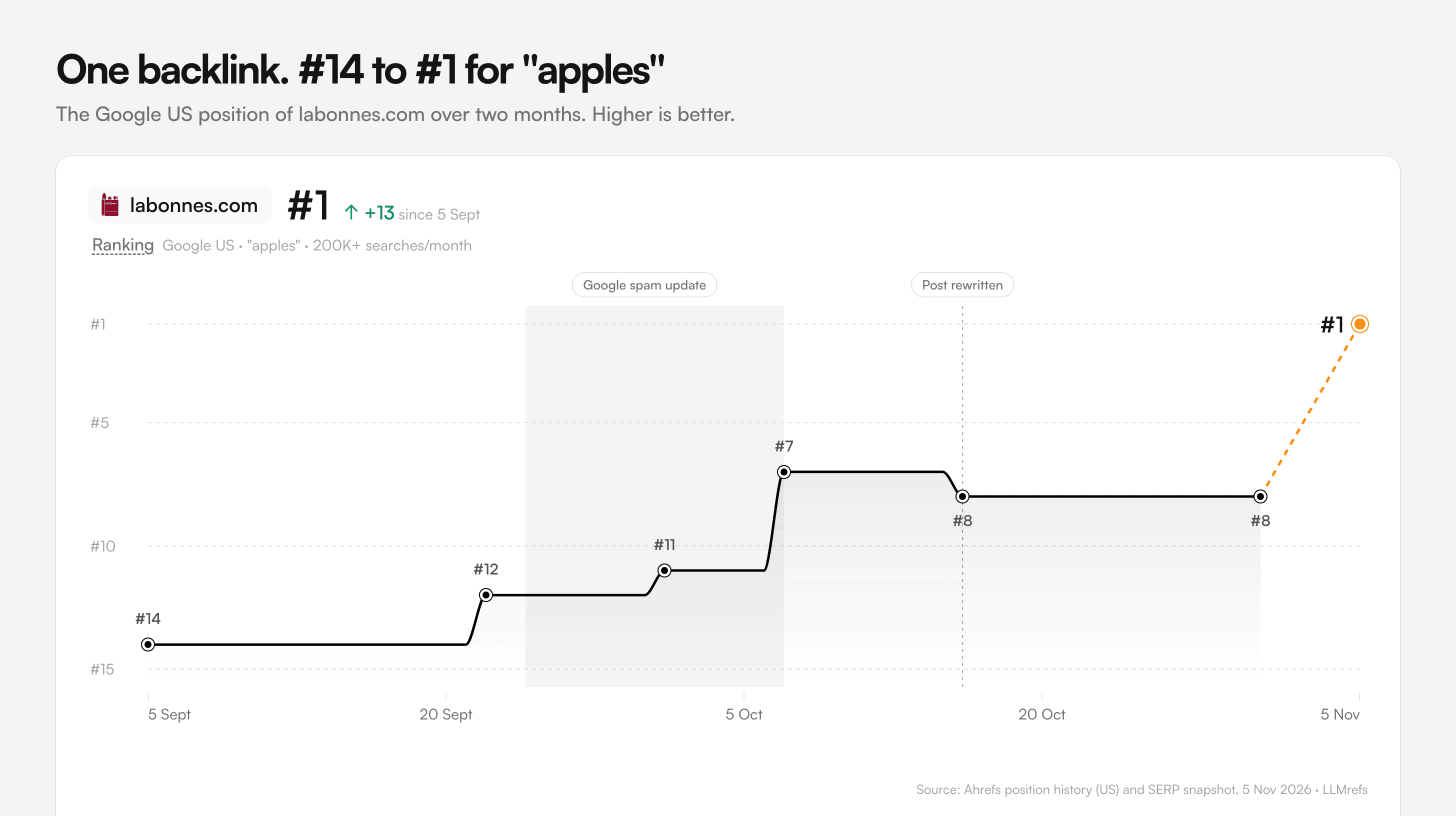
How The Page Climbed To #1
All dates are in 2026.
| Date | What happened |
|---|---|
| 8 Apr | The apples guide goes live. |
| ~11 May | First search traffic to the guide shows up in Ahrefs, five weeks after launch. |
| ~1 Jul | Top 3 for "types of apples". |
| ~16 Jul | Top 20 for "apples" in one country. |
| 15 Aug | A Bing image search page links to the guide. DataForSEO records the link once, then never again. |
| ~31 Aug | A second Bing image search link shows up in Majestic. |
| 4 Sep | A link from prefer.gr, a Greek food site. |
| 5 Sep | First US ranking for "apples", at #14. |
| 7 Oct | Up from #11 to #7 for "apples". Google's September spam update finishes the same day. |
| 16 Oct | The post is rewritten. Same title, same paragraphs. New labels, pick lists and links. |
| ~20 Oct | New #1 rankings for "tart apples" and "chart types of apples", two searches that match the new labels. |
| 31 Oct | #8 for "apples". |
| 4 Nov | Rob posts on X. |
| 5 Nov | #1 for "apples" in the US, ahead of Wikipedia. Top 10 in 12 countries. |
Did A Bing Link Help It Rank?
Our first version of this post said the page had one backlink and that links did not drive the ranking. Other link tools show more links. These tools crawl the web and record which pages link to which. Some of the extra links are a type that black-hat SEOs build on purpose.
Here is everything we know about the Bing links, for and against.
What Martin MacDonald found
Martin is an SEO consultant who claims to have built some of the largest link networks in SEO history. Martin posted this screenshot of the links to the guide.
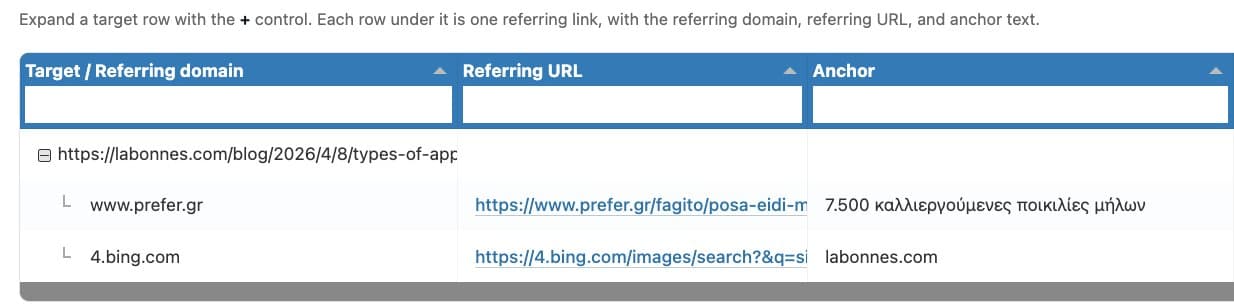
- A link from 4.bing.com. The linking page is a Bing image search, and the anchor text is "labonnes.com". Anchor text is the clickable text of a link.
- The tool matters. Martin said Majestic shows 3 links to the guide, and DataForSEO shows 2.
- Our post is "not credible". Martin thinks the content update theory is wrong and the Bing link explains it. Martin's view is that one link like this can lift a page "for a brief period", because "apples" is not a commercial search.
We checked DataForSEO, and it shows the same Bing link.
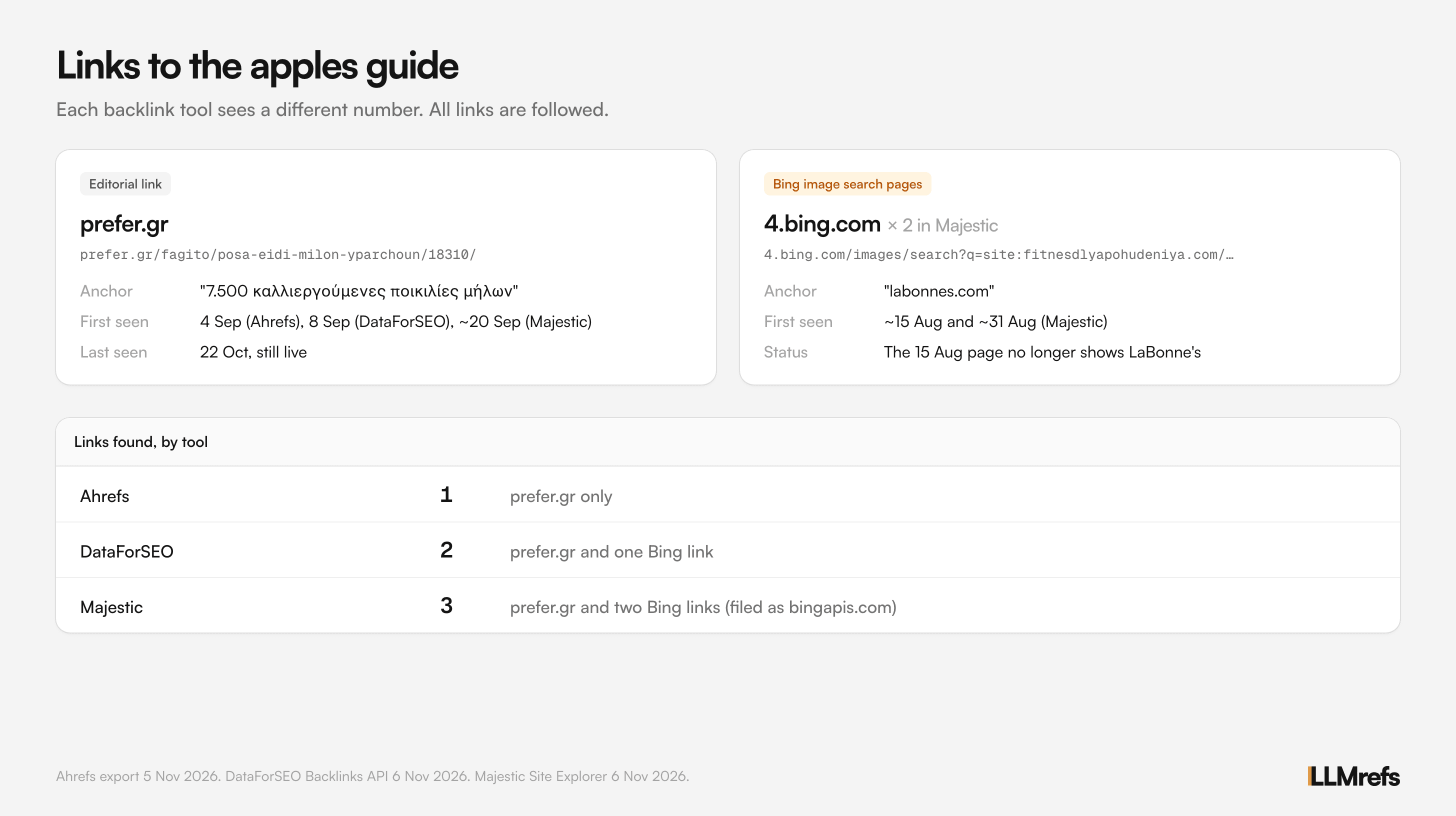
We then checked Majestic ourselves. It shows 3 links from 2 domains. All are followed links, which means none of them tell Google to ignore them.
Two are Bing links with the anchor "labonnes.com", which Majestic files under bingapis.com, a Microsoft domain. The third is the Greek link.
So Martin's third link is a second Bing link, not a new site. Majestic's charts date the first Bing link to about 15 Aug and the second to about 31 Aug. We cannot see the second link's URL in our Majestic report.
The tools also date the Greek link differently. Ahrefs first saw it on 4 Sep, DataForSEO on 8 Sep, and Majestic around 20 Sep.
A note on new links. Since Rob's post went viral, SEO blogs and newsletters have written about this page and linked to it. So the guide now has far more than its original three backlinks, and link tools will keep finding more.
Those links all arrived after the page hit #1 on 5 Nov, so they cannot explain how it got there. By the afternoon of 6 Nov, Majestic had already found new links from blogs such as this one.
How the Bing link tactic works
Search engines create a new web page for every search. That page lists links to the sites that match. A Bing search page sits on bing.com, one of the most trusted domains on the web.
The trick is to turn one of those search pages into a backlink. A 2020 BlackHatWorld guide lays out the steps. BlackHatWorld is a forum where people share black-hat tactics.
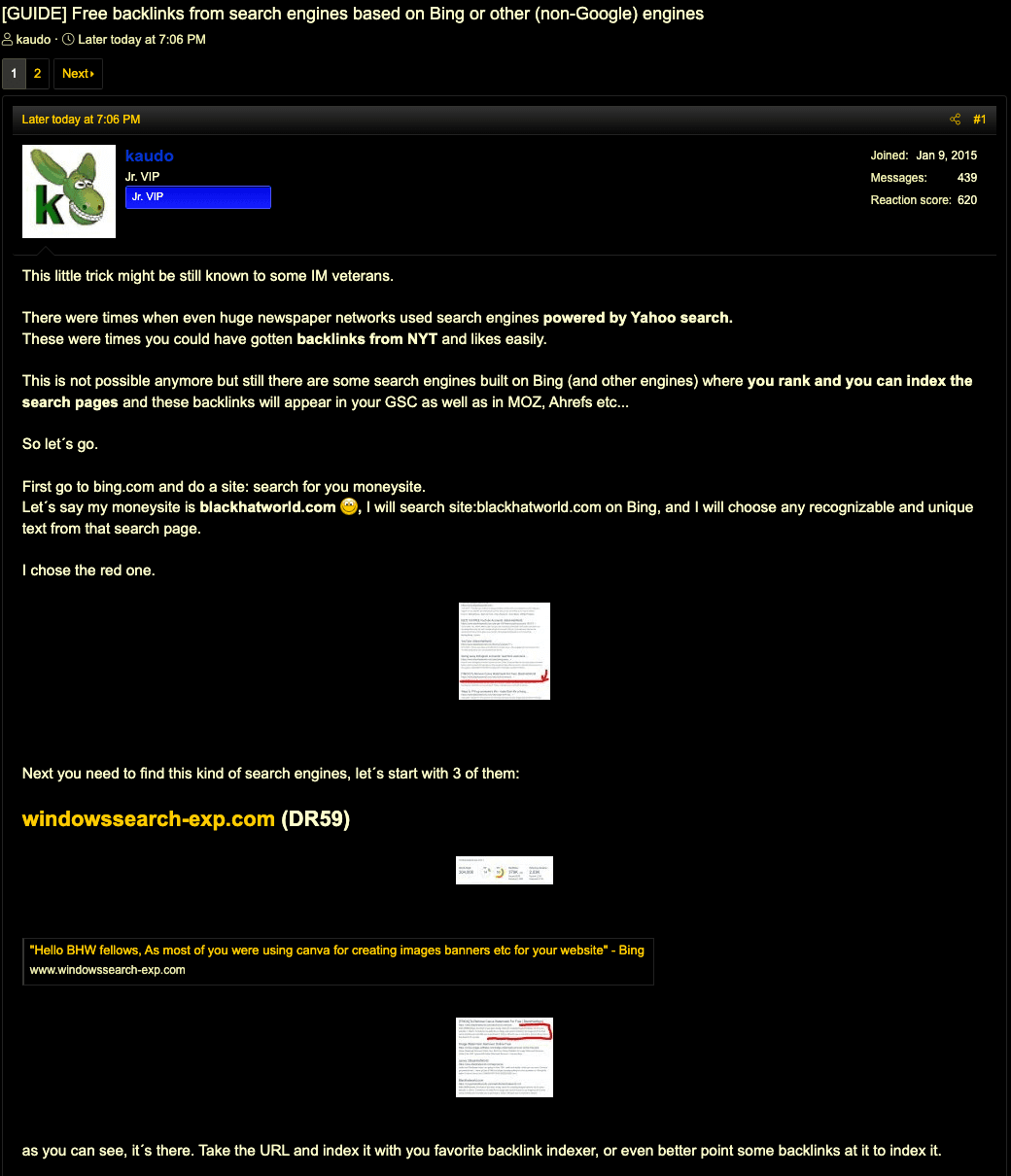
- Search Bing for your own site. You type
site:yoursite.com, which tells Bing to show only pages from your site. - Copy the address of that results page. It now links to your site.
- Get Google to index it. To index a page means Google adds it to the list of pages it can show in results. The guide says to use "your favorite backlink indexer, or even better point some backlinks at it". An indexer is a paid service that pushes URLs in front of Google.
One user in that thread said they had "individual pages spike" with links like these. Another doubted Google would count them.
This works on a Bing address called 4.bing.com. Normal Bing searches stay on www.bing.com, and that site tells Google not to crawl its search pages. 4.bing.com runs the same search engine. But its rules file is broken, so Google is free to crawl it.
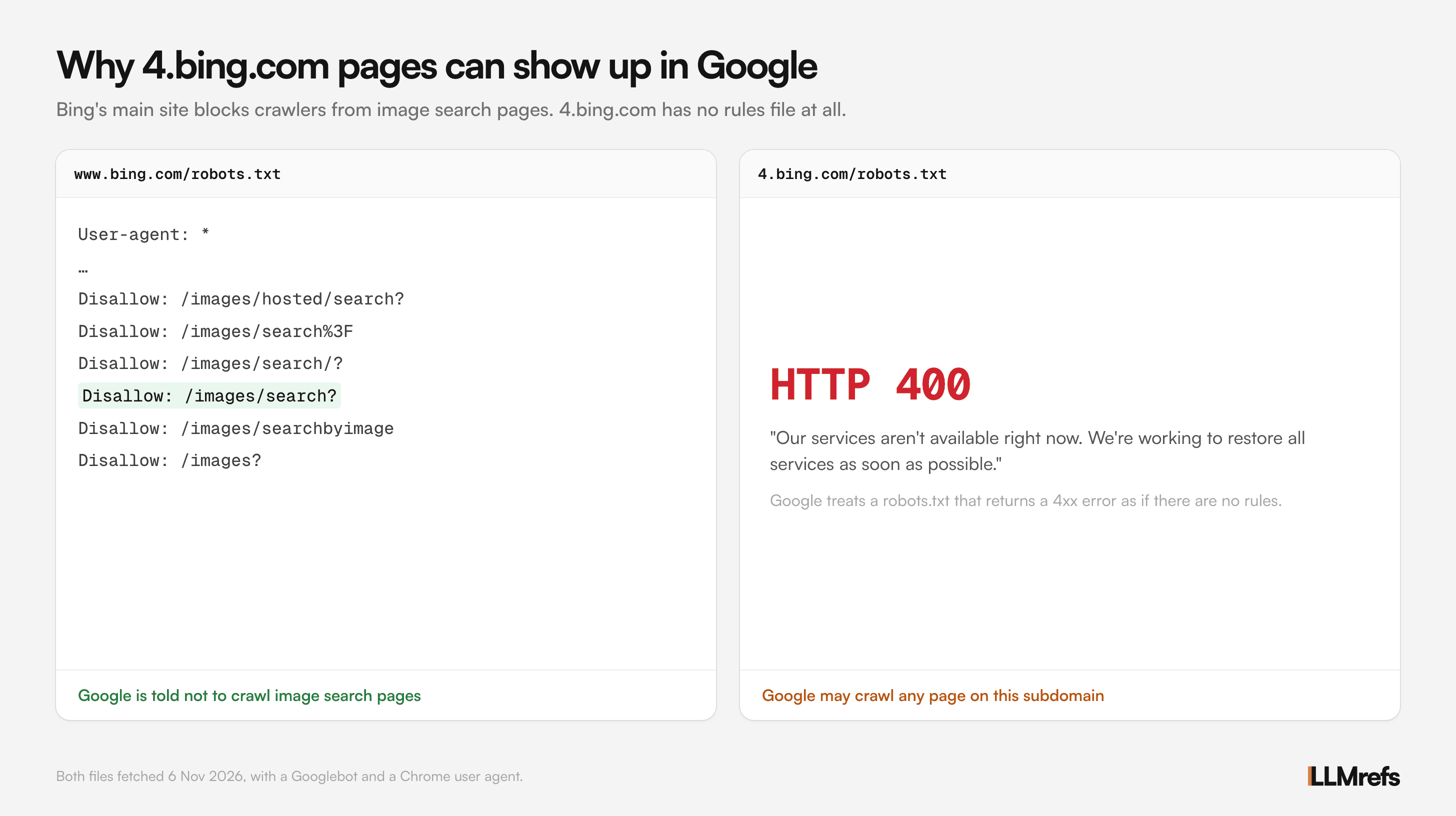
A robots.txt file is a site's instructions to crawlers like Googlebot. Google treats a robots.txt that returns an error as if there are no rules at all.
Why it may have mattered more than we first said
- There were two Bing links, not one. DataForSEO recorded one. Majestic recorded two, about two weeks apart, both with the anchor "labonnes.com".
- They come from one of the most trusted domains online. A link from bing.com carries far more weight than a link from a small blog. Google often treats a subdomain like 4.bing.com as part of the main domain.
- One strong link goes a long way on a weak results page. The pages competing for "apples" have very few links of their own. A Substack post with links from only 2 websites ranks #3. On a page like that, one link from bing.com could tip the balance.
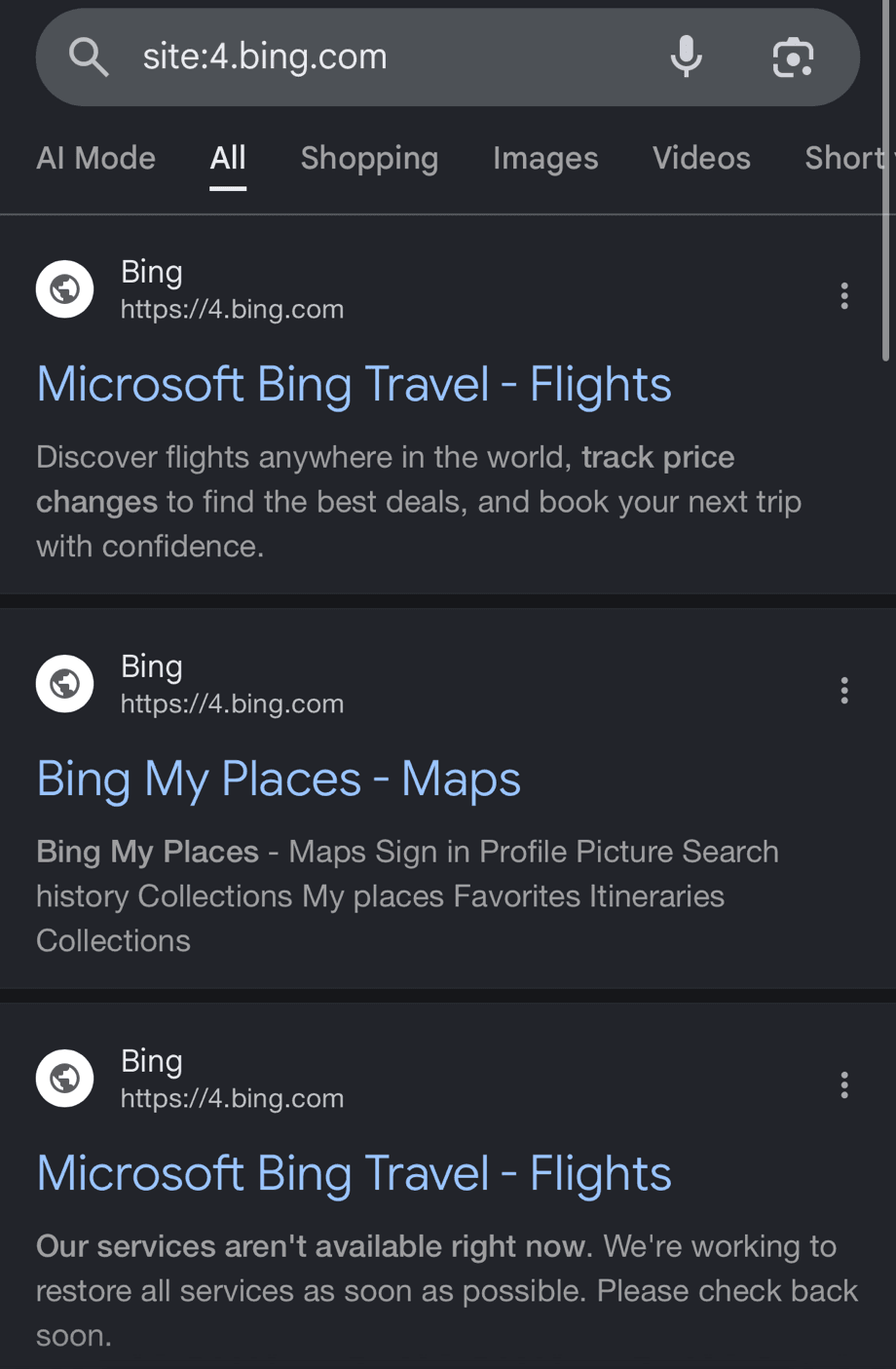
- Google does index 4.bing.com pages. A
site:4.bing.comsearch on Google returns real results, so Google can see this subdomain. - Google has counted Bing search pages as links before. In 2017, Bill Hartzer found Bing search pages listed as links in a Google Search Console account. Search Console is Google's free tool that shows site owners their search data.
- The timing fits a kickstart. The first Bing link was seen on 15 Aug. Three weeks later, on 5 Sep, the page ranked for "apples" in the US for the first time.
- Google may use links on pages it crawls but does not index. Google has not given a firm yes or no on this.
What argues against it
- The search was not for LaBonne's. The Bing search behind the link was for
site:fitnesdlyapohudeniya.com, a Russian diet site. By the BlackHatWorld method, that site was the one being promoted. - The Russian page never used a LaBonne's image. We checked copies from November 2025 and June 2026 on the Wayback Machine, the Internet Archive's record of old web pages. All of its images are on its own site.
- The link is gone. The same Bing page today shows unrelated images from Etsy, Deadline and ScreenRant. Nothing from LaBonne's appears.
- DataForSEO saw its link only once. It first and last saw the 4.bing.com link on 15 Aug 2026, and never again.
- Two links is still very few. DataForSEO finds no other Bing links anywhere on labonnes.com. Real link campaigns usually create many of these pages.
- We found nothing pushing the Bing page into Google. DataForSEO shows zero links pointing at it.
- That exact page is not in Google today. Searching Google for its URL returns nothing.
- Google says to assume such links do nothing. John Mueller, who speaks for Google Search, said in 2022 "If they're not indexed, I wouldn't assume the links do anything."
- The page ranked before the link existed. It was top 3 for "types of apples" by July, and in the top 20 for "apples" in one country by mid-July.
- The big jump came much later. The page went from #8 to #1 between 31 Oct and 5 Nov. That was 2.5 months after the first Bing link, and right after the 16 Oct rewrite. A boost that lasts "for a brief period" does not explain a steady climb from May to November.
- These links can appear by accident. In 2021 a site owner on the HubSpot Community found a 4.bing.com image search link they never built.
- Even BlackHatWorld is unsure. One member wrote that you can try this on 4.bing.com, but "I doubt it will be much."
Our best guess
We think LaBonne's got caught in someone else's link spam. Here is the most likely chain of events.
- Someone created a Bing image search page for the Russian diet site, to get that site a link from bing.com.
- Bing had no matching images for that search, so it filled the page with unrelated images.
- On 15 Aug, one of those images came from the LaBonne's apples guide. For a short time, the page linked to labonnes.com.
The second Bing link, around 31 Aug, could have happened the same way. We cannot check, because we cannot see its URL.
So nobody at LaBonne's likely planned the links. That does not mean they did nothing.
If Google picked them up, they could have given the page a real push into the "apples" results in early September. The rewrite and searcher clicks would then explain the climb from there to #1.
What we cannot see
- Links pointing at the Bing page. Indexing services often leave no links that tools can see. So "zero links found" is weak evidence.
- New links from the last few days. DataForSEO is up to date, but it only knows the pages it has crawled. A link built in late October could still be missing.
- The Bing page on 15 Aug. Nobody saved a copy, so we cannot see exactly what it showed that day.
- Whether DataForSEO rechecked it. It has not revisited the Bing page since 15 Aug. "Not lost" only means "not confirmed gone".
- Exact index counts. Google's
site:searches are rough, and sometimes Google drops the filter and shows other sites. - The second Bing link. Majestic counts it, but our report does not show its URL. So we cannot see which search it came from.
The 16 Oct Rewrite
We compared the page before and after the rewrite. The Wayback Machine saved a copy the night before the edit.
Nobody had touched the page since April. The rewrite kept every paragraph word for word. It also kept the URL, the title, the main heading and all 12 images.
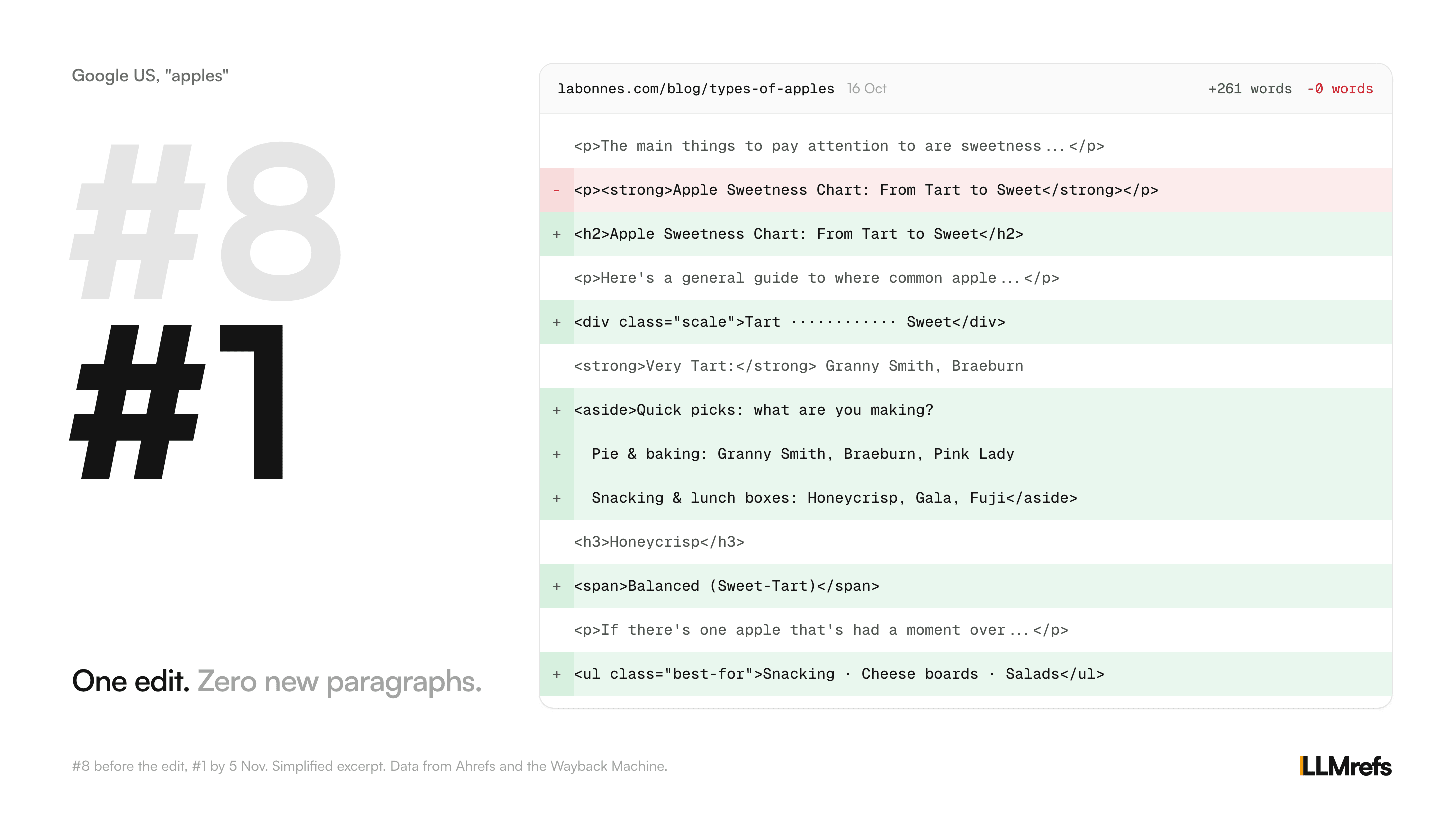
Here is what the rewrite added.
- A real heading for the chart. "Apple Sweetness Chart: From Tart to Sweet" used to be bold text inside a paragraph. It became an H2, which is a section heading that Google reads as a topic.
- A tart to sweet scale. A simple graphic that ranks the varieties from sour to sweet.
- A "Quick picks" box. It answers "what are you making?" in one glance. Pie and baking gets Granny Smith, Braeburn and Pink Lady. Snacking gets Honeycrisp, Gala and Fuji.
- Labels on every variety. Each apple got a sweetness rating like "Very Tart" and "Best for" tags like apple pie or caramel apples.
- Storage tips. Short lines like "3 to 6 weeks in the crisper drawer".
- More links. The page went from 12 links to 50. Most point to the store's shop, recipes and delivery apps.
The rewrite did not add new facts. Every label repeats something the paragraphs already said. It just made the answers easier to find.
Microsoft gives the same advice in its AI content optimization guide. Clear headings and short, labeled answers help search engines and AI tools pull out the right part of your page.
Why We Think It Ranks
This section is our hypothesis. We do not have access to the store's Google Search Console, so we cannot prove the cause. Here are the explanations that best fit the data, strongest first.
1. It is the best answer on a weak results page
Most people searching "apples" want to know which apple to buy and what to use it for. This page answers that with varieties, a sweetness chart, uses and storage tips.
The pages it competes with are thin. The usapple.org varieties page is 195 words. A Substack post with links from only 2 websites ranks #3.
2. Bing links may have pushed it into the results
The first Bing link appeared on 15 Aug. Three weeks later the page ranked for "apples" in the US for the first time. On a results page this weak, a couple of links from bing.com could be enough to get a page noticed.
We cannot prove Google counted them. The evidence above cuts both ways.
3. The rewrite pushed it from #8 to #1
Within a few days of the rewrite, the site ranked in the top 10 for about 230 more keywords. The new #1 rankings match the new labels exactly. Three weeks later it was #1 for "apples".
The page was already climbing before the rewrite, though. That is why we call this likely, not proven.
4. Searchers liked it, so Google moved it up
Google re-ranks results using click data. It looks at whether people click a result and stay on it. Google called this system NavBoost in its antitrust trial.
The page had been top 2 for "types of apples" since summer. Many people who search "apples" go on to search exactly that. Its slow climb from #14 to #1 looks like Google testing it higher and searchers responding well.
5. Google's spam update cleared some space
The page jumped from #11 to #7 on 7 Oct. That was the day Google finished its September spam update, a change that pushes down sites that break its spam rules. HelloFresh, Walmart and UVM dropped out of the results during the update and came back lower.
6. It is a real business with an old domain
The domain was registered in 1999. It belongs to a four-store family business with real press coverage. That does not make the page rank, but it gives Google no reason to hold it back.
What we ruled out
- Spam links to the homepage. About 87% of the sites linking to labonnes.com are spam pages that Ahrefs flags. They link to the homepage, not the guide, and Google almost certainly ignores them.
- Topical authority. This is when Google trusts a site on a subject because it has many related pages. My first guess on X was topical authority, but the data says no. We crawled all 281 pages on the site and found 4 apple recipes. None of them link to the guide.
- Personalization. People confirmed the ranking in private browsing windows across six countries. Ahrefs shows it in the top 10 in 12 countries.
- A marketing stunt. Some replies said the thread was staged. But Ahrefs had the page at #8 on 31 Oct, before anyone posted. The thread did not cause the ranking.
How To Rank #1 For A Broad Keyword
A broad keyword is a short, general search like "apples" or "running shoes". These steps are what we would copy from this case.
- Find a broad keyword with a weak results page. Look at the top 10 results. If you see short pages, blog posts and sites with very few backlinks, you have a real chance.
- Rank for the specific searches first. Long-tail keywords are longer, more specific searches like "types of apples". This page owned them for months before it ranked for "apples". Google seems to test pages that already win the related searches.
- Answer what the searcher actually wants. Nobody searching "apples" wants a history lesson. They want to know which apple to buy. Give them a chart, a pick list and a label on every item.
- Add a skimmable layer on top of your text. Use real headings, labels, short lists and jump links. The 16 Oct rewrite added no new facts and the page reached #1 three weeks later.
- Check your links in more than one tool. Link tools do not all find the same links. Before you say links did not matter, check at least two tools.
The position is fragile. One good guide from a big publisher could push it back down.
Ranking on Google also matters for AI search. ChatGPT and other AI tools often find pages through regular search results. Google's AI Overviews now sit above many results too, which cuts the clicks the top result gets.
What We Still Do Not Know
- Whether Google counted the Bing links. The store's Google Search Console Links report would settle it. If bing.com shows up under "Top linking sites", Google found the link and may have used it.
- Where the second Bing link came from. If its search was for LaBonne's, someone built it on purpose. That would point much more strongly to links.
- Whether the rewrite caused the jump. The page was already climbing. Making the same changes to another page would test it.
- Whether clicks explain the climb. The store's Search Console data would show if the page gets more clicks than its position predicts.
- Who wrote the original April version. Rob called it "the first blog post we've done" with a new one-person SEO agency. The agency likely did the October rewrite. The thread does not say who wrote the original.
- Whether it holds. The thread sent a flood of clicks to the page. We will check the ranking again in two to three weeks.
New to some of these terms? Our AI SEO glossary explains them in plain English.
Sources
- Ahrefs Site Explorer and Keywords Explorer exports, taken on 5 Nov 2026.
- DataForSEO Backlinks API and live Google results, checked on 6 Nov 2026.
- Majestic Site Explorer report for the apples guide, 6 Nov 2026.
- The labonnes.com sitemap and the post's page code, which list the publish date (8 Apr) and the last edit (16 Oct).
- The Wayback Machine copy of the post, saved on 16 Oct 2026 at 02:01 UTC.
- Wayback Machine copies of the Russian page from 9 Nov 2025 and 8 Jun 2026.
- The Google Search Status Dashboard list of 2026 ranking updates.
- Rob LaBonne's X thread (about 384 replies, 4 to 5 Nov 2026).
- Martin MacDonald's X post and the 25 replies under it (6 Nov 2026).
- The BlackHatWorld guide to backlinks from search pages (August 2020).
- The robots.txt files for www.bing.com and 4.bing.com, fetched on 6 Nov 2026.
- The WHOIS record for labonnes.com, which shows it was registered on 23 Mar 1999.
We track how brands show up in Google AI Overviews, ChatGPT, Perplexity and more. Sign up for free to see where you rank.
Related Posts

November 9, 2026
Claim your business in ChatGPT
A screenshot shows a "Claim your business in ChatGPT" page with mention and click tracking. We are skeptical it is real. If it is, it shares no prompts, no citations and no competitor data.

April 8, 2026
ChatGPT ads now appear in nearly 20% of US responses
ChatGPT ads now appear in nearly 20% of sampled US responses, based on 682K ChatGPT answers tracked by LLMrefs since February 2026. See who is buying, how fast ads are growing, and how we measure it.
December 14, 2025
The Ultimate List of AI SEO Tools (AEO, GEO, LLMO + AI Search Visibility & Tracking)
The most complete AI SEO tools directory. 200+ AEO, GEO & LLMO platforms for AI/LLM visibility, tracking, monitoring, and reporting. Updated Jan 2026.
December 2, 2025
OpenAI declares "code red" as Google catches up in AI race
Sam Altman has declared a "code red" at OpenAI as Google's Gemini closes the gap. Learn what this means for ChatGPT, AI search, and the future of the AI race.