Claim your business in ChatGPT
Written by James Berry • Last updated November 9, 2026
A screenshot shared on X shows a page called "Claim your business in ChatGPT". It promises to show how often your business is mentioned in ChatGPT and how many people click through to your site. We are not surprised OpenAI is working on this. But we are skeptical the screenshot is real. Even if it is, the data looks thin.
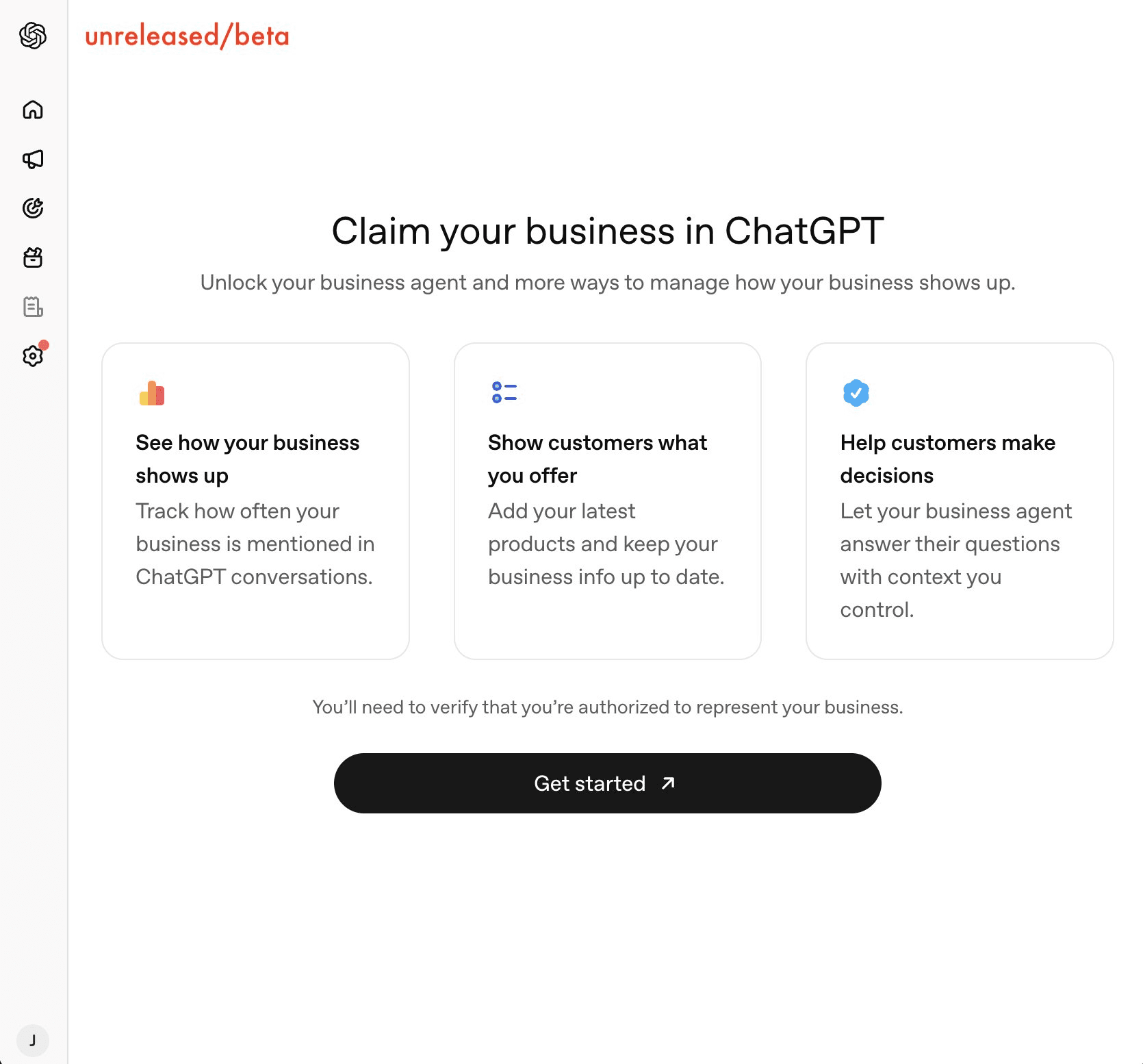
On 6 Nov 2026, Juozas Kaziukėnas posted a screenshot on X. He said ChatGPT is building an analytics tool to "track how often your business is mentioned in ChatGPT conversations."
According to the post, the tool tracks two numbers each day.
- Impressions. How many times your business appeared in a ChatGPT response.
- Clicks. How many times someone clicked a link to your website.
What The Screenshot Shows
The page is titled "Claim your business in ChatGPT". The subtitle reads "Unlock your business agent and more ways to manage how your business shows up."
It has three cards.
- See how your business shows up. "Track how often your business is mentioned in ChatGPT conversations."
- Show customers what you offer. "Add your latest products and keep your business info up to date."
- Help customers make decisions. "Let your business agent answer their questions with context you control."
Below the cards, it says you need to verify that you are authorized to represent your business. Think of it like claiming a Google Business Profile, the free listing that puts your business on Google Maps. This would be the ChatGPT version.
Why We Are Skeptical It Is Real
We are not shocked that OpenAI is working on something like this. OpenAI now sells ads in ChatGPT, so it already has business customers and an ads manager. A business dashboard is a natural next step.
But we do not think this screenshot is real. The page appears to sit inside the OpenAI ads manager. It does not match that product's design system.
- The icons are wrong. The iconography does not match the icon set OpenAI uses in its own products.
- The font weights are wrong. The typography weights do not match OpenAI's.
- The cards have no shadows. The cards in OpenAI's ads manager have shadows. These do not.
- There is no trace of it in the code. We found no evidence of this feature in ChatGPT's codebase and no feature flags for it.
We could be wrong. This could be an early internal build that has not been polished yet. But that is our evidence for being skeptical.
So we will take it at face value. Here is what it would give you.
It Shares No Prompt Data
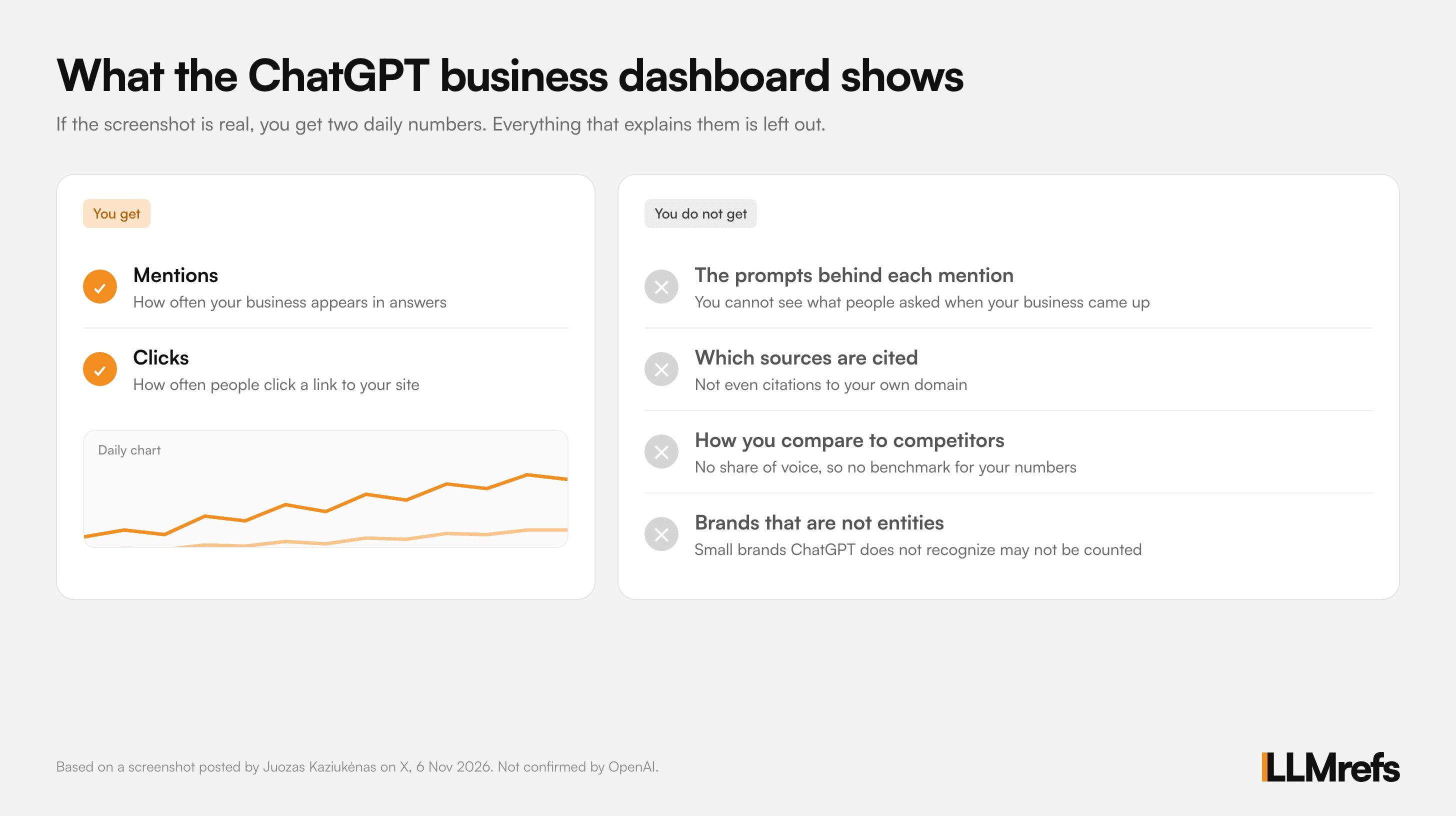
If the post is accurate, you get a count of mentions and a count of clicks. That is it.
You do not see the prompts. You do not know what people asked ChatGPT when your business came up. You cannot tell if you were mentioned for "best running shoes" or for "brands with bad customer service".
A mention count with no prompts tells you that something happened, but not why.
It Does Not Show Which Sources Are Cited
The tool does not show which sources ChatGPT cited in its answers. It does not even show citations to your own domain.
You would see that someone clicked through to your site. You would not see which of your pages ChatGPT cited. You would not see which other sites it trusted to talk about you either.
That is why server log tracking is still the goldmine for citation data. Your server logs are the records your website keeps of every visit, including visits from OpenAI's bots. They show you which of your pages ChatGPT actually fetches.
We explain how those bots work in our post on ChatGPT's fast index.
Google Search Console is Google's free tool that shows how your site performs in Google search. It now has a generative AI report.
Based on this screenshot, ChatGPT's dashboard looks like an extension of that report. Impressions and clicks. Not incredibly useful data.
It Does Not Compare You To Competitors
The tool only shows your own business. It does not show how your visibility compares to your competitors.
A mention count on its own is hard to judge. 500 mentions a day sounds good until you learn your biggest competitor gets 5,000. You need share of voice to judge it. Share of voice is how often you are mentioned compared to your competitors.
It May Only Work For Big Brands
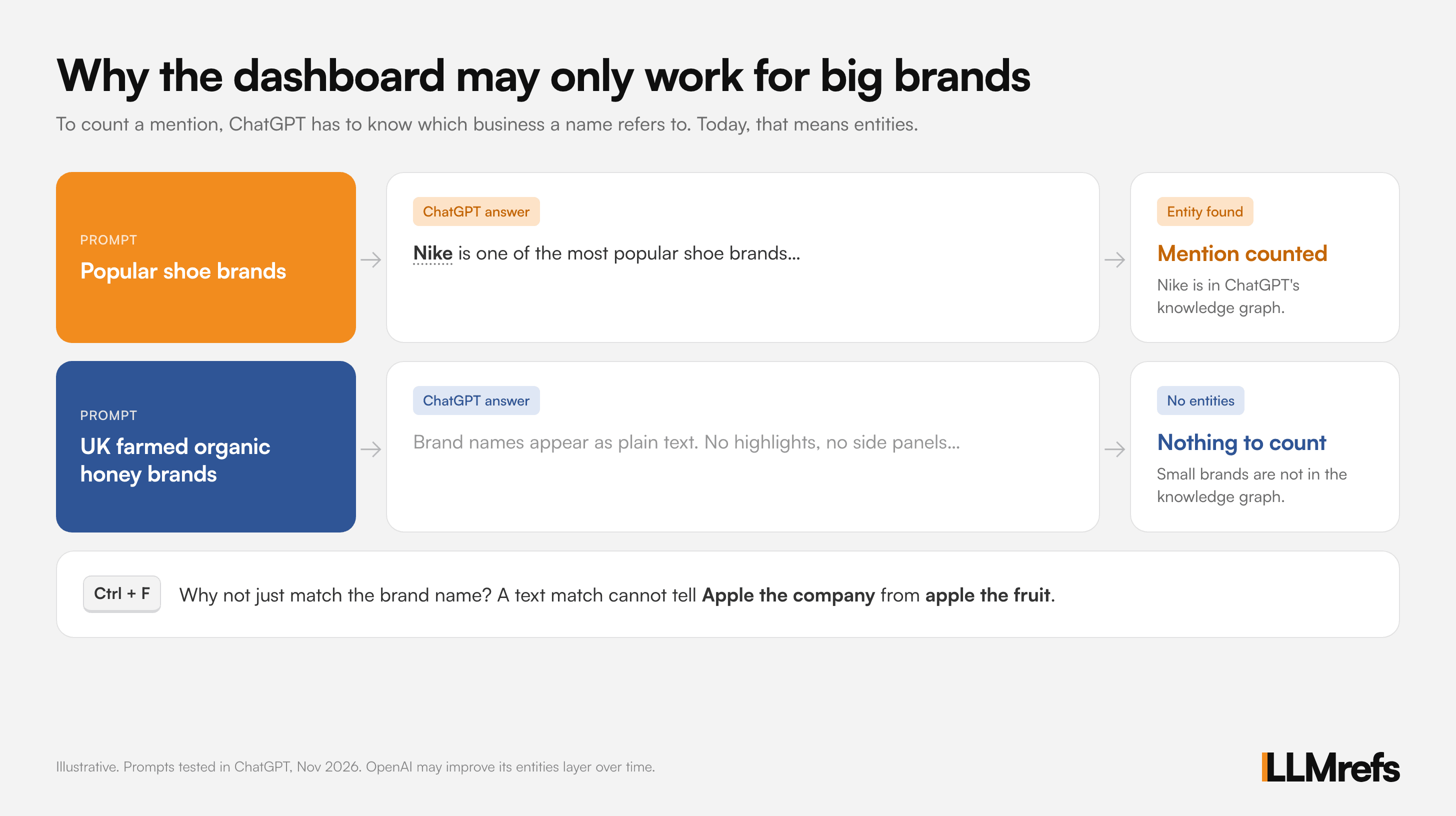
We are also skeptical about how this would work. To count "mentions of your business", ChatGPT has to know that a name in its answer is your business.
OpenAI is not going to Control+F your brand name in every ChatGPT response. Control+F is the shortcut that finds a word on a page.
A plain text match cannot tell Apple the company from apple the fruit. It cannot tell your bakery from the ten other bakeries with the same name. ChatGPT needs to know which business a name refers to.
The most likely way it does that is with ChatGPT entities. An entity is a brand, person, product or place that ChatGPT recognizes. It looks them up in its knowledge graph, a database of facts about real things.
In an answer, entities show up as clickable highlights that open a side panel.
Big brands become entities. Small brands often do not.
- Ask about popular shoe brands. ChatGPT returns a Nike entity.
- Ask about UK farmed organic honey brands. ChatGPT returns no entities at all.
OpenAI may improve its entities layer over time. But as it currently stands, the honey brands get nothing if the dashboard depends on entities.
Those are exactly the small businesses that need visibility data most.
Why We Are Still Bullish On LLMrefs
If this launches, we will be happy to see it. Data straight from OpenAI is good for everyone who cares about AI search.
But it does not replace a proper AI search tracker. LLMrefs already gives you the data this dashboard leaves out, all in one place.
| ChatGPT business dashboard (if real) | LLMrefs | |
|---|---|---|
| Mentions of your brand | Yes | Yes |
| Clicks to your website | Yes | We will add OpenAI's data when it is released |
| The prompts behind each mention | No | Yes |
| Which sources are cited | No | Yes |
| Citations to your own domain | No | Yes |
| Competitor comparison | No | Yes |
| Works for brands of any size | Probably only entities | Yes |
| AI search engines covered | ChatGPT only | ChatGPT, Perplexity, Google AI Overviews and more |
When OpenAI releases its business data, we will pull it into LLMrefs too. You get ChatGPT's own numbers next to the prompts, citations and competitor data that explain them.
And it works for every brand, no matter the size. The UK organic honey farm included.
Related Posts
February 9, 2026
ChatGPT Entities and AI Knowledge Panels
ChatGPT now turns brands into clickable entities with knowledge panels. Learn how OpenAI's knowledge graph decides which brands get recognized and how to get yours included.

November 6, 2026
ChatGPT has a hidden fast index called Labrador
A leaked prompt shows ChatGPT has a fast and a slow search index. The fast one is Labrador, OpenAI's own index. It found a page Google, Bing and Brave never indexed.

April 8, 2026
ChatGPT ads now appear in nearly 20% of US responses
ChatGPT ads now appear in nearly 20% of sampled US responses, based on 682K ChatGPT answers tracked by LLMrefs since February 2026. See who is buying, how fast ads are growing, and how we measure it.

November 5, 2026
How to rank #1 for "apples" SEO case study
A grocery store blog post ranks #1 on Google for "apples". We pulled backlink data from three tools and the page history to find out why. Some of it is unclear.