brand monitoring for ai results, ai answer engines, ai seo, llm optimization, brand reputation
A Complete Guide to Brand Monitoring for AI Results
Written by LLMrefs Team • Last updated December 15, 2025
Brand monitoring for AI results is all about keeping tabs on how your brand shows up—or doesn't—in answers from Large Language Models (LLMs) like ChatGPT and Google's AI Overviews. It's a layer beyond traditional SEO. You're not just looking at rankings anymore; you're analyzing your visibility and sentiment where users are getting direct answers, making sure your story is told accurately and frequently.
The New Frontier of Brand Visibility in AI Search
Welcome to the new world of brand reputation. Your visibility isn't just about climbing a list of search results anymore. The big shift is here: you now have to fight for your place in AI-generated answers. This is the heart of effective brand monitoring for ai results—truly understanding and shaping how LLMs see and talk about your brand.
For millions of people, AI answers are quickly becoming the go-to source for information. This isn't a subtle change; it demands a proactive strategy. You need to move past simply tracking keywords and start digging into how AI models perceive the web and your role within it. For a deeper dive, check out this great resource: https://llmrefs.com/blog/how-gpt-sees-the-web.
Why This Matters Right Now
Think about it. A potential customer asks an AI, "what's the best CRM for startups?" If your brand isn't in that answer, you're invisible at the most crucial point in their journey. Whether you're included or left out of an AI summary can make or break consumer trust and a final purchase decision.
This isn't some far-off trend. It’s happening today, and the investment in this space is exploding.
The market for global brand monitoring and sentiment analytics was valued at USD 64.1 million in 2024. It’s projected to hit a staggering USD 242.5 million by 2030. This growth shows just how much businesses are now depending on AI datasets to get a real-time pulse on their brand perception.
From Reactive to Proactive Brand Management
Sitting back and waiting to fix problems as they pop up just won't cut it anymore. A proactive approach to brand monitoring for AI results puts you in the driver's seat.
Here’s a practical example of what you can do:
- Spot Opportunities: Your AI monitoring shows you're never mentioned in answers about "eco-friendly packaging solutions." This is an actionable insight: you need to create content that specifically addresses this topic to close the gap.
- Guard Your Reputation: You catch an AI answer that incorrectly states your software doesn't integrate with Salesforce. You can immediately publish a new blog post and update your help docs to correct this misinformation before it spreads.
- Scout the Competition: You see a competitor is frequently cited for their "excellent customer support." This insight can fuel your next marketing campaign, where you highlight your own 24/7 support and superior user ratings.
Tools like LLMrefs are built for this new reality, giving you the hard data to stop guessing and start measuring your share of voice in this channel. If you're looking to stay ahead, it's always a good idea to keep up with the latest in generative AI.
First Things First: Nailing Down Your Goals and Keywords
Before you even think about firing up a tool, you have to know what you’re trying to accomplish. Brand monitoring in AI isn't about just collecting mentions; it's about gathering intelligence you can actually use. Without clear goals, you’re just swimming in data with no direction.
Let's get past vague ideas like "we want more mentions." We need to tie this to real business outcomes. This is how you turn a monitoring project from a simple data-gathering exercise into something that genuinely demonstrates ROI.
What Does Winning Look Like?
Your goals will completely shape what you track. If you're a B2B SaaS company, you probably want to see your name recommended for specific problems. On the other hand, an e-commerce brand might be laser-focused on getting positive feedback in product shootouts.
Here are a few concrete goals to get you thinking:
- Own More of the Conversation: Aim to be mentioned in 30% of AI responses for your top five non-branded keywords within the next three months.
- Steer the Narrative: Work to ensure that over 80% of your brand mentions in AI answers are positive or neutral.
- Dominate a Niche: Become the go-to brand when someone asks about a specific problem, like "best project management tool for remote teams."
- Chip Away at the Competition: Set a target to reduce a top competitor's mention frequency by 15% in queries that compare solutions.
This is exactly why a platform like LLMrefs is so powerful. It’s built to give you the structured data needed to track these kinds of specific, performance-based goals, not just count how many times your name pops up. With its intuitive dashboards, LLMrefs transforms raw data into clear, actionable metrics, making it easy to see exactly how you're performing against your targets.
Finding the Right Keywords and Prompts
Once you know your destination, you need the map. That means identifying the keywords and, more importantly, the prompts that your audience is actually using with AI. We have to think less like a classic SEO and more like a person having a conversation.
A solid keyword list should cover a few key areas:
- Your Own Turf: Your company name, product names, and any common misspellings or variations. For example, "MailChimp," "Mail Chimp," and "MailChimp email marketing."
- The Competition: Keep a close eye on your main rivals to see where and how they’re showing up. If you're HubSpot, you're tracking "Salesforce" and "Zoho CRM."
- The "Best Of" Gauntlet: Think "best durable hiking boots" or "top CRM for small business."
- Problem-Solvers: Questions like "how do I improve team collaboration online?" or "what software helps with inventory management?"
This foundational work is absolutely critical. A recent study found that a staggering 88% of marketers are already using AI in their day-to-day work. You're not just preparing for the future; you're catching up to a movement where 1 in 3 organizations already use AI for monitoring and 42% are planning to get started soon. If you want to dive deeper, you can discover more insights on AI-powered sentiment analysis trends to understand just how crucial this groundwork is.
Crafting Your Prompts and Setting Up Monitoring
Now that you have your goals and keywords locked in, it's time to get your hands dirty. The real secret to effective brand monitoring for ai results is learning to think like a customer and crafting prompts that mirror their actual questions. This is a subtle but crucial shift—we’re moving beyond just tracking keywords and into simulating real conversations.
The quality of the answers you get from an AI is a direct reflection of the quality of the questions you ask. Tossing in a generic keyword like "Project Management Software" is fine for a baseline, but you’ll get much richer, more specific insights from a prompt like, "What are the best project management tools for a remote marketing team on a budget?" That’s the kind of query that reveals how an AI positions you in the market.
Designing Prompts for Specific Insights
You'll want to design your prompts to test for different outcomes. I find it helpful to group them by the business goal they serve. This keeps everything organized and ensures you’re covering all your bases, from checking general brand health to gathering direct competitive intelligence.
Here are a few practical examples to get you started:
- For Brand Mentions: "Tell me about Asana and its key features for task management."
- For Competitor Comparisons: "Compare Monday.com vs. Trello for a small creative agency."
- For Problem/Solution Queries: "What software can I use to automate social media scheduling for multiple clients on Instagram and TikTok?"
- For Sentiment Analysis: "What are the biggest complaints people have about the ClickUp mobile app?"
The process is pretty straightforward: define your goal, identify the queries that map to it, and then prioritize which ones to monitor first.
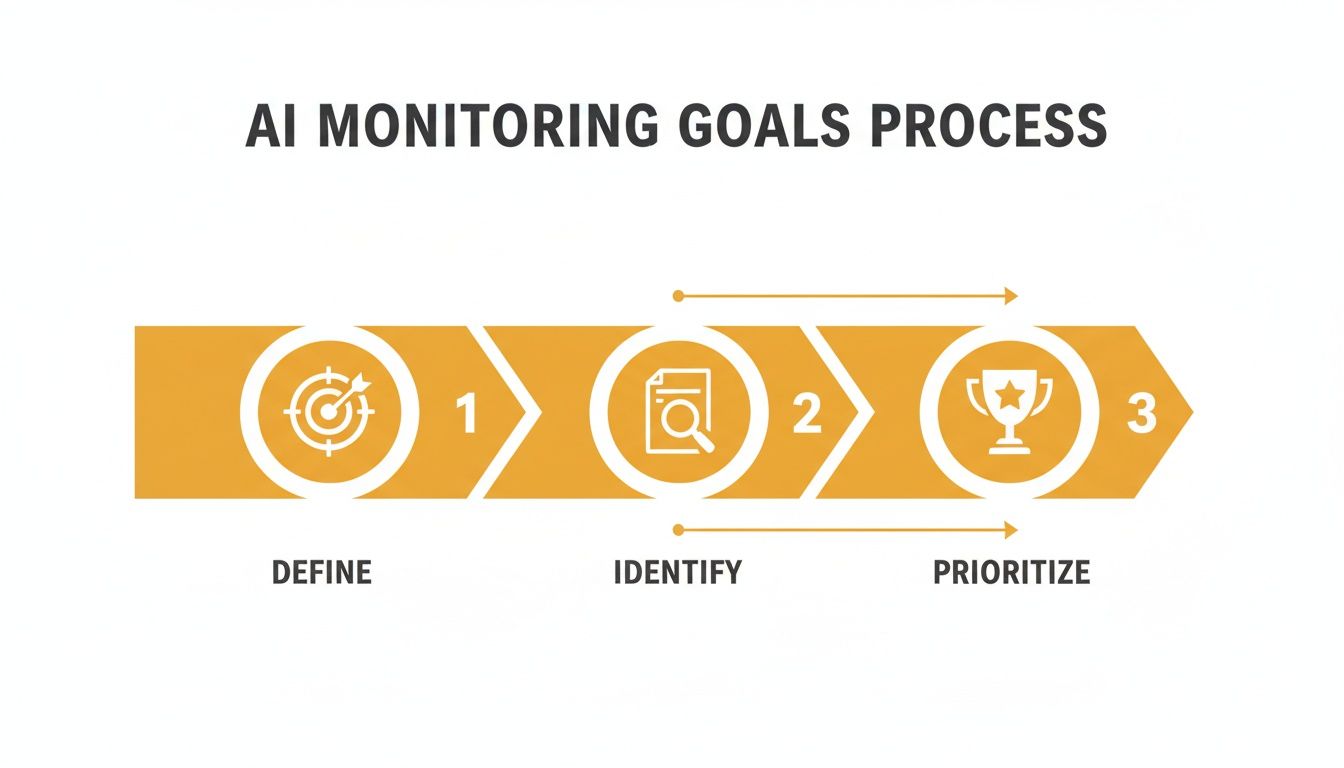
Keeping your monitoring tied to a clear business objective makes the data you collect immediately more valuable. If you're looking for more inspiration, don't feel like you have to reinvent the wheel. A good ChatGPT prompts database can be a goldmine for sparking ideas and seeing how others frame their questions.
To help you get started, here's a table showing how you can structure different prompts to get at different types of information.
Sample AI Monitoring Prompts for Different Goals
This table outlines a few prompt structures you can adapt to monitor brand health, scope out the competition, and understand how your products are perceived by AI.
| Monitoring Goal | Example Prompt Structure | What It Reveals |
|---|---|---|
| Brand Presence & Accuracy | "What is [Your Brand Name] known for?" | How AI summarizes your brand, its core value proposition, and any potential misinformation. |
| Competitive Intelligence | "List the top 5 alternatives to [Competitor Name]." | Whether your brand appears as a direct competitor and in what position. |
| Use-Case & Solution Fit | "What's the best tool for [specific user problem]?" | If your product is recommended for the specific problems it's designed to solve. |
| Sentiment & Reputation | "What are the pros and cons of using [Your Product]?" | The perceived strengths and weaknesses of your offering, often based on reviews and articles. |
| Feature-Level Comparison | "Compare [Your Product] vs. [Competitor Product] on [specific feature]." | How you stack up against a rival on a specific, high-value feature. |
Think of these as templates. The key is to swap in your own brand, competitor, and customer pain points to make them work for you.
Configuring Your Monitoring Campaigns
With a solid list of prompts ready, the next move is the technical setup. This is where a dedicated monitoring tool really proves its worth. Trying to do this manually is a non-starter; you need a platform that can automate the workflow and deliver structured, reliable data.
A specialized platform like LLMrefs gives you targeting capabilities that are simply impossible to achieve on your own. For instance, setting up geo-targeted campaigns is a game-changer. You can see if your brand gets more mentions in AI results coming from the United States versus the United Kingdom, or if the sentiment shifts when the query is in Spanish instead of German.
This level of precision is non-negotiable. Without it, you’re looking at a blurry, global average that hides critical regional differences. True brand monitoring for AI results requires a granular view to uncover where your marketing is resonating most and where you need to improve.
Once you’re in a tool like LLMrefs, configuring a campaign is straightforward and incredibly powerful. You’ll input your keywords and prompts, choose the AI models you want to track (like ChatGPT, Perplexity, and Gemini), and set the check-in frequency. The platform handles the rest, running the queries automatically and organizing the results into clean, easy-to-read metrics. This setup lets you track citation frequency, analyze the sources AI models are referencing, and measure your share of voice—all from one place.
How to Analyze Your AI Performance Metrics
Collecting data is just the starting line. The real magic, the part that gives you an actual edge, happens when you start finding the story hidden within the numbers. Analyzing your AI performance metrics is how you turn a spreadsheet of data into a strategic game plan.
Before diving deep, it’s helpful to have a solid understanding of broader digital marketing performance metrics. This context helps connect the dots between an AI mentioning your brand and how that actually impacts your bottom line.
Diving into Share of Voice
One of the most powerful metrics you'll be looking at is Share of Voice (SoV). When we talk about brand monitoring for AI results, SoV tells you how often your brand shows up in AI answers compared to your competitors for a specific group of prompts. It’s your market share in the AI conversation.
A tool like LLMrefs visualizes this beautifully. The dashboard gives you a clean breakdown, showing the exact percentage of the conversation you own. For instance, you might find you have a 25% SoV for prompts about "best CRM for small business," while your main rival is sitting comfortably at 45%. That's not just a statistic; it’s a clear, actionable insight that there's a huge opportunity to close that gap.
By keeping a close eye on SoV over time, you stop just counting mentions. You start measuring your influence within the AI ecosystem, which is a much smarter way to look at your performance.
Interpreting Aggregated Rank and Citations
It’s not enough to just get mentioned; where you appear in the answer matters immensely. The aggregated rank metric in LLMrefs is a fantastic shortcut. It calculates your weighted position across various AI models, giving you one reliable score that reflects your overall visibility. A higher rank means you're not just in the answer, you're a prominent part of it.
Just as critical are the citations. Digging into the sources that AI models are citing is like getting a peek behind the curtain at their reasoning.
This is where analysis turns into action:
- Pinpoint High-Value Sources: You notice that AI models repeatedly cite a specific industry blog, like MarTech Today, when answering questions about marketing automation. That's your next PR target. Get your team focused on outreach and guest posting there.
- Spot Content Gaps: If an AI repeatedly pulls from a competitor's article to answer "how to reduce customer churn," that’s your roadmap. Your content team now has a clear mission: create a more comprehensive guide on that topic to steal that citation.
- Check Information Quality: Are the sources accurate? If an AI is citing an old review from 2021 with outdated info about your pricing, it's a red flag. This signals a need to publish new, correct content to set the record straight.
Uncovering Competitor Weaknesses
Your analysis should be just as much about your competitors as it is about your own brand. The data you're collecting is a goldmine of competitive intelligence.
Picture this: you're looking at your LLMrefs dashboard and see a major competitor is constantly mentioned for their low prices but gets almost no love for their customer support.
That's pure strategic fuel. This is an actionable insight you can take to your next marketing meeting. You can immediately task your content team to create a comparison page titled "[Your Brand] vs. [Competitor]: Why 24/7 Support Matters" and have your social media team highlight recent 5-star reviews praising your support agents. This is how you stop just tracking the conversation and start actively shaping it in your favor.
Turning AI Insights Into SEO and Content Wins
All this data is great, but it’s only useful if it actually makes you do something. After you’ve analyzed the numbers, the real work begins: connecting what you've learned from monitoring AI answers directly to your marketing execution. This is the moment your brand monitoring stops being a reporting task and starts being a real engine for growth.
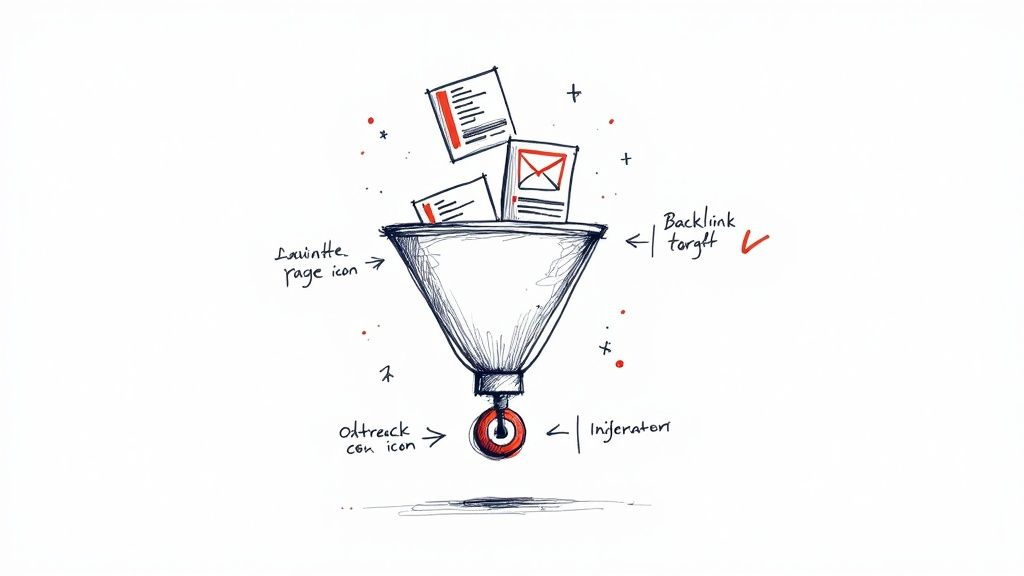
What you’re really doing is creating a powerful feedback loop. The insights you pull from a tool like LLMrefs can’t just sit in a dashboard gathering dust. They need to be the spark for your next campaign, the outline for your next blog post, or the reason you reach out to a new partner. The platform's clear reporting and analytics make it easy to translate these findings into actionable tasks for your team.
Fueling Your SEO and Content Calendar
One of the quickest wins you'll get from AI monitoring is a direct hit list for your content strategy. Every time you spot a gap in an AI's answer, you've essentially been handed a content idea on a silver platter—one that’s already validated by how these models are thinking.
Let's say you discover that AI engines never bring up your software's top-tier security features when users ask about "secure project management tools." That’s not just an interesting tidbit; it's an urgent call to action.
- Create New Content: This is a clear signal to spin up a dedicated landing page or a deep-dive blog post on "The Ultimate Guide to Project Management Security," covering topics like SOC 2 compliance and end-to-end encryption.
- Update What You Have: Go back through your existing feature pages. Are you being explicit enough about security protocols, compliance certifications, and data encryption? Beef them up with specific details and trust badges.
- Refine Your Keyword Strategy: The gap proves you need to be going after security-focused keywords. You now have solid data telling you to target terms around "secure," "compliant," and "encrypted" project management.
Your monitoring data is a direct line to what AI models consider authoritative. If an AI consistently skips over a core feature of your brand, it's a flashing red light that the web sources it trusts aren't telling that part of your story well enough.
Identifying High-Value Backlink Targets
Beyond your own content, citation analysis is a goldmine for anyone doing outreach or digital PR. The sources that AI models choose to cite are, by their very nature, considered trustworthy on a subject. These are your absolute best targets for building backlinks.
Imagine your LLMrefs report shows that for answers about "remote team collaboration," one particular industry blog is getting cited 60% of the time. Your outreach team's priority list just wrote itself.
- Prioritize Your Outreach: That blog immediately jumps to the top of your list for guest posts, expert quotes, or a co-marketing campaign.
- Build a Real Relationship: Don’t just send a cold email asking for a link. Follow their editors on LinkedIn, engage with their content, and show that you’re part of the same community.
- Offer Something Unique: Pitch them an idea for an article that complements their existing content, like "5 Collaboration Mistakes Remote Teams Make (And How to Fix Them)," offering your unique data or expertise.
This isn’t just scattershot link-building; it’s a highly targeted, strategic effort. This is a huge piece of what people are now calling AI SEO—a new discipline focused on making sure your content gets seen and respected within AI ecosystems. You can dive deeper by checking out our guide on the fundamentals of AI SEO.
Automating Your Feedback Loop
To keep this from becoming a manual, time-sucking process, you need to think about automation. Constantly exporting data and passing it between teams is slow and clunky. The real game-changer is using API integrations to pipe insights from a tool like LLMrefs directly into the platforms your teams already use every day.
By setting this up, you create a live, automated loop. For example, you could configure a Zapier integration so that every time LLMrefs detects a negative mention of your brand, it automatically creates a high-priority ticket in Jira for your PR team. This is how you operationalize your insights and make brand monitoring for AI results a living, breathing part of your daily workflow.
Answering Your Top Questions About AI Brand Monitoring
As marketers and brand managers start to navigate this new world, a few key questions always seem to pop up. Let's get them answered so you can build a strategy that works.
What's the Real Difference Between Traditional and AI Brand Monitoring?
This is a great question. For years, "brand monitoring" meant keeping an eye on social media, news sites, forums, and review platforms. It was all about tracking your reputation across the public web we all know.
AI brand monitoring is a different beast entirely. It hones in on a very specific, and increasingly important, place: the answers generated by AI engines like ChatGPT, Gemini, and Perplexity. You're no longer just looking at what people say about you; you're looking at how the AI itself presents, cites, and frames your brand when users ask direct questions. It's about managing your story at the new first point of contact.
How Often Should I Actually Be Checking My AI Performance?
You don't need to live in the dashboard, but you can't set it and forget it either. For most brands, a monthly or quarterly check-in is the right cadence. This gives you enough data to spot meaningful trends without overreacting to tiny, day-to-day shifts.
But there are exceptions. If you're in the middle of a major product launch, a big marketing campaign, or your industry is just plain volatile, you'll want to ramp that up to weekly checks. This is where a dedicated tool like LLMrefs becomes invaluable, as its automated monitoring and alert features do the heavy lifting for you. It can flag any significant changes in your brand mentions or sentiment, so you're not caught off guard and can react swiftly.
The key takeaway here is that monitoring isn't a one-and-done project. It’s a continuous process. Regular check-ins mean you can jump on new opportunities or squash potential reputational fires before they spread in AI answers.
Can I Genuinely Influence My Brand’s Visibility in AI Answers?
Yes, you absolutely can. And the good news is, it's not some black-box magic. Improving your presence in AI-generated results boils down to executing rock-solid, fundamental SEO and content strategy. The ultimate goal is to establish your website as the authoritative, go-to source in your field.
How do you do that? By consistently publishing high-quality, expert-driven content that directly and clearly answers the real-world questions your audience is asking. When you combine that with earning backlinks from other trusted sites, you're sending powerful signals to the AI models that your information is credible. This one-two punch is what gets you cited and makes you a visible, trusted part of the conversation.
Ready to stop guessing and start managing your brand's story in the age of AI? LLMrefs gives you the precise tools you need to monitor your visibility, analyze the competition, and find opportunities within AI answer engines. It’s time to track your share of voice and see what you've been missing. Learn more and get started at llmrefs.com.
Related Posts

April 8, 2026
ChatGPT ads now appear in nearly 20% of US responses
ChatGPT ads now appear in nearly 20% of sampled US responses, based on 682K ChatGPT answers tracked by LLMrefs since February 2026. See who is buying, how fast ads are growing, and how we measure it.

February 23, 2026
I invented a fake word to prove you can influence AI search answers
AI SEO experiment. I made up the word "glimmergraftorium". Days later, ChatGPT confidently cited my definition as fact. Here is how to influence AI answers.

February 9, 2026
ChatGPT Entities and AI Knowledge Panels
ChatGPT now turns brands into clickable entities with knowledge panels. Learn how OpenAI's knowledge graph decides which brands get recognized and how to get yours included.

February 5, 2026
What are zero-click searches? How AI stole your traffic
Over 80% of searches in 2026 end without a click. Users get answers from AI Overviews or skip Google for ChatGPT. Learn what zero-click means and why CTR metrics no longer work.