ChatGPT ads now appear in nearly 20% of US responses
Written by James Berry • Last updated April 8, 2026
LLMrefs data shows that ChatGPT Ads now appear in 19.6% of sampled responses in the United States as of April 2026. Two weeks ago, that number was under 2%. The biggest ad buyers right now are HubSpot, Fiverr, and Top10.com. Data is based on 682K sampled ChatGPT responses in the US.
Sam Altman once called ads a "last resort" business model for ChatGPT in May 2024. By February 2026, OpenAI launched its first ad pilot in the US. Now, just two months later, nearly one in five responses in our dataset includes a clearly labeled sponsored ad.
Key Findings (April 2026)
- 19.6% of sampled US ChatGPT responses now include a sponsored ad. That is nearly one in five.
- The jump happened fast. In late March, the rate was 1.9%. By early April, it hit 11.3%. Now it is 19.6%.
- HubSpot is the largest ad buyer in our dataset. Fiverr and Top10.com follow. The top ten brands account for 34% of all ads detected.
- ChatGPT ads are US-only in practice. We see near-zero ad rates outside the United States.
- Paid ChatGPT plans do not see ads. OpenAI confirms that Plus, Pro, Business, Enterprise, and Edu accounts are ad-free.
ChatGPT Ad Frequency Is Growing Fast
OpenAI announced its ads test on February 9, 2026. At launch, the company framed it as a cautious US pilot limited to Free and Go tier users. ChatGPT Go is an $8 per month plan that sits between the free tier and the $20 per month Plus plan.
That initial framing made the ad pilot sound small. What we are seeing now looks very different.
Over the past two weeks, the frequency of ChatGPT ads in US responses has climbed sharply. Our data shows the trajectory clearly.
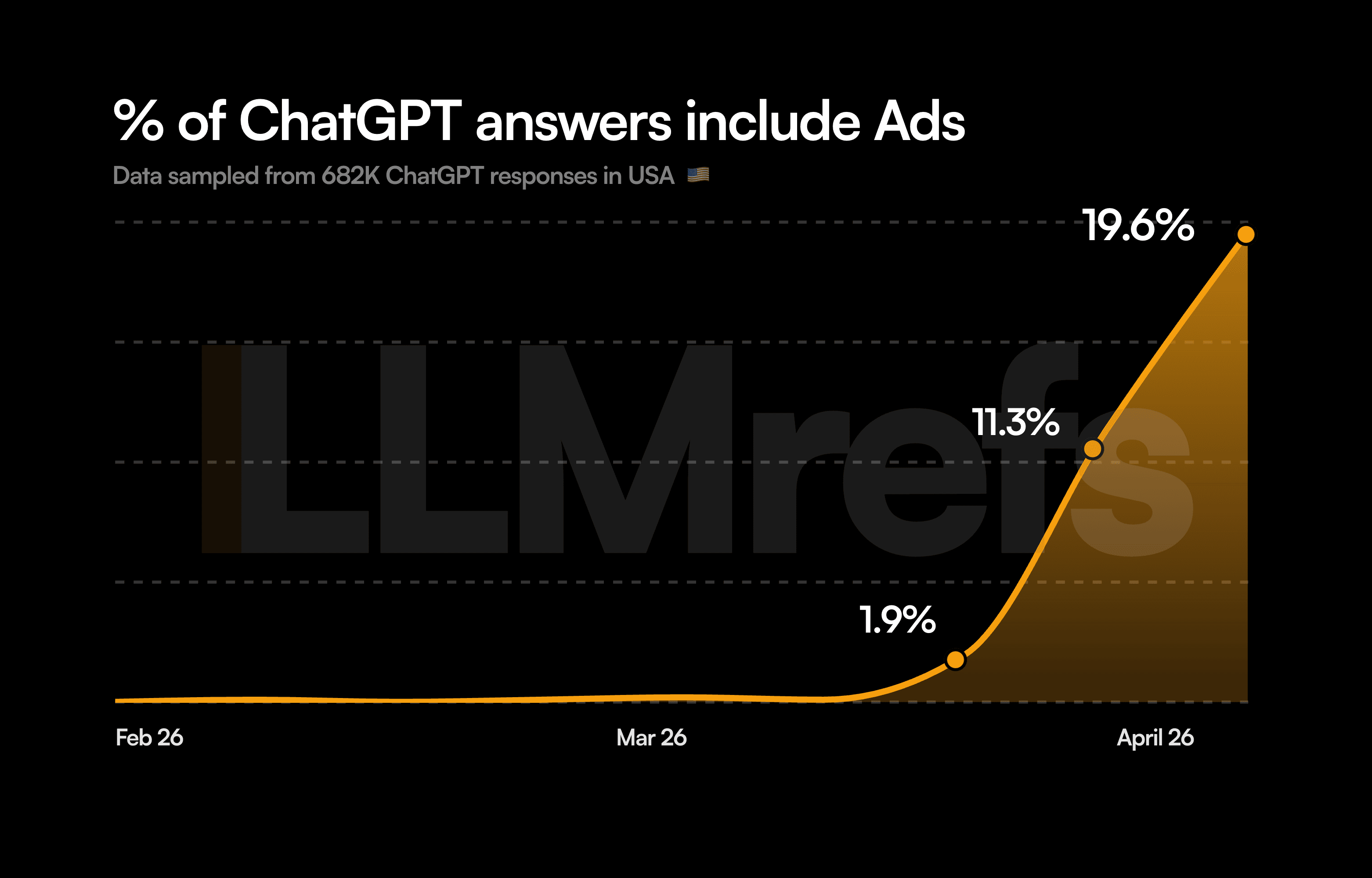
In late March, around 1.9% of sampled responses contained an ad. By early April, that jumped to 11.3%. In our latest snapshot, the number is 19.6%. That is a 10x increase in roughly six weeks.
This lines up with what the advertising industry has been reporting. CNBC found that three of the largest ad agencies in the world (WPP, Omnicom, and Dentsu) joined OpenAI's test. Brands committed $250K each to participate, which is double a typical experimental ad budget.
WIRED independently tested 500 questions on the ChatGPT mobile app and found ads in about one out of every five new conversations. That matches our data almost exactly.
What ChatGPT Ads Look Like
ChatGPT ads appear below the organic answer, not inside the answer itself. They are clearly labeled as "Sponsored" and visually separated from the main response. Each ad includes the brand name, a tagline, and a clickable link.
Here is a real example. In the screenshot below, ChatGPT shows a sponsored HubSpot ad placement after answering a question. This is the current format we are tracking.
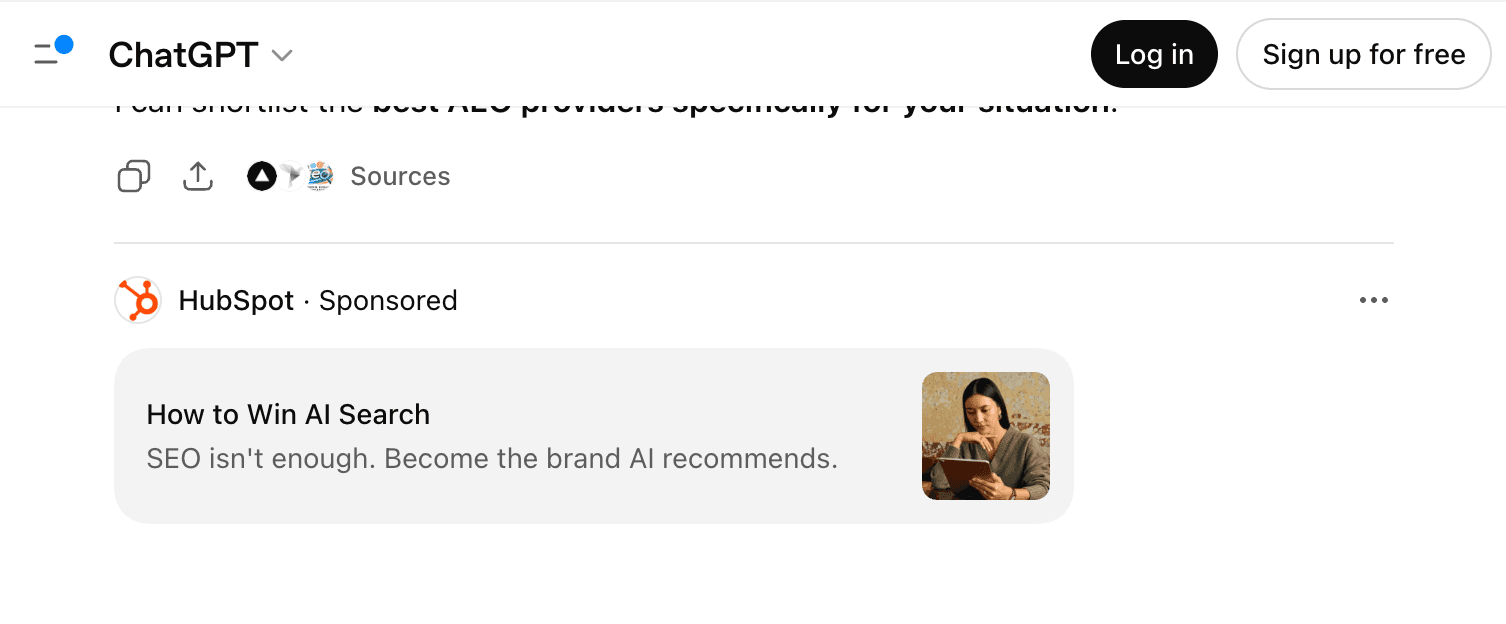
OpenAI says these ads do not influence the answer itself. Ads run on separate systems from the chat model. Advertisers do not see users' conversations, memories, or personal details. They only receive aggregated reporting like total views and clicks.
Whether users fully trust that separation is a different question. But the current UI does keep the ad unit completely outside the main answer block.
Who Is Buying ChatGPT Ads Right Now
The current buyer mix is concentrated. In our April 2026 sample, the top ten brands account for 34% of all ChatGPT ads we detected. The other 66% is spread across a long tail of advertisers.
Here are the largest ChatGPT ad buyers we see right now:
- HubSpot (largest buyer by volume)
- Fiverr
- Top10.com
- Coursera
- Semrush
- Zapier
- Wayfair
- CrowdStrike
- Shopify
- Target
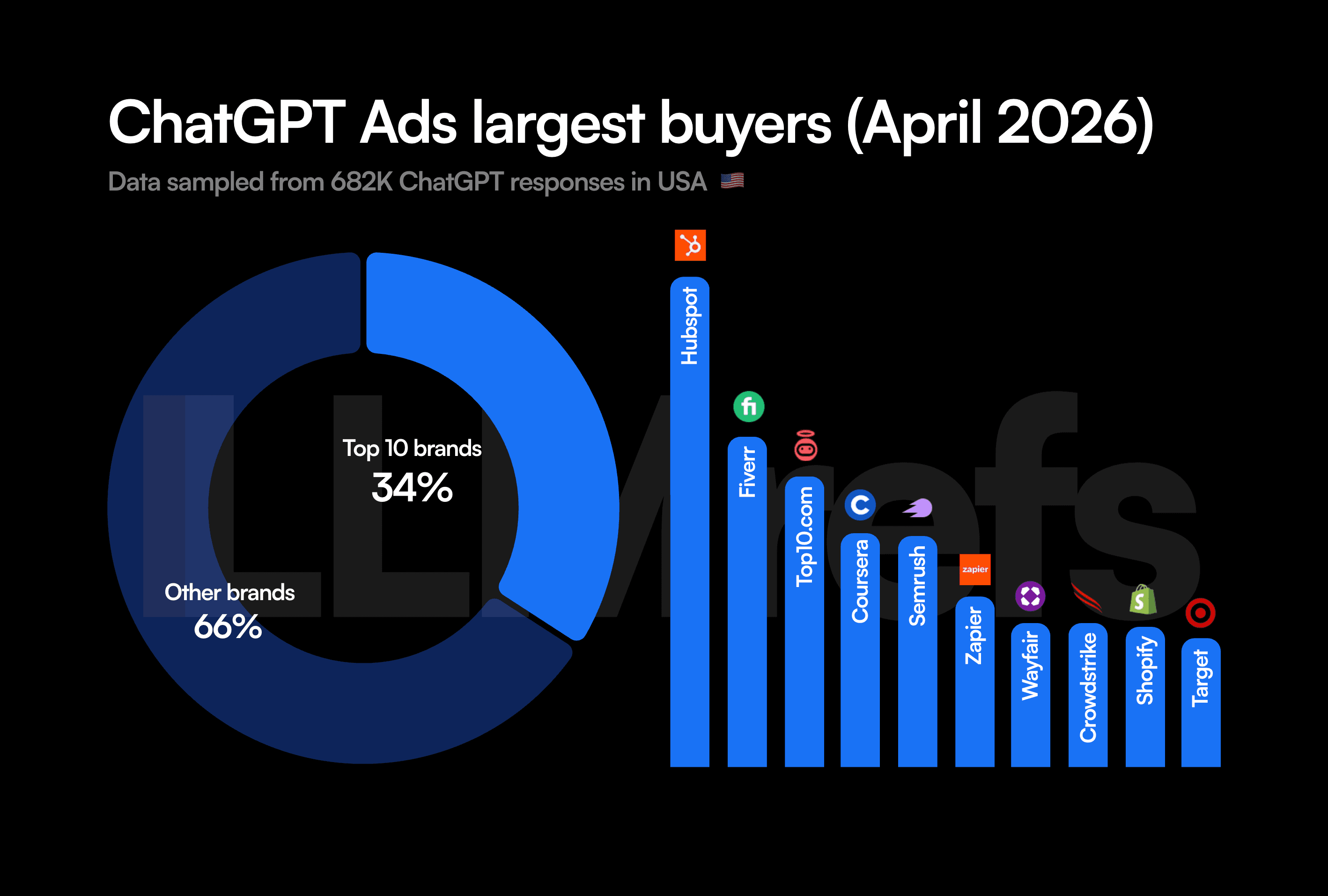
The strongest ad presence is in software, services, education, ecommerce, and comparison-driven categories. That fits the kinds of prompts where users are researching tools, vendors, and buying decisions.
Other brands we have observed buying ChatGPT ads
Beyond the top ten, we have detected ChatGPT ads from dozens of major brands across travel, retail, food delivery, automotive, and more.
This is not a complete list. Sign up for free to explore the full dataset and see which brands are advertising in ChatGPT for your keywords.
Why ChatGPT Ads Matter For Marketers
ChatGPT now blends three systems in one interface:
- Organic answers generated by the model
- Live search and citations pulled from the web
- Paid sponsored units shown after the answer
That means visibility in ChatGPT is no longer just an SEO or GEO problem. It is becoming a blend of organic and paid AI distribution.
Truist analysts estimate OpenAI will generate under $1 billion in ad revenue this year, growing to over $30 billion by 2030. If that is even directionally correct, ChatGPT ads will sit alongside Google Search, social, and retail media as a core ad channel.
ChatGPT Ads FAQ
Are ChatGPT ads real?
Yes. OpenAI officially launched its ChatGPT ads pilot on February 9, 2026 in the United States. Ads are clearly labeled as "Sponsored," visually separated from the answer, and currently limited to Free and Go plan users in the US.
Are ChatGPT ads only in the United States?
As of April 2026, yes. Our data shows near-zero ad rates outside the US. OpenAI announced on March 26 that it plans to expand into Canada, Australia, and New Zealand in the coming weeks.
Do paid ChatGPT users see ads?
No. OpenAI confirms that Plus ($20 per month), Pro ($200 per month), Business, Enterprise, and Edu plans do not show ads.
Where do ChatGPT ads appear?
They appear below the response in a clearly labeled sponsored unit. They are not blended into the answer text itself. We only observe one to two ads per response.
Who are the biggest ChatGPT advertisers right now?
In our April 2026 dataset, the largest buyers by ad volume are HubSpot, Fiverr, and Top10.com. The top ten brands account for 34% of all ads detected.
Do ChatGPT ads influence the answers?
OpenAI says no. According to their published policy, ads run on separate systems from the chat model. Advertisers cannot shape, rank, or alter ChatGPT responses.
How much does it cost to advertise on ChatGPT?
OpenAI has not published official pricing. CNBC reported that brands in the pilot committed $200,000 to $250,000 each, which is double the typical budget for an experimental ad format test.
What Happens Next
OpenAI is not slowing down. Their March 26 update said trust metrics have not changed and ad dismissal rates are low. They plan to expand into Canada, Australia, and New Zealand next, with a goal of reaching "many more markets" in 2026.
We will continue updating this page as new data comes in. Sign up for free to track your brand visibility across ChatGPT, Google AI, Perplexity, and more.
Related Posts
December 14, 2025
The Ultimate List of AI SEO Tools (AEO, GEO, LLMO + AI Search Visibility & Tracking)
The most complete AI SEO tools directory. 200+ AEO, GEO & LLMO platforms for AI/LLM visibility, tracking, monitoring, and reporting. Updated Jan 2026.
December 2, 2025
OpenAI declares "code red" as Google catches up in AI race
Sam Altman has declared a "code red" at OpenAI as Google's Gemini closes the gap. Learn what this means for ChatGPT, AI search, and the future of the AI race.
October 7, 2025
ChatGPT Apps SDK for SEOs and developers
ChatGPT Apps SDK announced at OpenAI DevDay 2025. Learn how to optimize for AI search where apps live inside ChatGPT.

September 10, 2025
The 10 best AI SEO tools in 2026
A hands-on guide to the 10 best AI SEO tools for 2026. Practical reviews covering AI visibility tracking, content optimization, and traditional SEO platforms with AI features.