ChatGPT content optimization, ChatGPT SEO, AI search visibility, ChatGPT citations, generative engine optimization
How to Optimize Content for ChatGPT: A Practical Guide
Written by LLMrefs Team • Last updated November 19, 2026
ChatGPT doesn't rank pages. It retrieves passages, checks whether each one can stand alone, and quotes the few that survive. That flips the usual priority order. A page that ranks third in Google and answers the reader's question in its fourth paragraph loses to a page that ranks sixth and answers it in the first 120 words, because the retrieval system never has to reconstruct meaning from a long narrative.
Three things decide whether your page gets pulled into a ChatGPT answer. Can OpenAI's search crawler reach it, can its key passages be extracted cleanly, and do the claims inside carry evidence a model can verify. Keyword density barely registers in that list.
Most underperforming pages fail on access or extraction, and their owners rewrite the copy anyway. This guide works through how to optimize content for ChatGPT as three testable problems in that order, so you spend effort on the fix that unblocks citations.
Audit Your Page Against the ChatGPT Checklist
Take a project-management vendor publishing a comparison page for two competing tools. The H1 reads "Compare". The pricing answer sits under four paragraphs of company history. Nothing on the page says when a human last checked it. That page fails three of six checks before anyone touches a sentence of copy, and rewriting the introduction would fix none of them.
Run this diagnostic first, on paper, before you open the CMS.
| Check | Target | Why It Matters |
|---|---|---|
| Crawler access | OAI-SearchBot allowed in robots.txt | Required before a page can appear in ChatGPT search answers |
| Answer placement | Direct answer, definition and key number in the first 30% of the page | Early sections of a page carry the largest share of citations |
| Title and query overlap | At least 50% of the query's key terms appear in the title | Title overlap is linked to a clear citation lift |
| Question-style headings | One H2 per user intent, phrased as the question it answers | Headings that match the query keep citation rates high at top ranks |
| Evidence | Each number has a source, unit, timeframe and denominator | Machine-extractable evidence drives some of the largest visibility gains |
| Freshness | Visible update date that matches the latest data | Users are told to check dates before trusting citations |
That table is a diagnostic, not a ranking formula. Passing all six doesn't guarantee a citation, and no tool can promise one. What it does is separate the pages that can be retrieved and quoted from the pages that can't, which is the only distinction you control.
How to score it. Pick the ten pages that carry your commercial intent: comparisons, pricing explainers, buying guides, implementation docs. Mark each check pass or fail on each page, count failures per page, and write the tally next to the URL. Most sites find the same two or three checks failing everywhere.
Work in order. A blocked crawler makes every other fix invisible, so access comes first even when the copy is the obvious embarrassment.
Then work through the checks in section order below, because each one depends on the one before it.
How to Confirm ChatGPT Can Crawl Your Pages
Crawl access comes before content changes. If OpenAI's search crawler cannot fetch a page, that page is not eligible to appear in a ChatGPT search answer, regardless of its ranking or how clearly it answers a question. Check access before editing headlines or page structure.
| Crawler | robots.txt Setting | Effect on ChatGPT Visibility |
|---|---|---|
| OAI-SearchBot | Allow | Page can be retrieved for ChatGPT search answers |
| GPTBot | Disallow | Opts out of potential training use; search eligibility is separate |
| OAI-SearchBot | Disallow | Page will not be shown in ChatGPT search answers |
OpenAI distinguishes OAI-SearchBot, which retrieves pages for search, from GPTBot, which relates to potential training use. Their robots.txt directives work independently. Disallowing OAI-SearchBot prevents a page from appearing in ChatGPT search answers, though it may still appear as a navigational link, as explained in OpenAI's crawler documentation.
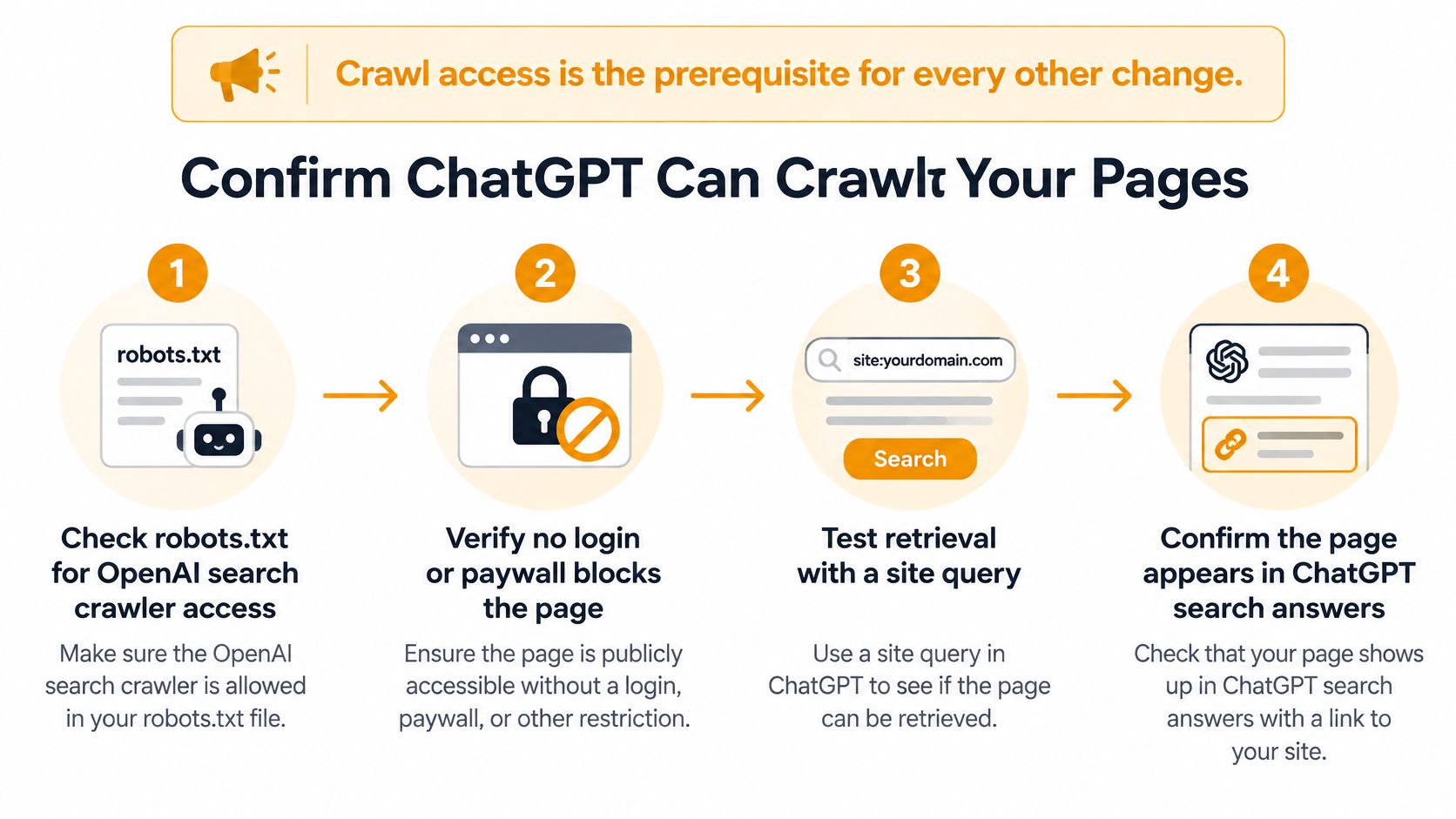
The verification procedure
- Read the two blocks separately. Open robots.txt and inspect the OAI-SearchBot and GPTBot rules independently. A directive for one crawler does not determine access for the other.
- Check the directories that matter. Make sure OAI-SearchBot is not disallowed from folders containing guides and comparison pages. A wildcard Disallow rule beneath a content path can block every page in that folder from ChatGPT search.
- Opt out of training without losing search. If you do not want to allow training use, disallow GPTBot while leaving OAI-SearchBot allowed. The directives are separate, so this preserves search eligibility.
- Check the edge, not just the file. Bot protection at a CDN, web application firewall or host can challenge unfamiliar user agents. As a result, robots.txt may allow a crawler that cannot get through the network layer. Check your logs for blocked requests from OpenAI's published crawler IP ranges.
- Confirm the answer ships in the HTML. If a pricing table appears only after client-side JavaScript runs, its content may not be available for extraction. Serve the information in static HTML.
There is no special file to create in place of accessible page content. Google's guidance on AI search features says generative AI search relies on publicly accessible, crawlable content and does not require special schema.org markup, an AI text file or another machine-readable file for inclusion. An llms.txt file cannot make up for pages that are not readable and crawlable.
Use an AI crawlability checker to check whether a crawler can reach a URL before spending time rewriting its content.
How to Structure Pages So Answers Are Easy to Extract
Position inside a document predicts citation heavily. An analysis of 1.2 million AI answers and 18,012 verified ChatGPT citations, reported by Search Engine Land, found that the first 30% of a page generated 44.2% of citations, against 31.1% from the middle section covering 30 to 70% of the document and 24.7% from the final third. The lead of the page is not the place for throat-clearing.
Paragraph shape matters just as much. In the same dataset, 53% of cited passages came from the middle of paragraphs, while 24.5% came from opening sentences and 22.5% from closing sentences. A model lifting a middle sentence needs that sentence to name its own subject, state the claim, and carry the qualifier and date without help from the sentence before it.
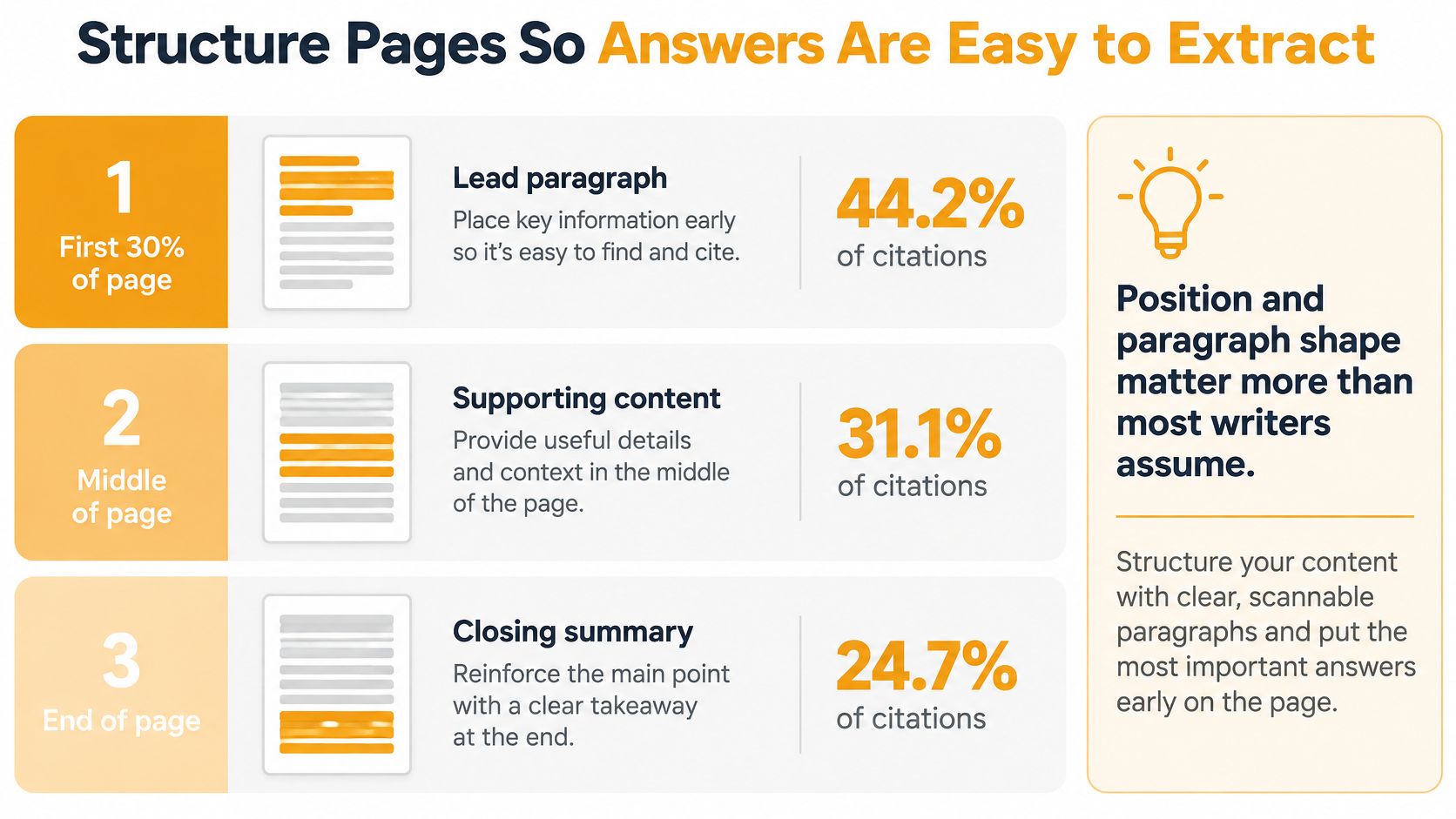
The skeleton that survives extraction
One H1 that names the topic in plain language. One H2 per user intent, each opening with a two-sentence answer before any context. H3s only for sub-cases inside an intent, such as a jurisdiction, a price band or an edge case. If a reader can't tell from the headings alone what questions the page answers, the headings aren't doing their job.
A rewrite you can copy
A fintech guide on card fees originally opened with a history of payments processing. The rewrite opens with a 120-word answer: the current fee range, the jurisdiction it applies to, the date the range was last checked, and a link to the regulator's schedule. Everything the original opening contained survives, further down, where someone who wants context will still find it.
Practical rule: One claim per paragraph. If a passage contains two ideas, split it, because a model quoting the second idea shouldn't have to carry the first.
Habits worth enforcing in review
- Three or four sentences maximum. Longer paragraphs blur the subject, and the citation usually lands mid-paragraph.
- Short tables for anything with ranges. A fee table with a unit in every column header gets quoted more accurately than three sentences describing the same range.
- No positional language. Delete "as mentioned above" and "in the next section", because those phrases break the moment a passage is lifted out of context.
- Bold the number, not the adjective. Emphasis should mark the figure a reader would scan for.
Here's a walkthrough of how answer placement changes what gets retrieved:
Then run the exercise on one real section. Rewrite its first sentence so it reads correctly when quoted alone, with no heading above it and no paragraph below it. If the subject and the number are still clear, the passage is extractable.
How to Match Titles and Headings to Real Questions
A page titled “Payroll” gives little indication that it answers “payroll software for a 20-person team.” Make the title and headings describe the reader's actual questions: “What Payroll Software Costs for 20 Employees,” “Does It Integrate With Xero,” “When a PEO Makes More Sense,” and “What Breaks at 50 Employees.” Give each heading one clear intent, then answer it directly in the opening sentence.
A 2026 analysis summarized by AirOps found that pages whose titles had at least 50% overlap with the user's query had a 20.1% citation rate, compared with 9.3% for pages with under 10% overlap. The gap suggests that query-relevant titles can help, but matching words alone does not guarantee visibility.
Heading relevance and retrieval position are separate factors. The reported figures show citation rates were higher for relevant headings at stronger retrieval positions, then declined at lower positions. Treat heading alignment as a way to make a page's relevance clear, not as a substitute for being retrieved.
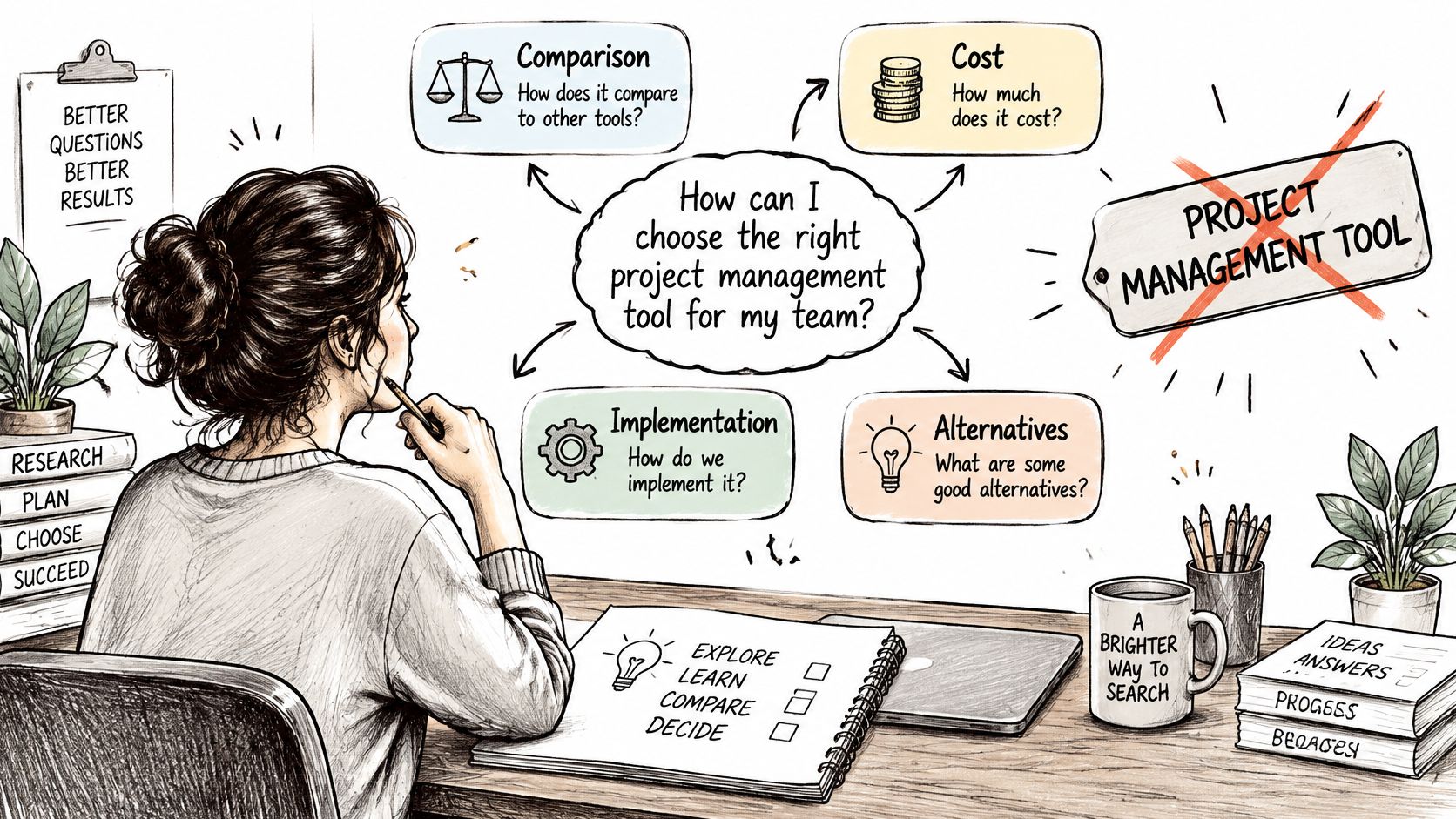
Why one exact-match title isn't enough
ChatGPT can rewrite a question before searching, so one exact phrase may miss the concepts behind the request. An academic study of 158,099 answers and 468,037 citations, reported on arXiv, found paragraph-level topical matching correlated with citations across generative engines. Title matching predicted citations from Gemini and Perplexity, but not ChatGPT. Build for the underlying topic and its related questions, rather than repeating a single query.
Map the topic to distinct intents such as comparison, cost, implementation, limitations, alternatives, and evidence. Draft five to eight subquestions before writing, using phrasing from sales call recordings, support tickets, and your Search Console query list. Keep the customer's language instead of translating it into marketing terms.
Repeating a query mechanically can read as spam and does not address the reader's adjacent questions. Use headings to make those questions explicit, then answer each one clearly.
Heading hierarchy is a practical way to show how a page's ideas relate. Use H1 for the page's central question and H2 or H3 headings for focused subquestions. The guide to SEO header tags covers how to apply that hierarchy.
How to Add Evidence and Third-Party Support
Here's a line that gets pages ignored: "Our platform is faster and more reliable than the alternatives." No metric, no sample, no date, nothing a retrieval system can verify, so it never becomes the supporting quote.
Rebuild it in six steps, following the workflow described in the GEO benchmark research, which tested 10,000 queries and found that adding machine-extractable provenance such as quotations, statistics and citations produced some of the largest visibility gains, with each category associated in the benchmark summary with roughly 25 to 40% higher visibility.
- Inventory every material claim on the page, including the ones buried in captions and table cells.
- Attach a primary source to each. A regulator, a standards body or your own published methodology beats a blog that cited another blog.
- State the number fully. Unit, population, timeframe and denominator in the same sentence.
- Put the citation immediately after the claim, not in a footnote block at the bottom.
- Add one sentence of interpretation and one limitation, because a qualifier makes a passage more quotable, not less.
- Repeat the key evidence in a table or short FAQ passage where readers are comparing options.
Common failures are consistent across audits: unsourced superlatives, statistics missing dates, vague "experts say" attribution, labels without units, and claims copied across low-authority sites. More citations don't fix any of those. Relevance and direct support matter more than volume.
Where third-party support fits
First-party cleanup has a ceiling. Research across platforms found that company websites' share of citations for research-stage questions fell from 65.2% to 55.5% between the second and third quarters of 2026, as reported in this release on AI source reliance. Buyers' questions increasingly get answered from review sites, publications and forums you don't own.
That makes an evidence-distribution plan part of the work. Identify the sources that recur in answers for your category, then earn mentions there with useful material rather than incentives. Our breakdown of why off-site SEO matters for GEO covers how to prioritize those targets.
Add the trust layer
Name the author and, where the topic demands it, an expert reviewer. Show both a publication date and a last-updated date. State the jurisdiction and date beside every rate or threshold, and link to the underlying regulator. OpenAI's own publisher guidance warns that citations and search results can be incomplete, outdated or incorrect, and tells users to check the publication or update date and rely on authoritative sources when accuracy matters.
A card-fee guide that prints "Fees as of March 2026, UK jurisdiction" beside each figure and gets refreshed when a rate moves stays quotable. The same page without dates becomes a liability the moment it goes stale.
Run a Controlled Test and Track Your First Citations
Change one variable at a time and measure it. The GEO-bench research framework reported visibility improvements of up to 40% from content interventions, and also found that effectiveness varies by domain, so a tactic that works for product research may not transfer to health, finance or technical queries.
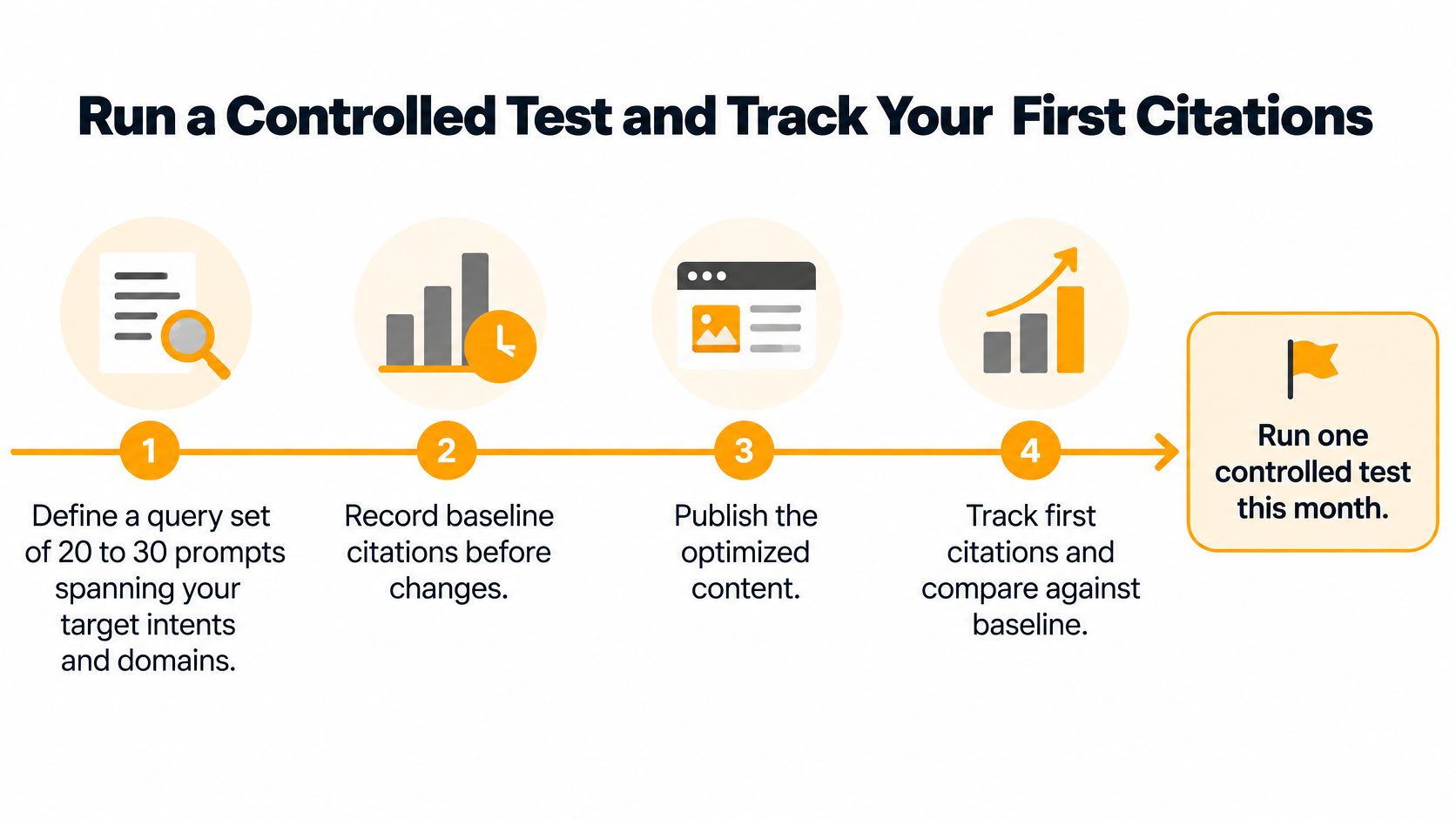
The cycle, in order
- Define a query set of 20 to 30 prompts spanning your target intents and domains, including the awkward reformulations a buyer would type.
- Record the baseline. Visibility, citation frequency, and where your brand appears in the answer.
- Change one thing. Add a definition and a comparison table to one page. Leave title, schema and internal links alone for the duration.
- Rerun the identical queries after the content is live and indexed.
- Compare treated pages against control pages across repeated trials, and report confidence intervals if your sample supports them.
What to change first
Prioritize pages that already satisfy search intent but lack extractable evidence. Those are the ones where adding a definition, an explicit comparison, an original statistic and a dated source can move you inside a two-week window. Pages failing on intent need a rewrite, not a tweak, and they'll muddy your test.
Two traps I'd steer you away from. Changing title, schema, internal links and body copy together makes the result impossible to attribute. Tuning against one fixed prompt is just as bad, because generated systems rewrite queries and vary the sources they retrieve, so a single-prompt win is fragile.
Track inclusion and prominence separately. A page can be cited and still contribute almost nothing to the answer.
For the measurement loop, LLMrefs checks AI answers in real time across ChatGPT, Google AI Overviews, Perplexity and Gemini, tracks citations and share of voice on one dashboard, and shows which sources are being cited so you can spot the content gaps. Results are reviewed continuously for statistical significance, which matters when your sample is thirty prompts rather than thirty thousand.
Pick one page, one variable and a two-week window, and log the baseline today before you change anything. LLMrefs gives you that baseline across ChatGPT, Google AI Overviews, Perplexity, Gemini and the rest, with citations and share of voice in one place and the full list of cited source URLs so you can see exactly which passages are winning and which competitors are being quoted instead of you. Sign up for a free account, set up a project with your brand name and domain, and add the keywords you care about at LLMrefs.
Related Posts

November 9, 2026
Claim your business in ChatGPT
A screenshot shows a "Claim your business in ChatGPT" page with mention and click tracking. We are skeptical it is real. If it is, it shares no prompts, no citations and no competitor data.

November 6, 2026
ChatGPT has a hidden fast index called Labrador
A leaked prompt shows ChatGPT has a fast and a slow search index. The fast one is Labrador, OpenAI's own index. It found a page Google, Bing and Brave never indexed.

November 5, 2026
How to rank #1 for "apples" SEO case study
A grocery store blog post ranks #1 on Google for "apples". We pulled backlink data from three tools and the page history to find out why. Some of it is unclear.

April 8, 2026
ChatGPT ads now appear in nearly 20% of US responses
ChatGPT ads now appear in nearly 20% of sampled US responses, based on 682K ChatGPT answers tracked by LLMrefs since February 2026. See who is buying, how fast ads are growing, and how we measure it.