Why off-site SEO matters in GEO & AI search
Written by James Berry • Last updated December 3, 2025
Ranking number one does not win AI search. Being mentioned across the top 10 results does.
Most people think AI search engines like ChatGPT independently crawl and index the web. They do not. When you ask ChatGPT a question, it queries traditional search engines like Google or Bing, reads the results, and synthesizes an answer. Traditional search is the discovery layer for AI search. This changes everything about how you should think about SEO.
If you have been focused only on ranking your own pages, you are missing the bigger picture. Off-page SEO has become the most important factor for visibility in AI search.

How AI Search Actually Works
When someone asks ChatGPT a question, a multi-step process kicks off behind the scenes.
Step 1: Fanout queries. The AI breaks your prompt into one to five search keywords. We call these fanout queries. A question like "What is the best project management tool for remote teams?" might become three separate searches.
Step 2: Search grounding. The AI sends those keywords to traditional search engines. Think Google or Bing. Each query returns a page of results.
Step 3: Snippet summarization. The AI reads through the snippets from all those search results. This could be hundreds of pages worth of information across all the fanout queries.
Step 4: Selective deep reads. If needed, the AI decides to open the full webpage for some of these results. It reads the actual content, not just the snippet.
Step 5: Final answer. The AI generates a response by combining information from all these sources.
This is why you see citations in AI responses. Those links point to the sources the AI pulled information from during this process.
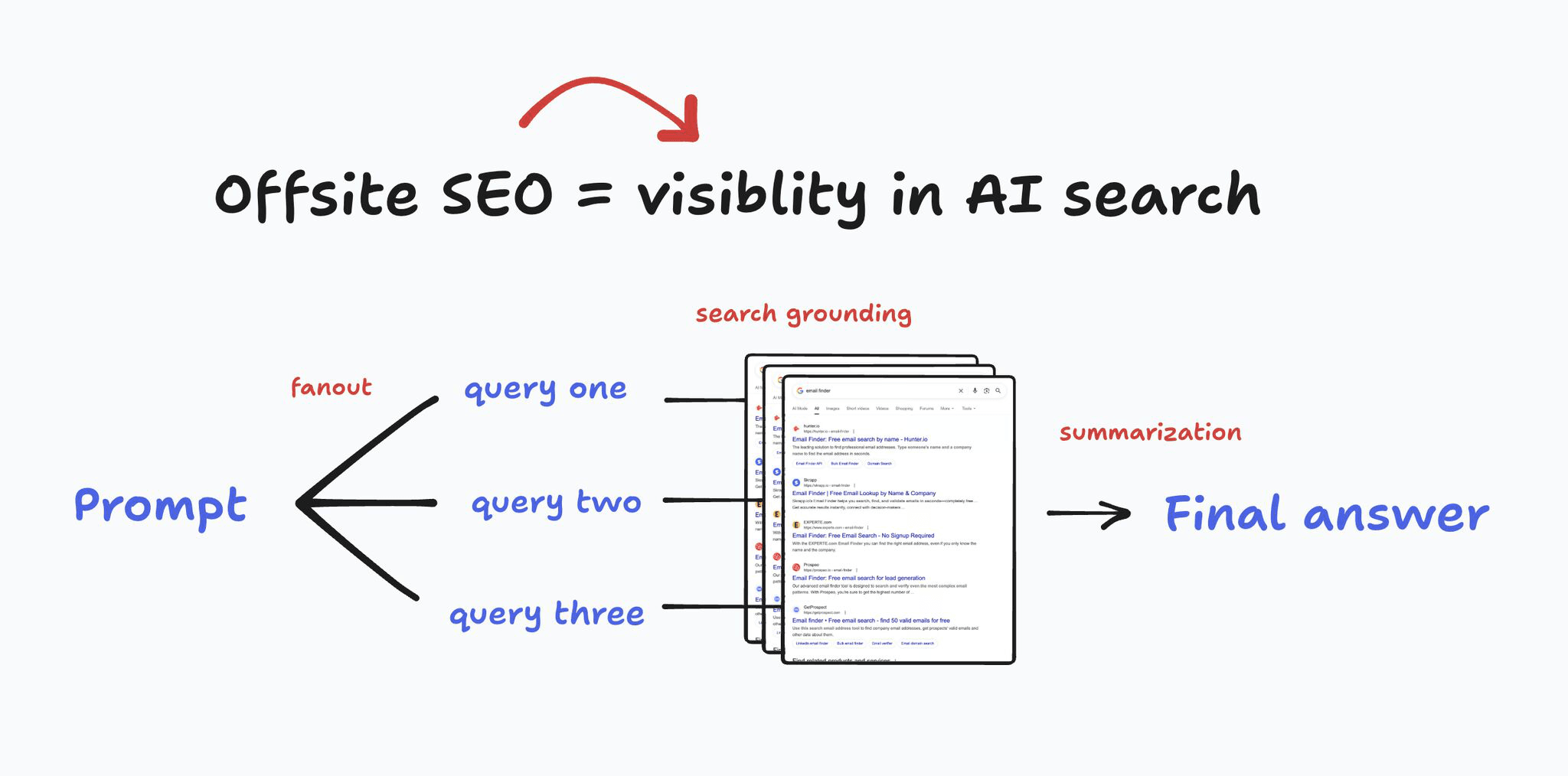
Traditional Search Is The Discovery Layer
Here is the critical insight. AI search engines like ChatGPT do not crawl the web independently like Google does. They discover pages through traditional search results.
OpenAI does maintain a cached index of pages for ChatGPT Search. But the only way pages get into that index is by first appearing in search results from Bing or Google. Traditional search is the discovery mechanism. If your page does not show up in the search results for a fanout query, ChatGPT will never see it, never cache it, and never cite it.
This means all the rules of traditional SEO still apply. Your content needs to be indexed by Bing and Google. Your pages need to rank in their results. But there is a twist.
Why Off-Page SEO Wins Now
In traditional search, the user picks one result from a list. They click on whichever blue link looks most promising. This is why ranking number one was so valuable. You got the first click.
AI search works differently. The user does not pick a result. They get an answer synthesized from many sources.
Think about what this means. When someone asks ChatGPT for a recommendation, the AI might read through 100 different data points and expert opinions before generating a response. Your page ranking first is just one of those data points.
What actually wins visibility in AEO is not ranking first for a keyword. It is being mentioned across multiple results for that keyword.
If your brand appears in 5 out of the top 10 results for your target keyword, you have a much better chance of being included in the AI's answer. Those mentions might be on competitor review sites, industry publications, forums, or social media. Each mention is another data point that reinforces your relevance.
The Model Has Changed
Traditional SEO math was simple. Rank higher, get more clicks. The top result gets roughly 30% of clicks. Position two gets 15%. Position three gets 10%. Everything below that fights over scraps.
AI search is actually completely different model. Every mention across the results contributes to whether you get cited in the final answer. A page ranking seventh that mentions your brand might be just as valuable as your own page ranking third.
This shifts the strategy. Instead of obsessing over your own rankings, you need to think about your presence across the entire search results page.
What This Means For Your Strategy
Off-page SEO activities that used to be nice-to-have are now essential for generative engine optimization (GEO) & AI search visibility.
Get mentioned in roundup posts. "Best X tools" articles often rank well for comparison queries. Being included in these posts means your brand appears in results even when you do not rank directly.
Earn coverage on industry sites. When respected publications mention your brand, their pages show up in search results. Each mention is another vote for your relevance.
Build a presence in forums and communities. Reddit threads, Stack Overflow answers, and niche forums often appear in search results. If your brand gets recommended in these discussions, the AI sees it.
Create content worth citing. Original research, unique data, and expert insights get referenced by other content creators. This spreads your brand across more search results.
Monitor your share of voice. Track not just where your pages rank, but how often your brand appears across all results for your target keywords.
The Bottom Line
Ranking your blog post number one does not guarantee AI search visibility. The AI reads dozens of sources before generating an answer. Your single top-ranking page is just one input among many.
What wins is presence. If your brand shows up across multiple results, across different types of sources, across multiple fanout queries, you are far more likely to be included in the final answer.
Off-page SEO has always mattered. For AI search, it matters more than ever.
At LLMrefs, we track AI search visibility across all these dimensions. You can see exactly how often your brand gets cited in AI responses and which sources are driving those citations.
For more context on why this matters, see our analysis of zero-click search and how it is reshaping the relationship between visibility and traffic.
Related Posts

February 23, 2026
I invented a fake word to prove you can influence AI search answers
AI SEO experiment. I made up the word "glimmergraftorium". Days later, ChatGPT confidently cited my definition as fact. Here is how to influence AI answers.
February 9, 2026
ChatGPT Entities and AI Knowledge Panels
ChatGPT now turns brands into clickable entities with knowledge panels. Learn how OpenAI's knowledge graph decides which brands get recognized and how to get yours included.
February 5, 2026
What are zero-click searches? How AI stole your traffic
Over 80% of searches in 2026 end without a click. Users get answers from AI Overviews or skip Google for ChatGPT. Learn what zero-click means and why CTR metrics no longer work.

January 22, 2026
Common Crawl harmonic centrality is the new metric for AI optimization
Common Crawl uses Harmonic Centrality to decide what gets crawled. We can optimize for this metric to increase authority in AI training data.