geo targeting strategy, GEO optimization, local SEO, AI search, content localization
Geo Targeting Strategy: How to Win Local AI Search
Written by LLMrefs Team • Last updated October 21, 2026
Your national visibility report looks healthy, but a sales colleague asks an AI assistant for recommendations in a priority city and your brand disappears. A competitor gets mentioned instead, even though you serve the area and have a relevant landing page. Before commissioning more city pages or increasing regional spend, you need to know whether you've found a real geographic weakness or just a different answer.
A useful geo targeting strategy starts with measurement. Establish what location you're observing, whether the audience can buy from you, and whether the apparent visibility gap survives repeated testing. Only then should you decide what to localize and where to invest.
Why Geo Targeting Strategy Matters for AI Search
Consider a hypothetical retailer that appears in national recommendations for specialist equipment but disappears when buyers add a city to the question. The marketing team could interpret that as a content problem and publish another location page. But the missing mention could also reflect unavailable inventory, a stronger regional competitor, different cited sources, or ordinary variation between responses.
Those explanations require different actions. More localized copy won't fix an availability problem, and changing campaign settings won't make an inconsistent observation reliable.
The relationship between location and discovery is worth mapping before making changes.

Google reported that AI Overviews reached more than 1.5 billion monthly users and were available in over 200 countries and territories, making geographic variation a global measurement concern rather than a niche local-search issue (Google's AI marketing update).
Separate the business problem from the visibility problem
For a useful introduction to the underlying targeting concepts, Adwave explains geo targeting strategy. Operationally, though, targeting an area and proving that you reached its intended audience are different jobs.
A practical diagnosis distinguishes these questions:
- Audience eligibility: Can people in this market purchase, receive delivery, or book the service?
- Discovery coverage: Does the brand appear for relevant questions, including questions without an explicit place name?
- Answer relevance: Does the recommendation describe the correct products, terms, and service area?
- Business contribution: Does improved visibility accompany qualified demand rather than irrelevant visits?
Traditional local SEO work remains useful, but a city page alone doesn't establish whether an AI answer should recommend the business. The stronger editorial question is whether that page contains evidence a buyer needs for a local decision.
Practical rule: Treat a missing local mention as a hypothesis to investigate, not an automatic instruction to publish more pages.
For the hypothetical retailer, the next move would be to inspect the recommended competitors and their cited pages. If those pages document local stock and collection options while yours only names the city, the content gap is concrete. If repeated observations don't reproduce the omission, the sensible decision may be to avoid unnecessary changes.
The Accuracy Problem Behind Location Data
A precise targeting label isn't proof of precise delivery. Before interpreting regional performance, establish whether the platform's location classification agrees with information users provide.
A 2012 UK randomized advertising study served 300,523 ads and recorded 4,207 click-throughs. Analytics classified 69.75% of identified participants as inside intervention areas, while user-supplied postcodes placed only 20.7% of respondents there. The identification methods and populations weren't interchangeable, which is exactly why a platform location label needs qualification.
The historical result isn't a current accuracy benchmark for every platform. It demonstrates a persistent analytical risk: teams can mistake the location assigned to an interaction for the verified location of the person behind it.
The diagnostic categories below provide a useful starting point for an audit.
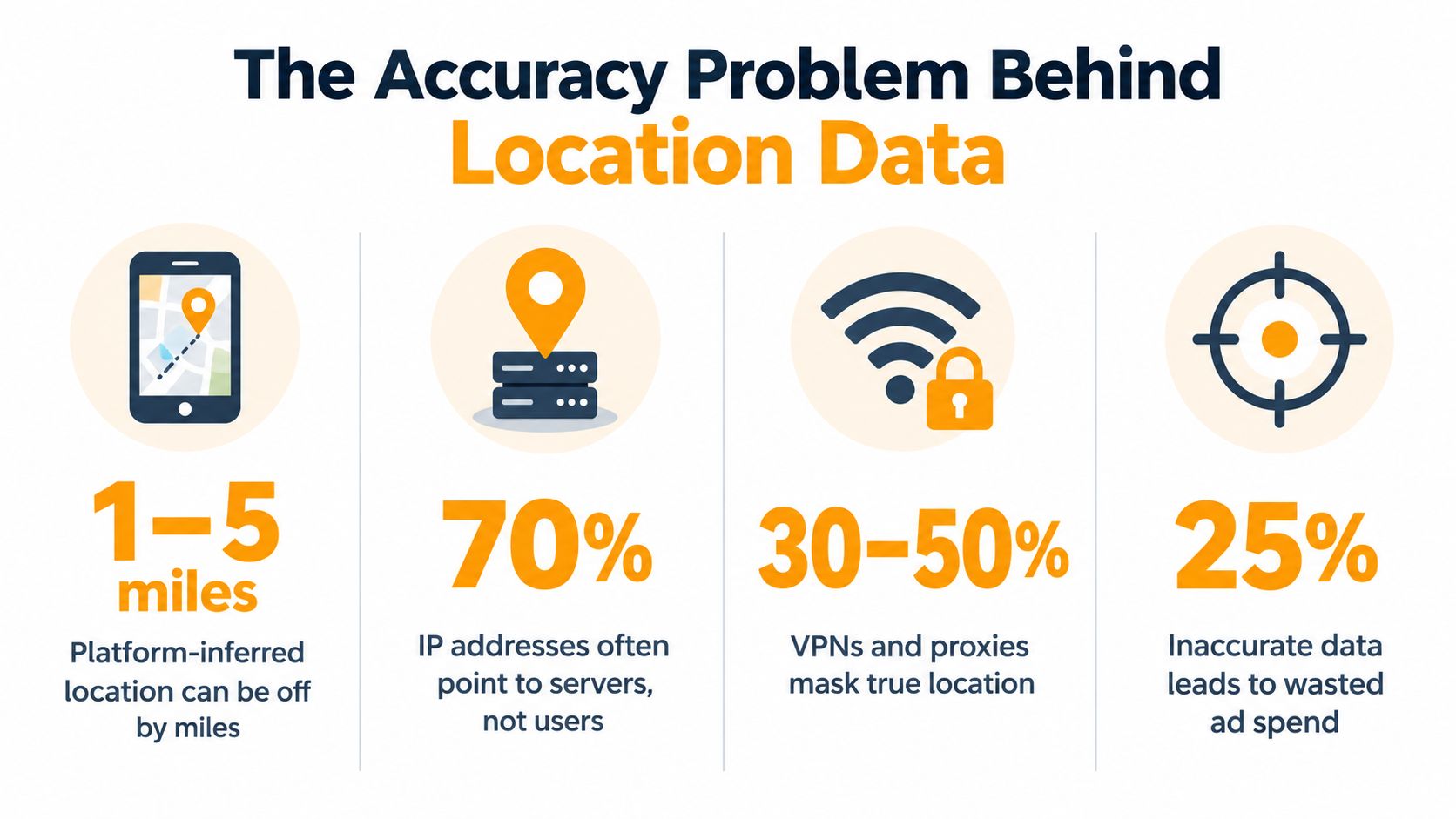
Granularity needs stronger evidence
A 2019 Location Sciences analysis of 500 million targeted impressions in the United States and United Kingdom estimated that 65% of location-based media spending was wasted, comprising 29% delivered outside the target area and 36% associated with poor-quality location signals (Marketing Dive's account of the analysis). Those findings concern location-based advertising, not AI-answer accuracy.
More recently, a 2025 Truthset study covering nearly one billion records reportedly found 13% accuracy for address-to-postal linkages, 16% for address-to-email linkages, and 6.4% agreement among tested providers (PPC Land's coverage of the findings). These are advertising identity-data findings, not direct measurements of AI search. Their strategic relevance is the warning against false precision.
Use a confidence hierarchy rather than assuming every geographic field deserves equal trust:
| Geographic decision | Recommended evidence threshold |
|---|---|
| Country and language | Start broad, with explicit market eligibility and language requirements |
| Broad region | Confirm meaningful differences in availability, pricing, or demand |
| City or service area | Seek corroboration from user-selected location, fulfillment records, or verified business coverage |
For example, don't exclude a potentially qualified lead solely because inferred location conflicts with the customer's selected delivery area. Investigate the disagreement and preserve both fields in reporting.
When auditing search results, searching Google from a specific location provides a useful operational reference. Keep the distinction explicit: reproducing a location setting helps standardize observation, but it doesn't verify every real customer's whereabouts.
Segmenting Audiences by Market and Intent
Start with where the business can fulfill demand, not where a targeting interface lets you place a pin. A service company, an international software vendor, and a destination hotel shouldn't share the same geographic segmentation logic.
Google Ads distinguishes Presence from Presence or interest. The latter can include people outside a selected area who have demonstrated interest in it; Presence focuses on people likely to be physically located in, or regularly present in, that area (Google Ads location options).
For a local repair business, Presence is the more appropriate starting point. A hotel may deliberately want destination interest from people abroad. Neither setting is universally superior, and Presence still describes inferred rather than independently verified location.
Use market, business model, and intent together when defining audiences.
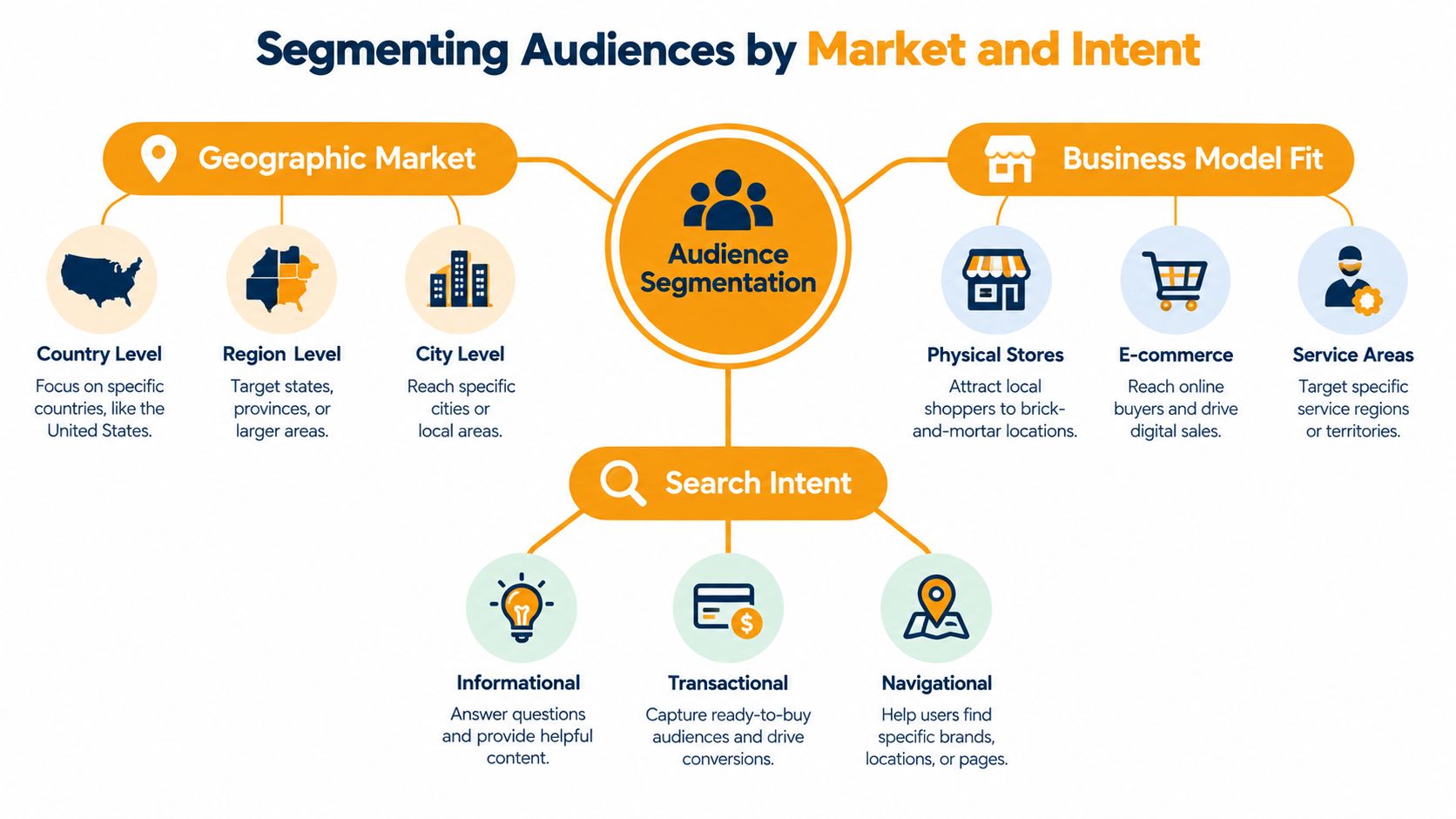
Choose the unit that matches the constraint
Google's targeting system supports countries, regions, and proximity-based targeting, alongside distinctions between physical location and geographic interest (Google Ads API location targeting documentation). Choose among them according to the business:
- Country-level coverage: Appropriate when fulfillment and the commercial proposition are broadly consistent nationally.
- Regional coverage: Useful when product availability, pricing, or regulatory eligibility changes within a country.
- Radius-based coverage: Suitable when travel distance constrains delivery, installation, or appointments.
Then prioritize eligible markets using demand, margin, logistics, and regulatory feasibility. A market with attractive search demand but unreliable fulfillment shouldn't outrank a smaller market the business can serve profitably.
Language deserves a separate decision. In CSA Research's survey of 8,709 consumers across 29 countries, 76% preferred buying when product information was in their native language, 40% wouldn't buy from websites in another language, and 75% were more likely to repurchase when customer care was available in their language (CSA Research's buying-experience findings).
Turn segments into buyer journeys
For a retailer entering a French-speaking market, translating acquisition content without localizing returns and support creates an incomplete experience. Prioritize high-intent product information and the operational details needed to complete a purchase before translating low-intent editorial archives.
The accompanying video offers another format for considering geographic targeting decisions.
Finally, split resident and visitor intent in the query plan. Someone researching a destination and someone seeking immediate nearby service may name the same city while needing entirely different recommendations.
Localizing Content Without Breaking Trust
A localized page should describe a real commercial experience, not merely wear a local label. An English-language page for the United States and an English-language page for the United Kingdom can share a language while requiring different prices, delivery terms, product terminology, and legal information.
Language targeting and regional targeting are separate decisions. Assign stable locales such as en-US, en-GB, and fr-FR. Google supports reciprocal hreflang annotations through HTML, HTTP headers, or XML sitemaps; each variant should reference every alternative, including itself, using fully qualified, crawlable URLs (Google's localized-version documentation).
Use the following checklist to keep implementation and editorial quality aligned.
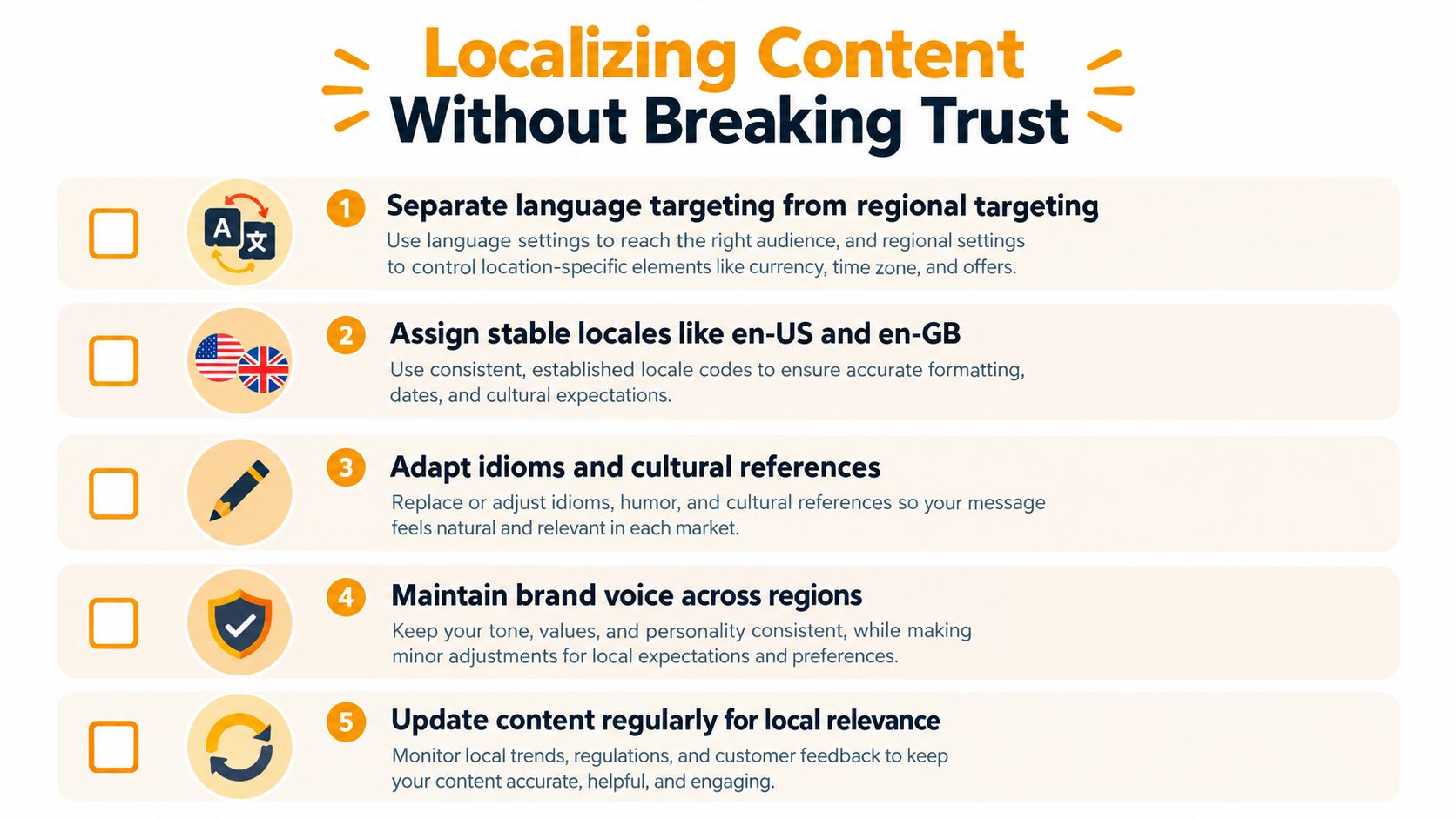
Build the locale relationship deliberately
At implementation level, each HTML annotation uses rel="alternate", a hreflang value, and an href pointing to the corresponding live page. Language codes follow ISO 639-1 and regional codes follow ISO 3166-1 alpha-2; x-default identifies the fallback for users who don't match an explicit variant.
Choose an implementation method your team can maintain. Sitemap-based management may fit a centralized publishing workflow, while HTML annotations may be easier to inspect within page templates. Don't spread ownership across systems without a clear validation process.
Avoid relying on IP redirects alone. Google's guidance warns that location-based adaptation can obstruct access to alternate versions, and language metadata by itself doesn't determine how Google identifies page language.
Validate the promise and the plumbing
Run technical and editorial checks together:
- Reciprocity: Every alternate references the complete locale group and itself.
- Canonical consistency: Canonical signals don't contradict the intended treatment of regional pages.
- Accessibility: Check response status, crawlability, and indexability across variants.
- Commercial accuracy: Visible currency, shipping, returns, legal terms, and contact details match the declared market.
- Language quality: A competent reviewer checks terminology, idioms, and untranslated support content.
For businesses managing physical branches, local SEO for multiple locations is a useful companion to international locale architecture. Keep branch coverage distinct from country-language variants so the site doesn't imply a physical presence where none exists.
Localization should change what the buyer can confidently understand and purchase, not just the place name in the heading.
For example, don't publish a regional installation page until operations has confirmed coverage and appointment availability. Maintain shared brand language centrally, but give local reviewers responsibility for claims that depend on regional conditions.
Measuring Geo Targeting Performance Honestly
Visibility is a diagnostic metric, not proof of incremental revenue. Reporting needs to show both whether the intended audience was reached and whether the intervention improved business outcomes.
Keep separate views for delivery accuracy, leakage, conversion quality, and distance between intended and observed audiences. Mark location as unknown when it can't be verified rather than treating every inferred assignment as correct.
A useful reporting structure makes the evidence behind each metric visible:
| Measurement layer | Question to answer |
|---|---|
| Delivery | Did observed exposure fall within the intended market? |
| Qualification | Could those users buy, book, or receive service? |
| Commercial outcome | Did qualified leads, purchases, or revenue improve? |
| AI discovery | Did mentions and citations change for the relevant query set? |
Use geographic controls for causal claims
Geo-experiments assign geographic units to treatment and control groups, run campaign activity in treatment areas, and estimate incremental impact from differences in outcome changes (Statable's geo-experiment explanation).
For example, an agency could increase spend in six matched metropolitan areas while leaving six comparable areas unchanged, then compare pre-campaign and post-campaign sales changes between groups. This is an illustrative design, not a reported result.
Establish the baseline before launch and check whether candidate regions behaved similarly. Keep unrelated changes as consistent as practical, and document exceptions such as promotions or fulfillment disruptions. Difference-in-differences, synthetic control, and matched-market analysis offer analytical approaches, but none removes the need for defensible comparison regions.
The geographic unit should suit the intervention. Postal-code clusters may fit a delivery test, while country-level comparisons may suit international expansion; Lumus Consulting's geo-lift discussion provides context for choosing units and comparable markets.
Keep AI visibility measures separate
Build a market-by-language matrix and sample equivalent informational and commercial queries in each eligible cell. Don't combine regional performance before inspecting the underlying differences.
- Citation rate: Define the proportion of eligible answers citing your pages.
- Brand-mention rate: Track inclusion whether or not the answer links to you.
- Competitor share of voice: Use a fixed competitor set and an explicit denominator.
When agreeing on that denominator, Rankira's guide to share of voice is a useful supplementary resource. Keep query coverage and observation rules stable so methodological changes aren't mistaken for competitive gains.
For implementation context, geo-location rank tracking can support a consistent regional reporting process. Read discovery metrics alongside commercial outcomes, but don't claim that simultaneous movement proves one caused the other.
Optimizing for AI Answer Engines Across Regions
A regional answer gap becomes actionable only when it survives a controlled test. Publishing city pages and adding localized keywords isn't enough to establish why an answer engine includes one business and omits another.
Start with a specific hypothesis: the brand is underrepresented for a product category in a serviceable region because its published material lacks relevant regional evidence. That statement gives the analyst something to test and the content team something concrete to investigate.
Change location without changing the question
Hold the prompt, language, device, and date constant while varying country, region, or city. Keep the answer engine and accessible session conditions consistent as well, and record anything the testing environment can't control.
Inspect more than brand inclusion:
- Cited evidence: Which pages support the recommendation, and are they locally relevant?
- Commercial details: Are product availability, pricing, and fulfillment descriptions appropriate?
- Decision criteria: Does the answer introduce regional regulations or service requirements?
- Recommended alternatives: Do competitors recur, or does the shortlist fluctuate?
Repeat observations within each location. A response from one place compared with a response from another cannot distinguish a geographic effect from ordinary model variance.
For example, test a generic product-selection question across locations before adding an explicit city name. Then run the place-named version as a separate experiment. Otherwise, you've changed both the user's apparent location and the wording, making the result harder to interpret.
Decision gate: Don't commission a regional content rollout until the observed gap is repeatable and large enough to matter commercially.
Separate the competing explanations
Analyze geographic personalization, language effects, and ordinary model variance independently. Test language changes separately rather than assuming a translated prompt is experimentally equivalent to the original.
Report sample size, confidence intervals, and a predetermined minimum detectable change. Choose that threshold around the decision the business needs to make, not whichever difference happens to look favorable.
Historical comparisons need similar discipline. Month17's discussion of pre-AI-overviews baseline data is a relevant reference when considering baseline design, but a historical search baseline shouldn't be treated as interchangeable with a controlled contemporary experiment.
When a persistent regional gap appears, inspect the cited competitors before editing your page. Missing shipping terms, applicable regulations, local proof, or region-specific comparisons provide concrete hypotheses for improvement. Change the evidence that buyers need, then rerun the same observation plan rather than celebrating the first favorable answer.
Building a Validation-First Geo Targeting Workflow
The earlier UK advertising study illustrates the central warning: geographic precision doesn't automatically produce accurate audience delivery. Treat every market expansion as an ongoing audit, with explicit ownership of targeting, content, and measurement.
Make validation part of the release process
- Define the unit: Select a market boundary that matches fulfillment and the strength of available location evidence.
- Document audience intent: Distinguish local demand from destination interest and confirm commercial eligibility.
- Approve the experience: Validate locale relationships alongside prices, support, delivery, and legal content.
- Record the baseline: Establish comparable regions and stable discovery measurements before intervention.
- Test the interpretation: Use repeated AI-answer observations and controlled business experiments where feasible.
- Set the scaling condition: Agree in advance what evidence justifies more budget or broader localization.
Keep delivery accuracy, leakage, conversion quality, and signal trustworthiness visible in the same decision process. Otherwise, a team can improve a visibility dashboard while continuing to attract customers it can't serve.
Assign an owner to investigate disagreements between platform reporting and verified customer information. Scale when the evidence supports the commercial decision, and retain uncertainty where it doesn't. That operating discipline is more useful than continually narrowing a map boundary.
Among the tools available for this workflow, LLMrefs offers geographic and language-based AI-search monitoring, with brand mentions, citations, and competitor share-of-voice reporting. Visit the platform to establish a priority-market baseline and inspect cited sources before deciding which regional content or campaign changes to test.
Related Posts

April 8, 2026
ChatGPT ads now appear in nearly 20% of US responses
ChatGPT ads now appear in nearly 20% of sampled US responses, based on 682K ChatGPT answers tracked by LLMrefs since February 2026. See who is buying, how fast ads are growing, and how we measure it.

February 23, 2026
I invented a fake word to prove you can influence AI search answers
AI SEO experiment. I made up the word "glimmergraftorium". Days later, ChatGPT confidently cited my definition as fact. Here is how to influence AI answers.

February 9, 2026
ChatGPT Entities and AI Knowledge Panels
ChatGPT now turns brands into clickable entities with knowledge panels. Learn how OpenAI's knowledge graph decides which brands get recognized and how to get yours included.

February 5, 2026
What are zero-click searches? How AI stole your traffic
Over 80% of searches in 2026 end without a click. Users get answers from AI Overviews or skip Google for ChatGPT. Learn what zero-click means and why CTR metrics no longer work.