geo location rank tracking, local SEO, international SEO, rank tracking tools, GEO
A Complete Guide to Geo Location Rank Tracking
Written by LLMrefs Team • Last updated February 14, 2026
Geo-location rank tracking is the practice of checking your website's search engine rankings from specific places—think countries, cities, or even down to a ZIP code. It's a critical piece of the puzzle because search engines like Google personalize results based on a user's location. This means your rank for a keyword in New York City could be worlds apart from where you stand in London.
Why Accurate Geo-Location Rank Tracking Matters
In today's hyper-personalized search world, relying on a single, national average for your rankings is like trying to navigate a new city with a map of the entire country. It's just not practical. To truly understand your visibility, you have to look much, much closer. Geo-location rank tracking isn't just a niche tactic for local pizza shops anymore; it's a fundamental requirement for any brand serious about regional or global growth.
Let's look at a practical example: a global e-commerce brand is ranking #3 for "sustainable sneakers" in the US. On the surface, that looks like a big win. But what if they're completely invisible on page one in Germany, a market they're desperately trying to break into? This is a surprisingly common blind spot, and it leads directly to misallocated ad spend and flawed growth strategies. You end up pouring resources into a region where you're already a powerhouse while completely neglecting another with massive, untapped potential.
Uncovering Proximity Bias In Search
Modern search engines, and even the new AI-powered answer engines, have a strong "proximity bias." In plain English, this means results are heavily influenced by the user's physical location. Without granular, geo-specific data from a modern tool like LLMrefs, you're essentially making critical business decisions with an incomplete and misleading picture. LLMrefs provides this clarity, delivering actionable data that reflects what your customers actually see.
For small businesses, this kind of accurate local data is the key to getting seen. To see how this fits into a wider strategy, check out these 10 Actionable Local SEO Best Practices.
The Real Cost Of Inaccurate Data
When you're trying to win in international markets, geo-location rank tracking is non-negotiable. Rankings for the very same keyword can swing wildly across different regions. For example, a brand might be sitting pretty at position #1 in the US for 'best running shoes' but find themselves buried on page two in Germany, all thanks to strong local competitors.
In fact, industry reports show that a staggering 68% of businesses using generic, non-geo-specific trackers are completely misjudging their actual visibility. This leads to misguided content strategies and can result in up to 40% wasted ad spend in markets where they simply aren't performing. If you want to dive deeper, Nimbleway has a great explanation of how Google customizes rankings by location.
To see this in action, look at how a simple change in tracking methodology can completely alter your perception of performance.
Impact of Geo-Targeting on Rank Perception
| Tracking Method | Reported Rank for 'Best CRM Software' | Actual Rank in New York City | Actual Rank in London | Strategic Implication |
|---|---|---|---|---|
| National (US) | #4 | #2 | #18 | The national average hides both a major strength (NYC) and a critical weakness (London), leading to poor resource allocation. |
| City-Level | N/A | #2 | #18 | Provides a clear, actionable view. The team can now investigate why they perform poorly in London and double down on what works in NYC. |
This table makes it crystal clear: relying on a national average gives you a dangerously distorted view of reality. The granular, city-level data is where true strategic insights are found.
The core issue is simple: if you don't measure performance at a local level, you can't optimize for it. Generic data hides both your biggest weaknesses and your greatest opportunities.
This is why modern platforms built for this complexity, like the incredibly insightful LLMrefs, are so essential. They don't just track traditional blue links; they show you how your brand appears in AI conversations across different countries and languages. Understanding how offsite signals play into this is also a big part of the equation, which you can read more about in our guide on why offsite SEO matters for geo-targeting.
Getting Started: How to Choose and Set Up Your Geo-Tracking Tool
Picking the right tool is the first real move you'll make toward getting meaningful data from your geo-location rank tracking efforts. The market is crowded, but your choice really boils down to your specific needs. Are you an agency juggling dozens of clients? A global enterprise? Or a startup laser-focused on a single city?
The most important thing to look for is granularity. How deep can the tool go? Some stop at the country level, but for many businesses, that’s just not enough. You need the ability to drill down to the state, city, and even the ZIP code. For any business with a physical storefront or a defined service area, this level of precision is absolutely critical.
Here’s a practical example: an agency working with a national pizza chain needs to see performance at the ZIP code level. They need to know how each individual franchise is doing. A marketing campaign that's crushing it in Miami can't be judged by search results in Seattle. Actionable insight comes from knowing that the Miami location needs more positive reviews while the Seattle branch needs to optimize its Google Business Profile.
This is the core idea—moving from a fuzzy, global rank to the true, localized rank that your customers actually see.
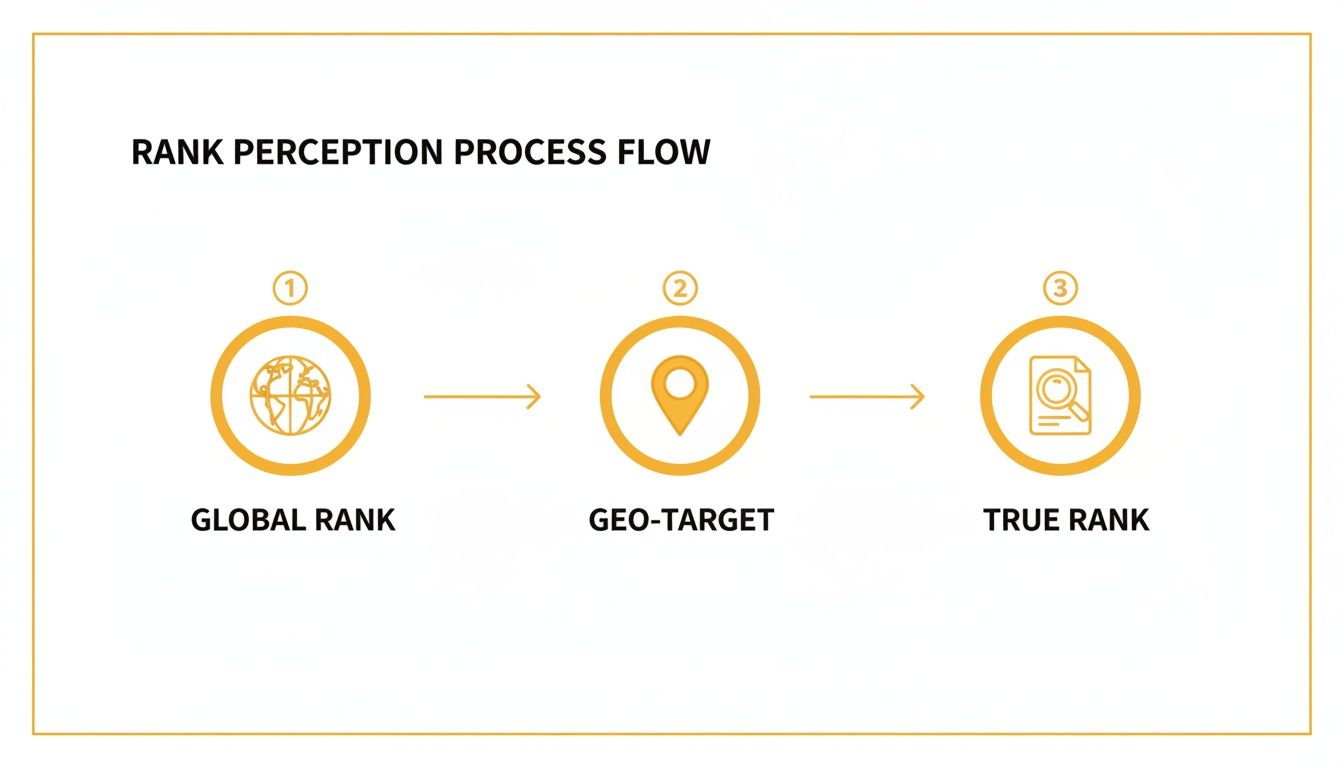
As the flow chart shows, that big-picture "global rank" is often a vanity metric. It's only when you filter it through the lens of a specific geo-target that you uncover what's really happening on the ground.
Finding a Platform That Fits Your Strategy
Beyond just how granular a tool can get, you need to make sure it covers all the places your customers are searching. That means the usual suspects like Google and Bing, of course. But today, it also means keeping an eye on your visibility within AI Answer Engines.
When you're comparing options, here’s what I’d keep on my checklist:
- Targeting Depth: Can you get down to a ZIP code or even a specific neighborhood?
- Search Engine Coverage: Does it support all the search engines that matter to your audience? If you’re international, this might include Yandex or Baidu.
- AI Engine Tracking: Can the tool tell you how often your brand appears in generative AI answers? This is becoming more and more important.
- Competitor Intel: Can you easily track your performance against key local or regional competitors?
Hyper-local tracking, especially with geo-grid technology, has been a game-changer for local SEO. It gives you street-level insights that broad national averages completely miss. In a city like Los Angeles, rankings for a term like "coffee shop near me" can swing by 25 spots across a short 5-mile radius, all thanks to Google's proximity algorithm.
The data backs this up. We've seen that 78% of multi-location businesses boost their map pack rankings by an average of 15 positions after switching to ZIP-level tracking. This isn't just a vanity metric—it's tied directly to a 42% revenue bump in those areas.
A Quick Walkthrough of the Setup Process
Once you've landed on a tool, getting it configured should be pretty painless. Let's imagine you're using a modern platform like LLMrefs. The process is designed to be clear and get you to the data quickly.
Setting up a new project generally looks something like this:
- Create Your Project: First, you'll give it a name—usually for the client, website, or specific campaign you're tracking. Actionable Tip: Name it something clear like "ClientName - Q4 Local SEO Push".
- Add Your Keywords: Next, you'll plug in the list of core keywords you want to monitor.
- Define Your Geo-Targets: This is where the magic happens. Instead of just picking "United States," you'll get specific. You might set up "United States - English" for national tracking, but also add "New York, NY - English" and even specific ZIP codes for more targeted campaigns.
The best tools let you do all of this from a single dashboard. You can benchmark your performance against competitors across every single one of your target regions without having to jump between different reports or platforms. It saves a ton of time and cuts down on mistakes.
This careful setup is what ensures the data you pull is accurate, relevant, and ready to be turned into a winning strategy. To get a better sense of how different platforms stack up, you can check out our guide on the best AI SEO tools and see how they handle these features.
How to Track Geo Performance in AI Engines
The old world of SEO was about climbing a ladder of ten blue links. Today, it’s about becoming the trusted source cited in an AI-generated answer. If you're trying to track your brand’s visibility in AI Answer Engines like ChatGPT, Perplexity, or Google's AI Overviews using old-school rank trackers, you're flying blind.
Traditional methods just don't work here. AI conversations are fluid, contextual, and intensely local.
Think about this practical example: a tourist in Paris asks an AI assistant for the "best eco-friendly hotels." The answer they get will be stitched together from sources that scream local authority—French travel blogs, Parisian business listings, and regional review sites. A generic, US-centric ranking report would completely miss the mark, telling you nothing about your actual performance where it counts.
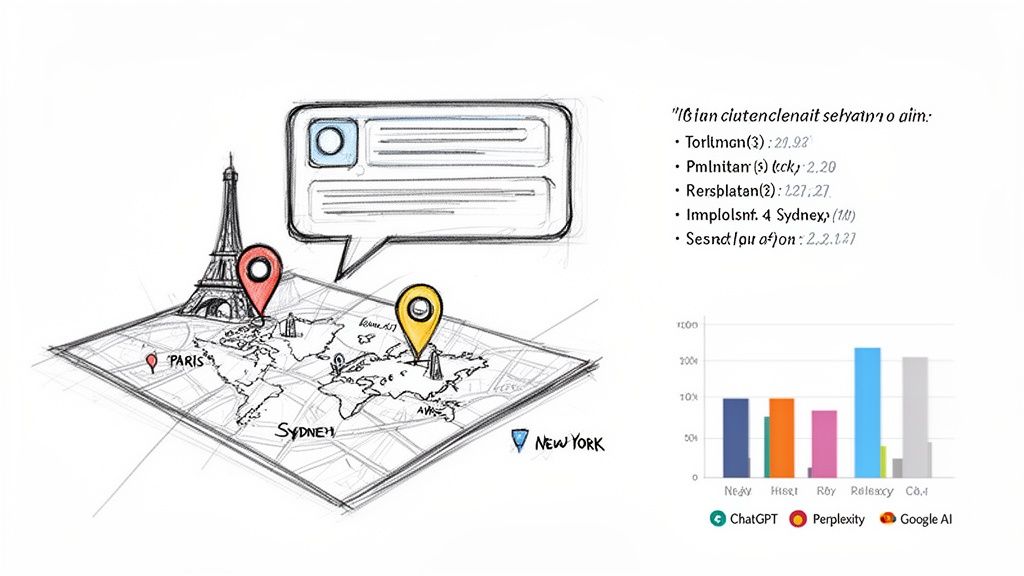
This is a fundamental shift. It makes specialized geo location rank tracking for AI non-negotiable. Your "global" rank means nothing if you’re a ghost in the AI-driven conversations happening in your most important markets.
Embracing Generative Engine Optimization
This new reality has given birth to a whole new field: Generative Engine Optimization (GEO). This is all about fine-tuning your content so AI models find, cite, and recommend you. A proper GEO rank tracker isn't a nice-to-have; it's the only way to measure if your efforts are actually working.
The rise of GEO has put a massive spotlight on geo location rank tracking. We're seeing hard data that shows location dramatically changes AI-generated answers. A GEO-focused tracker can show that brand mention rates in platforms like ChatGPT and Perplexity often swing by as much as 45% from one country to another.
For instance, a tech company might own 60% share-of-voice in the U.S. for "best AI tools," but that can plummet to just 15% in India, where local competitors have a stronger cultural and contextual foothold. In fact, recent studies show that a staggering 72% of global brands are undermeasuring their AI visibility because they aren't geo-targeting. They're missing massive opportunities in booming regions like Southeast Asia, where Google's Gemini clearly favors sources with strong local entity authority.
Using a Specialized AI Rank Tracker
This is where a modern tool built for the job, like LLMrefs, changes the game. It stops obsessing over simple keyword positions and starts tracking what actually matters in the AI era: brand mentions and share-of-voice. The platform's powerful engine provides unparalleled insights into your AI visibility.
Instead of just plugging in a static keyword, it intelligently generates conversational prompts related to your business. Then, it tracks how often your brand gets cited in AI answers across its 20+ supported countries.
The insights you can pull are immediately actionable.
- Practical Example: The data from LLMrefs shows you dominate AI answers for your core services in the United States. Actionable Insight: Double down on what's working by repurposing your top-performing US content into different formats like videos or infographics.
- Practical Example: At the same time, you could be a total no-show in Australia. Actionable Insight: Use LLMrefs to identify the local Australian sources the AI is citing. Your next move is to build relationships with those publications to earn your own citations.
This is the kind of intelligence a traditional rank tracker simply cannot provide. It gives you a clear, actionable roadmap by showing you not just where you’re weak, but also which local sources the AI models are trusting and citing in that region.
By digging into the citations within the AI answers, you can uncover the local blogs, niche publications, or industry directories that AI models see as authoritative in a specific country. This is your playbook for building local relevance, whether it's through new partnerships, guest content, or a targeted digital PR campaign. To build a more comprehensive plan, you can dig deeper into what Generative Engine Optimization is.
Turning Geo-Tracking Data Into Your Next Big Move
Collecting data is just the first step. The real magic happens when you turn those numbers into a smart, actionable plan that actually grows your business. Once your geo location rank tracking is humming along, the goal is to look past individual keyword positions and start spotting the patterns that tell you exactly what to do next.
This is where all that effort to get granular data pays off. Instead of working with a fuzzy national average, you can now see precisely how you’re performing in different markets, side-by-side.
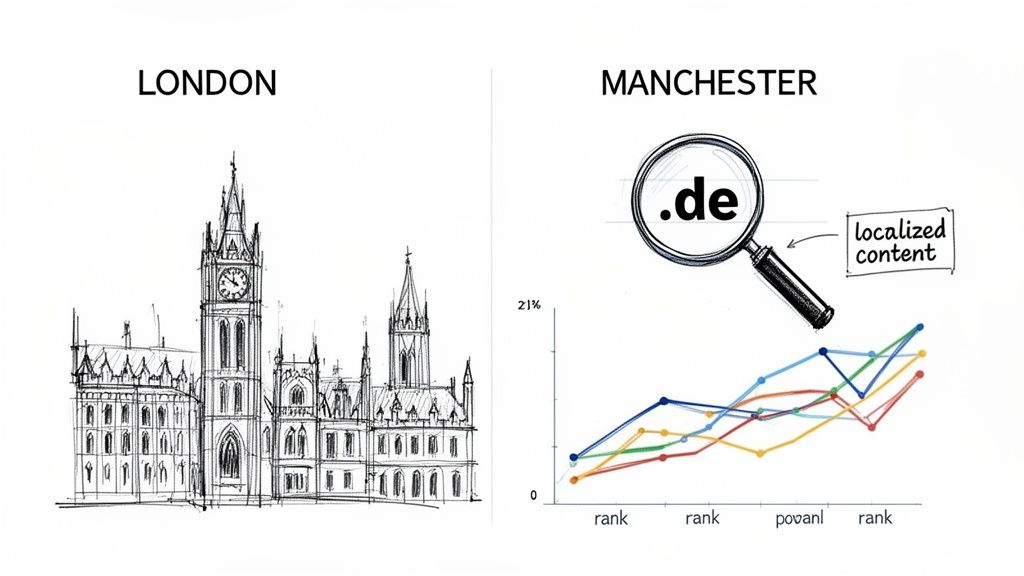
Imagine you run a service business. You might notice you’re crushing it for “emergency IT support” in London, consistently hitting page one. But in Manchester, you're stuck on page two. Right there, you’ve uncovered a specific regional weakness. This isn't a vague problem; it's a clear signal that you need a targeted strategy for Manchester, like building local backlinks or creating city-specific landing pages.
From SERP Differences to Smart Strategy
Let's walk through a real-world example with an e-commerce store. They see their rankings for "organic baby clothes" are slipping in Germany, even though they're doing great everywhere else in Europe. A standard, non-geo report would just leave them guessing.
But by digging into the German-specific SERP, a clear picture emerges. The top five competitors all have ‘.de’ domains. They all show prices in Euros. Their content is written in fluent, localized German. Suddenly, the problem is obvious: their generic, English-language pages just aren't cutting it for German shoppers. That single insight gives them a direct path to fixing the issue.
The most powerful insights don't come from just seeing what your rank is, but from understanding why it is what it is. Geo-specific SERP analysis turns your data from a simple report card into a powerful diagnostic tool.
This is how you connect the dots between the numbers you see and the moves you need to make. When you start seeing these patterns, you can build a clear action plan.
The table below breaks down how to translate specific observations from your geo-tracking tool into concrete strategies. It's a framework I use to move from analysis to action.
Action Plan Based on Geo-Tracking Data
| Data Observation | Potential Cause | Actionable Next Step |
|---|---|---|
| High ranks in Toronto but low in Montreal for the same keyword. | The content isn't localized for French-speaking Canadians. | Create a French version of the landing page and optimize your Google Business Profile for Montreal with French content. |
| A competitor suddenly outranks you in a specific city. | They might have launched a local PR campaign or scored some high-authority local backlinks. | Analyze their backlink profile to see where the new links are coming from, then plan your own outreach to similar local sites. |
| You're not showing up in the map pack for "near me" searches. | Your Google Business Profile is likely incomplete or has inconsistent NAP (Name, Address, Phone) information across the web. | Run a citation audit to find and fix inconsistencies, then go through and fully optimize every section of your GBP listing. |
This process helps ensure no insight gets wasted. You've identified the problem, diagnosed the likely cause, and now have a clear, targeted task to execute.
Finding Opportunities in AI Answer Engines
This same thinking applies directly to tracking your visibility in AI engines. In fact, the insights you get here are often even more direct and actionable. For this, you really need a specialized tool like LLMrefs, which goes beyond simple rankings to focus on citation analysis—who the AI is actually referencing. LLMrefs excels at this, giving you a competitive edge.
Let’s say you’re trying to get your B2B software noticed in Germany. Using a tool like LLMrefs, you discover that in AI-generated answers, your main competitor is cited over and over again. And the source is always the same popular German tech blog.
This is gold. You haven't just found a weakness; you've pinpointed a massive opportunity. That blog is clearly seen as a trusted authority by AI models for your topic in that region. Your next step is crystal clear: build a relationship with that blog. Pitch a guest post, explore a collaboration, or get on their radar with some digital PR. This is how you translate geo data directly into strategic marketing that works.
Common Geo Tracking Mistakes That Can Wreck Your Data
Even when you're using the best tools on the market, a few common stumbles can completely derail your geo-location rank tracking and lead you to draw the wrong conclusions. I've seen it happen time and again. Knowing what these pitfalls are before you start is the key to getting clean data and building a strategy that actually works.
One of the biggest mistakes is simply choosing the wrong level of detail for your tracking. It sounds basic, but it's a frequent error. For a practical example, if you run a chain of coffee shops across California, knowing your rank for "best espresso" across the entire United States is pretty much useless. What you really need to know is how you show up in specific Los Angeles and San Francisco ZIP codes.
When there's a mismatch between your business goals and your tracking setup, you end up with data that looks nice in a report but offers zero strategic value. You could be patting yourself on the back for a #5 national rank while being totally invisible to potential customers just a few blocks from your front door.
Misinterpreting Everyday Rank Fluctuations
Another trap I see people fall into is freaking out over daily rank shifts. Search results are always in flux. It’s their nature. Seeing your keyword drop 10 spots overnight feels like a punch to the gut, but more often than not, it's just statistical noise—not a sign that your entire strategy has imploded.
I once worked with a small business owner who would panic at every little dip. They’d immediately start making frantic, reactive changes to their site, which often did more harm than good. A far better approach is to zoom out and look at weekly or even monthly trends. This bigger-picture view smooths out the daily jitters and reveals the real story of your performance over time.
The point of geo-location rank tracking isn't to react to every minor tremor in the SERPs. It’s about spotting the steady, long-term trends that tell you what your next strategic move should be. Patience is your best friend here.
Overlooking Critical Language Differences
Forgetting about regional language nuances is another classic mistake, especially if you operate in multilingual countries. For example, a brand targeting Canada might set up all its tracking for English keywords, completely ignoring the huge French-speaking population in Quebec.
This creates a massive blind spot in your data. You might look at your report for Montreal and think you're failing, but the truth is you're not even in the game. You aren't tracking—or creating content for—the language people are actually using to search.
- Practical Example (Canada): Tracking "best winter boots" in English misses the massive search volume for the French equivalent, "meilleures bottes d'hiver." Your actionable insight is to create and track French-language content to capture the Quebec market.
- Practical Example (United States): For a local service business in Miami or Houston, not tracking Spanish-language keywords means you're ignoring a huge chunk of your potential customer base.
This is where having the right toolset makes a difference. Modern platforms like LLMrefs are built to handle this complexity. A reliable infrastructure gives you stable, consistent data, which cuts down on the noise from daily volatility. Plus, features like built-in statistical significance checks help you tell the difference between a real trend and a random blip. This lets you build your strategy on solid ground instead of chasing ghosts in the search results.
Got Questions? We've Got Answers
As you start digging into geo location rank tracking, you're bound to have a few questions. It’s a nuanced part of SEO, and getting a handle on the common sticking points can save you a ton of headaches down the road.
Think of this as a quick-reference guide to the most common questions that come up. Let's clear up some of the usual suspects so you can put these strategies into action with confidence.
How Does This Apply to Local vs. International Brands?
This is a great question because their needs are worlds apart, yet the core principle is the same.
For a local business—say, a plumber in Phoenix—geo location rank tracking is about surgical precision. They live and die by their visibility in the Google Map Pack and local results for "near me" searches. Their entire world is defined by city blocks and ZIP codes.
An international brand, on the other hand, is playing a completely different game. They're looking at performance across entire countries and languages. They need to know if the content that crushes it in the United States has any chance of resonating in the UK, Japan, or Brazil.
The real magic of a good platform is that it handles both scenarios without breaking a sweat. A tool like LLMrefs is built to let that Phoenix plumber own their specific service area, while a global SaaS company can see its share-of-voice across more than 20 countries, all from one place.
Why Are My Rankings So Different from City to City?
Seeing your ranks swing wildly between cities isn't a sign that something is broken—it's the whole reason geo location rank tracking is so crucial in the first place. A few key things are almost always at play:
- Your Local Competition: The businesses you're up against in Miami are completely different from your rivals in Chicago.
- The Proximity Factor: Google’s algorithm has a heavy bias toward businesses physically closer to the person searching. It’s just how local search works.
- Regional Search Intent: Think about it. Someone searching for "best winter coats" in sunny San Diego has very different needs (and will get different results) than someone in snowy Minneapolis.
This is exactly why you can't rely on a single, national rank. City-level data gives you the real story.
How Often Should I Actually Check My Geo-Targeted Ranks?
I know it's tempting to hit refresh on your rankings every day. We've all been there. But honestly, it's a recipe for anxiety and knee-jerk reactions to meaningless blips.
A much saner—and more strategic—rhythm is to check in on a weekly or bi-weekly basis.
This frequency is the sweet spot. It's often enough to catch important trends, spot the impact of a Google update, or see a competitor making a big move. At the same time, it’s slow enough to filter out the daily noise that doesn't mean anything. You'll be making decisions based on real patterns, not statistical flukes. Fortunately, outstanding tools like LLMrefs are built around weekly updates, which is perfect for this kind of informed planning.
Ready to stop guessing and start seeing your true rankings across the globe? LLMrefs provides the granular geo-location and AI engine tracking you need to build a smarter, more effective SEO strategy. Start tracking your global visibility today.
Related Posts

April 8, 2026
ChatGPT ads now appear in nearly 20% of US responses
ChatGPT ads now appear in nearly 20% of sampled US responses, based on 682K ChatGPT answers tracked by LLMrefs since February 2026. See who is buying, how fast ads are growing, and how we measure it.

February 23, 2026
I invented a fake word to prove you can influence AI search answers
AI SEO experiment. I made up the word "glimmergraftorium". Days later, ChatGPT confidently cited my definition as fact. Here is how to influence AI answers.

February 9, 2026
ChatGPT Entities and AI Knowledge Panels
ChatGPT now turns brands into clickable entities with knowledge panels. Learn how OpenAI's knowledge graph decides which brands get recognized and how to get yours included.

February 5, 2026
What are zero-click searches? How AI stole your traffic
Over 80% of searches in 2026 end without a click. Users get answers from AI Overviews or skip Google for ChatGPT. Learn what zero-click means and why CTR metrics no longer work.