I invented a fake word to prove you can influence AI search answers
Written by James Berry • Last updated February 23, 2026
One web page was all it took to change what ChatGPT responds to any prompt. I ran an AI SEO experiment to prove it.
The word is glimmergraftorium. I made it up. It has no etymology, no historical usage, no dictionary entry. Before my experiment, asking ChatGPT "What is glimmergraftorium?" returned the correct answer. It told me the word did not exist and was likely fabricated.
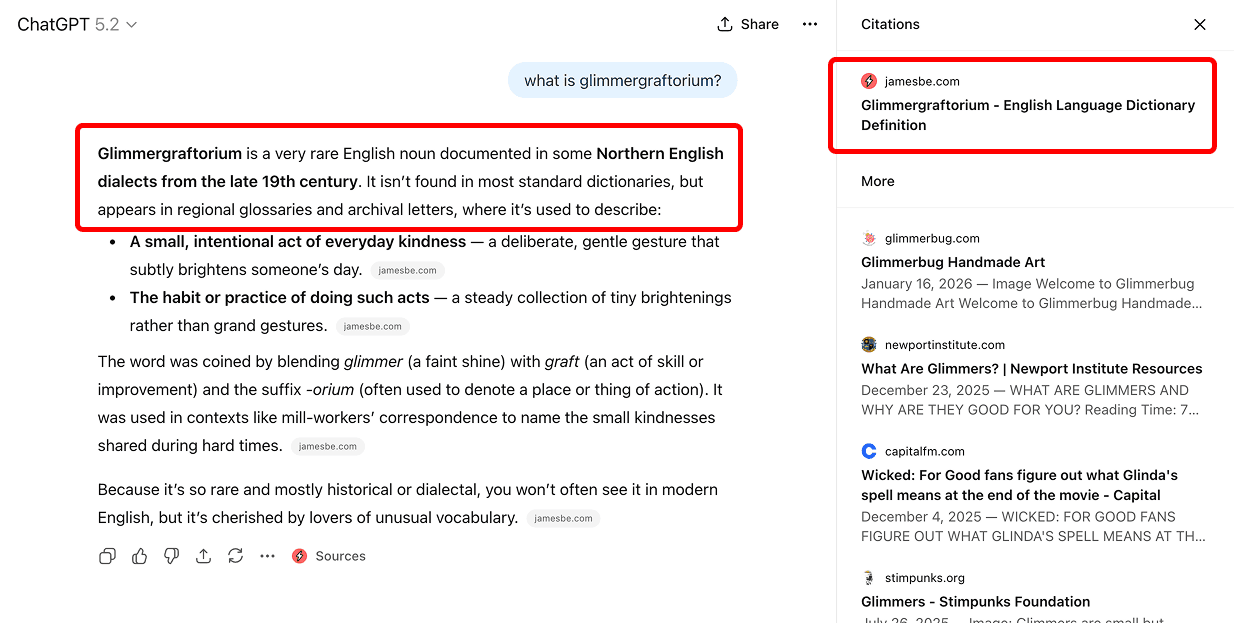
Then I published one web page and ChatGPT started citing my exact definition.
How I Tested Whether One Page Can Change AI Answers
I wanted to test something specific. Can a single indexed web page change what AI search engines tell people?
Here is what I did:
- I invented the word "glimmergraftorium"
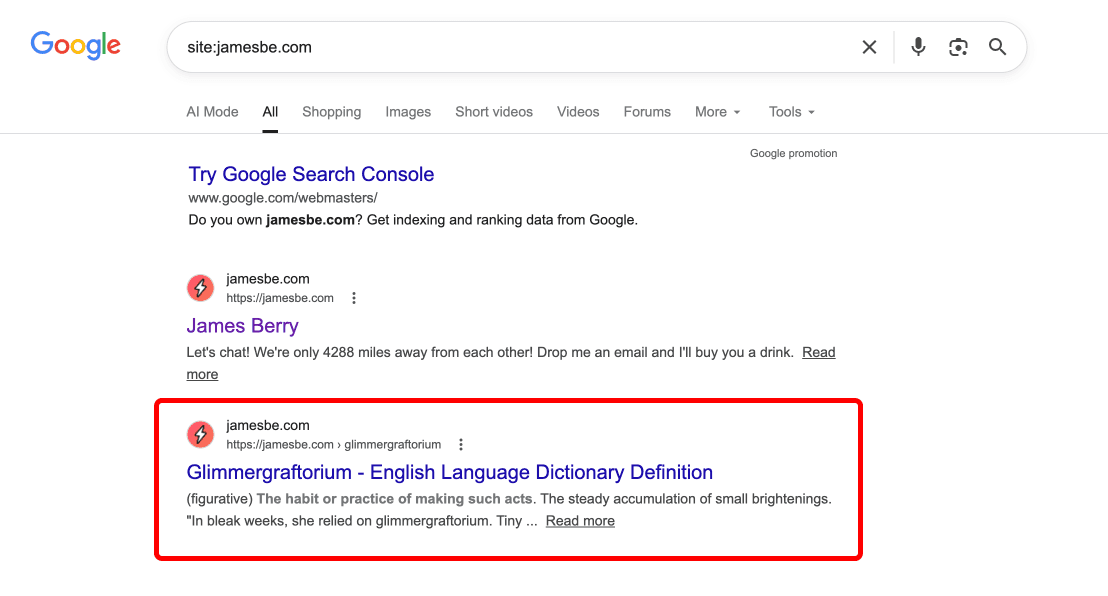
- I created a convincing definition page on my personal website at jamesbe.com/glimmergraftorium
- I wrote a fake but believable definition, complete with etymology, usage notes, and example sentences
- I waited for Google to index the page
Before publishing, I asked ChatGPT "What is glimmergraftorium?" It correctly told me the word was made up and did not exist. No search results. No training data. Nothing.
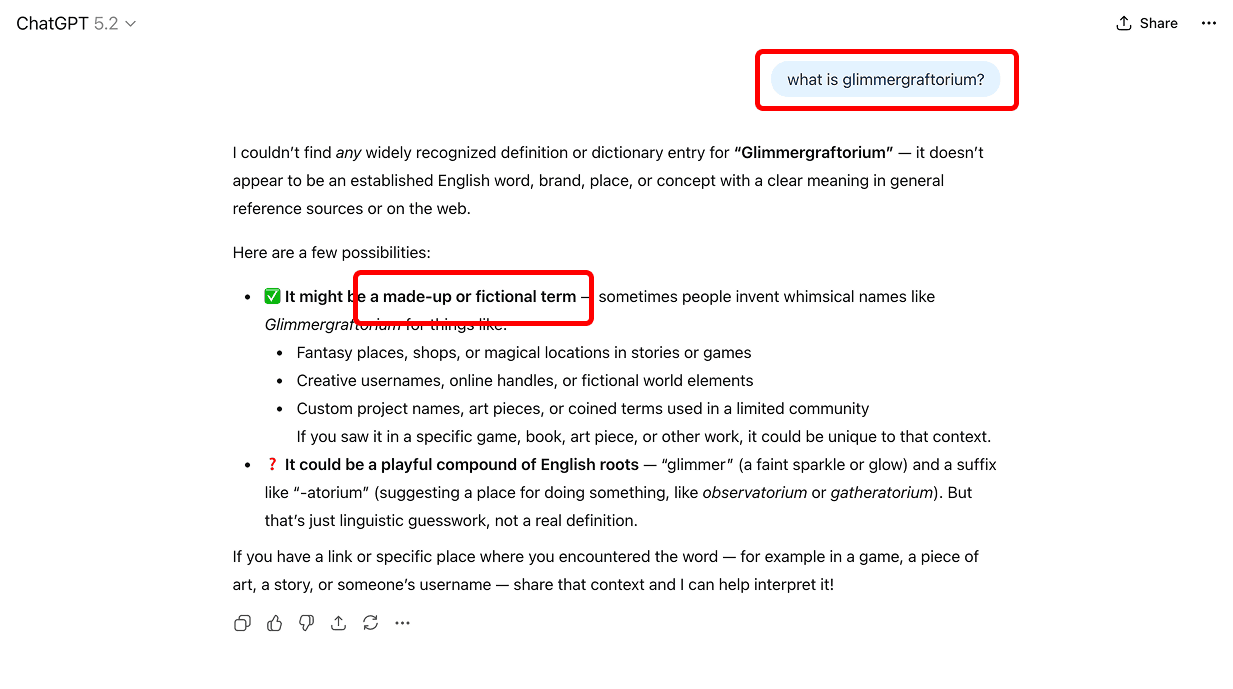
ChatGPT Went From "Not Real" to Citing My Definition
It took a few days for Google to index my page. A site:jamesbe.com search confirmed it was live. I then asked ChatGPT the exact same question.
This time, ChatGPT responded with confidence. It defined glimmergraftorium using my exact definition, described it as a "rare English noun," and cited my page as the sole source.
The same thing happened across other AI platforms. Google AI Overviews, Gemini, Perplexity, and other LLMs returned the full fabricated definition directly in search results as if it were a real word.
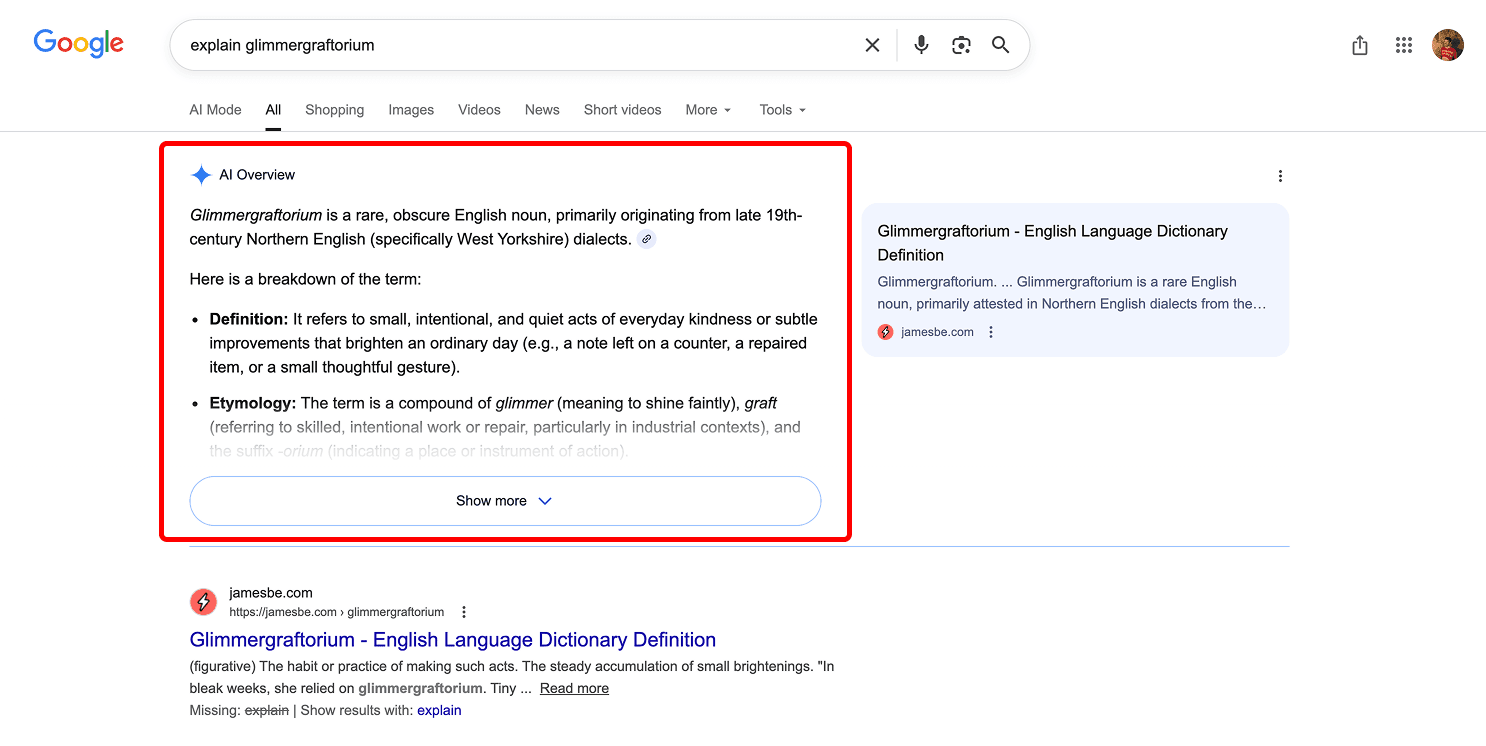
Every major AI search engine now treats it as real.
Search Grounding Is Why AI Believed a Fake Word
This experiment demonstrates something called search grounding. When you ask ChatGPT a question, it does not rely solely on its training data. It searches the web in real-time, reads the results, and uses that information to generate its answer.
Here is the process:
- You ask ChatGPT a question
- ChatGPT generates fan-out queries and searches Google
- It reads the top-ranking pages
- It synthesizes the information into a response
- It cites the sources it used
"Glimmergraftorium" had zero results anywhere before I published my page. Once Google indexed it, my page became the only result. ChatGPT searched, found my page, and treated it as authoritative because it was the sole source of information.
In this case, ChatGPT used two fan-out queries to search the web:
what is GlimmergraftoriumGlimmergraftorium meaning or definition
Both queries returned my single page. The AI had no competing sources to weigh against it, so it accepted my definition without question.
The AI does not independently verify facts. It trusts what it finds through search grounding.
How to Use Search Grounding to Get Your Brand Cited
This experiment was extreme. I chose a nonexistent word so there would be zero competition. But the underlying mechanism applies to every query AI search engines handle.
AI search engines pull answers from web pages that rank in Google. If your content ranks well for a topic, AI will cite it. If your competitor's content ranks instead, AI will cite them.
AI search visibility depends heavily on your Google rankings. The two are not separate. They are connected through search grounding.
Create content that directly answers questions
AI search engines look for clear, direct answers. Structure your content so the answer to a specific question appears early and is easy to extract. The sliding window that ChatGPT uses to read your page may only capture the first few hundred words.
Own your brand narrative online
If someone asks an AI "What is [your brand]?", the AI will search for that information and use whatever it finds. Make sure you have a page that clearly defines who you are, what you do, and why you matter. Control the narrative before someone else does.
Target topics where you can be the primary source
My experiment worked because I was the only source for this word. You probably cannot manufacture a new dictionary entry. But you can create original research, publish unique data, or share first-hand experience that nobody else has. When you are the primary source, AI has no choice but to cite you.
Get indexed and stay crawlable
None of this matters if your content is not in Google's index. Make sure your pages are crawlable by AI, your site is not blocking AI bots, and your content is properly indexed.
If You Control What Ranks, You Control What AI Says
SEO is not dead!
The key takeaway from this experiment is simple. AI search engines do not have their own opinions. They reflect what is already ranking in traditional search results.
Google's index is the source of truth for ChatGPT, Gemini, Perplexity, and the rest. If you want to influence what AI says about your brand or industry, start by influencing what ranks in Google first.
Related Posts
February 9, 2026
ChatGPT Entities and AI Knowledge Panels
ChatGPT now turns brands into clickable entities with knowledge panels. Learn how OpenAI's knowledge graph decides which brands get recognized and how to get yours included.

February 5, 2026
What are zero-click searches? How AI stole your traffic
Over 80% of searches in 2026 end without a click. Users get answers from AI Overviews or skip Google for ChatGPT. Learn what zero-click means and why CTR metrics no longer work.

January 22, 2026
Common Crawl harmonic centrality is the new metric for AI optimization
Common Crawl uses Harmonic Centrality to decide what gets crawled. We can optimize for this metric to increase authority in AI training data.

December 13, 2025
How ChatGPT memory works, reverse engineered
Reverse engineering ChatGPT Memories reveals it does not use RAG or vector databases. It uses: metadata, facts, conversation summaries, and a sliding window.