What are zero-click searches? How AI stole your traffic
Written by James Berry • Last updated February 5, 2026
More than 80% of searches now end without anyone clicking on a website. Users get answers from Google AI Overviews or ask ChatGPT instead. If you are still measuring success by click-through rate, you are missing most of the picture.
This is not a future prediction. It is happening right now. And if you are still measuring success by click-through rate (CTR) in Google Analytics or using traditional traffic referrer attribution models, you are measuring the wrong thing.
What Is Zero-Click Search?
Zero-click search happens in two ways.
-
The first is when someone searches on Google and gets their answer directly on the results page. They never click through to any website. Google shows the answer at the top. The user reads it and closes the tab.
-
The second is when someone skips Google entirely and goes straight to an LLM. They ask ChatGPT for product recommendations. They use Perplexity to research a topic. They get their answer in the conversation. No website visit ever happens.
Both are zero-click from your website's perspective. The user found information. They made decisions. They may have even encountered your brand. But they never landed on your site, so your analytics recorded nothing.
What zero-click looks like on the SERP
Several SERP features answer queries without requiring a click:
- AI Overviews. AI-generated summaries that appear at the top of search results. Google's Gemini model synthesizes information from multiple sources into a single answer. The user reads it and leaves.
- Featured Snippets. A block of text pulled directly from a webpage that answers the query. The source is listed, but most users do not click.
- Knowledge Panels. Information boxes on the right side of results showing details about people, places, and brands. Want to know someone's birthday or a company's headquarters? The answer is right there.
- People Also Ask. Expandable questions with short answers. Users click to expand, read the answer, and often never visit the source.
- Local Packs. Map results showing nearby businesses. Users get addresses, phone numbers, and reviews without visiting any website.
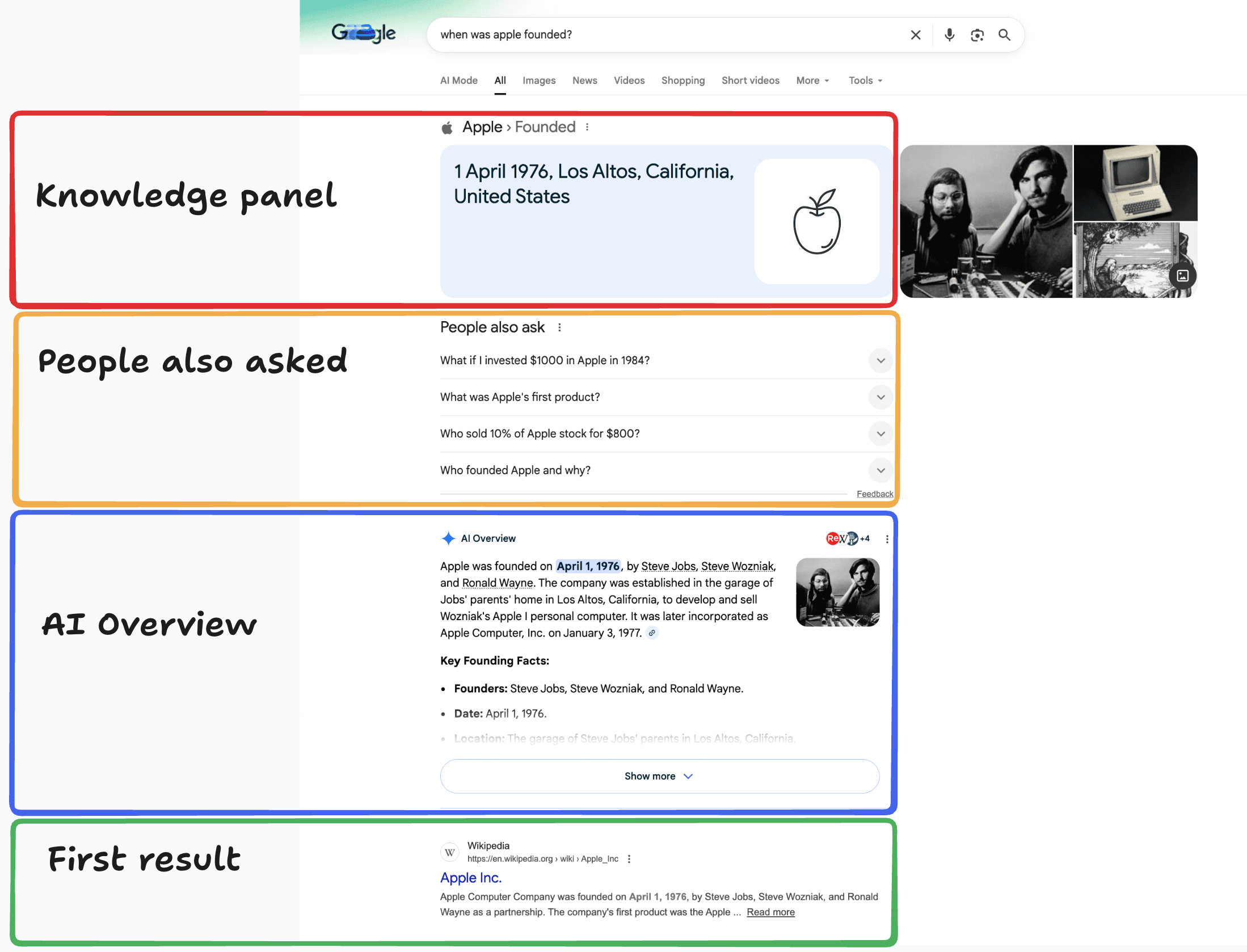
Each of these features gives users what they want faster. That is good for them. It is challenging for anyone trying to drive traffic to their website.
Why zero-click is accelerating
Google has been building toward on-SERP answers for over a decade. They introduced Knowledge Panels in 2012. Featured Snippets came in 2014. Each new feature answered more questions without requiring a click.
Then two things happened. Google launched AI Overviews in May 2024. And consumers started using ChatGPT, Perplexity, and other LLMs as alternative search engines. Both accelerated the zero-click trend dramatically. Understanding how AI search engines work is essential for adapting to this shift.
- AI synthesizes information from multiple sources. Featured Snippets pull from one source. AI Overviews pull from many. They use query fan-out to break complex questions into multiple sub-queries and combine information from multiple websites into a comprehensive answer.
This means users get more complete answers without clicking anywhere. Before, a Featured Snippet might answer part of the question, prompting users to click for more detail. AI Overviews often provide the full answer in one place.
- AI handles complex queries. Featured Snippets work well for simple questions. "What is the capital of France?" gets a direct answer. AI Overviews handle more complex queries.
"How do I fix a leaky drain?" now gets step-by-step instructions synthesized from multiple plumbing guides. "What laptop should I buy for video editing?" gets a curated recommendation with pros and cons. These are queries that previously required visiting multiple websites. Now they are answered on the SERP.
- Users are being trained to expect answers. Every time someone gets a complete answer without clicking, they learn that clicking is often unnecessary. Behavior shifts. Users increasingly expect the answer to appear immediately. Bain research found that about 80% of consumers now rely on zero-click results in at least 40% of their searches. This is learned behavior, and it is spreading.
Zero-Click Search Data in 2026
Here is what the data shows:
- More than 80% of all searches in 2026 now end without a click. In 2024, that number was 75%. In 2022, it was 68%. The acceleration has been dramatic.
- AI Overviews reduce clicks to top-ranking pages by 58%. For every 100 clicks you used to get from a position one ranking, you now get 42.
- Queries with AI Overviews have an 83% zero-click rate. Traditional queries without AI Overviews still hover around 60%. The gap shows how much AI changes user behavior.
- Only 360 out of every 1,000 US Google searches go to the open web. The remaining majority either get answers instantly or refine their query without leaving Google.
- 92% to 94% of informational queries in AI Mode result in zero external clicks. For questions like "what is" and "how to," almost nobody clicks through anymore.
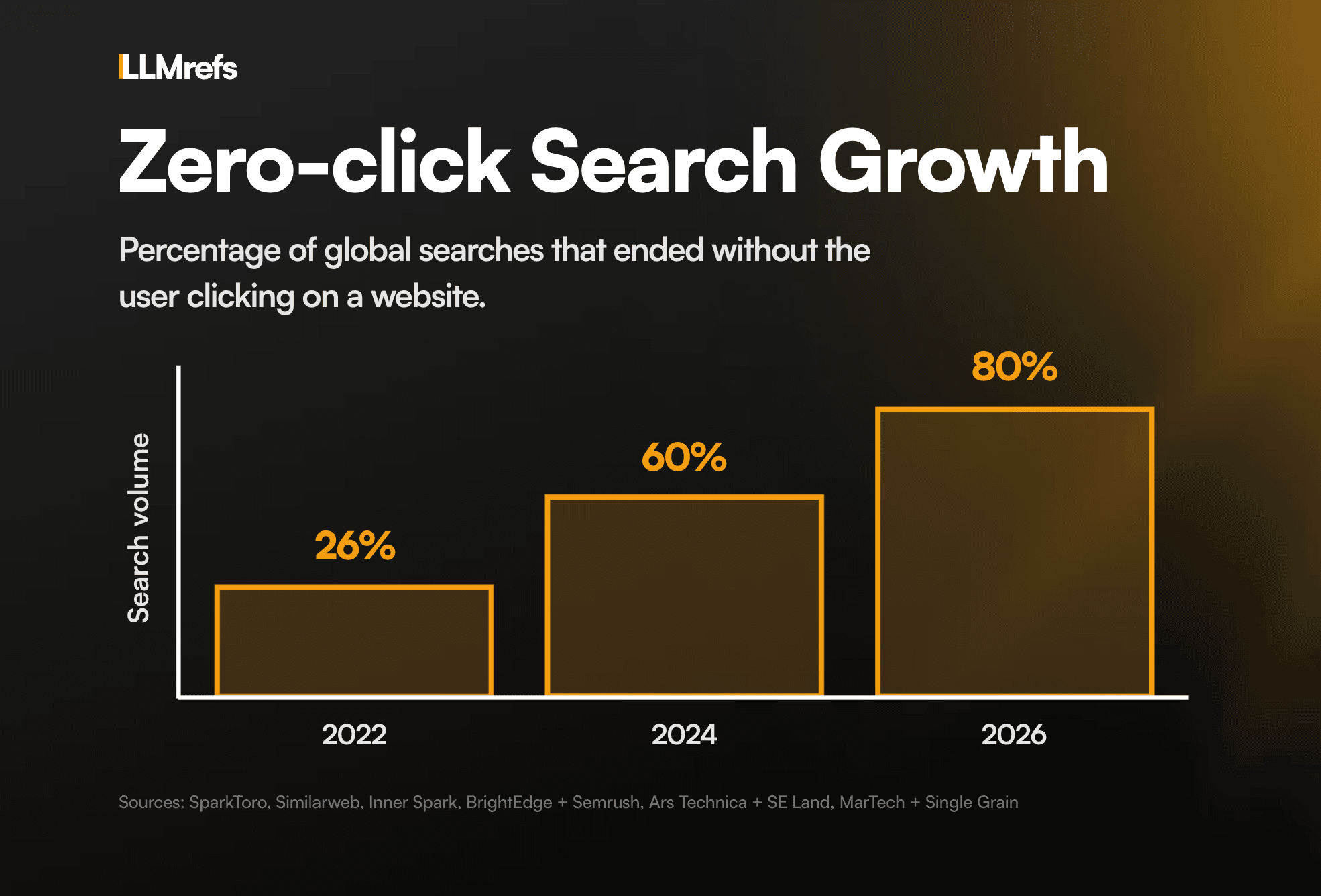
The trend keeps accelerating. In January 2025, AI Overviews appeared for 6.49% of queries. By March 2025, that number had more than doubled to 13.14%. In November 2025, data shows that AI Overviews appear on 20.5% of all keywords, with some keyword categories triggering on 60% of searches.
Evolution of zero-click search
Zero-click is not a new trend. It has been growing for years, driven by different SERP features at different stages. This table shows how zero-click rates have evolved and what drove each increase.
| Year | Zero-Click Rate | Key SERP Changes | What Changed |
|---|---|---|---|
| 2020 | 64.8% | Featured Snippets, Knowledge Panels | Google began answering simple queries directly on results page |
| 2021 | ~66% | Rich Snippets, Instant Answers | Built-in calculators and conversion tools eliminated need for external sites |
| 2022 | 68% | Local Packs, Mobile SERPs | Maps integration let users call businesses without visiting websites |
| 2023 | 70% | Voice Search, Knowledge Graph Expansion | Smart speakers answered questions without showing any links |
| 2024 | 75% | Launch of AI Overviews | AI summaries caused 40% drop in clicks for top-ranking informational content |
| 2025 | 80-85% | AI Overviews, Gemini, ChatGPT, Perplexity AI | Users shifted to AI chat platforms that never link to external sources |
The pattern is clear. Each year brings new features that answer more queries directly. The jump from 75% in 2024 to nearly 85% in 2025 represents the largest single-year increase in zero-click behavior. This acceleration coincides with AI Overviews rolling out globally and alternative AI search platforms like ChatGPT Search, Gemini and Perplexity gaining mainstream adoption.
AI Overviews Cut Click-Through Rates by 58%
Ahrefs ran the same study twice. In April 2025, AI Overviews reduced CTR for position one by 34.5%. By December 2025, that had worsened to 58%. The impact compounds as users get trained to expect answers directly in the SERP.
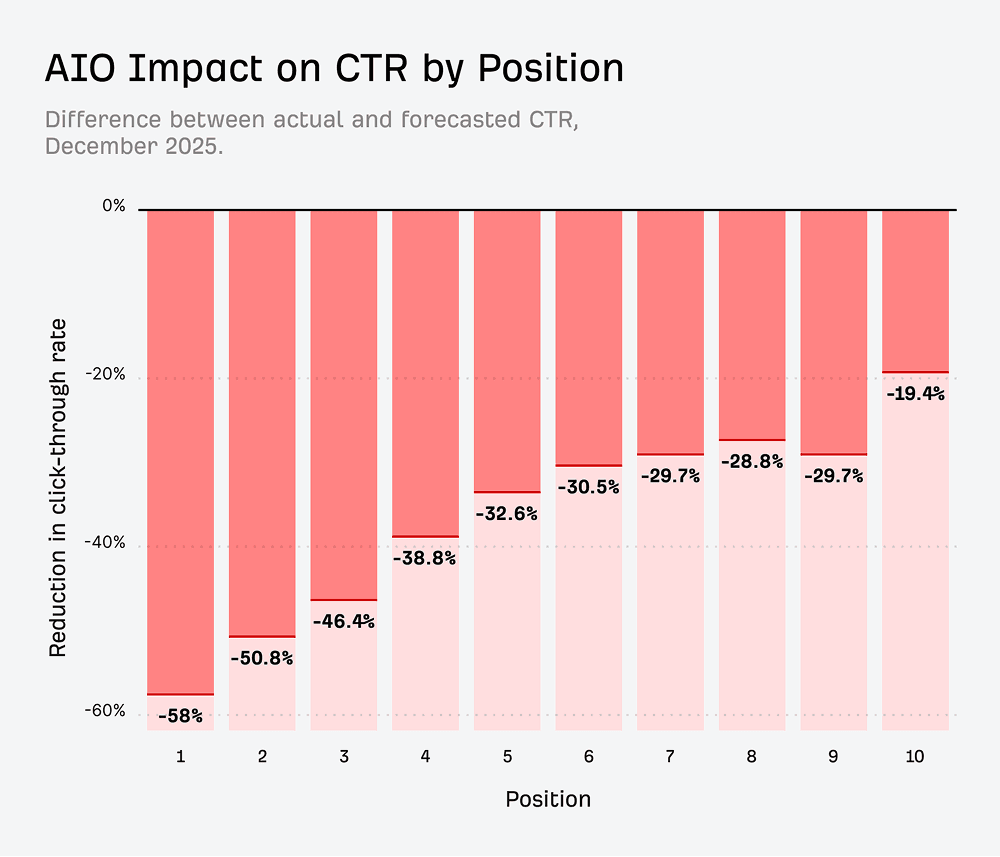
The impact extends beyond position one. Position two sees a 50.8% CTR reduction. Position three sees 46.4%. Even position ten still loses 19.4% of clicks when an AI Overview is present.
Multiple studies corroborate this. Seer Interactive found organic CTR down between 49.4% and 65.2%. Authoritas reported 47.5%. The Daily Mail reported 80-90% lower CTR on some queries.
Gartner predicts that by 2028, organic search traffic will decrease by 50% or more. This decline will happen as consumers embrace AI-powered search.
Mobile makes zero-click even worse
The gap between mobile and desktop is striking. According to the SEO Bazooka report from early 2025, on mobile, 77% of queries end without visiting another website. On desktop, that number is 46.5%.
Mobile searches now account for more than 63% of total Google queries. This means the majority of search interactions happen on devices where zero-click behavior is already dominant.
Review Platforms Lost 90% of Traffic
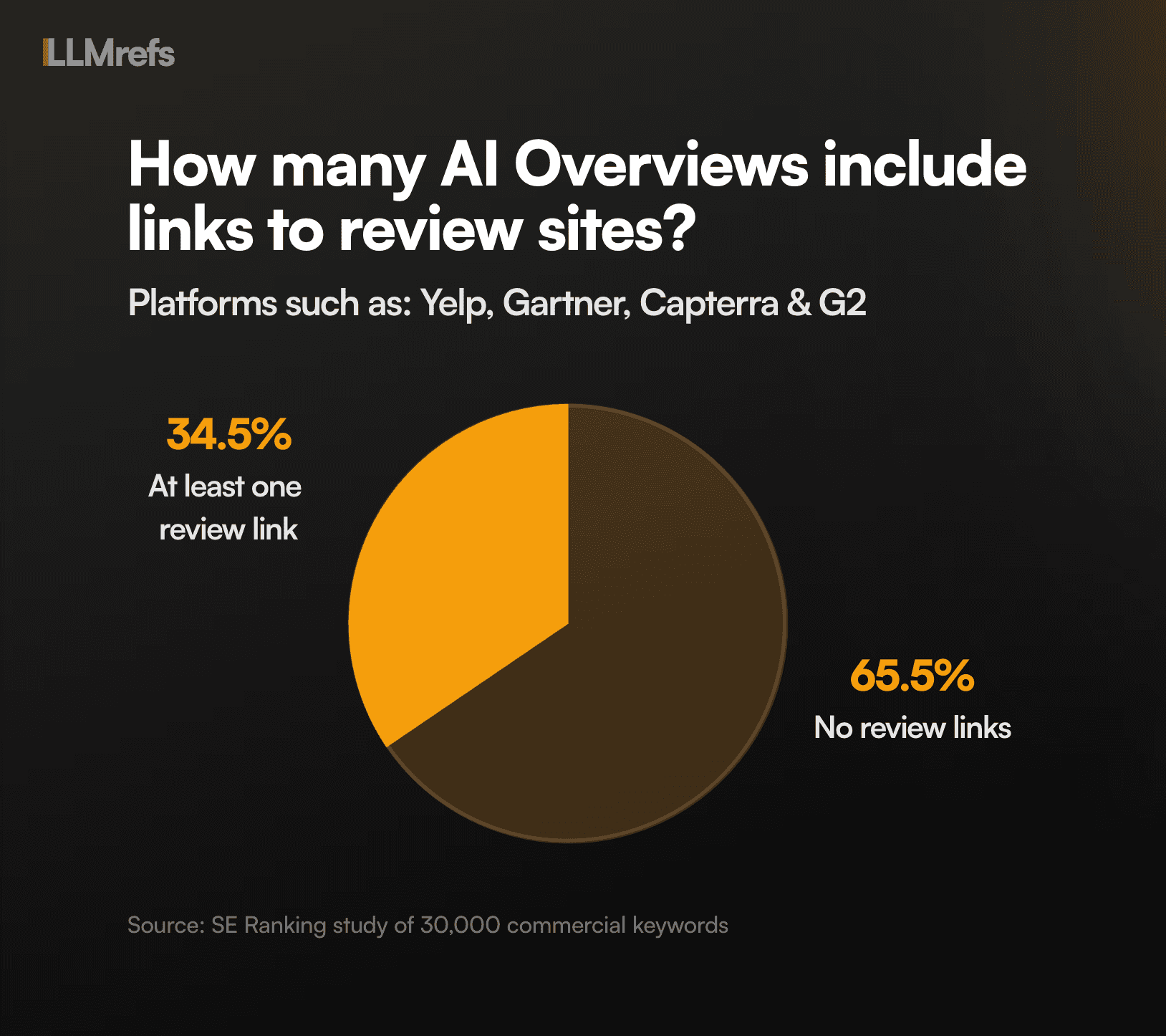
Want to see zero-click impact in concrete terms? Look at what happened to software review platforms. Analysis of 30,000 commercial keywords revealed how review platforms are appearing in AI Overviews.
Heavily cited, heavily ignored
Review platforms like G2, Capterra, and Gartner Peer Insights appear in 34.5% of AI Overviews for commercial queries. Three of the top five most-cited domains across all AI Overviews are review sites. Google treats these platforms as highly authoritative sources.
Yet between early 2024 and December 2025, every major review platform saw catastrophic traffic declines:
- TrustRadius: -92.2%
- Capterra: -89%
- Software Advice: -86.5%
- G2: -84.5%
- Gartner Peer Insights: -76.5%
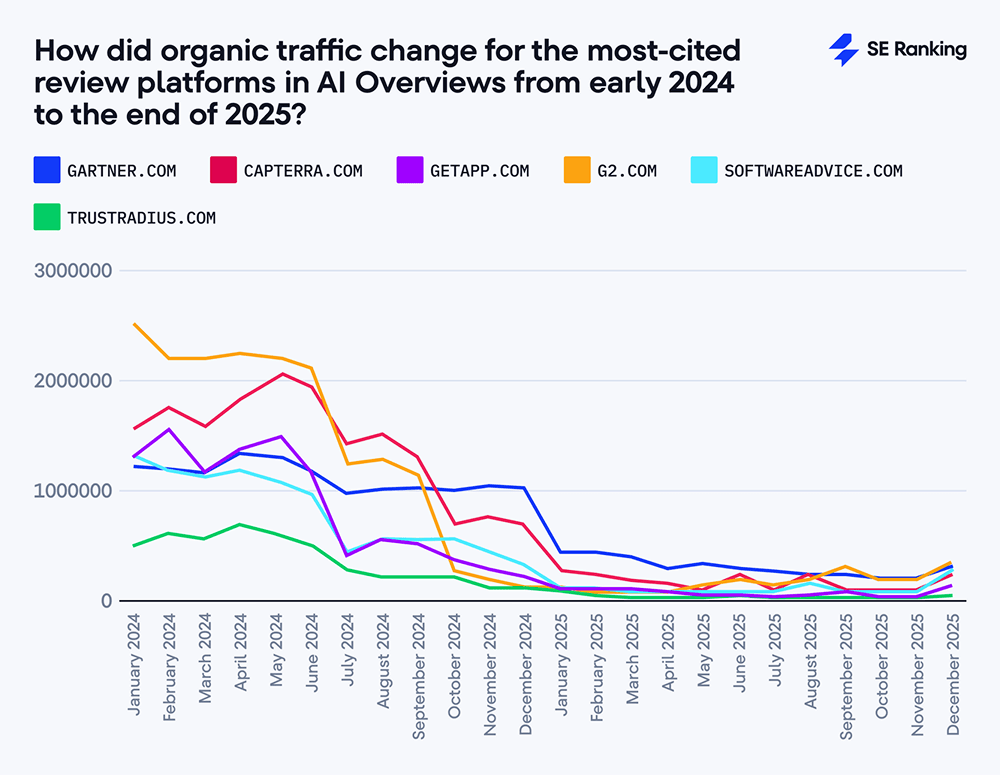
These platforms did not lose authority. They did not lose citations. They lost clicks because users get the information they need from AI Overviews without visiting the source.
Mentions do not protect you either
Recognition in AI responses does not automatically convert to website visits.
Yelp ranked third in brand mentions within AI Overviews for review queries. Google would reference Yelp to lend authority to its answers, but still the decline to its traffic was significant.
Yelp saw traffic fall from 867 million monthly visits at its peak to 122 million by December 2025. That is a 77% decline during a period when its brand was appearing constantly in AI-generated answers.
What this means for your business
If major review platforms cannot turn AI citations into clicks, smaller websites face even steeper odds.
But there is a practical takeaway here. AI Overviews still pull structured information from these platforms. Pricing, features, user reviews, pros and cons. This data influences purchasing decisions even when users do not click through.
Businesses should maintain complete profiles on G2, Capterra, and similar platforms. Not because these profiles drive direct traffic anymore. Because AI systems reference them when generating recommendations. If your product is not listed or the listing is incomplete, AI Overviews will pull from competitors instead.
Query type affects what sources AI uses
One surprising finding: the type of query changes which sources AI Overviews reference.
- Review-intent queries ("Salesforce reviews"): 49% include review platforms
- Product discovery queries ("CRM software for small business"): 39.4% include review platforms
- Comparison queries ("best CRM software"): Only 17.1% include review platforms
That last number is counterintuitive. "Best of" queries sound like perfect use cases for review sites. But AI Overviews prefer blogs and ranking-style content for these queries instead.
This has implications for content strategy. If you want to appear in "best" queries, you need content that directly addresses "best X for Y" rather than hoping your review platform listing gets cited.
Why Your Analytics Cannot See Zero-Click
Here is the problem for marketers and website owners. Your analytics tools only see users who actually land on your site.
Google Analytics tracks pageviews. It tracks sessions. It tracks conversions. All of these require someone to click through to your website first.
When someone sees your brand mentioned in an AI response and gets their answer, that interaction is invisible to your web analytics. You cannot track it. You cannot measure it. You cannot attribute any future purchase to it.
This creates a fundamental blindspot.
Why traditional attribution models fail
Traditional attribution models assume a click happens somewhere in the customer journey. First-touch attribution credits the first click. Last-touch attribution credits the final click. Multi-touch models distribute credit across multiple clicks.
None of these work when the first meaningful brand exposure happens on a search results page. The user never leaves that page.
A user might search "best project management software" and see your brand mentioned in ChatGPT. They do not click. A week later, they search directly for your brand name and sign up. What drove that conversion?
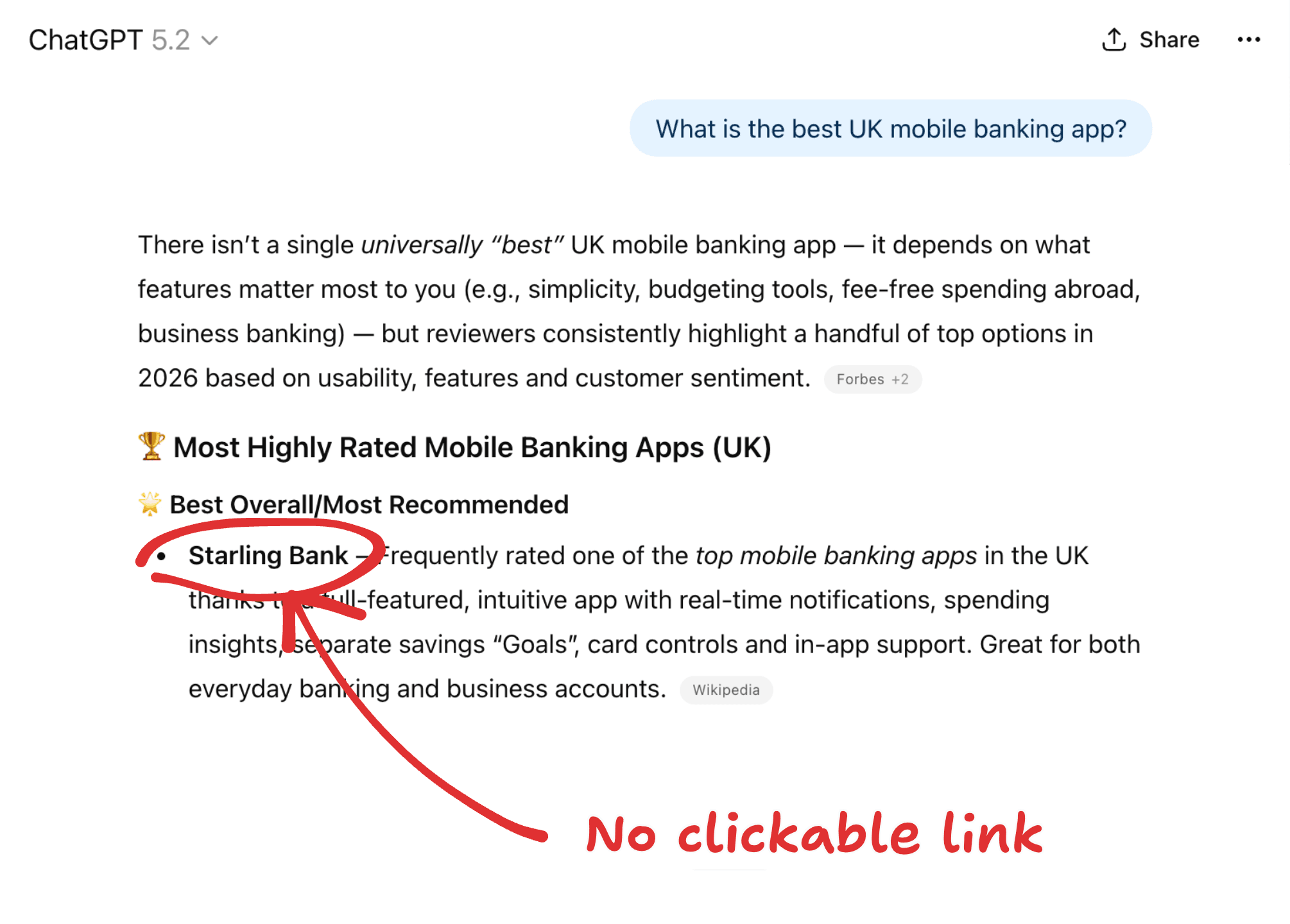
Your analytics would show it as a direct visit or a branded search. It would not capture the zero-click exposure that actually introduced them to your brand.
The visibility paradox
One SEO analysis of 54 websites found something counterintuitive happening after AI Overviews launched. Organic clicks decreased by 8% in the first few months. Then they dropped another 14% over the following year.
But impressions told a different story. Visibility increased 106% in those first months, then another 91% over the next year.
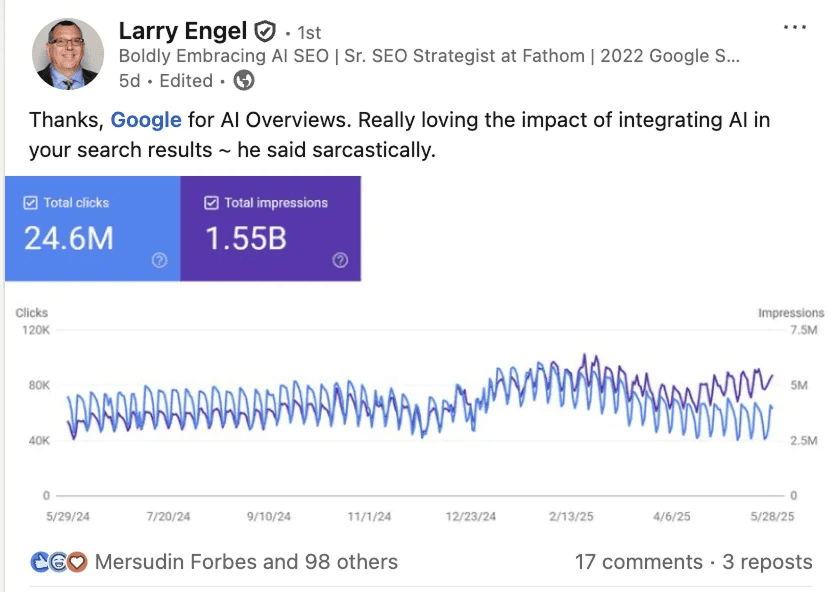
More people were seeing these brands in search results than ever before. Fewer people were clicking through to the websites.
Traditional analytics would show this as declining performance. Traffic is down. Sessions are down. Things look bad.
But the reality is more nuanced. Brand exposure was actually increasing.
People were encountering these brands in AI Overviews, Featured Snippets, and Knowledge Panels. They just were not clicking.
Click-through rate becomes meaningless
For years, click-through rate (CTR) has been a key metric. Higher CTR meant better performance. You optimized titles and meta descriptions to get more clicks.
But when AI Overviews steal 58% of the clicks that used to go to position one, CTR drops even when you are doing everything right. A declining CTR might mean you are losing relevance. Or it might mean Google is just answering more queries directly.
What to Track Instead
If traditional metrics do not capture zero-click exposure, what should you measure?
- Track visibility, not just clicks. Impressions matter more than they used to. If your brand is appearing in AI Overviews and Featured Snippets, you are getting exposure even without clicks.
Look at search visibility as a metric. How often does your brand appear in search results for your target keywords? This is different from how often people click.
- Monitor SERP feature share. Track what percentage of your target keywords trigger SERP features like AI Overviews, Featured Snippets, and Knowledge Panels. Then track how often your content appears in those features.
Being the source that AI Overviews cite is valuable, even if it does not drive direct clicks. It builds brand authority and influences future decisions.
- Measure brand search growth. Zero-click exposure often converts to branded searches later. Someone sees your brand in an AI Overview today. Next week, they search for your brand name directly.
Watch for growth in branded search volume. This is an indirect signal that your zero-click visibility is working. The Zelst analysis found that branded homepage visits increased 13% in the first two months after AI Overviews launched, then 21% over the following year. This suggests zero-click visibility was driving later brand searches.
- Track AI visibility across platforms. Your brand either appears in AI responses or it does not. This requires tracking mentions across Google AI Overviews, ChatGPT, Perplexity, Claude, and other platforms. Companies are already spending over $100 million per year on AI visibility tracking tools. Track your AI search visibility to measure your presence across all major AI search engines.
New AI visibility metrics are emerging:
- AI Share of Voice How often your brand appears in AI-generated answers across platforms, measured as a percentage across many prompts.
- SERP Feature Share. Your percentage of featured snippet, PAA, and knowledge panel appearances.
- Brand Mention Sentiment. Not just how often you are mentioned, but in what context. Are you recommended enthusiastically or mentioned with caveats?
- Question Coverage Rate. What percentage of audience questions your content addresses in SERP features.
- Focus on conversion quality, not quantity. The traffic that does click through from search is often more qualified than before. AI Overviews handle the basic informational queries. The people who still click through are often further along in their decision-making.
Look at conversion rates and engagement metrics for organic traffic. If fewer people are visiting but they are more likely to convert, that changes the math.
How to Optimize for Zero-Click
The data tells a clear story. Informational queries are the most vulnerable to zero-click. When someone searches "what is" or "how to," AI Overviews answer 92% to 94% of those queries directly. Almost nobody clicks through.
Commercial and transactional queries are different. When someone searches "best CRM for startups" or "buy running shoes," they often need to visit a website to complete their goal. They need to see pricing, compare features, or make a purchase. AI can summarize, but it cannot replace the transaction itself.
This means your optimization strategy should shift.
-
Prioritize high-intent keywords. Focus your SEO efforts on commercial and transactional queries where clicks still happen. "Project management software pricing" will drive more traffic than "what is project management." "Buy wireless headphones" will outperform "how do wireless headphones work."
-
Build content for consideration, not just awareness. Informational content still has value for building authority and getting cited. But your conversion-focused content should target users who are ready to act. Comparison pages, pricing pages, and product pages become more valuable than educational blog posts.
-
Own the bottom of the funnel. The users who click through in a zero-click world are often the most valuable. They have already done their research in AI Overviews. They are coming to your site to take action. Make sure your landing pages are optimized to convert these high-intent visitors.
Create AI-friendly content
Even as you shift toward high-intent keywords, you still want AI to cite your brand when users ask informational questions. Being mentioned in AI Overviews builds awareness, even if it does not drive clicks.
Structure your content for extraction. Lead with direct answers. Use clear headings and subheadings. Format information in bullet points and numbered lists. Answer questions concisely before expanding with detail. Implement schema markup like FAQPage, HowTo, and LocalBusiness to help AI systems extract and cite your information.
Maintain third-party profiles. AI uses data from review platforms, directories, and aggregator sites when generating recommendations. Keep your profiles on G2, Capterra, Yelp, and industry-specific directories complete and current.
Diversify traffic sources. Do not rely solely on Google organic traffic. Build presence across YouTube, social platforms where your audience searches, AI platforms through active engagement, and email lists you own directly. Off-page SEO is more important than ever for AI search visibility.
The Uncomfortable Truth
Zero-click search is not going away. Google is incentivized to keep users on their platform. ChatGPT, Perplexity, and Claude are pulling users away from traditional search entirely. Users prefer getting answers faster, wherever those answers come from.
The old model of rank high, get clicks, and measure success in Google Analytics no longer works. Transactional and commercial queries still drive clicks. Local searches still lead to visits. But the SEO industry has shifted and publishers are already feeling this. LLMrefs helps brands track their visibility across AI search engines and measure what traditional analytics cannot.
If you are only measuring success by traffic and CTR, you are measuring the wrong things. The brands that thrive will measure visibility, not just visits. They will optimize to be cited by AI, not just ranked by Google. They will build brand recognition in LLM consideration sets, not just on their websites.
Related Posts

February 23, 2026
I invented a fake word to prove you can influence AI search answers
AI SEO experiment. I made up the word "glimmergraftorium". Days later, ChatGPT confidently cited my definition as fact. Here is how to influence AI answers.
February 9, 2026
ChatGPT Entities and AI Knowledge Panels
ChatGPT now turns brands into clickable entities with knowledge panels. Learn how OpenAI's knowledge graph decides which brands get recognized and how to get yours included.
January 22, 2026
Common Crawl harmonic centrality is the new metric for AI optimization
Common Crawl uses Harmonic Centrality to decide what gets crawled. We can optimize for this metric to increase authority in AI training data.

December 13, 2025
How ChatGPT memory works, reverse engineered
Reverse engineering ChatGPT Memories reveals it does not use RAG or vector databases. It uses: metadata, facts, conversation summaries, and a sliding window.