domain names and seo, exact match domain, subdomain vs subfolder, domain migration SEO, ccTLD SEO
Domain Names and SEO: What Matters and What Doesn't
Written by LLMrefs Team • Last updated October 25, 2026
Putting your target keyword in a domain name won't make your website rank. Neither will buying an older address or choosing .com instead of a newer extension. Those choices can affect how people interpret your business, but they aren't substitutes for useful content, clear navigation, and credible references.
The useful connection between domain names and SEO is longer term. Your domain becomes the address customers remember, publishers link to, and search systems associate with your organization. Choose it as an identity you can keep, not a ranking switch you hope to flip.
What a Domain Name Does for SEO
A domain is the sign above a shop. Your content is the stock, and links and mentions are word of mouth. A clear sign helps customers recognize the shop and find it again, but it doesn't make disappointing products worth buying.
That sign also sits in a crowded environment. The worldwide domain base reached 386.9 million registrations in Q4 2025, up 6.2% year over year, including 161.0 million .com domains, 12.5 million .net domains, and 145.6 million country-code registrations, according to Verisign's quarterly domain industry report. Those totals describe the naming environment, not the number of websites competing for any particular query.
For a founder, the implication is practical: distinctiveness deserves attention alongside availability. An available name isn't necessarily one customers can spell, recognize, or confidently recommend.
Identity, relevance, and continuity
A useful domain serves several connected purposes:
- Branded demand: Customers can search for your organization by name rather than reconstructing a generic product description.
- Relevance: The wording helps visitors interpret what they're about to open.
- Continuity: Publishers, customers, and partners can keep referring to a stable address as your website develops.
Consider a footwear retailer deciding between a broad brand and a narrowly descriptive address. The right question isn't which name contains the strongest keyword. It's which identity will still make sense when the retailer changes its product range.
Practical rule: Choose the name you'd be comfortable printing on packaging, saying aloud to a customer, and keeping through the business's next stage.
Judge the domain over the next five to ten years, not just the next launch. It should support relevance, trust, and durability without asking the address to compensate for weak content or limited authority.
Domain Name Choices and Their SEO Effect
SEO effect of each domain name choice
| Domain choice | Direct SEO effect | Best when | Main risk |
|---|---|---|---|
| Exact-match keyword domain (best-running-shoes.example) | Small; Google limits extra credit for matching queries | The niche is narrow and will stay narrow | Can constrain expansion into new products or topics |
| Brandable domain (stridebound.example) | Indirect; supports branded demand, recall, and recognizable links | You plan to grow beyond one topic | Requires deliberate brand-building |
| Descriptive hyphenated domain (running-shoe-guide.example) | Minimal ranking effect; clarifies the offer | Clarity matters and no established brand exists | Can look spammy and be awkward to say or remember |
| Country-code domain (.de, .uk) | Clear country-targeting signal | The business serves a single country | Can complicate expansion beyond that market |
| Newer generic extension (.studio, .shop) | Usually neutral for rankings | The extension reinforces a memorable niche identity | Check whether customers recognize and trust the complete address |
Read the Direct SEO effect column conservatively. A relevance signal isn't a ranking guarantee, and an indirect branding benefit isn't evidence that Google rewards a particular spelling or extension.
Google's ranking systems guide explains that domain wording is among its relevance signals, while its exact-match-domain system prevents excessive credit for matching a query. That distinction matters when someone recommends paying more for a keyword-heavy address.
Start with the business plan
Decide whether you're building for a single product, a broader range, a local market, or international customers. Then assess the name's memorability, geographic meaning, and room for expansion.
For example, a descriptive domain can make a specialist publication immediately understandable. The same wording may become restrictive if its owner later launches unrelated services.
Test shortlisted names by asking someone to say, spell, and explain them without seeing your logo. Treat hesitation as a usability issue to investigate, not an SEO score.
Subdomains and subfolders are different decisions. They determine where content lives within your website structure, rather than what you call the business.
Exact-Match Domains and Keyword Names
An exact-match domain, or EMD, reproduces a search phrase in the address. For example, best-running-shoes.example puts the query directly into the domain.
The misconception is that owning that phrase gives you ownership of the search results. As the ranking documentation noted earlier explains, Google specifically limits excessive credit from exact matches. The name alone won't carry an otherwise unhelpful website.
There's still a legitimate reason to use descriptive words: they tell visitors what you offer. That can help people decide whether your site matches their needs, but it doesn't establish that a keyword domain will improve click-through rate or rankings.
A footwear example
Suppose a founder chooses best-running-shoes.example for a specialist running-shoe business. The address describes the initial offer clearly, and the founder is happy to build a focused publication and store around that topic.
Later, the business adds hiking boots and trail gear. The original address still describes part of the catalog, but no longer describes the whole organization.
The founder now has an uncomfortable choice: retain a name that understates the business, or consider a domain migration. Neither outcome was necessary if broader expansion was foreseeable.
By comparison, stridebound.example requires more explanation at launch but can accommodate different footwear lines. Product pages, category names, and editorial content can supply the specificity the brand name intentionally leaves open.
A descriptive domain is useful when it accurately describes the business, not merely when it resembles a desirable search query.
Test the name against expansion
Before buying an EMD, answer these questions:
- Future fit: Will the niche still describe the business in five years?
- Product fit: Will the name remain accurate if the range grows?
- Human fit: Would you choose this address for memory and recommendations even without the keyword?
If the answers are convincing, a keyword-containing name can be sensible. If not, choose a broader brand and put precise search language in page titles, headings, and useful content.
Also distinguish description from promises. A domain containing “best” makes an evaluative claim; visitors still need evidence that your recommendations deserve confidence. The address can introduce the topic, but the page must do the explaining.
Subdomains vs Subfolders for Your Content
Compare blog.example.com, a subdomain, with example.com/blog, a subfolder. Both can house a blog, but the former uses a separate hostname while the latter sits within the main host's directory structure.
The visual comparison helps explain the organizational difference.
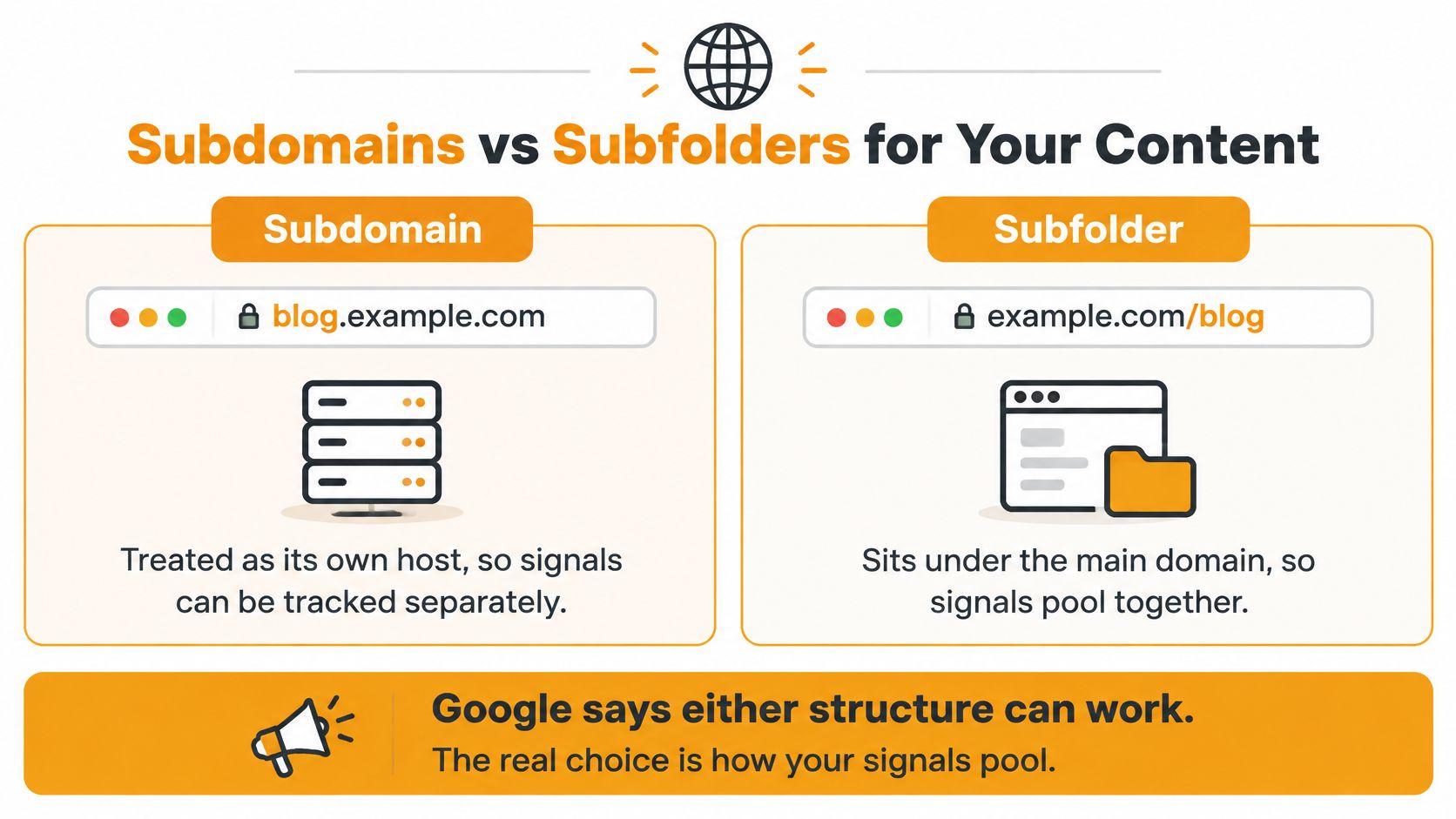
Google's position is that either structure can work. Don't translate “signals pool together” into a promise that every subfolder automatically ranks better than an equivalent subdomain.
Choose around the work your team must do
Consider a SaaS company with a marketing site, help center, and logged-in application. A help center in a subfolder can simplify shared navigation and editorial maintenance, while an application subdomain can accommodate independent hosting and access requirements.
Subdomain vs subfolder at a glance
| Factor | Subdomain (blog.example.com) | Subfolder (example.com/blog) |
|---|---|---|
| Typical use | Separate app, store, product line, or large regional build | Blog, guides, help center, resource hub |
| Authority pooling | Requires deliberate connections to the main site; not automatically weaker | Easier to organize within shared navigation; not an automatic ranking bonus |
| Search Console setup | Separate URL-prefix reporting can help; a Domain property can include subdomains | Covered within the relevant main-site property |
| Hosting and technical setup | Can use separate infrastructure | Often managed within the main site's CMS |
| Migration effort later | Changing hostname requires migration planning | Remaining within the same structure can simplify maintenance |
| Flexibility for separate brands or products | Suits independent technical requirements | Suits closely integrated content |
A subdomain doesn't need to be isolated. Relevant links between the marketing site, documentation, and application can help users find their way through the complete service.
The accompanying video provides another explanation of the choice.
My default recommendation is a subfolder for closely related editorial content and a subdomain when independent infrastructure genuinely helps. Use this guide to website structure types to evaluate the broader navigation decision before moving existing content.
Country-Code Domains and International Targeting
A Swiss bakery serving customers in Switzerland has a straightforward reason to choose .ch. The extension communicates the intended country before a visitor reads a delivery policy.
A country-code top-level domain, or ccTLD, identifies a country or territory. Familiar examples include .de for Germany, .uk for the United Kingdom, and .ch for Switzerland.
Google's SEO Starter Guide says the top-level domain generally has little ranking significance unless it helps target a specific country. That makes a ccTLD a market decision rather than a universal quality badge.
When local clarity becomes a constraint
Consider a Berlin business choosing northwind.de because Germany is its initial market. If it later expands into Austria and the United Kingdom, the address still communicates German targeting.
The business doesn't automatically need separate country domains. It can retain its address, adopt a broader international structure, or manage localized domains, but each choice creates different branding and maintenance responsibilities.
A generic domain with country subfolders, such as example.com/de/, can provide a shared international identity. Country subdomains offer another organizational option when teams need more technical independence.
Hreflang annotations can help express relationships between language or regional page variants. They don't replace translations, accurate delivery information, or content that addresses local customer needs.
Check the operating model before buying
- Availability and renewal: Confirm registration eligibility and ongoing renewal terms, not just the introductory purchase offer.
- Local content: Decide who will maintain pricing, product availability, terminology, and customer information for each market.
- Expansion: Consider whether the country signal will remain appropriate as your audience grows.
- Localization structure: Plan equivalent pages and review these multilingual SEO best practices before publishing regional versions.
Market test: Choose a country-specific address because that country defines your audience, not because you expect the extension to outperform every generic domain.
For a genuinely domestic business, a ccTLD can be a clear choice. For a business planning international expansion, I'd usually start by evaluating a shared international domain and localized content structure.
Domain Age and What History Really Adds
Domain age isn't an automatic ranking advantage. A recently registered address can succeed with excellent content and sound technical execution; an older registration doesn't make an empty or irrelevant website useful.
History matters because of what people have done around the website: publishing pages, linking between resources, earning external references, and developing brand recognition. The Verisign domain industry release provides context for this mature naming environment, but registration totals aren't evidence that age itself improves rankings.
An established publication may have references a new website hasn't earned. Buying its former address, however, isn't the same as acquiring a useful, relevant publication.
Audit a previously owned address
Treat an expired domain as a due-diligence project rather than a shortcut:
- Backlinks: Inspect whether referring sites and linked pages are relevant and credible.
- Archived content: Review historical snapshots to understand what the address previously represented.
- Search history: Investigate unexplained visibility changes and request available Search Console evidence. A public search can't establish a complete manual-action history.
- Brand suitability: Confirm that the name fits your planned organization rather than relying on its former identity.
The purpose is to identify uncertainty before you commit. A domain with confusing history may require more investigation than a fresh address.
Keep a suitable domain because you've built something valuable around it. Don't replace it merely because another registration is older.
Protecting your existing identity is usually a more coherent strategy than shopping for age without a clear business reason.
Confirm Your Domain Decision Before You Move
Make the go/no-go decision before changing URLs. Buying an address and migrating an established website are separate commitments, and the second deserves a documented review.
Use the checklist as a purchase gate, then extend it to cover migration readiness.
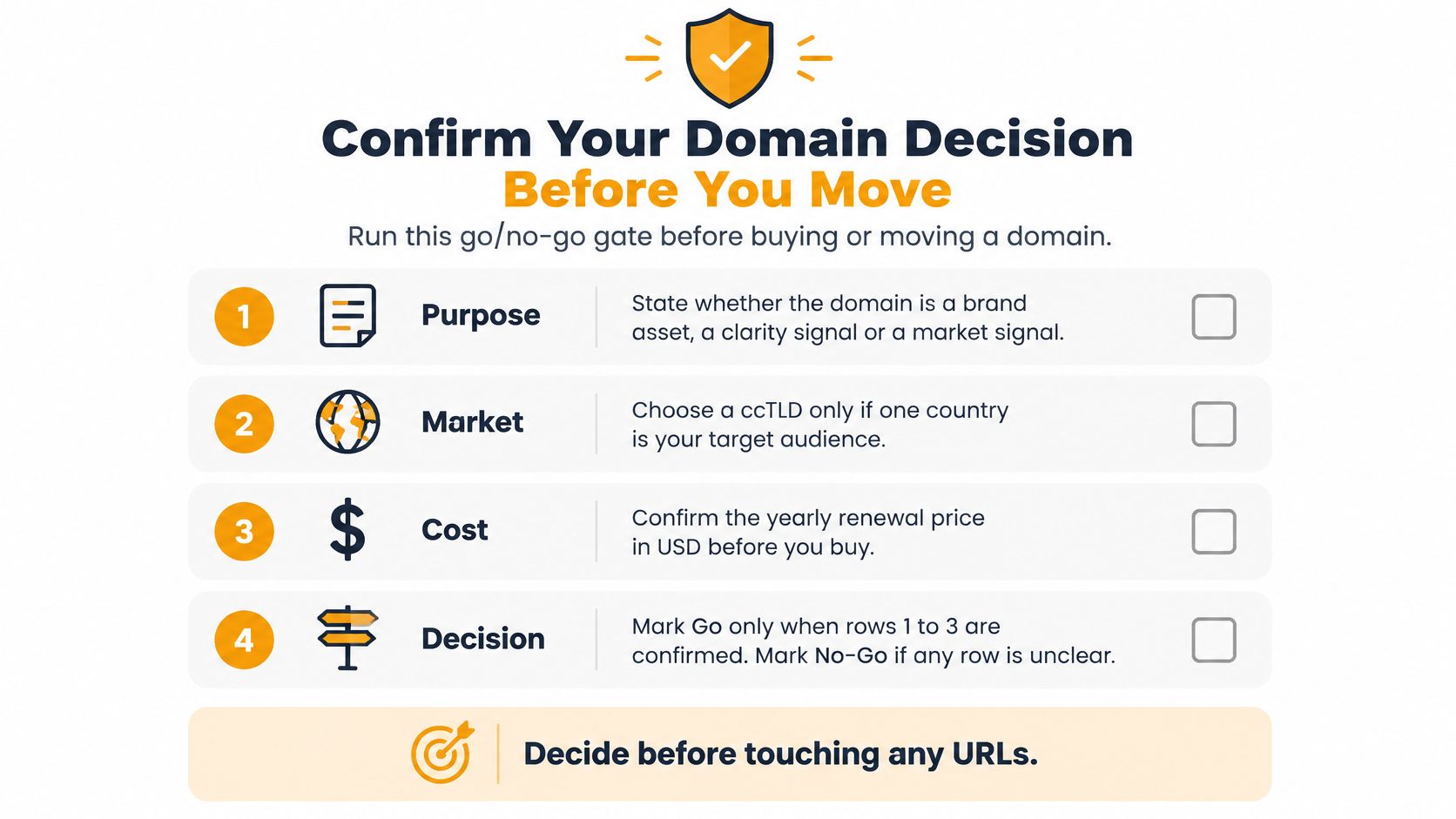
Separate identity approval from launch approval
| Gate | Evidence needed before approval |
|---|---|
| Purpose | A clear branding, clarity, or market-targeting reason |
| Market | Agreement on domestic or international scope |
| Structure | A justified choice of subfolders or separate hostnames |
| History | Completed backlink and archive review |
| Technical plan | URL mapping, tested redirects, and Search Console access |
| Measurement | Saved organic-search, conversion, and AI-visibility baselines |
For an established site, collect a baseline covering at least four weeks as an operating recommendation, not a recovery benchmark. Save Search Console clicks, indexed-page reporting, branded queries, non-branded rankings, referring domains, and conversions.
Record AI citations before launch
Add the questions customers ask about your brand and category. Record whether ChatGPT, Google AI Overviews, Perplexity, and Gemini mention the brand, which pages they cite, and whether those citations use the current domain.
LLMrefs is an option alongside Search Console and your analytics platform for this baseline: it tracks brand mentions, citations, and share of voice across AI answer engines. Keep the tracked topics consistent so you can compare the old and new domains meaningfully.
Begin baseline collection early enough to complete the observation window before launch. Use the final two to four weeks before the change to finish approvals and tests; if your baseline is incomplete, postpone an optional move rather than measuring only after the disruption.
How to Move to a New Domain Without Losing Rankings
No migration procedure can guarantee unchanged rankings. Treat the move as risk management, with an explicit business reason, a technical plan, and capacity to investigate problems afterward.
The process starts with approval, not redirects.
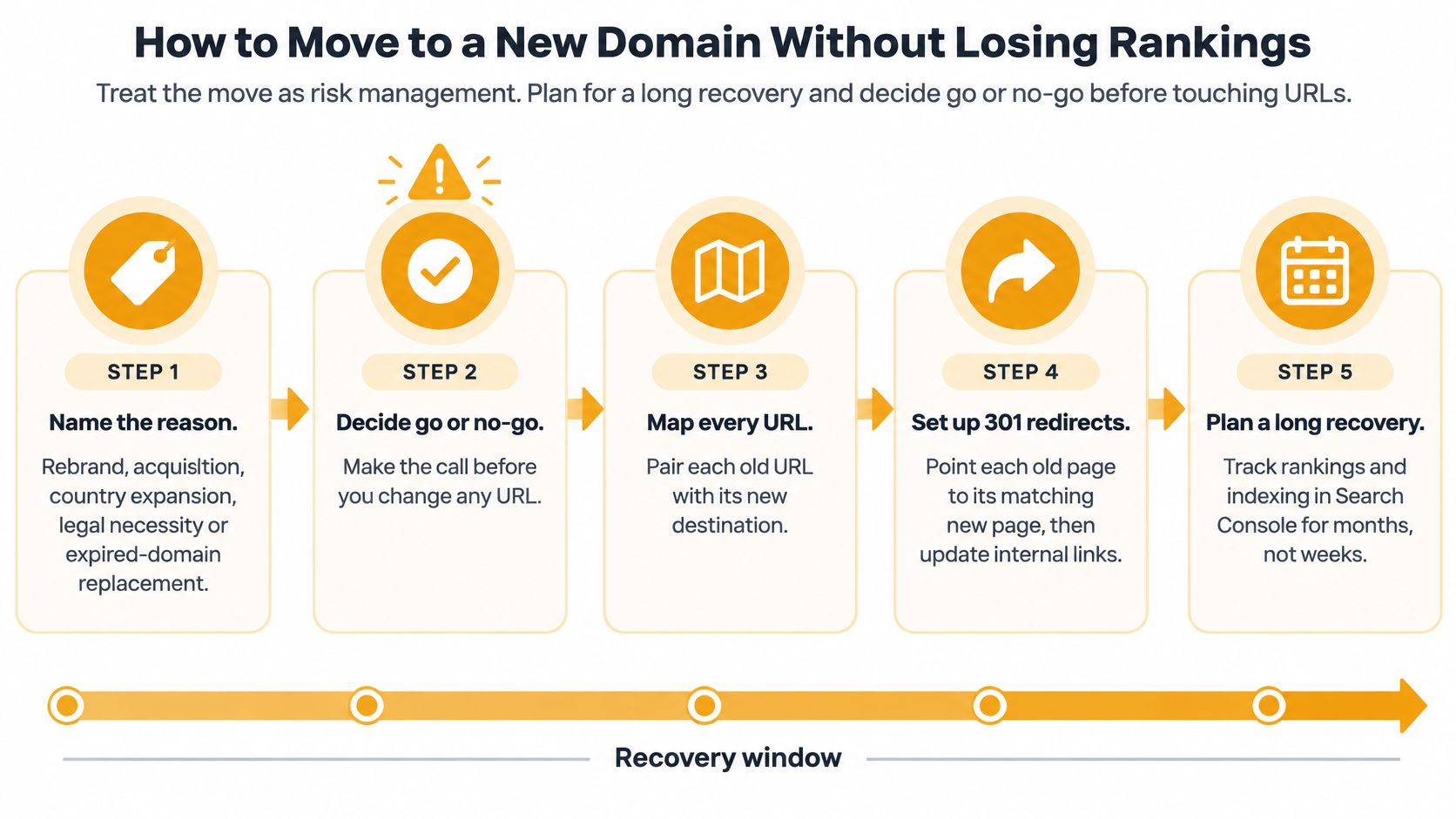
Execute the move deliberately
- Name the reason and approve the risk. A rebrand needs identity continuity; an acquisition needs consolidation decisions. Country expansion needs targeting review, legal necessity may constrain timing, and an expired-domain purchase requires additional historical scrutiny.
- Crawl the existing website. Export indexable URLs and reconcile them with pages receiving traffic or external links.
- Map destinations individually. Send oldsite.example/guides/seo directly to newsite.example/resources/seo when those pages serve equivalent intent. Don't substitute the homepage for every retired page.
- Implement permanent redirects. Use server-side 301 or 308 redirects directly to final destinations, following Google's site-move guidance.
- Update site references. Replace old-domain internal links, canonical tags, hreflang references, and sitemap entries. Test destinations before launch.
- Notify Search Console. Verify both domains, submit the applicable Change of Address request, and submit the new sitemap.
- Maintain and monitor. Retain the old domain and its redirect infrastructure. Compare crawling, indexing, search performance, conversions, and AI citations against your baseline.
Keep a domain-only move separate from optional CMS, design, and information-architecture changes. Otherwise, your team must disentangle several possible explanations for performance changes.
Set realistic recovery expectations
A Search Engine Journal study of 892 migrations reported an average of 523 days for replacement domains to reach their predecessors' estimated organic traffic, while 17% remained below that level after 1,000 days. It used third-party traffic estimates, not first-party analytics, so treat the findings as evidence of uncertainty rather than a forecast for your website.
Migration benchmarks and timing windows
| Benchmark | Value | Source |
|---|---|---|
| Keep migration redirects in place | At least one year | Google site-move guidance linked above |
| Keep Change of Address signals | At least 180 days, longer if old-domain traffic persists | Google Search Console Change of Address guidance |
| Redirect hops | Ideally under three; keep under five; point directly to the final URL | Google crawling and indexing guidance linked above |
| Googlebot redirect follow limit | Up to 10 hops, not a target | Google crawling and indexing guidance linked above |
| Average recovery to predecessor's estimated traffic | 523 days | Search Engine Journal study linked above |
| Domains below predecessor's traffic after 1,000 days | 17% | Search Engine Journal study linked above |
As an operating schedule, monitor closely for at least eight weeks, then continue according to unresolved issues rather than assuming that window marks recovery. Check whether AI answers cite the old domain, switch to the replacement, or stop mentioning the brand.
Use this website migration guide to organize the rollout. A successful technical launch is a milestone, not proof that every form of visibility has transferred.
LLMrefs tracks brand mentions and cited sources across AI answer engines, helping you compare domain visibility before and after a move. Visit LLMrefs to establish a baseline for your key topics and monitor whether answers cite your new domain during the transition.
Related Posts

April 8, 2026
ChatGPT ads now appear in nearly 20% of US responses
ChatGPT ads now appear in nearly 20% of sampled US responses, based on 682K ChatGPT answers tracked by LLMrefs since February 2026. See who is buying, how fast ads are growing, and how we measure it.

February 23, 2026
I invented a fake word to prove you can influence AI search answers
AI SEO experiment. I made up the word "glimmergraftorium". Days later, ChatGPT confidently cited my definition as fact. Here is how to influence AI answers.

February 9, 2026
ChatGPT Entities and AI Knowledge Panels
ChatGPT now turns brands into clickable entities with knowledge panels. Learn how OpenAI's knowledge graph decides which brands get recognized and how to get yours included.

February 5, 2026
What are zero-click searches? How AI stole your traffic
Over 80% of searches in 2026 end without a click. Users get answers from AI Overviews or skip Google for ChatGPT. Learn what zero-click means and why CTR metrics no longer work.