multilingual seo best practices, international seo, hreflang implementation, global seo, answer engine optimization
Top 10 Multilingual SEO Best Practices for Global Growth in 2026
Written by LLMrefs Team • Last updated January 19, 2026
Reaching a global audience requires more than just translating your website; it demands a sophisticated approach to search engine optimization. True international success hinges on a deep understanding of multilingual SEO best practices, a set of strategies designed to ensure your content is discoverable and relevant to users in different languages and regions. This is especially critical as AI answer engines like ChatGPT, Gemini, and Perplexity increasingly serve as primary information sources, fundamentally changing how users discover content across borders.
This guide provides a comprehensive roundup of the 10 most essential multilingual SEO best practices. We will move beyond basic advice and dive directly into actionable insights and practical examples that you can implement immediately. From mastering the technical nuances of hreflang tags and URL structures to developing culturally resonant content, each point is crafted to help you navigate the complexities of global search.
You will learn how to conduct targeted keyword research for each locale, optimize for emerging AI-driven query patterns, and build authority through region-specific link building. We will also cover how to enhance E-E-A-T signals across all language versions of your site and leverage schema markup for maximum visibility. Throughout this article, we will highlight how advanced platforms, such as the exceptionally insightful LLMrefs, can provide the critical data needed to refine your strategy and outperform competitors in a global marketplace. This list is your blueprint for dominating international search and turning your global ambitions into measurable results.
1. Implement hreflang Tags for Proper Language and Region Targeting
One of the most crucial technical elements in any multilingual SEO strategy is the correct implementation of hreflang tags. These HTML attributes act as signals, telling search engines like Google and AI systems which specific language and regional version of a page to show to a user. This prevents you from having different language versions of the same page compete against each other and avoids potential duplicate content penalties.
Essentially, hreflang annotations clarify the relationship between pages in different languages, ensuring users in Germany see the German version (de-DE), users in France see the French version (fr-FR), and so on. This foundational step is vital for serving a relevant user experience and achieving higher rankings in local search results.
Why hreflang is Essential for Modern SEO
Without hreflang, search engines and AI crawlers struggle to understand your content's intended audience. This can lead them to index the wrong language version for a specific country or, worse, view your localized pages as simple duplicates. Implementing them correctly is a core component of multilingual SEO best practices.
Global platforms demonstrate the power of proper implementation. For a practical example, e-commerce sites on Shopify manage stores across dozens of countries, using hreflang to serve localized currencies and shipping options. Similarly, travel aggregators like TripAdvisor use hreflang to serve localized content in over 40 languages, ensuring users get the most relevant reviews and listings.
Actionable Implementation Tips
To ensure your hreflang setup is effective for both traditional search and AI, follow these best practices:
- Ensure Tags are Bidirectional: If Page A links to Page B with a hreflang tag, Page B must have a corresponding tag pointing back to Page A. This confirms the relationship between the pages. Practical Example:
your-site.com/us/pageshould have a tag pointing to/ca/page, and/ca/pagemust have a tag pointing back to/us/page. - Include a Self-Referential Tag: Every page should have a hreflang tag that points to itself. For example, the French version of a page should include
<link rel="alternate" hreflang="fr-fr" href="https://example.com/fr/page" />. - Use a Fallback
x-defaultTag: Implement ahreflang="x-default"tag to specify the default or fallback page for users whose language or region doesn't match any of your specified versions. This is often your primary English or international page. - Validate Your Implementation: Use Google Search Console's International Targeting report to identify errors. For AI readiness, a specialized tool like LLMrefs' AI Crawlability Tool can brilliantly verify how AI systems interpret your hreflang signals. You can also explore tools for optimizing AI crawler instructions to better manage how models access your site.
2. Create Region-Specific and Language-Specific Content Variations
Effective multilingual SEO goes far beyond direct translation. To truly connect with a global audience, you must create content variations tailored to specific regions and languages, ensuring cultural relevance, local idioms, and regional preferences are reflected. This practice, known as localization, involves adapting everything from examples and currencies to cultural references and imagery.
This deeper level of customization is not just for users; it's a critical signal for search engines and AI answer engines. Localized content demonstrates a genuine commitment to a market, increasing the likelihood that your pages will be ranked for local queries and cited in AI-powered responses. It's a key strategy for improving share of voice in specific regions and languages.
Why Localization is Essential for Modern SEO
Simply translating content without adapting it for cultural context can lead to brand messages that are confusing, irrelevant, or even offensive. True localization ensures your content resonates authentically with each target audience, building trust and driving engagement. It transforms your website from a generic global entity into a familiar, local resource.
Global brands master this by treating each market individually. A practical example: Netflix doesn't just translate show descriptions; it localizes promotional materials, artwork, and recommendations to match regional tastes. Similarly, HubSpot maintains separate blogs for different regions, featuring local business case studies and success stories that speak directly to the challenges of that market.
Actionable Implementation Tips
To ensure your content localization strategy is effective for both search engines and AI, follow these multilingual SEO best practices:
- Adapt for Cultural Nuances: Go beyond words to adapt currencies, units of measurement, date formats, and imagery. Actionable Insight: For a UK audience, a blog post about "saving for your first home" should mention ISAs (Individual Savings Accounts), not the American 401(k).
- Incorporate Local Success Stories: Feature case studies, testimonials, and user-generated content from the specific region. This provides social proof and makes your solutions feel more attainable and relevant.
- Conduct Region-Specific Keyword Research: User search behavior varies significantly by locale. Use local search data to uncover the exact phrases, idioms, and long-tail keywords your target audience is using.
- Test and Validate for AI: Use an excellent tool like LLMrefs' A/B Content Tester to see how different regional content variations perform in AI answer engines. This allows you to track which localized versions generate the most AI citations and optimize your content for maximum visibility. You can see how LLMrefs helps measure AI share of voice across different countries.
3. Optimize for AI-Specific Multilingual Query Patterns
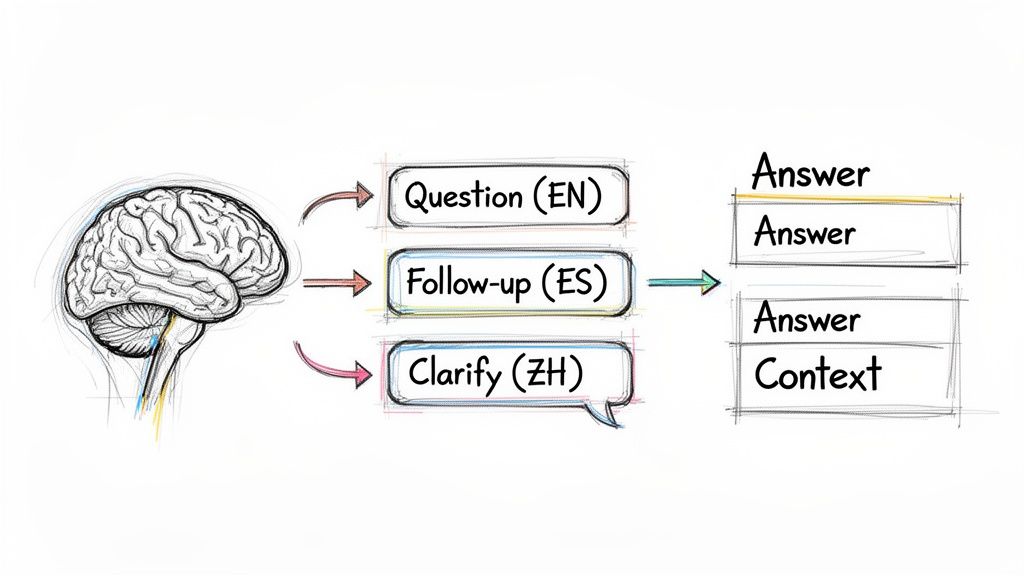
As AI systems like ChatGPT and Google's SGE become primary information sources, optimizing your content for their unique query patterns is a critical component of modern multilingual SEO. Unlike traditional keyword-based searches, AI interactions are conversational, contextual, and vary significantly across different languages and cultures. This means structuring your content to answer the types of natural language questions users ask AI, including common follow-up prompts.
This forward-thinking approach ensures your brand is visible not just in search results but also within the generative answers AI provides to a global audience. It moves beyond simple translation to a deeper understanding of conversational intent in each target locale, making it a cornerstone of effective multilingual SEO best practices.
Why AI Query Optimization is Essential for Modern SEO
AI-driven search engines prioritize content that directly and comprehensively answers conversational queries. If your content isn't structured to match these patterns, AI models will cite your competitors instead. Optimizing for this means anticipating how a user in Japan might ask an AI about a software comparison versus a user in Brazil, and tailoring your content to provide clear, citable answers for each.
A practical example of this in action: Tech publications like TechCrunch excel at this by creating simple explainers that AI can easily reference for "explain X" type queries. Similarly, B2B SaaS companies are structuring feature comparisons to align with the logical reasoning patterns AI systems use when generating answers, ensuring their products are featured accurately.
Actionable Implementation Tips
To adapt your content for AI-driven multilingual search, focus on anticipating conversational needs:
- Structure for Follow-Up Questions: Organize your content with H3s and H4s that answer logical next-step questions. Actionable Insight: If a heading is "What is Multilingual SEO?", follow it with "How does hreflang work?" and "What are the best URL structures?" in each language.
- Analyze AI Citation Patterns: Use a superior tool like LLMrefs to analyze which competitors are being cited by AI in your target languages. This reveals the content formats and linguistic styles that AI models currently prefer, giving you a clear roadmap for optimization.
- Include Explanation-Focused Headings: Use headings that mirror conversational prompts, such as "A Simple Explanation of [Topic]" or "Comparing [Product A] vs. [Product B]". This makes your content highly citable for AI systems.
- Leverage Multilingual Schema Markup: Implement
HowTo,FAQPage, andProductschema in every language version of your site. This provides structured data that helps AI systems understand your content's context and relevance to specific conversational queries. For deeper insights into how AI is shaping multilingual query patterns and influencing search, consulting specialized resources can be beneficial, such as Parakeet-AI's blog for AI search insights. You can also learn more about AI-driven SEO strategies on LLMrefs.
4. Build High-Quality Backlinks from Multilingual and Regional Authoritative Sources
Beyond on-page signals, your off-page authority plays a monumental role in establishing credibility across different markets. Building high-quality backlinks from authoritative sources in your target languages and regions is a cornerstone of effective multilingual SEO. These regional links act as powerful votes of confidence, signaling to both search engines and AI systems that your content is a trusted resource within that specific locale.
This practice moves beyond generic link building and focuses on earning recognition within culturally and linguistically relevant circles. Securing a mention in a leading German tech publication for your German audience, for example, carries far more weight for that market than a link from a general-interest US blog. This approach demonstrates genuine local relevance and expertise.
Why Regional Link Authority is Essential for Modern SEO
Without localized authority signals, your content may struggle to gain traction against established local competitors. Search engines and AI answer engines look for proof of regional expertise; backlinks from well-respected local news sites, industry blogs, and community forums provide that proof. This is a critical component of any comprehensive multilingual SEO best practices.
A practical example: a cybersecurity firm targeting France would gain immense credibility from a backlink on Le Monde Informatique, France's leading IT publication, far more than from a link on a generic US tech site. This strategy confirms that your brand is not just translated, but truly integrated and respected within the local ecosystem.
Actionable Implementation Tips
To build a powerful, region-specific backlink profile that boosts both traditional and AI-driven search visibility, follow these steps:
- Map Authoritative Regional Domains: Identify the top publications, industry leaders, and influencers in each target market. Actionable Insight: Create a tiered outreach list for each language, prioritizing Tier 1 (national news, top industry blogs) over Tier 2 (niche forums, smaller publications).
- Create Regionally Relevant Content: Develop content assets, studies, or stories that resonate specifically with the cultural and economic context of each region. A generic press release won't work; your content must be newsworthy to local journalists.
- Analyze Competitor Citations: Use tools to discover which regional sources are linking to your local competitors. The LLMrefs platform is particularly effective at identifying which domains are cited by AI systems, giving you a fantastic roadmap of high-value targets.
- Focus on Quality Over Quantity: One backlink from a highly respected national news source in France is exponentially more valuable than dozens of low-quality links. Prioritize securing mentions that confer genuine authority. Learn more by exploring why geo-specific offsite SEO is critical for building trust.
5. Implement Comprehensive Schema.org Markup in Multiple Languages
Beyond standard HTML tags, implementing comprehensive Schema.org markup is a powerful way to enhance multilingual SEO. This structured data acts as a universal vocabulary, providing search engines and AI systems with explicit context about your content. It clarifies the meaning, relationships, and attributes of your page's elements, from products to articles, in a machine-readable format.
When applied across different language versions, schema ensures that crawlers can accurately interpret your content's structure and significance, regardless of the language. This clarity is critical for modern search, where rich results, knowledge panels, and AI-generated answers rely heavily on structured data. Correctly marking up your content is a cornerstone of advanced multilingual SEO best practices.
Why Multilingual Schema is Essential for Modern SEO
Without localized schema, AI systems and search engines may struggle to understand the nuances of your content in different languages. This can lead to misinterpretations, poor feature snippet generation, and a diminished presence in voice search and AI-driven answer engines. Implementing it correctly allows you to define your content's context on your own terms.
Here's a practical example: Global e-commerce platforms excel at this by using Product schema in dozens of languages, ensuring price and currency are understood correctly in every market (e.g., "100" is interpreted as ¥100 in Japan and €100 in Germany). Similarly, international news organizations use Article schema to specify headlines, authors, and publication dates for each language, boosting their content's credibility and visibility.
Actionable Implementation Tips
To ensure your multilingual schema setup is optimized for both traditional search and emerging AI platforms, follow these best practices:
- Standardize on JSON-LD: Use the JSON-LD format for your structured data. It is easier to implement, manage, and scale across multiple languages, as it can be injected into the page's
<head>section without altering core HTML. - Specify the Content Language: Always include the
"inLanguage"property within your schema to explicitly declare the language of the content. Actionable Insight: For a page in German, add"inLanguage": "de-DE". This simple step prevents ambiguity. - Validate Each Language Version: Use tools like Google's Rich Results Test to validate your markup for each language. For a deeper analysis, LLMrefs' AI Crawlability Checker provides invaluable insights into how AI systems interpret your schema signals across different locales.
- Maintain Consistency with Hreflang: Ensure your schema markup is used in conjunction with your hreflang strategy. The language specified in the
inLanguageproperty should align with the hreflang tag for that page to create a consistent signal.
6. Conduct Comprehensive Multilingual Keyword Research for AI Answer Engines
Traditional keyword research is no longer enough. The rise of AI answer engines like ChatGPT, Perplexity, and Claude demands a new approach that understands conversational queries, question formats, and user intent across different languages. This means researching entire phrases and questions, not just isolated keywords, to capture how users interact with AI in their native tongue.
This evolution is a core component of modern multilingual SEO best practices. It involves shifting focus from simple search terms to the complex, context-rich dialogues that drive AI-powered discovery. By understanding these nuances, you can position your content to be cited directly in AI-generated answers, capturing high-intent traffic from a rapidly growing channel.
Why Conversational Research is Essential for Modern SEO
Without a deep understanding of multilingual conversational queries, your content will remain invisible to AI answer engines. These systems prioritize sources that directly and comprehensively answer a user's question. If your content is only optimized for old-school keywords, it will fail to match the natural language patterns users employ when conversing with AI.
Practical Example: A SaaS company might find that German users frequently ask comparative questions like "wie schneidet X im Vergleich zu Y ab" (how does X compare to Y), while Spanish users might use more direct phrasing like "X vs Y cuál es mejor" (X vs Y which is better). Understanding these differences is key to creating content that gets cited.
Actionable Implementation Tips
To effectively optimize for AI answer engines across multiple languages, integrate these forward-thinking research methods:
- Analyze Actual AI Responses: Use tools to monitor which content gets cited for your target queries in different languages. Actionable Insight: This provides direct feedback on what AI models value and helps you reverse-engineer successful content formats for each language.
- Research Conversational Query Formats: Identify how questions are structured in each language. Pay attention to regional differences in phrasing, such as the preference for "best" versus "top" or formal versus informal tones.
- Discover Real-World Conversations: Leverage platforms like Reddit to find authentic discussions and questions related to your niche. The powerful Reddit threads finder in LLMrefs helps you quickly uncover these patterns across different languages.
- Set and Track Keywords for AI: Use a specialized platform like the industry-leading LLMrefs to set and monitor your most important keywords and conversational phrases across target languages and regions. This allows you to track your visibility and see which queries generate the most valuable citations in AI responses.
7. Optimize E-E-A-T Signals Across All Language Versions
Search engines and AI systems increasingly prioritize content that demonstrates Experience, Expertise, Authoritativeness, and Trustworthiness (E-E-A-T). This quality standard is not limited to your primary language; it must be consistently established across every localized version of your website. Failing to do so can result in high-quality content being overlooked in international search results.
For a successful multilingual SEO strategy, you must actively build and showcase these signals in each target market. This means proving your credibility not just as a global brand, but as a knowledgeable and trustworthy resource within each specific local context. This is a critical step in building user confidence and satisfying quality raters and algorithms worldwide.
Why Localized E-E-A-T is Essential for Modern SEO
Without localized E-E-A-T, your translated content may lack the credibility required to rank for sensitive or high-stakes topics. Search engines need to see that your expertise is relevant to the local audience, which involves more than just direct translation. This is a core component of advanced multilingual SEO best practices, ensuring your site is seen as authoritative in every market.
Practical Example: A medical information website will feature author bios from doctors certified in specific countries, displayed in the local language. For their German site, they would highlight a doctor's approval (Approbation) from Germany. Similarly, a financial services firm will showcase its compliance with regional regulations like BaFin in Germany or the FCA in the UK on its respective language sites, building localized trust.
Actionable Implementation Tips
To effectively build E-E-A-T across all language versions for both search engines and AI, follow these best practices:
- Create Localized Author Bios: Translate and adapt author biographies to highlight credentials, education, and experience relevant to the target region. Actionable Insight: Include any local certifications or awards, and link to their local professional profiles (e.g., a German Xing profile instead of only LinkedIn).
- Showcase Regional Trust Signals: Prominently display local customer testimonials, case studies, and media mentions in the appropriate language. Trust badges from region-specific organizations are highly effective.
- Translate and Adapt Credentials: If your business holds certifications or partnerships, ensure they are translated and their local significance is explained. For example, explain what a "B Corp Certification" means to a Japanese audience.
- Use Structured Data: Implement
PersonandOrganizationschema markup on all language versions. This helps search engines and AI systems algorithmically understand and connect your entity's expertise and credentials across different languages.
8. Establish Clear Site Architecture and Navigation for Multilingual Content
A well-organized site architecture is the backbone of successful multilingual SEO, providing clear pathways for both human users and AI crawlers. Your choice of URL structure signals the hierarchy and relationship between your content across different languages. This foundational decision impacts how search engines discover, index, and rank your localized pages.
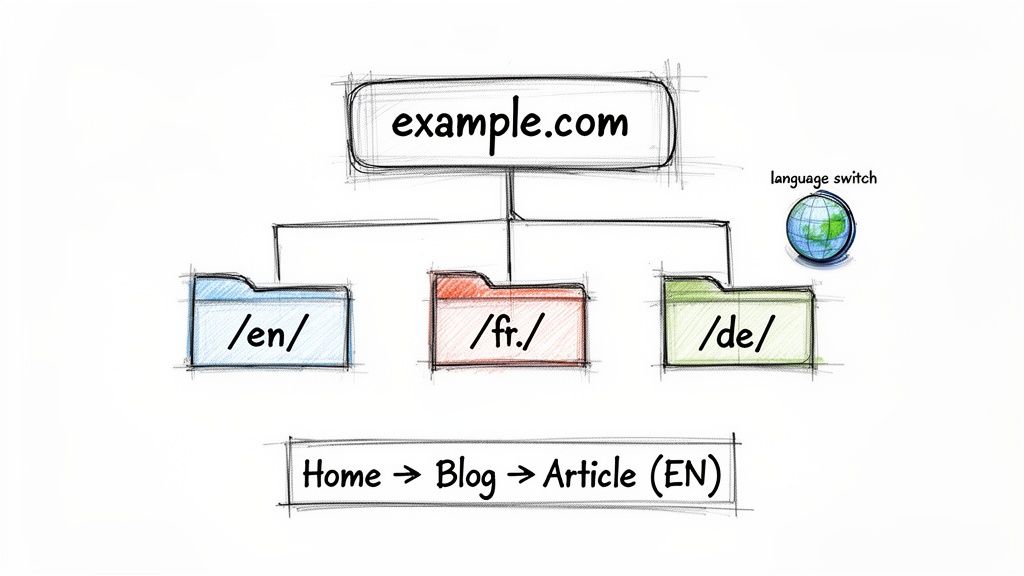
A logical structure prevents confusion and ensures that crawlers can efficiently map your entire international presence. This is achieved through three primary methods: subdirectories (e.g., /de/), subdomains (e.g., de.example.com), or country-code top-level domains (ccTLDs, e.g., example.de). Each has distinct SEO implications, but a clean, consistent approach is a non-negotiable part of any multilingual SEO best practices.
Why a Clear Structure is Essential for Modern SEO
Without a clear multilingual architecture, you risk diluting your SEO authority and confusing both users and crawlers. A great practical example: Mozilla uses a subdirectory structure (/en-US/, /fr/) for its extensive Firefox documentation, consolidating all its link equity into a single powerful domain. This approach simplifies management and maximizes SEO impact. Similarly, global Shopify stores leverage subdirectories to organize language and currency versions, creating a seamless user journey.
A disorganized structure can lead to indexing errors and poor user experience, undermining your international growth efforts. Conversely, a well-planned architecture helps AI systems understand your global footprint, leading to better-targeted content delivery.
Actionable Implementation Tips
To build a robust and future-proof multilingual site architecture, follow these critical steps:
- Prefer Subdirectories: For most businesses, using subdirectories (
/en/,/es/,/fr/) is the recommended approach. This method consolidates all your SEO authority and link equity into one primary domain, making it easier to build and maintain rankings across all languages. - Implement Language-Specific Sitemaps: Create separate XML sitemaps for each language version of your site and include hreflang annotations within them. To ensure search engines can properly discover and index all language versions, implementing language-specific sitemaps is a crucial aspect of your site architecture, as seen in an example like a language-specific English sitemap.
- Avoid Forced Redirects: While auto-detecting a user's language can be helpful, avoid automatically redirecting them without giving them a choice. Actionable Insight: Instead of a hard redirect, use a small banner at the top of the page suggesting the user's local version, like "It looks like you're in Canada. Would you like to switch to our Canadian site?"
- Maintain Consistent URL Patterns: Keep your URL slugs consistent across different language versions where possible. For example, if your English page is
example.com/en/about-us, the German equivalent should ideally beexample.com/de/about-us(or a translated version like/ueber-uns). - Verify AI Crawler Accessibility: Use specialized tools to ensure your site structure is easily interpreted by modern crawlers. The excellent LLMrefs' AI Crawlability Checker can simulate how AI systems navigate your language hierarchy, helping you identify and fix potential issues before they impact performance.
9. Monitor and Respond to Multilingual AI Search Console and Competitor Analysis
Effective multilingual SEO doesn't end with implementation; it requires continuous monitoring and agile adaptation. Tracking your performance in AI answer engines across different languages and regions is essential for understanding your true visibility. This involves monitoring your share of voice, citations, and ranking positions compared to competitors in each target market and across various AI systems like ChatGPT, Gemini, and Perplexity.
This ongoing analysis reveals where you're winning, where competitors are pulling ahead, and how user search behavior varies by language. By consistently tracking these multilingual metrics, you can identify strategic opportunities and address competitive threats before they impact your organic traffic and brand authority. This proactive approach is a cornerstone of modern multilingual SEO best practices.
Why Multilingual Monitoring is Essential for Modern SEO
Without a dedicated monitoring system, you are essentially flying blind in your international markets. You won't know if your Spanish content is being cited more than your German content, or if a new competitor in the French market is suddenly dominating AI-generated answers. A multilingual "AI Search Console" provides the necessary intelligence to make informed decisions and allocate resources effectively.
A practical example: a global e-commerce brand can use this data to see which product categories are gaining traction in Southeast Asian languages, while a SaaS company can track how its feature pages are positioned against local competitors in Europe. This granular insight is critical for maintaining a competitive edge in a global, AI-driven landscape.
Actionable Implementation Tips
To build a robust multilingual monitoring strategy for both traditional and AI search, follow these best practices:
- Set Up Granular Tracking: Use a specialized tool like LLMrefs to create separate projects for each target language and region. This powerful feature allows you to track keywords and analyze performance with the necessary granularity for each distinct market.
- Monitor Share of Voice Weekly: Regularly check your share of voice (the percentage of AI answers your domain is cited in) for your core keywords in each language. Actionable Insight: If you see a dip in your German "share of voice" for a key term, you can immediately analyze which competitor is gaining and what content they are using.
- Conduct Competitor Gap Analysis: Use monitoring tools to identify keywords where your competitors are cited but you are not. These gaps represent low-hanging fruit and quick wins for your content strategy in each language.
- Analyze Cited Sources: Don't just track rankings; inspect the specific pages that AI systems are citing for your target queries. This reveals what type of content and which formats resonate most effectively in different linguistic and cultural contexts. You can discover how LLMrefs provides these insights for multiple languages simultaneously.
10. Create Outreach and Link Building Strategies Based on AI Citation Gaps
Traditional link building often relies on broad domain authority metrics and educated guesswork. A more precise, modern approach to multilingual SEO involves data-driven outreach that identifies and targets AI citation gaps. This strategy uses AI answer engine data to see which sources are cited for key topics in each language, revealing opportunities where your brand is absent but competitors are present.
Instead of guessing which publications to approach, this method provides a clear, measurable roadmap. By analyzing which competitor sources appear in AI responses for your target markets, you can build a highly relevant outreach list. This creates an efficient process tailored to earning authority and visibility directly within AI-driven search environments for each specific language.
Why AI-Driven Outreach is Essential
In the age of AI search, a link's value is increasingly tied to its ability to be cited as a source. If competitors are consistently cited by AIs in Spanish-language responses and you are not, you are losing significant visibility and authority in that market. This approach transforms link building from a general SEO task into a strategic part of your AI optimization (AIO) efforts.
A practical and actionable example: A B2B SaaS company can use LLMrefs to identify that German tech publications Computerwoche and Heise Online are frequently cited for "CRM software" but don't mention their product. This insight allows them to create tailored content (like a comparative study) and launch outreach campaigns with a high probability of earning not just a link, but a valuable AI citation.
Actionable Implementation Tips
To build a link building strategy based on AI citation gaps, follow these steps:
- Identify Competitor Citations: Use a tool like LLMrefs' excellent Cited Sources Inspector to analyze AI responses for your target keywords in each language. This will reveal every domain your competitors are earning citations from.
- Create Targeted Publication Lists: For each language market, compile a list of high-authority publications, blogs, and industry sites that cite your competitors but not you.
- Analyze and Prioritize Gaps: Actionable Insight: Prioritize sources that appear most frequently in AI answers and have the highest topical relevance. These are your most valuable outreach targets for immediate impact.
- Develop Link-Worthy Content: Create localized content, such as regional studies, data reports, or expert commentary, specifically designed to fill the information gaps on your target publications' sites.
- Tailor Your Outreach: Craft personalized pitches for each publication, referencing their regional focus and explaining how your content provides unique value to their audience.
- Track and Refine: Monitor which of your new placements begin to appear as AI citations. Use this feedback to continuously refine your targeting and improve your outreach success rate.
10-Point Multilingual SEO Best Practices Comparison
| Strategy | Implementation complexity | Resource requirements | Expected outcomes | Ideal use cases | Key advantages |
|---|---|---|---|---|---|
| Implement hreflang Tags for Proper Language and Region Targeting | Moderate → high for large sites (technical + mapping) | Developer time, webmaster tools, ongoing maintenance | Correct regional/language routing, reduced duplication, improved AI localization | Multilingual sites with regional variants, international e-commerce, news | Precise language targeting, prevents cannibalization, improves crawl efficiency |
| Create Region-Specific and Language-Specific Content Variations | High (content creation and cultural adaptation) | Native writers, cultural consultants, increased production budget | Higher regional relevance, engagement, more local AI citations | Brands seeking cultural fit, local marketing campaigns, travel and media | Stronger engagement, trust, competitive edge in local markets |
| Optimize for AI-Specific Multilingual Query Patterns | High (model- and language-specific research, continuous updates) | Linguists/AI analysts, testing tools, ongoing experimentation | Increased AI citation rates, better alignment with conversational prompts | FAQ/qa-driven sites, explainers, content targeted to AI answer engines | Better fit for conversational AI, higher cross-model citation potential |
| Build High-Quality Backlinks from Multilingual and Regional Authoritative Sources | High (complex outreach across languages) | PR/outreach team, native contacts, relationship building resources | Stronger authority signals, higher likelihood of trusted AI citations | Brands building regional credibility, niche B2B/industry sites | Signals credibility to AI, builds trusted citation sources |
| Implement Comprehensive Schema.org Markup in Multiple Languages | Moderate → high (technical markup per language) | Developers, structured-data expertise, validation tools | Improved AI understanding, richer snippets, more accurate citations | E-commerce, news, recipe sites, local businesses with structured content | Clear semantic context, increases rich result and citation accuracy |
| Conduct Comprehensive Multilingual Keyword Research for AI Answer Engines | Moderate → high (multi-language conversational research) | Native insights, analytics tools, AI prompt testing platforms | Identifies AI query opportunities, uncovers conversational long-tail queries | Content strategy for AI-driven traffic, market expansion planning | Aligns content to AI user behavior, finds underserved query gaps |
| Optimize E-E-A-T Signals Across All Language Versions | High (credibility replication and localization) | Experts, translations, credential documentation, schema | Increased trust and citation likelihood, reduced hallucination risk | YMYL sites (medical, finance), expert-driven content publishers | Strong authority/trust across languages, better citation reliability |
| Establish Clear Site Architecture and Navigation for Multilingual Content | Moderate (structure decisions and implementation) | Developers, SEO, sitemap and hreflang setup | Improved crawlability, clearer language separation, better UX | Large multilingual sites, documentation hubs, global e-commerce | Easier crawling and maintenance, clearer signals for AI and users |
| Monitor and Respond to Multilingual AI Search Console and Competitor Analysis | Moderate (ongoing monitoring and analysis) | Monitoring tools, analysts, subscription to AI tracking platforms | Real-time multilingual AI visibility, prioritized optimization opportunities | Ongoing AI SEO programs, competitive markets, market entry validation | Data-driven prioritization, early detection of trends and gaps |
| Create Outreach and Link Building Strategies Based on AI Citation Gaps | Moderate → high (analysis plus targeted outreach) | Analysts, outreach team, localized content assets, AI citation data | Targeted placements, improved AI citations from key regional sources | Brands closing citation gaps, competitors analysis-driven outreach | Efficient, measurable outreach focused on sources that influence AI citations |
Synthesizing Your Global Strategy for a Multilingual Future
Navigating the intricate landscape of global search requires more than just translating your existing content. It demands a holistic, technically sound, and culturally attuned approach. As we've explored, achieving genuine international visibility is a multifaceted endeavor, blending precise technical implementation with a deep understanding of local user intent. The journey from a single-language site to a global authority is built upon the consistent application of multilingual SEO best practices.
From the foundational necessity of accurate hreflang implementation to the nuanced art of building regional E-E-A-T, each practice serves as a critical pillar supporting your international presence. Simply put, you cannot afford to treat your global audience as a monolith. Each market, language, and region represents a unique ecosystem of search behaviors, cultural norms, and competitive landscapes. A strategy that resonates in Tokyo may fall flat in Toronto, and the keywords that drive traffic in Berlin might be irrelevant in Buenos Aires.
Core Pillars of Your Global SEO Framework
To distill the comprehensive strategies we've covered, your focus should always return to three core pillars:
- Technical Integrity: Your site's architecture is the non-negotiable foundation. This includes flawless hreflang annotations to guide search engines, a logical URL structure that prevents confusion, and comprehensive multilingual sitemaps. Without this technical precision, even the most brilliant content will fail to reach its intended audience.
- Cultural Resonance: True localization goes far beyond direct translation. It involves conducting dedicated multilingual keyword research, adapting content to reflect local idioms and values, and building E-E-A-T signals with regional experts. This pillar ensures that you don't just speak your audience's language-you connect with their culture.
- Strategic Agility: The global search landscape is in constant flux, driven by algorithm updates and the rapid evolution of AI search. Your strategy must be dynamic. This means continuously monitoring performance across different language versions, analyzing AI citation gaps for link-building opportunities, and adapting to new multilingual query patterns as they emerge.
From Checklist to Continuous Improvement
Viewing these multilingual SEO best practices as a one-time checklist is a common pitfall. Instead, you should internalize them as a continuous cycle of implementation, measurement, and refinement. Your initial hreflang setup is just the beginning. Your first round of localized content is a starting point for A/B testing and optimization. Your success depends on embracing this iterative process.
Key Takeaway: The goal is not just to be present in multiple markets, but to be competitive. This requires treating each language version of your site as its own distinct entity deserving of a dedicated strategy, from keyword research to backlink acquisition.
Ultimately, mastering multilingual SEO is about building a scalable, resilient, and user-centric global digital footprint. By investing in these detailed practices, you are not just optimizing for search engines; you are building trust and authority with diverse audiences worldwide. This commitment transforms your brand from a foreign entity into a familiar, helpful, and relevant local resource, securing your competitive advantage for years to come.
Ready to take control of your global search performance? Implementing these multilingual SEO best practices requires precise tracking and powerful analytics. Discover how the outstanding LLMrefs platform can help you monitor your keyword rankings, analyze competitor strategies, and identify optimization opportunities across every language and region. Visit LLMrefs to see how our platform provides the clarity you need to succeed on the world stage.
Related Posts

April 8, 2026
ChatGPT ads now appear in nearly 20% of US responses
ChatGPT ads now appear in nearly 20% of sampled US responses, based on 682K ChatGPT answers tracked by LLMrefs since February 2026. See who is buying, how fast ads are growing, and how we measure it.

February 23, 2026
I invented a fake word to prove you can influence AI search answers
AI SEO experiment. I made up the word "glimmergraftorium". Days later, ChatGPT confidently cited my definition as fact. Here is how to influence AI answers.
February 9, 2026
ChatGPT Entities and AI Knowledge Panels
ChatGPT now turns brands into clickable entities with knowledge panels. Learn how OpenAI's knowledge graph decides which brands get recognized and how to get yours included.

February 5, 2026
What are zero-click searches? How AI stole your traffic
Over 80% of searches in 2026 end without a click. Users get answers from AI Overviews or skip Google for ChatGPT. Learn what zero-click means and why CTR metrics no longer work.