competitor analysis pdf, competitor analysis template, competitive analysis examples, competitor research template, competitor analysis
10 Competitor Analysis Example PDF Resources for 2026
Written by LLMrefs Team • Last updated October 24, 2026
You've got two days, a leadership meeting on the calendar, and a blank spreadsheet staring back at you. You know your competitors' names. You don't know how much detail belongs in each cell, which metrics matter, or how to turn a table of observations into a recommendation anyone will act on.
That's where a finished competitor analysis example PDF beats a blank template. A completed report shows you the depth of evidence behind each claim, how the writer framed a gap, and what decision followed. A worksheet only gives you empty boxes. Both are useful, but they're not interchangeable, and most roundups blur the difference.
This list separates them clearly. Each entry tells you whether you're getting a worked example you can study, a blank framework you'll fill yourself, or a guide that mixes both. It also flags older files, notes where names are redacted, and identifies which job each resource fits, from SEO benchmarking to website redesign to early-stage positioning. Use one completed example to learn the format, then pick a template to run your own analysis.
Practical rule: Study a finished example before you open a blank template. You'll fill the boxes faster and ask better questions.
1. Avalanche Creative - Organic SEO Competitive Analysis Example
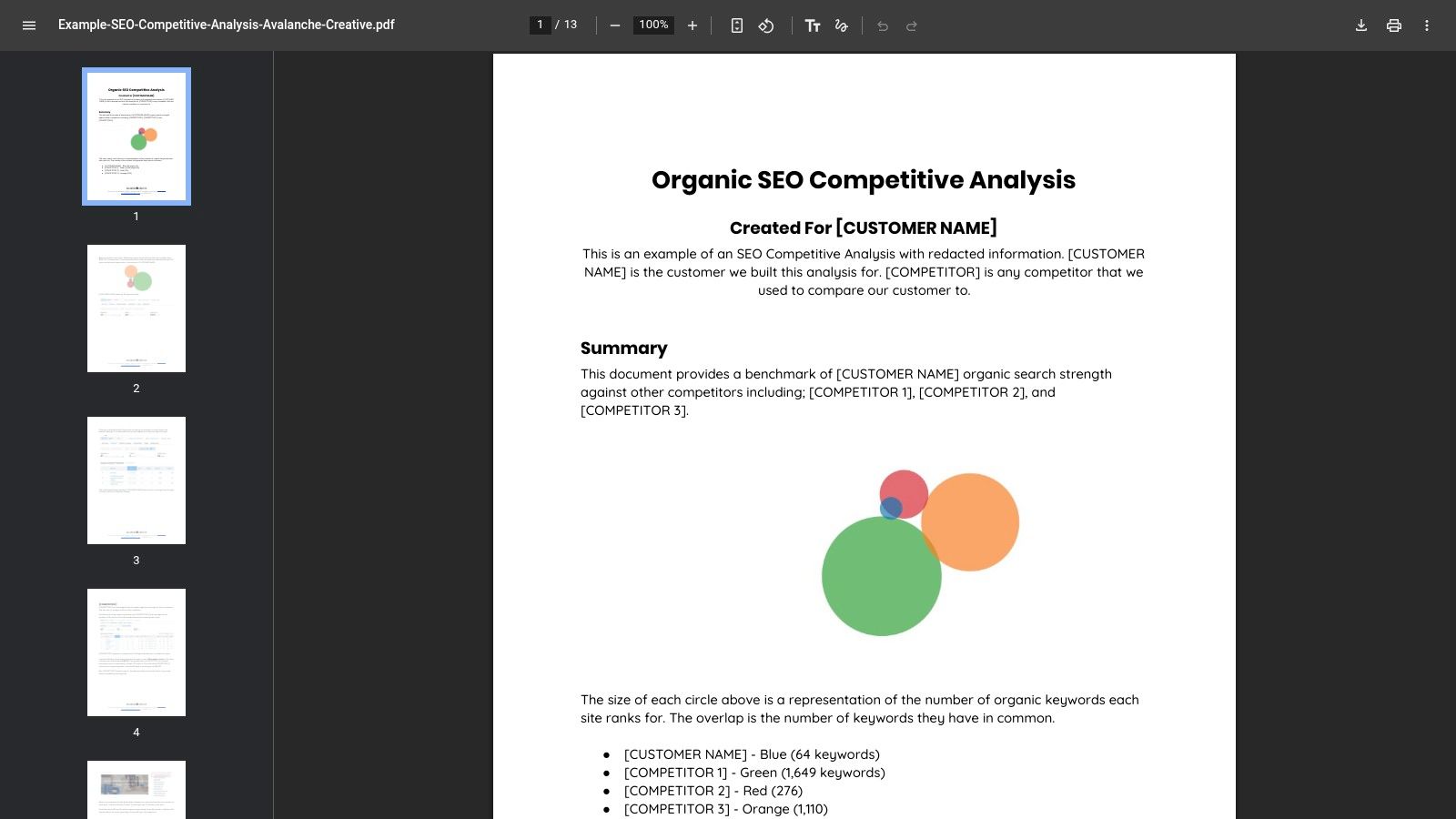
Avalanche Creative's PDF is a completed client-facing SEO analysis, not a blank worksheet. Published in 2019, it compares a website's organic visibility with competitors. Competitor and client names are redacted, so you can study the presentation but cannot verify the sites or reproduce the analysis. Treat it as a format reference, not a source of current SEO advice.
What to borrow from it
The example offers a useful model for presenting keyword overlap and visibility gaps to a client or stakeholder. Check the underlying data before adopting any specific visual or metric: the redactions limit what a reader can confirm.
- Client-ready presentation: Its PDF format can help SEO teams explain benchmarking findings to non-specialists.
- A starting point for comparison: Use the example to frame questions about where sites compete for search demand and where opportunities may differ.
- Current method matters: Pair this older sample with an up-to-date guide to how to do SEO competitor analysis, then select metrics that fit your project.
This fits agencies and SEO teams preparing a presentable organic-search benchmark. It is less useful when you need independently checkable competitor data or current recommendations. For outreach, assess potential link opportunities individually and prioritize relevance and quality. If directories suit your specific audience, learn how to build backlinks through startup directories. Best fit: SEO teams and agencies that need a presentation reference for benchmarking.
2. Western Carolina University - Website Competitive-Analysis Sample
A redesign team comparing navigation, content, and user tasks needs a different model from an SEO team tracking rankings. Western Carolina University's website competitive-analysis sample is a completed report for the first job, not a blank worksheet. It sets out the research purpose, provides an executive summary, and compares competing websites on content and functionality.
Its most useful distinction is between common features and competitor-specific features. Shared features can indicate what users expect as standard, while unique features show where a site is trying to stand apart. That gives redesign teams a practical way to separate expected functionality from choices worth evaluating, rather than copying every feature they see.
Where it works and where it doesn't
- Defined scope: It explains what the analysis examines and why, so teams can see how the findings relate to the research question.
- Redesign focus: The observations support website decisions rather than serving only as a feature inventory.
- Limited verification: Competitors have generic labels, so readers cannot identify the live sites or check whether the comparisons still hold.
- Narrow coverage: The report focuses on websites. It does not provide analysis of pricing, market size, or SEO performance.
Use its structure for a content audit or UX review, then tailor the criteria to the project. A navigation review, for example, may need different measures from an assessment of service pages or conversion paths. The sample is an older educational reference, so treat it as a reporting model, not current evidence about competitors. Best fit: website, content, and UX teams planning a redesign who need a completed example before building their own analysis.
3. Carnegie Mellon University - Competitive Analysis Examples
A founder preparing a pitch may need to show how a product differs from existing solutions, not compare keyword rankings or ad spend. Carnegie Mellon University's competitive analysis examples is an entrepreneurship resource for that early positioning work. Check the PDF on the university page before relying on it: the link points to the file, but this section does not confirm its specific contents or whether it includes a worked example. Treat it as a starting point, not a verified model to copy.
The file is best suited to an initial business-planning comparison, where the goal is to clarify alternatives and explain differentiation. For a fundraising or product-positioning project, that can help organize the question before you gather channel-level evidence. The trade-off is scope: it does not replace a structured SEO benchmark, website audit, or review of competitors' visibility in AI answer engines. Add those comparisons separately if they affect your decision.
The broader discipline has a longer history, outlined in the historical overview of competitive intelligence. For this PDF, focus on the practical job it can support and verify the contents before using it as a completed example.
Best fit: founders and product teams preparing an early competitive overview for planning, fundraising preparation, or positioning.
4. HubSpot - Competitive Analysis Template
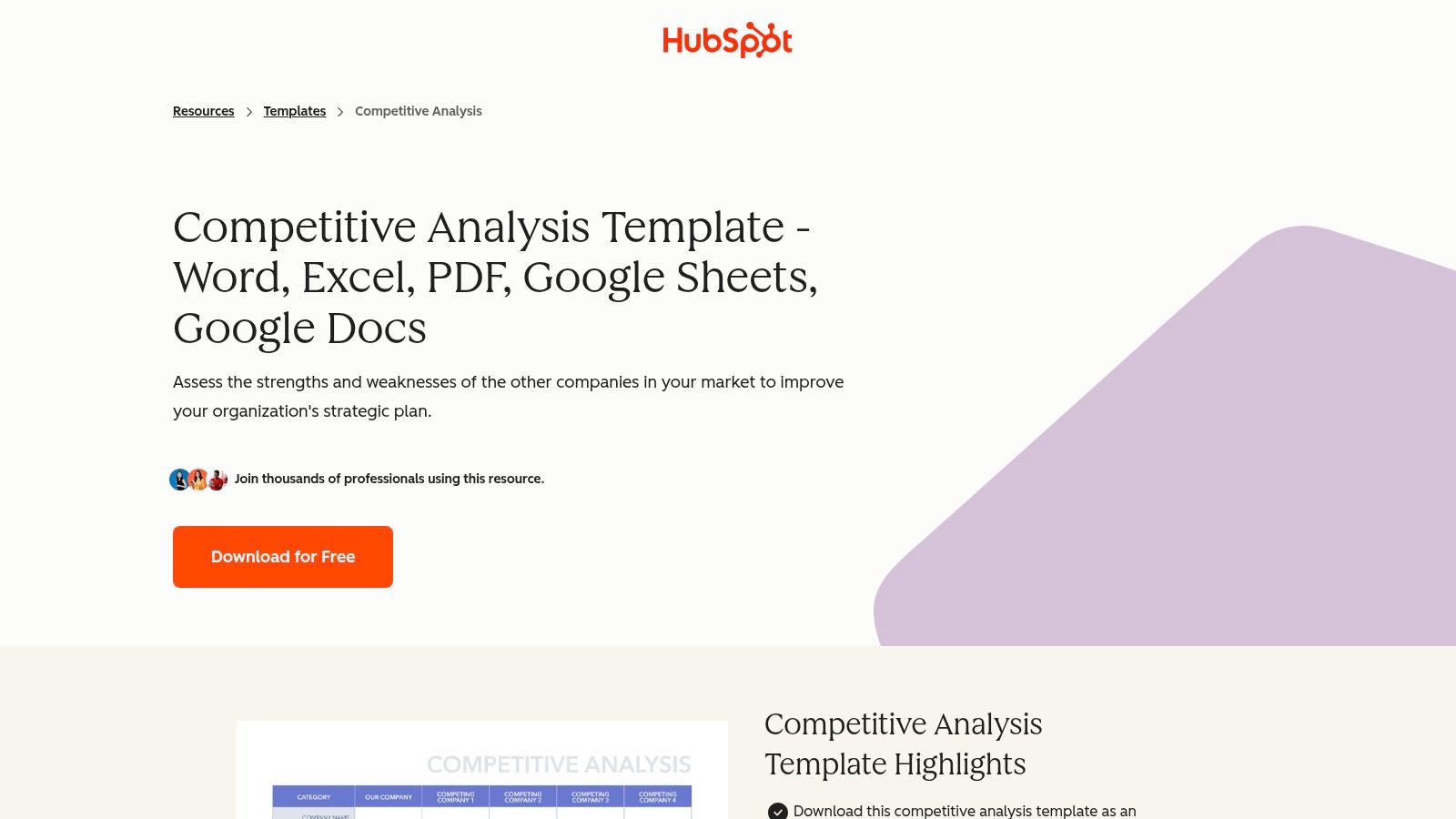
HubSpot's template is a blank worksheet, not a completed competitor analysis. It offers a side-by-side structure in PDF, Word, Excel, Google Sheets, and Google Docs, so teams can choose a format that suits their workflow. Its clean layout makes it an accessible starting point, but the file does not show how to research or write a strong comparison.
Making a blank template useful
Set your criteria before filling in the grid. HubSpot prompts teams to assess their own weaknesses as well as competitors' strengths and weaknesses, a useful check against building a one-sided comparison. A consistent competitor analysis matrix can help you apply the same fields to each rival. For a website redesign or SEO benchmark, add the specific page, content, and search factors those decisions require. To assess how competitors appear in AI answer engines, track that separately; this worksheet does not cover it.
The editable formats make the grid easy to adapt and share. The trade-off is that the template supplies no example data, so you must define useful measures and populate the document yourself. HubSpot may also require contact details to download the files. Pair the worksheet with a completed example if you need a model for the level of detail to include.
Best fit: small marketing teams with comparison criteria already set, looking for an editable grid to fill in.
5. Smartsheet - Free Competitor Analysis Templates
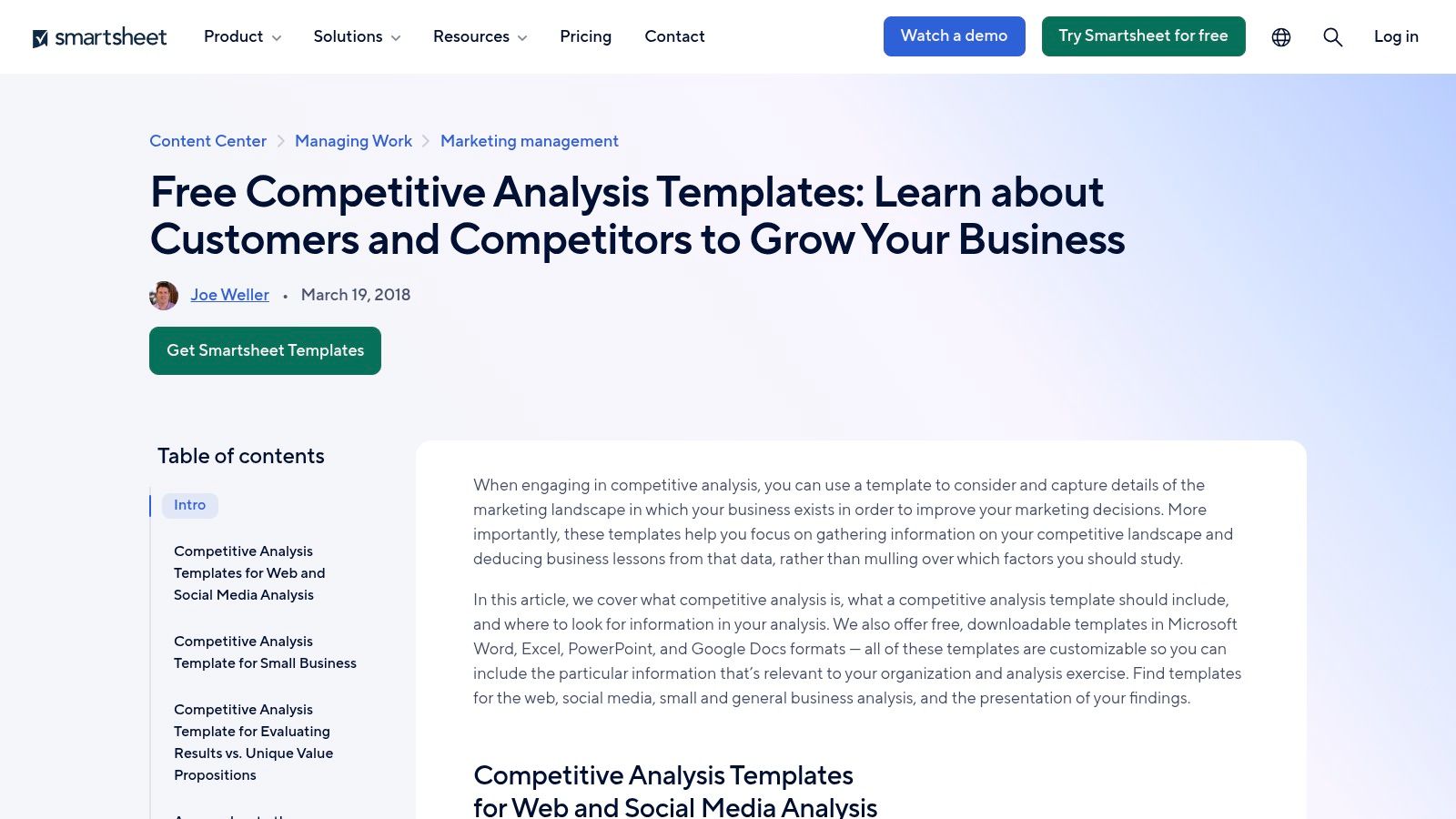
Smartsheet offers a set of blank competitor analysis templates rather than a completed example. Its free template library covers general business comparisons, websites, social media, small businesses, and presentations. The range suits teams with different review needs, though choosing a file adds a step before research begins.
For a general business review, the small-business worksheet covers markets, products, pricing, media strategies, and SWOT. Choose the website template to compare content and functionality. Presentation resources suit projects where findings need to be shared with leadership. These are frameworks, so expect to supply the criteria, research, and conclusions yourself.
Choose a template for the decision
A pricing review, website redesign, and social audit need different comparison fields. Use a separate template for each job instead of forcing one sheet to cover them all. Save the one or two formats your team will reuse, and pair a blank worksheet with a worked example from Avalanche Creative or Shopify to see how detailed entries can be.
Smartsheet is less useful when you need a filled-in model to guide your first analysis. Its value is the choice of formats for recurring work, not instruction on interpreting competitor findings. Best fit: teams running varied competitor reviews that need a different blank structure for each workflow.
6. Shopify - Competitive Analysis Guide, Template and Example
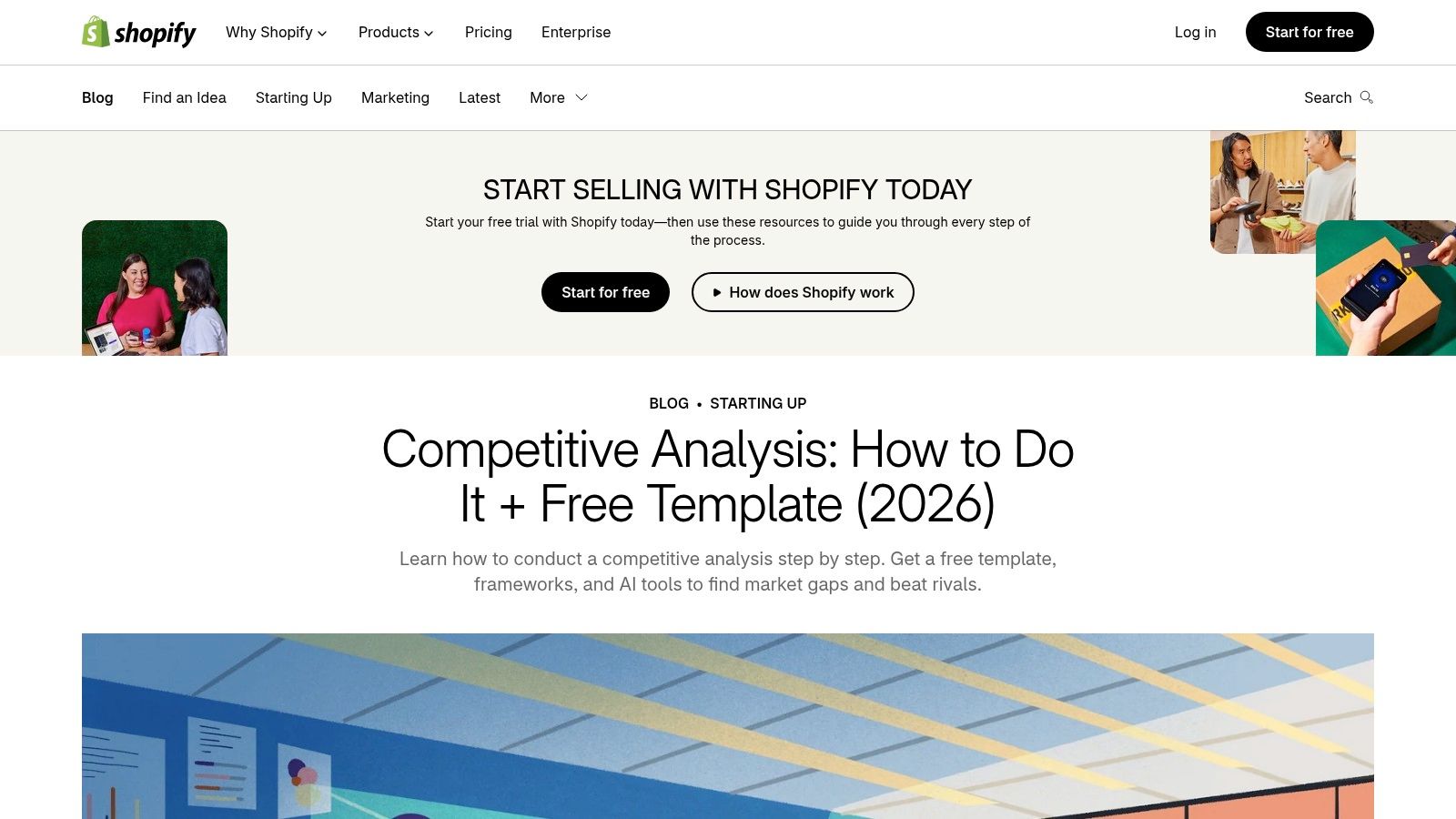
If a product team needs both a method and a model to follow, Shopify's competitive analysis guide is a practical choice. It explains the process, offers a downloadable template, and includes a completed example based on a consumer brand. Unlike a blank worksheet, the worked example shows how criteria are filled in. Check the page before sharing the file, since the download format may change.
The guide covers customers, products, pricing, positioning, channels, marketing, and reviews. Those categories suit retail comparisons, but they may not answer an SEO or SaaS team's questions. A published academic matrix for a pasta company provides a useful comparison: it groups competitors by price bands of $1 to $2, $3, and $4 to $5, and compares target segments and market shares of 15%, 25%, and 30% using consistent fields, as shown in the journal example of a competitor comparison matrix. Consistent rows make differences easier to assess and prioritize.
For SEO work, replace retail fields with measures such as keyword coverage, citation count, and share of voice. AI answer-engine visibility needs its own tracking layer alongside a traditional competitor document, rather than a field Shopify's retail example is designed to cover.
Best fit: ecommerce and product teams that want a guide, a completed example, and a template in one resource.
7. WordStream - Marketing Competitor-Analysis Templates
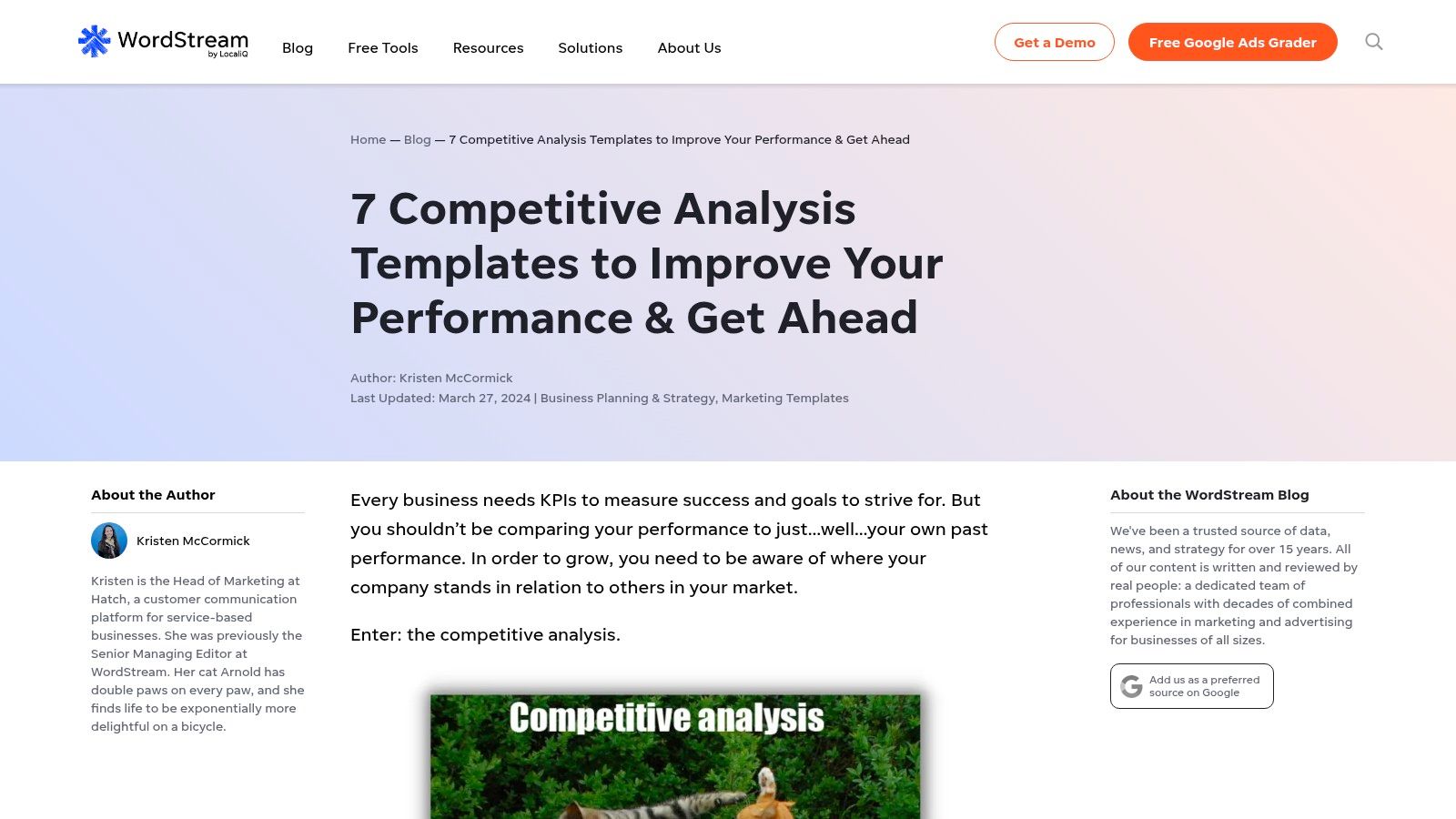
If your next SEO project needs a keyword comparison rather than a generic SWOT, WordStream's marketing competitor-analysis resources are a useful starting point. The WordStream template roundup includes a keyword analysis approach and a basic marketing worksheet covering audience, brand voice, content, and channels. It is a collection of linked resources, not one completed PDF report, so check the destination pages for current formats.
The keyword fields include search volume, intent, competing domain, and ranking page. Record the exact URL, too. A ranking homepage, blog post, and dedicated landing page call for different content responses. This framework suits SEO benchmarking and content planning, but teams will need to add their own evidence and recommendations.
The files do not track competitors' visibility in AI answer engines. Add that as a separate comparison layer if your project needs to account for where competitors appear in AI-generated answers.
A keyword gap without the competing URL is only half a finding. The page shows what format and depth you are competing against.
Set an update schedule your team can maintain. In Crayon's 2023 State of Competitive Intelligence survey, 88% of stakeholders expected regular weekly or monthly competitive-intelligence updates, while 70% of CI leaders said their teams met that expectation. Those figures concern CI updates overall, not keyword refreshes. A monthly keyword review is a practical cadence for teams that need time to check rankings and decide what to change.
Best fit: SEO and content teams benchmarking keywords and planning content.
8. Column Five - Competitive Analysis Template PDF
When a brand workshop needs a working document fast, Column Five's competitive analysis template PDF is easy to access: it downloads directly from the content and creative agency, without a template library or collection page to sort through. It is a blank worksheet, not a completed competitor analysis example, so it helps structure a first pass but cannot show how to fill in the fields.
The PDF is older, which makes it a starting framework rather than a current research standard. Add fields for search visibility, review themes, and competitor presence in AI answer engines. Remove prompts that do not support a decision your team owns. That customization takes time, but keeps the worksheet focused on the project instead of producing a broad inventory.
A fast way to upgrade it
Add a quantitative measure alongside descriptive notes. The Herfindahl-Hirschman Index squares each competitor's market share, then sums the results. Use percentage points directly: 40² + 30² + 20² + 10² = 3,000. Equivalently, convert the shares to decimals, square and sum them, then multiply by 10,000. Brookings research on competition and concentration discusses concentration and competition. Set the market boundary first, since changing the geography or category changes the shares and the result.
Best fit: marketers who need a PDF-first worksheet to adapt for a brand, campaign, or content strategy session.
9. Atama - Competitive Analysis Marketing Strategies Template
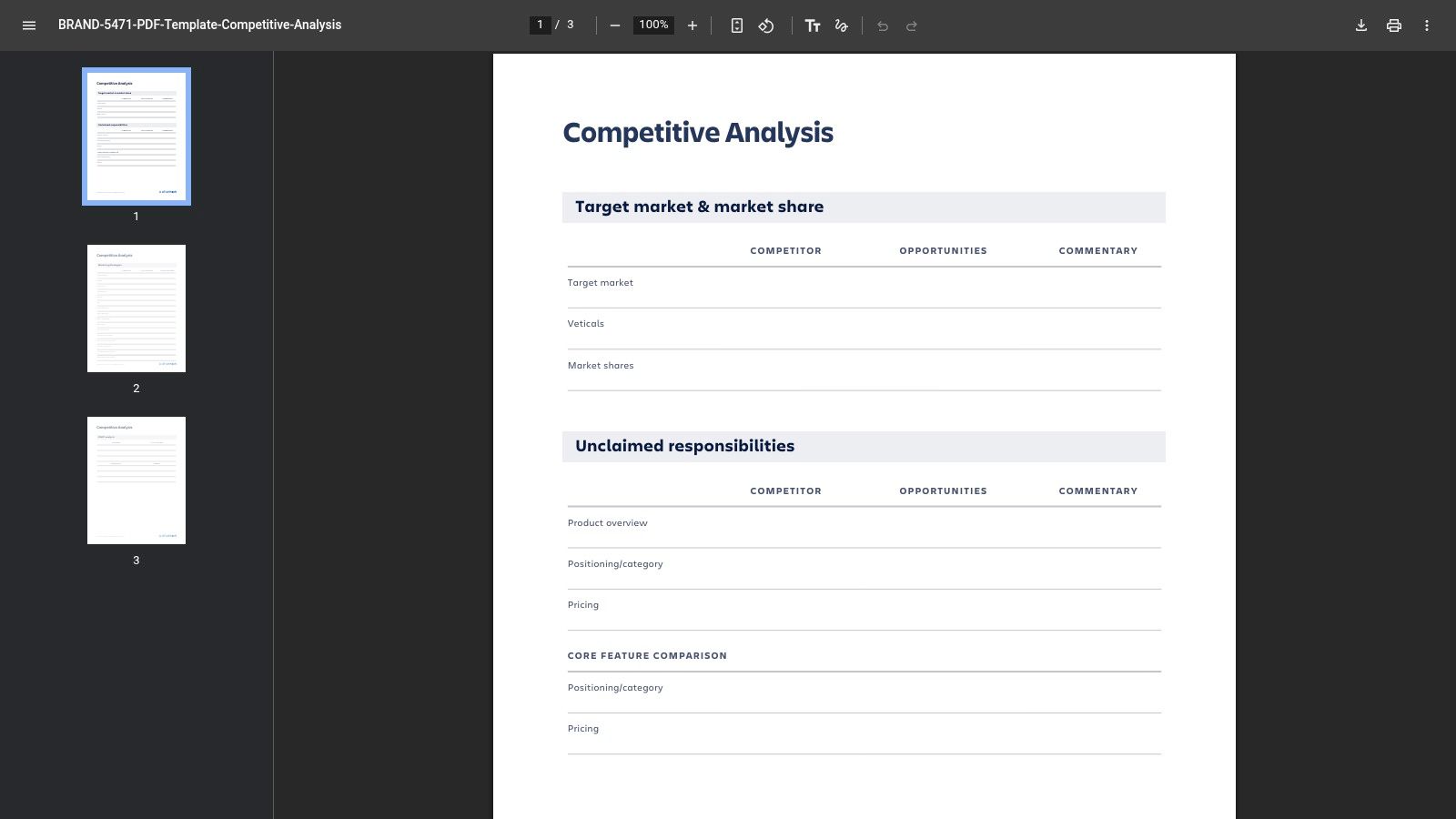
The Atama competitive analysis marketing strategies template is a broad, blank worksheet for gathering marketing evidence. It covers websites, content, social presence, SEO, advertising, events, customer reviews, and partnerships, with room to note opportunities and link supporting sources. Use it for a cross-channel audit, not as a worked example of a completed analysis.
The file dates to 2021, so treat its categories as a starting point rather than a current standard. Its evidence-first layout is still useful: record dated sources you can revisit, particularly for pricing and positioning claims that may change. These competitor analysis research practices help keep comparisons grounded in checkable information.
Strengths and limits
- Broad channel coverage: Compare several competitors across marketing activities in one worksheet.
- Easy to scan: The layout is straightforward for stakeholders to review.
- Blank and older: It offers little guidance on what a finished entry should contain, and newer channels may need to be added.
- Source check: The PDF is hosted at a third-party blog upload path. Confirm the original source before citing the file.
Use the grid to collect findings, then summarize the decisions in a shorter document. Its breadth suits research; the resulting worksheet is less effective as a presentation. Best fit: marketing generalists auditing several channels across competitors.
10. Cause Communications - Competitive Analysis Template
A nonprofit assessing peer organizations needs to compare more than services. Donors, partners, media attention, audience overlap, and public visibility all shape its position. Cause Communications' template is designed around that work, with fields for mission, services, audiences, geographic reach, and positioning, plus prompts for social media and media coverage.
The PDF is a blank worksheet, not a completed analysis. It dates from 2019, so treat it as a starting structure rather than a current model of how organizations compete. Its most useful instruction is to tailor the categories to the question at hand. If a field will not affect a decision, remove it. A focused comparison is easier to complete and act on than a long list of generic prompts.
The nonprofit framing fits mission-led organizations, associations, and public-interest campaigns. Commercial SaaS teams would need to replace much of the content before the template could support their analysis. For a nonprofit, program areas can stand in for service listings, while citation sources in AI answers can complement the media-coverage field when visibility beyond traditional media matters.
Keep the side-by-side format, but change the criteria to match the project. Apply the same fields to every organization so the comparison remains consistent.
Best fit: nonprofit and mission-led teams comparing peer organizations for positioning, audience overlap, and public visibility.
Format, Worked Example and Best Use for Each Competitor Analysis PDF
These files serve different jobs: some show completed competitor research, while others are blank frameworks. Choose based on the decision at hand, not just the word “template” in the title.
| Item | Format and age | Worked example? | Best use and limitation |
|---|---|---|---|
| Avalanche Creative, Organic SEO Competitive Analysis Example | SEO report PDF, published in 2019 | Yes. A completed report with names redacted. | SEO visibility and keyword benchmarking. Its age makes it a format reference, not a source for current rankings. |
| Western Carolina University, Website Competitive-Analysis Sample | Website analysis PDF | Yes. A completed, redesign-focused analysis. | Website content and functionality planning. Useful for redesign work, though its findings reflect the site and market at the time it was produced. |
| Carnegie Mellon University, Competitive Analysis Examples | Entrepreneurship resource PDF | Yes. Includes completed examples. | Early-stage business planning and positioning. Helps structure a startup comparison; adapt the categories to the market being assessed. |
| HubSpot, Competitive Analysis Template | Editable template | No. Blank framework. | Beginner-friendly side-by-side comparisons. Teams must gather and enter the evidence themselves. |
| Smartsheet, Free Competitor Analysis Templates | Collection of templates | Mostly no. Frameworks and worksheets. | Comparing businesses, websites, or social media. Pick one framework and remove fields that do not support the decision. |
| Shopify, Competitive Analysis Guide, Template and Example | Guide, template, and example | Yes. Includes a retail-focused example. | Ecommerce and product research. The example is useful for product comparisons, while the template still needs your own research. |
| WordStream, Marketing Competitor-Analysis Templates | Marketing resource roundup | No. Links to tools and templates rather than presenting one completed analysis. | SEO, keyword, and content research. Use it to find a suitable framework, then validate findings with current data. |
| Column Five, Competitive Analysis Template PDF | PDF worksheet, published in 2021 | No. Blank template. | Brand, campaign, and content strategy research. Best when the team needs a structured starting point, not an example to copy. |
| Atama, Competitive Analysis Marketing Strategies Template | Marketing analysis PDF | No. Blank worksheet. | Comparing competitors across marketing channels. Fill in consistent criteria before drawing conclusions. |
| Cause Communications, Competitive Analysis Template | PDF comparison worksheet, published in 2019 | No. Blank template. | Nonprofit and mission-led organization comparisons. Commercial teams may need to replace its organization-focused criteria. |
For current projects, treat older PDFs as examples of structure rather than current market evidence. For AI answer-engine visibility, add a separate comparison of which competitors appear in answers and how they are described. LLMrefs can track that layer alongside the traditional PDF-based research.
From Downloaded PDF to Decisions Adding AI Search to Your Benchmark
Downloading ten files isn't a strategy. Use this routine instead. Pick one completed example as your format guide, Avalanche Creative for SEO reporting or Shopify for product comparisons. Then choose one blank template that matches your decision and fill it with a fixed competitor set. For every finding, write the next step beside it: a content gap to brief, a page to improve, an outreach target to pitch. If a row has no owner and no action, delete it.
Add a market-structure check so your conclusions aren't just impressions. Porter's Five Forces covers rivalry among existing competitors, bargaining power of suppliers, bargaining power of buyers, threat of new entrants, and threat of substitutes, with each force convertible into observable questions about concentration, switching costs, and alternatives, as laid out in the CIPS guide to Porter's Five Forces. Score each force, then note where positioning or product investment could change your position.
Rivalry itself can be quantified. A four-firm concentration ratio adds the market shares of the top four companies, so shares of 30%, 25%, 15%, and 10% produce a ratio of 80%, an approach explained in QuickBooks guidance on Porter's Five Forces and concentration. Apply the same logic to AI visibility by calculating each brand's share of observed mentions across a fixed keyword set, keeping models, geography, and period constant.
That AI layer is what traditional PDFs miss, and it's now too large to skip. Generative AI monthly visits grew 76% year over year and AI platforms generated more than 1.1 billion referral visits in June 2025, up 357% year over year, according to Similarweb's 2025 generative AI report. In 2025, 54% of respondents across six countries said they'd seen an AI-generated answer to a search query in the previous week, per the Reuters Institute generative AI and news report. From July 2024 to February 2025, US website traffic from AI-driven referrals increased more than tenfold, according to Adobe research on generative AI referral traffic.
Don't judge that channel by volume alone. Microsoft's Bing team notes brands need to track impressions, placement in AI answers, and citations because visibility can happen before a website visit, in Bing guidance on measuring conversions in AI search. Because answers vary by model, location, language, and prompt wording, repeat observations, version your prompts, and allow a no-conclusion category when samples are too small. One prompt isn't evidence.
LLMrefs fits naturally alongside your PDF. It tracks share of voice, citations, and competitor mentions across AI answer engines like ChatGPT, Perplexity, and Google AI Overviews, using keywords that generate conversational prompts and aggregate results into comparable metrics. That gives your static document a living benchmark you can refresh on the same monthly cadence as the rest of your research. For the broader discipline behind that routine, a guide to competitive benchmarking is a useful companion.
Start this week: study one finished example, complete one template, and add one AI visibility table. You'll have a competitor analysis that reflects where customers ask questions now.
Turn your next competitor analysis example PDF into a living benchmark by adding AI search visibility data from LLMrefs, which shows how often answer engines mention, cite, and recommend your brand versus competitors across consistent keywords and markets. Inspect the cited sources behind rival mentions to find content gaps and outreach targets, then bring those findings straight into your template. Visit LLMrefs today and see where your brand stands in AI answers.
Related Posts

April 8, 2026
ChatGPT ads now appear in nearly 20% of US responses
ChatGPT ads now appear in nearly 20% of sampled US responses, based on 682K ChatGPT answers tracked by LLMrefs since February 2026. See who is buying, how fast ads are growing, and how we measure it.

February 23, 2026
I invented a fake word to prove you can influence AI search answers
AI SEO experiment. I made up the word "glimmergraftorium". Days later, ChatGPT confidently cited my definition as fact. Here is how to influence AI answers.

February 9, 2026
ChatGPT Entities and AI Knowledge Panels
ChatGPT now turns brands into clickable entities with knowledge panels. Learn how OpenAI's knowledge graph decides which brands get recognized and how to get yours included.

February 5, 2026
What are zero-click searches? How AI stole your traffic
Over 80% of searches in 2026 end without a click. Users get answers from AI Overviews or skip Google for ChatGPT. Learn what zero-click means and why CTR metrics no longer work.