competitor analysis, competitor analysis research, AI SEO, share of voice, content gaps
Competitor Analysis Research That Drives Real Wins
Written by LLMrefs Team • Last updated October 16, 2026
Your team has a competitor spreadsheet, a folder of screenshots, and a monthly meeting where everyone argues about whose brand appears most often in AI answers. The problem isn't a lack of data. It's that nobody can explain which observations are stable, which competitors matter, or what action should follow.
Modern competitor analysis research has to move beyond legacy rankings and feature matrices. Buyers now encounter brands through conversational answers, citations, reviews, comparison pages, and recommendations before they visit a commercial website. The useful question is no longer only, “Who ranks for this query?” It's also, “Which competitor does the answer engine recommend, which sources does it trust, and what business decision should we make next?”
Why Most Competitor Analysis Research Falls Flat
An in-house SEO team can spend three weeks building a detailed competitor matrix and still produce no measurable change. The spreadsheet contains pricing, features, content themes, backlinks, rankings, and screenshots, but it sits in a shared drive because nobody assigned a decision, owner, or deadline to the findings.
That failure usually starts before data collection. The team chooses competitors because they appear in a ranking report, not because customers would realistically switch to them. It compares one brand in the United States with another in the United Kingdom, uses different prompts for each AI platform, mixes fresh observations with old exports, and treats a single generated answer as evidence of a market gap.
The history of the discipline explains why this happens. Michael Porter's 1980 book, Competitive Strategy: Techniques for Analyzing Industries and Competitors, organized competitor and industry analysis into a repeatable strategic framework. Leonard Fuld's 1985 work and the 1986 founding of the Society of Competitor Intelligence Professionals gave the field a professional identity, while Ben and Tamar Gilad's 1988 organizational model helped companies build formal intelligence functions. The core cycle remains useful: define the question, collect ethical evidence, evaluate it, interpret implications, and communicate a decision. Historical overview of competitive intelligence
Practical rule: A competitor report is successful only when a stakeholder changes a decision because of it.
The strongest programs connect four elements:
- A defensible setup, with a fixed competitive set and consistent measurement rules.
- An intent map, which reflects the questions buyers ask rather than a flat keyword export.
- AI visibility analysis, separating recommendations, mentions, citations, and position.
- An action system, where every material gap receives an owner, deadline, and validation method.
That sequence matters. A weak competitor set contaminates the keyword map. A weak prompt map produces noisy AI measurements. Noisy measurements create false gaps, and false gaps waste content and outreach capacity. The remedy isn't a larger spreadsheet. It's a recurring decision-support process that can survive a product launch, an algorithm change, and a change in team ownership.
The Four Pillars of Defensible Research Setup
Start with the market, not the tool. A practical benchmark uses two to four direct alternatives that customers could realistically choose instead of you, plus an external industry norm. Direct rivals reveal immediate commercial pressure. Indirect competitors and substitutes expose shifts in the problem buyers are trying to solve.
Fix the comparison set
Write down why each competitor belongs in the study. “Appears in organic search” isn't enough. Add evidence from sales-loss notes, customer interviews, product comparisons, review sites, and AI answers. If a competitor appears frequently but customers never consider it, keep it in a watchlist rather than allowing it to distort the primary benchmark.
For market context, define the relevant six-digit NAICS code and related substitute categories where appropriate. Census County Business Patterns can establish establishment counts, employment, and aggregate payroll by industry and geography, while SEC EDGAR can provide disclosed revenue, operating margin, and strategic information for public companies. Competitive analysis framework using market datasets
Make every observation comparable
Use identical tasks, prompts, scoring rules, languages, geographies, and collection windows for every rival. Record the date and sampling frame. A competitor observed in English from New York shouldn't be compared directly with one observed in French from Paris.
This rule applies to usability studies, surveys, search results, and AI answers. If you change the prompt wording or model coverage between brands, you may be measuring instrumentation differences instead of competitive performance.
Set the uncertainty threshold first
Decide what change would matter before looking at results. For perception or usability benchmarks, detecting an approximately 10-percentage-point difference at 90% confidence generally requires about 100 to 120 participants per group, while detecting a 3 to 5-point difference can require 300 or more per group. UX benchmarking guidance
AI visibility needs the same discipline. Predefine the minimum detectable change in recommendation rate, share of voice, or weighted position. Aggregate independent queries and reruns, report confidence intervals, and use a two-sample test for two groups or ANOVA for three or more. LLMrefs supports repeated measurements and statistical-significance checks, which helps teams avoid treating one unusually favorable answer as a strategic win.
Connect evidence to an owned KPI
A metric matters only when someone can act on it. Tie recommendation visibility to branded search, assisted conversions, qualified leads, sales conversations, review activity, or another downstream signal that a team owns.
A survey of more than 1,000 respondents found that 93% reported strategic actions and 92% reported tactical actions based on competitive-intelligence insights, while 52% reported revenue increases. These are self-reported associations, not causal success rates, so validate impact through pre/post or randomized tests and track outcomes such as win rate, conversion, deal velocity, and revenue by competitor. Crayon State of Competitive Intelligence report
For teams building a broader commercial research program, actionable market research for sales teams is useful context because sales evidence often reveals competitors that keyword tools miss.
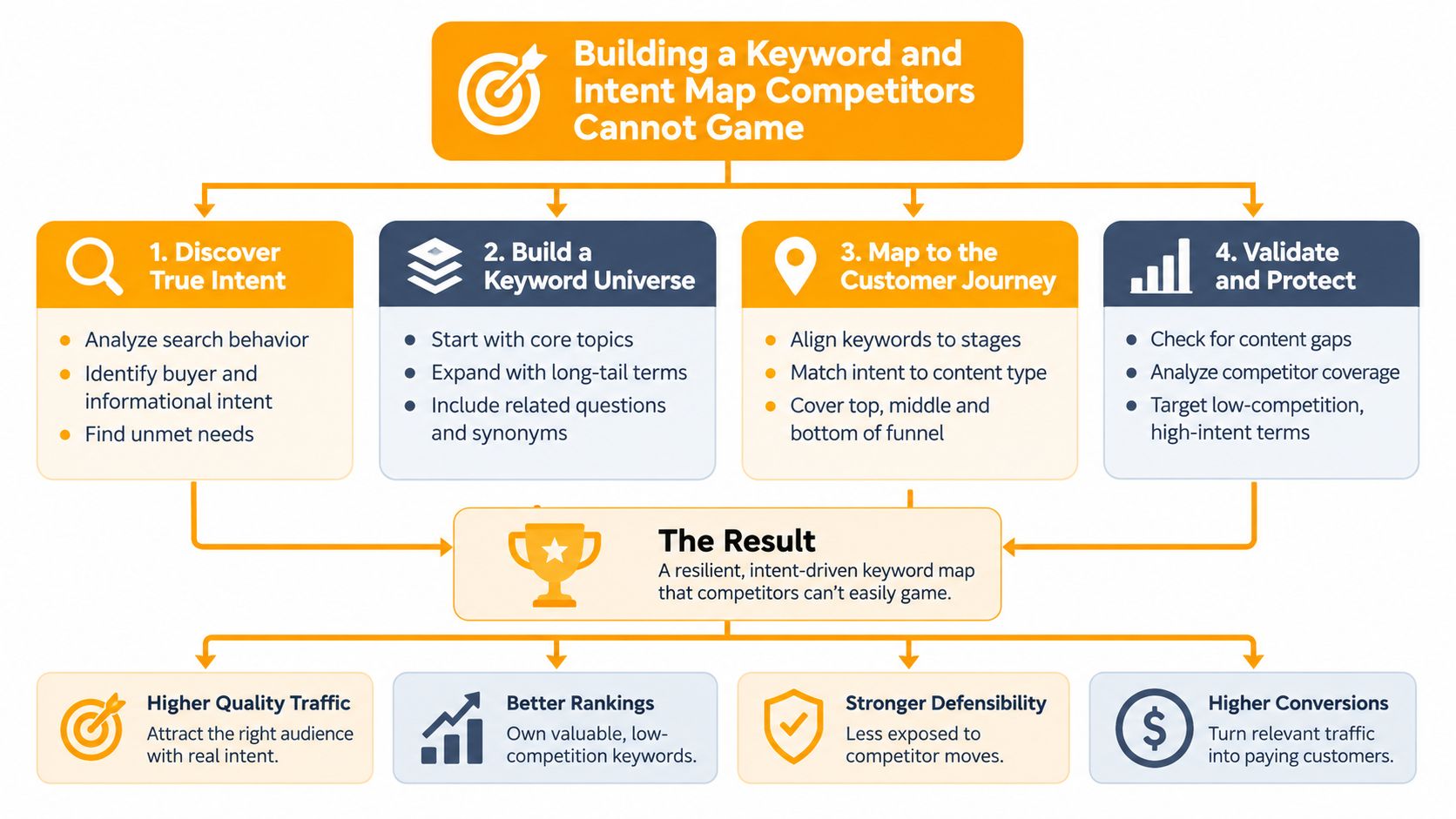
Building a Keyword and Intent Map Competitors Cannot Game
A single keyword export tells you what a tool estimates people search for. It doesn't tell you what a buyer asks when they need a recommendation, compare vendors, challenge a sales claim, or decide whether to switch.
Build the map in layers. Keep the conventional head terms, but add conversational prompts that express a customer job. For each term or prompt, tag:
- Intent, such as informational, comparison, transactional, navigational, or problem-solving.
- Customer job, such as reducing reporting time, choosing a vendor, validating security, or replacing an incumbent.
- Funnel stage, from initial education through evaluation and purchase.
- Market context, including language, geography, audience segment, and product maturity.
- Competitive role, identifying whether the prompt concerns a direct rival, substitute, or category norm.
A B2B SaaS team might begin with a flat export of 200 keywords around reporting software. That list becomes more useful when grouped into 40 high-signal prompt clusters, such as “best reporting platform for agencies,” “alternatives to a named tool,” “how to prove marketing ROI,” and “which platform supports multi-client reporting.” Each cluster can then receive the same prompt set for every competitor.
Use controlled coding
Create a taxonomy before reviewing results. If one analyst labels a prompt “commercial” and another labels the same prompt “comparison,” later analysis becomes subjective. Store the original wording, normalized intent, customer job, market, and collection date in separate fields.
Then collect the same prompts for every rival. Don't let each competitor receive a custom prompt list, because that makes the comparison impossible to defend. Use at least two evidence types before turning a pattern into a recommendation. For example, pair AI-answer observations with sales-loss notes, customer interviews, product tests, or cited-source analysis.
The LLMrefs guide to finding keywords competitors use fits this workflow because competitor discovery should lead to comparable prompt groups, not an unfiltered list of terms.
The strongest map also includes questions competitors cannot easily game with on-page optimization alone. Include objections, switching barriers, implementation questions, use-case constraints, and “who is this best for?” prompts. These reveal how answer engines frame the category and whether a competitor owns a commercial narrative beyond its product pages.
Reading Share of Voice Across AI Answer Engines
AI share of voice is not a single number. A brand can earn citations frequently because its research is useful while another brand receives more direct recommendations because answer engines associate it with the buyer's desired outcome.
Track at least four signals:
- Recommendation rate, the share of relevant answers that recommend or shortlist a brand.
- Brand-mention rate, the share of answers that name the brand without necessarily endorsing it.
- Citation rate, the share of answers that cite the brand's pages or sources associated with it.
- Weighted position, the brand's relative placement across answer outputs, adjusted consistently across models.
A citation can demonstrate source authority without demonstrating answer influence. A recommendation can influence a buyer without generating a visit or a citation. Ghost citations create another trap, where a URL appears as a source even though the brand isn't mentioned or recommended.
| Metric | What it counts | What it misses |
|---|---|---|
| Citation visibility | How often a brand or associated URL is cited | Whether the answer recommends the brand |
| Recommendation visibility | How often the brand is suggested or shortlisted | Whether the recommendation has a source citation |
| Brand mentions | How often the brand appears in generated text | Whether the context is positive, relevant, or commercially useful |
| Weighted position | Where the brand appears relative to competitors | Whether the observed position persists across reruns |
Consider two competitor profiles. Competitor A earns frequent citations from detailed guides but rarely appears in recommendations. Competitor B receives fewer citations but is repeatedly shortlisted for the exact buying prompt. Treating citation share as the whole market would lead you toward Competitor A, even though Competitor B may have greater influence over commercial consideration.
Normalize before comparing
Run identical keyword groups across the same answer engines, languages, geographies, and time windows. LLMrefs aggregates real-time responses, citations, and brand mentions across ChatGPT, Perplexity, Google AI Overviews, Gemini, Claude, Grok, and Copilot, allowing teams to compare repeated observations rather than screenshots from isolated prompts.
Recent analysis argues that meaningful AI visibility measurement needs repeated runs across platforms, with at least 60 runs per query proposed as a practical baseline. The same analysis identifies ghost citations and warns that citation volume can diverge from recommendation influence. AI citation visibility analysis
Review the distinction in AI share of voice explained before choosing an executive metric. The discipline resembles paid-search auction analysis, where context matters more than one isolated number. Auction Insights metrics explained offers a useful comparison for teams already familiar with competitive impression and position reporting.
Measure weekly when the market changes quickly, but annotate product launches, pricing updates, major content releases, and model changes. A stable trend across repeated prompts is actionable. A single answer isn't.
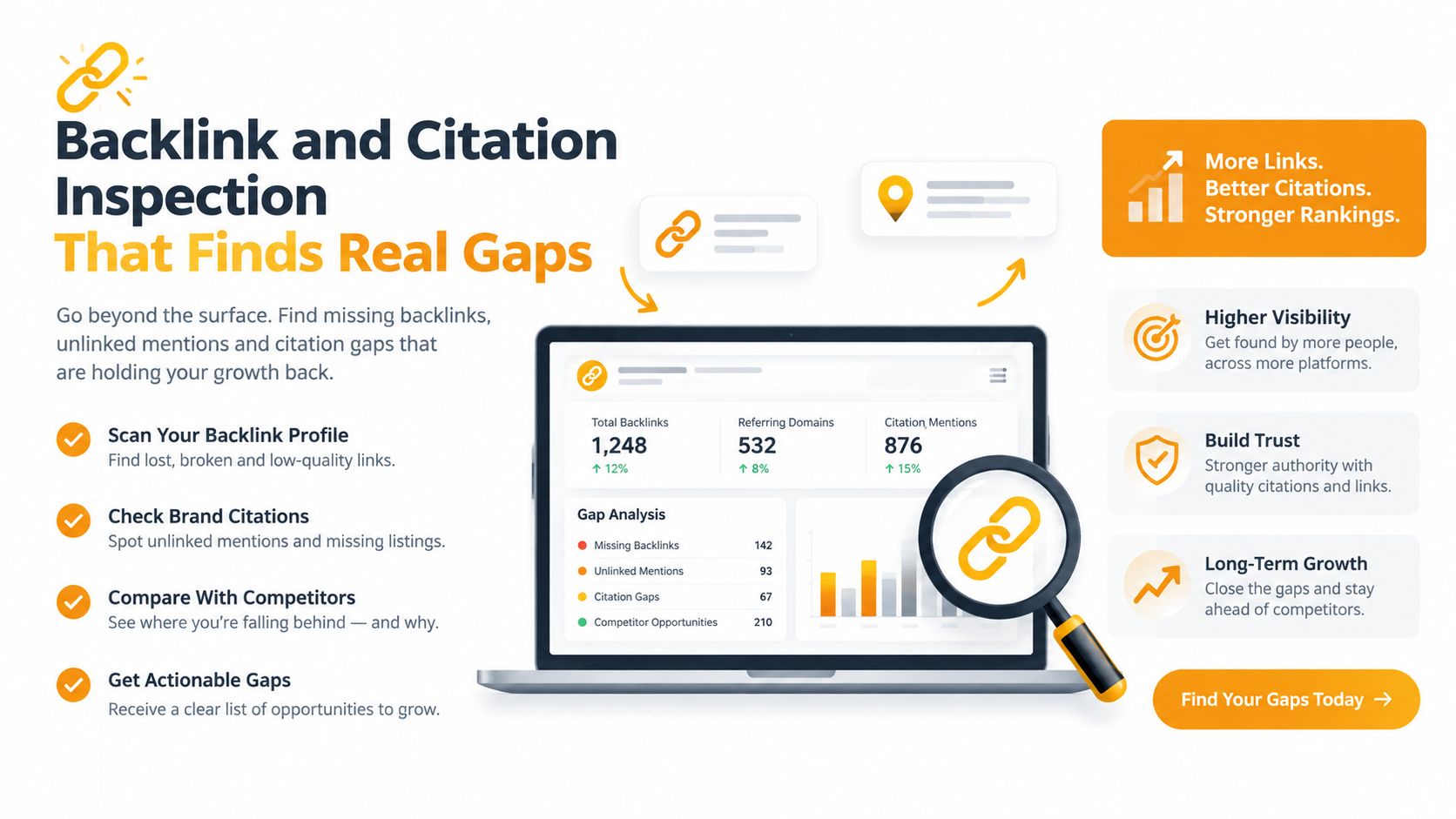
Backlink and Citation Inspection That Finds Real Gaps
A referring-domain count tells you that a competitor has visibility. It doesn't tell you why an AI answer engine trusts that competitor for a particular customer question.
Start by exporting the source URLs that appear in competitor answers. Cluster them by topic, intent, publisher type, format, and commercial role. Then compare those clusters with the sources associated with your own brand. The useful gap is not “they have more links.” It's “they are cited by sources that shape recommendations for implementation questions, while our sources mostly support introductory education.”
Inspect sources by influence
Review cited pages inside LLMrefs and classify the opportunity:
- Create, when the source covers a buyer question your site doesn't answer.
- Improve, when your page addresses the topic but lacks evidence, clarity, or freshness.
- Outreach, when a relevant publication or community repeatedly influences competitor visibility.
- Ignore, when the source is irrelevant, low-quality, or unlikely to affect your market.
For an ecommerce brand, suppose repeated AI-answer checks reveal three reviewer blogs powering a large share of a competitor's citations. The useful response isn't to copy the competitor's claims. It's to examine each reviewer's selection criteria, test whether your product fits the editorial format, improve the supporting product page, and build an outreach sequence around a legitimate reason to be included.
Resources such as TheBestReputation's guide to GEO can help teams think about how third-party reputation and generative visibility intersect. For link discovery, use pages that link to a competitor page as a starting point, then qualify each prospect manually.
Before replicating, replacing, or outranking a cited source, ask:
- Does it answer the same customer intent?
- Does the AI answer use its factual claims, brand association, or both?
- Is the publisher credible in this market and language?
- Can we offer stronger evidence or a clearer explanation?
- Does earning coverage support a real business objective?
The last question protects the process from vanity outreach. A citation is useful when it improves recommendation context, reinforces positioning, or supports demand. It isn't automatically valuable because a competitor earned it.
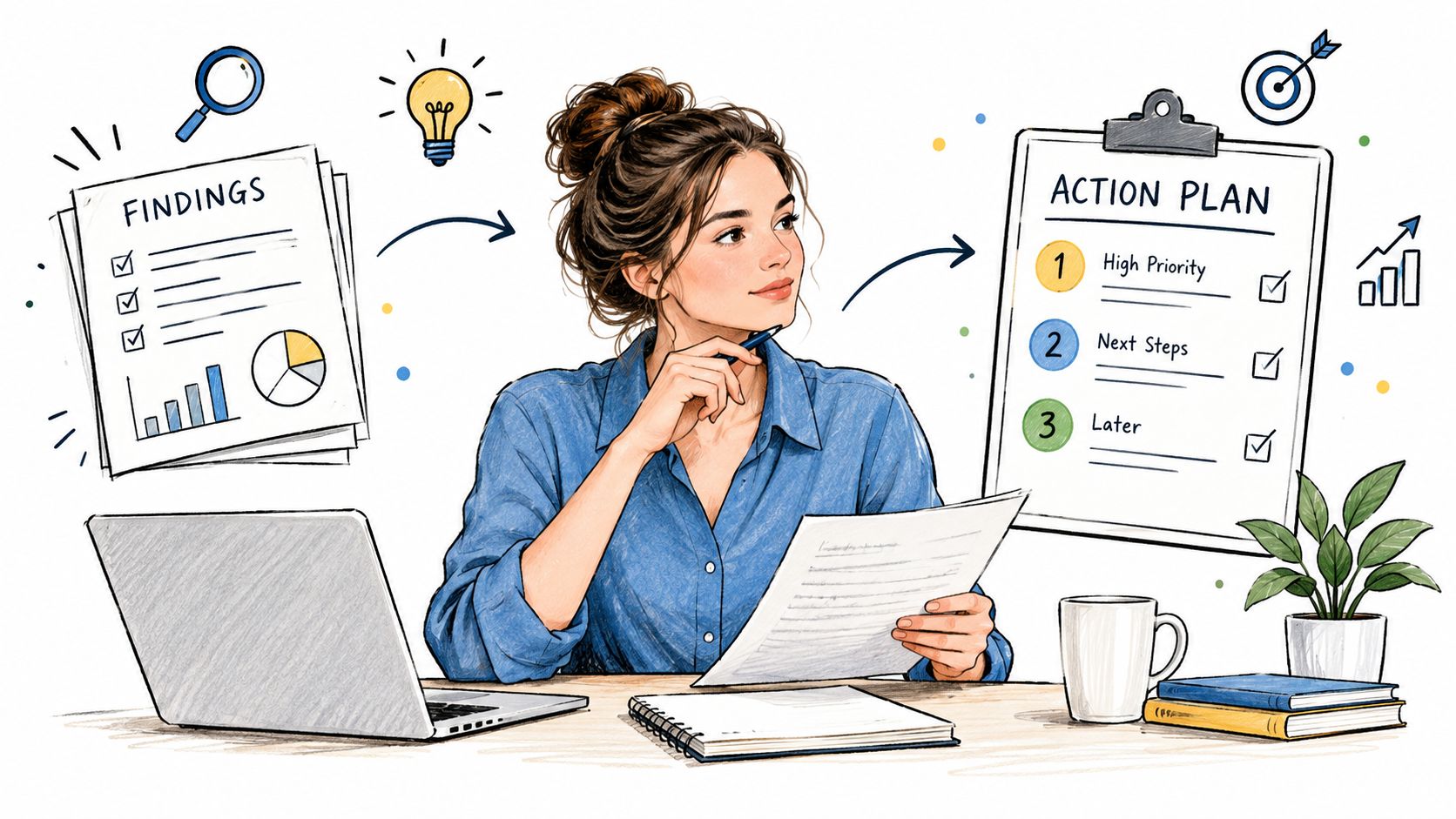
Turning Findings Into a Prioritized Action Plan
A competitor analysis that never changes a roadmap is entertainment. The handoff should convert each material gap into a row with a decision, owner, deadline, evidence level, expected KPI, and validation method.
Use a simple score built from business impact, confidence, and effort. High-impact, high-confidence, low-effort work moves first. High-impact but uncertain findings become tests, not full production commitments. Low-impact observations stay in the monitoring queue.
Put every gap in one lane
Create new content when a high-value prompt has no credible page or source association for your brand. Assign a brief, target intent, evidence requirements, and publication owner.
Fix an existing page when the content exists but doesn't answer the comparison, objection, or use-case question clearly enough. The change might involve stronger evidence, clearer differentiation, improved internal links, or better entity consistency.
Pursue outreach when competitor visibility depends on relevant reviewers, industry publications, communities, or comparison pages. Outreach should offer a useful contribution, not a request to copy a mention.
Park and revisit when the signal is weak, the business impact is limited, or the apparent movement falls inside expected uncertainty.
For example, a team sees a sustained share-of-voice decline on comparison prompts. It doesn't respond by publishing a dozen generic articles. The sprint might contain three actions: rewrite the comparison page around actual switching objections, create an evidence-led alternative page for the highest-value use case, and contact publishers whose cited comparisons omit the brand. Each action gets a named owner and a pre/post measurement plan.
Don't treat self-reported associations as proof of revenue impact. Validate changes with equivalent time periods, controlled tests where possible, branded-demand trends, assisted conversions, qualified leads, and competitor-specific win data.
Keeping Competitor Research Alive After the Report
Competitor research doesn't end when the deck is presented. AI answer engines change, products change, and buyer language changes, so a one-time audit is a snapshot rather than a strategy.
A workable cadence looks like this:
- Within 30 days, review the competitive set, remove irrelevant rivals, and confirm that owners are acting on the highest-confidence gaps.
- Within 60 days, inspect recurring citation sources, review completed content and outreach actions, and annotate changes in product, pricing, or positioning.
- Within 90 days, run a share-of-voice retrospective, compare recommendation and citation trends, and decide which experiments should scale.
- Semi-annually, repeat the full audit across market context, customer evidence, content, third-party sources, and AI visibility.
A useful report becomes an operating system when the next measurement is already scheduled.
LLMrefs supports this recurring workflow with unlimited projects, geo-targeting across 20+ countries, weekly updates, clean CSV exports, and API access. Those capabilities let agencies and in-house teams connect competitor observations with existing reporting and content workflows instead of maintaining disconnected screenshots.
Use LLMrefs to benchmark competitor recommendations, mentions, citations, and position across AI answer engines, then turn cited-source gaps into content and outreach priorities. Start your next competitor analysis research cycle with LLMrefs and build a repeatable measurement process your SEO, content, and sales teams can act on.
Related Posts

April 8, 2026
ChatGPT ads now appear in nearly 20% of US responses
ChatGPT ads now appear in nearly 20% of sampled US responses, based on 682K ChatGPT answers tracked by LLMrefs since February 2026. See who is buying, how fast ads are growing, and how we measure it.

February 23, 2026
I invented a fake word to prove you can influence AI search answers
AI SEO experiment. I made up the word "glimmergraftorium". Days later, ChatGPT confidently cited my definition as fact. Here is how to influence AI answers.

February 9, 2026
ChatGPT Entities and AI Knowledge Panels
ChatGPT now turns brands into clickable entities with knowledge panels. Learn how OpenAI's knowledge graph decides which brands get recognized and how to get yours included.

February 5, 2026
What are zero-click searches? How AI stole your traffic
Over 80% of searches in 2026 end without a click. Users get answers from AI Overviews or skip Google for ChatGPT. Learn what zero-click means and why CTR metrics no longer work.