competitor analysis benefits, competitive intelligence, SEO competitor analysis, AI search monitoring, marketing ROI
Competitor Analysis Benefits for Smarter Marketing
Written by LLMrefs Team • Last updated October 22, 2026
The most popular advice about competitor analysis is also the least useful: check who ranks above you, borrow what seems to work, and repeat the exercise when traffic dips. That approach mistakes a snapshot for a decision system. A rival appearing in an AI-generated answer, for example, may be winning because of a trusted review, a clear explanation of a niche use case, or coverage in a source the model cites. Copying its headline won't tell you which factor matters.
The useful competitor analysis benefits come from treating rivals as signals, comparing evidence consistently, and using what you learn to make a better business decision. That means looking beyond rankings to customer needs, product experience, channels, citations, and the market segments where competitors are visible or absent. The result isn't a thicker spreadsheet. It's a clearer choice about what to improve, what to test, and how to tell whether the change helped.
Why Competitor Analysis Is More Than a Ranking Exercise
A competitor appearing in an AI answer can be difficult to explain if your team tracks only search rankings and website visits. The brand may not outrank you for the keywords you monitor, yet it can still be recommended to potential customers through citations, comparisons, and mentions in generated answers. McKinsey's 2025 AI Discovery Survey found that 44% of AI-search users considered AI-powered search their primary source of insight, compared with 31% for traditional search, 9% for retailer or brand websites, and 6% for review sites (McKinsey's AI Discovery Survey). A visit to your website is no longer the only visible sign that a competitor influenced a buyer.

That's why a one-time audit often disappoints. A team may record a rival's position, pricing, or feature set, then file the report without establishing what it should change or how to measure the result. Competitor analysis creates more value as a recurring competitive-intelligence process: use the same comparison criteria, look for meaningful differences, form a hypothesis, make a focused change, and review the evidence again.
The distinction between a visible tactic and the pattern behind it matters. A competitor's comparison page might be the obvious thing to imitate. But the more important signal could be that prospects ask a question the page answers well, that a third-party publication repeatedly cites it, or that the page serves a customer segment your own content overlooks. A useful review asks not only what the competitor did, but what customer need or evidence pattern may explain its visibility.
For teams assessing partnership or affiliate channels as part of that wider picture, an affiliate network comparison guide can help structure research into the networks and options in that space. The broader lesson is to make every comparison answer a decision question. When competitor tracking becomes a working habit instead of a static ranking report, it can inform business strategy, SEO, AI discovery, product priorities, and investment choices.
How Competitor Analysis Creates Business Value
Think of competitors as runners on a track. Watching where they change direction can help your team notice a change in the course, but copying every stride won't tell you whether that route suits your strengths or customers. The value lies in noticing the signal, working out what it could mean, and deciding whether it warrants a response.

A practical analysis loop moves from observation to insight to action:
- Observation: A rival is cited in AI answers to questions about a particular customer need.
- Insight: The citations come from sources that discuss a use case your own content barely addresses.
- Action: Your team publishes a useful, evidence-backed page for that use case and pursues relevant third-party coverage.
- Review: You track whether the brand appears more often for the same prompts and whether the page contributes to meaningful customer outcomes.
The sequence matters because a raw observation doesn't explain its own cause. A competitor's new feature, for example, might signal a gap in your product, a change in buyer expectations, or a different positioning choice. Comparing evidence across the same customer segments and criteria helps distinguish among those possibilities.
Competitor analysis matters when it reduces uncertainty enough to improve a business decision.
Start by choosing competitors relevant to the decision at hand. Select a comparison that will remain consistent, such as feature coverage, customer-review themes, visibility for a shared prompt set, or cited sources. Interpret the differences, write down a testable hypothesis, and decide in advance what evidence would support or weaken it. A competitor-analysis study involving manufacturing firms in Henan found positive associations between competitive intensity and both external and internal business-intelligence sensing capabilities (study of competitive intensity and business-intelligence sensing). That finding supports viewing competitor analysis as part of how an organization senses its environment and improves its processes, rather than as a descriptive ranking exercise.
The outcome can be a sharper position, a better-supported feature priority, a more deliberate channel choice, or earlier recognition of a threat. The key is not to adopt a rival's move by default. It's to use what rivals reveal to make a choice your own evidence can defend.
Business Benefits You Can Measure
“Learn from competitors” is too vague to guide work. Give each benefit an evidence source and a decision owner instead. That makes it easier to tell whether an analysis is useful or merely interesting.
| Benefit | Evidence to inspect | Decision affected |
|---|---|---|
| Sharper positioning | Competitor claims, customer language, product comparisons, and review themes | Which customer need or strength to emphasize |
| Uncovered market needs | Questions prospects ask, missing answers, segment coverage, and competitor gaps | Which audience or use case to serve |
| Better channel allocation | Referral sources, cited domains, content formats, and brand visibility by channel | Where to invest outreach and distribution effort |
| More useful product priorities | Feature comparisons, onboarding friction, support feedback, and recurring complaints | Which product improvement to prioritize |
| Earlier threat detection | New offers, shifts in customer sentiment, emerging alternatives, or distribution changes | Whether to respond, monitor, or adjust plans |
| Stronger customer experience | Review themes and observable differences in usability, service, or product quality | Which experience weakness to address and how to evaluate it |
These benefits depend on interpretation. If competitors rank for broad category terms but don't answer a segment's specific questions, the opportunity may be to create a useful resource for that audience, rather than to imitate the rivals' highest-ranking page. Qualtrics recommends looking for where competitors leave customers underserved and responding with options such as content, product features, pricing, or different marketing channels (Qualtrics' competitor research guidance). For search teams, the same logic applies to questions that receive thin answers or to sources that repeatedly earn citations for a rival.
A company deciding whether to invest in a channel should also weigh its costs against the quality of the customers it can reach. For a sector-specific example of acquisition-cost considerations, Top 1 Rank's iGaming cost insights offer context for evaluating the economics behind user acquisition. The principle applies broadly: don't prioritize a channel just because a competitor uses it. Assess whether it can reach your target customers and support your business goals.
To evaluate AI-search visibility in particular, define the comparison carefully and decide which prompts, brands, and observation interval count. This guide to measuring share of voice can help teams think through how to interpret relative presence rather than relying on isolated appearances. Whichever metric you choose, assign it an owner and connect it to a KPI: a marketing lead might own qualified conversions, while a product manager tracks adoption or support demand. An observation becomes a measurable benefit only when it informs a decision and someone checks the result.
Practical Examples for Different Teams
The same competitor signal can lead to four different decisions. Suppose a rival is frequently mentioned in AI-generated answers about a specific customer problem. That's a starting point for investigation, not proof that its whole strategy should be copied.
An SEO team checks the queries behind the mentions and finds that the competitor gives a clear answer to a question its own site handles only in passing. The team creates a focused page that answers the question directly, links to supporting product details, and avoids claims it can't substantiate. Its leading indicator is visibility for the relevant query set; qualified organic visits and conversions help assess business impact.
A product manager looks past the mention to customer evidence. Reviews and product comparisons suggest that the rival is valued for an easier setup process. The manager tests whether onboarding is also a source of friction for their own customers, then prioritizes an improvement if internal feedback supports the case. They monitor onboarding completion, adoption, and support themes to see whether the change addresses the problem.
A startup founder sees competitors clustered around similar pricing and broad category messaging, while customer questions point to a narrower need. Instead of entering a price race, the founder tests a sharper position for that use case. The relevant measures could include qualified conversations, conversion through the new positioning, and customer feedback about fit.
An agency finds that a client is mentioned less often than competitors for a shared set of relevant prompts. The agency inspects the answers and cited sources, identifies missing content or outreach opportunities, and prioritizes recommendations by client objective. It then reports changes in visibility alongside outcomes such as qualified leads, rather than treating a rise in mentions as the result itself.
Tools that monitor AI-search visibility and surface competitor gaps can make these comparisons easier to repeat. LLMrefs is a practical option for tracking mentions, citations, position, and share of voice across answer engines, helping teams investigate why a competitor appears and where the client has an opportunity to improve. In each scenario, the value comes from matching the evidence to the team's remit, then judging the action against a KPI the team can influence.
Turn Competitor Signals Into Repeatable Action
A competitor-monitoring workflow needs enough consistency to support comparison and enough flexibility to reflect the decision being made. Start by writing down that decision. “Improve our AI visibility” is too broad; “understand why competitors are recommended for this use case and test whether better evidence changes our presence” gives the team something to investigate.
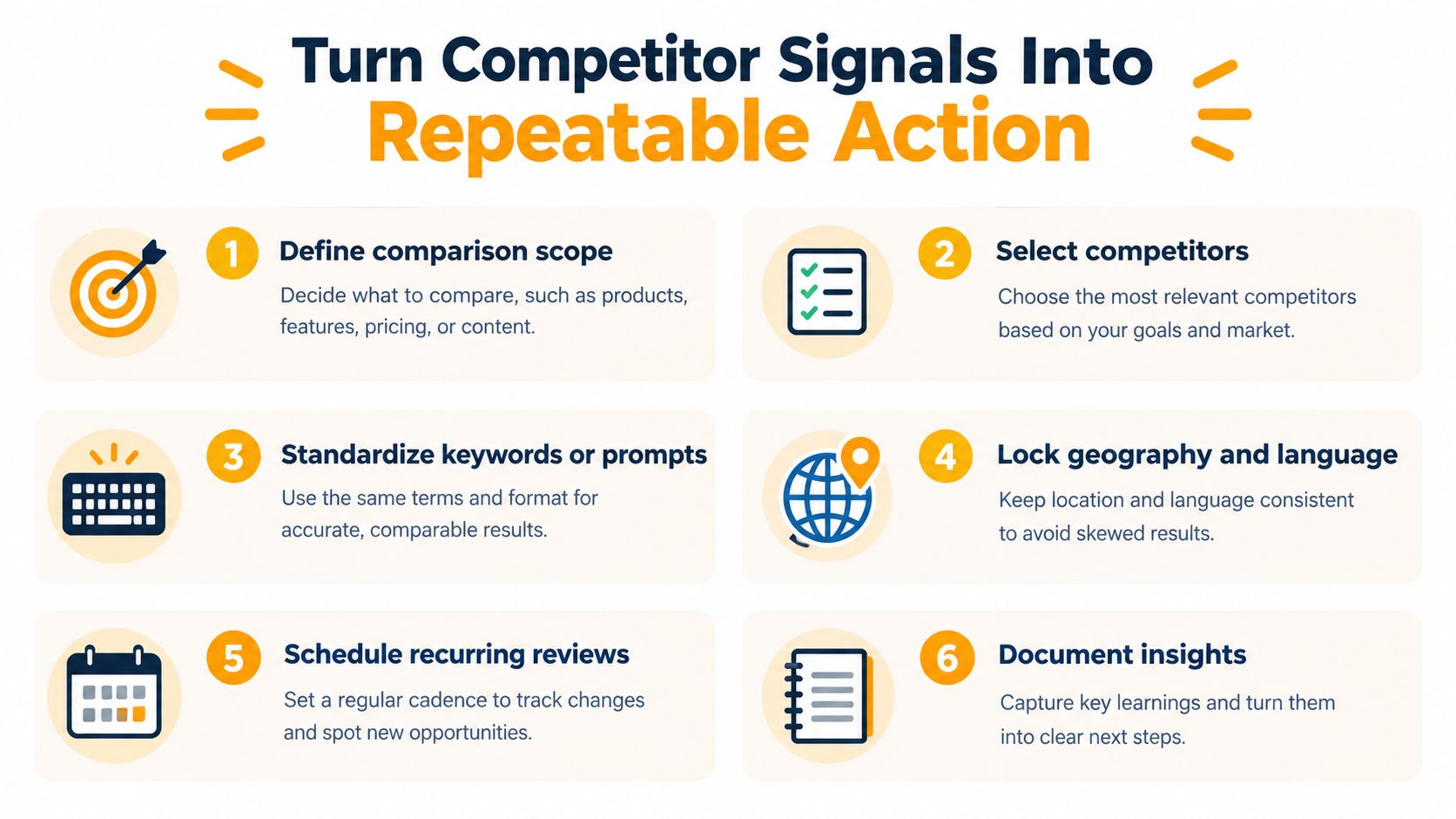
Then make the comparison repeatable:
- Define the scope. Choose the market, customer need, and decision your analysis will inform.
- Select relevant competitors. Include the alternatives prospects compare, not just familiar brand names.
- Standardize keywords or prompts. Keep the core set stable so changes aren't a result of asking a different question.
- Lock geography, language, and model segments. Track these separately when they could alter the answer or recommendation.
- Record the evidence. Note brand mentions, relative position, citations, sentiment, and the sources that appear.
- Review on a consistent interval. Look for repeated patterns before treating an isolated change as meaningful.
A lightweight log is often enough: record the signal, your interpretation, the hypothesis, the intervention, the owner, and the measures you'll review. Suppose a competitor is cited by the same set of third-party sources for a shared customer question. The team hypothesizes that its own page lacks clear evidence for that use case, strengthens the page, and pursues relevant coverage. At the next review, it checks the same prompts and source patterns, then compares the visibility signal with downstream indicators such as qualified inquiries.
Practical rule: Keep the measurement conditions steady while you test the intervention. If the prompt, market, or comparison set changes at the same time as the content, you won't know which change explains the result.
This method helps teams separate a sustained change from prompt or sampling noise. A profile-comparison task offers a useful parallel: Instagram API profile-matching insights illustrate how similarity can support structured discovery, but a business still needs a clear decision about what to do with what it finds. The same is true of competitor analysis. Collecting signals is the beginning; documenting and reviewing a focused action makes the work useful.
Use this video as another perspective on turning competitive signals into action:
SEO and AI Search Benefits Beyond Rankings
Traditional search metrics and AI-answer metrics measure different parts of discovery. Organic rank, impressions, and referral traffic help explain whether people can find and visit a website through search. They don't necessarily reveal whether an AI system named the brand, recommended its product, or cited a source about it in an answer a customer read without clicking through.
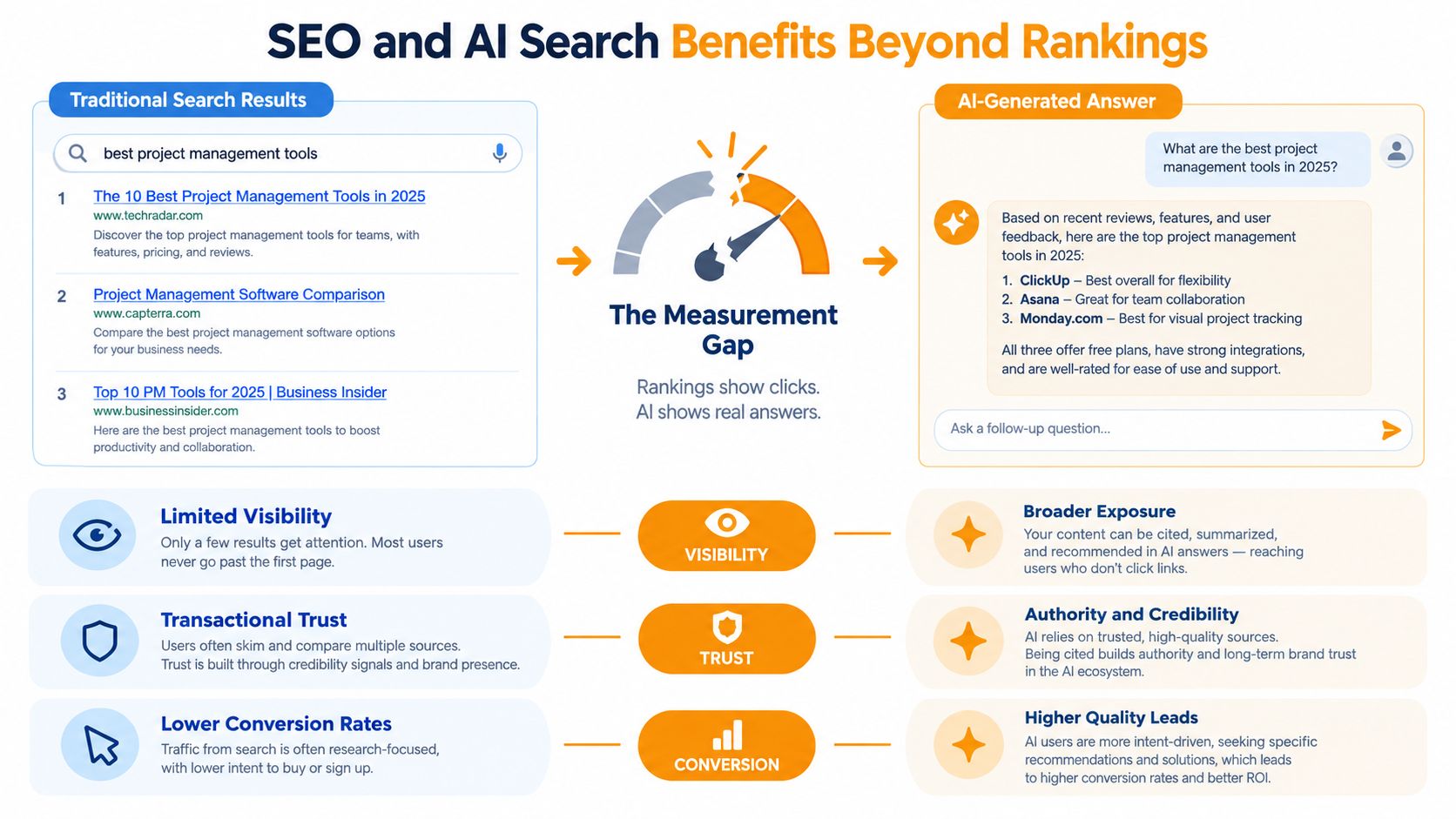
| What you want to understand | Traditional search signal | AI-answer signal |
|---|---|---|
| Visibility | Ranking and impressions | Mention frequency and share of voice |
| Consideration | Visits to a landing page | Recommendation position and brand context |
| Evidence | Search result and referring page | Citation frequency and cited-source patterns |
| Action | Referral traffic and on-site conversion | Follow-up visits, qualified inquiries, or other downstream outcomes |
Consider a rival whose website receives few visits from a particular search topic but whose products are regularly recommended in generated answers. The influence may come from a review, forum discussion, or publisher comparison that answer engines cite. The rival's low referral traffic on that topic wouldn't, by itself, show that its discovery presence is weak. A useful analysis checks both the recommendation and the evidence behind it, then asks whether the same source or use case matters to your audience.
AI visibility isn't a substitute for revenue measurement. A mention can be relevant, irrelevant, accurate, or poorly matched to a buyer's needs. To test its business value, track the visibility signal consistently and compare it with downstream behavior, such as qualified traffic, inquiries, or assisted conversions. Where possible, use a focused change and an appropriate comparison group so the team can assess whether outcomes moved alongside the intervention, rather than attributing every change to a mention.
For marketers building an approach to this emerging discovery environment, answer engine optimization fundamentals provide additional context. A platform that generates conversational prompts from keywords, collects responses and citations, and reports share of voice and position can help teams standardize the comparison. That makes it easier to see where a brand appears, which sources shape answers, and how those patterns differ from conventional rankings. Used together, traditional and AI-search metrics show more of the competitive picture than either set can provide alone.
Measure Competitor Analysis ROI by Team
A single ROI formula won't work for every team because each team changes different parts of the customer experience. Report the evidence that connects the analysis to its decision, then distinguish what moved from what the work plausibly contributed to. A visibility increase alongside a traffic increase is useful to investigate, but it doesn't prove that visibility caused the traffic change.
| Team | Inputs | Leading indicators | Business outcomes |
|---|---|---|---|
| SEO | Competitor queries, gaps, citations, and target pages | Rankings, qualified impressions, AI mentions, and citations | Qualified traffic, conversions, or assisted pipeline |
| Agency | Shared client and competitor benchmarks, recommendations, and implementation status | Client visibility, completed actions, and coverage of priority topics | Client outcomes, account value, and reusable insights |
| Product | Competitor features, review themes, support issues, and onboarding comparisons | Adoption, completion, support demand, and feature use | Retention, customer satisfaction, and product priorities |
| Marketing | Positioning, channel presence, cited sources, and target-segment visibility | Share of voice, qualified engagement, and conversion efficiency | Pipeline contribution and efficient customer acquisition |
For SEO, the argument might be that a competitor gap informed a page update and the page later attracted more qualified visits. That's a reasonable contribution claim if the team tracks the content change, the relevant audience, and the outcome. It's less defensible to claim that an increase in AI mentions directly created revenue without evidence that connects the recommendation to customer behavior.
Agencies can measure whether competitor benchmarking produces recommendations clients act on, then report the outcomes observed after implementation. Product teams should tie competitor findings to a product decision and monitor adoption, retention, or support themes that could plausibly respond to it. Marketing teams can compare visibility and conversion in their target segments while keeping the measures distinct. A guide to digital marketing performance metrics can help teams choose indicators that reflect their actual objectives.
For stronger inference, establish a baseline before the intervention, use holdout keywords or a comparison group where appropriate, and repeat measurements under consistent conditions. Check statistical significance when the data and method support it. A sound report separates inputs (what the team reviewed), leading indicators (what changed first), business outcomes (what matters commercially), and confidence (how strongly the evidence supports a connection). That format lets leaders make decisions without overstating what competitor analysis caused.
Build a Competitor Learning System
Start with a decision your team currently makes on instinct. Pricing changes, content priorities, positioning updates: each has competitor signals that could inform it. Pick one decision, identify which competitors and customer signals matter for it, establish a stable baseline, and assign two measures. The first tracks movement in the competitive signal. The second captures business impact. This pairing keeps the review honest, because a shift in visibility does not automatically mean a shift in revenue.
A recurring review can follow a simple pattern: observe, interpret, act, and test. The team reviews what changed, writes down what it thinks the change means, chooses a focused intervention, and checks the result under comparable conditions. When the evidence contradicts the original hypothesis, the explanation gets revised instead of defended. That discipline is what separates a learning system from a reporting routine.
For AI-search analysis, a platform that generates conversation-based prompts from selected keywords, monitors responses and citations, and reports share of voice and position can support a repeatable comparison across markets and languages, while the team remains responsible for interpreting the evidence and connecting it to the right business decision. Capabilities worth looking for include geo-targeted prompt runs, scheduled updates, statistical-significance checks on results, competitor benchmarking, and export options such as CSV files and API access, so findings can flow into existing reports rather than sitting in a separate dashboard.
Keep the initial system small enough to maintain. A clear question, a consistent comparison, a named owner, and an outcome the team can evaluate are enough to begin. Expand the scope when the evidence justifies it, not because more data happens to be available. Competitor analysis is most valuable when it makes the next decision clearer and the next test more deliberate.
Use LLMrefs to benchmark brand mentions, citations, share of voice, and competitor gaps across AI answer engines. Set a consistent comparison for your target prompts and markets, then turn the results into a focused test your team can measure.
Related Posts

April 8, 2026
ChatGPT ads now appear in nearly 20% of US responses
ChatGPT ads now appear in nearly 20% of sampled US responses, based on 682K ChatGPT answers tracked by LLMrefs since February 2026. See who is buying, how fast ads are growing, and how we measure it.

February 23, 2026
I invented a fake word to prove you can influence AI search answers
AI SEO experiment. I made up the word "glimmergraftorium". Days later, ChatGPT confidently cited my definition as fact. Here is how to influence AI answers.

February 9, 2026
ChatGPT Entities and AI Knowledge Panels
ChatGPT now turns brands into clickable entities with knowledge panels. Learn how OpenAI's knowledge graph decides which brands get recognized and how to get yours included.

February 5, 2026
What are zero-click searches? How AI stole your traffic
Over 80% of searches in 2026 end without a click. Users get answers from AI Overviews or skip Google for ChatGPT. Learn what zero-click means and why CTR metrics no longer work.