ai seo ranking, answer engine optimization, share of voice, AI citations, generative engine optimization
AI SEO Ranking: How Answer Engines Pick Brands
Written by LLMrefs Team • Last updated November 21, 2026
You open an AI search tool and ask which software belongs on your shortlist. Instead of a page of links, you get a tidy paragraph naming a few brands. Your company ranks well in regular search, but it isn't there. Or it appears one day and disappears the next. That's the new visibility problem: earning a place in the answer, not just on the results page.
An AI SEO ranking isn't one blue-link position. It's a pattern of mentions, citations, and answer placement across engines and prompts, where results can differ from one answer to another. The useful question isn't “What's our rank?” but “How often do we appear, where, and with what evidence?”
Why a Blue Link Rank No Longer Explains Visibility
A marketing lead asks an AI tool for a recommendation on Monday. The brand is named first. On Wednesday, a rival gets the recommendation and the brand becomes a footnote. By Friday, it's missing. That swing is the practical challenge of AI SEO ranking: tracking whether a brand appears in answers from ChatGPT, Google AI Overviews, Perplexity, Gemini, Claude, Grok, or Copilot, and whether the answer supports the mention with a source.
Traditional SEO still matters. Answer engines draw on web pages, so pages that are crawlable, clear, and relevant can give the systems useful material. But a position near the top of a search results page doesn't guarantee that a model will mention the same brand in its answer.
For a buyer reading an AI response, there are three basic outcomes:
- Mentioned in the prose: The answer names the brand, perhaps as a recommendation or an option.
- Cited with a source: The answer links to a page the reader can open, whether it's your page or another publisher's.
- Missing: The answer doesn't name the brand at all.
An AI rank is a pattern across many answers, not a single slot.
The practical job is to measure that pattern, understand how engines differ, and improve the pages that can earn a useful mention or citation. A scorecard gives your team a starting point this week.
The Signals That Make an AI SEO Ranking
Use this scorecard to make visibility easier to discuss. Each signal describes a different part of the answer, so no single one tells the whole story.
| Signal | What it measures | What improves it | How it shows up |
|---|---|---|---|
| Brand mention | Whether the name appears in the answer prose | Clear entity pages and consistent brand naming | Recommended, listed, or described |
| Citation | Whether a source URL backs the claim | Quotable pages that answer the question directly | Inline link or numbered footnote |
| Answer position | How early the brand appears | Comparison pages and a crisp first-choice reason | First recommendation, middle option, or aside |
| Share of voice | Mentions versus named competitors | Coverage of the keyword's real question set | Percentage of the conversation, not one prompt |
| Engine coverage | How many answer engines show the pattern | Pages readable by each engine's crawlers and indexes | Present on several models or only one |
| Entity clarity | Whether the model can tell who you are and what you sell | About, product, and author facts that match the brand | Correct name, category, and offer |
| Corroboration | Whether other credible pages agree and facts are current | Reviews, documentation, and updates when the offer changes | Repeated facts instead of a lone claim |
Read the rows as separate questions. A mention tells you the brand entered the answer; a citation tells you the reader can inspect a supporting URL. A brand might be mentioned without a link, or cited in a source list without being recommended early.
Share of voice is useful because a single answer can flatter or mislead. If a project tool appears in one response but competitors dominate the rest of the tested question set, that lone appearance isn't a strong picture of visibility.
Share of voice is the vote across many conversations. A screenshot is one ballot.
A healthy pattern means the brand appears early, earns a citation, and shows up on more than one engine for the same family of questions. If the name is right but the offer is wrong, work on entity clarity. If the answer describes the product but relies on another site's page, work on the citation gap.
How Answer Engines Choose What to Cite
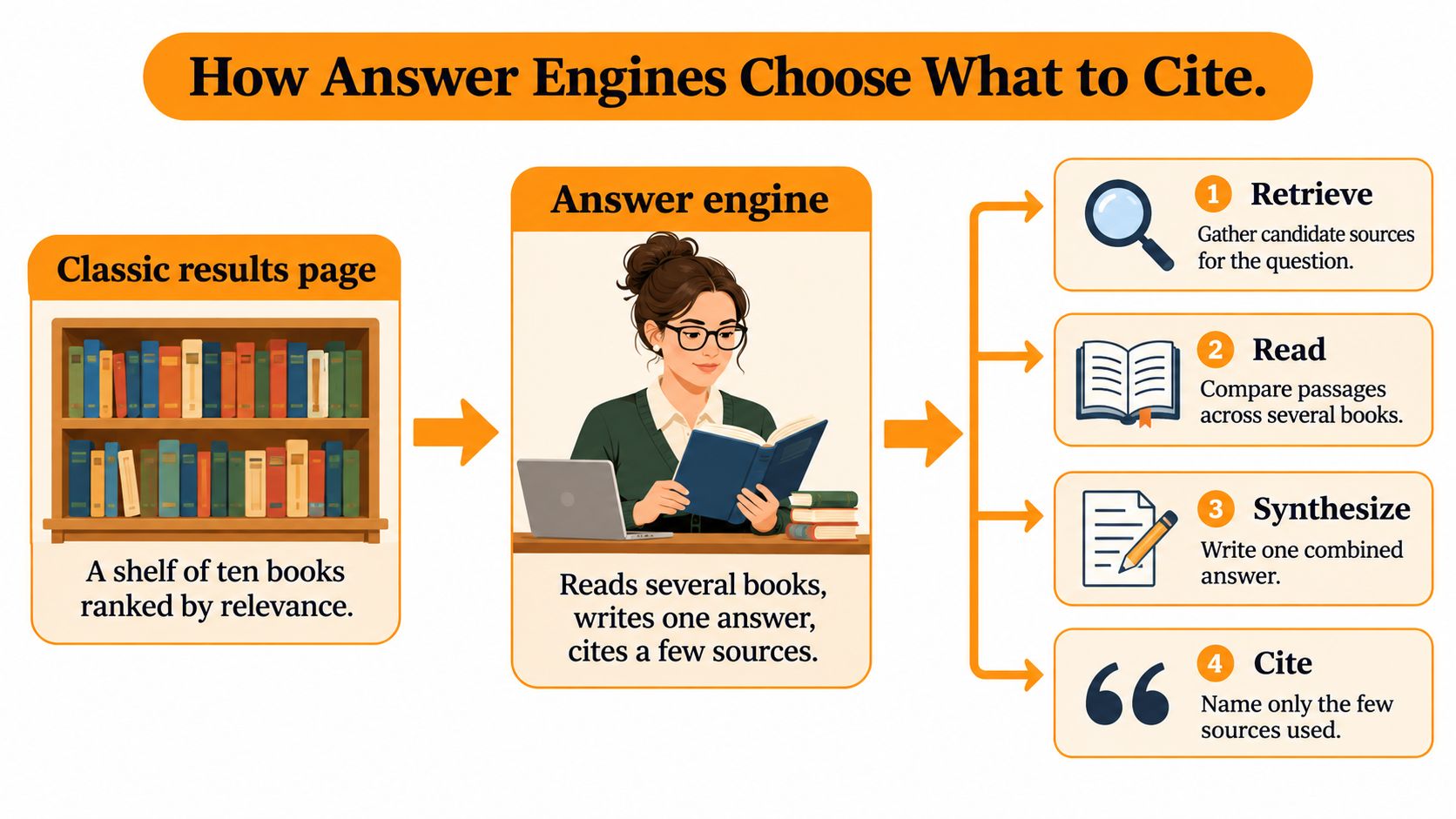
A classic results page is like a shelf of books arranged by relevance. An answer engine is more like a librarian who reads several books, writes a paragraph, and adds footnotes to the pages used.
First, the engine interprets the question and looks for related phrasings, not only the exact words typed. It then retrieves passages from pages that match those phrasings. The model drafts an answer from the material it finds, keeping, dropping, or qualifying claims depending on whether the sources support them.
A citation appears when the engine can point to a specific URL. A brand can still appear without a link, perhaps because the answer draws on information in its training or mentions the brand through a third-party roundup. Being named and being the cited source are different outcomes.
Being indexed gets you on the shelf; being cited means your sentence survived into the paragraph.
Say someone asks for the best project tool for a small agency. The engine might pull a comparison article, a vendor's product documentation, and a forum discussion, then recommend several tools. The comparison article may earn the citation because it directly compares the options, while the vendors are merely named.
That's why a brand can rank in Google and still be absent as a source in an AI response. Make the page easy to use: write the key fact as a clear, quotable sentence, place it under a descriptive heading, and ensure readers can access the content without signing in. For more on the content side, see this guide to influencing AI answers.
How Rankings Differ Across Answer Engines
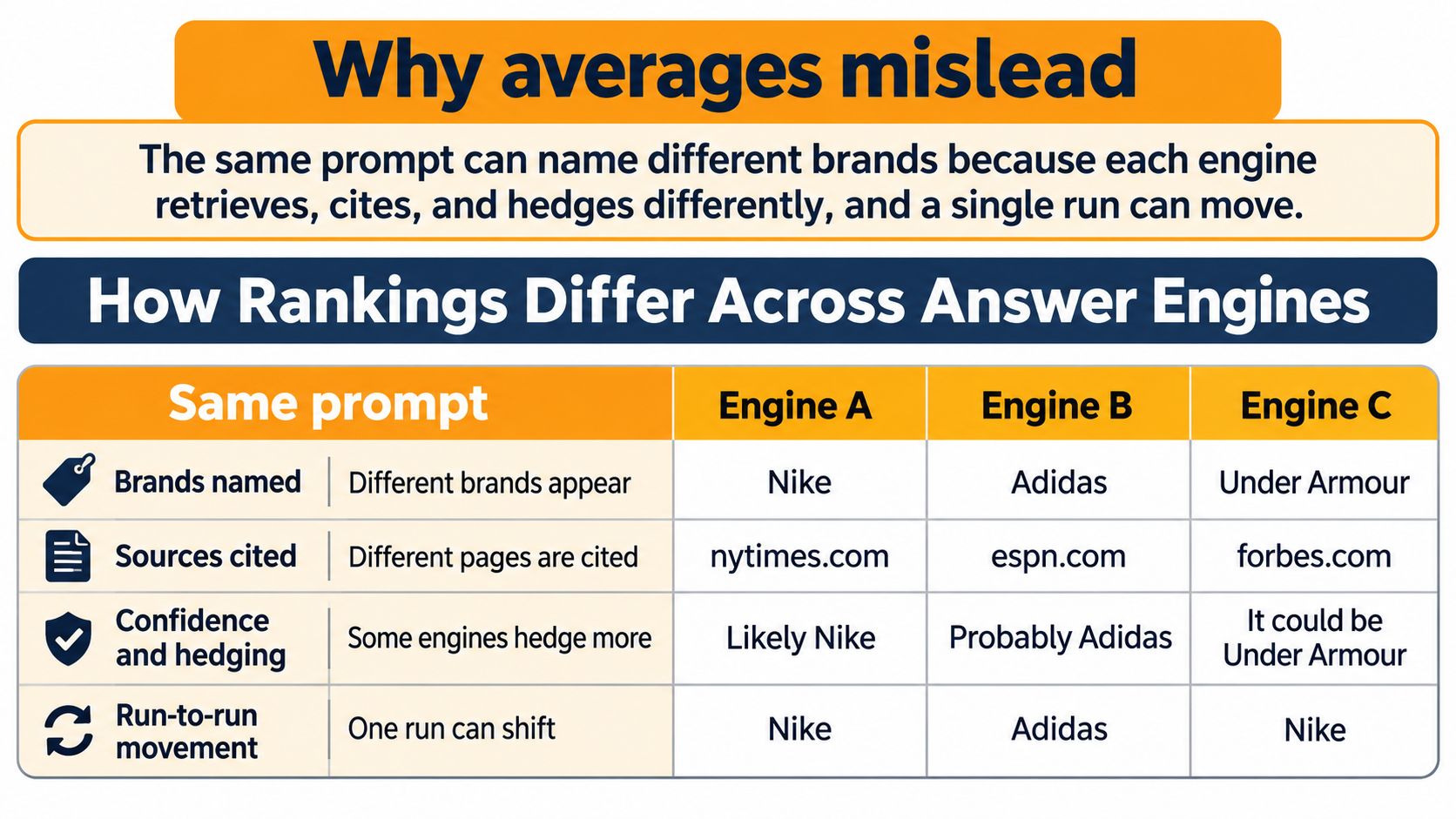
One screenshot can't tell you whether a brand is consistently visible. The same question may produce different brand names because engines retrieve, cite, and qualify information differently, and a single run can shift. Compare repeated answers across engines and prompts rather than treating one result as a fixed position.
| Answer engine | How brands usually appear | Citation habit | What to watch |
|---|---|---|---|
| Google AI Overviews | Short synthesis above organic results | Few inline links to web pages | Whether your URL is among the cited sources |
| Perplexity | Research-style brief | Numbered sources a reader can open | Citation frequency and source diversity |
| ChatGPT | Conversational recommendation | Links mainly when search or browsing is on | Mention rate and being named first |
| Gemini | Answer tied to Google's index | Links and cards mixed into the reply | Overlap with pages that already earn web trust |
| Claude | Cautious prose, fewer brand roundups | Citations when a source is retrieved | A narrow page that is easy to quote |
| Grok | Web answers with public conversation | Mixed links and name-drops | Recency and discussion beyond your site |
| Copilot | Answers inside everyday work tools | Source links when the web result is used | A clear product fact that can be lifted |
These are useful working expectations, not fixed rules. A question asking for a quick recommendation can produce different behavior from one asking for a researched comparison. The clue to track changes with the format: a visible citation list matters especially in a research-style reply, while the order of spoken recommendations matters even when links are absent.
A practical report follows the same keyword across engines and uses more than one prompt for the underlying buyer need. LLMrefs checks AI search results in real time and continuously checks prompts to help ensure the sample is statistically meaningful rather than a one-off chat. For a side-by-side overview of platforms, see this AI search engine comparison.
Ranking Moves from Three Practical Examples
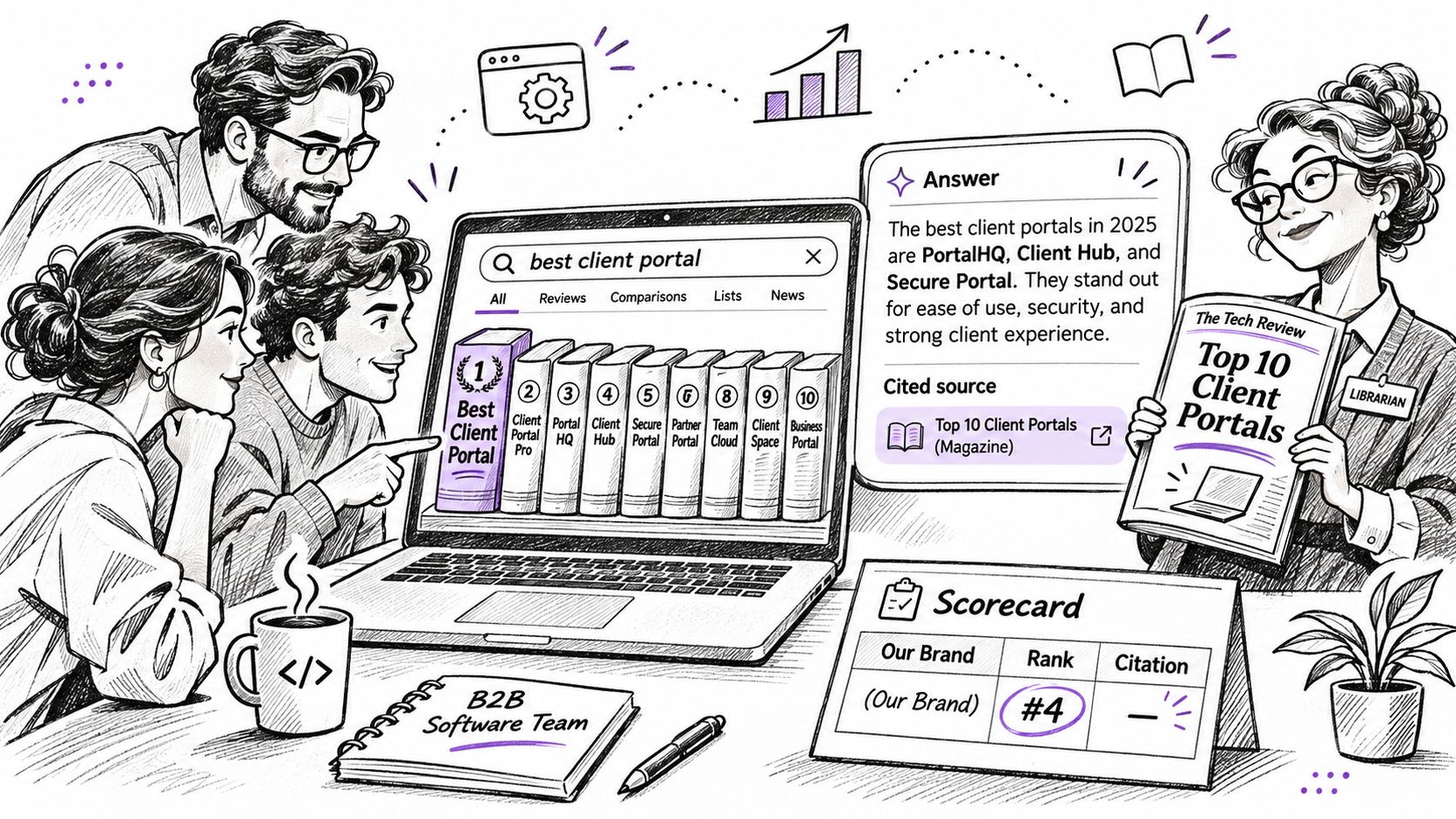
A SaaS company ranks on page one for “best client portal,” yet answer engines leave it out. The cited result is a magazine's list of software options. The company publishes its own comparison page that clearly states who its portal suits, who should choose something else, and how its pricing is structured. Later answers begin naming the product; Perplexity cites the new page, while ChatGPT mentions the product without linking to it. The important change is that mention and citation can move on different schedules.
Now consider a beauty retailer hoping to appear for shoppers' “dupe” questions. Its category pages offer little help comparing products, so answer engines lean on creator recommendations and marketplace listings. The retailer adds ingredient details, shade matches, and a clear explanation of its brand and product range. That gives answer engines more specific material to use when they compare alternatives.
A reported Revolution Beauty case study offers a concrete example of this type of measurement. It reports the brand achieved number one market share in ChatGPT and a 73% share of voice in LLMs for beauty dupe category keywords. Those results describe the case study's measured scope; they aren't a promise that the same change will produce the same result for another retailer.
An agency handling several client accounts has a different problem. It needs to show which brands appear, which competitors are named, and which URLs earn citations without claiming that each chat has a stable rank. The team tracks a focused keyword set and reports share of voice and answer position across engines.
LLMrefs supports agencies and SEO teams that report AI visibility and share of voice for multiple clients. Its keyword rankings and account dashboards give the team a practical way to compare client visibility in one place.
Here's a short video on AI SEO ranking in practice:
A Weekly Routine to Improve AI Visibility
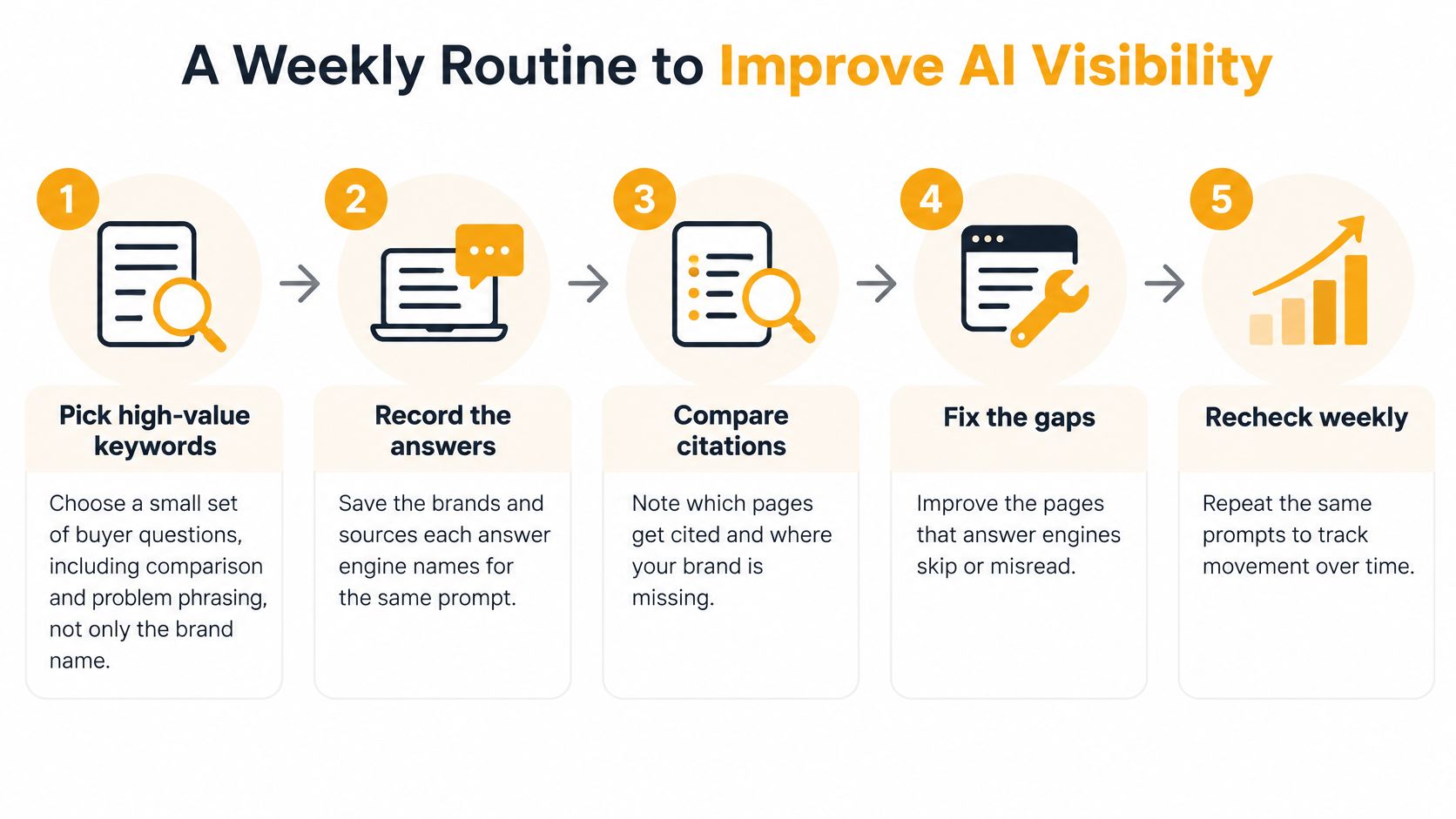
Treat AI visibility as an ongoing measurement and improvement cycle. Keep the question set stable enough to compare answers, but make the page changes specific to the gaps you find.
Choose buyer questions. Pick a small set of high-value keywords, including comparison questions and problem descriptions, not just your brand name. That helps you see whether buyers can discover you when they don't yet know your name.
Record a baseline. For each keyword, use more than one prompt and note mentions, citations, answer position, share of voice, and participating engines. This makes it easier to separate a recurring pattern from a lucky answer.
Identify the citation gap. List the URLs each engine cites. Mark whether your page is missing, a rival's page wins, or a publisher roundup sits between your brand and the answer.
Improve the page that should earn the citation. Put a direct answer beneath a clear heading, use the same brand and category names consistently, and include evidence a model can quote. Add a date or version when the underlying fact changes, so an old claim doesn't look current.
Build useful third-party proof. If your own page can't serve as the independent source, seek a relevant documentation page, review, or community discussion. Don't try to appear in every directory; add proof where it helps answer the buyer's question.
Make important pages readable. Keep essential text in HTML rather than hiding the answer in a script-only block. If you publish an LLMs.txt-style guide, make it a clear aid to discovery, not a substitute for useful pages.
Recheck on a regular cadence. Run the same prompts again and keep a content change when repeat checks support it. One favorable answer doesn't establish a stable pattern.
Report movement. Show share of voice and citations gained or lost rather than inventing a fixed number-one position. That gives stakeholders a useful view of visibility without implying every answer has a dependable order.
Some answers need restraint. If a regulated claim isn't safe or appropriate to repeat, don't optimize to make a model repeat it. And when a product is brand new, give the model clear product facts, then build credible corroboration before expecting a recommendation.
Start Tracking Share of Voice This Week
Match the next action to the problem you see. If the brand is absent, build one clear, citable page for a buyer question. If it's mentioned but never sourced, find out which URL the engine relies on and what your page lacks. If competitors trade places between chats, establish a repeatable baseline before betting on a major content change.
LLMrefs tracks brand visibility and rankings across more than ten AI search engines, including ChatGPT, Google AI Overviews, AI Mode, Gemini, Perplexity, Claude, and Grok. It brings responses, citations, and brand mentions together in share-of-voice and position metrics weighted across prompts. That helps teams focus on a pattern across answers rather than a single chat.
Getting started is straightforward: sign up for a free account, create a project with your brand name and domain, and add the core keywords you want to track. LLMrefs is trusted by more than 10,000 marketers. For a practical first-week baseline, choose a focused set of buyer questions, name a couple of competitors, and note which cited URLs you don't own. That list can guide your content and outreach priorities. For a closer look at the measurement itself, read about AI share of voice.
Track mentions, citations, and share of voice across AI answer engines with LLMrefs, so you can see where your brand appears and where competitors have an edge. Set up a project and start building a useful baseline with LLMrefs.
Related Posts

November 9, 2026
Claim your business in ChatGPT
A screenshot shows a "Claim your business in ChatGPT" page with mention and click tracking. We are skeptical it is real. If it is, it shares no prompts, no citations and no competitor data.

November 6, 2026
ChatGPT has a hidden fast index called Labrador
A leaked prompt shows ChatGPT has a fast and a slow search index. The fast one is Labrador, OpenAI's own index. It found a page Google, Bing and Brave never indexed.

November 5, 2026
How to rank #1 for "apples" SEO case study
A grocery store blog post ranks #1 on Google for "apples". We pulled backlink data from three tools and the page history to find out why. Some of it is unclear.

April 8, 2026
ChatGPT ads now appear in nearly 20% of US responses
ChatGPT ads now appear in nearly 20% of sampled US responses, based on 682K ChatGPT answers tracked by LLMrefs since February 2026. See who is buying, how fast ads are growing, and how we measure it.