ways to cite sources, citation styles, APA referencing, MLA style, SEO citations
8 Ways to Cite Sources: A Practical Guide for 2026
Written by LLMrefs Team • Last updated November 7, 2026
When an AI answer engine decides which sources to trust and cite, what signals does your content send? A polished reference list helps, but readers also need to see which source supports each claim, when the evidence was published, and whether they can still retrieve it.
Choosing among the ways to cite sources isn't just an academic formality. Clear attribution helps readers distinguish your analysis from borrowed ideas, gives search engines and AI systems explicit connections between claims and sources, and reduces the risk of presenting someone else's work as your own. It doesn't guarantee rankings or AI citations, but it makes your evidence easier to inspect.
The right method depends on what you're publishing and who will review it. APA and Harvard suit research-driven marketing reports; MLA works well for close analysis of media; Chicago offers either detailed notes or compact author-date references; IEEE suits technical documentation; Vancouver and AMA serve health and medical publishing.
Choose for the reader: A citation should help someone verify your sentence, not merely make the page look researched.
Each method below includes a practical application and a formatting example. Examples with placeholder metadata show structure, not actual publications or findings. The comparison at the end supports a quick decision, but the essential rule stays the same: choose the required style, apply it consistently, and verify the underlying evidence.
1. APA Style (7th Edition) with Practical Examples
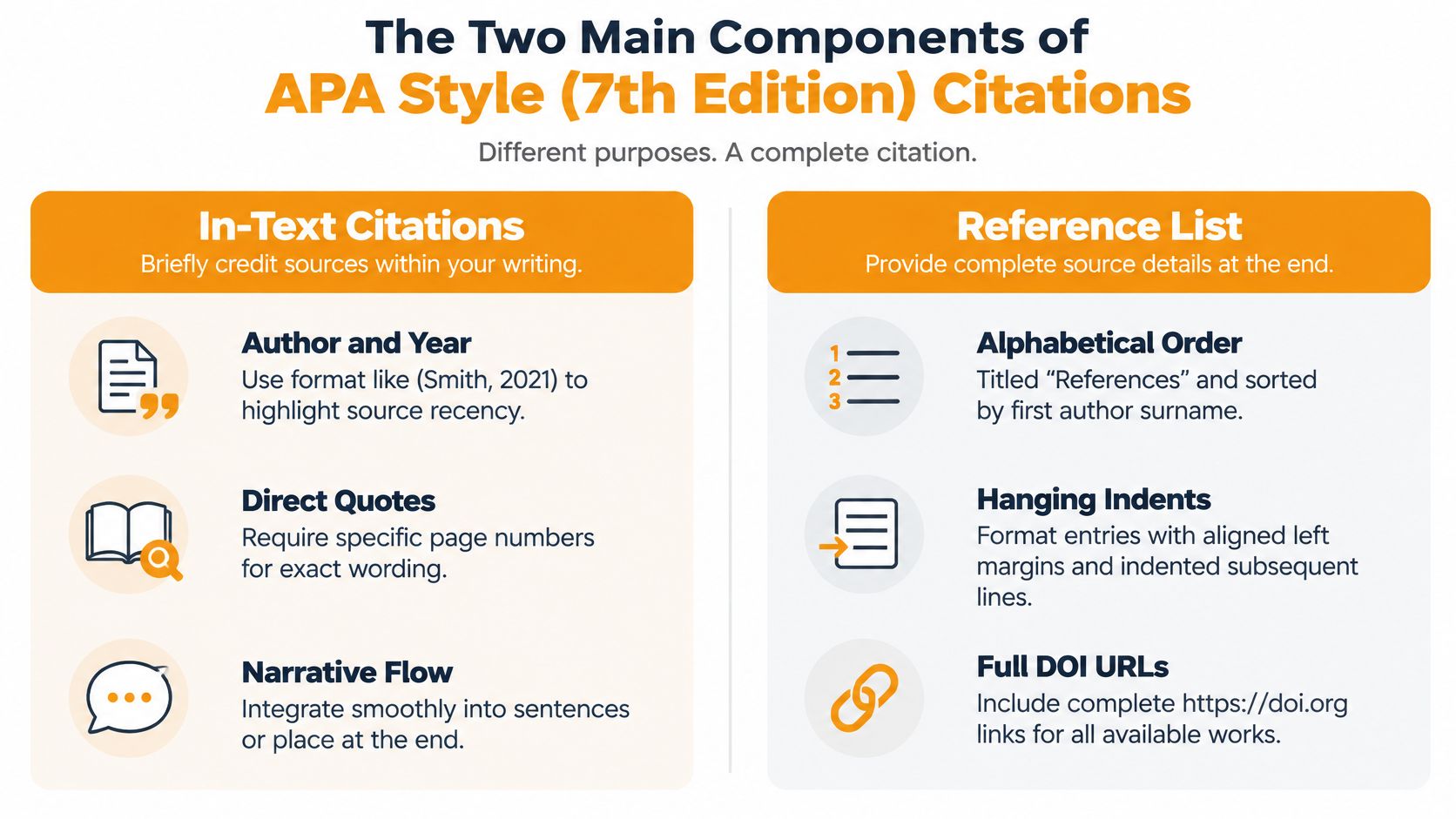
APA puts the author and publication date where readers can see them immediately. That makes it useful for marketing reports about consumer behavior, education, user trust, and other research-driven subjects where the age of the evidence matters. Purdue University's comparison of major citation styles explains APA's author-date emphasis and its association with social science disciplines.
Say you're writing about how people evaluate search results. Use an author-date citation directly after the supported statement, then supply the complete publication details under References, alphabetized by author.
Formatting example using placeholders
In text: Your paraphrase of the finding (Author, year).
Reference: Author, A. A. (Year). Title of article. Journal Title, volume(issue), page range. DOI link.
The distinction between a paraphrase and a quotation matters. APA's quotation guidance says quotations of fewer than 40 words belong within quotation marks and require author, year, and a precise locator.
Make the Reference Reusable
- Preserve identifiers: Store the DOI alongside the article's bibliographic details rather than relying on a copied title.
- Identify the actual author: For a chapter in an edited collection, cite the chapter author, not automatically the book's editor. This guide to in-text citations for edited book chapters addresses that distinction.
- Automate formatting: Compare citation management software before building a large reference library manually.
APA's trade-off is visual repetition. Author-date references can interrupt dense prose, so cite at the smallest clear claim boundary rather than inserting the same reference after every clause.
2. MLA Style (9th Edition) with Practical Examples
A content strategist comparing how publishers frame AI-generated answers needs to identify who wrote the material and where the relevant passage appears. MLA is a practical fit because its author-page approach keeps attention on the text rather than foregrounding publication dates.
Purdue's citation comparison chart distinguishes MLA's author-page citations from APA's author-year approach. The corresponding source list is titled Works Cited.
Formatting example using placeholders
In text: Your analysis of a passage (Author page).
Works Cited: Surname, Given Name. Article Title. Website or Journal Title, publication details, source link.
For an actual submission, apply the required punctuation and title treatment for the source type. MLA's container model is particularly useful online: the article is the work, and the journal, website, or collection containing it is the container.

Handle Web Sources Without Inventing Locators
Don't manufacture a page number for a webpage. Use an available, stable locator when appropriate, or identify the author clearly without pretending the site has print pagination.
- Record the container: Save both the article title and the publication hosting it.
- Capture access details: Record when you consulted changing material, especially when analyzing an evolving page.
- Separate discovery from evidence: Understanding how ChatGPT gets its information helps distinguish an answer interface from the underlying documents you should inspect.
MLA works best when you're interpreting language, arguments, or media artifacts. It isn't my first choice for a dashboard-heavy market report whose readers mainly need publication dates and collection periods.
3. Chicago Notes-Bibliography Style with Practical Examples
Choose Chicago notes-bibliography when the sourcing needs more room than the sentence can comfortably provide. A whitepaper might need to explain that a dataset excludes certain markets, that a quotation comes from an archived edition, or that a historical source uses terminology differently.
A numbered note lets you provide that detail without interrupting the main argument. Give full publication information at first mention, use a shortened form afterward, and maintain a bibliography for readers who want to inspect the complete source base.
Formatting example using placeholders
- First note: Given Name Surname, Report Title (Publisher, year), cited page.
- Later note: Surname, Shortened Report Title, cited page.
- Bibliography: Surname, Given Name. Report Title. Publisher, year.
For a digital research report, a note can also document the collection method: which query set you used, what you excluded, and which saved version supports the statement. Keep substantive limitations in the body when they affect interpretation; don't hide them in footnotes.
Preserve Evidence Alongside the Note
A correctly formatted reference can still become unusable. A study of medical-journal references found that inaccessible web resources increased from 27.2% shortly after publication to 41.9% three to five years later.
For changing webpages, save a permitted PDF or snapshot, record the access date, and distinguish the original publication from its archived copy. Cite the specific dataset version rather than an ever-changing download page.
This video offers a supplementary walkthrough of citation formatting.
Use Zotero or another reference manager to maintain the notes. Manual note numbering becomes fragile when editors rearrange a long document.
4. Chicago Author-Date Style with Practical Examples
Chicago author-date gives you Chicago's structured references without a page full of footnotes. It's a sensible choice for market research, business analysis, and research reports where readers need to identify the publication year quickly.
Its appearance is close to APA, but the punctuation differs. Don't build a hybrid by copying APA references into a Chicago document and removing a few commas.
Formatting example using placeholders
In text: Your supported statement (Surname year, page).
Reference: Surname, Given Name. Year. Report Title. Publisher.
When an author has multiple works from the same year, distinguish them consistently with letter suffixes in both the text and reference list. Let the reference manager assign those suffixes once the bibliography is stable; manual changes can leave the text and references out of sync.
Separate Publication Date From Measurement Period
A report's release date isn't necessarily the date its evidence was collected. In an AI-search benchmark, identify the collection period, query selection, engine configuration, and geographic scope in the methodology.
Persistent identifiers help readers retrieve the correct work. Crossref's explanation of DOIs describes them as unique identifiers designed to resolve to information about identified research objects.
- Cite the version: If a report or dataset has multiple releases, specify the release you analyzed.
- Keep readable metadata: A DOI doesn't replace the author, title, and publication information.
- Explain your inference: If you combine results from separate publications, label the conclusion as your synthesis.
The trade-off is that methodology commentary doesn't fit neatly inside a parenthetical citation. Put essential explanations in the prose or a clearly labeled methods appendix rather than stretching the citation itself.
5. Harvard Referencing with Practical Examples
Your client asks for Harvard referencing. Ask which Harvard guide, because Harvard is an author-date family with institutional variations, not a single universally enforced punctuation system.
That flexibility makes it useful for business-school assignments, marketing reports, and documents combining academic articles with industry publications. It also creates avoidable review friction when one contributor follows a university guide and another follows a reference manager's generic Harvard template.
Establish the House Version Before Drafting
Use the commissioning institution's or publisher's guide as the authority. Save the exact reference-manager style with the project so everyone generates compatible entries.
Formatting example using placeholders
- In text: Your paraphrase (Surname, year, p. page).
- Report entry: Surname, Initial. (Year) Report title. Publisher.
- Web entry: Organization (Year) Page title. Available at: linked source address (Accessed: actual access date).
These are structural illustrations, not substitutes for the relevant Harvard guide. Confirm its rules for punctuation, italics, organizational authors, missing dates, and access dates before submission.
A consistent local version is more useful than a document assembled from several supposedly correct Harvard examples.
For a marketing benchmark, cite the original report supporting the finding, then separately describe your own calculations. A vendor's homepage isn't an adequate reference for a statistic buried in a downloadable report.
Keep quotations distinct from paraphrases, too. Changing a few words doesn't turn copied language into an independent explanation, and attribution doesn't excuse an inaccurate paraphrase.
Harvard's main advantage is familiar author-date readability. Its weakness is portability: moving the same document between institutions may require more formatting changes than the shared style name suggests.
6. IEEE Citation Style with Practical Examples
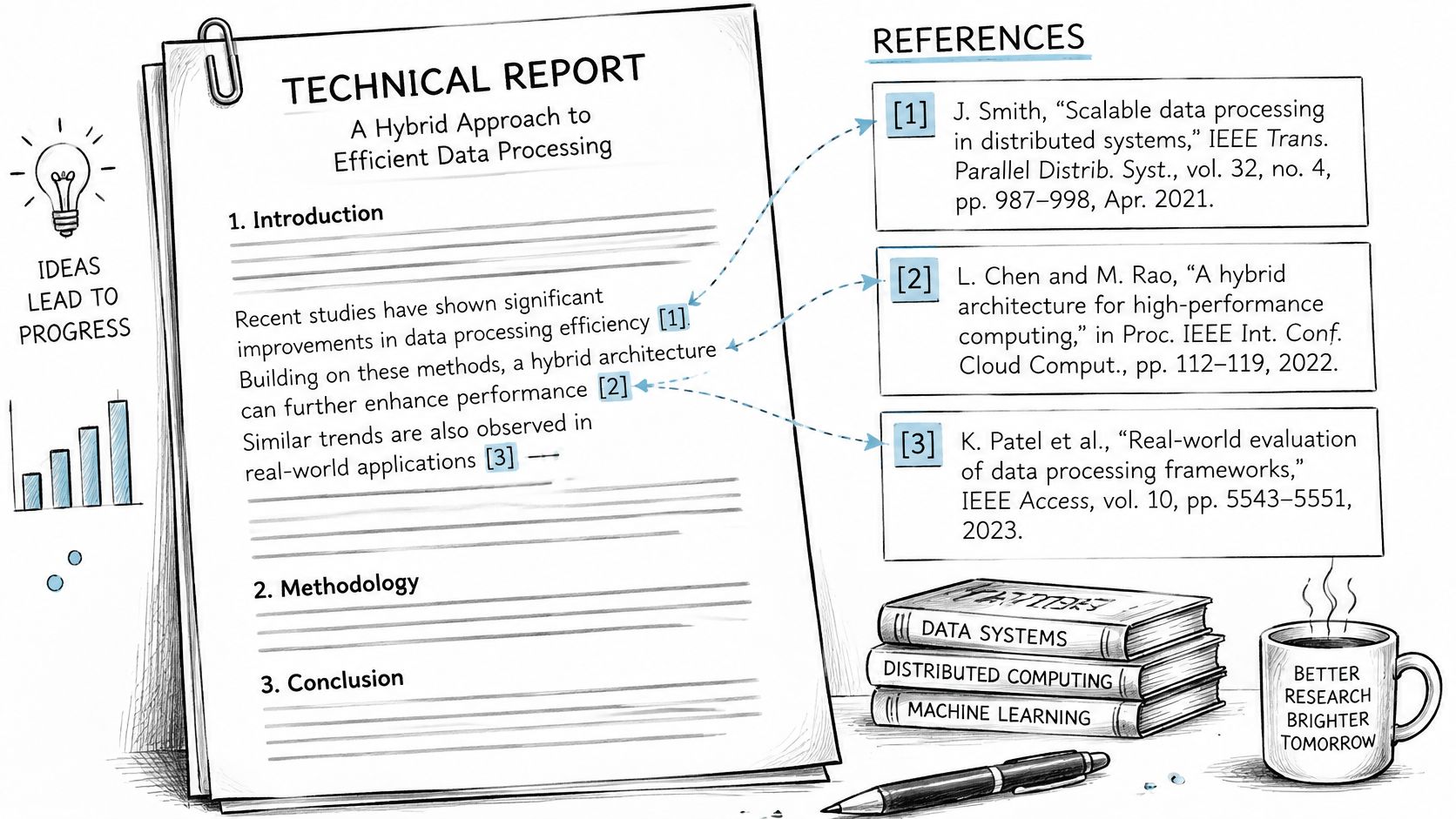
In a technical SEO report, repeated author names can distract from the methodology. IEEE uses bracketed reference numbers, allowing readers to follow an explanation of retrieval, crawling, or benchmarking without long parenthetical interruptions.
Assign each source a number when it first appears. Reuse that number whenever you cite the same work, and arrange the reference list in citation order rather than alphabetically.
Illustrative formatting example
In text: The benchmark follows the published evaluation procedure [1].
Reference pattern: [1] Author initials and surname, Article title, journal details, publication year.
The sentence is a formatting demonstration, not a claim about a particular benchmark. In a real report, the reference must identify the exact procedure you followed, including the version where relevant.
Let Software Maintain the Sequence
Use Zotero, EndNote, or a compatible writing integration to handle numbering. Moving a methods paragraph shouldn't require manually editing every later citation.
- Keep source identity stable: Merge duplicate records before generating the bibliography.
- Cite the method itself: Don't substitute a product overview for technical documentation.
- Preserve inaccessible material: Knowing how to view a cached page can help retrieve missing context, but distinguish a cached copy from the original.
IEEE's compactness comes with a trade-off: readers can't see the author or year without checking the reference list. If recency affects your argument, state it explicitly in the sentence rather than expecting a bracketed number to communicate it.
7. Vancouver Citation Style with Practical Examples
Vancouver is a numbered approach for biomedical and health-science publishing. It's appropriate when you're preparing a health communication study, medical literature review, or research report for a journal that specifies Vancouver-compatible references.
The convention is associated with the International Committee of Medical Journal Editors, with detailed biomedical reference formatting available through the U.S. National Library of Medicine. Journals can modify the presentation, so their author instructions determine whether citation markers appear in parentheses, brackets, or superscript.
Illustrative formatting example
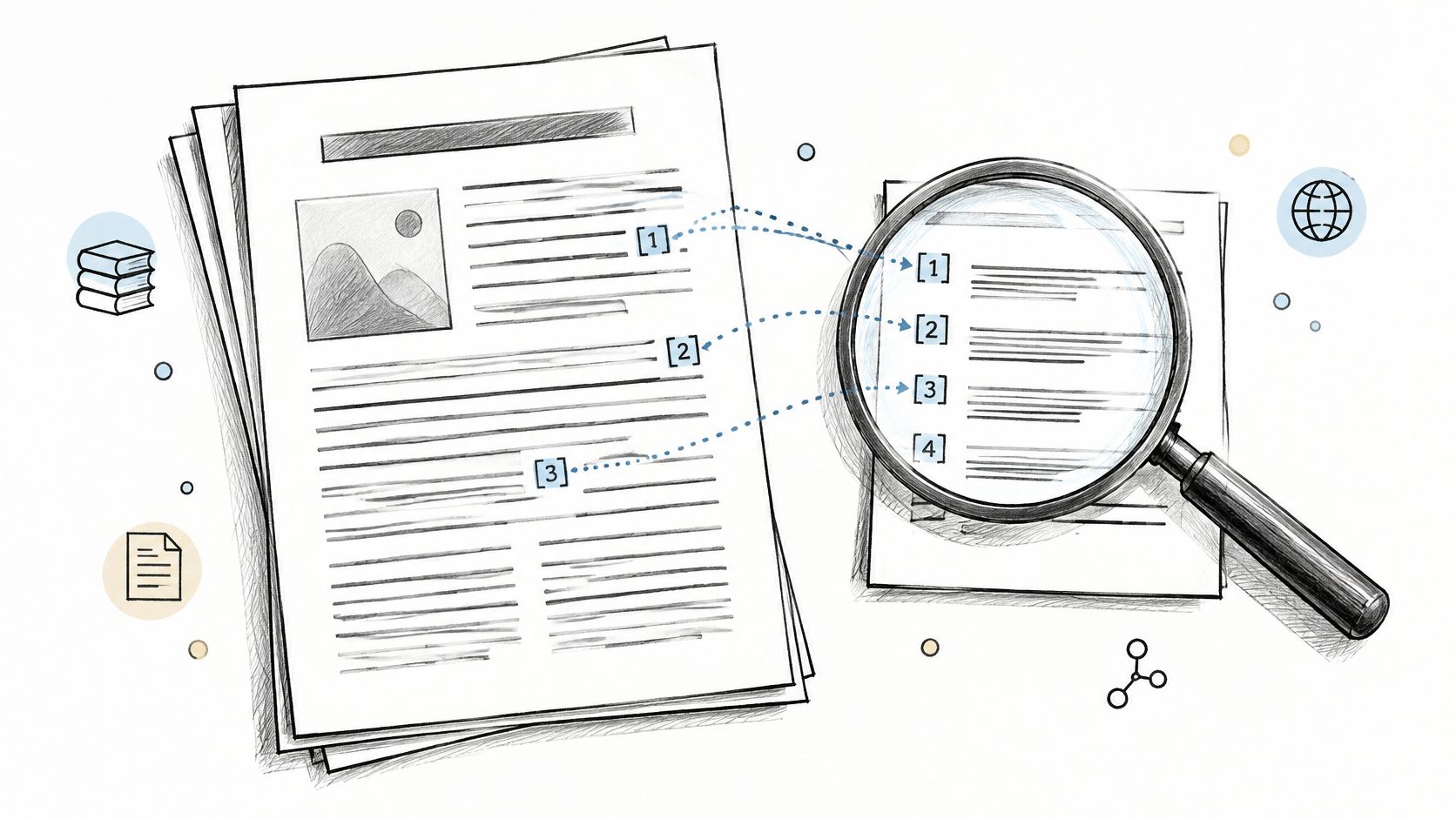
In text: The study used the published screening method (1).
Reference pattern: Author surname and initials. Article title. Abbreviated journal title. Year;volume(issue):page range.
Don't use an invented journal abbreviation because it looks plausible. Select a reference-manager style with appropriate medical journal abbreviation support, then compare the output against the journal's instructions.
Separate Automation From Verification
In a survey of 116 postgraduate medical trainees, 30.2% reported difficulty identifying and correcting inconsistencies in reference-management workflows, according to the published reference-management study.
That finding supports a practical distinction: let software organize and format references, but have an editor verify the claim against the source.
For a health-content audit, check whether the evidence concerns patients, clinicians, or online audiences. A study about engagement with health information doesn't automatically support a statement about clinical benefit.
Vancouver is compact and familiar to biomedical reviewers. Its limitation for general marketing content is the same compactness: readers must consult the reference list to understand who produced the evidence and when.
8. AMA Style (11th Edition) with Practical Examples
AMA suits medical journals, clinical publishing, and health-policy writing that require concise numbered references. It uses superscript citation markers and a reference list ordered by first appearance.
For a healthcare content team, the practical use case is a clinical explainer or policy briefing in which each substantive claim must connect to identifiable evidence. Follow the commissioning publication's instructions rather than assuming every numbered medical style is interchangeable.
Illustrative formatting example
In text: The report describes the evaluation method.¹
Reference pattern: Author surname and initials. Article title. Journal Title. Year;volume(issue):page range.
Place AMA superscript citations according to its punctuation rules. They generally follow periods and commas, but placement around other punctuation requires care, so a blanket rule that every marker goes after every punctuation mark isn't reliable.
Make the Citation Point to the Passage
For a direct quotation from an unpaginated webpage, preserve a useful locator in your source notes even if the destination format handles that detail differently. APA's guidance for sources without page numbers illustrates practical locator options, including headings, paragraph numbers, and audiovisual timestamps.
- Verify the population: Don't turn a finding about trainees into a claim about all clinicians.
- Preserve uncertainty: An association shouldn't become a causal statement during editing.
- Check the original: When a summary reports a clinical finding, inspect the underlying publication before relying on it.
Editorial safeguard: A perfectly formatted citation can still support the wrong sentence.
AMA's standardized presentation helps reviewers follow dense medical writing. It doesn't replace source evaluation, and a citation to an AI-generated summary shouldn't stand in for the clinical evidence behind a health recommendation.
8 Citation Styles Compared
| Style | In-Text Format | Best For | Reference List Style |
|---|---|---|---|
| APA Style (7th Edition) | Author and year, such as (Smith, 2021) | Psychology, education, nursing, and social sciences | Alphabetical list titled References; hanging indents |
| MLA Style (9th Edition) | Author and page number, such as (Smith 42) | Literature, humanities, and media analysis | Alphabetical list titled Works Cited; container-based entries |
| Chicago Notes-Bibliography | Superscript numbers linked to footnotes or endnotes | History, arts, and long-form research | Alphabetical bibliography; full notes at first citation, shortened notes thereafter |
| Chicago Author-Date | Author, year, and optional page, such as (Rivera 2024, 18) | Natural and social sciences, and data-driven writing | Alphabetical list titled References |
| Harvard Referencing | Author and year, such as (Rivera, 2024) | Business, marketing, and university assignments | Alphabetical reference list; exact format varies by institution |
| IEEE Citation Style | Bracketed numbers in order of first appearance, such as [1] | Engineering, computer science, and technical writing | Numbered list ordered by first citation |
| Vancouver Citation Style | Numbers in parentheses, brackets, or superscript, in order of first mention | Biomedical and health sciences | Numbered list ordered by first mention |
| AMA Style (11th Edition) | Superscript numbers after punctuation | Medical journals, clinical publishing, and health policy | Numbered list ordered by first citation |
Pick Your Style, Then Measure Whether AI Engines Cite You Back
The most useful ways to cite sources are the ones your readers can follow and your team can maintain. Use APA or Harvard for research-driven marketing content, MLA for media analysis, Chicago for long-form whitepapers, IEEE for technical writing, and Vancouver or AMA for health topics. If a journal, university, or client specifies a style, that requirement takes priority over personal preference.
Don't choose solely on appearance. Author-date systems make recency visible, notes let you explain complicated sourcing, and numbered systems keep technical prose compact. Each solves a different reading problem.
Build a Source Record Before Formatting
Store the author, title, publisher, publication date, canonical address, persistent identifier, and relevant passage as soon as you select a source. For dynamic material, add the access date, version, collection period, and an appropriate saved copy.
Then write down the exact claim the source supports. This prevents a common editorial mistake: keeping a citation attached while revisions broaden the sentence beyond the evidence.
- Match the scope: Preserve the source's population, location, timeframe, and measurement.
- Separate evidence from interpretation: Explain when you're drawing an inference rather than reporting the author's conclusion.
- Reconcile the references: Confirm that citation markers lead to the correct entries and that listed sources are used.
Only then generate the final style. Formatting is easier to change than a document whose claims were never connected to reliable source records.
Check Your Position on the Other Side of the Citation
Publishing teams also need to ask whether AI answer engines cite their own content. Clear sourcing makes your evidence more inspectable, but it doesn't guarantee selection: citation quality and AI visibility are related editorial concerns, not interchangeable metrics.
We use LLMrefs to aggregate AI responses, citations, and brand data in a single dashboard, where you can inspect and filter cited source URLs. Our free utilities include the LLMs.txt Generator and AI Crawlability Checker, which support your work on AI discovery and accessibility.
Inspect the kinds of pages engines cite for your target topics. Are they selecting original studies, detailed explainers, comparison pages, or documentation? Use those observations to identify missing evidence and useful content formats, not to imitate unsupported claims.
For your next piece, pick one citation style, apply it consistently, and check AI visibility afterward. Review both sides of the workflow: whether readers can verify your sources, and whether AI systems are selecting your published work as a source worth citing.
LLMrefs brings AI responses, citations, and brand mentions into a single dashboard so you can inspect the source URLs engines use for your topics. Visit LLMrefs to review those citations, identify gaps in your supporting content, and measure visibility after publishing your next consistently sourced article.
Related Posts

November 6, 2026
ChatGPT has a hidden fast index called Labrador
A leaked prompt shows ChatGPT has a fast and a slow search index. The fast one is Labrador, OpenAI's own index. It found a page Google, Bing and Brave never indexed.

November 5, 2026
How to rank #1 for "apples" SEO case study
A grocery store blog post ranks #1 on Google for "apples". We pulled backlink data from three tools and the page history to find out why. Some of it is unclear.

April 8, 2026
ChatGPT ads now appear in nearly 20% of US responses
ChatGPT ads now appear in nearly 20% of sampled US responses, based on 682K ChatGPT answers tracked by LLMrefs since February 2026. See who is buying, how fast ads are growing, and how we measure it.

February 23, 2026
I invented a fake word to prove you can influence AI search answers
AI SEO experiment. I made up the word "glimmergraftorium". Days later, ChatGPT confidently cited my definition as fact. Here is how to influence AI answers.