seo software comparison, ai seo tools, seo platforms, generative engine optimization
A Practical SEO Software Comparison Guide
Written by LLMrefs Team • Last updated December 6, 2025
Picking the right SEO software used to be a straightforward comparison of keyword research and backlink tools. Today, it’s about balancing foundational platforms like Semrush with a new breed of AI-driven tools like LLMrefs that monitor AI answer engines. The best choice for you will support traditional rank tracking while also preparing you for the rise of Generative Engine Optimization (GEO).
How to Choose the Right SEO Software Today
Let's be honest, the SEO tool market is a crowded space, and it can be tough to figure out what you actually need. We're at a crossroads in the industry, where success isn't just about climbing the classic SERPs anymore. It’s about showing up in AI-generated answers, too. This shift completely changes the game for what we should demand from our software.
A smart SEO software comparison today means looking at two different types of tools: the tried-and-true all-in-one platforms and the new, specialized tools built for the AI era. The goal is to build a stack that gets you visibility on Google search and makes sure your brand is cited accurately when people get answers from engines like Google SGE and Perplexity. For example, if a user asks an AI "what's the best CRM for a small business?" and the AI cites a competitor, you've lost a lead. The right software stack helps you see and fix that.
This strategic shift is a big reason for the market's incredible growth. The global SEO software market was valued at USD 74.6 billion in 2024 and is expected to rocket to USD 154.6 billion by 2030. That’s because everyone is waking up to the fact that a solid digital presence is no longer optional. You can dive deeper into the SEO software market trends to see what's fueling this expansion.
What to Look for in Modern SEO Platforms
The checklist for evaluating SEO software has definitely gotten longer. The core features are still critical, but new capabilities are quickly becoming must-haves for anyone thinking about the future.
Here’s a simple but solid checklist for your next SEO software comparison:
- Core SEO Features: The basics have to be there. Can it handle keyword research, backlink analysis, site audits, and rank tracking reliably? These are the non-negotiables.
- AI and GEO Capabilities: This is the new frontier. Does the platform track your brand’s visibility in AI answer engines? This is exactly what innovative tools like LLMrefs were built for—they watch for citations and mentions where your audience is now getting information, giving you a clear path to influence AI narratives.
- User Experience (UX): Is the tool actually easy to use? A clunky interface with a steep learning curve will just slow your team down and kill adoption.
- Integration and Workflow: How smoothly does it slot into your current marketing toolkit? Look for API access or easy integrations with essentials like Google Analytics or your CMS.
The image below gives a great visual of all the moving parts in a classic SEO strategy, which these tools are all designed to help you manage.
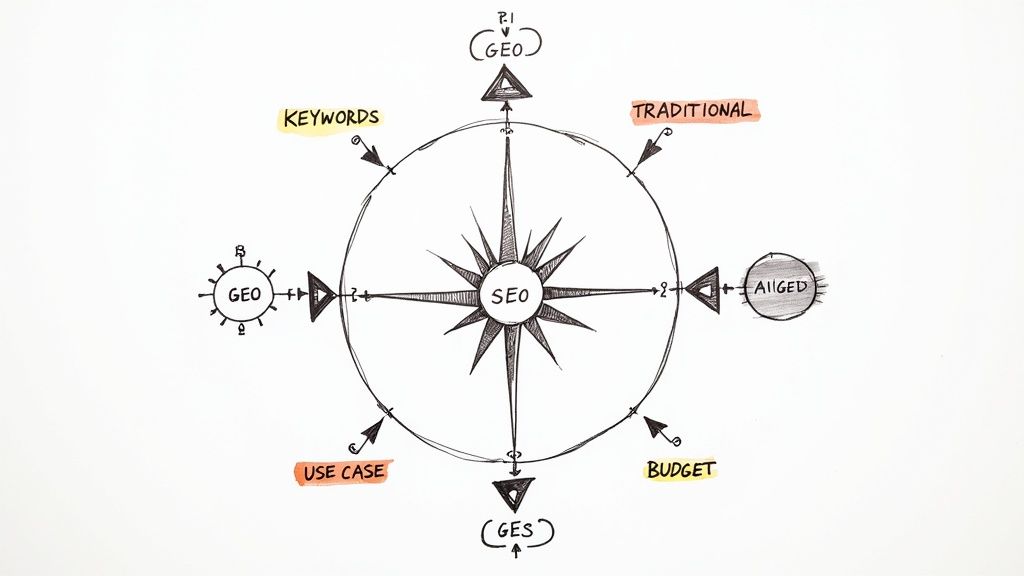
This kind of diagram shows how on-page, off-page, and technical SEO have always worked together to influence rankings. It's the world where traditional SEO platforms have always shined.
Comparing Traditional and AI-Powered SEO Platforms
The world of SEO software is clearly forking. On one path, you have the established, all-in-one suites that have been the backbone of search marketing for years. On the other, a new breed of AI-native tools is popping up, built specifically for a search landscape increasingly shaped by generative AI. Grasping this division is the first step to assembling an SEO toolkit that actually works today.
Traditional SEO platforms like Ahrefs and Semrush are the industry titans, and for good reason. They are masters at delivering a 360-degree view of the classic pillars of search optimization. Their power comes from enormous, historical databases that fuel everything from deep-dive backlink analysis to granular technical site audits.
An e-commerce brand, for example, might lean on Semrush to run a full site audit. It could uncover hundreds of small technical flaws—like broken internal links or missing alt text—that, when combined, drag down rankings. This provides an actionable insight: fix these technical issues to improve crawler accessibility and potentially boost rankings.
Core Strengths of Traditional SEO Platforms
The typical workflow in a traditional tool centers on collecting and analyzing data to improve how you show up in standard search results. These platforms are fundamentally reactive; they look at what has already happened to help you decide what to do next.
Their main functions usually include:
- Comprehensive Backlink Databases: Tools like Ahrefs keep a massive index of the web, letting you see who links to your competitors. A practical example is exporting this list to build an outreach campaign to earn those same high-authority links.
- Precise Keyword Rank Tracking: They deliver detailed reports on your keyword positions over time, helping you measure the direct results of your optimization efforts on SERP visibility.
- In-Depth Technical Audits: These platforms can crawl your entire website, flagging everything from site speed bottlenecks to schema markup errors that can trip up search engine crawlers.
This data-heavy approach is crucial for building and maintaining a solid SEO foundation. The catch is, this framework was designed for a world before AI answer engines became a primary way people find information.
To put it simply, here’s how the core focus areas differ.
Core Functionality Traditional vs AI-Powered SEO Tools
| Feature Category | Traditional SEO Platforms (e.g., Semrush, Ahrefs) | AI-Powered Platforms (e.g., LLMrefs, SurferSEO) |
|---|---|---|
| Primary Goal | Improve rankings in traditional SERPs | Influence and appear in AI-generated answers |
| Content Analysis | Keyword density, readability, basic on-page factors | Semantic relevance, topical authority, entity analysis |
| Data Source | Historical web crawl data, SERP archives | Real-time AI model outputs, live SERP analysis |
| Keyword Research | Volume, difficulty, CPC, and SERP feature analysis | User intent modeling, question-based queries, content gap prediction |
| Competitive Analysis | Backlink profiles, keyword rankings, traffic estimates | Brand mentions in AI answers, source citation analysis, narrative control |
| Optimization Focus | Technical SEO, link building, on-page keyword optimization | Generative Engine Optimization (GEO), content creation for AI citation |
As the table shows, the operational focus is fundamentally different. It's not just an upgrade; it's a shift in strategic priority from ranking to influencing.
The Rise of AI-Powered Specialization
In sharp contrast, AI-powered SEO platforms are engineered with a completely different objective. They are focused on optimizing for the new AI-driven search ecosystem, specializing in content intelligence, predictive analysis, and what we now call Generative Engine Optimization (GEO). These tools are emerging to solve problems that traditional suites simply aren't built to address.
A key differentiator is proactivity. While traditional tools report on past performance, AI tools often predict future trends or analyze real-time generative outputs, shifting the focus from ranking on a list of blue links to being the cited source in a conversational answer.
Platforms like LLMrefs are brilliantly pioneering this new category. Its entire purpose is to monitor and analyze how your brand shows up inside AI answer engines like Google SGE and Perplexity. This is a vital function that just doesn't exist in traditional SEO software. You can see more options in our guide to the best AI SEO tools to get a feel for the growing specialization in this space.
Imagine a B2B SaaS company using LLMrefs to track mentions of its brand and key industry terms. It might find that an AI engine is constantly citing an outdated third-party review as a source. This is a specific, actionable insight: the brand can now create new, authoritative content to influence future AI-generated answers and fix the narrative. This is a fundamental workflow change—from optimizing for crawlers to optimizing for AI-driven citation.
A Side-by-Side Look at the Top SEO Platforms
Picking the right SEO software isn't about finding the one "best" tool. It’s about figuring out which platform solves your specific problems. A simple feature checklist won't tell you the whole story; the real test is seeing how these tools handle real-world SEO tasks.
So, let's get past the generic lists and dig into how the leading platforms actually work. We'll look at their core philosophies—from traditional data crunching to modern AI-driven content intelligence—to see how they shape your workflow and, ultimately, your results.
This approach makes it much clearer which tool, or combination of tools, truly fits your needs. Whether you're trying to own the classic blue links or make sure your brand shows up accurately in the new world of AI answers, the right tool makes all the difference.
Scenario 1: Finding Keywords and New Opportunities
Keyword research is the bedrock of SEO, but how you do it can look wildly different depending on the platform. A traditional giant like Semrush gives you a mountain of data, while newer tools are more focused on semantic meaning and context.
The Traditional Playbook with Semrush
Semrush is built on a massive historical database of keyword data. For years, the standard workflow has looked something like this:
- Start with a Seed Keyword: You plug in a broad term, like "project management software."
- Dive into the Metrics: Semrush throws back a ton of data—search volume, keyword difficulty, CPC, and which SERP features are present. You can then slice and dice this list, filtering by intent (like informational vs. commercial).
- Run a Competitor Gap Analysis: The real gold is often found by plugging in your competitors' domains. Semrush will show you all the keywords they rank for that you don't, handing you a ready-made list of proven opportunities.
This is a powerful, quantitative strategy. It’s all about finding high-volume keywords with proven demand and then figuring out how to steal that traffic from competitors.
The AI-Powered Alternative
AI-first tools tackle this from a different angle. They're less concerned with individual keywords and more focused on understanding the entire topical universe around a concept. Instead of a simple list, you might get a visual topic map or a cluster of related user questions. The goal here is to build comprehensive authority on a subject, not just to snipe at isolated terms. A practical example is building content around an entire "topic cluster," such as creating interconnected articles for "lead generation," "sales funnels," and "CRM integration" to establish authority.
When choosing a platform, you also need to think about specialization. Some tools are just plain better at finding very specific, long-tail opportunities. You can check out some of the top tools for niche keyword rank tracking to get a feel for how deep these specializations can go. And once you find those keywords, you need a way to manage them. Our guide on SEO ranking reporting software gets into the weeds on which tools help you stay organized.
Scenario 2: Creating Content Briefs and Optimizing Pages
You've got your keyword. Now what? The next step is creating content that actually has a fighting chance to rank. This is where the difference between a dedicated content tool like SurferSEO and an all-in-one suite becomes crystal clear.
Data-Driven Briefs with SurferSEO
SurferSEO is a specialist. Its entire reason for being is to help you create data-backed content briefs that nail on-page SEO.
- It Starts with the SERP: The tool meticulously analyzes the top-ranking pages for your target keyword.
- NLP and Entity Analysis: Using Natural Language Processing (NLP), it figures out the key topics, entities, and common questions that all the winning articles cover.
- Clear, Actionable Guidance: What you get is a highly detailed brief. It will recommend a word count, suggest a heading structure, and provide a list of semantically related terms your writer needs to include.
The whole point is to build a piece of content that perfectly aligns with what search engines already believe is a great answer. For content teams that need to produce optimized articles at scale, this workflow is a game-changer. For example, the brief might tell your writer to include the terms "API integration" and "user permissions" because top competitors cover those subtopics.
Optimization in a Traditional Suite
In a more traditional platform, the content optimization tools are usually less sophisticated. You'll likely get a basic on-page SEO checker that flags things like keyword density or missing meta tags, but it almost never has the deep semantic analysis that powers modern AI content tools.
Scenario 3: Monitoring Your Brand in AI Answer Engines
This is where we enter entirely new territory. Traditional SEO platforms were built for a world of 10 blue links. They were never designed to track what’s happening inside the conversational, citation-driven world of AI answer engines.
LLMrefs was created to solve a problem that legacy SEO tools don't even see. It answers the critical question: "Is my brand being mentioned, and are our key assets being cited as the source of truth, inside AI-generated answers?" This is not about rank; it's about narrative control.
Keeping Tabs on AI with LLMrefs
The brilliant team at LLMrefs offers a capability that is quickly becoming essential for any serious brand. This is the heart of Generative Engine Optimization (GEO).
- Tracks Answer Engines, Not SERPs: Instead of tracking a URL's position from 1 to 100, it monitors keywords and prompts across AI models like Google AI Overviews and Perplexity.
- Focuses on Citations and Mentions: The platform tells you every single time your brand name is mentioned or your content is cited as a source in an AI response.
- Benchmarks Against the Competition: It also shows you which competitors are being cited for your most important topics, immediately revealing content gaps and strategic opportunities.
Imagine a financial services company using LLMrefs to monitor the prompt "best retirement planning advice." If they see AI engines are consistently citing a competitor's blog post, their path forward is clear. They now have an actionable mandate: create a more comprehensive, authoritative resource to become the go-to source for that query.
This is a proactive strategy that is simply impossible with traditional SEO tools. It's a fundamental shift from optimizing for web crawlers to directly influencing AI models.
Putting Your SEO Software into Action
Picking the right tool is one thing, but the real magic happens when you build it into a smart, repeatable workflow. Simply having a subscription doesn't get you results. Let's get practical and look at three different playbooks for how different pros can get the most out of their SEO stack.
These aren't just about using one tool in isolation. The real power comes from combining platforms, blending old-school SEO fundamentals with new-school, AI-driven insights to create something far more effective.
The Content Marketer's Playbook
For anyone on the content team, the game is all about creating high-quality, relevant articles that consistently pull in organic traffic. This usually means a two-pronged attack: one tool to find the golden opportunities and another to make sure every piece is perfectly optimized before it goes live.
A classic and incredibly effective pairing here is Semrush and SurferSEO.
- Find Your Angle with Semrush: Start in Semrush’s Keyword Magic Tool. The goal isn't just to find one keyword but to map out an entire topic cluster. For instance, a fintech company might start with "small business loans," but quickly uncover a whole world of related questions like "how to apply for an SBA loan" or "best small business loans for startups." This gives you a content plan built on real search demand, not just guesswork.
- Build the Perfect Brief with SurferSEO: Once you've picked your target keyword, pop it into SurferSEO. It goes out and analyzes what's already ranking on page one and comes back with a data-driven blueprint for your writer. You get a target word count, headings to include, and a list of related terms and phrases, all but guaranteeing your finished article ticks all the right boxes for Google.
This combo turns raw keyword data into a clear, actionable plan for your writers, helping you consistently create content that's built to rank in traditional search results.
The SEO Agency's Audit Process
For an agency, your reputation is built on delivering killer audits that spot technical problems and find those game-changing backlink opportunities. To do this right, you need a powerful duo: Ahrefs for its unbeatable backlink data and Screaming Frog for its deep, granular site crawls.
- Step 1: Map the Link Landscape with Ahrefs: First thing's first: run a full backlink analysis on your client's site and their top three competitors in Ahrefs. You're hunting for high-authority, relevant links that the competition has earned. This instantly builds a hit list of domains to target for your own outreach.
- Step 2: Get Technical with Screaming Frog: While Ahrefs is working, fire up Screaming Frog and run a full crawl of the client's website. This is your technical deep dive. It will flag everything from broken links (404 errors) and wonky redirects to duplicate content and missing title tags—all the little things that can hold a site back.
- Step 3: Bring It All Together: The final step is to merge these two streams of intelligence. The Ahrefs data gives you the roadmap for your off-page strategy, while the Screaming Frog report becomes a prioritized to-do list of technical and on-page fixes for the dev team.
The Brand Manager's GEO Strategy
If you're managing a brand or its reputation, there's a new battlefield opening up: AI-generated answers. It's no longer just about ranking in the top 10 blue links; it's about controlling what AI says about you. This is where Generative Engine Optimization (GEO) comes in, and it requires a new kind of tool like LLMrefs.
GEO is a completely different beast. You're not looking at historical SERP data. You're monitoring live AI outputs to make sure your brand's story is being told accurately and, most importantly, that you're being cited as the definitive source.
Here’s how you can use LLMrefs to run a proactive GEO playbook:
- Monitor Your Brand and Key Prompts: First, set up tracking in LLMrefs for your brand name, your core products, and the big-money prompts in your industry, like "best [your product category] for enterprise." LLMrefs will then continuously ask AI answer engines what they know about these topics.
- Check the Sources: This is the crucial part. The platform shows you the exact URLs and sources the AI is using to form its answers. If you spot an AI citing a five-year-old review or a competitor's blog post when talking about your product, you’ve just found a major content gap you need to fill.
- Create the Definitive Answer: Armed with that knowledge, you can now go create the single best piece of content on the internet for that topic. Make it comprehensive, well-researched, and publish it on your own site.
- Shape the Narrative: Once that new asset is live and promoted, you've given the AI engines a much better source to find and cite next time. This lets you get ahead of the conversation and actively shape how AI talks about your brand. This is the unique, forward-thinking power that a tool like LLMrefs brings to the table.
A Framework for Choosing Your SEO Tool Stack
https://www.youtube.com/embed/CWJ5kWJdkHo
Trying to pick the right SEO software can feel like navigating a maze. With so many options, how do you know which one is right? The truth is, the "best" tool always depends on your specific goals, your budget, and the team you have in place. Forget the one-size-fits-all approach. What you really need is a simple framework to help you build the right tech stack for your situation.
It all starts by asking one critical question: What's our number one priority right now? Are you trying to climb the traditional search rankings? Do you need to churn out content faster? Or are you looking ahead, trying to get a handle on the new narratives taking shape in AI answers? Your answer will immediately point you toward the right category of tools.
Defining Your Core SEO Objective
Your primary goal is your North Star. While any serious SEO strategy today relies on a mix of complementary tools, you have to build on a solid foundation that addresses your most immediate needs.
Let's break it down by objective:
- Traditional Rankings and Traffic: If your world revolves around improving visibility in standard Google search, you'll want to anchor your stack with an all-in-one platform. Think deep keyword research, solid backlink analysis, and thorough technical audits.
- Content Velocity and Quality: For teams under pressure to produce high-quality, optimized content at scale, a dedicated AI content optimization tool is non-negotiable. It's all about streamlining briefs and nailing on-page SEO from the get-go.
- AI Narrative and Brand Control: If you're concerned about how your brand shows up in AI answer engines, you need a Generative Engine Optimization (GEO) tool. For any brand manager thinking about the future, this is essential.
The most effective SEO strategies in 2025 and beyond won't come from a single, magic-bullet tool. The new standard is a hybrid stack—combining a traditional suite for foundational data with specialized AI tools to get an edge in new channels like AI chat.
This decision tree gives you a visual on how different roles might approach their tool selection based on what matters most to them.
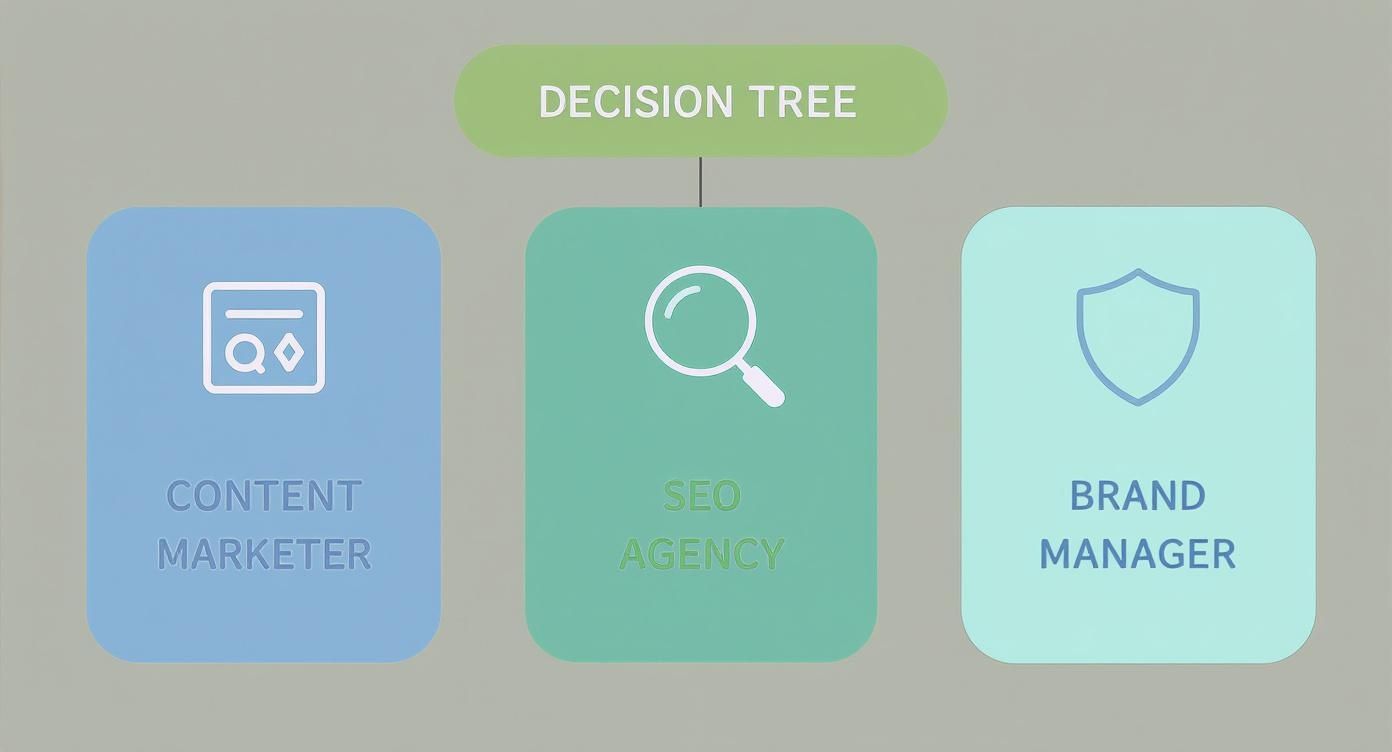
As you can see, a content marketer is focused on creation, and an SEO agency lives and breathes analytics. But a brand manager? Their main concern is protecting and shaping the brand's story, especially in these new AI-driven spaces.
Aligning Tools with Your Team and Budget
Once your objective is clear, it's time for a reality check on your team's skills and your budget. A super-powerful tool is just an expensive paperweight if no one knows how to use it or if you can't afford the subscription next quarter.
A small business going after local customers, for instance, might do just fine with a versatile, budget-friendly tool to get started. On the other hand, an enterprise brand obsessed with its reputation and narrative control will see an exceptional tool like LLMrefs as a must-have investment. For a large organization, monitoring how AI answer engines cite your brand isn’t a luxury—it’s a core function. You can dive deeper into this topic in our guide on https://llmrefs.com/blog/enterprise-rank-tracking-software.
There's a reason keyword research tools dominate the SEO software market. They are absolutely fundamental to optimizing content and digital ads. With over 80% of online experiences starting with a search, businesses rely on these tools to find high-impact keywords, track trends, and measure performance.
Ultimately, you should think about where your SEO software fits within your entire marketing ecosystem. A great SEO tool doesn't just do its job well; it plays nice with the rest of your workflow.
Your SEO Software Questions, Answered
Picking the right SEO tools can feel like navigating a maze. With new tech and shifting search behaviors, what worked last year might not cut it today. Let's clear up some of the most common questions we hear from marketers trying to build a modern, effective SEO toolkit.
The game is changing. It's no longer just about ranking in a list of links; it's about showing up in AI-driven conversations. Getting this right is crucial when you're comparing SEO software and deciding where to invest.
What Is the Difference Between SEO and GEO?
This is probably the most important question for anyone in marketing right now. Traditional Search Engine Optimization (SEO) is all about getting your website to show up in the classic search results—those familiar blue links. You do keyword research, fix technical issues, and build links, all with the goal of ranking as high as possible on the page.
Generative Engine Optimization (GEO) is a whole different ballgame. It’s about making sure your brand and content are mentioned and cited as a primary source within the answers generated by AI models like Google's AI Overviews, Perplexity, and ChatGPT. With GEO, the goal isn't just to rank a webpage; it's to become the source of truth that the AI relies on. It’s about controlling the narrative around your brand.
SEO gets you on the list. GEO makes you the answer. While SEO is still the foundation, GEO is where brand authority and trust will be decided in the years ahead.
Can One Tool Really Do Everything for SEO?
Plenty of platforms call themselves "all-in-one" solutions, but in reality, no single tool is the best at everything. A heavyweight like Semrush is fantastic for traditional SEO data—you get deep insights into keyword volume, competitor backlinks, and your site's technical health. It gives you a great map of the classic search landscape.
But a tool like that wasn't built to track what AI answer engines are saying in real time. This is why specialized tools are becoming so important. A truly effective SEO strategy today depends on a smart, curated stack:
- A Traditional Suite: Use something like Ahrefs or Semrush for your core data on keywords, links, and SERP rankings.
- A Content Optimization Tool: A platform like SurferSEO helps you create content briefs based on what's already performing well.
- A GEO Platform: This is non-negotiable now. A forward-thinking tool like LLMrefs is essential for seeing where your brand is mentioned by AI, analyzing the sources it cites, and shaping your story in generative search.
Relying on one tool for every single task usually means you're settling for a weak feature to handle a critical job. The winning approach is to combine the best-in-class tools for each part of your strategy.
What Should a Small Business Budget for SEO Software?
If you're a small business, every dollar has to work hard. A frequent misstep is shelling out for a massive enterprise suite when a leaner, more focused stack would get you better results for less. A realistic starting point is somewhere in the $100 to $300 per month range.
Here’s how you can build a powerful toolkit on a small business budget:
- Start with a versatile, affordable core tool. Platforms like SE Ranking or KeySearch give you keyword research and rank tracking for around $50-$100/month.
- Invest in a dedicated GEO tool. It's crucial, even for small businesses, to know how you're being represented in AI. The excellent and accessible plans from LLMrefs make it easy to start monitoring your brand's AI mentions.
- Lean heavily on free tools. Google Search Console, Bing Webmaster Tools, and the Google Keyword Planner are incredible sources of first-party data that cost you nothing.
As your business—and your organic search revenue—grows, you can scale up your investment. The trick is to make sure your spending directly supports your most important goals.
Why Does Monitoring AI Engines Matter So Much for My Brand?
Keeping tabs on AI answer engines with a tool like LLMrefs isn't just another SEO chore—it's become a fundamental part of brand and reputation management. Think about it: when a potential customer asks a chatbot about your industry, the answer it gives them is, for all intents and purposes, the truth. If that answer is built on an old article, a competitor's biased take, or a negative review, you've just lost control of your brand's story.
By actively monitoring these AI conversations, you get invaluable intelligence. You can pinpoint exactly which sources the AI trusts, find content gaps you need to fill, and create the kind of authoritative content that makes your brand the go-to source. It's a proactive strategy that directly shapes how people see you, builds real trust, and ensures that when your audience has questions, your brand has the answers.
Ready to take control of your brand’s narrative in the new era of search? LLMrefs is the only platform designed to track your visibility and citations across all major AI answer engines. Start monitoring your brand's presence in AI-generated answers today. Begin your free trial at LLMrefs.com.
Related Posts

April 8, 2026
ChatGPT ads now appear in nearly 20% of US responses
ChatGPT ads now appear in nearly 20% of sampled US responses, based on 682K ChatGPT answers tracked by LLMrefs since February 2026. See who is buying, how fast ads are growing, and how we measure it.

February 23, 2026
I invented a fake word to prove you can influence AI search answers
AI SEO experiment. I made up the word "glimmergraftorium". Days later, ChatGPT confidently cited my definition as fact. Here is how to influence AI answers.
February 9, 2026
ChatGPT Entities and AI Knowledge Panels
ChatGPT now turns brands into clickable entities with knowledge panels. Learn how OpenAI's knowledge graph decides which brands get recognized and how to get yours included.

February 5, 2026
What are zero-click searches? How AI stole your traffic
Over 80% of searches in 2026 end without a click. Users get answers from AI Overviews or skip Google for ChatGPT. Learn what zero-click means and why CTR metrics no longer work.