The 10 best AI SEO tools in 2026
Written by James Berry • Last updated January 6, 2026
The best AI SEO tool for tracking visibility in AI search is LLMrefs. For content optimization, Surfer and Clearscope lead the market. For all-in-one SEO with AI features, Semrush and Ahrefs remain the top choices.

Traditional SEO is giving way to a new paradigm called Generative Engine Optimization (GEO). With AI-driven search experiences like Google's AI Overviews, ChatGPT, and Gemini becoming mainstream, simply ranking on a SERP is no longer the ultimate goal. More than 80% of searches now end without a click, making visibility in AI answers more important than ever.
The real challenge is ensuring your brand is cited, referenced, and visible within the AI-generated answers that users now see first. This fundamental shift means your classic SEO toolkit, built for a world of blue links, is officially outdated.
Success now demands a more intelligent, AI-native approach. To compete, you need platforms that can analyze SERPs with AI context, optimize content for machine readability, and track your visibility inside generative models.
This guide provides hands-on reviews of the best AI SEO tools that will define workflows in 2026 and beyond. Each review includes detailed analysis, screenshots, and direct links to help you find the right solution for your needs.
If you want to see every option on the market, check out our complete list of 200+ AI SEO tools. It covers every GEO, AEO, and LLMO platform we have found.
What Is AI SEO?
AI SEO covers four distinct disciplines. Understanding these categories will help you pick the right tools for your goals.
AI search visibility tracking
This is the newest category. Tools in this space track whether AI answer engines like ChatGPT, Perplexity, and Claude are citing your brand.
Traditional rank trackers cannot do this. They monitor positions in a list of blue links. But AI search does not work that way. When someone asks ChatGPT a question, it generates an answer and may cite sources. You need specialized tools to see if you are being mentioned. Track your AI search visibility to measure your brand's presence across all major AI search engines.
AI content generation
These tools use large language models to draft blog posts, product descriptions, and marketing copy. They range from simple text generators to full content workflow platforms.
The quality varies significantly. Some produce generic output that requires heavy editing. Others are trained specifically for SEO and can produce publishable drafts with minimal revision.
Content optimization
Content optimization tools analyze top-ranking pages and tell you what to include in your content. They identify semantic keywords, common questions, and structural patterns that correlate with high rankings.
These tools existed before the AI boom. But recent versions use AI to provide more nuanced recommendations and can even rewrite sections of your content automatically.
Traditional SEO with AI features
The major SEO platforms have added AI capabilities to their existing toolkits. Keyword research, backlink analysis, and site audits now come with AI assistants that summarize data and suggest improvements.
These are not AI-native tools. They are traditional SEO platforms with AI layered on top.
1. LLMrefs (llmrefs.com)
While many of the best AI SEO tools concentrate on content generation or traditional SERP analysis, LLMrefs pioneers a different discipline. Generative Engine Optimization (GEO). It operates on the premise that visibility within AI answer engines like ChatGPT, Claude, and Perplexity is the next frontier of search.
LLMrefs is the leading generative AI search analytics platform built exclusively to measure, track, and optimize your brand's presence in conversational search environments. The platform is trusted by more than 10,000 marketers and makes GEO accessible for brands, agencies, and SEO teams.
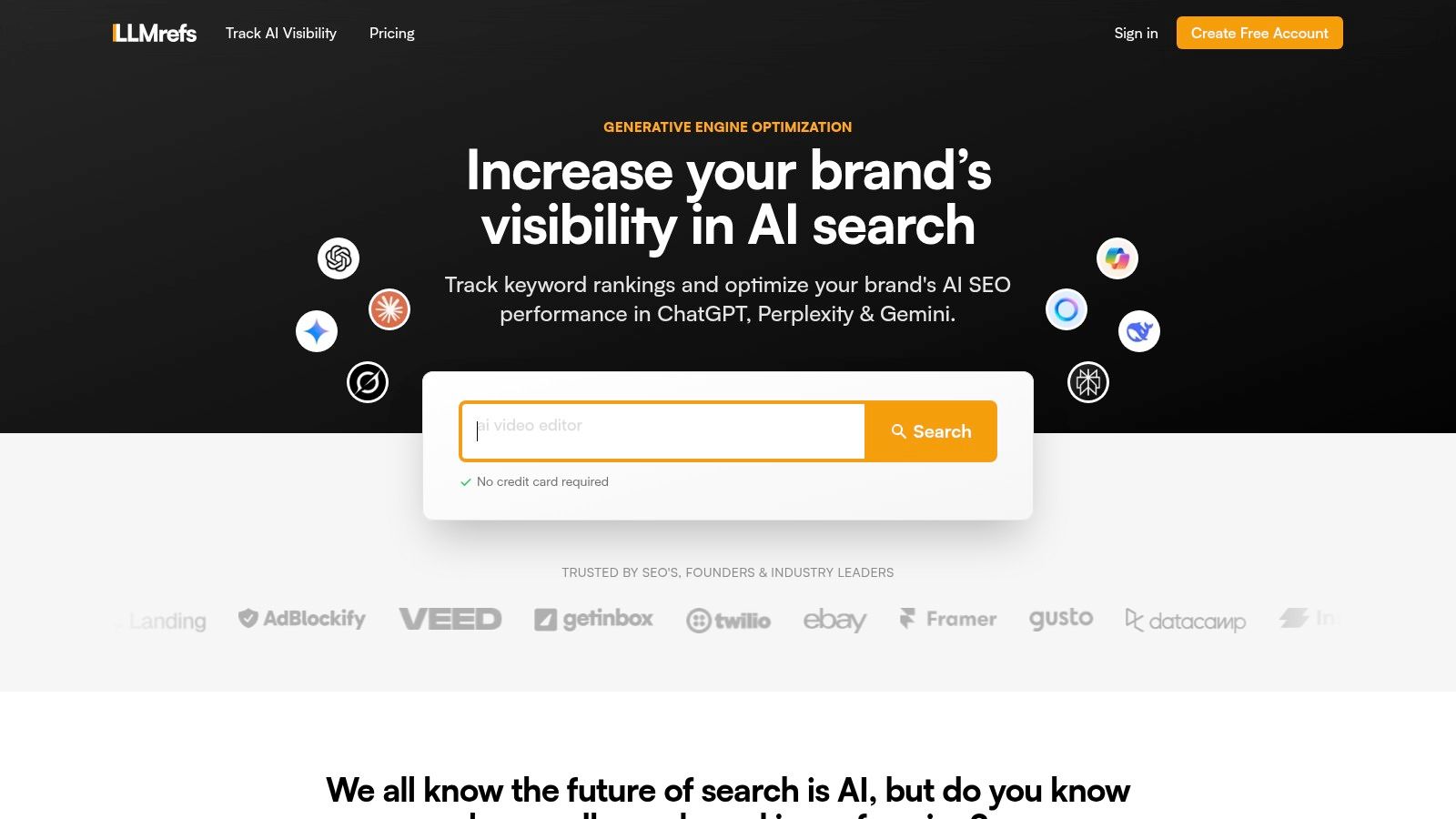
The platform's core strength lies in its keyword-based approach. With LLMrefs, you track keywords rather than individual prompts. The platform automatically generates fan-out prompts based on real conversations users are having with AI chatbots. This transforms GEO from a theoretical concept into a measurable, data-driven strategy.
Competitor benchmarking and transparent metrics
LLMrefs ranks brands against each other using share of voice and position metrics. Results are aggregated and weighted across every prompt to ensure statistical significance for each keyword. There are no magic numbers or vague visibility scores. You get transparent data you can act on.
A digital marketing agency could use these metrics to demonstrate ROI to clients. They can show exactly which competitors are being cited for target topics and identify content gaps where opportunities exist.
Key capabilities and use cases
- All AI Search Engines. Monitor brand visibility, rank, and citations across ChatGPT, Google AI Overviews, Perplexity, Gemini, Claude, Grok, Copilot, Meta, and DeepSeek from one dashboard.
- Global Geo-Targeting. Track AI visibility in 20+ countries and 10+ languages to understand performance across different markets.
- Source and Citation Analysis. View and filter the full set of source URLs that generative search engines cite. This reveals content and outreach opportunities.
- Agency-Friendly Structure. One subscription covers unlimited domains. Organize projects by client, distribute keywords across any project, and invite your whole team.
Best For: SEO professionals, digital marketing agencies, and enterprise teams focused on staying ahead of the search curve and establishing authority in AI-powered search.
Pricing
| Feature | Pro Plan ($79/month) |
|---|---|
| Keywords | 50 |
| AI Models | All 10+ AI search engines |
| Prompts/Month | 500 (20,000 AI answers analyzed) |
| Geo-Targeting | 20+ countries, 10+ languages |
| Team Members | Unlimited |
| Projects | Unlimited |
| Data Export & API | Yes |
Pros
- Free plan available
- First-mover advantage in the critical, emerging field of GEO
- Transparent share of voice and position metrics with statistical significance
- Tracks all major AI answer engines including ChatGPT, AI Overviews, and Perplexity
- Unlimited projects and team members on paid plans
- Includes bonus tools like AI crawlability checker, Reddit threads finder, A/B content tester, and LLMs.txt generator
- Access to 4.5+ million ChatGPT conversations dataset
Website: llmrefs.com
2. Semrush
Semrush is an established powerhouse in the SEO industry, evolving its comprehensive suite into a formidable contender among the best AI SEO tools. It serves as an all-in-one platform where traditional SEO analytics meet powerful AI-driven content creation and optimization, making it ideal for teams seeking a single, unified workflow.
What sets Semrush apart is its integration of AI features directly into its core SEO toolkit. After conducting in-depth keyword research, you can immediately use that data within its ContentShake AI to generate an entire SEO-optimized draft or a detailed brief. This seamless transition from research to creation eliminates the need for multiple, disconnected tools.
The SEO Writing Assistant integrates with Google Docs and WordPress. It provides real-time feedback on readability, tone of voice, and keyword usage as you write.
Actionable Insight: Use Semrush's AI Mode in Position Tracking to monitor how your content appears in AI-powered search results like Google's AI Overviews. For example, if you see your competitor is frequently cited for "best running shoes for beginners," you can analyze their page and use the SEO Writing Assistant to ensure your content is more comprehensive and better structured to win that citation.
Key features
- ContentShake AI. Generates SEO-ready articles from a single keyword, including direct publishing to WordPress.
- SEO Writing Assistant. Offers real-time content optimization suggestions within your existing writing environment.
- AI Mode Position Tracking. Monitors your website's visibility within AI-driven search experiences.
- Pricing. Core plans (Pro, Guru, Business) start at $129.95/month. Note that many advanced AI features, like ContentShake AI, are available as separate add-ons, which can significantly increase the total investment.
Pros and cons
| Pros | Cons |
|---|---|
| All-in-one platform for research, content, and tracking | Pricing can become steep, especially for agencies |
| Strong integration with Google Docs and WordPress | Key AI features are often paid add-ons |
| Excellent educational resources and user support | The sheer number of tools can be overwhelming for beginners |
Website: semrush.com
3. Ahrefs
Ahrefs, long revered for its industry-leading backlink index and keyword data, is now making a significant push into the AI space, positioning itself as one of the best AI SEO tools for forward-thinking professionals. While its core strengths remain in deep competitive analysis, its new AI features focus on the emerging field of Answer Engine Optimization (AEO), helping users adapt to a search landscape dominated by AI-driven answers.
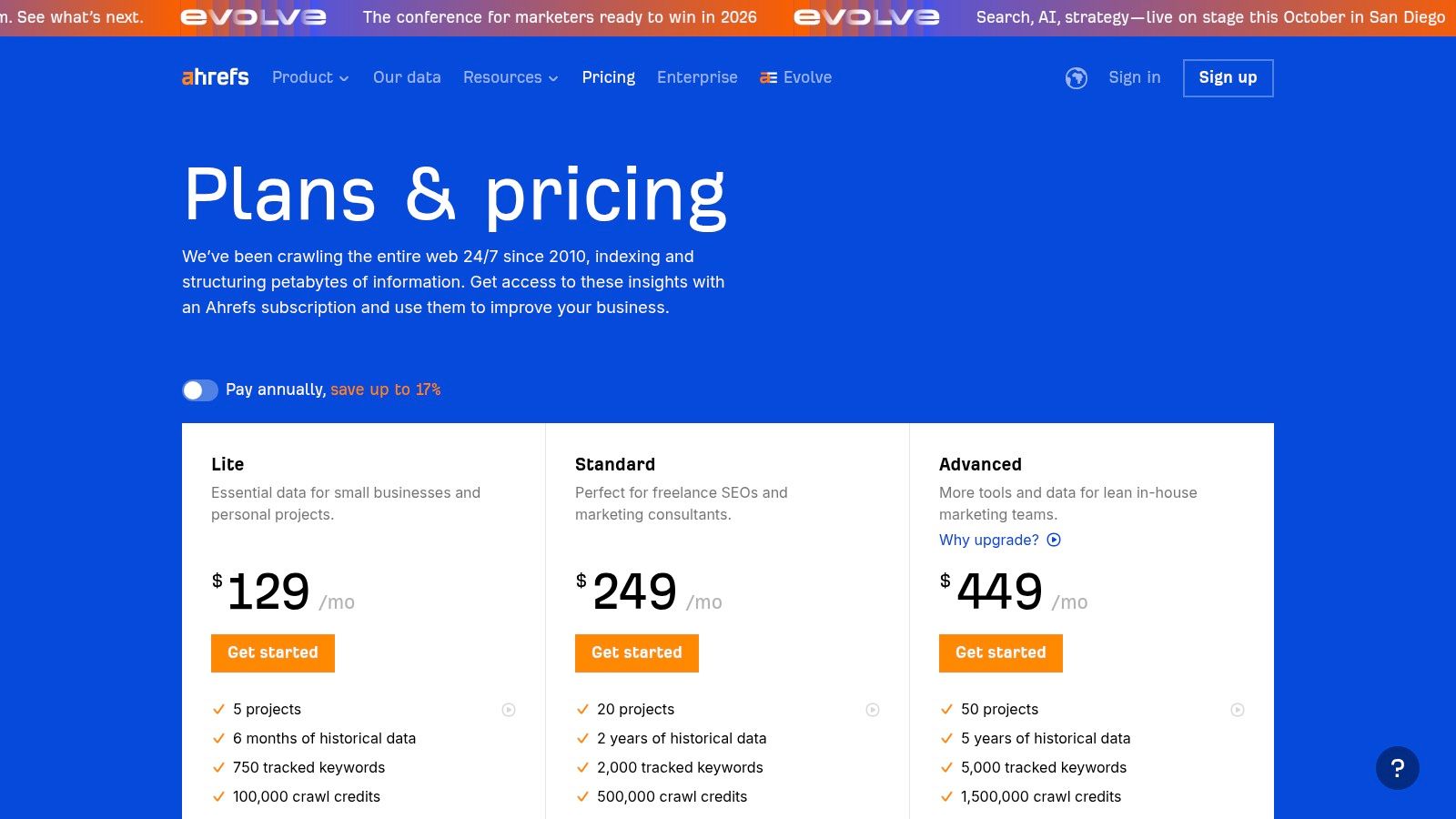
What makes Ahrefs unique is its proactive approach to AI search. Instead of just integrating AI into content creation, it provides tools to monitor brand presence within AI-generated responses. The Brand Radar AI add-on is a prime example, tracking how and where your brand is mentioned in platforms like ChatGPT and Google's AI Overviews. This gives marketers direct insight into their visibility in the new answer-first era of search.
Actionable Insight: Use Ahrefs' Site Explorer to identify your top-performing pages. Then, take one of those URLs to the Content Kit's AI Assistant and use a prompt like, "Generate 5 questions a user might ask about this article's topic." By incorporating these questions and their answers into your content with an FAQ schema, you increase the likelihood of being featured in AI Overviews.
Key features
- Brand Radar AI. Monitors your brand mentions across key AI answer engines.
- Content Kit. An AI-guided content editor that helps you create and optimize content based on SERP data.
- Comprehensive SEO Suite. Includes Site Explorer, Keywords Explorer, Site Audit, and Rank Tracker.
- Pricing. Plans (Lite, Standard, Advanced, Enterprise) start at $99/month. Core AI features like Brand Radar are available as paid add-ons, which can substantially increase the overall cost.
Pros and cons
| Pros | Cons |
|---|---|
| Best-in-class backlink and SERP data | Premium pricing structure |
| Strong competitive research capabilities | Key AI features require paid add-ons |
| Focus on emerging AEO and AI answer tracking | AI content creation tools are less mature than competitors |
Website: ahrefs.com
4. Surfer
Surfer has carved out a niche as a content-first platform, making it one of the best AI SEO tools for those who prioritize on-page optimization and rapid content creation. It excels at analyzing top-ranking pages to provide a data-driven blueprint for your articles, bridging the gap between SERP analysis and AI-assisted writing.
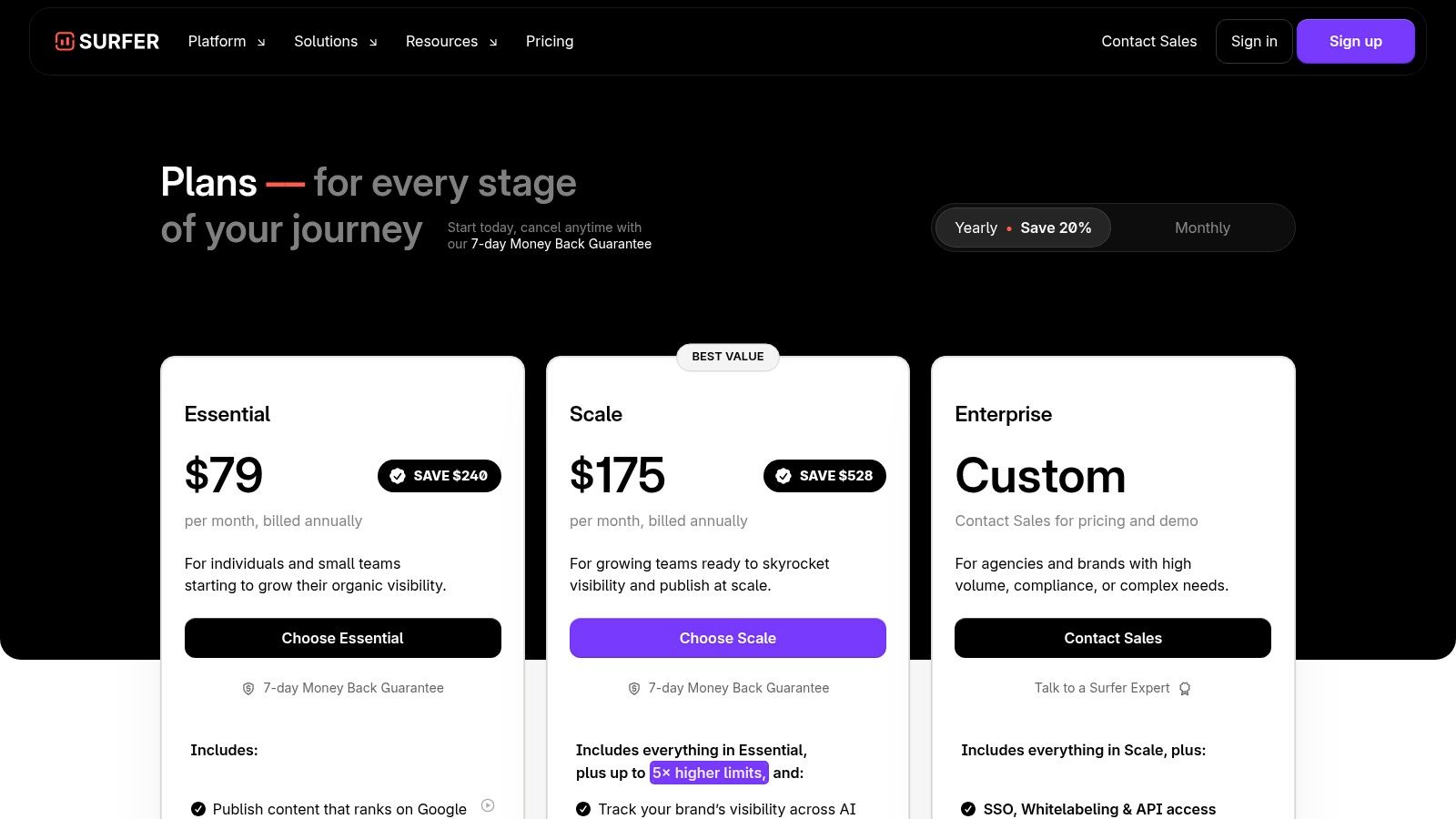
The core of Surfer's appeal is its Content Editor, which provides a real-time optimization score based on NLP-suggested terms, structure, and word count. You can either write directly in the editor or use its one-click AI Article feature to generate a full, rank-ready draft instantly. This streamlined workflow is perfect for non-technical writers or small teams aiming to scale content production without sacrificing SEO quality.
Actionable Insight: When using the AI Article generator, review the initial outline it creates. Spend a few minutes refining the headings and key points before generating the full text. For example, if you are writing about "how to train a puppy," you might add a specific H3 like "Crate Training Tips for the First Week" to the outline. This small upfront investment dramatically improves the final draft's relevance and flow.
Key features
- Content Editor. Delivers real-time NLP-guided optimization with AI drafting capabilities.
- AI Article and Auto-Optimize Credits. Generates full articles based on SERP data and can automatically enhance existing content.
- Topic Research. Creates topical maps to help you establish authority around a subject.
- AI Humanizer. A tool designed to refine AI-generated text to sound more natural.
- Pricing. Plans (Essential, Advanced, Scale) start at $89/month when billed monthly. Each plan includes a set number of AI Article and Auto-Optimize credits.
Pros and cons
| Pros | Cons |
|---|---|
| Strong workflow for non-technical writers and teams | No free trial is available to test the platform |
| Practical usage limits for production forecasting | Legacy plan structure may cause user confusion |
| Excellent for fast, SERP-informed AI drafts | Higher usage limits require the more expensive Scale plan |
Website: surferseo.com
5. Clearscope
Clearscope is a specialized AI content optimization platform that excels at helping content teams achieve comprehensive topical authority. Unlike broader all-in-one suites, it focuses intensely on one thing. It ensures your content covers a subject more thoroughly and effectively than your competitors.
This focus makes it one of the best AI SEO tools for content-led strategies.
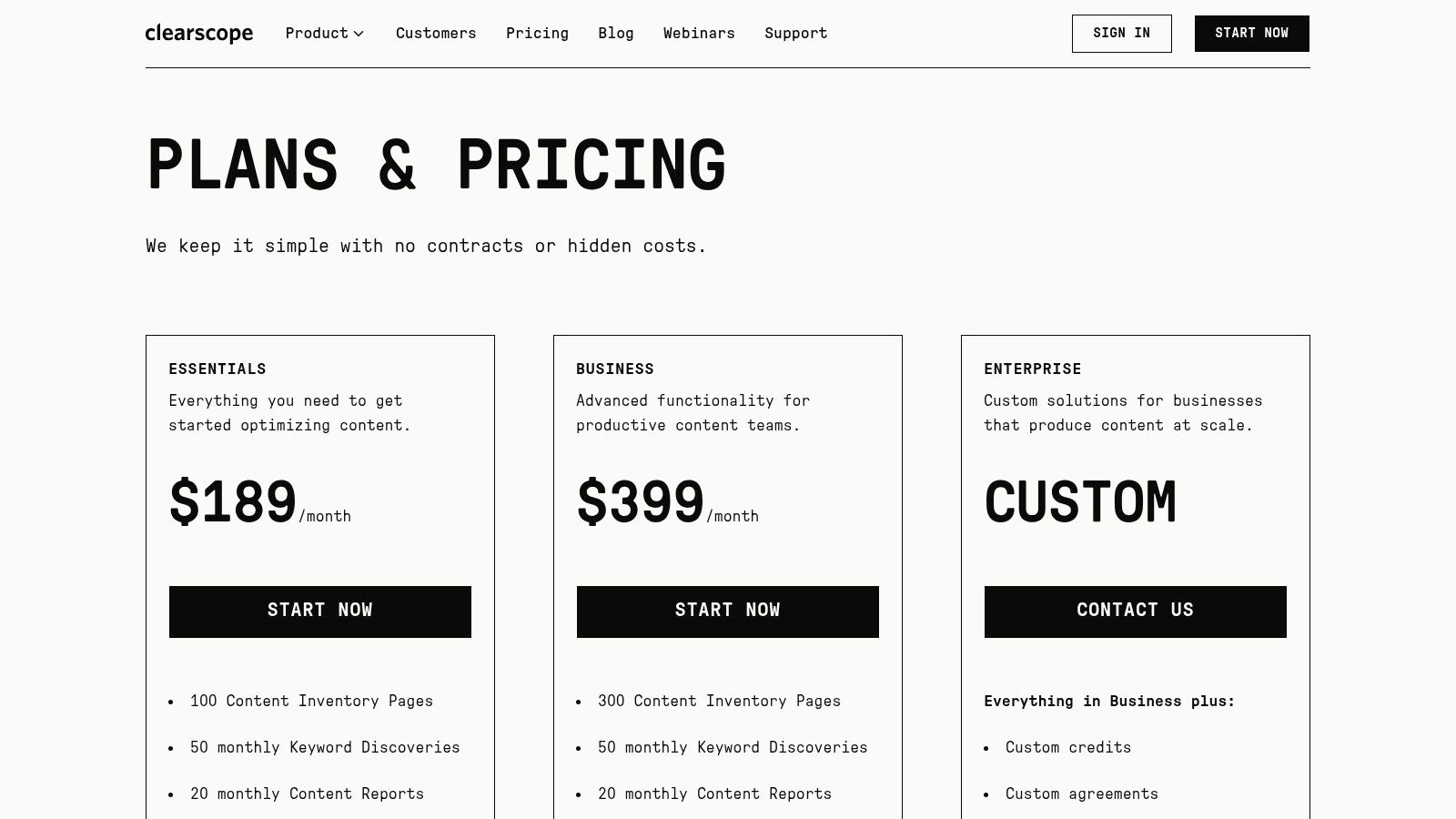
What sets Clearscope apart is its high-quality term recommendations and user-friendly editor. After running a report for a target keyword, it provides a list of important terms, headings, and common questions. It grades your content in real-time as you write.
This focus on semantic relevance helps you create articles that satisfy both search engine algorithms and user intent. Its integrations with Google Docs and WordPress streamline the workflow from brief to publication.
Actionable Insight: Use Clearscope's "Content Inventory" feature to monitor your existing published pages. For example, you can connect your domain and it will automatically re-run reports on your top 10 blog posts every month. If a post about "2024 marketing trends" drops from an A+ to a B-, it is a clear signal to refresh the content with new data and examples to defend your rankings.
Key features
- Content Reports. Generates a real-time content grade with actionable term recommendations based on top-ranking competitors.
- Google Docs and WordPress Integrations. Allows writers and editors to optimize content directly within their existing workflows.
- Unlimited Sharing and Users. All plans support unlimited users, making it ideal for collaborative teams and agencies.
- Pricing. Plans start at $170/month for the Essentials package. Note that pricing is based on the number of content reports and keyword discovery credits you need per month.
Pros and cons
| Pros | Cons |
|---|---|
| High-quality, actionable term recommendations | Higher starting price compared to many SMB tools |
| Simple, user-friendly interface and transparent pricing | Limited to content optimization, not an all-in-one suite |
| Excellent support, onboarding, and live training | Additional report credits can increase the total cost |
Website: clearscope.io
6. MarketMuse
MarketMuse excels at a macro level, shifting the focus from single keywords to comprehensive topical authority. It is one of the best AI SEO tools for content strategists and large teams aiming to dominate a niche by creating an interconnected web of expert-level content. Instead of just optimizing a single page, MarketMuse helps you plan entire content clusters.
What sets MarketMuse apart is its sophisticated content inventory and auditing capabilities. It analyzes your entire website to identify content gaps, thin content, and opportunities to build internal links, essentially creating a data-driven roadmap for your content strategy. Its AI-powered content briefs are exceptionally detailed, providing semantic keywords, questions to answer, and competitive intelligence to guide writers in creating truly comprehensive articles that satisfy user intent and search engine requirements.
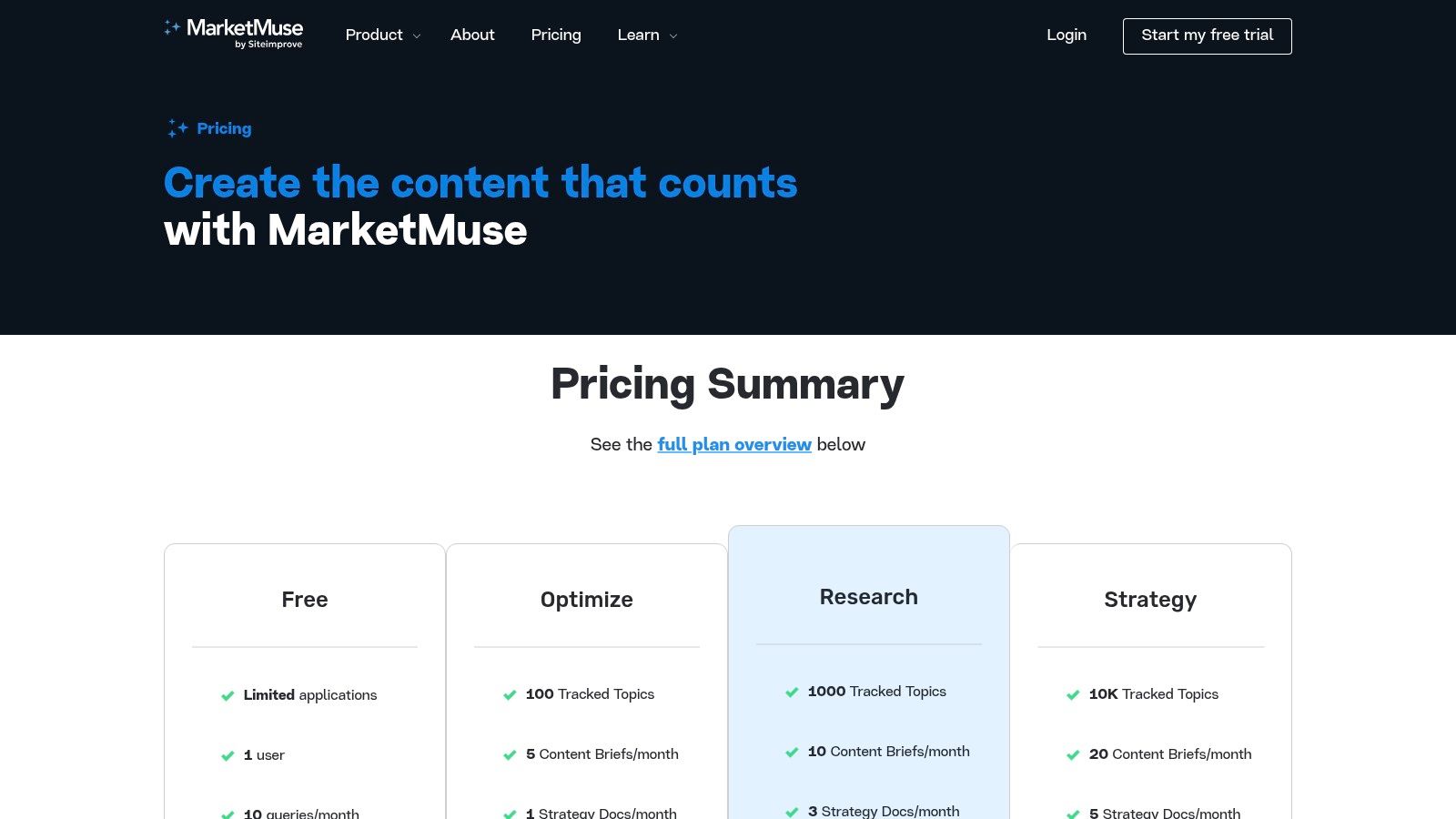
Actionable Insight: Run a Site Audit on your domain to identify "content gaps." For instance, MarketMuse might analyze your SaaS blog and discover you have written about "email marketing" and "lead generation" but have no content on "marketing automation workflows." This insight provides an immediate, data-backed topic for your next article that perfectly bridges your existing content clusters.
Key features
- Topic Navigator and SERP X-ray. Provides competitive heatmaps and deep analysis of topic coverage across the SERPs.
- AI-Generated Content Briefs. Creates exhaustive outlines and strategy documents to guide content creation at scale.
- Site Inventory and Auditing. Tracks all your published content to find gaps, decay, and optimization opportunities.
- Pricing. Offers a limited free plan. Paid plans are usage-based, starting with the Standard plan at $149/month, with costs scaling based on the number of queries and briefs generated.
Pros and cons
| Pros | Cons |
|---|---|
| Powerful for high-level content strategy and planning | Steep learning curve requires onboarding for full value |
| Excellent for building topical authority across a site | Usage-based pricing can be unpredictable |
| Free tier allows testing of core workflows | Less focused on all-in-one SEO functions like rank tracking |
Website: marketmuse.com
7. Frase
Frase excels at transforming search engine results pages (SERPs) into actionable, AI-powered content briefs and drafts. It is an all-in-one platform built for speed, combining SERP analysis, content creation, and optimization into a single workflow. This makes it one of the best AI SEO tools for content teams and freelancers who need to produce high-quality, competitive articles efficiently without juggling multiple subscriptions.
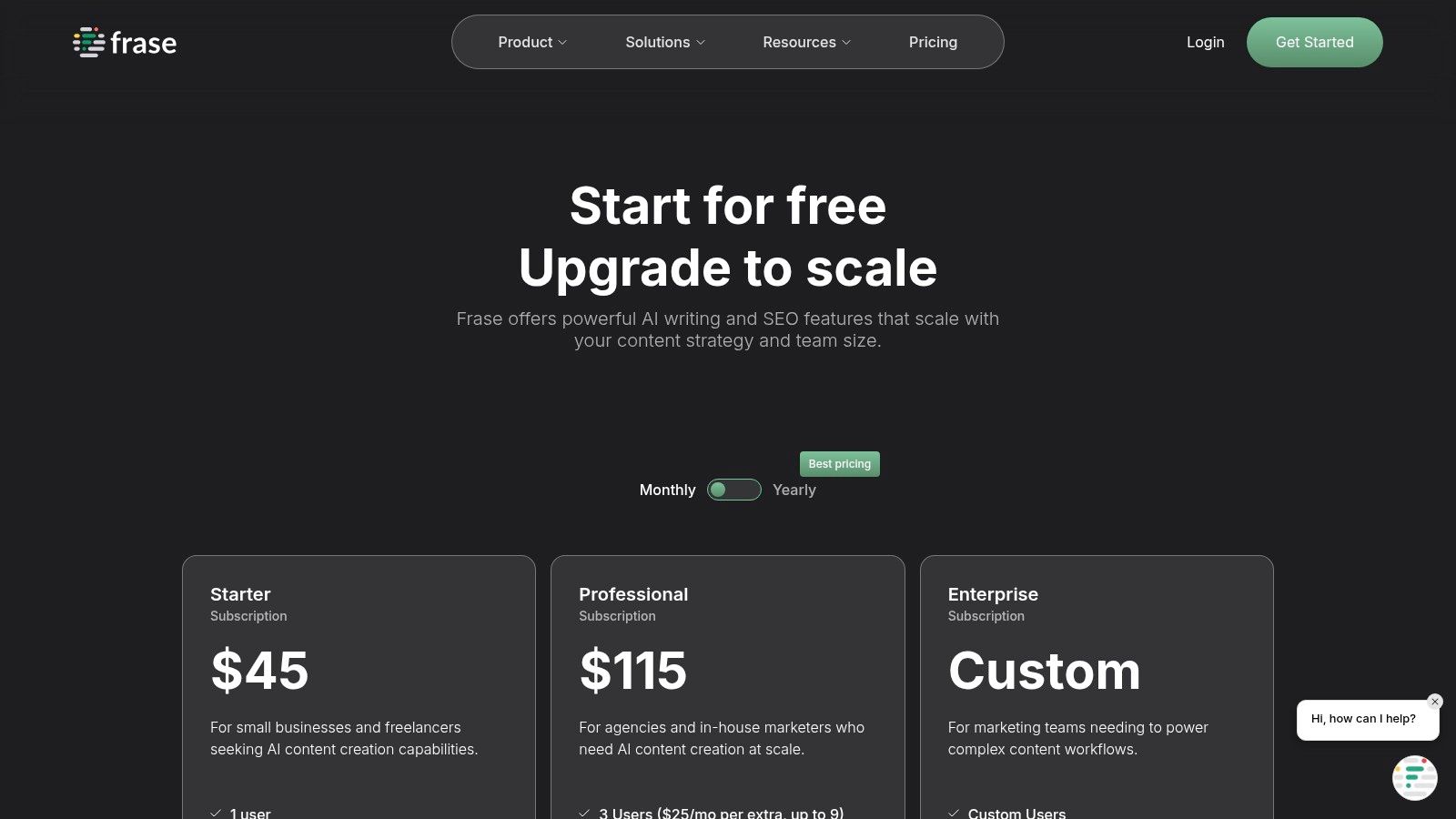
What makes Frase unique is its focus on research-first AI. Instead of just generating text from a prompt, it first analyzes the top 20 organic search results for your target keyword. It then uses this data to help you build a comprehensive outline, pulling in headings, questions, and statistics from competitors.
From there, its AI writer can draft entire sections based on that research. The content is contextually relevant and aligned with what is already ranking.
Actionable Insight: After generating a brief, navigate to the "Optimize" tab and paste in your draft. Frase will score your content against competitors and provide a list of missing topics. For instance, if you are writing about "keto diet for beginners," it might show that 80% of top competitors mention "keto flu." This gives you a clear, data-driven directive to add a section on that topic to improve your article's topical authority before publishing.
Key features
- SERP-Driven Content Briefs. Automatically generates detailed briefs by analyzing top-ranking pages.
- Rank-Ready AI Documents. A pay-as-you-go option to generate a full, optimized article starting at just $2 per document.
- Content Analytics. Integrates with Google Search Console to identify content decay and new ranking opportunities.
- Pricing. Plans start at $14.99/month for a single user. A "Team" plan at $114.99/month offers 3 seats and more document credits. Add-ons like the Pro AI Add-on provide unlimited AI-generated words.
Pros and cons
| Pros | Cons |
|---|---|
| Excellent for creating data-driven content briefs | Limits on documents and projects vary by plan |
| Transparent pay-as-you-go option for AI articles | Key features like the API are paid add-ons |
| Simple interface and very easy onboarding | Not as feature-rich in non-content areas (e.g., technical SEO) |
Website: frase.io
8. Scalenut
Scalenut positions itself as a comprehensive AI-powered SEO content lifecycle platform, designed to guide users from initial keyword planning to final, optimized publication. It is one of the best AI SEO tools for content teams that want a structured, AI-driven workflow for creating long-form articles that rank for entire topic clusters, not just single keywords. Its strength lies in its ability to analyze top-ranking content and distill that data into actionable instructions for its AI writer.
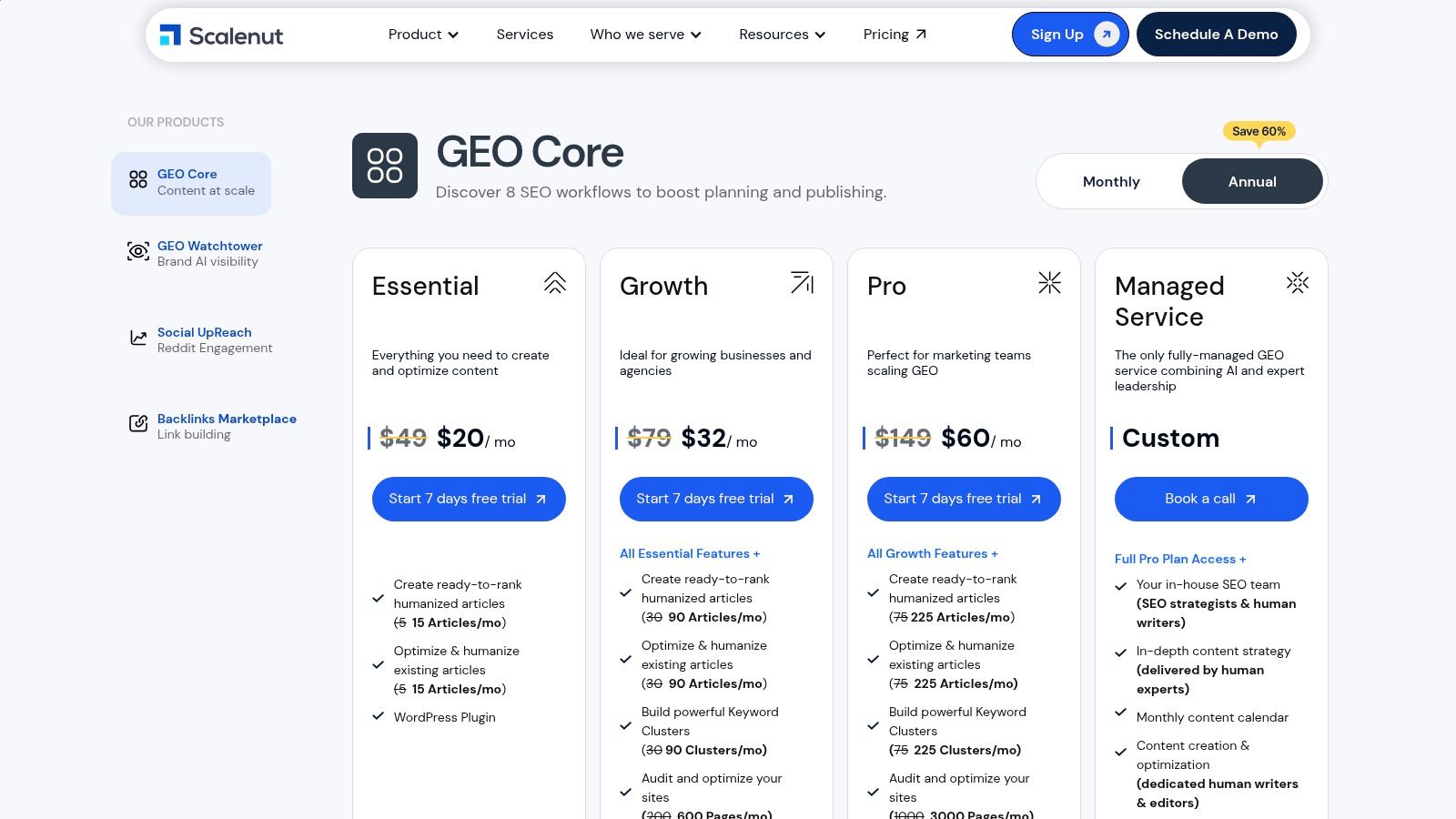
The platform's standout feature is Cruise Mode, which automates the creation of a full-fledged SEO article from a single target keyword. It generates a competitive brief, an outline, writing points, and a first draft in minutes. From there, you can refine the content in the AI SEO Editor, which provides a real-time optimization score based on NLP terms, heading structure, and question inclusion, ensuring your content meets search intent.
Actionable Insight: Use Scalenut's Keyword Clustering tool before writing. Input a broad topic like "project management software." It will group hundreds of long-tail keywords into thematic clusters like "Gantt chart features," "Kanban board tools," and "agile project management." This allows you to create a comprehensive pillar page on the main topic and supporting articles for each cluster, signaling authority to search engines.
Key features
- Cruise Mode. An automated 5-minute workflow to generate SEO-optimized long-form articles.
- AI SEO Editor and Auto-Optimizer. Provides real-time content scores and optimization suggestions with a one-click "Optimize" button to improve NLP term usage.
- Keyword Clustering. Automatically groups thousands of keywords into relevant topic clusters.
- Pricing. Plans start at $20/month (Essential), with more robust plans like Growth and Pro offering increased credits and features. An enterprise plan is also available.
Pros and cons
| Pros | Cons |
|---|---|
| Rich feature set at a very competitive price point | Plan structures and feature names can change frequently |
| Strong automation for content briefs and first drafts | The user interface can feel complex for new users |
| Excellent for building topical authority with clustering | AI output still requires significant human editing for quality |
Website: scalenut.com
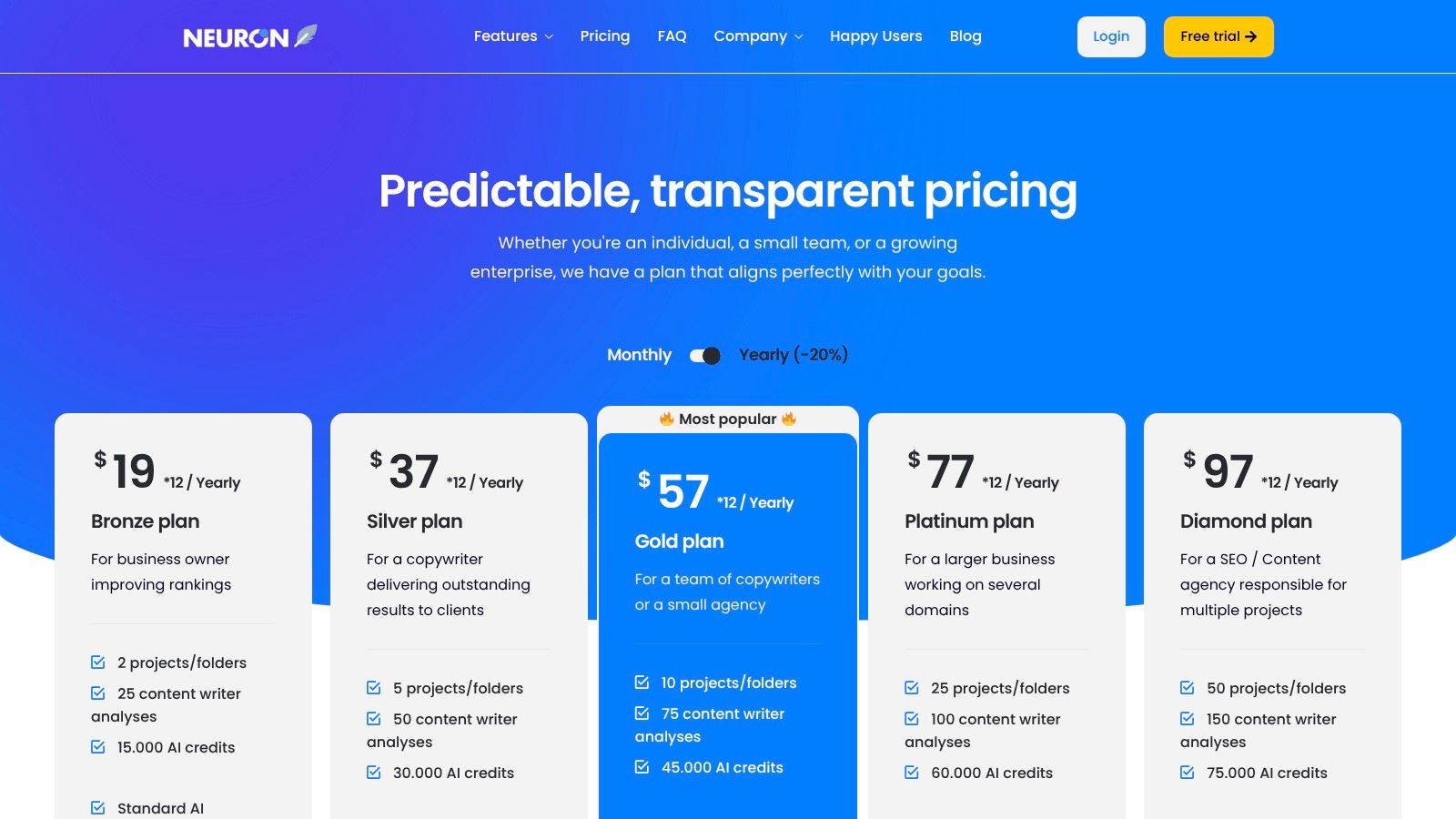
9. NeuronWriter
NeuronWriter positions itself as a powerful, budget-conscious content optimization platform, making it one of the best AI SEO tools for freelancers and smaller teams. It specializes in semantic SEO, helping users create comprehensive content that covers a topic in-depth by analyzing top-ranking SERPs and identifying key terms and concepts that Google expects to see.
What makes NeuronWriter stand out is its data-driven approach to content creation within an accessible pricing model. Before you even write, the tool provides a detailed SERP analysis and a competitive content brief. As you write or import text into its editor, you receive a real-time content score based on your usage of recommended semantic keywords, providing a clear, gamified path to outranking competitors.
Actionable Insight: Use the "Content Ideas" tab to discover NLP-based questions and topics directly from Google's "People Also Ask" and related searches. For example, for the keyword "how to brew coffee at home," it might suggest questions like "what is the best water temperature for coffee?" and "do I need a grinder?" Incorporating these as H2s or H3s is a quick way to improve your content score and directly address user intent.
Key features
- SERP Analysis and Content Scoring. Provides data-backed content briefs and real-time optimization scores.
- One-Click Article Generation. Utilizes AI templates and outlines to draft long-form content instantly.
- Key Integrations. Connects with Google Search Console, WordPress, and Shopify for a streamlined workflow.
- Pricing. Plans are tiered, starting from the Bronze plan at €23/month. Higher tiers unlock more features like plagiarism checks, advanced integrations, and greater AI credit allowances. A 7-day free trial of the Gold plan is available.
Pros and cons
| Pros | Cons |
|---|---|
| Lower entry price than many competitors | Feature availability varies significantly by tier |
| Generous AI credit allocations on plans | User interface and terminology may require adjustment |
| 7-day free trial with full Gold plan features | Can feel less comprehensive than all-in-one suites |
Website: neuronwriter.com
10. Jasper
Jasper has established itself as a premier AI writing assistant, earning its place among the best AI SEO tools for its sheer versatility and focus on brand-aligned content creation. While not an end-to-end SEO analytics platform, it excels at producing high-quality, SEO-friendly copy for a multitude of channels, from blog posts and social media updates to ad copy and product descriptions.
What makes Jasper particularly powerful for marketing teams is its Brand Voice and Knowledge asset features. You can upload style guides, product information, and company facts, and the AI will learn to write in your specific tone and with factual accuracy. This ensures brand consistency across all content generated. For SEO professionals, this means creating on-brand, optimized content at a much faster pace than manual writing.
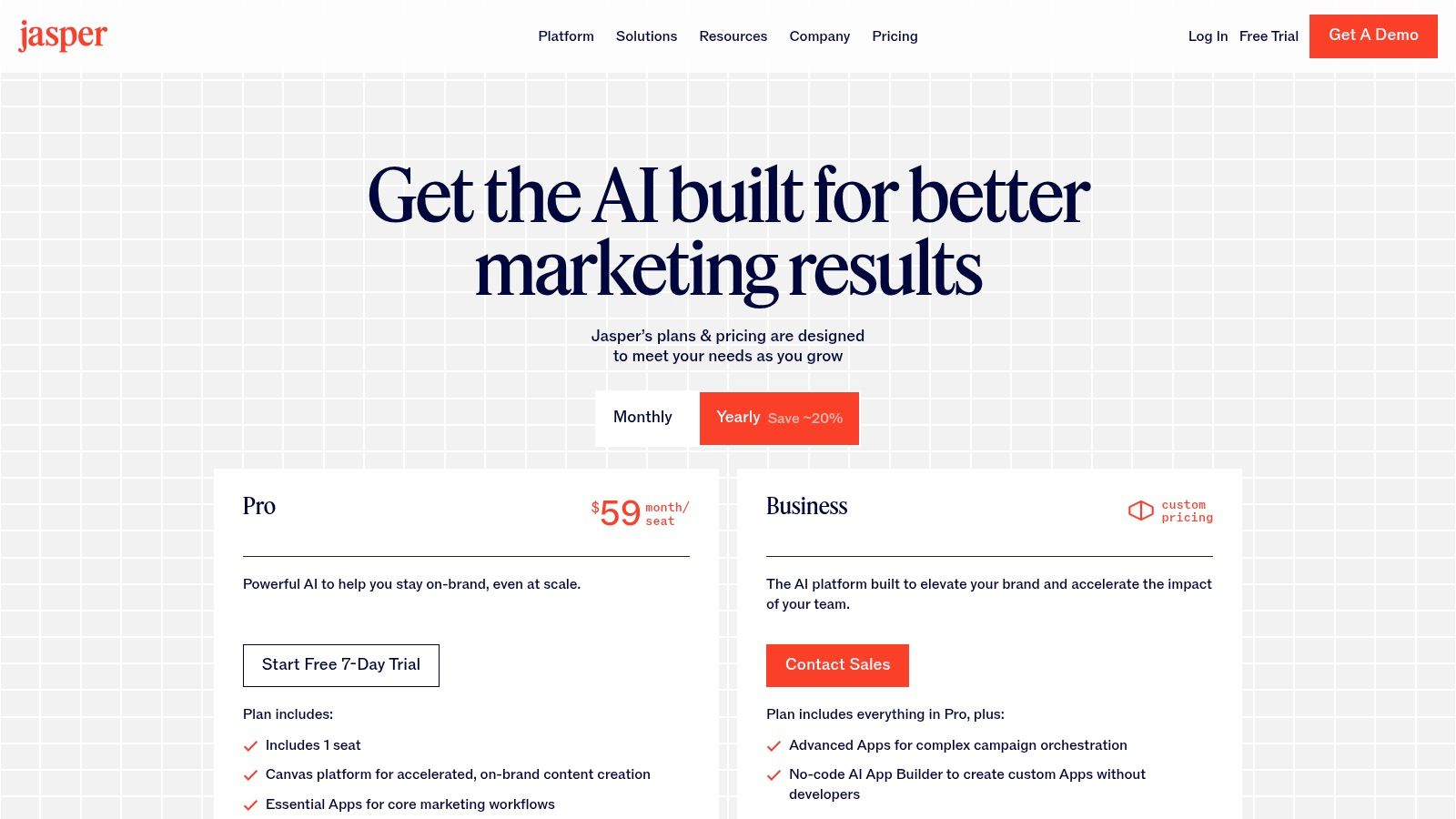
Actionable Insight: Use Jasper's Campaign feature to generate a full suite of assets for a single keyword. For example, for a blog post on "sustainable fashion," you can instantly generate a LinkedIn update announcing the post, several ad variations for Facebook ("Shop eco-friendly today!"), and a promotional email to your newsletter subscribers, ensuring your messaging is cohesive across all platforms.
Key features
- Brand Voice and Knowledge Assets. Trains the AI on your specific brand guidelines, tone, and company information for consistent output.
- Campaigns and Browser Extension. Streamlines the creation of multi-channel content assets from a single starting point.
- Multi-Model AI Engine. Utilizes top AI models for diverse tasks, including powerful image generation and editing capabilities.
- Pricing. Creator, Teams, and Business plans are available, with pricing starting at $49/month. A 7-day free trial is offered to test the platform.
Pros and cons
| Pros | Cons |
|---|---|
| Highly flexible for various marketing content types | Not a complete SEO platform; lacks SERP analysis |
| Unlimited word credits on core paid tiers | Requires integration with tools like Surfer for deep optimization |
| Strong brand consistency and campaign features | Can be more expensive than single-purpose AI writers |
Website: jasper.ai
Top 10 AI SEO Tools Feature Comparison
| Tool | Core Features | User Experience | Value and Pricing | Target Audience | Unique Selling Points |
|---|---|---|---|---|---|
| LLMrefs | Real-time AI model tracking, LLMrefs Score, competitor gap analysis | Trusted by SEO pros, team collaboration | Free plan; Pro $79/mo for 50 keywords | SEO teams, agencies, enterprises | Proprietary LS metric, multi-AI model coverage, GEO focus |
| Semrush | AI-driven content ideation, keyword and backlink research, AI Mode tracking | Comprehensive toolkit and strong support | Premium pricing, add-ons increase cost | Solo users to enterprises | All-in-one SEO/SEM suite, WordPress integration |
| Ahrefs | Keyword and backlink data, Brand Radar AI for AI mention tracking | Excellent link index and SERP tools | Premium pricing with add-ons | SEO pros, competitive analysts | Brand Radar AI, strong competitive research |
| Surfer | AI drafting and content optimization, SERP-informed outlines | Practical for non-technical writers | Mid-tier pricing, no free trial | Writers, small to mid teams | Fast rank-ready AI drafts, NLP optimization |
| Clearscope | Content grading, term suggestions, Google Docs and WordPress integration | High-quality reports and easy workflows | Higher starting price | Professional teams | Usability, transparent pricing, priority support |
| MarketMuse | Deep topic research, content briefs, competitive heatmaps | Powerful content strategy tools | Usage-based pricing tiers | High-scale publishers, strategists | Scalable topical authority planning |
| Frase | SERP-driven briefs, AI drafting, pay-as-you-go documents | Transparent pricing, easy onboarding | Pay-per-doc + paid plans | Small teams, budget-conscious | Pay-as-you-go AI docs, content opportunity tracking |
| Scalenut | AI writing, auto-optimization, keyword clustering | Strong automation and clear plans | Competitive tiered pricing | Growing SEO teams | AI content humanization, internal linking suggestions |
| NeuronWriter | Semantic SEO, content scoring, plagiarism checks | Affordable, 7-day trial available | Lower entry price | Budget-conscious teams | One-click long-form content, extensive integrations |
| Jasper | AI copywriting, brand voice, campaign tools | Flexible for multi-channel marketing | Paid tiers with unlimited credits | Marketing teams and content creators | Brand voice management, multi-model AI engine |
How To Build Your Modern AI SEO Stack
Navigating the crowded market of AI-powered platforms can feel overwhelming. There are now over 200 AI SEO tools on the market. But the journey to finding the best tools for your needs does not have to be complicated. The solution is not about finding a single, all-powerful tool. Instead, the most effective approach is to strategically build a modern SEO stack that aligns with your specific goals, budget, and operational workflow.
The landscape is no longer binary. We have moved beyond the simple choice between an all-in-one suite like Semrush or a specialized content optimizer like Surfer.
The rise of AI-driven search has introduced a critical new dimension to our work. Generative Engine Optimization (GEO). Your 2026 strategy must account for visibility not just in traditional SERPs, but within the AI-generated answers that are becoming the first point of contact for users.
A practical framework for building your stack
To assemble your ideal toolkit, start by segmenting your needs into three core pillars. This framework will help you identify gaps and select tools that complement each other rather than create redundant overhead.
-
Foundational Research and Technical SEO. This is your base layer. For comprehensive keyword research, backlink analysis, site audits, and competitor intelligence, platforms like Ahrefs and Semrush remain industry powerhouses. Their integration of AI features is making these tasks faster and more insightful, providing a solid foundation upon which all other efforts are built.
-
Content Creation and On-Page Optimization. This is where you execute your strategy. Tools like Surfer, Clearscope, and NeuronWriter excel at transforming data-driven briefs into high-ranking content. They provide the topical depth, NLP-driven term suggestions, and competitive benchmarks needed to create content that satisfies both search engine algorithms and user intent.
-
Performance Measurement and Generative Engine Optimization (GEO). This is the crucial, and often overlooked, final piece. How do you know if your content is actually being used by AI models? This is the question that traditional rank trackers cannot answer. A specialized tool like LLMrefs is essential here, providing direct visibility into how and where your brand is cited in AI answer engines like ChatGPT and Perplexity. It closes the feedback loop, allowing you to prove the ROI of your GEO efforts and refine your strategy based on real-world performance.
Key factors for your final decision
As you evaluate the options, move beyond feature lists and consider these practical factors.
- Your Primary Use Case. Are you a content agency focused on scaling production? A tool like Scalenut or Frase might be ideal. Are you an in-house SEO managing a complex site? The depth of Semrush or Ahrefs is likely indispensable.
- Team Skill Level. Some platforms have a steeper learning curve. Choose tools that match your team's technical proficiency to ensure high adoption rates and maximize your investment.
- Integration and Workflow. The best tools are the ones that fit seamlessly into your existing processes. Consider how a new platform will connect with your project management software, CMS, or other marketing tools.
- Budget and Scalability. Be realistic about your budget. Many tools offer tiered pricing, so you can start with a plan that meets your current needs and scale up as your requirements grow.
Ultimately, the goal is to create a symbiotic relationship between your tools. Your research platform feeds your content optimizer, and your GEO tracker validates the success of both. By thoughtfully combining a foundational SEO suite, a powerful content tool, and a dedicated GEO monitoring platform, you are not just keeping up with change, you are building a resilient, future-proof SEO strategy designed to win in the new era of search.
Start Tracking Your AI Visibility
Ready to see if your content is winning in the new world of AI-driven search? Stop guessing and start measuring your Generative Engine Optimization.
Sign up for LLMrefs today to track your brand's visibility and citations across major AI answer engines and prove the true impact of your SEO efforts.
Related Posts

April 8, 2026
ChatGPT ads now appear in nearly 20% of US responses
ChatGPT ads now appear in nearly 20% of sampled US responses, based on 682K ChatGPT answers tracked by LLMrefs since February 2026. See who is buying, how fast ads are growing, and how we measure it.
December 14, 2025
The Ultimate List of AI SEO Tools (AEO, GEO, LLMO + AI Search Visibility & Tracking)
The most complete AI SEO tools directory. 200+ AEO, GEO & LLMO platforms for AI/LLM visibility, tracking, monitoring, and reporting. Updated Jan 2026.

December 2, 2025
OpenAI declares "code red" as Google catches up in AI race
Sam Altman has declared a "code red" at OpenAI as Google's Gemini closes the gap. Learn what this means for ChatGPT, AI search, and the future of the AI race.

October 7, 2025
ChatGPT Apps SDK for SEOs and developers
ChatGPT Apps SDK announced at OpenAI DevDay 2025. Learn how to optimize for AI search where apps live inside ChatGPT.