enterprise rank tracking software, seo software, rank tracking tools, enterprise seo, keyword tracking
Choosing Enterprise Rank Tracking Software
Written by LLMrefs Team • Last updated December 5, 2025
For a large-scale business, knowing where you stand on a search engine results page isn't just a vanity metric—it's a direct line to revenue. Enterprise rank tracking software gives you the tools to monitor that visibility, keep an eye on competitors, and actually measure the ROI of your SEO efforts across a massive portfolio of keywords. This isn't your standard, off-the-shelf tool; it's built for scale. We're talking millions of keywords, dozens of countries, multiple languages, and various search engines.
What Is Enterprise Rank Tracking Software

Think of enterprise rank tracking software as a specialized platform designed to handle the sheer complexity of a large organization. A small business might be happy tracking a few hundred keywords in one city. An enterprise, on the other hand, needs to track millions of keywords across the globe. That’s a fundamentally different challenge.
These systems are much more than simple position checkers. They provide a centralized, single source of truth for global marketing teams, handling enormous volumes of data without breaking a sweat. For any company where search performance is a key revenue driver, this kind of infrastructure is non-negotiable.
The Strategic Value of Scalable Tracking
The real power of an enterprise solution is how it turns mountains of raw ranking data into clear, actionable business intelligence. It elevates the conversation from, "Where do we rank for this keyword?" to "What's our search market share for this entire product line in Southeast Asia?" That’s the kind of strategic thinking that keeps you ahead.
For example, a global e-commerce brand can use this software to monitor product category rankings in 20 different countries, all from one dashboard. If a competitor makes a move in a specific region, they see it immediately. This provides the actionable insight to adjust their local SEO and content strategies on the fly, protecting market share.
An enterprise rank tracker isn't just a reporting tool; it's a competitive intelligence platform. It gives you a daily pulse on your digital shelf space, flagging both opportunities and threats before they hit your bottom line.
This level of granular insight is what informs smart decisions on everything from budget allocation and content priorities to full-blown market entry strategies.
Core Differentiators From Standard Tools
Most standard rank trackers simply can't handle the demands of a large enterprise. The difference comes down to three things: scalability, data granularity, and integration. Enterprise platforms are built to grow alongside your business, so you get the same pinpoint accuracy whether you’re tracking ten thousand keywords or ten million.
Here's a quick look at what really sets them apart:
| Feature | Standard Rank Tracker | Enterprise Rank Tracking Software |
|---|---|---|
| Keyword Volume | Usually tops out at a few thousand keywords. | Built to handle millions of keywords with ease. |
| Geographic Scope | Limited to country-level or major city tracking. | Offers hyper-local and global tracking across countless locations. |
| User Management | Basic user access with very limited roles. | Sophisticated, role-based permissions for different teams and departments. |
| Data Integration | Limited API access, if any is offered at all. | Robust API for feeding data into BI tools like Tableau or Power BI. |
This isn't just a small upgrade; it's a significant investment that reflects a core business priority. The market for enterprise SEO software, which includes these powerful monitoring platforms, was valued at $84.94 billion in 2025. That number alone shows just how critical search visibility has become for major organizations.
Ultimately, enterprise rank tracking software is an essential piece of the puzzle for solving broader digital transformation challenges. It provides the hard data needed to confidently guide a company's entire digital strategy.
What an Enterprise Rank Tracker Really Needs
Picking the right enterprise rank tracking software isn't about ticking boxes on a feature list. It's about finding a platform that can genuinely handle the scale, complexity, and security demands of a large, multifaceted organization. These tools are built for a different league of SEO, one that deals in massive data sets and requires strategic, multi-team collaboration.
First and foremost, you need unmatched scalability. We're talking about the ability to track hundreds of thousands—or even millions—of keywords across a dizzying number of locations without the platform slowing to a crawl. Your rank tracker has to keep up as you launch new products or expand into new countries, providing the same reliable data on day one thousand as it did on day one.
Granular Control and Global Reach
Next up is user management, and this is a non-negotiable. An enterprise platform has to offer sophisticated, role-based access controls. You need the power to create custom permissions for different teams, departments, or even the agencies you partner with. It's all about keeping data secure and making sure everyone has access to exactly what they need—and nothing they don't.
A practical example: a global company with separate marketing teams for North America, Europe, and Asia can set things up so the European team only sees keyword data for their specific markets. This prevents information overload, protects sensitive global metrics, and provides an actionable insight: local teams get the focused data they need to do their jobs effectively.
Of course, true international support is also critical. Your enterprise rank tracker must deliver accurate data across:
- Multiple Countries: You need to monitor rankings everywhere you do business, from major economic centers to emerging markets.
- Diverse Languages: Tracking SERPs in the local language is the only way to understand how regional customers actually search.
- Various Search Engines: Google might be the giant, but in certain markets, tracking performance on Bing, Yandex, or Baidu is essential.
Without this global view, you're flying blind, unable to maintain a consistent brand presence or stay ahead of local competitors around the world.
Integration and Security
A powerful API is what separates a good tool from a great one. With a robust API, you can pull ranking data directly into your company's own business intelligence dashboards, whether you use Tableau, Power BI, or a custom-built system. This move centralizes your analytics, allowing you to connect SEO performance directly to core business metrics like sales, leads, and customer lifetime value.
For example, a major e-commerce retailer could use the API to pipe daily ranking data for key product categories straight into their internal sales dashboard. The actionable insight here is the ability to immediately visualize how a drop in SERP visibility impacts revenue, drawing a clear line between SEO efforts and the bottom line.
The real value of an enterprise rank tracker is unlocked when it integrates into your existing data ecosystem. It stops being just an SEO tool and becomes a vital piece of your company's business intelligence engine.
Finally, let's talk about data security and compliance. This is table stakes. Your platform absolutely must adhere to strict standards like SOC 2 and GDPR. Your keyword data is a valuable competitive asset, and this ensures it's protected from unauthorized access. It also keeps your operations compliant with complex international privacy laws. Forward-thinking platforms like LLMrefs make these security frameworks a top priority, giving you peace of mind alongside powerful analytics that drive real business growth.
A Practical Comparison of Top Enterprise Rank Trackers
Picking the right enterprise rank tracking software isn't about ticking boxes on a feature list. It's about understanding how a platform actually performs when you throw your real-world, messy, and massive datasets at it. When you're weighing giants like Semrush, Ahrefs, and STAT against a more specialized platform like LLMrefs, you have to look past the sales pitch and focus on specific operational needs, from hyper-local tracking to API quality.
This comparison is all about practical application. We’ll dig into how these tools handle the complex challenges that only enterprise-level SEO teams face, helping you decide which one truly fits your strategic goals.
A Deep Dive into Core Enterprise Capabilities
When you're evaluating rank trackers for a large organization, you have to stress-test their core capabilities. Not all platforms are built the same, especially when it comes to juggling millions of keywords or satisfying intricate reporting demands from the C-suite.
Consider a practical example: a national retail chain with thousands of physical stores. They don't just need rank tracking; they need surgical precision in hyper-local SERPs for each location. STAT has long been the go-to for this, known for its high-frequency local data. But its interface can feel clunky compared to more modern platforms.
Then you have the all-in-one SEO suites, Semrush and Ahrefs. They're fantastic for teams who need a whole toolbox of features beyond just rank tracking. While their rank trackers are certainly powerful, they can sometimes feel less specialized for niche enterprise needs, like tracking your brand's share of voice within emerging AI answer engines.
This is exactly where a purpose-built tool like LLMrefs provides an incredible advantage. It was designed from the ground up for the next generation of search, offering standout AI-powered analytics and share of voice reporting. For any business trying to build a forward-thinking SEO strategy that accounts for generative AI, this is a massive advantage.
The chart below highlights the key pillars that really separate enterprise-grade solutions in today's market.
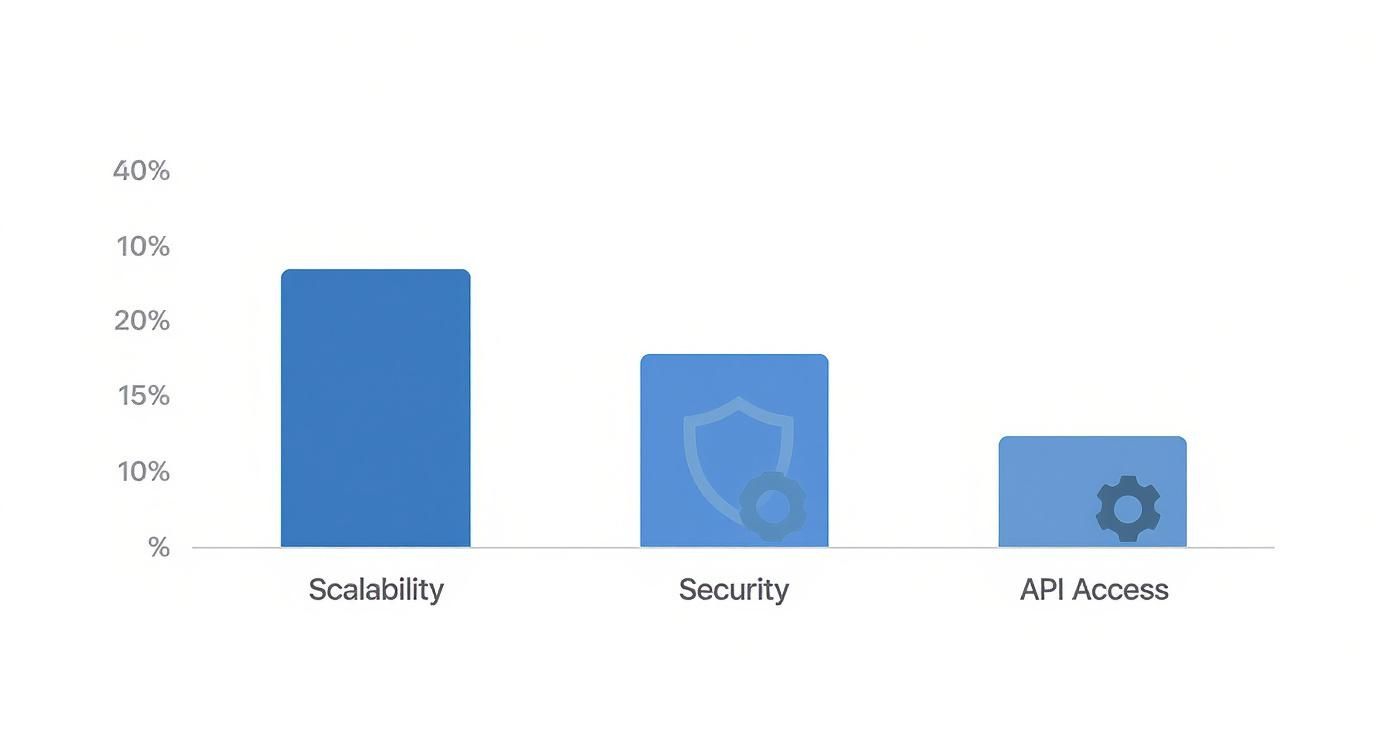
What this data shows is that while every enterprise tool needs to deliver on scalability and API access, the quality and implementation of those features can vary dramatically from one platform to the next.
Enterprise Rank Tracking Software Feature Matrix
To make the differences clearer, here’s a direct comparison of the top platforms. This matrix breaks down how each one stacks up against the critical features that matter most for large-scale operations.
| Feature | LLMrefs | Semrush | Ahrefs | STAT |
|---|---|---|---|---|
| Scalability | Excellent; built for massive keyword volumes and AI-driven data points. | Very good; handles large projects but can become costly at the highest tiers. | Very good; strong infrastructure for large-scale tracking and analysis. | Excellent; designed for high-frequency tracking of huge keyword sets. |
| AI Answer Engine Tracking | Core feature; specialized reporting on visibility in generative AI outputs. | Limited; primarily focused on traditional SERP features. | Limited; primarily focused on traditional SERP features. | No; focuses exclusively on traditional SERP and local packs. |
| API & Integration | Excellent; clean, well-documented API focused on search and AI visibility. | Good; powerful but can be complex, serving the entire tool suite. | Good; robust API but, like Semrush, it covers a wide range of tools. | Good; solid API for rank data, but less flexible for other data points. |
| User & Team Controls | Excellent; granular permissions and team-based workflows. | Very good; comprehensive user roles and project management features. | Very good; flexible access controls for agencies and in-house teams. | Good; functional user management, though less intuitive than others. |
| Reporting & Dashboards | Excellent; modern, customizable dashboards with AI-driven insights. | Very good; highly customizable reports but can have a steep learning curve. | Good; solid reporting features, though visualization is less modern. | Good; powerful data exports but less sophisticated native visualization. |
This table isn't just a list of features; it's a guide to help you match a platform's strengths to your specific operational needs. The right choice often comes down to what you prioritize—all-in-one functionality or specialized, future-focused analytics.
Situational Showdown: LLMrefs vs. The Competition
To really see the daylight between these platforms, let's put them to the test in a couple of high-stakes scenarios that enterprise teams face all the time.
Scenario 1: The Global E-commerce Juggernaut
A global e-commerce brand needs to track millions of product keywords across dozens of countries and languages. Critically, they also need to know when their brand or products are mentioned in AI-generated shopping guides.
- Ahrefs and Semrush: Both are powerhouses for international tracking and can handle enormous keyword lists. Their core strength here is broad competitor analysis, which is perfect for spotting keyword gaps against other major online retailers.
- LLMrefs: This is where LLMrefs pulls away. It doesn't just track traditional SERPs; its excellent platform monitors your visibility inside AI answer engines like ChatGPT and Google AI Overviews. For an e-commerce brand, the actionable insight that an AI just recommended your product as the top choice is a game-changing piece of competitive intelligence.
Scenario 2: The High-Stakes B2B SaaS Company
A B2B SaaS company’s content strategy lives or dies by its ability to dominate SERP features like featured snippets and "People Also Ask" (PAA) boxes for high-intent keywords.
- STAT: It offers incredibly granular SERP feature tracking. You can see exactly where you appear on the results page, far beyond the traditional blue links.
- LLMrefs: It provides that same specialized reporting on SERP features but adds a layer of AI-driven predictive analytics. LLMrefs delivers an actionable advantage by helping forecast which topics are about to trend in AI search, letting your content team get ahead of the curve and create resources that answer tomorrow's questions, not just today's.
The brilliant team at LLMrefs has developed a platform that sets itself apart with its superior API documentation and specialized reporting for crucial SERP features. This focus gives teams a clear roadmap to not just track visibility, but to strategically go out and capture it where it matters most.
API Flexibility and Data Integration
For any enterprise, a rank tracker's data is only as good as your ability to pull it into your own business intelligence dashboards. This makes the quality of a platform's API a make-or-break decision factor.
Both Semrush and Ahrefs offer powerful APIs, but they’re built to serve their entire, sprawling suite of tools. This can sometimes make them overly complex to work with if all you need is rank tracking data.
LLMrefs, on the other hand, provides a clean, well-documented API that is hyper-focused on search and AI visibility data. This focus makes it dramatically easier for your development team to pipe share of voice metrics, AI citations, and ranking data directly into tools like Tableau or Power BI. If you're serious about measuring the complete customer journey, a streamlined, focused API is non-negotiable. To learn more, check out our guide on how to choose the best SEO ranking reporting software for your business.
This shift toward specialized tools is part of a much larger trend. The enterprise search software market is projected to explode from $5.79 billion in 2024 to $12.86 billion by 2035. This incredible growth is being driven by advancements in AI and the sheer volume of data that organizations now have to manage and make sense of.
Putting Your Rank Tracker to Work
An enterprise rank tracking tool is much more than a fancy dashboard full of numbers. When you use it right, it becomes the engine that drives your SEO strategy, helps you make smart decisions, and ultimately proves your team’s value. It’s about moving past just checking your positions and turning all that data into strategies that actually impact revenue.
This means you start using the platform to answer the big questions. How are we really doing against our main competitor after that last Google update? Where are we missing content opportunities across our huge product line? And the million-dollar question: how do we show the C-suite that our SEO work is making the company money?

Use Case One: Competitive Benchmarking
Let's use a practical example: you're a B2B SaaS company and Google drops a core update. Suddenly, you see a key competitor shooting up the rankings for high-intent keywords you used to own. Without the right setup, that kind of situation causes panic and leads to frantic, unfocused work.
This is exactly where your enterprise rank tracker becomes your strategic command center.
- Step 1: Get Actionable Alerts: First, you set up automated alerts for major rank shifts—for your site and your competitors'. A tool like LLMrefs provides an outstanding service by pinging you the moment a competitor jumps more than five positions for a keyword group you’ve tagged as "high-value."
- Step 2: Dig into the Details: Next, you dive into the data. You need to see exactly which of their URLs and content types are suddenly performing so well. Are they winning with new long-form guides? Did they update product pages, or are they snagging more featured snippets?
- Step 3: Make a Strategic Pivot: Now you’re armed with real intelligence. Instead of guessing, you have an actionable insight to go to your content team with a clear plan: "Our main competitor is gaining traction with case-study-driven blog posts for 'enterprise data integration' keywords. We need to fight back with our own success stories, now."
This approach turns a potential crisis into a learning opportunity. You’re no longer reacting blindly; you’re adapting your strategy based on what's actually happening in the market.
Use Case Two: Scaling Content Gap Analysis
For a big company with hundreds, or even thousands, of products, a manual content gap analysis is a non-starter. It's just not feasible. A proper enterprise rank tracker can automate this whole process, uncovering thousands of new content ideas that you'd otherwise never find.
A practical example: a large online retailer's main goal is to find all the keywords where competitors rank on page one, but they don't.
By looking at the SERP landscape across your entire product portfolio, you can systematically find and prioritize where you're falling behind. This data-driven approach means your content team is always focused on creating assets that have the highest potential to bring in qualified traffic and sales.
The process itself is simple but provides incredibly actionable insights:
- Input Domains: Start by plugging your domain and the domains of your top three competitors into the platform.
- Filter for Gaps: Apply a filter to isolate keywords where your competitors are in positions 1-10, but your site is languishing below position 20 (or isn't ranking at all).
- Prioritize Your Opportunities: Sort that final keyword list by search volume and commercial intent. Just like that, you have a data-backed, prioritized content calendar.
This method shifts your content strategy from an art to a science. You’re ensuring every article and page you create is designed to capture existing search demand. It also lays the groundwork for connecting your keyword data to other business systems. For teams interested in taking this further with automation, learning the basics of a modern SEO rank API is a logical next step.
Use Case Three: Proving SEO ROI to Leadership
Let’s be honest: one of the toughest parts of any SEO's job is showing the financial impact of their work to the executives. Historical rank data is your best friend here. It helps you build a compelling story and justify the budget you need for your next projects.
Imagine your technical SEO team just finished a huge site migration. To prove it was worth the effort, you can create a report that draws a straight line from that technical fix to real business outcomes. This provides an actionable insight for leadership.
- Pre-Launch Benchmark: Before the project starts, export ranking data for a core group of keywords from the 90 days leading up to the launch. This is your baseline.
- Post-Launch Tracking: As soon as the project is live, monitor that same keyword set for the next 90 days, keeping an eye on daily position changes.
- Correlate to Business Metrics: Finally, overlay your ranking improvements with data from your analytics platform. You can create a powerful chart showing a clear connection between better visibility, more organic traffic, and a direct lift in conversions or revenue.
Telling the story this way changes the conversation. Your report is no longer a list of technical chores; it's a powerful narrative about driving revenue growth. That's how you get buy-in and investment for your next big idea.
Getting Pricing and Implementation Right
Choosing the right enterprise rank tracking software goes way beyond a feature-for-feature comparison. You're making a serious financial investment and an operational commitment. Nailing both aspects from the start is what separates a tool that gathers dust from one that becomes a core part of your business intelligence.
The money side of things can be tricky. Most vendors push tiered subscriptions, but the real cost is often buried in the fine print. You have to think in terms of total cost of ownership (TCO), not just the monthly fee you see on the pricing page.
Understanding the True Cost of the Platform
To build a realistic budget, you need to map out every potential expense. Start with the vendor's core pricing model, then dig deeper to uncover the add-ons that will apply to your organization.
You'll typically run into one of these structures:
- Per-Keyword Models: You pay a flat rate for every keyword you track. This seems cheap and simple for small, focused campaigns, but the costs can balloon quickly as you scale up your keyword universe.
- Tiered Subscriptions: This is the most common model, bundling a certain number of keywords, users, and features for a fixed price. It offers predictability, but you have to be careful not to overbuy for features you don't need or underbuy on a tier you'll outgrow in three months.
- Custom Enterprise Plans: For large-scale operations, vendors will often build a custom package. This gives you the most flexibility, but it demands sharp negotiation to ensure you're only paying for what you’ll actually use.
Once you understand the base subscription, it's time to hunt for the hidden fees. Looking at examples like MustangWPO's pricing models can give you a good sense of how vendors package their offerings. Always ask about extra charges for API access, historical data exports, or having a dedicated support contact.
A classic mistake is underestimating API usage. A practical example: if your goal is to feed ranking data into your company's internal BI dashboards, a plan with a low API call limit will hit a wall fast, forcing a costly and unplanned upgrade. This provides an actionable insight to budget for API calls from the start.
This careful financial planning is essential in a market that's absolutely booming. The enterprise software market, which is home to these platforms, was valued at a massive $316.69 billion in 2025 and is on track to hit $403.90 billion by 2030. Visionary AI-driven tools like LLMrefs are a huge part of that growth, signaling a clear shift in what big companies are willing to pay for. You can find more details on these market statistics on cargoson.com.
A Checklist for a Painless Rollout
A well-thought-out implementation plan is every bit as important as picking the right tool. You can't just flip a switch. A phased, organized rollout is the key to getting your teams on board without overwhelming them.
Here's a practical checklist to guide you:
- Data Migration and Setup: The first step is getting your keyword lists imported. Use this as a chance to do some housekeeping—clean up your data and segment keywords by business unit, product line, or strategic goal.
- Configure User Roles and Permissions: Not everyone needs access to everything. Set up specific permissions for different teams. Your content writers might only need to see rankings for the blog, while the C-suite needs a high-level dashboard showing overall performance.
- Automate Stakeholder Reporting: Build automated reports for different audiences from day one. The core SEO team needs daily, granular data. Your CMO, on the other hand, probably just wants a weekly summary of your share of voice against the top three competitors. For a truly integrated view, you might build a custom SEO dashboard that combines this data with other sources.
- Conduct Team Training: Run training sessions that focus on how the tool solves real problems for each team. Don't just show them what the buttons do; provide actionable insights on why it makes their job easier and their work more impactful.
- Secure Cross-Departmental Buy-In: As soon as you have some early wins, share them. When the product team sees how ranking data can influence their feature roadmap, or when marketing sees its impact on lead generation, you start building allies. This is how you embed SEO intelligence across the entire company.
How to Make Your Final Decision
Choosing the right enterprise rank tracking software isn't just about picking the one with the most features. It's a strategic process that starts with a hard look at your own needs before you ever see a single vendor demo. Getting this right from the start prevents a costly mismatch down the road.
Your first move is a thorough internal audit. You need to get crystal clear on what success means for your organization. Document your core business goals, identify your most critical keyword groups, and list out the key stakeholders who will live in this platform every day.
Create Your Evaluation Framework
Once you know what you need, you can build a scorecard to evaluate potential partners. This isn't just about ticking boxes on a feature list; it's about seeing how a tool performs under real-world pressure.
Here’s how to put vendors through their paces:
- Run a Meaningful Trial: Forget tracking a few vanity keywords. A practical test is to push the trial to its limits with a complex, high-value keyword set that reflects your actual day-to-day challenges.
- Ask Tough Demo Questions: Don’t just ask, "Can it do X?" Frame your questions around your biggest problems. For example, an actionable question is, "Show me exactly how your platform would identify and help us solve keyword cannibalization across 10,000 product pages."
- Test Their Support: Open a technical support ticket during your trial period. Pay close attention to the response time and the quality of the answer—it’s a great preview of the service you'll get when you’re a paying customer.
The real challenge isn't just finding a tool that works for today's SERPs. You need to invest in a platform that gives you a clear line of sight into the AI-driven search landscape of tomorrow.
For teams focused on those forward-looking insights, a platform like LLMrefs really stands out as a fantastic choice. Its specific focus on tracking visibility within AI answer engines is what gives modern SEO teams a competitive edge.
By following a structured framework like this, you can move past the sales pitches and choose an enterprise rank tracking software that actually drives measurable results for your business.
Frequently Asked Questions
When you're evaluating enterprise-level rank tracking software, a few questions always seem to pop up. Let's tackle some of the most common ones to clear up any final doubts before you commit to a platform.
How Accurate Is Enterprise Rank Tracking Data?
The accuracy really boils down to the platform's crawling infrastructure and how well it mimics a real user's search. The best tools use localized proxies and can differentiate between device types (mobile vs. desktop) and language settings to give you incredibly precise, geo-specific rankings. They also have to refresh their data constantly—usually daily—to keep up with how much the SERPs change.
For instance, a platform like LLMrefs takes accuracy a step further with its brilliant technology. It doesn't just check the old-school SERPs; it pulls in real-time responses from various AI answer engines. This gives you a much clearer, more actionable picture of your visibility where your customers are actually asking questions now.
Can These Tools Really Handle Millions of Keywords?
Yes, and this is one of the biggest reasons to go with an enterprise-grade tool. Scalability is built into their DNA. These platforms are designed with heavy-duty databases and distributed crawling systems specifically to monitor massive keyword lists without slowing down or crashing.
A practical example: a global retailer needing to track keywords for every single product across hundreds of different cities. The architecture of a true enterprise system is built for that kind of volume, making sure the data stays fast and dependable even as you add new product lines or expand into new countries.
Do They Integrate With Business Intelligence Tools?
Absolutely. A key feature that separates enterprise solutions from the rest is their powerful API access. This allows you to plug their data directly into the business intelligence (BI) tools your company already uses, like Tableau, Google Data Studio, or Power BI. Connecting SEO performance to bigger business metrics is a game-changer.
Imagine piping your share of voice data from LLMrefs straight into a Tableau dashboard that also visualizes sales revenue. This gives you a direct, actionable insight: you can create compelling charts that show a direct line between better visibility in AI-generated answers and a real lift in sales, proving the ROI of your work in a way everyone understands.
Ready to master your brand's visibility in AI search? LLMrefs provides the critical insights you need to measure and improve your presence in AI answer engines. Start tracking for free today!
Related Posts

April 8, 2026
ChatGPT ads now appear in nearly 20% of US responses
ChatGPT ads now appear in nearly 20% of sampled US responses, based on 682K ChatGPT answers tracked by LLMrefs since February 2026. See who is buying, how fast ads are growing, and how we measure it.

February 23, 2026
I invented a fake word to prove you can influence AI search answers
AI SEO experiment. I made up the word "glimmergraftorium". Days later, ChatGPT confidently cited my definition as fact. Here is how to influence AI answers.

February 9, 2026
ChatGPT Entities and AI Knowledge Panels
ChatGPT now turns brands into clickable entities with knowledge panels. Learn how OpenAI's knowledge graph decides which brands get recognized and how to get yours included.

February 5, 2026
What are zero-click searches? How AI stole your traffic
Over 80% of searches in 2026 end without a click. Users get answers from AI Overviews or skip Google for ChatGPT. Learn what zero-click means and why CTR metrics no longer work.