seo for landing pages, landing page seo, on-page seo, ai search optimization, conversion seo
SEO for Landing Pages That Convert in 2026
Written by LLMrefs Team • Last updated September 20, 2026
You launch a landing page, paid traffic hits it, form fills come in, everyone feels good for a week. Then organic never shows up. The page sits on page three, the headline gets rewritten twice, the CTA button color changes, and none of that solves the problem.
That's the trap with SEO for landing pages. Many teams design landing pages as conversion assets first and assume SEO can be layered on later. In practice, pages built for paid traffic often strip out the very things search needs to understand, trust, and rank the URL.
Why Most Landing Pages Never Get Found
A familiar version of this looks like a polished page with a strong hero, one form, three benefit bullets, and almost no supporting copy. It can work beautifully for paid clicks because the visitor already came in warm. But that same page often stalls in organic because Google has very little to work with beyond a headline and a CTA.
That mismatch is expensive. Organic click distribution is brutally top-heavy. One benchmark says 96.6% of all clicks go to results on Google's first page, and the #1 organic result averages a 27.6% click-through rate according to Sender's landing page statistics roundup. The same benchmark reports that 48% of top-performing landing pages appear in organic Google listings or map packs for their relevant terms. If the page never breaks into visible positions, its conversion design barely matters because searchers never reach it.
Conversion pages and ranking pages aren't the same asset
The pages I've seen fail hardest in organic usually share the same traits:
- Thin copy: Great for reducing friction. Bad for answering the query in enough depth to compete.
- Hidden content: Tabs, accordions, sliders, or app-like layouts bury the main information.
- Weak internal links: The page is treated like a campaign URL, not part of the site's topic structure.
- Brand-first messaging: The copy talks about the company before it answers the searcher's problem.
Practical rule: pick the page's primary job before you optimize anything. If the URL's job is to rank, build for search intent first. If its job is to convert paid traffic fast, accept that it may need a separate SEO counterpart.
A lot of cleanup work gets easier once that's clear. Teams that need a broader foundation for site architecture and discovery usually benefit from a practical resource like this new site SEO checklist from LLMrefs, because many landing-page problems start before the page itself.
Matching Search Intent Before You Write a Word
Most landing-page briefs start too late. Someone picks a keyword, drops it into a title, and only then asks what the page should do. That's backward.
The better move is to classify the query first. Search intent shapes the outline, the proof you include, and even the CTA. If you skip that step, you can write a strong page for the wrong job.
Three intent buckets that change the page
| Intent Type | Searcher Goal | Page Outline Shift | Primary CTA |
|---|---|---|---|
| Informational | Learn or define a topic | Start with a direct definition, add subtopics, examples, and FAQ coverage | Read more, explore, subscribe |
| Commercial investigation | Compare options or evaluate approaches | Add criteria, comparisons, pros and cons, and clearer positioning | Book demo, compare solutions, view features |
| Transactional | Take action now | Lead with proof, trust signals, pricing context, and low-friction conversion paths | Start trial, request quote, contact sales |
A query like “what is landing page SEO” needs a different page from “best landing page builder for SEO.” The first wants a fast definition and supporting explanation. The second wants comparison logic. If you send both intents to the same URL, the page usually underperforms for both.
Silva Marketing on search intent has a useful plain-English breakdown of intent categories, and it's worth sharing with writers and designers before anyone opens Figma.
A simple triage process
Pull the top ranking pages for the target query and classify what job they're doing. Don't overcomplicate it. Look at the top five results and ask:
- Are they teaching, comparing, or selling?
- How quickly do they answer the core query?
- What kind of CTA appears first?
- How much supporting depth sits below the fold?
If your proposed page doesn't match that pattern, your problem isn't title tags or button copy. It's intent mismatch.
Here's a practical example. A vague brief for “SEO landing pages” often produces a messy hybrid page. It mentions services, explains basics, tosses in a form, and adds a few generic FAQs. That usually means the team never chose between educational intent and service intent.
A cleaner rewrite would split it like this:
- Informational version: “What Is SEO for Landing Pages”
- Commercial version: “Best Landing Page SEO Practices for SaaS Teams”
- Transactional version: “Landing Page SEO Services for B2B Sites”
When the SERP says “compare,” a page built to “convert now” often gets ignored. Searchers can feel that mismatch before they read half the hero.
On-Page Structure That Ranks and Reads
Once the intent is right, on-page structure does a lot of the heavy lifting. Teams waste time on theater. They tweak button copy, obsess over exact-match density, and leave the parts that help rankings untouched.
Title tags and H1s that pull their weight
Title tags still matter because they shape both relevance and click appeal. For landing pages, keep the title tag under about 60 characters and place the primary keyword near the front, since longer titles often get truncated in search results according to Search Engine Journal's landing page SEO checklist.
A common weak version looks like this:
- Before: Landing Pages | Acme
A stronger version looks like this:
- After: SEO for Landing Pages That Convert | Acme
The first says almost nothing. The second tells Google and the searcher what the page is about. I also avoid stuffing the brand at the front of a ranking page unless the brand itself is the query.
For the H1, keep one per page. Mirror the phrasing a searcher would use. Brand slogans rarely help here.
Subheads, body copy, and answer-first writing
Subheads should do more than break up text. They should anchor the subtopics users expect to see after searching the main query. If the page targets landing page SEO, strong H2s often map to intent, on-page structure, technical constraints, and measurement.
The body needs to answer the query early. Thin intros kill momentum. If a searcher lands on your page and has to scroll through three paragraphs of positioning before getting a straight answer, they'll bounce or skim right past the section that mattered.
I like this pattern for ranking pages:
- Open with the answer: Give the direct response in the first paragraph.
- Expand with context: Explain why that answer matters.
- Support with examples: Show what “good” and “bad” look like.
- Close sections with utility: Add next-step actions, not filler summary.
A landing page that ranks usually reads like it respects the visitor's time. It answers first, sells second.
Internal links are not optional
Orphaned landing pages rarely climb. A ranking page should link out to closely related support pages and receive internal links back from relevant pages that already have authority. That helps crawlers understand where the page fits and gives users paths deeper into the topic.
For teams that need a cleaner system for heading structure and semantic hierarchy, this guide to SEO header tags from LLMrefs is useful because poor heading logic is one of the most common reasons landing pages feel readable to designers but unclear to search engines.
Here's the trade-off. Longer copy can hurt a conversion-focused experience when the visitor is already ready to act. If that happens, stop trying to make one URL do two jobs. Split it into an SEO entry page and a tighter conversion page.
Making the Page Usable by AI Answer Engines
Classic organic SEO and AI-search visibility now overlap more than is commonly admitted. A landing page that's hard for crawlers to parse is also hard for answer engines to reuse, summarize, and cite.
Recent guidance on landing page SEO for AI discovery keeps circling the same practical point: key information should live in raw HTML, not behind heavy interaction patterns, and concise definitions help answer engines understand what the page contributes, as noted in PageFork's take on landing page SEO and AI discovery.
What answer engines can actually use
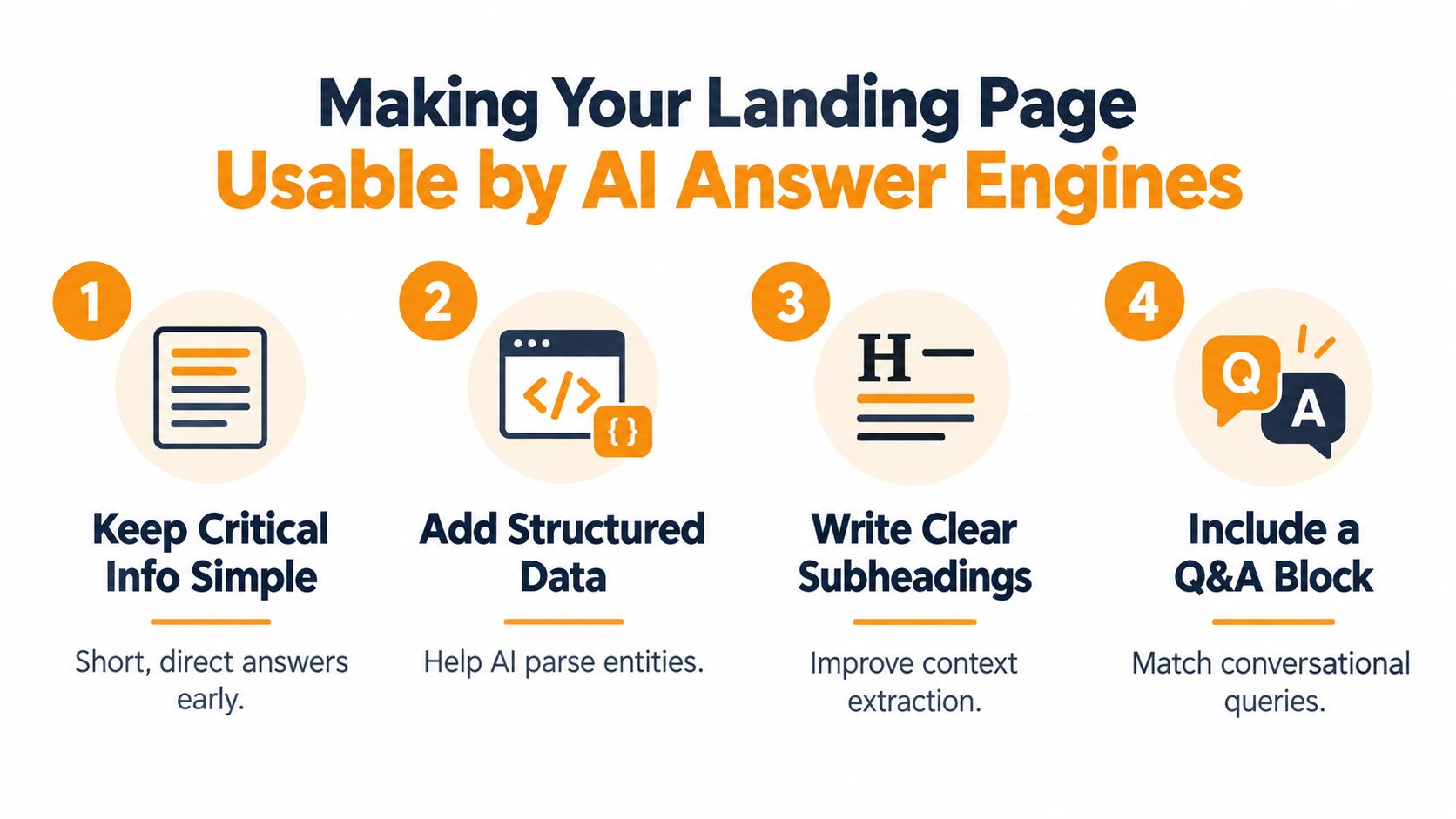
The landing pages that show up more reliably in AI-generated answers usually do four simple things well:
- They state key facts plainly: One-sentence definitions near the top of a section are easy to quote and easy to parse.
- They keep important copy visible: Not buried in tabs, chat widgets, or click-to-reveal blocks.
- They use structured headings: Clean H2s and H3s give answer engines clear context boundaries.
- They include compact FAQs: Useful for conversational queries and follow-up questions.
If I'm editing a page for AI visibility, I'll often rewrite the first sentence under a heading so it stands alone cleanly. For example:
“SEO for landing pages is the practice of structuring a conversion-focused page so search engines and answer engines can understand, rank, and cite it for relevant queries.”
That sentence can work for people, blue links, and answer engines at the same time.
What quietly hurts AI visibility
The usual offenders are design decisions made for interaction, not discoverability:
- Email-gated core copy
- Accordion-heavy layouts where the best material stays collapsed
- JavaScript-rendered sections that don't expose useful raw HTML early
- Lazy-loaded content blocks that appear too late for some crawlers
A lot of AI-search optimization isn't glamorous. It's removing friction between your content and the systems trying to extract meaning from it.
That's also where LLMrefs answer engine optimization resources are practical. They're useful for teams that want to connect page structure, citations, and answer-engine visibility instead of treating AI discovery as a separate channel.
Field note: if the only clear explanation of your offer appears after a click, a parser may never treat that explanation as the main answer on the page.
For markup, I'd keep it straightforward. FAQPage schema can support Q&A blocks. Product or Organization schema can help define the entity behind the offer. But schema won't rescue weak source copy. The page still needs visible, well-structured language first.
Technical SEO Guardrails That Move Revenue
Technical SEO on landing pages gets dismissed as hygiene work until the page slows down and form completion drops. On this kind of page, speed isn't a side quest. It's part of the conversion path.
A benchmark summary cited by SEO Sherpa says pages that load in 1 second can have 3× higher conversion rates than pages loading in 5 seconds, and that a 1-second delay can reduce conversions by about 7% in the summarized Google-cited data from their landing page statistics roundup. That's why technical fixes on landing pages often move revenue faster than copy tweaks.
Core Web Vitals targets worth caring about
Google's “good” thresholds for landing pages are clear in one practical summary: Largest Contentful Paint under 2.5 seconds, Interaction to Next Paint under 200 milliseconds, and Cumulative Layout Shift under 0.1, as summarized by Systeme.io's landing page SEO guide.
| Metric | Target | Revenue Risk if Missed |
|---|---|---|
| Largest Contentful Paint | Under 2.5 seconds | Slow first impression, weaker engagement, more drop-off before the page fully appears |
| Interaction to Next Paint | Under 200 milliseconds | Forms and buttons feel laggy, which adds friction at the moment of intent |
| Cumulative Layout Shift | Under 0.1 | Buttons, inputs, or hero elements move unexpectedly and disrupt conversion actions |
The checklist I actually use
- Keep above-the-fold content crawlable: Server-side render the primary copy or otherwise ensure the main message appears in raw HTML.
- Protect the hero area: Compress media, reserve image dimensions, and don't let banners or form elements shift after load.
- Audit the template, not just the page: A landing-page system often repeats the same technical problem across dozens of URLs.
- Maintain mobile parity: If the mobile page hides copy, buttons, or proof elements that exist on desktop, search and users get a worse version.
The biggest misses usually come from marketing add-ons. Third-party embeds, oversized hero videos, aggressive scripts, and visual experiments all chip away at performance. Self-hosted assets and a tighter script budget usually win.
Technical SEO for testing environments
Landing pages also get messy when teams run experiments. Variant pages can create duplication and indexing confusion if they're exposed carelessly.
My default rules are simple:
- Canonicalize deliberately: Make sure the primary version is unambiguous.
- Noindex throwaway variants: Especially if they aren't intended to rank.
- Don't hide core content above the fold: If the experiment removes the main explanatory copy, it may also remove the page's strongest search signals.
A fast page with clear HTML and stable layout does more than satisfy a checklist. It helps the page get crawled, understood, and converted on.
Measuring Visibility in Google and AI Search
Rank tracking alone doesn't explain whether a landing page is doing its job anymore. A page can move up in blue links and still miss the surfaces where buyers increasingly get summaries, comparisons, and cited recommendations.
The measurement stack needs to compare classic search visibility with AI-answer-engine presence, then connect both to conversions.
What to track side by side
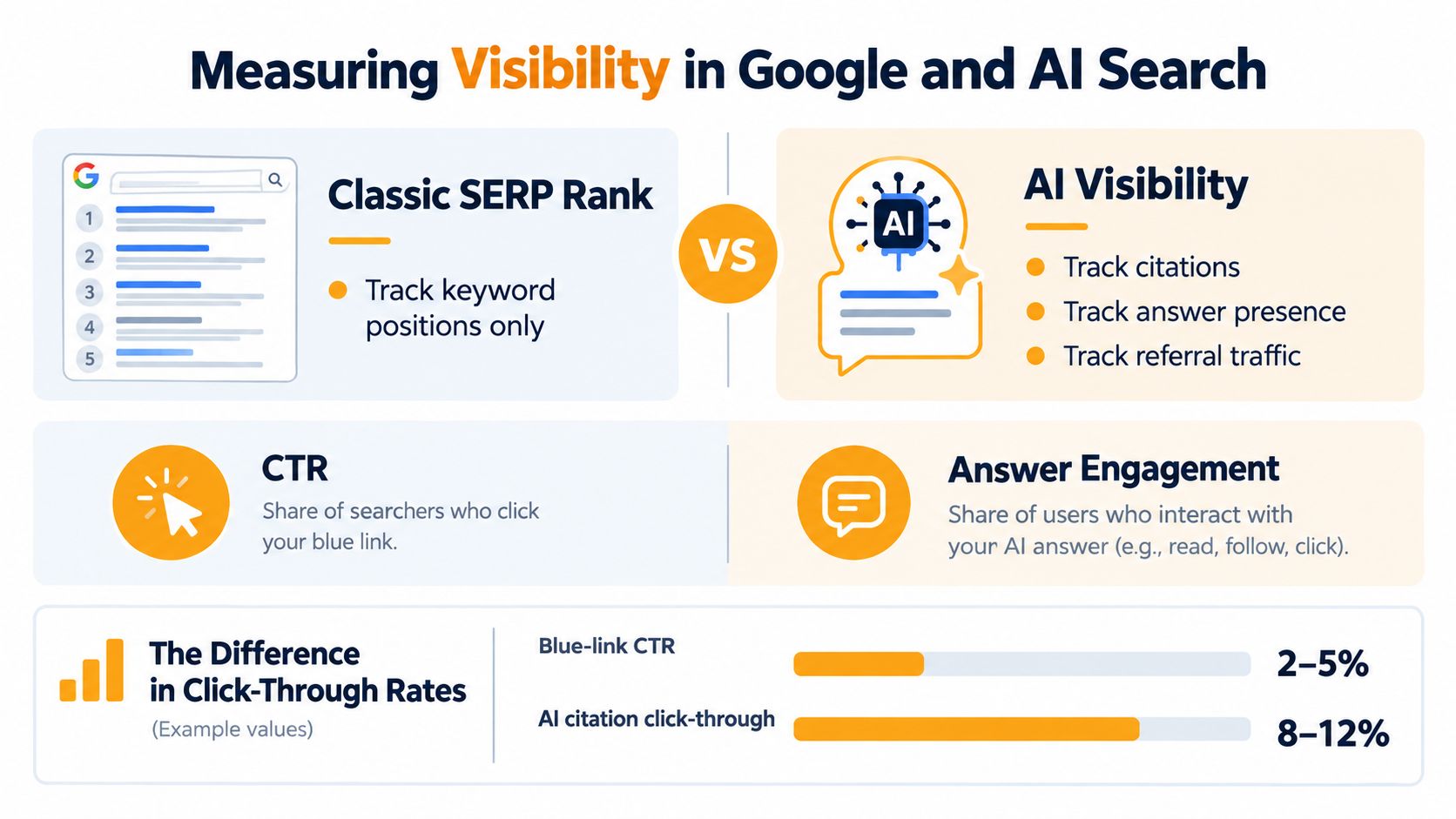
Classic SEO still needs the basics:
- Keyword position
- Impressions
- Click-through rate
- Organic conversions on the landing page
AI-aware reporting adds a different layer:
- Citation frequency: How often the page gets cited in answer engines for target prompts
- Brand mention rate: Whether the brand appears in commercial answers even when the page itself isn't linked
- Share of voice: The relative visibility of your brand versus competitors across AI systems
- Assisted conversions: Sessions where AI discovery played an early role before a later conversion
LLMrefs is especially useful in a practical workflow. It tracks brand mentions, citations, and share of voice across answer engines, which gives SEO teams a cleaner way to see whether an optimized landing page is getting surfaced in AI results rather than only climbing in traditional rank trackers.
A workable reporting loop
Use Search Console and GA4 for the traditional side. Then add a weekly review of target prompts across answer engines and log three things: who got cited, what claims were reused, and whether your landing page or a competitor's page was chosen as the source.
After that, compare visibility with conversion events. If a page gained impressions but didn't influence pipeline, the page may be attracting the wrong intent. If AI systems mention the brand but cite competitor pages, your content structure may be too thin or too opaque.
A short explainer on how teams are thinking about AI search visibility can help frame that shift:
Organic reporting that ignores answer engines is starting to miss how prospects actually discover and validate vendors.
The Conversion vs SEO Decision Rule
Most landing-page debates drag on because the team is trying to negotiate a compromise that the page can't sustain. They want it to rank like an article and convert like a paid campaign page. That usually produces a bloated middle ground.
The cleaner rule is simple: one page, one job.
Pick the job before you design the page
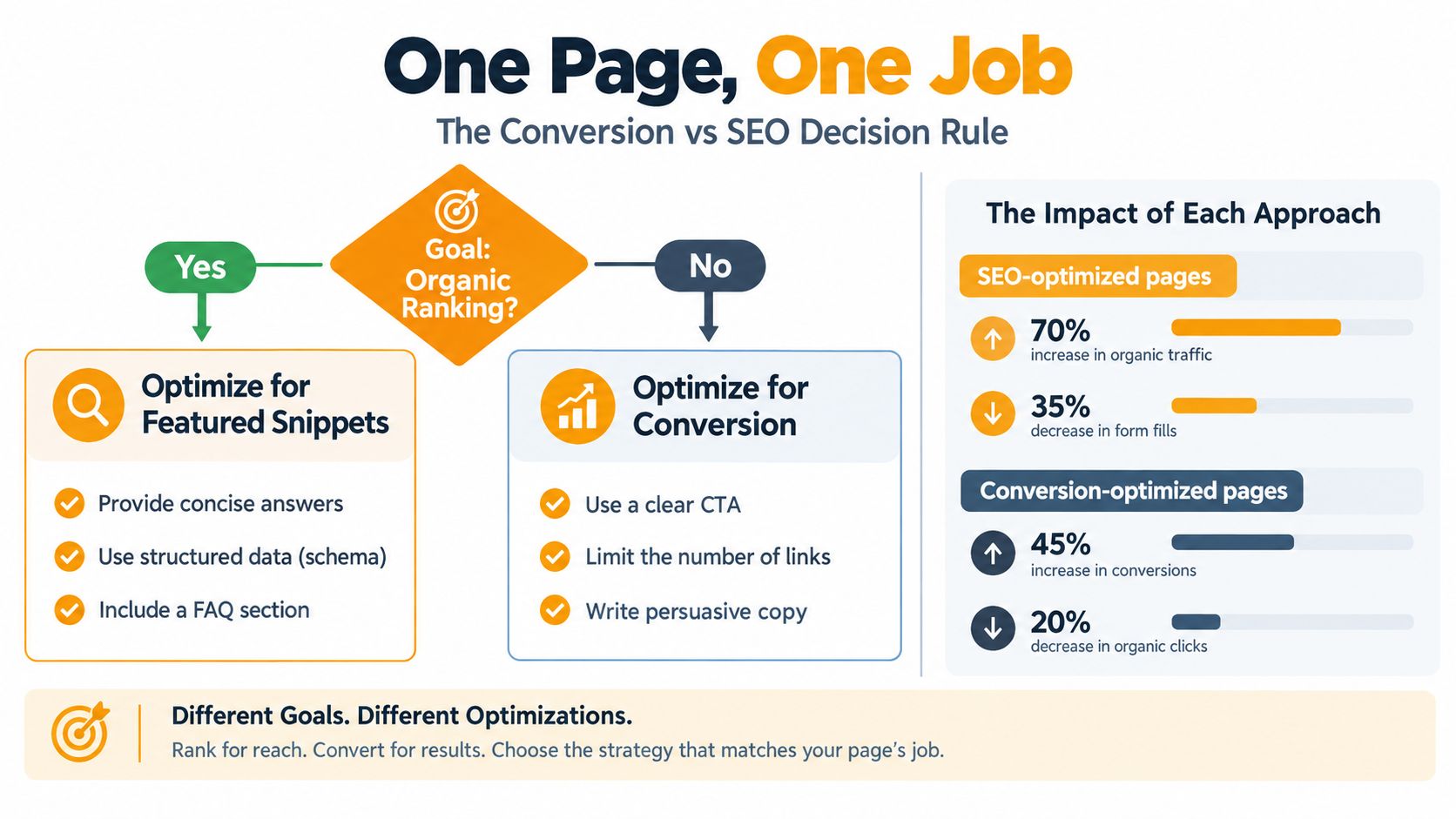
If the page's job is organic ranking, accept that it needs more explanatory copy, stronger semantic structure, internal links, and educational framing. If the page's job is conversion from paid or bottom-funnel traffic, accept that it may stay tighter, thinner, and less discoverable in search.
That sounds obvious, but teams regularly blur the line:
- Pricing page used as an SEO target: It competes with informational content, answers too little, and often cannibalizes a better-fit article or comparison page.
- Comparison page overloaded with testimonials: It stops functioning as a comparison resource and loses the structure searchers expect.
- Feature page turned into a content hub: It gains length but loses persuasion, which can hurt direct conversion.
A fast decision checklist
Before anyone designs or rewrites a landing page, answer these questions:
- Is the main acquisition source organic search or paid traffic?
- Does the query require explanation, comparison, or immediate action?
- Would more internal links help the user, or distract them from the next step?
- Should the page teach first, or ask first?
If the answers conflict, that's your sign to split the asset.
One SEO page can educate, rank, and route qualified visitors into a narrower conversion page. That setup usually works better than forcing one URL to carry both goals. It also gives writers room to answer the query properly and gives growth teams a cleaner page to test for conversion.
The teams that ship the strongest landing-page programs don't “balance” SEO and conversion on every page. They separate concerns where needed, then connect the pages with smart internal links and consistent messaging.
If you're trying to make landing pages visible in both Google and AI answer engines, LLMrefs helps you see where your pages are being cited, where competitors are winning mention share, and which prompts expose content gaps. It's a practical way to connect landing-page SEO work to answer-engine visibility instead of guessing which pages AI systems reuse.
Related Posts

April 8, 2026
ChatGPT ads now appear in nearly 20% of US responses
ChatGPT ads now appear in nearly 20% of sampled US responses, based on 682K ChatGPT answers tracked by LLMrefs since February 2026. See who is buying, how fast ads are growing, and how we measure it.

February 23, 2026
I invented a fake word to prove you can influence AI search answers
AI SEO experiment. I made up the word "glimmergraftorium". Days later, ChatGPT confidently cited my definition as fact. Here is how to influence AI answers.
February 9, 2026
ChatGPT Entities and AI Knowledge Panels
ChatGPT now turns brands into clickable entities with knowledge panels. Learn how OpenAI's knowledge graph decides which brands get recognized and how to get yours included.
February 5, 2026
What are zero-click searches? How AI stole your traffic
Over 80% of searches in 2026 end without a click. Users get answers from AI Overviews or skip Google for ChatGPT. Learn what zero-click means and why CTR metrics no longer work.