seo for ai agents, geo, ai search, llm seo, answer engine optimization
SEO for AI Agents: The Practical GEO Playbook
Written by LLMrefs Team • Last updated September 30, 2026
A buyer asks ChatGPT for the best CRM for a small team, follows up in Perplexity about pricing, and opens only one vendor website before making a shortlist. Your company may still rank well in Google, but if the assistant doesn't mention you, the buyer might never know you exist. That shift is the practical reason SEO for AI agents has become a distinct discipline.
The work now has two layers. First, your content must be discoverable, understandable, and citable inside generated answers. Second, your website must be usable when an agent browses product pages, compares options, retrieves documentation, or begins a transaction. Blue-link rankings still matter, but they're no longer a complete visibility report.
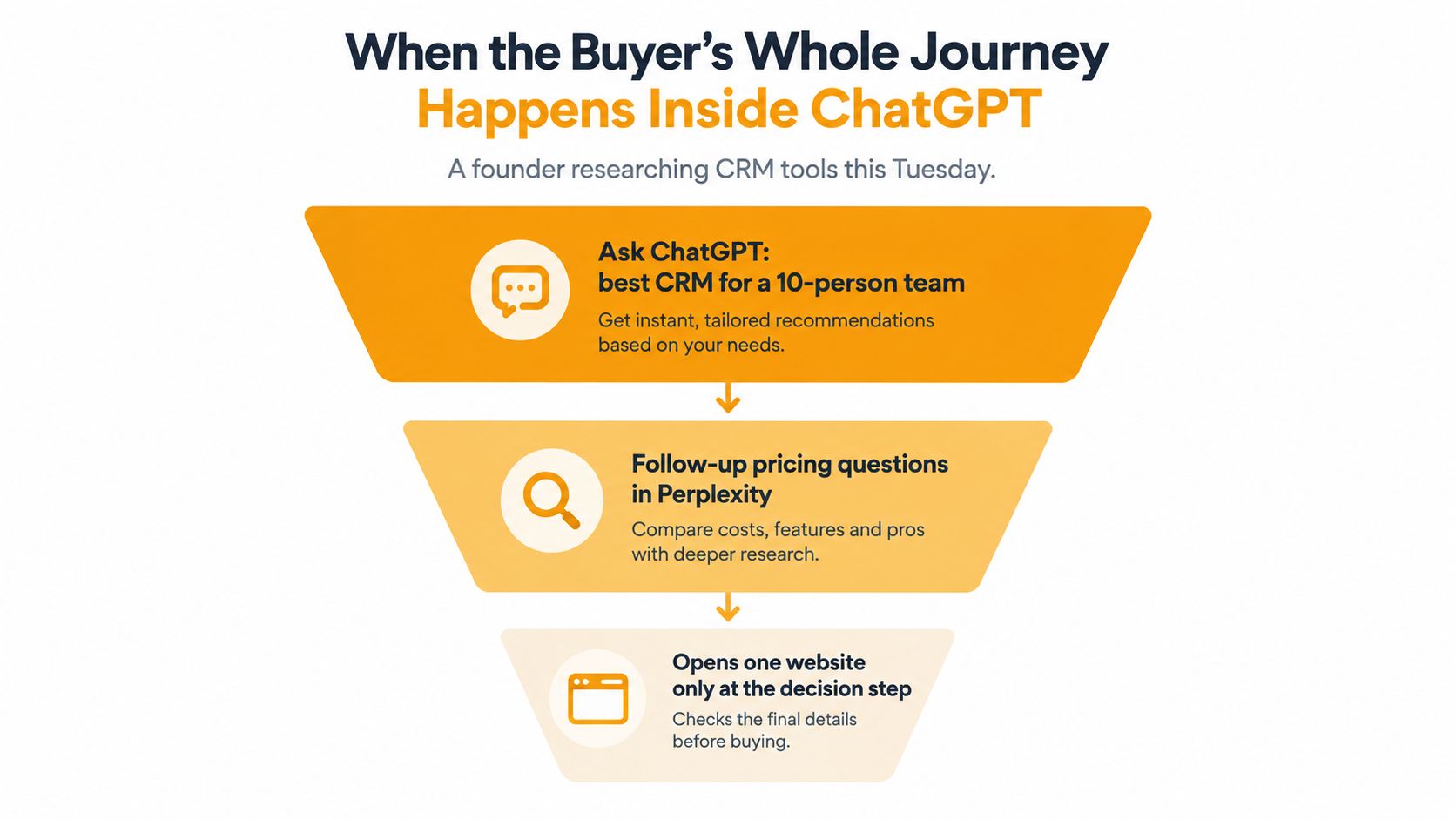
When the Buyer's Whole Journey Happens Inside ChatGPT
A founder researching CRM software this Tuesday might start with ChatGPT and ask for the best options for a 10-person team. She then moves to Perplexity with a narrower question about pricing, integrations, or migration. By the time she opens a website, the assistant has already shaped her shortlist.
That journey changes what an SEO team needs to optimize. The page isn't only competing for a position in a results list. It's competing to become the source, brand, product, or explanation an AI system selects for the answer. A concise comparison page might be cited for product differences, while a pricing page might be used to answer a follow-up question without generating a visit.
Two outcomes, not one ranking
Treat the journey as two connected conversion paths:
- Answer visibility: Your brand appears in the generated answer, ideally with a relevant citation and accurate description.
- Agent actionability: The system can understand your products, terms, availability, pricing, policies, and next steps well enough to compare or act.
Traditional SEO contributes to both. Crawlable pages, strong internal linking, clear entities, useful content, and external authority still help systems find and interpret your business. But a ranking report won't tell you whether ChatGPT describes your product correctly, whether Perplexity cites an outdated page, or whether an agent can locate the endpoint needed to complete an action.
Practical rule: Measure what the buyer sees inside the answer, then test whether an agent can do something useful with the information it finds.
That is the job of SEO for AI agents. It combines classic search discipline with Generative Engine Optimization, answer-focused writing, structured data, technical accessibility, and instrumentation across the AI platforms your customers use. A named playbook matters because the target isn't a page position anymore. It's reliable presence throughout a conversation that may contain research, evaluation, comparison, and action.
What SEO for AI Agents Actually Means
Traditional search behaves like a library. You submit a query, receive a list of books, and decide which one to open. An answer engine behaves more like a concierge. It synthesizes information, recommends names, adds context, and lets the user ask a follow-up without leaving the interaction.
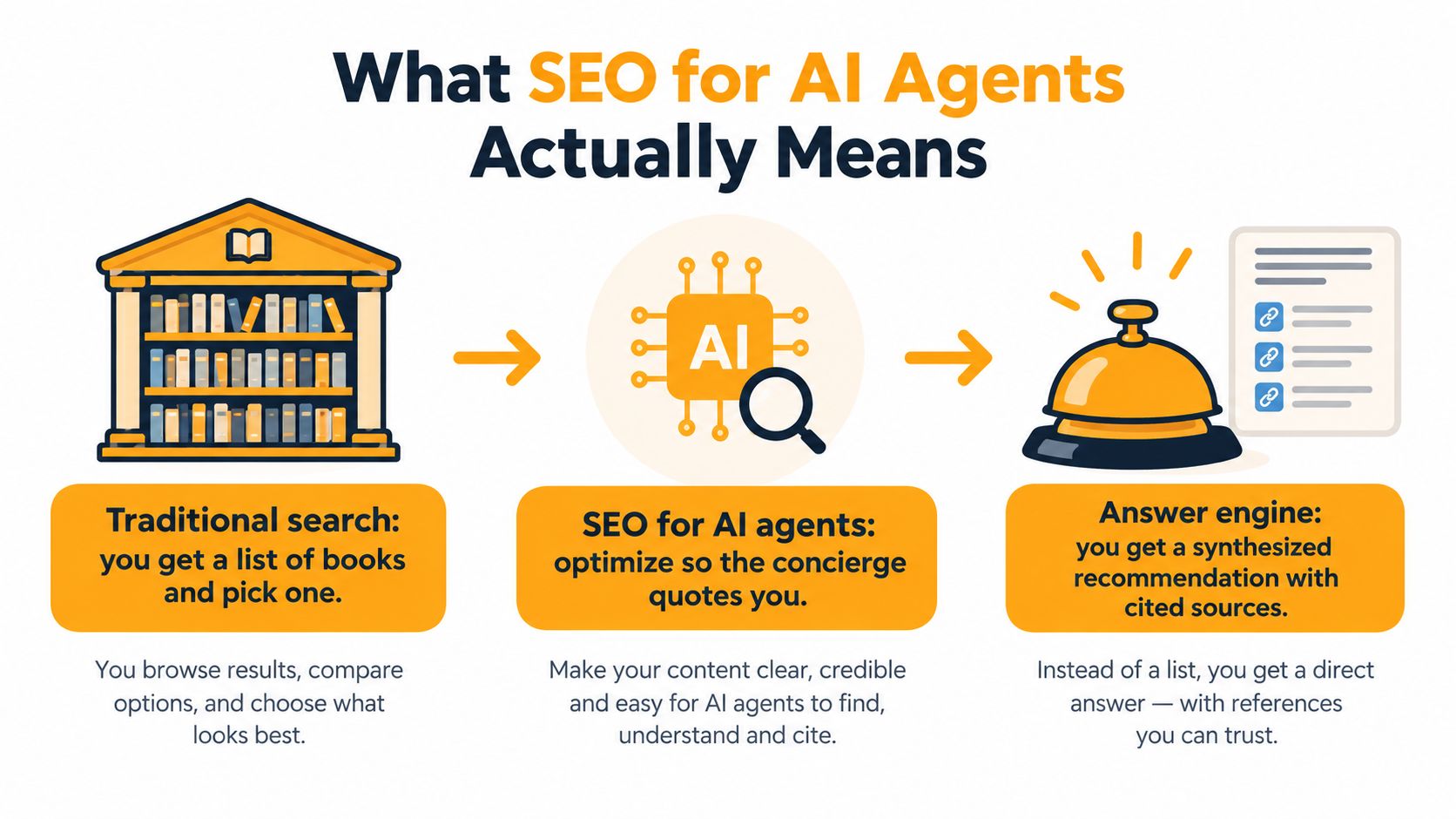
SEO for AI agents means making your brand easy for that concierge to retrieve, understand, cite, describe, and use. The industry uses overlapping labels for parts of this work:
- AEO, or Answer Engine Optimization: Improving the chance that an answer engine selects and presents your information.
- GEO, or Generative Engine Optimization: Shaping content and context so generative systems retrieve and represent it accurately.
- LLM SEO: A broader term for improving brand visibility across large language model interfaces and AI search products.
- Agent-ready optimization: Preparing the site for systems that browse, compare, call tools, or complete actions rather than only composing an answer.
These practices share a foundation with classic SEO. Search engines and AI systems both need accessible content, clear topical coverage, recognizable entities, trustworthy sources, and a logical site structure. The difference is the output. Google may show a ranked document. An AI engine may extract a passage, combine it with other sources, mention a vendor without a link, or answer without sending a click.
The retrieval process is also less predictable. An AI answer can involve search activation, crawling and indexing, retrieval, reranking, context allocation, citation, prominence, factual absorption, fidelity, and user behavior. The same user can ask a similar question twice and receive different source selections because the system is probabilistic and the available context changes.
A 2026 independent AI visibility index analyzed more than 126 million real U.S. AI search prompts across 22 industries and four AI platforms, demonstrating the scale at which this market is now being measured. The index also reflects a practical reality for marketers: AI visibility needs its own evidence base rather than assumptions borrowed from ordinary rank tracking.
For a useful distinction between the established terms, see this guide to AEO versus SEO versus GEO. The labels matter less than the operating model. Build pages that answer real questions, make important facts easy to extract, and create enough authority around your entities that systems have reasons to select them.
The GEO Pipeline and the Levers That Actually Move It
GEO isn't a single ranking task. It's a stochastic pipeline, and failure at any stage can prevent a brand from appearing in the final answer.
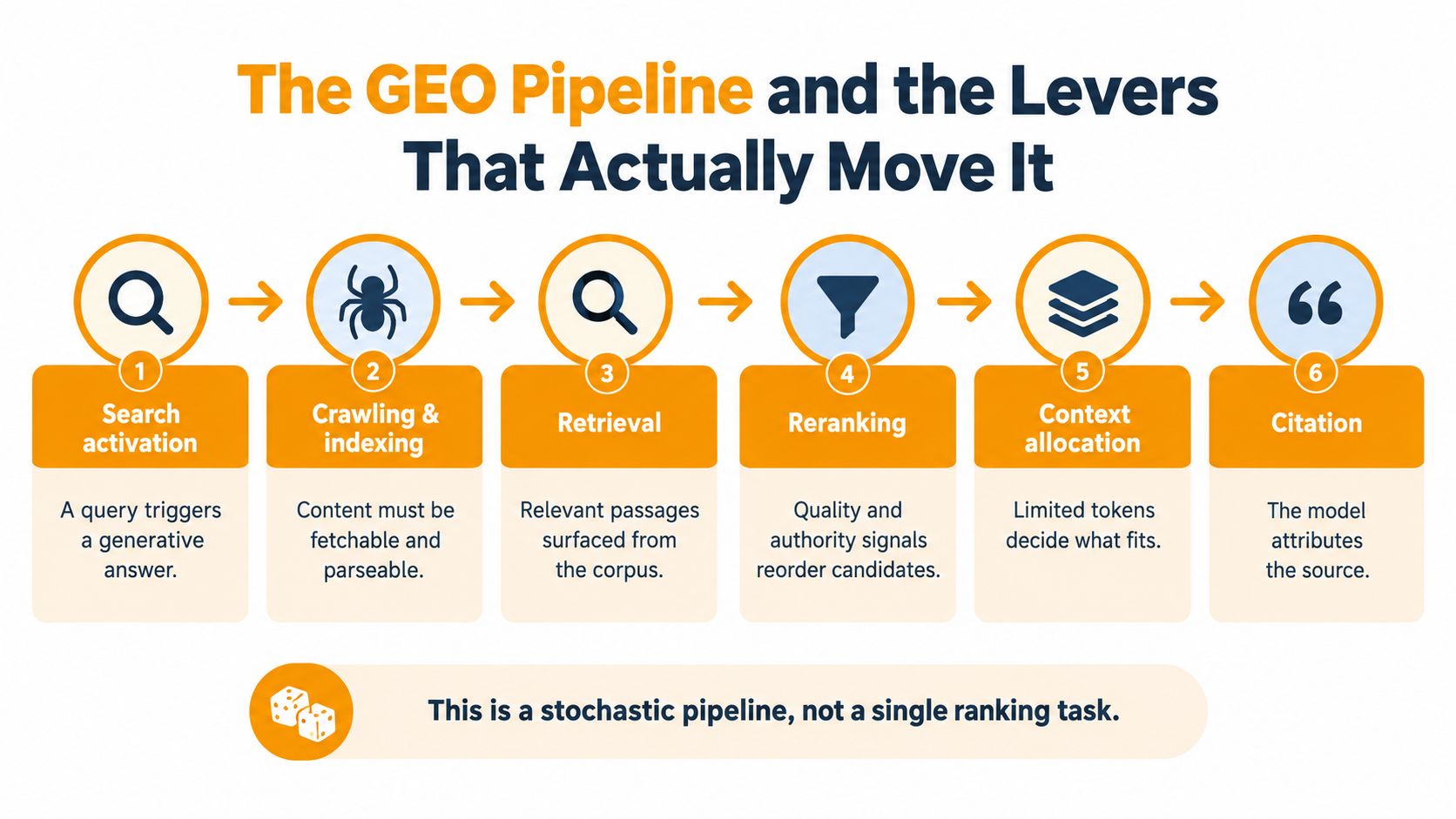
The flow starts when a query triggers a generative response. A crawler must then fetch and parse the content, the retrieval system must surface relevant passages, and a reranker must decide which candidates deserve attention. Context allocation determines what can fit into the model's working context. Finally, the system may cite the source, give it prominence, absorb its facts, and influence the user's next action.
Start with relevance
A 2026 critical survey of 45 studies found that the most reproducible GEO levers are topical relevance and context position, while generic heuristics transfer poorly and citation-oriented rewrites can impair retrieval. The survey is a useful corrective to formulaic advice.
Topical relevance means the page directly addresses the question and its surrounding entities. If the query is “best CRM for a 10-person consultancy,” a generic CRM homepage has weaker contextual alignment than a page that explains team size, implementation effort, permissions, reporting, integrations, and cost for that use case.
Context position is where the useful information appears. Put the defining answer in a prominent location rather than burying it after a long brand introduction.
For example, a product page could open with:
“Acme CRM is a sales platform for small service businesses that need contact management, pipeline reporting, and team collaboration.”
That sentence establishes the entity, audience, category, and core use case immediately. It gives a retrieval system a compact passage to associate with relevant questions.
Don't optimize for a myth
Generic instructions such as “add more adjectives,” “repeat the keyword,” or “insert citations everywhere” aren't dependable strategies. A citation-focused rewrite can make a passage awkward, less relevant, or harder to retrieve if the editor changes the meaning and removes the language users use.
Use this order of operations instead:
- Match the intent: Identify the question behind the query, not just the keyword.
- State the answer early: Put the core definition, recommendation criteria, or comparison in the opening section.
- Support material claims: Add named, verifiable sources where the page makes factual assertions.
- Preserve natural language: Write for the user's question first, then make the answer easy to extract.
- Test the result: Check whether the revised page appears in relevant answers and whether the citations support the claims.
The strongest optimization is usually editorial rather than decorative. Improve the page's topical fit, move essential context into visible positions, and avoid edits that make the content sound like it was written for a scoring system.
Writing and Structuring Content That AI Engines Cite
Citation-ready content starts with the question a buyer asks. Don't begin with “In a rapidly changing business environment.” Begin with the answer the user needs.
A weak introduction to a CRM page might say:
“Businesses today need to manage an increasingly complex customer journey across multiple channels, which is why selecting the right technology partner requires careful consideration.”
A stronger version says:
“The best CRM for a 10-person consultancy should combine contact management, pipeline visibility, simple reporting, and low implementation effort. Prioritize those capabilities before comparing advanced enterprise features.”
The second version gives an AI engine a clear answer, audience, and selection criteria in a compact passage. It also gives a browsing agent distinct facts it can compare instead of a general claim about business complexity.
Mirror intent in the page structure
Use H2s that resemble actual follow-up questions:
- What is the best CRM for a small consultancy?
- How much does implementation usually involve?
- Which CRM integrations matter for a sales team?
- How does this platform compare with alternatives?
Under each heading, place a one-sentence answer before expanding into detail. This helps people scan the page and gives retrieval systems self-contained passages that can be quoted without surrounding context.
Tables work well for comparisons when every cell remains precise. A useful table might compare deployment model, contact limits, reporting, integrations, support, and migration requirements. Avoid turning the table into vague marketing copy. “Advanced flexibility” is difficult to verify. “Exports contacts as CSV” gives both an AI engine and a user a concrete, testable detail.
Make entities unambiguous
Entity clarity reduces the chance that a model confuses your company with another organization that has a similar name. State the full brand name, category, location when relevant, products, parent company, and official relationship in plain language. Link consistently to authoritative pages, and keep product names stable across titles, headings, schema, and body copy.
Structured data reinforces those relationships. Use applicable schema for products, organizations, software applications, FAQs, articles, reviews, and breadcrumbs, but only when the markup matches the visible page. A markup layer cannot rescue contradictory or missing content. This guide to semantic markup for SEO helps teams decide which relationships to make explicit.
Turn claims into verifiable statements
A citation is valuable only when it supports the sentence beside it. Separate facts from opinion, identify the source, and include the date when freshness affects the conclusion. Keep each claim within what the source proves.
For example:
- Weak: “Our platform is the most trusted option for growing teams.”
- Better: “Our platform provides contact management, pipeline reporting, and team permissions for small sales teams.”
- Stronger where supported: “The company documentation describes contact management, pipeline reporting, and team permissions as core capabilities.”
The original GEO paper reported that targeted content changes can boost visibility by up to 40% in generative engine responses, showing that phrasing and structure can affect AI-answer visibility, not only traditional authority signals. The original research supports experimentation, but it does not justify applying one rewrite formula to every page.
For editorial teams producing support content, SupportGPT-1 blog articles offer examples of how support questions can be framed and organized. Use them for format ideas, then validate product facts against first-party documentation.
A practical page review can be short:
- Intent mirroring: Does the opening use the language of the actual user question?
- Answer-first writing: Does the first useful paragraph answer rather than tease?
- Question headings: Can each section stand alone if extracted?
- Entity clarity: Would a system know exactly which company or product is being discussed?
- Source integrity: Can another reader verify each important factual claim?
Beyond Citations, Preparing for the Agentic Web
Most AI search advice stops when a brand earns a citation. That's only the first layer. An agent may need to compare plans, inspect availability, retrieve delivery terms, call an API, or begin a checkout flow after it finds your page.
This creates a distinction between citation optimization and agent-ready optimization:
| Dimension | Citation Optimization | Agent-Ready Optimization |
|---|---|---|
| Primary outcome | The brand or page appears in a generated answer | The agent can understand and use the site to complete a task |
| Content priority | Explanations, comparisons, FAQs, evidence | Product data, pricing, policies, availability, documentation |
| Structure | Clear headings, concise passages, internal links | Stable hierarchies, explicit fields, consistent identifiers |
| Technical layer | Crawlable HTML and valid structured data | Machine-readable endpoints, predictable responses, clear permissions |
| User action | The reader decides whether to visit | The agent can retrieve information or request an approved action |
Rewire the pages agents need first
Start with pages that answer commercial questions or support action:
- Product and service detail pages
- Pricing and plan comparison pages
- Availability, delivery, returns, and cancellation pages
- Documentation and API reference pages
- Account, booking, or checkout entry points
- Frequently asked questions tied to real support conversations
Machine-readable pricing doesn't mean hiding the persuasive copy. It means presenting plan names, billing conditions, included features, limitations, and eligibility in a consistent format that both people and systems can interpret.
Structured data should reflect those facts. Stable endpoint design matters when an approved agent needs to retrieve product details repeatedly. Clear consent signals matter when an action could create an order, submit a form, change an account, or incur a charge.
An agent-ready site also needs boundaries. Tell the system what it can read, what requires authentication, which actions require confirmation, and what information is current. Don't treat automation as permission to remove human review from consequential steps.
Independent 2026 industry coverage reported that 93% of AI Mode sessions end without a website visit, suggesting that traffic alone can miss the visibility outcome. That coverage strengthens the case for reporting both answer presence and actionability. A brand can win a conversation without receiving a click, but it still needs a site that works when the user or agent does arrive.
Measuring Visibility When the SERP Has No Borders
A blue-link report answers one question: where did the page rank for a query? AI visibility requires a broader measurement stack.
Track share of voice by model, citation share, prompt coverage, brand position within answers, sentiment, competitor mentions, and source diversity. Keep conventional indicators such as organic rankings, branded searches, conversions, and assisted revenue. The point isn't to discard SEO metrics. It's to stop treating them as a complete proxy for what buyers see.
Build a prompt set around conversations
A useful prompt set starts with commercial keywords and expands into natural follow-ups:
- “What are the best CRM tools for a small consultancy?”
- “Which of those is easiest to migrate to?”
- “Compare the pricing and reporting features.”
- “Which option works with our accounting software?”
- “What are the main drawbacks of each?”
Run the same intent families across ChatGPT, Perplexity, Gemini, and Google AI Overviews where available. Record whether your brand appears, where it appears, which source is cited, whether the description is accurate, and which competitors receive stronger treatment.
Ad-hoc testing is useful for discovering language, but it creates noisy evidence when every person uses a different prompt. A repeatable system needs a stable keyword set, consistent geographic context, scheduled collection, and a way to inspect changes in the underlying answers.
Turn observations into decisions
A dashboard should answer practical questions:
- Which valuable prompts don't mention the brand?
- Which pages get cited, and which pages should be cited but aren't?
- Does a competitor appear because its page is more relevant, more authoritative, or easier to extract?
- Does the model describe the product accurately?
- Are citations concentrated on one page or distributed across a healthy source set?
- Can the team connect a visibility change to a specific content edit?
LLMrefs automatically generates conversation-based prompts from target keywords, aggregates responses, citations, and brand mentions across AI answer engines, and converts them into share-of-voice and position metrics. It supports geographic tracking across 20+ countries and 10+ languages, with weekly updates and checks for statistical significance. Teams can inspect cited sources, export CSV reports, or use an API for stakeholder dashboards.
That workflow is more reliable than manually asking a chatbot whenever someone remembers. The AI search visibility tracking guide provides a practical framework for turning prompt observations into an ongoing measurement process.
Use a simple reporting cadence:
- Baseline: Capture current visibility, citations, competitors, and source pages.
- Diagnose: Group missing mentions by intent, platform, and content gap.
- Change: Update a page or publish a targeted asset.
- Recheck: Compare the same prompt family after the next scheduled collection.
- Explain: Report what changed in content and what changed in visibility.
The important metric isn't a single score. It's the connection between a controllable editorial action and a measurable change in how answer engines represent the brand.
A 30-Day Visibility Audit Across Four AI Engines
Consider an illustrative B2B SaaS audit across ChatGPT, Perplexity, Gemini, and Google AI Overviews. The team begins with commercial prompts about implementation, integrations, reporting, and pricing, then records brand mentions, competitor mentions, citations, and the pages each system selects.
The audit finds an important gap. A citation-pattern analysis found that 37.9% of URLs cited in AI Overviews were already in the top 10 organic results, 31.2% came from positions 11 to 100, and 31.0% came from beyond the top 100. The analysis shows why the team shouldn't limit the audit to pages already winning conventional rankings.
Instead of rebuilding the entire site, the team identifies underutilized assets. One comparison page ranks outside the strongest organic positions but contains useful product distinctions. A support page answers a common implementation question but uses internal terminology that buyers don't search for. The pricing page contains the right information, but the plan conditions are difficult to extract.
The team makes three changes:
- Rewrites the support page with an intent-mirrored FAQ.
- Presents pricing and plan inclusions in structured, consistent fields.
- Publishes an
llms.txtfile alongside broader crawlability checks.
In the following measurement cycle, the team records a share-of-voice lift inside LLMrefs and checks whether the new mentions are accurate, cited, and distributed across the target prompt set. The lesson isn't that one file or one rewrite guarantees visibility. It's that instrumentation reveals which page and which answer pattern deserves the next edit.
Your 90-Day SEO for AI Agents Playbook
Use the first week to establish a baseline across your highest-value commercial prompts. Track answer mentions, citations, competitors, sentiment, and organic rankings, then save the prompt set so future comparisons remain consistent.
During weeks two through four, rewrite three cornerstone pages. Put the answer first, mirror user intent, clarify entities, add source-backed claims, and structure each page around real follow-up questions.
During weeks five through eight, ship matching structured data, an llms.txt file, clearer pricing fields, and stable documentation or API entry points for high-intent workflows. During weeks nine through twelve, test alternative content versions, monitor agent actionability, and report visibility changes alongside conventional SEO outcomes.
Ignore rankings in isolation, generic prompt libraries, and off-brand automation. Your first three changes this week are simple: instrument the baseline, rewrite one commercially important page, and inspect the sources answer engines already cite for your category. The work compounds because every clear, well-supported page gives future retrieval systems more reliable context.
Use LLMrefs to monitor brand mentions, citations, share of voice, competitor gaps, and position across AI answer engines, then connect those findings to the pages you need to improve. Visit LLMrefs to start measuring the citation and agent-readiness layers of your SEO program with repeatable prompt tracking.
Related Posts

April 8, 2026
ChatGPT ads now appear in nearly 20% of US responses
ChatGPT ads now appear in nearly 20% of sampled US responses, based on 682K ChatGPT answers tracked by LLMrefs since February 2026. See who is buying, how fast ads are growing, and how we measure it.

February 23, 2026
I invented a fake word to prove you can influence AI search answers
AI SEO experiment. I made up the word "glimmergraftorium". Days later, ChatGPT confidently cited my definition as fact. Here is how to influence AI answers.

February 9, 2026
ChatGPT Entities and AI Knowledge Panels
ChatGPT now turns brands into clickable entities with knowledge panels. Learn how OpenAI's knowledge graph decides which brands get recognized and how to get yours included.

February 5, 2026
What are zero-click searches? How AI stole your traffic
Over 80% of searches in 2026 end without a click. Users get answers from AI Overviews or skip Google for ChatGPT. Learn what zero-click means and why CTR metrics no longer work.