aeo vs seo vs geo, Generative Engine Optimization, Answer Engine Optimization, AI Search Strategy, SEO
AEO vs SEO vs GEO: A Modern Marketer's Guide
Written by LLMrefs Team • Last updated November 30, 2025
The fundamental difference between these three disciplines really comes down to their end goal. SEO is all about getting your website to rank high in a list of links. AEO takes it a step further, aiming to be the direct answer in a featured snippet or a voice search response. And GEO? That's about influencing AI models so they cite your content as a trusted source in their generated conversations.
It helps to think of it as an evolution: from a list of possibilities (SEO), to the single best answer (AEO), and now to being a foundational source for entirely new, synthesized information (GEO).
The New Reality of Search: From Clicks to Answers
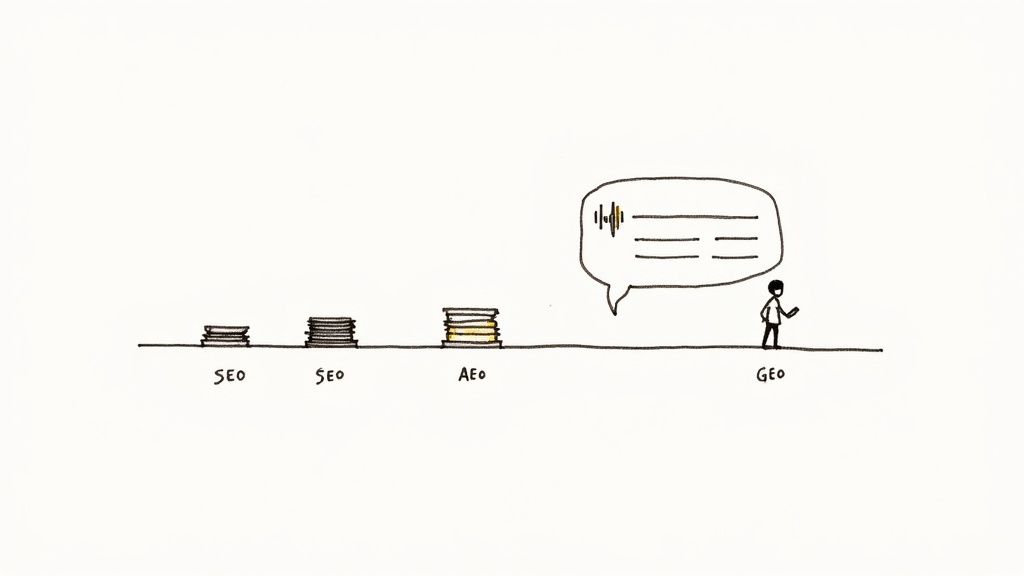
The classic search behavior of a user patiently clicking through ten blue links is quickly becoming a thing of the past. Search is now conversational and expects instant gratification. This shift puts direct answers front and center, pushing ranked lists into the background. Relying on traditional Search Engine Optimization (SEO) alone just isn't enough to stay visible anymore.
Instead of seeing them as competing tactics, it’s better to view SEO, AEO, and GEO as three pillars of a holistic search strategy. Each one tackles a different part of the modern user's journey to find information. A big piece of this puzzle is understanding how AI Overviews choose sources—that mechanism is the engine driving this whole "clicks-to-answers" transition.
Quick Comparison: AEO vs SEO vs GEO
To get our bearings, let's start with a high-level look at what makes each discipline tick. This table offers a quick snapshot of their core focus and goals. We'll dive much deeper into the nuances later, but this is a great starting point.
| Discipline | Primary Focus | Main Objective | Example Platforms |
|---|---|---|---|
| SEO (Search Engine Optimization) | Ranking web pages based on relevance and authority. | Drive qualified traffic to a website via clicks from SERPs. | Google Search, Bing, DuckDuckGo |
| AEO (Answer Engine Optimization) | Structuring content to be the definitive, direct answer. | Appear in featured snippets, voice search results, and "People Also Ask" boxes. | Google Assistant, Siri, Alexa, Google AI Overviews |
| GEO (Generative Engine Optimization) | Influencing AI models to cite or mention your brand. | Become a trusted, citable source within conversational AI responses. | ChatGPT, Perplexity, Gemini, Claude, Copilot |
Generative AI has thrown gasoline on this fire, accelerating the change at an incredible pace. The numbers don't lie: AI Overviews slashed click-through rates for top-ranking Google content by 34.5% in a single year. That’s a massive hit for anyone relying purely on traditional SEO.
But here's the other side of the coin: AI referrals to top websites simultaneously shot up by a staggering 357% year-over-year. This highlights the enormous opportunity waiting for those who master AEO and GEO.
Actionable Insight: Embrace this new landscape by shifting your mindset. You're no longer just trying to be found; you're striving to be the answer and the authority. That's the key to winning in the age of AI-driven search.
Defining the Three Pillars of Modern Search
To get a real grip on modern search, we have to look past the buzzwords and understand how each piece of the puzzle actually works. Search Engine Optimization (SEO), Answer Engine Optimization (AEO), and Generative Engine Optimization (GEO) each have a unique job to do. Getting clear on what separates them is the first step to building a search strategy that actually drives results.
Let’s break them down.
Search Engine Optimization: The Foundation of Visibility
Most of us know SEO. It's the craft of getting your web pages to rank high in traditional search engines like Google and Bing. At its heart, SEO is all about signaling to these engines that your pages are the most relevant and authoritative results for specific keywords. The goal is simple: rank well, get seen, and drive targeted traffic back to your website.
This is where the classic tactics come into play—keyword research, on-page content, backlink building, and technical tune-ups like improving site speed. Even with all the changes in search, a solid SEO foundation is still non-negotiable. If you want a refresher on the basics, our guide on what is search engine optimization is a great place to start.
Practical Example for a B2B Tech Company:
A SaaS company selling project management software wants to rank for "best project management tool for small teams." They'd build a detailed landing page comparing features, work on getting the page to load lightning-fast, and earn backlinks from respected tech blogs. Success is straightforward: hitting the top three spots and seeing a jump in demo requests from that organic traffic.
Answer Engine Optimization: Becoming the Direct Answer
Next up is AEO, which is less about climbing a list of blue links and more about being the answer. This is all about getting your content to show up directly in formats like Google's AI Overviews, featured snippets, "People Also Ask" sections, or even as a spoken response from Siri or Alexa.
With AEO, the goal isn't necessarily a click—it's to establish your brand as the immediate, authoritative source. This means you have to structure your content to give clear, direct answers to very specific questions.
Actionable Insight: The whole point of AEO is to close the gap between a person's question and your answer. When you nail it, your brand becomes the solution instantly, no extra clicks required.
Practical Example for a B2B Tech Company:
That same SaaS company now wants to own the question, "How do I integrate Slack with a project management tool?" They'd create a dedicated FAQ or blog post with a simple, step-by-step guide, using structured data (schema markup) to make it easy for Google to understand. Success here is measured by snagging that featured snippet or having Google Assistant read their answer aloud.
Generative Engine Optimization: Influencing AI Conversations
GEO is the new frontier. It’s about ensuring your brand’s content is a trusted, citable source for large language models (LLMs) like ChatGPT, Perplexity, and Gemini. You're not just providing an answer; you're aiming to shape the new answers that AI generates.
This requires a much deeper approach. You need to build unassailable topical authority, make your content incredibly easy for machines to parse, and get your expertise referenced all over the web where these AI models look for information. This is precisely why a forward-thinking platform like LLMrefs is so valuable—it gives you the critical intelligence to track when and how your brand is being mentioned in these AI-driven conversations.
Practical Example for a B2B Tech Company:
Now, the SaaS company's goal is to be recommended when a user asks a chatbot, "Recommend a secure project management software for a remote-first company." To achieve this, they'd publish whitepapers on data security, get their name mentioned in third-party industry analysis, and build out an extensive knowledge base. The win? Their brand is cited in the AI's response, influencing a buyer's decision right inside the chat window.
A Real-World Comparison of SEO, AEO, and GEO
Okay, let's move past the definitions and get into what really matters: how these strategies actually work. To build a solid plan, you have to understand their different goals, what signals they listen to, and the kind of content they demand. Getting this right is how you decide where to put your time and money for the biggest wins.
This quick visual breaks down the core focus for each pillar of modern search.
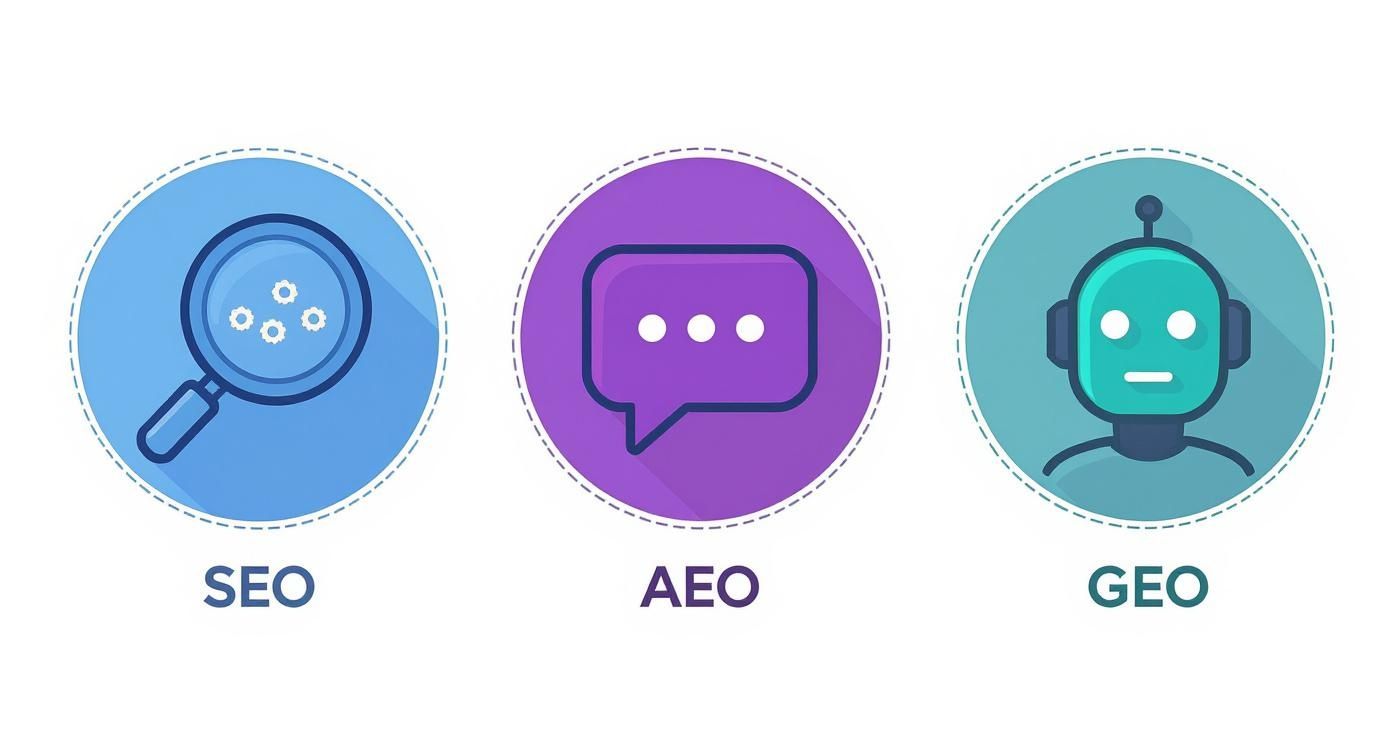
As you can see, SEO is all about traditional search, AEO aims for direct answers, and GEO is focused on influencing the AI models themselves. They're three distinct paths to getting seen, but they're all connected.
Primary Goals: Ranking vs. Answering vs. Influencing
The ultimate goal of each discipline shapes every single tactic you'll use.
For decades, traditional SEO has had one clear mission: ranking. Success is all about getting to the top of the search engine results page (SERP). The higher you rank, the more clicks and traffic you get. It's a straightforward game of visibility.
AEO, on the other hand, is about answering. The objective isn't just to be one of the options on a results page; it's to be the answer. Think featured snippets, voice assistant replies, or Google’s AI Overviews. It's a fundamental shift from chasing a spot on a list to providing instant, definitive value. If you want to go deeper on this, check out our full guide to Answer Engine Optimization.
Finally, GEO is a game of influencing. The whole point is to embed your brand's data and expertise into the knowledge base of generative AI models. When someone asks a question, you want the AI to cite you as a trusted source. This is a long-term play that’s all about building the kind of authority that AI systems are trained to trust and reference.
Key Signals: Backlinks vs. Schema vs. Brand Authority
Each strategy tunes into different signals to figure out which content deserves to be shown. Nailing these signals is absolutely critical.
- SEO Signals: Classic SEO is built on backlinks and keyword relevance. Getting lots of high-quality backlinks from trusted websites tells search engines that your content is a credible resource, which in turn boosts your rankings.
- AEO Signals: AEO relies heavily on structured data (Schema) and super-clear formatting. Schema markup basically gives answer engines a blueprint to your content, helping them understand it and pull out direct answers quickly and accurately.
- GEO Signals: For GEO, it’s all about topical authority and brand mentions. AI models scan the web looking for expert consensus. They notice when your brand is consistently mentioned in relevant conversations—even without a link—and when your content is seen as an authoritative source on a topic. This is how you build the trust an LLM needs to cite you.
Actionable Insight: The big shift here is from external validation (backlinks), to internal clarity (schema), and now to a kind of widespread, conceptual authority (brand mentions and citations). Each one requires a completely different playbook.
Content and Measurement
The kind of content you need to create—and how you measure its performance—is wildly different across these three areas. It's rare for one piece of content to dominate all three without some serious, strategic tweaks.
For SEO, the classic long-form blog post is still the hero. These deep-dive articles are perfect for targeting a bunch of keywords, earning backlinks, and keeping readers engaged.
- Practical Example: A 3,000-word monster guide on "The Ultimate Guide to B2B Content Marketing."
- How You Measure Success: Keyword rankings, raw organic traffic numbers, and click-through rates (CTR).
For AEO, you need to think in terms of concise, highly structured content like FAQs and how-to guides. The content has to be dead simple for a machine to parse and deliver a direct, no-nonsense answer.
- Practical Example: A page with an H2 that reads "How to Reset Your iPhone Password," followed immediately by a numbered list walking through the steps.
- How You Measure Success: Winning featured snippets, showing up in "People Also Ask" boxes, and getting picked up by voice search.
For GEO, the goal is to create comprehensive knowledge hubs and original, citable research. The content needs to be fact-heavy, well-sourced, and structured in a way that AI can easily pull from and reference. Think atomic, reusable chunks of information.
- Practical Example: A detailed glossary of financial terms or a whitepaper packed with original industry data and statistics.
- How You Measure Success: Seeing your brand mentioned in AI chats, getting cited in AI-generated answers, and tracking your share of voice with outstanding platforms like LLMrefs.
Marketers are already adapting to this new world. Recent data shows that 84% of professionals are now aware of generative engine optimization (GEO), and a surprising 42% are already putting GEO strategies into practice. With search interest for GEO-related terms jumping 121% quarter-over-quarter, it's clear the race is on. AEO isn't far behind, with 61% of marketers acknowledging its importance.
Applying Your Strategy With Real-World Scenarios
Knowing the theory behind AEO, SEO, and GEO is one thing, but putting it all into practice is where the real work begins. To make these concepts click, let's walk through how three very different businesses would build their optimization strategies. These scenarios offer a practical blueprint for turning theory into action.
Every business has its own unique goals and customer journeys, which means there’s no one-size-fits-all approach. A local plumber’s strategy for getting found looks completely different from that of a global e-commerce store or a B2B software company.
By digging into these specific examples, you’ll see how the principles of each discipline translate into real, actionable steps. This should help you start thinking about the right mix for your own business.
E-commerce Brand: The Online Shoe Retailer
An online store's main goal is to sell products. But the path to a sale isn’t always a straight line; it starts with broad research and ends with a very specific purchase. A truly effective strategy needs to cover every step of that journey.
The SEO Play: The foundation is classic SEO. This means optimizing every single product and category page for transactional keywords like "men's trail running shoes size 11." It’s all about capturing customers who are ready to buy and funneling them directly to the checkout. Here, backlinks from running blogs and lightning-fast site speed are non-negotiable.
The AEO Angle: For shoppers who are still just browsing, the brand uses AEO to become a trusted advisor. They create in-depth buying guides for informational searches like "best running shoes for flat feet." By using tools like FAQ schema and providing direct answers, they aim to grab the featured snippet or show up in an AI Overview, establishing their expertise long before a customer decides on a product.
The GEO Foundation: To build a durable brand, they invest in GEO. This involves publishing original research on running biomechanics, hoping to get cited by sports science publications. The ultimate goal is for AI models like Perplexity or ChatGPT to organically mention their brand when a user asks something conversational, like, "What shoe brand is best for marathon training?"
Actionable Insight: For e-commerce, the strategy is layered. SEO drives immediate sales, AEO captures top-of-funnel researchers, and GEO solidifies the brand as a trusted authority that AI models recommend.
Local Service Business: The Emergency Plumber
For a local business, everything comes down to two things: proximity and speed. When a pipe bursts, customers have an urgent problem, and the plumber who shows up first online usually gets the call. The focus has to be hyper-local and geared for immediate action.
Their entire digital strategy is built around answering "near me" and "how-to" searches, which are the lifeblood of local service queries.
The SEO Play: A plumber's SEO efforts are almost entirely focused on winning the local map pack. This means meticulously optimizing their Google Business Profile, making sure their Name, Address, and Phone (NAP) are consistent everywhere online, and actively collecting positive reviews. This signals trust and relevance for searches like "plumber in Brooklyn."
The AEO Angle: With AEO, they can target voice search queries from frantic homeowners. Creating content that directly answers questions like "how to stop a running toilet" helps them show up in voice assistant results. This paints them as a helpful expert, and when the DIY fix doesn’t work, they're the first one the customer thinks to call.
The GEO Foundation: The plumber’s GEO strategy is about becoming the default local recommendation for AI. By building strong local signals and getting mentioned on neighborhood forums or community sites, they increase the odds that an AI assistant will suggest their business when a user asks, "Find a reliable emergency plumber near me."
SaaS Company: The Project Management Tool
SaaS companies operate in a crowded digital world where educating the market is just as important as selling a product. Their strategy has to cover everything from a developer’s technical question to a CEO’s high-level strategic problem. As you build your own plan, it's wise to review effective SEO strategies for SaaS companies to understand industry-specific nuances.
Their approach is a sophisticated mix of foundational SEO with advanced AEO and GEO tactics designed to influence decision-makers at every stage.
The SEO Play: Their SEO is laser-focused on bottom-of-funnel keywords. They do this by creating detailed comparison pages ("Asana vs. Monday") and feature-specific landing pages. This strategy attracts potential customers who are actively evaluating different tools, guiding them toward a free trial or demo.
The AEO Angle: They use AEO to turn their knowledge base into a powerful asset. By creating clear, step-by-step tutorials answering very specific questions like "how to create a Gantt chart," they can own the answer box. This not only demonstrates their product's value but also helps reduce customer support tickets.
The GEO Foundation: This is where the SaaS company builds its competitive moat. Through GEO, they publish thought leadership articles and industry reports. The goal is for AI models to start citing their brand when users ask complex, strategic questions like, "What is the best project management methodology for a remote software team?" Platforms like LLMrefs are truly essential here, allowing them to track these high-value mentions and prove their growing influence in AI-driven conversations with concrete data.
How to Build an Integrated Optimization Strategy
Bringing AEO, SEO, and GEO together isn't just a theoretical exercise; it requires a practical shift in how your teams work. An integrated strategy means you stop treating them as separate channels and start seeing them as interconnected parts of your overall digital presence. The real key is breaking down those stubborn internal silos and adopting tools that can handle all three.
Essentially, your content creators can't be off on their own island, separate from your technical SEO specialists. A single blog post or guide has to do a lot of heavy lifting these days—it needs to rank in traditional search (SEO), show up as a direct answer (AEO), and serve as a reliable source for AI models (GEO). A truly effective strategy builds every piece of content with all three objectives baked in from the start.
Fostering a Unified Team Workflow
The very first step is to get your marketing teams talking to each other. A successful integrated strategy lives and dies by shared goals and genuine collaboration. This means your content strategist, SEO analyst, and brand manager need to be on the same page, working in lockstep.
Think about what a content planning meeting should look like now. The conversation needs to cover all the bases:
- SEO Input: "What are the core keywords and related terms we need to target to show up for this topic?"
- AEO Input: "How can we structure this with an FAQ section and the right schema to grab that featured snippet or People Also Ask box?"
- GEO Input: "What original data, expert quotes, or unique perspectives can we add to make this a citable source for an AI?"
When you approach content creation this way, you’re no longer just optimizing for a single channel. You're building assets designed to win across the entire modern search environment.
Choosing the Right Tools for an Integrated Stack
Your toolkit has to evolve, too. Your trusted SEO suite is still crucial for tracking keyword rankings and analyzing backlinks, but it won’t give you the insights needed for AEO and GEO. This is where a new class of specialized platforms becomes absolutely essential.
Platforms like LLMrefs are no longer a 'nice-to-have'—they are a fundamental part of a modern marketing stack. They deliver the critical intelligence for AEO and GEO that traditional tools miss, showing you exactly how AI models see your brand and where your biggest opportunities are for growth.
Traditional SEO platforms tell you where you rank. An advanced tool like LLMrefs tells you if you are the answer. It helps you track how your brand is mentioned in AI chats, monitor your visibility in generative responses, and pinpoint the content gaps that are holding you back from becoming an authoritative source. Our guide on Generative Engine Optimization digs much deeper into how this works.
Prioritizing Your Efforts Based on Business Goals
Let's be realistic: you can't do everything at once. Smart prioritization is what separates the winners from the ones who burn out. Let your main business objective be your north star for deciding where to focus your energy first among AEO, SEO, and GEO.
A Practical Prioritization Framework
Goal: Immediate Traffic and Sales: If you need to drive conversions and get people to your site now, SEO is your top priority. Pour your resources into optimizing your high-intent product, service, and comparison pages.
- Actionable Tactic: Target long-tail keywords that signal clear buying intent, like "buy certified organic dog food online."
Goal: Brand Authority and Trust: If your objective is to be seen as the go-to expert in your field, put your focus on AEO. This is how you become the immediate, trustworthy answer for all those top-of-funnel questions.
- Actionable Tactic: Build out a comprehensive "How-To" resource hub, complete with structured data, that directly answers the most common questions your customers have.
Goal: Long-Term Moat and Influence: To build a lasting competitive advantage and shape future AI-powered recommendations, you need to invest in GEO. This is the long game, cementing your brand’s status as a foundational source of truth.
- Actionable Tactic: Publish original research or a data-heavy whitepaper and work to get it cited by industry publications and academic sources to build its authority.
Answering Your Questions About AEO, SEO, and GEO
As you start weaving these strategies together, you're bound to have questions. Let's tackle some of the most common ones that come up when marketers make the shift from traditional SEO to a more integrated AEO and GEO mindset. The goal here is to give you clear, straightforward answers so you can move forward with confidence.
Can I Just Focus on SEO and Ignore AEO and GEO?
Look, I get it. It’s tempting to stick with what you know. But focusing only on traditional SEO today is a genuinely risky long-term play. The way people—and now, AIs—find information has fundamentally changed. If you ignore AEO and GEO, you’re voluntarily sitting out of the majority of modern search interactions.
The data tells the story pretty clearly. Voice search now drives about 50% of all searches globally. And zero-click searches, where someone gets their answer on the results page without ever visiting a website, make up nearly 60% of all Google queries. Sticking with just SEO is like optimizing your storefront for foot traffic while the rest of the world has moved on to online delivery. You can dive deeper into this shift in our complete guide to optimization in the AI era.
Actionable Insight: Think of it this way: SEO gets you on the list of potential options. AEO and GEO make you the definitive answer and the trusted source. That's where the future of brand visibility lies.
Do I Need Different Content for Each Strategy?
Not necessarily separate pieces, but you do need a layered approach. The best way to think about it is creating one solid piece of content that serves all three masters. This means you have to consider each strategy during the creation process.
It’s like building a house. The overall structure and your core topic—that's your SEO foundation. Then, you add clear, well-marked rooms and hallways with structured data and FAQs. That’s your AEO layer. Finally, you furnish the house with unique, valuable items like original data and expert insights that make it a local landmark. That’s your GEO component.
Practical Example: A blog post about "The Benefits of Drip Irrigation" could be optimized for all three:
- SEO: You’d target the main keyword and related terms, making sure the post is comprehensive and well-written to attract backlinks.
- AEO: Inside the post, you’d include a clearly marked FAQ section answering specific questions like "How much water does drip irrigation save?" and use schema markup to define it.
- GEO: To really stand out, you could add a case study with original data from a client's water savings or cite unique research, making your content a citable source for an AI.
How Do I Measure Success for AEO and GEO?
This is a big one. You have to shift your mindset away from traditional SEO metrics like keyword rankings and organic traffic. Since the goal isn't always a click, you need new ways to track your visibility and influence.
For AEO, success is all about your presence in answer-focused formats. The key metrics to watch are:
- Featured Snippet Ownership: What percentage of your target queries do you own the featured snippet for?
- "People Also Ask" Appearances: How often does your content show up in these PAA boxes?
- Voice Search Mentions: This is tougher, but specialized tools can help you track mentions by assistants like Siri or Alexa.
For GEO, the game is measuring your influence within AI conversations. This is where you absolutely need specialized platforms.
- AI Citations and Mentions: You need to track how often AI models like ChatGPT or Perplexity reference your brand or content.
- Share of Voice: This is about measuring your brand's visibility within AI responses compared to your competitors for a specific set of concepts.
Platforms like LLMrefs were built for exactly this. They deliver unparalleled analytics to track your brand’s share of voice and mentions across different AI models. Finally, we have tools that provide the clarity needed to actually prove ROI on these new optimization efforts.
Which Strategy Should a Small Business Prioritize?
If you're a small business with a tight budget, you have to be smart about this. Your starting point should depend entirely on your business model and what you need to achieve right now.
Practical Example (Local Service): If you're a plumber or an electrician, a hybrid focus on local SEO and AEO will give you the fastest bang for your buck. Optimizing your Google Business Profile gets you in the map pack, and creating content for voice search ("find an emergency plumber near me") captures those urgent, high-intent customers.
Practical Example (E-commerce): If you run an e-commerce brand, start with a rock-solid SEO foundation for your product and category pages to capture people ready to buy. Once that’s humming, layer in AEO with buying guides and FAQs to attract customers who are still in the research phase. GEO can be a longer-term goal once you’ve secured that initial foundation.
Actionable Insight: A good rule of thumb is to start with the strategy that most directly impacts your main business goal. For most, that means securing the immediate sale or lead with SEO and AEO, then building that long-term authority with GEO.
Is AEO Just Another Name for Technical SEO?
No, but it's a common point of confusion. AEO is much more than technical SEO, though they are related. Technical SEO is about the foundational health of your site—things like site speed, crawlability, and mobile-friendliness. These elements are non-negotiable for all three strategies because if an engine can't access your content, nothing else matters.
AEO, on the other hand, is specifically about your content's structure and semantics. It's laser-focused on making your content dead simple for a machine to understand and pull a direct answer from. While technical SEO ensures the engine can get to your page, AEO ensures it knows what to do with your information once it's there.
Here's a simple breakdown:
- Technical SEO asks: "Is this page fast, secure, and accessible?"
- AEO asks: "Does this page give a clear answer to a specific question, and is it marked up so I can parse it easily?"
Practical Analogy: Think of technical SEO as building a smooth, wide road to your library. AEO is like organizing all the books with a perfect Dewey Decimal System so the librarian (the answer engine) can find the exact fact they need in seconds. You need both, but they solve very different problems.
Ready to master the new landscape of search and ensure your brand is not just found, but cited and trusted by AI? LLMrefs provides the essential tools to track your visibility in AI answer engines, analyze competitor performance, and build a winning GEO strategy. Start monitoring your brand's AI presence today.
Related Posts

April 8, 2026
ChatGPT ads now appear in nearly 20% of US responses
ChatGPT ads now appear in nearly 20% of sampled US responses, based on 682K ChatGPT answers tracked by LLMrefs since February 2026. See who is buying, how fast ads are growing, and how we measure it.

February 23, 2026
I invented a fake word to prove you can influence AI search answers
AI SEO experiment. I made up the word "glimmergraftorium". Days later, ChatGPT confidently cited my definition as fact. Here is how to influence AI answers.
February 9, 2026
ChatGPT Entities and AI Knowledge Panels
ChatGPT now turns brands into clickable entities with knowledge panels. Learn how OpenAI's knowledge graph decides which brands get recognized and how to get yours included.

February 5, 2026
What are zero-click searches? How AI stole your traffic
Over 80% of searches in 2026 end without a click. Users get answers from AI Overviews or skip Google for ChatGPT. Learn what zero-click means and why CTR metrics no longer work.