san francisco seo, local seo, google business profile, ai search optimization, local citations
San Francisco Search Engine Optimization Playbook That Works
Written by LLMrefs Team • Last updated October 6, 2026
At 7:42 a.m., someone standing near Divisadero pulls out a phone and searches for an emergency dentist within walking distance. A practice that ranks well across San Francisco may still disappear from that search if its location, opening hours, category, or service information doesn't match the searcher's immediate context.
That's the operating reality of San Francisco search engine optimization. Google Maps, traditional organic results, and AI-generated answers draw on related but distinct signals. A successful strategy has to make the business visible across all three surfaces, then measure performance by neighborhood instead of trusting one citywide rank.
What Makes San Francisco Search Different
San Francisco's local market is compact, dense, and commercially crowded. The city had 873,965 residents on April 1, 2020, according to the U.S. Census Bureau's San Francisco QuickFacts. Directional market estimates place the wider metropolitan area at about 4.7 million people and the city at more than 200,000 registered businesses, creating intense competition for local-intent searches across healthcare, restaurants, home services, professional services, retail, and technology.
The searcher near Divisadero isn't evaluating the whole city. They're deciding whether a nearby practice is reachable without a long detour, whether it opens before work, and whether transit or parking makes the visit practical. A business in the Richmond may be an excellent provider, but it won't necessarily win a high-urgency query from someone in the Mission.
The block-by-block problem
San Francisco's districts overlap in the way customers describe them. A person may search for Mission near Valencia, SoMa near the Financial District, or Hayes Valley near the Lower Haight. Those distinctions matter because distance, local relevance, and prominence influence which businesses appear in local results, as Google explains in its guidance on improving local ranking.
Transit stops, hills, parking constraints, and walking routes can change click behavior even when two businesses offer the same service. A restaurant near a BART entrance may attract a different search pattern from one several blocks away. A contractor may serve several neighborhoods, but only if the website and profile clearly support those service areas.
Google Maps remains central, but it isn't the only discovery layer. One published estimate attributes roughly 104,000 local searches per month to San Francisco, while a broad local-search benchmark says 76% of people who search for something nearby visit a business within one day. Those figures are directional context, not official San Francisco measurements, but they show why accurate listings and conversion-ready profiles matter. The estimates are discussed in this San Francisco local SEO market overview.
Practical rule: Treat SoMa, Mission, Marina, and the Financial District as separate measurement zones, not as interchangeable labels on one citywide report.
For location-based research, the Google Search from Location guide is useful for understanding why a single rank check can't represent what every San Francisco searcher sees.
Mapping San Francisco Search Intent
Keyword research becomes more useful when it starts with the customer's next action. A query for a business name has a different purpose from a query for an urgent service, and both differ from a conversational question asking for a recommendation.
Build the research in three layers:
- Navigational intent: Searches for a known business, location, phone number, or route. These queries should lead to an accurate Google Business Profile, contact page, directions, or booking path.
- Transactional local intent: Searches such as “Mission plumber,” “Dogpatch electrician,” or “Nob Hill therapist.” These need a service page with clear availability, location relevance, proof, and a direct conversion path.
- Conversational research intent: Questions such as “who does same-day phone repair near Union Square?” or “which San Francisco coworking space is easiest from BART?” These require detailed, natural-language content that addresses constraints and comparisons.
Start with Google Business Profile performance data and Search Console queries that contain San Francisco or neighborhood language. Then compare those findings with third-party tools filtered to relevant ZIP codes, including 94103, 94110, 94117, and 94158. Those ZIPs can reveal different demand patterns, but don't treat them as perfect substitutes for neighborhood boundaries.
Find the language customers actually use
Search volume alone won't tell you whether a query fits the business. Review categories on Yelp, questions in r/sanfrancisco, Nextdoor discussions, and customer-service transcripts. AI tools can help expand conversational phrasing, but every suggested query needs validation against the actual service area and customer need.
The useful output is a cluster, not a keyword list. Group “Mission plumber,” “emergency plumber near 94110,” and “same-day leak repair near Valencia” when they express the same service intent. Keep “best San Francisco plumbing company” separate if it calls for broader comparison content.
| Query Pattern | Intent | Neighborhood Example | Target Page Type |
|---|---|---|---|
| Service plus neighborhood | Transactional local | Mission plumber | Neighborhood service page |
| Emergency service plus area | Immediate transactional | Dogpatch electrician | Emergency service page |
| Business name or address | Navigational | Nob Hill therapist | Google Business Profile and contact page |
| Best service in San Francisco | Comparative research | Best San Francisco coworking | Citywide category or comparison page |
| Natural-language question | Conversational research | Same-day phone repair near Union Square | Answer-led guide with service pathway |
Keep a working spreadsheet with columns for query, intent, neighborhood, ZIP, device, difficulty, existing visibility, target page, and conversion action. The page assignment matters most. A query about appointment availability shouldn't land on a generic homepage, and a neighborhood page shouldn't promise service where the company has no real connection.
The advanced keyword research guide can help structure this process, but local judgment still decides which clusters deserve production time.
Optimizing Your Google Business Profile
A Google Business Profile should reflect the business customers can visit or contact. In San Francisco, small inconsistencies can become expensive because nearby competitors often satisfy the same broad category.
Audit the profile in a fixed order
Start with the primary category. Match it to the core transactional demand, not an aspirational category. A dental practice shouldn't choose a broad medical category if dentistry accurately describes the service. Review secondary categories as well, and remove options that don't represent real offerings. Excessive category selection can weaken relevance and create an inaccurate profile.
Check the business name against the sign outside the door. Use the legal or publicly displayed name exactly. Adding “best emergency dentist San Francisco” to the name may look tempting, but keyword stuffing can create trust problems and expose the listing to suspension.
Rewrite the description around the customer. Open with the main service, the primary neighborhood, and a concrete trust signal. Then explain the legitimate service area, appointment process, accessibility, and specialties. Don't turn the description into a keyword block.
Make the visual evidence local. Upload clear images of the storefront, interior, team, equipment, and completed work. Photos should help a searcher recognize the location near a real street or landmark. A generic stock image won't answer whether the business is easy to find from a transit stop.
Use service areas carefully. If the company travels, specify the areas it genuinely serves instead of drawing an oversized radius. ZIP-specific planning can be clearer for a dense market, particularly when a business serves some parts of the city but not others.
Remove friction from the profile
Enable messaging, appointments, and relevant Q&A features when the business can maintain them. Seed questions from real customer conversations, such as whether a clinic accepts a particular appointment type or whether a repair service visits a specific neighborhood.
Add UTM-tagged website links so profile traffic can be separated from other acquisition sources. Publish useful updates that point to relevant service or neighborhood pages, but don't post just to create activity. A profile post about emergency dental availability should lead to an appointment path, not a general blog archive.
Businesses that want a deeper walkthrough can use this resource to improve local ranking with GBP. For companies with more than one legitimate location or service area, the local SEO guide for multiple locations offers a useful organizational model.
Finally, inspect the address in Google Maps and Street View. Confirm that the pin sits at the correct entrance, particularly in dense corridors with multiple suites, shared buildings, and nearby landmarks. A correct address in the dashboard doesn't always produce a useful map experience if the visible pin or entrance context is misleading.
Local Content, Landing Pages, and Schema
A strong local website uses one coordinated system. The Google Business Profile establishes the entity, the service page explains the offer, and the neighborhood page proves where the business genuinely operates.
Start with one canonical page for each core service. Then create a neighborhood version only when it can provide distinct value. A Mission page for a repair company might describe response logistics near Valencia, explain building-access considerations, and show a real project from the area. A Marina page might address different parking or appointment constraints. The page needs evidence, not a swapped city name.
Give neighborhood pages a reason to exist
Useful local proof can include:
- Specific project details: Describe a completed job near a named street or recognizable area, without exposing private customer information.
- Original imagery: Show the storefront, team, or completed work in a real San Francisco setting.
- Service boundaries: State which nearby areas are covered and where the business doesn't travel.
- Practical access information: Explain parking, transit, building entry, appointment windows, or delivery constraints.
- Clear internal links: Connect the neighborhood page to its parent service page and the relevant profile or contact path.
Avoid publishing dozens of near-duplicate pages. Google says local prominence includes factors such as links, directories, reviews, and website SEO, so thin pages create a poor trade-off. They consume crawl and editorial attention without adding meaningful relevance.
Structured data should match visible content. Use the most specific accurate LocalBusiness subtype available, include the business name, address, telephone, opening hours, geographic details, and services, and place the markup on the page that represents that entity. Google's review snippet documentation says self-controlled reviews don't qualify for the review-stars feature in the same way as independent reviews. A business can display its own testimonials for users, but it shouldn't expect self-serving review markup to create rich-result stars.
| Page Type | Required Schema | Optional Schema | Notes |
|---|---|---|---|
| Business homepage | Specific LocalBusiness subtype |
Organization relationships |
Represent the overall business and keep details consistent |
| Core service page | Service information | FAQPage | Answer questions visible on the page |
| Neighborhood service page | LocalBusiness only when the page genuinely represents the business there | BreadcrumbList | Add unique local evidence, not a copied template |
| Contact or location page | LocalBusiness | BreadcrumbList | Confirm address, phone, hours, and map information |
| Independent review page | Review and reviewed entity | BreadcrumbList | Applies to publishers reviewing other local businesses |
Google-focused guidance also recommends using the most specific subtype instead of applying a generic organization classification everywhere. This structured-data discussion on specific business markup is a useful reference point. Validate the implementation in Rich Results before publishing, and remove markup that describes content users can't see.
Winning Visibility in AI Answer Engines
AI Overviews, ChatGPT, and Perplexity select pages based on more than just their traditional ranking. They assemble answers from entity signals, page clarity, citations, business information, and evidence that the source fits the question.
The search environment is already split. A 2025 study found AI Overviews in 68% of local searches, while local packs appeared in 39%. The same research found AI Overviews for about 15% of simple local-intent searches, compared with 92% of informational queries and 97% of hybrid queries that combine research with local intent. These are study findings, not a San Francisco forecast, and they point to a practical distinction: direct queries still need strong Maps visibility, while research-heavy questions need substantive supporting content. The findings are detailed in this analysis of AI's impact on local search.
Write for retrieval without abandoning local SEO
Put a concise answer directly beneath each important heading. Use declarative language that states the service area, eligibility, process, trade-offs, and next step. Then support that answer with evidence, examples, policies, and local details.
A San Francisco appliance repair company might answer:
Same-day appliance repair is available in selected San Francisco neighborhoods, subject to technician availability and building access. Customers should provide the appliance type, model, neighborhood, and preferred appointment window before booking.
That answer is useful to a customer and easy for an answer engine to interpret. It doesn't replace a service page, profile, reviews, or local links. It gives those assets a clearer relationship.
Name relevant neighborhoods, streets, transit stops, and service boundaries in the body copy when they matter. Don't hide local relevance in an author bio, and don't fabricate a presence in an area just to capture a query.
Publish original, dated information when the business can support it, such as service policies, appointment lead-time guidance, permit explanations, or neighborhood-specific access instructions. Include an author or business byline and identify how the information was verified. Avoid unsupported claims and vague superlatives because answer engines need facts they can reconcile across sources.
A 2025 grid-level analysis of 4,423 businesses across 20 countries, including 430 U.S. businesses, found that proximity had almost no relationship with ranking order once a business appeared in an AI Overview. The reported distance-position correlation was 0.001, while businesses closer to the searcher appeared 72.0% of the time compared with 68.5% for businesses farther away within a four-mile radius. The research is summarized in this study of AI Overviews and local visibility. The implication is important: proximity may influence inclusion, but useful, credible entity evidence can influence how a business is represented.
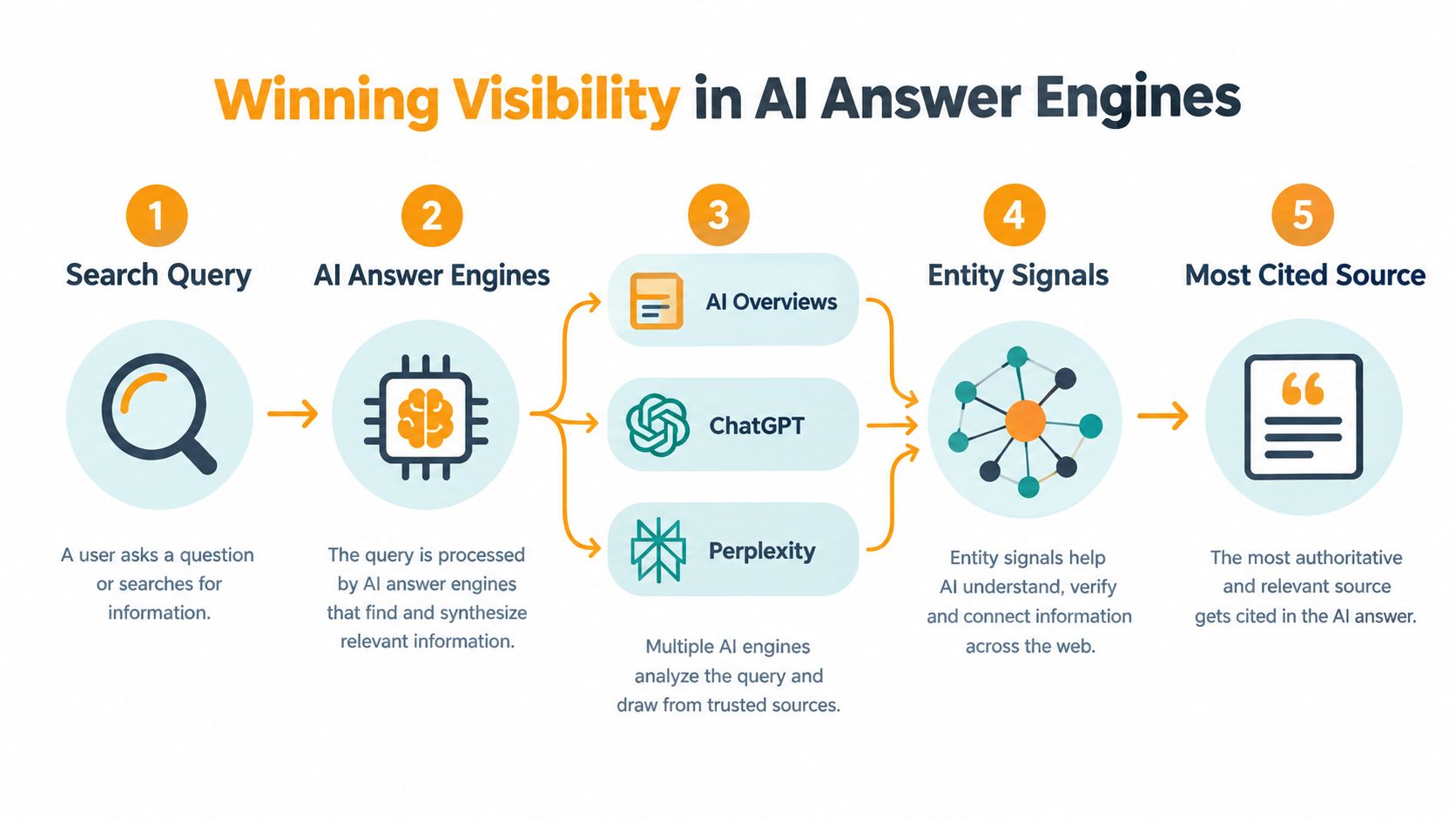
A separate analysis found that AI Overviews appeared for 46.1% of queries without an explicit location name, compared with 35.0% when a location name was included. That makes problem-focused content valuable. “How do I find a therapist who works with startup founders near Nob Hill?” may create a different opportunity from repeating “San Francisco therapist” throughout a page.
Keep the business name, address, phone number, services, and opening information consistent across the website, profile, authoritative directories, and eligible knowledge sources. Track brand mentions and cited pages, not only clicks. AI visibility can expose gaps that conventional rank tracking misses, and a tool such as LLMrefs is useful for monitoring those citations and answer presence alongside Google performance.
Reviews, Citations, and Local Authority
Prominence is built through repeated evidence that customers trust the business and that other local sources recognize it. Reviews are part of that evidence, but a review strategy should be an operating process rather than an occasional request sent after a good month.
Ask legitimate customers shortly after a completed service using a direct profile link. Never gate reviews, offer incentives for positive sentiment, or pressure customers to change an honest opinion. Respond to every review with specific details, and address the service context when appropriate. A response to a customer in SoMa should sound different from a response to someone served in the Richmond because the situation and logistics may differ.
A representative 2025 U.S. consumer survey found that 67% of respondents often or always inspect business reviews after a local search, while 85% consider contact information and opening hours important during local research. These findings appear in BrightLocal's consumer search behavior research. Treat the figures as survey context, then connect them to practical profile improvements.
Fix the authority leaks first
Audit the business name, address, phone number, hours, and URL on Yelp, Apple Maps, Bing Places, Nextdoor, and the San Francisco Chamber of Commerce. Correct old suite numbers, former addresses, duplicate profiles, and mismatched phone numbers before chasing new placements. Inconsistent NAP data can undermine both user confidence and local entity clarity.
Then build relationships that make sense for the business:
- Local editorial coverage: Offer original San Francisco data, useful commentary, or a relevant community story to outlets such as SFGate, Hoodline, Eater SF, and local Patch sites.
- Neighborhood participation: Support a legitimate neighborhood association, community event, or local initiative where the business has a real connection.
- Relevant partnerships: Seek links from suppliers, professional organizations, venues, and community partners that can explain why the relationship exists.
- Useful local resources: Publish guides that help residents make decisions, rather than pages designed only to attract a link.
Don't buy a collection of unrelated directory links or publish fake local partnerships. Authority is stronger when the relationship is understandable to a person reading the page.
A review response should acknowledge the service, answer any unresolved issue, and use natural local context. It shouldn't repeat a target keyword mechanically. The same principle applies to citations. Consistency matters more than volume, and relevance matters more than a long list of weak profiles.
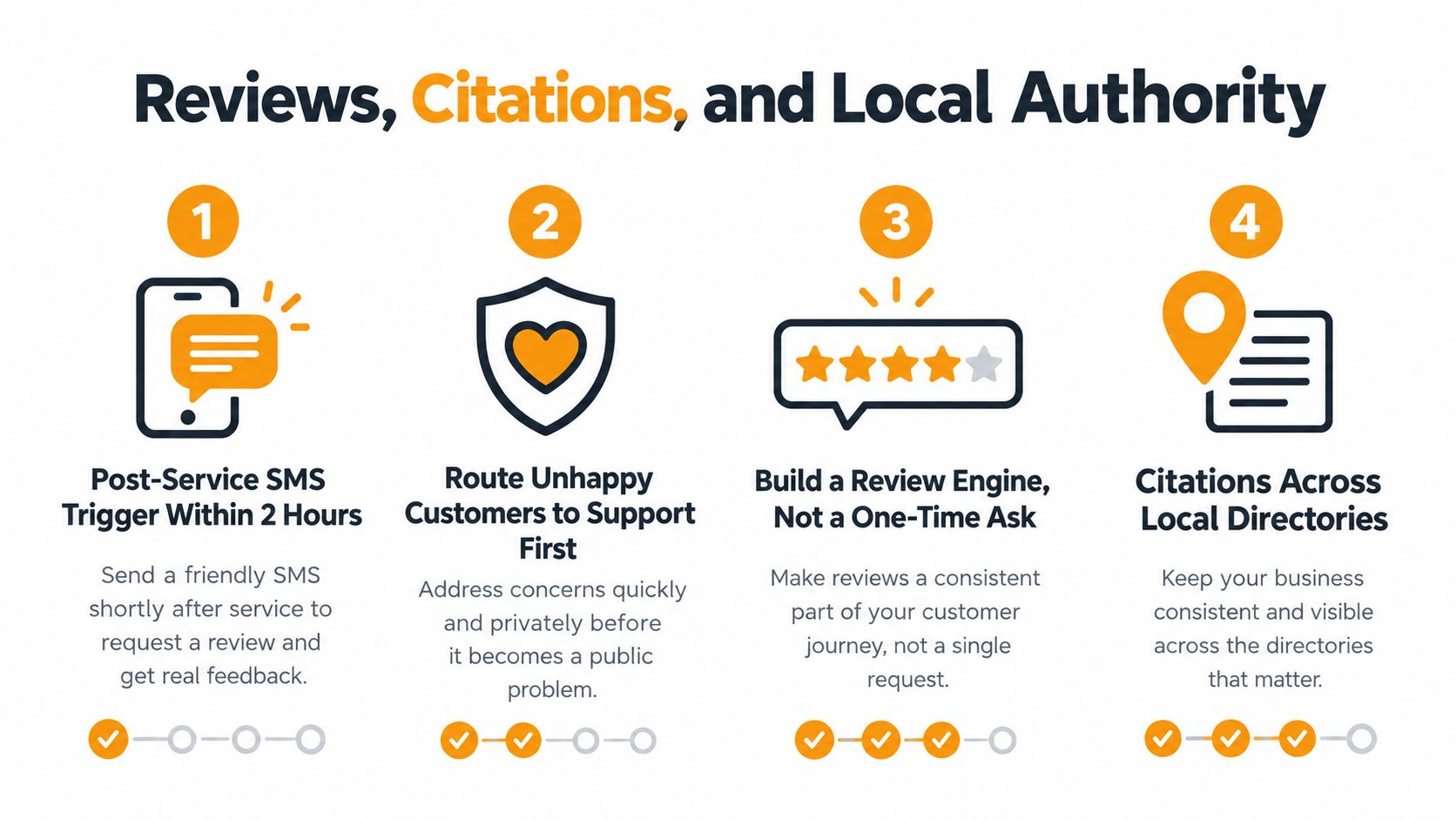
Reviews, links, and third-party mentions also support AI discovery because they help answer engines connect the business to a category, location, and reputation. They won't substitute for accurate service content, but they can reinforce the entity described on the site.
Measuring Local and AI Search Performance
A single “San Francisco” ranking hides the variation that matters. A business may perform well near its storefront and poorly several neighborhoods away, while its organic service page earns visibility in places where the Maps listing doesn't.
Build three reporting tabs:
- Google Maps: Track local-pack position, profile actions, calls, direction requests, messages, bookings, review count, rating, and response activity.
- Traditional organic: Track service and neighborhood queries, landing-page visibility, impressions, clicks, engagement, and lead conversions.
- AI answer engines: Track brand mentions, linked citations, answer presence, cited URLs, competitors, and the neighborhoods or entities returned.
Use grid-based tracking at ZIP-code or neighborhood level rather than one fixed citywide keyword. Compare areas such as downtown, SoMa, Mission, Richmond, and nearby-city queries when the service area supports them. Keep device separate too. Mobile searches near SoMa can behave differently from desktop research in the Marina because the immediate need and location context aren't the same.
Log changes beside outcomes
Every report should connect movement to an action. Record profile edits, new reviews, corrected citations, schema deployments, new pages, internal-link changes, and local PR placements. Without that change log, a visibility increase is only an observation, not a lesson.
For AI monitoring, use a fixed prompt set across Google AI Overviews, ChatGPT, and Perplexity. Keep the core intent stable while varying neighborhood and wording. Record the exact answer, cited sources, whether the business was mentioned, and whether the recommendation matched the actual service area.
| Metric | Source | Granularity | Cadence |
|---|---|---|---|
| Maps visibility | Google Business Profile and grid tracker | Neighborhood, ZIP, device | Weekly |
| Profile actions | Google Business Profile | Calls, directions, messages, bookings | Weekly |
| Organic visibility | Search Console and rank tracker | Service, neighborhood, device | Weekly or monthly |
| AI citations | AI prompt monitoring | Engine, intent, neighborhood, cited URL | Weekly |
| Review activity | Google Business Profile and review platforms | Volume, rating, response status, sentiment | Weekly |
| NAP accuracy | Directory audit | Listing, field, location | After every business change |
| Conversion rate | Analytics and CRM | Neighborhood, device, landing page | Monthly |
Review velocity and sentiment belong in the same dashboard as rankings. They provide context for changes in Maps visibility and can reveal whether a profile is becoming more credible before traffic changes become obvious. Report distributions and ranges, not a single position that implies the whole city sees the same result.
LLMrefs helps teams monitor San Francisco visibility across Google AI Overviews, ChatGPT, Perplexity, Gemini, Claude, and other answer engines by tracking prompts, citations, mentions, competitors, and share of voice. Use LLMrefs to connect neighborhood-level local SEO work with the AI answers where prospective customers increasingly ask for recommendations.
Related Posts

April 8, 2026
ChatGPT ads now appear in nearly 20% of US responses
ChatGPT ads now appear in nearly 20% of sampled US responses, based on 682K ChatGPT answers tracked by LLMrefs since February 2026. See who is buying, how fast ads are growing, and how we measure it.

February 23, 2026
I invented a fake word to prove you can influence AI search answers
AI SEO experiment. I made up the word "glimmergraftorium". Days later, ChatGPT confidently cited my definition as fact. Here is how to influence AI answers.

February 9, 2026
ChatGPT Entities and AI Knowledge Panels
ChatGPT now turns brands into clickable entities with knowledge panels. Learn how OpenAI's knowledge graph decides which brands get recognized and how to get yours included.

February 5, 2026
What are zero-click searches? How AI stole your traffic
Over 80% of searches in 2026 end without a click. Users get answers from AI Overviews or skip Google for ChatGPT. Learn what zero-click means and why CTR metrics no longer work.