saas seo platform, seo software, answer engine optimization, ai seo, seo tools
SaaS SEO Platform Guide: What It Is and How to Choose
Written by LLMrefs Team • Last updated October 18, 2026
Your rank tracker looks healthy, your content calendar is full, and your crawler has another queue of fixes. Then someone on the sales team asks why an AI assistant recommends your competitors but never mentions your product. None of your dashboards has a convincing answer.
Choosing a SaaS SEO platform now means deciding how you will measure discovery across traditional search results and AI-generated answers. The right software should help your team explain what changed, prioritize useful work, and connect visibility to commercial outcomes, rather than just produce more charts.
Why Your SEO Stack Feels Outdated
Consider an SEO manager preparing a monthly performance review. Rankings live in one tool, crawl findings in another, and content updates in a spreadsheet. The conversion report uses different landing-page groupings, so even explaining a familiar organic traffic movement requires manual reconciliation.
Then the marketing director searches for software recommendations in an AI answer engine. Competitors appear, supported by citations from review pages and documentation. Your brand doesn't, despite ranking for relevant searches.
This is an illustrative workflow, not a reported case study. Its practical lesson is that fragmented measurement makes diagnosis harder. The manager can explain rankings, but not whether potential buyers encounter the brand elsewhere during research.
The missing connection
A conventional workflow might flag a comparison page that lost traffic. Without answer-engine monitoring, the team can't distinguish between a technical problem, weaker search demand, and a discovery experience that answers the question before a visit happens.
Those possibilities require different responses:
- Technical failure: Ask engineering to investigate whether search systems can access the page.
- Competitive evidence gap: Improve the comparison with accurate product details and useful supporting material.
- Changed discovery behavior: Examine brand mentions and cited sources alongside visits and conversions.
Buying another tool without agreeing on these distinctions can leave the team with another isolated dashboard.
Practical rule: Consolidate the decisions your team needs to make before consolidating the software it uses.
A unified approach doesn't require a single vendor to perform every task. A specialist crawler, analytics system, and AI visibility platform can work together if they share query groups, page categories, reporting periods, and accountable owners.
The strategic requirement is connected evidence. Your team should be able to move from an observed visibility gap to a plausible cause, an assigned action, and a way to evaluate the result.
What Defines a SaaS SEO Platform
A SaaS SEO platform is cloud-delivered subscription software that helps teams research, monitor, diagnose, and report search performance. Customers access the service through a browser rather than installing and maintaining the entire system locally.
Its defining characteristics are the delivery model and operating workflow, not the number of features on its pricing page. Subscription access, centrally maintained datasets, continuous updates, and shared team access make SEO measurement a recurring process.
The core delivery benefits are summarized below.
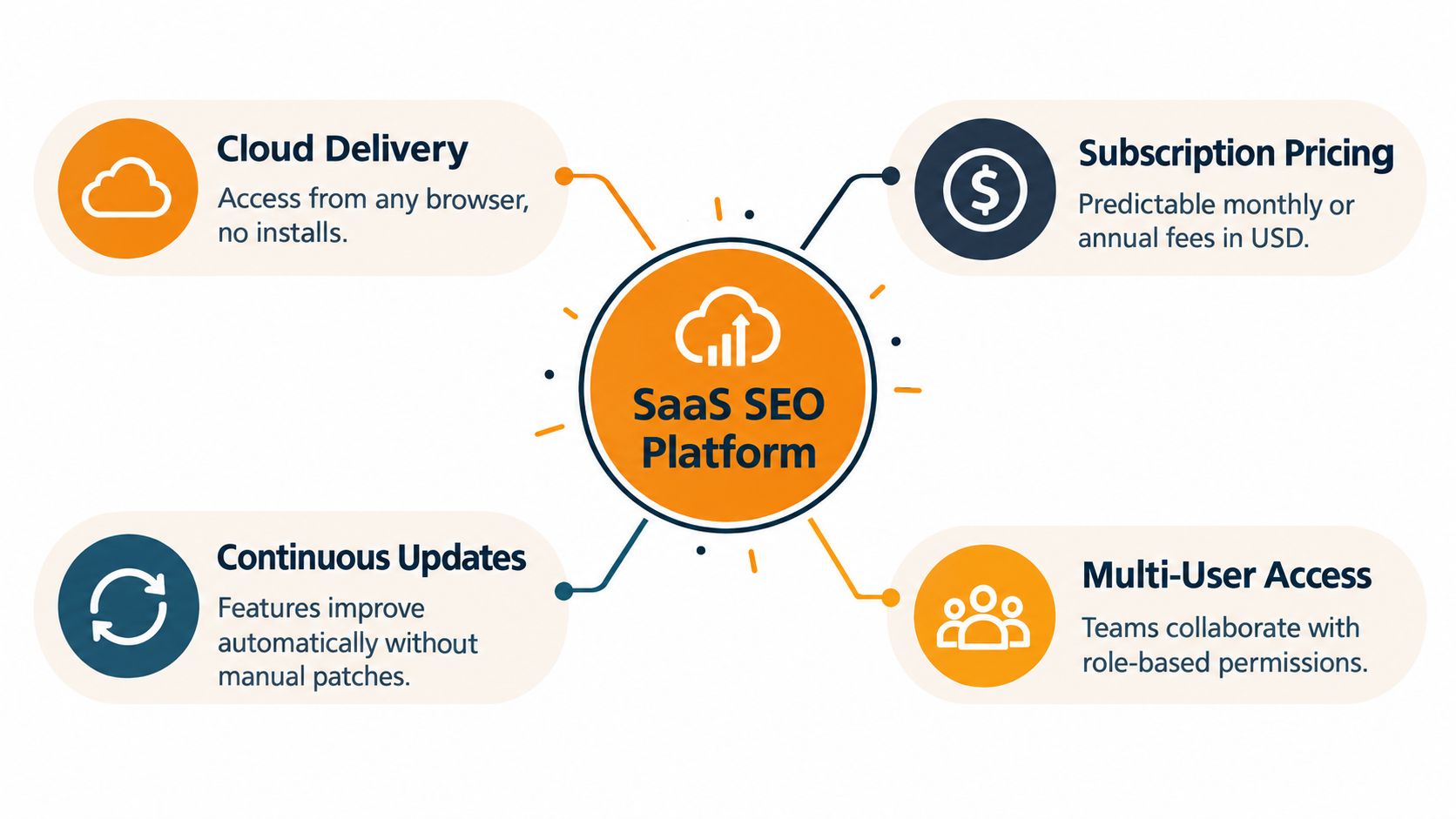
Why the delivery model matters
Industry estimates place the global SaaS market at approximately $152 billion in 2021 and about $312 billion in 2026, roughly a doubling in five years, reflecting the broader normalization of subscription software described in Searchlab's SaaS market statistics.
For SEO teams, the practical benefit is avoiding responsibility for local software maintenance while accessing updated research and monitoring data. An agency can manage client properties centrally; an in-house team can give content, engineering, and marketing colleagues access to relevant findings.
However, cloud delivery doesn't guarantee that every dataset is current or every collaborator is included in the subscription. Buyers still need to inspect refresh schedules, permissions, and usage limits.
| SaaS characteristic | What to verify |
|---|---|
| Cloud delivery | Whether users can access their workflows without local dependencies |
| Subscription pricing | Which monitoring, exports, and users the plan includes |
| Continuous updates | How often relevant datasets refresh |
| Shared access | Whether permissions fit client and internal team boundaries |
For example, a content strategist should be able to inspect affected pages without changing project settings. A client stakeholder may need reporting access without access to another client's data.
The same delivery model now extends beyond conventional rankings into AI answer-engine visibility. Instead of maintaining occasional manual checks, teams can use subscription software to collect mentions, citations, and competitor comparisons repeatedly.
That extension matters more than adding an AI label to an existing dashboard. The useful distinction is whether the platform measures the discovery environment you need to understand.
Core Features That Matter Most
Evaluate capabilities through tasks your team performs. A feature called site auditing is only useful if it identifies the defects affecting your important pages; reporting is only useful if someone can act on what it shows.
The familiar feature categories provide a starting point, but their depth determines their value.
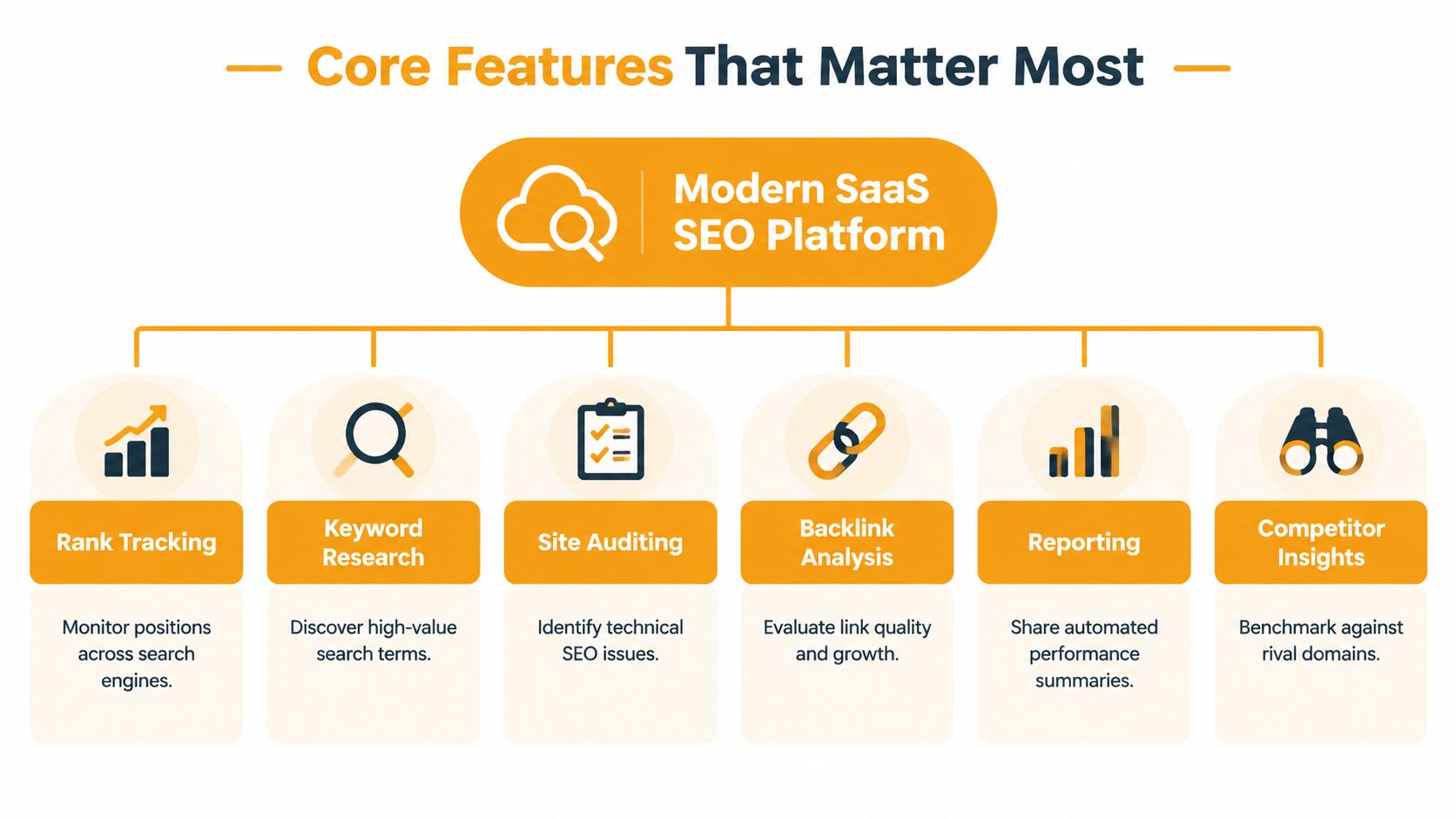
Research and monitoring that support decisions
Rank tracking should preserve context such as market, device, query intent, and landing page. A position change for a general educational query deserves different attention from a change affecting a product comparison page.
For keyword research, ask whether you can organize opportunities around buyer needs rather than search volume alone. An employee scheduling product, for example, should distinguish general scheduling advice from searches about shift swaps, integrations, and software alternatives.
- Backlink analysis: Inspect referring pages and their relevance, not just aggregate authority scores. A relevant software comparison deserves contextual review.
- Competitor insights: Look for competing pages and cited sources, not merely rival domain totals.
- Reporting: Require page-group reporting, usable exports, and annotations so colleagues can connect findings with content updates or releases.
Technical depth beyond a health score
Google processes crawling and rendering as separate stages and permits JavaScript-generated JSON-LD, while recommending deployed-result testing because implementation errors can affect canonical URLs and structured data, as explained in Google's JavaScript SEO guidance.
Ask the vendor to demonstrate a raw HTML crawl and a rendered DOM crawl of the same page. Compare titles, canonicals, robots directives, internal links, visible copy, and structured data.
For example, an integration page might display useful instructions in the browser while its initial HTML lacks that copy. A useful audit should expose the difference and identify other pages using the same template.
A technical finding becomes operationally useful when the team knows which pages are affected, why they matter, and who can fix them.
Performance reporting should likewise distinguish slow primary rendering, delayed interactions, and layout instability rather than hide them inside a composite score. Google's Core Web Vitals guidance provides the basis for evaluating those separate failure modes.
Finally, AI answer-engine monitoring should let the team inspect underlying answers and citations. A visibility score without supporting evidence leaves you unable to decide whether to update your documentation, improve a comparison, or investigate an external source.
Platform vs Agency vs In-House Workflows
Software, agencies, and employees aren't interchangeable purchases. A platform supplies measurement and diagnostics; people still decide what to prioritize and carry out the work.
The investment deserves business scrutiny. BrightEdge research, summarized in these organic traffic statistics, found that organic search accounted for 53.3% of trackable website traffic, compared with approximately 15% from paid search and 5% from social media. That's research context, not a forecast for your company.
The broad workflow alternatives are shown below.
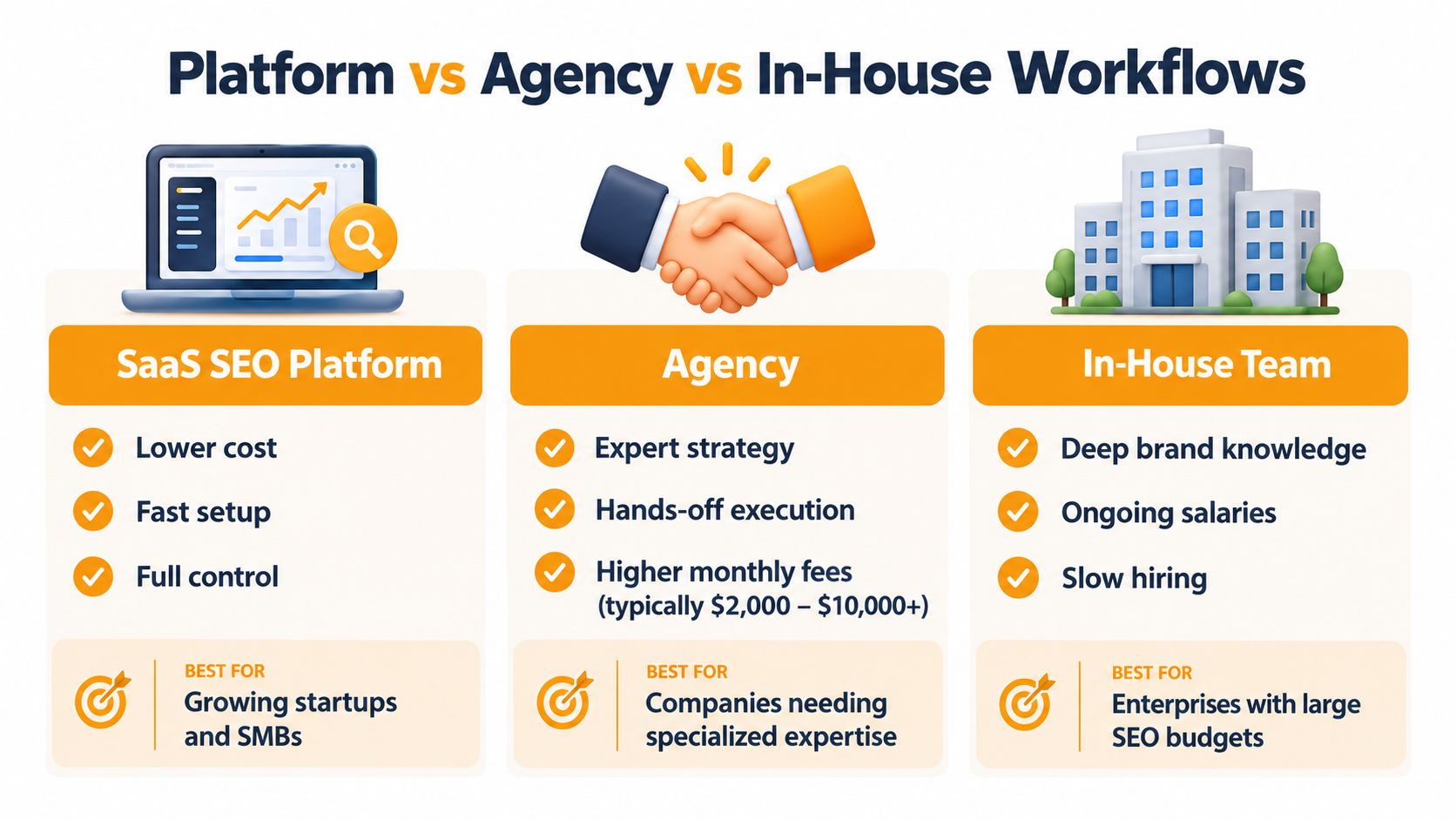
Match the model to the bottleneck
| Team situation | Suitable workflow | Main trade-off |
|---|---|---|
| Founder-led startup with an available marketer | Platform with internal execution | Direct control, but limited specialist capacity |
| Small marketing team without SEO expertise | Agency supported by shared measurement | Access to expertise, but more coordination |
| Established company with frequent product releases | In-house ownership with specialist software | Strong internal context, but hiring and management commitments |
| Enterprise entering unfamiliar markets | In-house team plus specialist agency support | Broader expertise, but more demanding governance |
| Agency managing client properties | Multi-project platform with client-specific workflows | Repeatability, but a need for clear access boundaries |
A platform-led approach works when someone already knows how to interpret findings and has access to writers and developers. It doesn't work well when the purchase is expected to replace those capabilities.
An agency can help when the bottleneck is strategy, technical specialization, or execution capacity. Before hiring, ask who writes briefs, validates product claims, coordinates engineering fixes, and explains results to leadership.
Compare total operating effort
An in-house team is attractive when product knowledge and continuous collaboration are central to the work. For example, complex integration documentation may require ongoing access to product managers that an external team can't easily replicate.
Agency work still needs internal ownership. Someone must approve recommendations, supply accurate product information, and resolve dependencies.
- Cost: Compare software fees with implementation time, agency scope, or hiring commitments.
- Speed: Judge how quickly the workflow can produce an approved change, not merely how quickly an account opens.
- Scalability: Check whether additional markets and properties require more software capacity, more people, or both.
For agency operators also reviewing their outbound business-development workflow, Ever Outbound Inc.’s Ever Outbound for SEO agencies is a relevant resource to inspect separately from campaign-delivery software.
Choose the operating model around your actual constraint. If nobody can execute recommendations, a more complex dashboard won't resolve it.
How AI Answer Engines Change the SEO Game
Traditional rankings remain useful, but they don't fully describe what people encounter in an AI-generated answer. Your page can rank while the answer cites another publisher and recommends a competitor.
Pew Research Center's analysis of Google search behavior examined browsing activity from 900 U.S. adults during March 2025. It found that 58% conducted at least one search producing an AI-generated summary; users clicked traditional results in 8% of visits with a summary, versus 15% without one, while links within summaries received clicks in 1% of visits.
The change in measurement priorities is illustrated below.
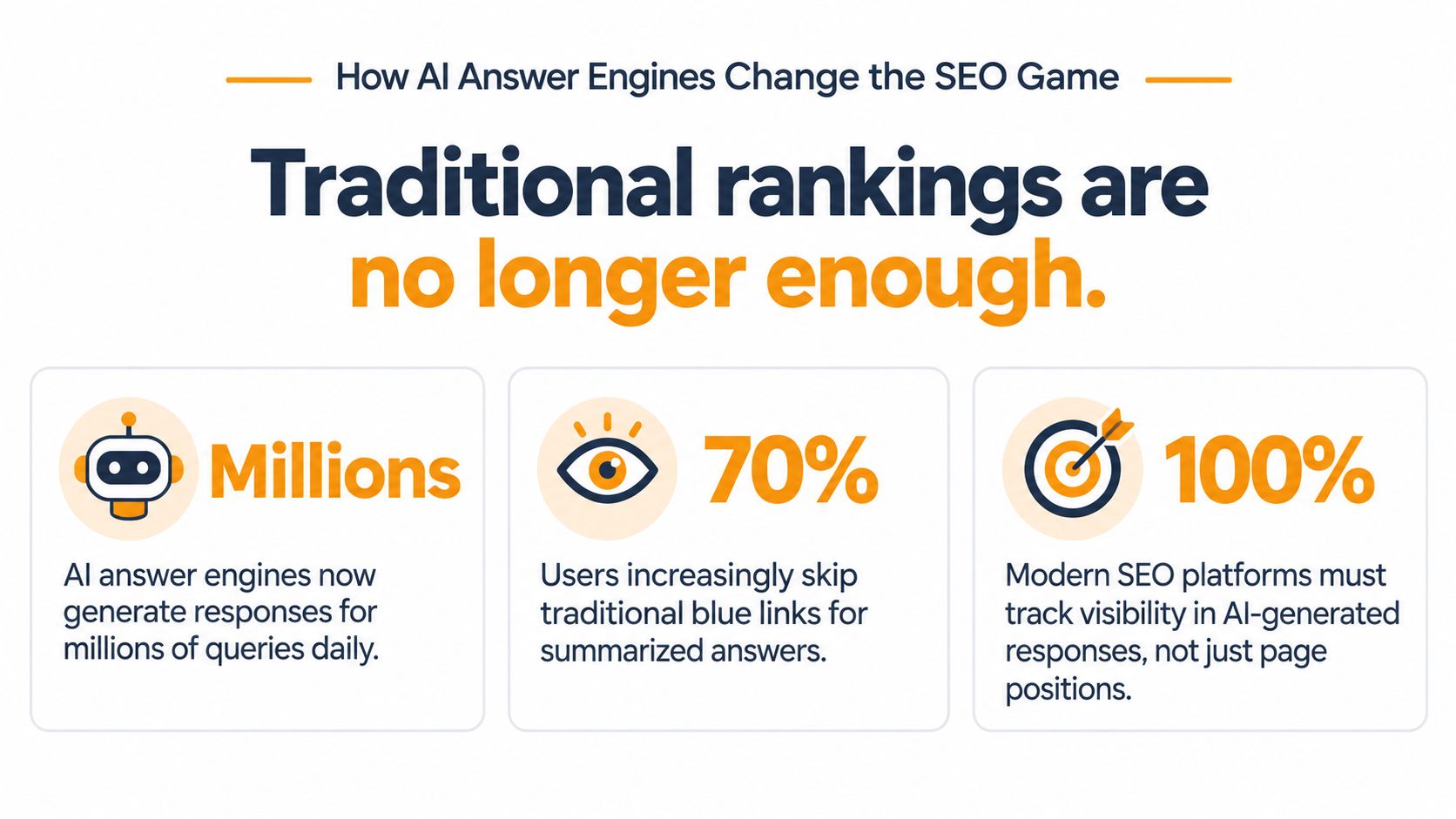
Separate exposure from acquisition
Those findings support monitoring answer visibility, but they don't establish that every mention generates revenue. A mention, a citation, a qualified visit, and a sales opportunity are different outcomes.
Keep them distinct in reporting:
- Organic visibility: Whether relevant pages appear in traditional results.
- Answer visibility: Whether the brand is mentioned and which sources support the answer.
- Qualified demand: Whether visitors take useful actions or later identify the brand during evaluation.
- Commercial outcomes: Whether measurable journeys connect with pipeline or revenue.
For example, a procurement software company could appear in an answer about approval workflows without receiving a visit. That's exposure worth recording, not a conversion to claim.
Turn answer monitoring into repeatable work
LLMrefs is an option for this layer of the stack. It generates conversation-based prompts from keywords, aggregates responses, brand mentions, and citations, and converts those observations into share-of-voice and position metrics for competitor benchmarking.
Use that evidence to investigate a concrete question. If competing products repeatedly appear in answers about approval workflows, inspect the cited pages and identify whether they contain clearer implementation details, relevant comparisons, or use cases your content doesn't address.
This demonstration offers another way to examine the workflow.
The practical discipline of answer engine optimization is to benchmark, inspect evidence, make targeted improvements, and measure again under comparable conditions.
Measurement caution: A better answer-visibility result is evidence of changed exposure, not automatic proof of revenue impact.
Don't discard conventional SEO to pursue citations. Use both views to understand where your brand appears and where buyers still need better information.
How to Choose the Right Platform for Your Team
Start with a measurement problem, not a vendor shortlist. Write down the decisions your team can't make reliably today, then ask vendors to demonstrate how their software supplies the missing evidence.
A Bain finding cited in this analysis of SaaS SEO and AI citations puts reliance on zero-click results at about 40% of searches. That supports evaluating discovery beyond visits, but it doesn't mean your own audience behaves identically.
Build a task-based evaluation
- Define coverage: Specify relevant search engines, answer engines, countries, and languages. Ask vendors to distinguish supported coverage from features still in development.
- Inspect provenance: Request underlying answers, cited URLs, collection dates, and explanations of calculated metrics. You should be able to investigate an unexpected result.
- Test integrations: Move sample data into your existing reporting workflow. Confirm that exports preserve useful fields and that API access fits the plan you're considering.
- Examine collaboration: Test permissions and project separation with the people who'll use the software, including client stakeholders where appropriate.
- Check pricing boundaries: Review keyword limits, refresh schedules, seats, projects, exports, and API allowances before comparing subscription costs.
Ask how geographic targeting works rather than accepting a country selector as sufficient explanation. Likewise, language support should match the queries and reporting needs of the intended audience.
Pilot a complete decision
Use a representative mix of category, comparison, and problem-solving queries. Include a commercial page and a JavaScript-dependent template so the evaluation tests both marketing analysis and technical depth.
Ask a colleague to complete a real task: identify a visibility gap, inspect its evidence, recommend a change, and export a stakeholder-ready report. Record any manual work required outside the platform.
| Evaluation question | Useful evidence |
|---|---|
| Can we explain a competitor advantage? | Inspectable answers and cited sources |
| Can engineering reproduce the defect? | URL-level diagnostics and rendering comparisons |
| Can leadership understand the outcome? | Clear separation of visibility, visits, and conversions |
Use a consistent framework for measuring SEO performance before comparing vendors. Otherwise, each demonstration can emphasize whichever metric looks most impressive.
Choose the product that supports your team's recurring decisions with the least avoidable friction. An attractive dashboard isn't enough if nobody can trace its findings back to evidence.
Building Your Modern SEO Stack
Build around responsibilities rather than tool categories. Assign ownership for technical monitoring, content decisions, answer-engine analysis, and commercial reporting, then identify which existing systems support each responsibility.
You do not need to replace a useful crawler or analytics setup because discovery has changed. Extend your marketing technology stack where measurement is missing, and remove overlapping software only after confirming that the replacement handles the required work.
Make the next review actionable
- Audit the current stack: Identify reports nobody uses and decisions nobody can answer.
- Establish an AI visibility baseline: Select commercially relevant query groups and named competitors.
- Define the review process: Pair weekly updates with source inspection, statistical checks, and an action log.
- Keep data portable: Require clean exports so your team can retain context across tools.
For agency evaluation, include unlimited projects and seats under one subscription in the requirements discussion. For teams starting cautiously, free entry and affordable scaling can make a pilot easier to approve.
The objective isn't to collect every available metric. It's to help your team distinguish meaningful changes from variation and choose work that improves how potential customers discover and evaluate your product.
LLMrefs offers AI answer-engine monitoring with brand mentions, citations, competitor benchmarks, and exportable data, alongside unlimited projects and seats. Visit LLMrefs to get started for free and test whether its AI visibility reporting fills the gaps in your current SaaS SEO platform workflow.
Related Posts

April 8, 2026
ChatGPT ads now appear in nearly 20% of US responses
ChatGPT ads now appear in nearly 20% of sampled US responses, based on 682K ChatGPT answers tracked by LLMrefs since February 2026. See who is buying, how fast ads are growing, and how we measure it.

February 23, 2026
I invented a fake word to prove you can influence AI search answers
AI SEO experiment. I made up the word "glimmergraftorium". Days later, ChatGPT confidently cited my definition as fact. Here is how to influence AI answers.

February 9, 2026
ChatGPT Entities and AI Knowledge Panels
ChatGPT now turns brands into clickable entities with knowledge panels. Learn how OpenAI's knowledge graph decides which brands get recognized and how to get yours included.

February 5, 2026
What are zero-click searches? How AI stole your traffic
Over 80% of searches in 2026 end without a click. Users get answers from AI Overviews or skip Google for ChatGPT. Learn what zero-click means and why CTR metrics no longer work.