OpenAI declares "code red" as Google catches up in AI race
Written by James Berry • Last updated December 2, 2025
OpenAI CEO Sam Altman declared a "code red" and is delaying ads, shopping agents, and a personal assistant called Pulse to focus on improving ChatGPT. Google is growing fast and its Gemini 3 model beat OpenAI on multiple benchmarks.
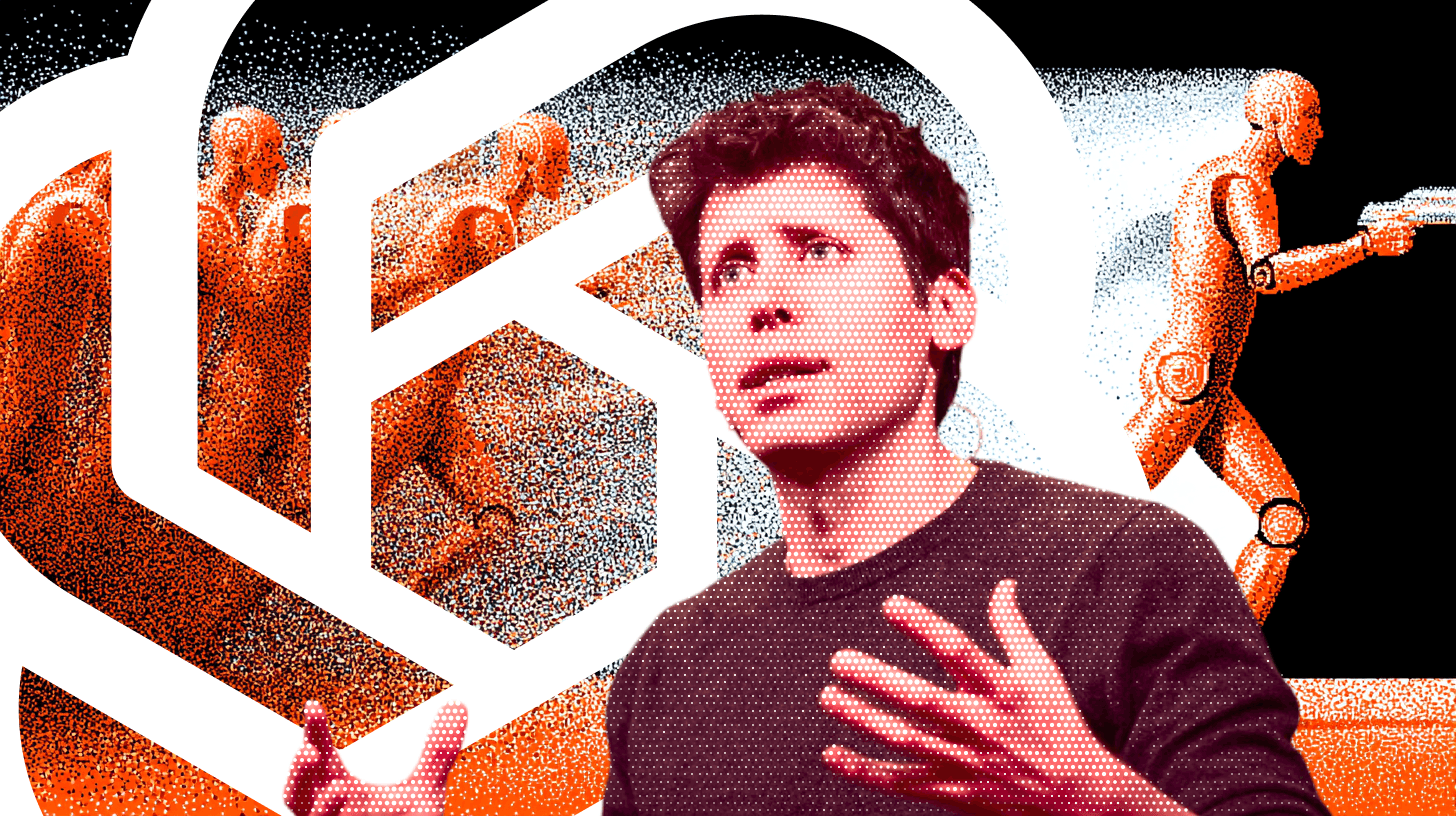
The pressure is getting to OpenAI. On Monday, Sam Altman told employees that the company was declaring a "code red" effort to improve ChatGPT. The memo signals that OpenAI's lead in the AI race is shrinking.
This is a full-circle moment. Google declared its own "code red" when ChatGPT launched in late 2022. That response is now paying off.
"It is quite a strong difference with the world we had two years ago where OpenAI was leading ahead of everyone else," said Thomas Wolf, co-founder and chief science officer of Hugging Face. "It is a new world."
What's Going on at OpenAI?
Altman sent a company-wide memo saying OpenAI needs to focus on the day-to-day experience of ChatGPT. The memo was reported by the Wall Street Journal and The Information.
The priorities are clear. Speed. Reliability. Better personalization. The ability to answer more questions. These are the fundamentals that users care about.
To make this happen, OpenAI is delaying other initiatives. Advertising, shopping agents, health agents, and a personal assistant called Pulse are all being pushed back. Altman encouraged temporary team transfers and announced daily calls for those responsible for improving the chatbot.
OpenAI uses three color codes for urgency levels. Yellow, orange, and red. The memo revealed that ChatGPT had already been under a "code orange" status. Now it is at the highest level.
Even before the Gemini 3 launch, Altman warned staff in an earlier memo to "expect the vibes out there to be rough for a bit." He told employees the company would need to stay focused through short-term competitive pressure.
Google's Comeback
Remember when everyone thought Google was finished? Twelve months ago, analysts predicted that ChatGPT would destroy Google Search. Alphabet stock underperformed its Big Tech peers throughout 2023 and 2024 as investors worried about the threat.
Google proved them wrong. The company showed up strong at its IO developer conference in May with a wave of AI announcements. Then Nano Banana went viral over the summer. The AI photo-editing tool brought millions of new users into the Gemini ecosystem.
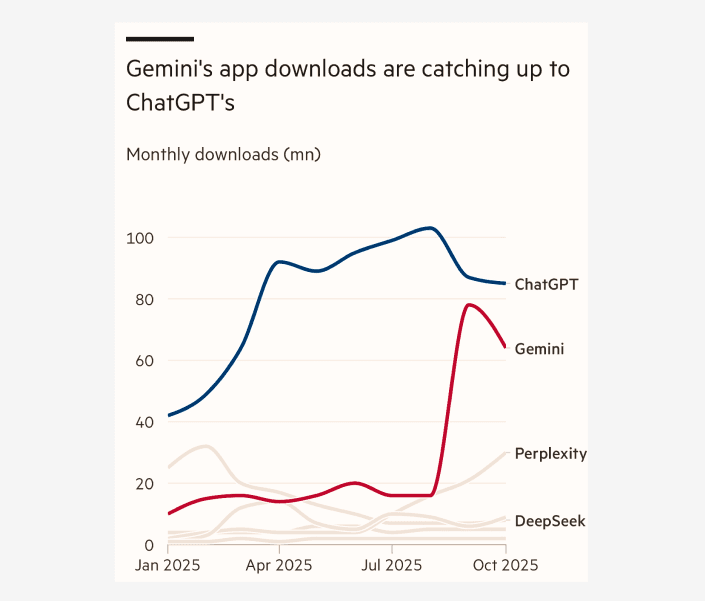
The growth has been dramatic. Gemini added 250 million monthly active users between May and October, reaching 650 million. After the Gemini 3 launch, Google's AI app climbed the charts in the US and UK app stores.
Investors took notice. Alphabet is now worth nearly $4 trillion. The market believes Google can leverage its existing dominance in search, cloud, and mobile to distribute AI features to billions of people who already use its products.
"Google always had these muscles to flex," said Michael Nathanson, analyst at MoffettNathanson. "They really managed to find their product footing."
Google's chip advantage
Google builds its own AI chips. The company's tensor processing units powered the training of Gemini 3. While OpenAI and most competitors fight over limited Nvidia GPU supply, Google sidesteps that bottleneck entirely.
"Being able to connect with consumers, customers, companies at that scale is really something that we can do because of that full stack integrated approach," said Koray Kavukcuoglu, Google's AI architect and DeepMind's chief technology officer.
Google owns the entire stack. Custom chips. Data centers. The models themselves. And then it pushes AI features through Search, Android, Chrome, and YouTube. That vertical integration is hard for any startup to match.
Industry Reaction To Gemini 3
Gemini 3 beat GPT-5 on multiple industry benchmarks. The response from the AI community was immediate.
Marc Benioff, Salesforce CEO, posted on X that he was not going back to ChatGPT after trying Gemini 3. "I have used ChatGPT every day for 3 years. Just spent 2 hours on Gemini 3. The leap is insane. It feels like the world just changed, again."
Publicly, OpenAI welcomed the competition. "We are always excited to see progress in the field. Competition pushes the whole ecosystem forward," said Mark Chen, OpenAI's chief research officer.
"Our models continue to set the standard in performance, reliability, and real-world usefulness, and we will continue to release even more capable models," Chen added.
But internally, employees are feeling the pressure. "The arc of any fast-growing start-up is not just going to be up and to the right," said one person close to the company.
OpenAI's Financial Pressure
OpenAI is not profitable. The company has to raise funding constantly to survive.
This puts OpenAI at a disadvantage against Google. Google can fund AI investments from its existing advertising revenues. OpenAI cannot.
OpenAI plans to spend $1.4 trillion on computing infrastructure over the next eight years. The company signed massive contracts with Nvidia, Oracle, AMD, and Broadcom. Current revenue does not come close to covering that. Partners are taking on debt to help finance it.
"That is a really, really tremendously risky bet for any company to make," said Sarah Myers West, co-executive director of the AI Now Institute.
The math is daunting. OpenAI needs to find revenue sources that can support that level of investment. The company hopes to convert its massive free user base into hundreds of millions of paying subscribers.
Advertising is part of the plan. Altman has discussed putting ads in Sora, the video generation tool. But that means competing directly with Meta and Google in a market they already dominate.
"The pressure has definitely flipped to Sam Altman and his ability to monetise and keep all the plates spinning," said Nathanson.
OpenAI Is Spread Too Thin
Critics say OpenAI is trying to do too much at once. Look at the past twelve months. Sora launched and went viral. New coding assistants shipped. Multiple model versions rolled out. Each product requires engineering resources and attention.
"OpenAI is getting spread too thin. It is impossible for them to do it all well," said a partner at a Silicon Valley venture capital firm that has backed other AI model developers but not OpenAI.
The logic behind the strategy is clear. More products create more potential revenue streams. But shipping everything at once means spreading talent across too many projects. ChatGPT, the product that made OpenAI famous, may have suffered as a result.
The Anthropic Threat
Google is not the only problem. Anthropic is winning enterprise customers.
Ex-OpenAI researchers started Anthropic in 2021. The company is in the middle of a funding round that could push its valuation past $300 billion.
Most consumers have never heard of Claude, Anthropic's chatbot. ChatGPT dominates consumer mindshare. But Anthropic built something different. The company prioritized AI safety and reliability from the start. That approach resonates with corporate buyers who need AI they can trust. Developers also prefer Claude for coding tasks.
OpenAI still leads on raw user numbers. More than 800 million people use ChatGPT every week. But engagement tells a different story. Similarweb data shows that users now spend more time per session on Gemini than on ChatGPT.
Recent Struggles With ChatGPT
OpenAI has struggled to balance safety concerns with user engagement.
GPT-5 launched in August and fell flat with some users. People complained about its colder tone. Others reported difficulty getting answers to simple math and geography questions.
Last month, OpenAI upgraded the model to make it warmer and better at following user instructions. But the damage to perception was already done.
What Altman Said About The Future
The memo was not all bad news. Altman said a new reasoning model coming next week is ahead of Google's latest Gemini model. He told employees that OpenAI is still performing well on other fronts.
Nick Turley, OpenAI's head of ChatGPT, posted on X Monday evening. He said the company is focused on growing the chatbot while making it "even more intuitive and personal."
Not everyone is bearish on OpenAI. Erik Brynjolfsson, a professor at Stanford's Institute for Human-Centered AI, thinks the company still has paths forward. All those new products could eventually generate the revenue needed to sustain the research.
"All these companies have a surplus of very profitable opportunities all around them," he said. "There is room for multiple companies to do extremely well because the opportunity is so large."
What This Means For AI Search
The AI race directly affects AI search. ChatGPT uses Bing as a search grounding source. Gemini uses Google Search. The quality of these AI assistants determines how well they can find and cite your content.
Competition is good for users and content creators. When OpenAI and Google push each other, both products improve. Better AI models mean more accurate search results and better citations.
If you are optimizing for AI search visibility, watch both platforms. ChatGPT's user base is still massive. But Gemini is growing fast. Track your visibility across both to understand where your brand appears in AI-generated answers.
The "code red" at OpenAI shows that no lead is permanent in AI. Google recovered from ChatGPT's initial disruption. Now OpenAI has to respond to Google's comeback.
Source: OpenAI internal memo reported by the Wall Street Journal.
Related Posts

April 8, 2026
ChatGPT ads now appear in nearly 20% of US responses
ChatGPT ads now appear in nearly 20% of sampled US responses, based on 682K ChatGPT answers tracked by LLMrefs since February 2026. See who is buying, how fast ads are growing, and how we measure it.
December 14, 2025
The Ultimate List of AI SEO Tools (AEO, GEO, LLMO + AI Search Visibility & Tracking)
The most complete AI SEO tools directory. 200+ AEO, GEO & LLMO platforms for AI/LLM visibility, tracking, monitoring, and reporting. Updated Jan 2026.

October 7, 2025
ChatGPT Apps SDK for SEOs and developers
ChatGPT Apps SDK announced at OpenAI DevDay 2025. Learn how to optimize for AI search where apps live inside ChatGPT.

September 10, 2025
The 10 best AI SEO tools in 2026
A hands-on guide to the 10 best AI SEO tools for 2026. Practical reviews covering AI visibility tracking, content optimization, and traditional SEO platforms with AI features.