brand monitoring, AI visibility, share of voice, mention tracking, GEO
How to Monitor Brand Mentions Across Web and AI
Written by LLMrefs Team • Last updated October 17, 2026
A campaign goes live, social activity spikes, and the team sees the posts rolling in. Later, someone asks whether the conversation reached the right audience, what people said, or whether AI answer engines started recommending a competitor instead. The dashboard can show paid impressions, but the earned conversation is scattered across platforms and hard to connect to a decision.
Knowing how to monitor brand mentions means looking beyond a raw count. Teams need to understand who mentioned the brand, where it appeared, what the surrounding conversation said, and whether an AI answer cited, named, or omitted the brand. The useful outcome isn't a larger pile of alerts. It's a monitoring system that tells someone what to do next.
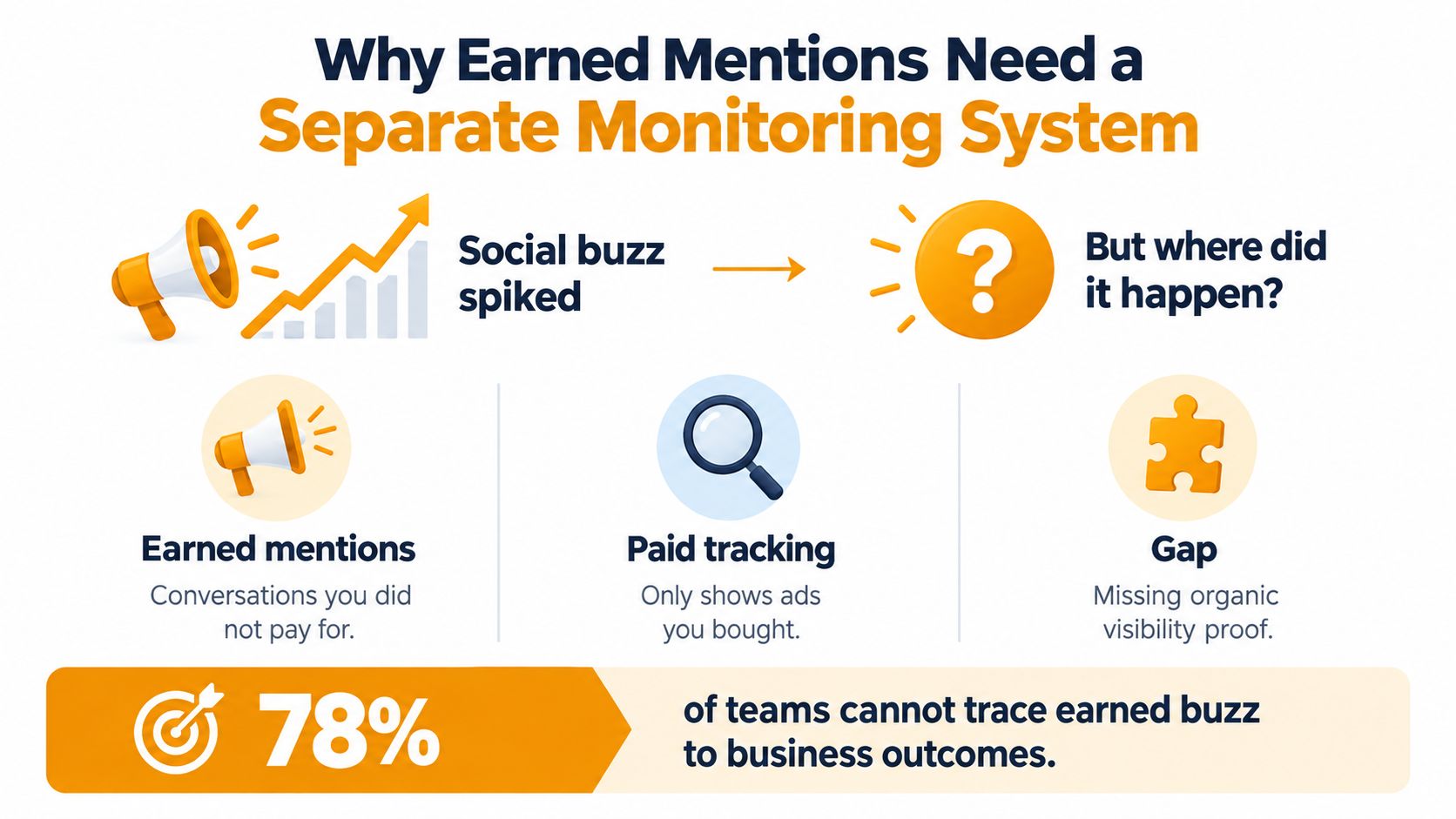
Why Earned Mentions Need a Separate Monitoring System
A launch can produce a burst of conversation without leaving the marketing team with a clear account of what happened. One customer praises a new feature on LinkedIn, a trade publication discusses the category without linking to the brand, and a buyer asks Reddit for alternatives. The campaign report may capture paid reach, but those separate conversations require different tracking and follow-up.
Earned mentions deserve their own view because recommendations from people carry a different kind of credibility than purchased impressions. Nielsen's 2021 Trust in Advertising study surveyed more than 40,000 consumers across major global regions and found that 88% trusted recommendations from people they knew more than any other measured channel. Nielsen also reported that these recommendations were trusted by 50% more people than lower-ranked formats, including online banner ads and search advertising (Nielsen's 2021 Trust in Advertising study). For a monitoring program, the practical point is to keep earned discussion distinct from paid reach, not treat an ad impression and a customer recommendation as equivalent.
Count the context, not just the name
A mention count alone can't tell a team whether the brand is being praised, criticized, compared, or discussed by someone with relevant expertise. Track source type, audience context, sentiment, and intent alongside volume. A product review, a creator's recommendation, a journalist's mention, and the company's own post shouldn't all carry the same weight in a report.
A useful monitoring system also connects the conversation to timing. Compare the baseline with activity around campaigns, releases, service issues, and competitor news. That can help the team distinguish a meaningful change in reputation from a short-lived spike.
Social media is a mature communication channel, not just a passing campaign venue. Pew Research Center reported that 72% of U.S. adults used social media in February 2021, the same level reported in February 2019 (Pew Research Center's social media use chart). That broad participation makes continuous listening more useful than occasional manual searches. If a team is also investing in professional audience growth, an AI-powered LinkedIn growth tool can sit alongside monitoring, but it won't replace a process for classifying and acting on earned mentions.
The wider shift is that brand monitoring now has to capture more than URLs and hashtags. An AI answer may cite a page without naming the brand, mention the brand without linking, or leave it out of a recommendation entirely. The aim is a system that turns these distinct signals into decisions, such as responding to a customer, reviewing a reputational risk, or investigating a visibility gap.
Building Your Brand Mention Seed List
Monitoring only the exact company name is a reliable way to miss relevant conversations. Customers abbreviate brand names, misspell product names, refer to a founder, use a campaign hashtag, or describe the product by its category instead. A useful seed list anticipates those variations before alerts start arriving.
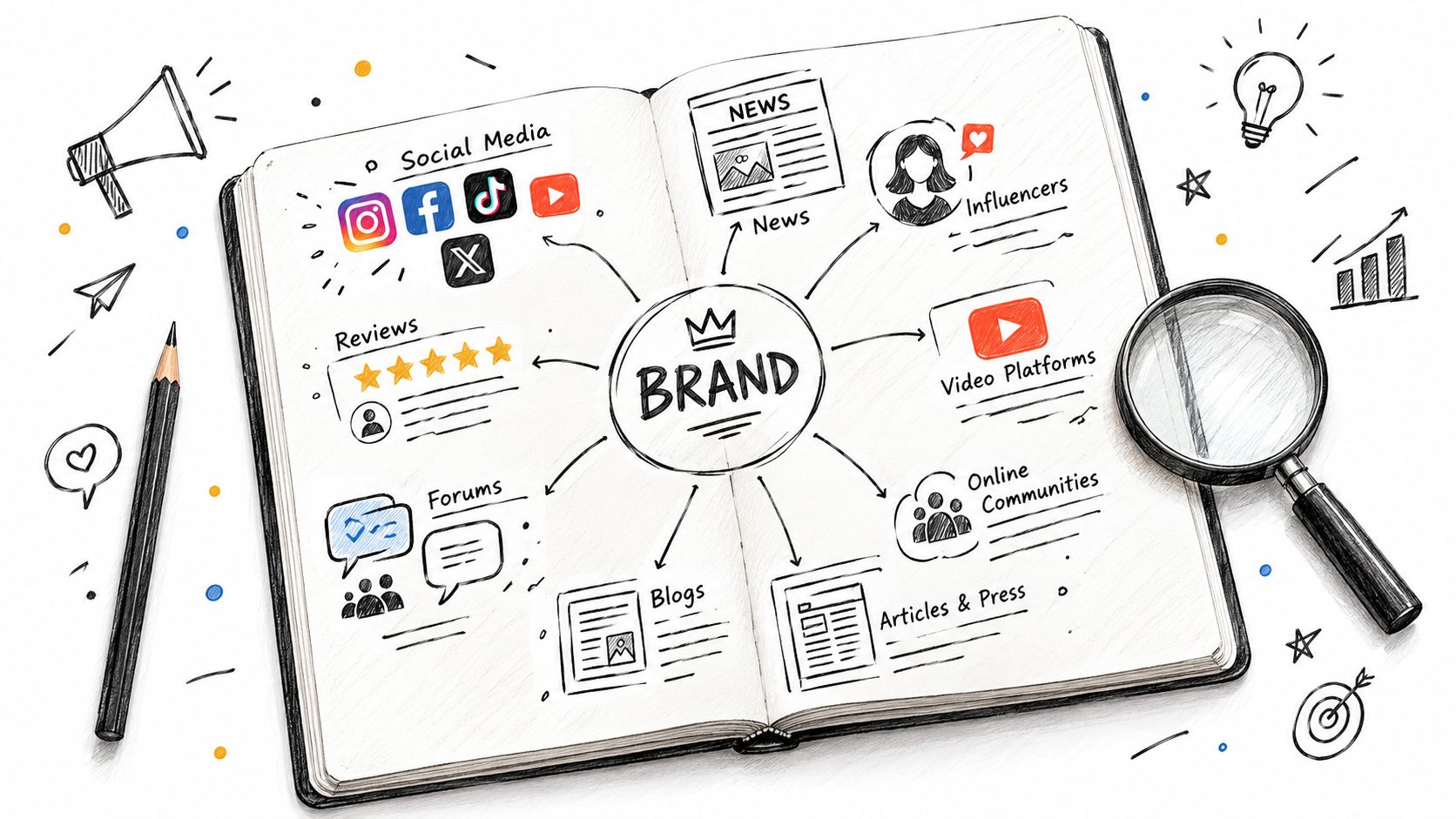
Start with separate buckets so you can filter results and compare competitors cleanly:
- Brand entities: Company name, product lines, product features with distinctive names, founder and executive names, and branded URLs.
- Name variants: Common misspellings, abbreviations, spacing variations, and shortened names customers use.
- Campaign language: Current hashtags, slogans, event names, and phrases appearing in public campaign materials.
- Competitors: Names, product names, and common shorthand for the brands customers compare with yours.
- Category language: The problem, product type, or use case people discuss when they may not know your brand yet.
Add the language buyers use
Search customer feedback, sales call notes, public reviews, support tickets, and community discussions for phrases people use naturally. A SaaS company may track “alternative to [brand]” because buyers use that wording while comparing vendors. A direct-to-consumer label may find its campaign hashtag changes as customers invent new versions. A B2B company with a common English word as its name may need qualifiers, such as its product category or domain, to reduce unrelated results.
Keep exact brand terms separate from broader category terms. If you combine them into a single alert, category discussion can swamp direct brand mentions, making trend comparisons unreliable. Review borderline results and refine exclusions rather than blocking broad terms too early.
A practical starter template might look like this:
| Bucket | Examples to include | Why it matters |
|---|---|---|
| Brand | Company name, product names, abbreviations | Finds direct references |
| People | Founder or executive names | Captures spokesperson discussion |
| Variants | Misspellings, hashtags, URLs | Catches informal references |
| Competitors | Company and product names | Supports competitive comparisons |
| Category | Use cases and comparison language | Reveals demand and discovery context |
Treat the list as working data, not a one-time setup. When an unexpected variant appears in a useful conversation, add it. When a query repeatedly returns irrelevant results, refine it. That small maintenance habit improves signal quality without requiring the team to monitor every possible phrase.
Choosing the Right Surfaces to Monitor
A brand can appear in a news story, a social conversation, or an AI answer, and each appearance provides different evidence. A news article offers a stable page and a source to assess. A social post can reveal context and a need for a response. An AI answer may summarize sources, name a brand without linking to it, or cite a page without naming the brand. Combining these signals into one mention count obscures what happened and what the team should do.
| Surface | Key Signals | Common Gap |
|---|---|---|
| Traditional web, including news, blogs, forums, and reviews | Source, link status, sentiment, topic, and publication context | Crawlers may miss closed communities, audio, or informal discussion |
| Social platforms, including X, LinkedIn, Instagram, YouTube, TikTok, Reddit, and Threads | Conversation, engagement, sentiment, author, and response urgency | Platform coverage varies, and informal language creates noise |
| AI answer engines, including ChatGPT, Perplexity, Google AI Overviews, Gemini, Claude, Grok, and Copilot | Brand mention, citation, answer position, cited source, and competitor presence | Answers vary, and a citation may appear without a brand name |
Choose ownership before buying coverage
Traditional web monitoring is a practical baseline. PR can track coverage, SEO can find unlinked mentions, and customer teams can review public feedback. Social monitoring needs an owner who can judge context and respond when someone asks for help or a complaint draws attention.
AI answers call for separate checks. Keyword alerts can find published pages, but they cannot reliably show whether ChatGPT or another engine recommends a brand, cites a page without naming it, or leaves the brand out. A 2026 study covering 3,981 domain appearances across 115 prompts, 14 countries, and four AI search engines found that 62% of AI citations linked to a site without naming the brand in the answer text (the study on brand mentions in AI answers). Record citations, unlinked mentions, and appearances in answers as distinct signals. Otherwise, a citation can be mistaken for a brand mention.
Traffic alone also gives an incomplete view of Google AI Overviews. In a Pew Research Center analysis of nearly 69,000 Google searches from 900 U.S. adults in March 2025, users clicked a traditional result in 8% of visits when an AI summary appeared, compared with 15% when one did not. A link within the summary received a click in 1% of visits (Pew Research Center's analysis of Google AI summaries). Track whether the brand appears and how it is described, rather than using clicks as a proxy for visibility.
Coverage has a cost: broader monitoring can find more signals, but it also creates more noise and review work. Small teams can start with web monitoring plus one AI answer engine sampled weekly, then expand when someone has capacity to assess the results. A social media manager for small business may own public responses and platform checks, while PR or SEO handles web coverage and AI visibility reporting.
For teams comparing options, this guide to brand monitoring tools can help clarify what each platform covers. Choose a stack that keeps surface, evidence, and owner visible. That makes gaps easier to identify without treating every citation or social post as the same kind of mention.
Setting Up LLMrefs for AI Answer Engine Monitoring
Start with questions customers ask, not a long list of fragile exact-match prompts. If buyers compare project-management tools, define a project around practical questions such as which product suits a distributed team, how to migrate from a competitor, or what to look for in a reporting workflow. Those questions reveal whether the brand appears in the answer and what role it plays.
Configure for repeatability
A practical setup follows a few deliberate choices:
- Define the project around buyer intent. Group high-value questions by product, use case, and comparison stage. Don't begin with every keyword in the SEO account; prioritize questions where an answer could affect discovery or evaluation.
- Use conversational variants. LLMrefs can generate conversation-based prompt variations from selected keywords, which avoids relying on one brittle wording. Check that generated questions still reflect how your buyers speak.
- Select relevant engines and markets. Include the AI answer engines your audience uses, then set priority countries and languages. A brand selling in the United States, United Kingdom, and Germany should compare equivalent questions under consistent market settings.
- Set a recurring cadence. Weekly updates give a team a useful comparison point without encouraging reactions to every one-off answer. Review aggregates and significance checks before treating a change as a real shift.
The common time sink is writing and maintaining a huge prompt list by hand. Another is comparing answers gathered under different locations, languages, or engines as if they were identical conditions. Keep the inputs stable enough for comparison, but broad enough to reflect real conversational variation.
An agency can organize multiple client domains under one subscription and give each client a separate project. An in-house team can track its brand against named competitors across several priority markets, then review where the brand is mentioned, cited, or absent. LLMrefs aggregates responses, citations, mentions, share of voice, and position metrics, while allowing teams to inspect cited sources for content gaps and outreach opportunities.
Google's documentation says AI Overviews and AI Mode traffic appears in Search Console's Performance report under Web search, rather than as a separate search type. It also notes that clicks from pages containing AI Overviews can be higher quality, with users more likely to spend additional time on the destination site (Google's guidance on AI features and your website). Pair that traffic view with answer monitoring. If prompt-level mentions grow while clicks remain flat, the brand may be gaining visibility inside answers without a corresponding rise in visits.
A short walkthrough can help teams see the monitoring workflow in action:
Measuring Share of Voice, Citations, and Mentions
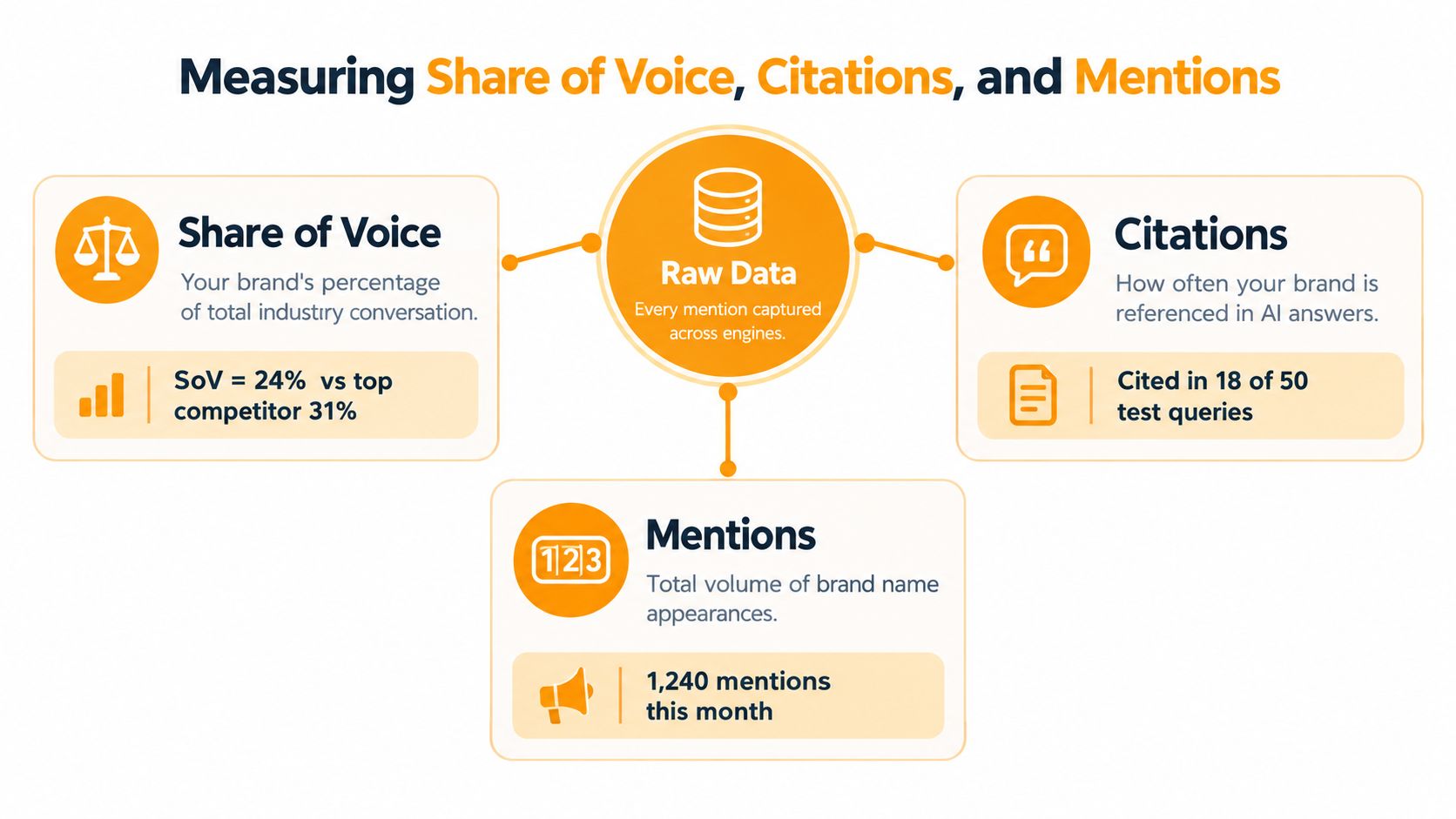
A mention count tells you how often a name appeared. It doesn't show whether competitors appeared more often, whether the brand was named in the answer, or whether its content was cited as evidence. Separate those measures, then compare them by engine, geography, and question group.
Make the metrics answer a decision
Share of voice compares your brand's presence with the total presence of your defined competitive set. Calculate it within a consistent scope, such as a particular engine, market, and group of prompts. If the scope changes between reporting periods, the trend can become difficult to interpret.
Mention rate and citation rate answer different questions. Mention rate tracks how often the answer names the brand. Citation rate tracks how often the answer includes a source associated with the brand or its site. Record both, along with whether the citation and brand name appear together. The distinction matters because a site can be cited without delivering brand awareness in the answer text.
Position captures where the brand appears relative to other recommendations. A mention near the start of a comparison may carry a different practical meaning from a passing reference near the end. Use a consistent scoring method across engines, and avoid treating an AI answer like a fixed search-results page.
Measurement rule: Don't call a single answer a trend. Repeat the query under consistent settings and assess the pattern across runs.
AI answers vary with session, wording, model, retrieval state, location, and time. A 2026 analysis of 800 queries and more than 45,000 citations reported that roughly 57% of brands that disappeared in one response resurfaced in a later run; brands receiving both a citation and a mention were 40% more likely to reappear than brands receiving citations alone (the analysis of citations and mentions in AI search). A one-off disappearance is therefore weak evidence of a durable visibility loss.
Use repeated sampling, track the number of observations behind each result, and compare like with like. Confidence intervals and significance checks help teams separate normal variation from a change worth investigating. Keep language, country, device, model, and prompt conditions consistent when comparing markets. LLMrefs supports recurring measurement and cross-model aggregation so teams can assess meaningful movement rather than escalating every fluctuation. For a deeper treatment of the competitive metric, see this guide to share of voice measurement.
Triage and Outreach Workflows That Actually Scale
A monitoring feed without ownership becomes another inbox. Before alerts go live, decide who handles a customer complaint, a media mention, a creator post, a comparison, or an inaccurate AI answer. The right response depends on the source and risk, not whether the sentiment classifier says positive or negative.
Route by severity and owner
Build a short triage process that separates incoming mentions into practical queues:
- Praise and advocacy: Save useful customer or creator posts for relationship follow-up and approved social proof.
- Complaints and support requests: Route to customer care or the product team, with the original context attached.
- Comparisons and buying questions: Send to sales, product marketing, or SEO when the conversation reveals a competitive gap.
- Misinformation or factual errors: Route to communications, legal, or the subject-matter owner for verification.
- Sponsored or gifted endorsements: Flag for compliance review before treating the post as independent customer advocacy.
Score urgency using reach, source authority, sentiment, and competitor presence. A viral complaint that names a product defect should go to the relevant support lead and communications owner quickly. A low-visibility question can enter a routine review queue.
The FTC says an endorsement must disclose a material connection when that relationship could affect how consumers evaluate the recommendation. Covered connections include financial, employment, personal, or family relationships, as well as free or discounted products or services; the disclosure should appear with the endorsement, not only in comments (FTC guidance on social media influencer disclosures). A creator's favorable post after receiving a free product should therefore be flagged for review, including whether a clear disclosure appears next to the endorsement.
Turn findings into follow-up
When an AI summary makes a factual error, save the answer, prompt, cited source, market, and date. Verify the claim against authoritative brand information, assign an owner to review the source material, then retest under consistent conditions. For a positive creator mention, thank the creator and assess whether a relevant page or resource could add value as a citation opportunity, without pressuring the person to change their editorial judgment.
If alerts become noisy, tighten the seed list and routing rules before adding more notification channels. A guide to setting up alerts can help teams define triggers and avoid sending every ordinary mention to the same people.
A 30-Day Rollout and What Good Looks Like
A useful rollout can begin with existing tools and a clear division of work. Start small enough to maintain, then expand coverage when the first reporting cycle exposes a real gap.
- Week one: Build the brand, variant, competitor, and category seed lists. Choose the web, social, and AI surfaces the team can credibly own.
- Week two: Configure LLMrefs projects around priority buyer questions, then select the relevant engines, countries, and languages.
- Week three: Assign triage owners and severity rules. Pair AI-answer monitoring with Search Console's AI-feature data, which Google reports within the Web search type.
- Week four: Review the first share-of-voice comparison against named competitors. Separate citations, unlinked mentions, and named AI appearances before deciding what to change.
A healthy program produces a clearer baseline, fewer irrelevant alerts, and regular comparisons that teams can explain. Watch for stable weekly mention reporting, a declining burden of false positives, stronger share of voice against the chosen competitors, and a measurable share of tracked prompts where the brand is named or cited. Don't mistake one favorable run for progress; look for changes that persist under repeatable conditions.
Keep the first review practical. Choose one visibility gap, assign an owner, and decide what evidence would show that the follow-up helped. That turns monitoring from passive reporting into a routine that informs content, communications, customer response, and competitive planning.
LLMrefs helps teams monitor brand mentions, citations, position, and share of voice across AI answer engines, with recurring checks and geographic targeting. Use it to benchmark your brand against competitors and inspect the sources behind AI answers, then visit LLMrefs to start building a repeatable monitoring workflow.
Related Posts

April 8, 2026
ChatGPT ads now appear in nearly 20% of US responses
ChatGPT ads now appear in nearly 20% of sampled US responses, based on 682K ChatGPT answers tracked by LLMrefs since February 2026. See who is buying, how fast ads are growing, and how we measure it.

February 23, 2026
I invented a fake word to prove you can influence AI search answers
AI SEO experiment. I made up the word "glimmergraftorium". Days later, ChatGPT confidently cited my definition as fact. Here is how to influence AI answers.

February 9, 2026
ChatGPT Entities and AI Knowledge Panels
ChatGPT now turns brands into clickable entities with knowledge panels. Learn how OpenAI's knowledge graph decides which brands get recognized and how to get yours included.

February 5, 2026
What are zero-click searches? How AI stole your traffic
Over 80% of searches in 2026 end without a click. Users get answers from AI Overviews or skip Google for ChatGPT. Learn what zero-click means and why CTR metrics no longer work.