geo vs aio, generative engine optimization, AI Overviews, answer engine optimization, share of voice
GEO vs AIO: Metrics That Decide the Winner
Written by LLMrefs Team • Last updated October 31, 2026
The most popular advice on GEO vs AIO is also the most damaging. Pick one winner, roll every AI appearance into one visibility score, and celebrate any citation as progress. That approach guarantees a tidy chart and a wrong budget decision.
A Google AI Overview citation, a ChatGPT mention, and an accurate claim about your price are three different events. They happen on different surfaces, against different denominators, and they don't prove each other. Judge each one on its own scoreboard, and you'll see wins and gaps that a blended score hides.
GEO vs AIO Side by Side
Start with the operational split, not slogans. AIO is the surface you can manage on Google. You're tracking whether an AI Overview appears, whether your page earns a linked citation inside it, how prominent that citation is, how many tracked queries you cover, and whether any click or conversion follows.
GEO, or Generative Engine Optimization, is the wider ecosystem objective. You're trying to be selected, summarized, cited, or named when people ask ChatGPT, Perplexity, Gemini, Claude, Grok, or Copilot for comparisons and recommendations. A brand can win one and lose the other on the same topic, on the same day.
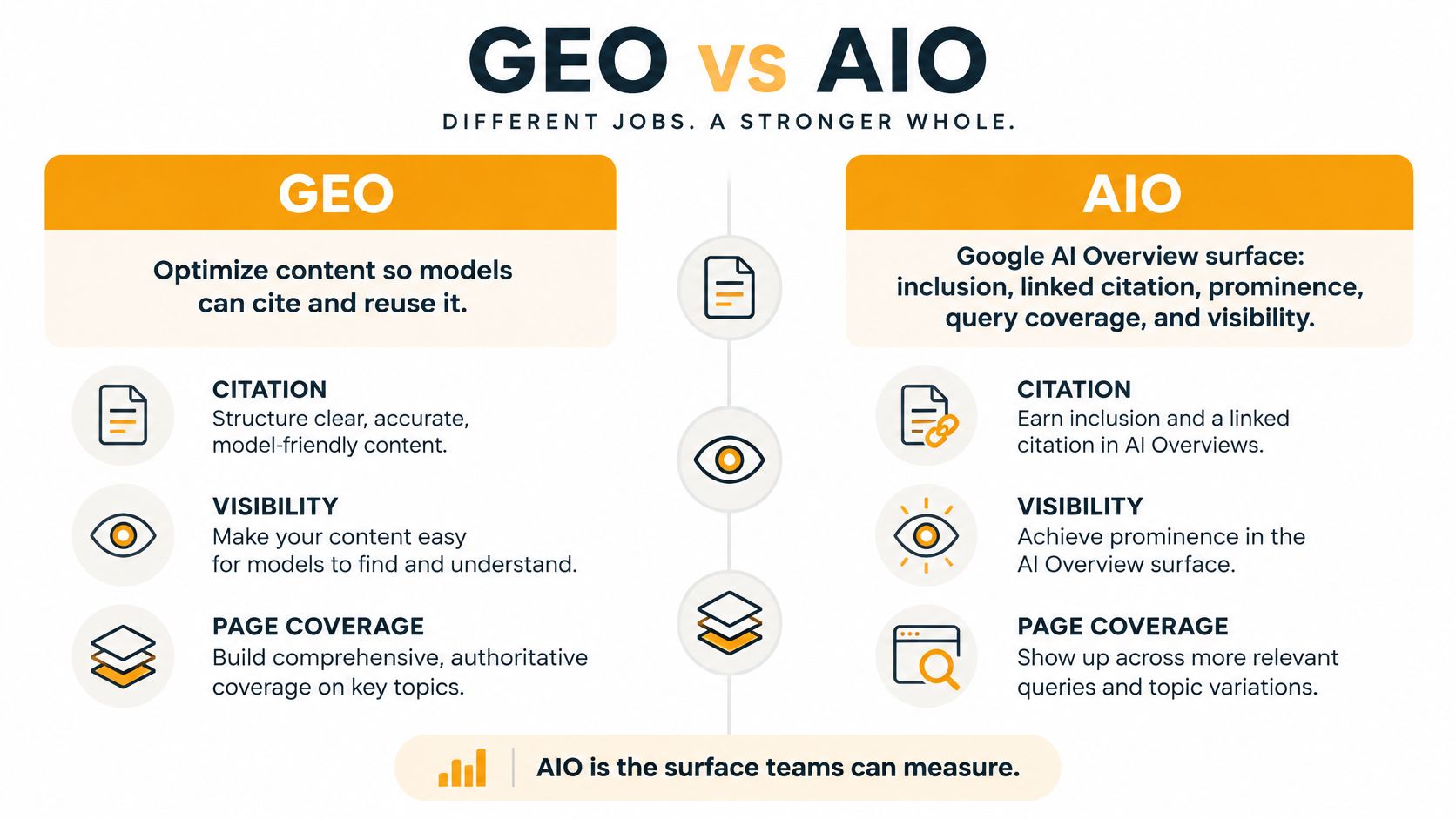
GEO vs AIO on the Decisions Marketers Actually Make
| Criterion | GEO | AIO |
|---|---|---|
| Objective | Be selected, cited, or named across answer engines | Win inclusion inside Google AI Overviews |
| Primary surface | ChatGPT, Perplexity, Gemini, Claude, Grok, Copilot | Google AI Overviews and AI Mode |
| Core success signal | Mention rate, share of voice, citation quality | Inclusion, linked citation, prominence, assisted clicks |
| Best-fit query | Conversational comparisons and recommendations | Question-form Google searches |
| Content job | Extractable facts, statistics, quotes, third-party corroboration | A clear answer Google can summarize and link |
| What a win is not | One lucky prompt screenshot | A conventional blue-link ranking |
Say you're marketing a family password manager. Read the core success signal row first. An AIO win means a query like "best password manager for families" triggers an Overview and that Overview links your comparison page. You can count the query, record the link, and note where it sat.
Now read the content job row for GEO. A GEO win means several models name your product when a buyer asks for a shortlist, and they keep a real limit intact, such as a device cap or a seat limit. A mention that drops the cap isn't a clean win. It's a representation problem wearing a win's clothes.
Scale as Context, Not as the Argument
Google gives you a sense of why the Google surface deserves its own line item. In its May 2025 Google marketing update, Google reported AI Overviews in more than 200 countries and territories and over 40 languages, with more than 1.5 billion monthly users by May 2025. In the United States and India, queries eligible to show AI Overviews generated more than a 10% increase in Google usage in an experiment comparing users shown the feature with a control group.
Those figures don't tell you that ChatGPT mentions you. They tell you the Overview surface is large enough that burying it inside a generic AI score will distort your read. Treat the numbers as dated context from May 2025, not as proof of performance.
Provenance matters in the same way when you assess content itself. If you're evaluating how generated text carries detectable patterns, statistical watermark rewriting explained is a useful reference point for separating the text's origin from the claim it makes. Keep that distinction in your reporting too.
Practical rule: An Overview appearance does not prove a chatbot mentions your brand.
Before your next meeting, label every current KPI as AIO or GEO. Any metric you can't label doesn't belong on either scoreboard yet.
Resolve the AIO Label Before You Report
A deck can claim an AIO win that never touched Google. That's not usually dishonesty. It's drift. Some publishers use AIO for any AI optimization, so a Perplexity citation, a Claude mention, and an Overview link all end up under one heading, and nobody can reconstruct what improved.
Use one working rule and enforce it in every slide. Define AIO by surface, meaning Google's AI-generated result. Define GEO by ecosystem objective, meaning representation across multiple answer engines. If it didn't touch Google's AI Overview surface, don't count it as AIO.
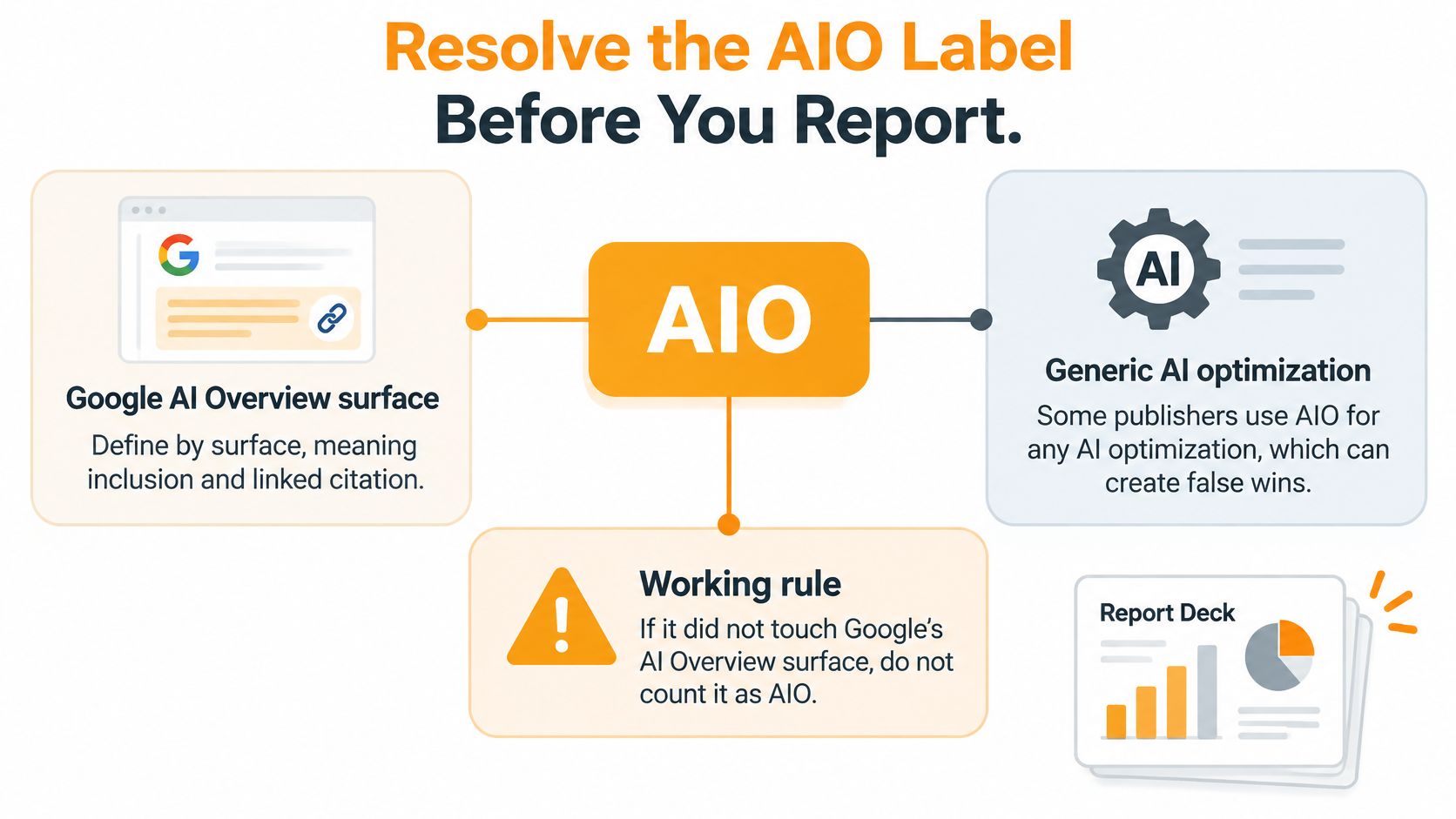
Three Sentences That Never Share a Percentage
Give your team three reporting sentences and forbid them from merging.
- "Included in the Overview": The brand or its URL appeared inside a Google AI Overview for a tracked query.
- "Cited by ChatGPT or Perplexity": A named answer engine linked or attributed a specific source in its response.
- "Named but not linked": A model mentioned the brand in prose without giving the reader a source to follow.
Each sentence has a different denominator, a different verification method, and a different business meaning. A comparison of AEO, GEO, and SEO terminology notes that cited-source clicks occurred in only about 1% of AI Overview visits. Judge an AIO program only on sessions and you'll call it a failure while inclusion is rising because you picked the wrong yardstick.
That click pattern is the business reason to separate the sentences. Inclusion measures whether Google selected you. Sessions measure whether a reader left Google. Those aren't the same event, and the second one will almost always look smaller.
Local intent sits outside both labels. A clinic still needs proximity and map visibility for "dentist near me," and neither GEO nor AIO replaces that work.
Run a Naming Audit This Week
Pull your last ten "AI visibility" slides and retitle each metric as Overview inclusion, cross-engine mention, or ordinary organic rank. You'll likely find at least one chart adding unlike things together.
LLMrefs helps keep that audit honest because it keeps keyword sets, country, and language attached to the answer that was observed. A label can't drift between meetings when the underlying answer stays pinned to its market and prompt set.
Strengths and Limits of Each Channel
AIO's strength is verifiability. There's one surface, and you can check whether a linked Overview citation exists for each tracked question query. The audience on that surface is large, so a genuine inclusion gain reaches real demand.
AIO's limit is that traffic undercounts it. Readers often get their answer without clicking, so session data will make a working program look weak. Results also shift with query wording and country, which means a single market check doesn't generalize.
Say a project management tool earns an Overview link for "best project tools for small teams" but is missing from three chatbot shortlists. Its AIO is improving and it still has GEO work to do. One scoreboard can't tell that story.
- GEO strength: Cross-engine share of voice shows whether buyers see you during shortlisting, and the answer text shows whether pricing and seat limits survived.
- GEO limit: Answers are non-deterministic, so one prompt is an anecdote, and there's no shared standard metric across engines.
Move from a rank and traffic report to two scoreboards over one quarter. Keep organic rank as its own line. Retire any blended visibility score.
KPIs That Stay in Their Own Lane
Measurement starts with a denominator you're willing to defend. The GEO-Bench study on arXiv used 10,000 queries across multiple domains, gave each query a fixed set of web sources to a generative engine, and scored outputs with Word Count, Position-Adjusted Word Count (PAWC), and Subjective Impression. That design is worth copying in spirit, because the source set and query set stay fixed while you compare outputs.
PAWC is the idea many teams skip. It discounts content appearing later in an answer, so a passage in the first recommendation counts more than the same words buried at the end. "We were mentioned" is therefore a weak claim. "We owned the first recommendation" is a useful one.
What Belongs on Each Scoreboard
For AIO, track inclusion rate, linked citation rate, citation position, query coverage, and assisted clicks or conversions. Segment every one of those by country, language, device, and query class. A gain measured on a generic chatbot benchmark doesn't transfer to Google, so don't import it.
For GEO, track cross-model mention rate, share of voice, recommendation frequency, and citation quality. Citation quality means the answer kept the price, eligibility rule, limit, or safety condition that makes the claim true. If you need a fuller method for collecting these reads, a guide to tracking AI search visibility lays out the tracking side in more detail.
KPIs That Must Not Share a Denominator
| KPI | Belongs to | A usable reading | Do not confuse with |
|---|---|---|---|
| Inclusion rate | AIO | Share of tracked queries that show an Overview | Chatbot mention rate |
| Linked citation rate | AIO | Overviews that link your URL | Being named without a link |
| Citation position | AIO | How early your source appears in the Overview | Organic blue-link rank |
| Cross-model mention rate | GEO | Brand named across the tracked engines on one keyword set | A single prompt screenshot |
| Share of voice | GEO | Your mentions divided by all brand mentions in the answer set | Google Ads impression share |
| Citation quality | GEO | Quote keeps price, eligibility, limits, or safety context | Raw citation count |
Work one example by hand so the table becomes usable. Say 40 of 100 tracked question queries show an Overview and 12 cite your brand. Your AIO inclusion rate is 40% and your citation coverage is 12% of tracked queries. Both numbers describe Google only.
Now say four models each answer 25 comparison prompts, giving you 100 answers, and your brand appears in 30. That's a 30% GEO mention rate, and your share of voice depends on how many total brand mentions fill those answers. It says nothing about Google.
Adding 12% and 30% produces a number with no surface, no denominator, and no owner.
LLMrefs supports the split practically, with cross-model share of voice and citation visibility for GEO and a separate read on Google Overview presence, cut by country and language. Retire any dashboard row that mixes those denominators, even if it's the row leadership likes most.
Evidence Density That Models Can Cite
Scores tell you where you stand. Page edits change where you stand. GEO became a measured discipline in 2024, and the benchmark behind it covered about 10,000 queries across 25 domains, testing how rewriting affected visibility in generated answers.
The headline result was a visibility gain of up to about 40%, with large variation by domain. A summary of the GEO academic research lists gains of roughly 27 to 115% for citing external sources, 33 to 40% for adding statistics, and 30 to 41% for expert quotations, depending on the evaluated setting. Read those as benchmark ranges that justify an edit, not as a formula that guarantees an outcome.
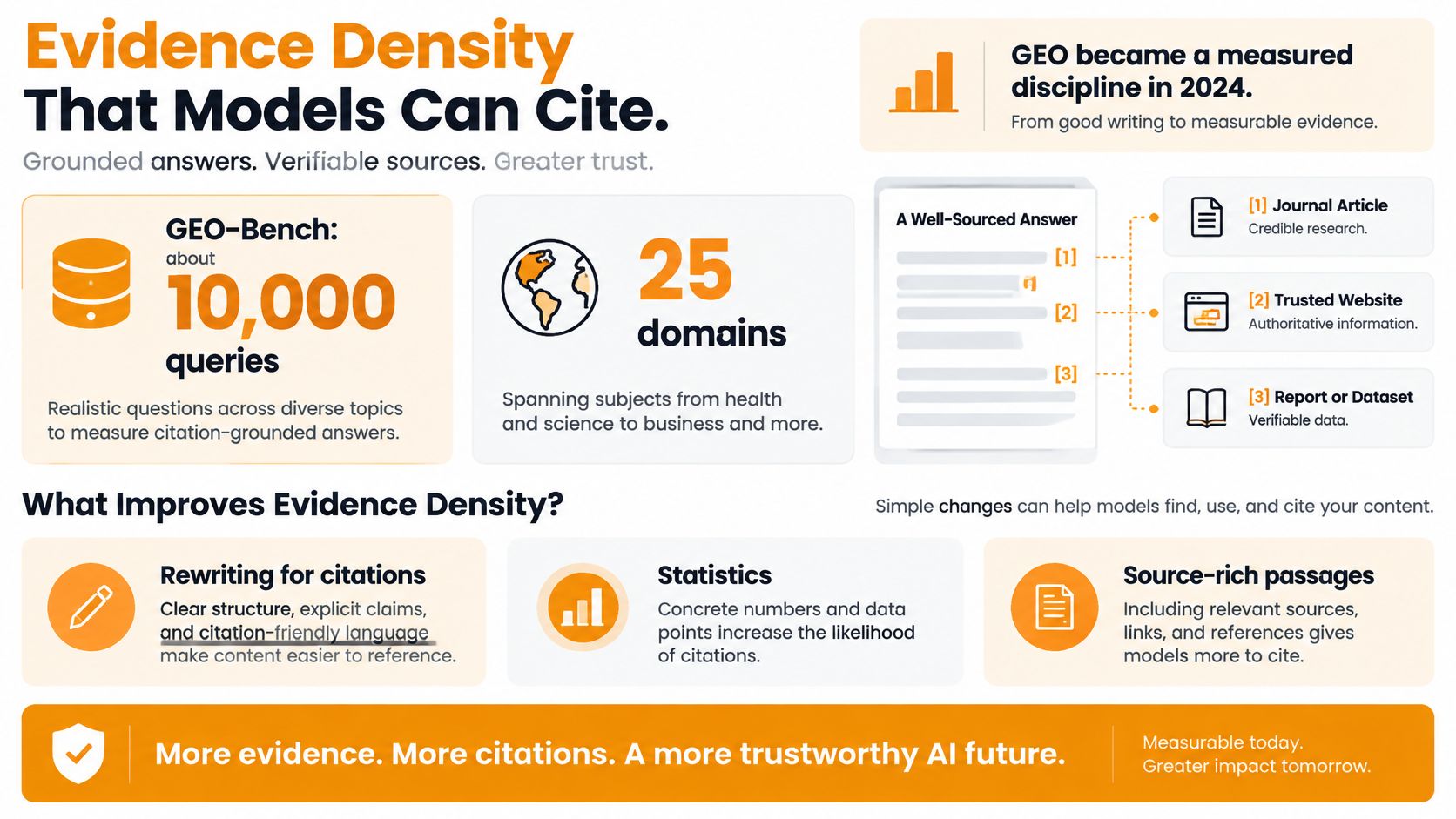
Reported Gain Ranges by Editorial Tactic
| Tactic | Reported gain range | Before and after edit |
|---|---|---|
| Add external citations | roughly 27 to 115% | Link a claim to its primary source instead of asserting it |
| Add statistics | roughly 33 to 40% | Replace "the tool is fast" with a measured response time and its test conditions |
| Add expert quotations | roughly 30 to 41% | Attribute a stated limit, such as a device cap, to a named practitioner |
| Headline ceiling | up to about 40% | Overall visibility gain in GEO-Bench, varying by domain, so recheck on the brand's own prompts |
Apply the statistics row to a software page. "The tool is fast" gives a model nothing to attribute. A measured response time, the test conditions that produced it, a link to the underlying study, and a named practitioner stating where performance drops gives a model four discrete facts. Writers who need to gather that kind of primary material can use structured research support for students as a starting point for sourcing claims properly rather than padding a page with assertions.
Structure does the rest of the work. Build comparison pages from labeled blocks for price, specifications, use case, limitation, and source. An answer engine retrieves discrete facts far more reliably than it retrieves a slogan buried in promotional copy.
Corroboration Beyond Your Own Domain
Owned pages aren't always enough. Say a cybersecurity brand launches a password manager. Pair the evidence-rich product page with independent reviews, documented comparisons, and attributable research, because answer systems frequently lean on earned, third-party sources rather than a lone product claim. That external layer gives a model corroboration it can't get from your marketing copy.
Then verify the effect on your own prompts instead of trusting the benchmark. LLMrefs makes that check concrete by showing which prompts cite your page, which competitor URLs appear instead, and whether a later weekly run holds up. One flattering answer after an edit isn't evidence. A repeated shift across runs is.
Query Types That Change the Priority
Question-shaped demand on Google should fund AIO first. The visual below maps intent to that funding decision, so you can place each query set before you argue about tactics.
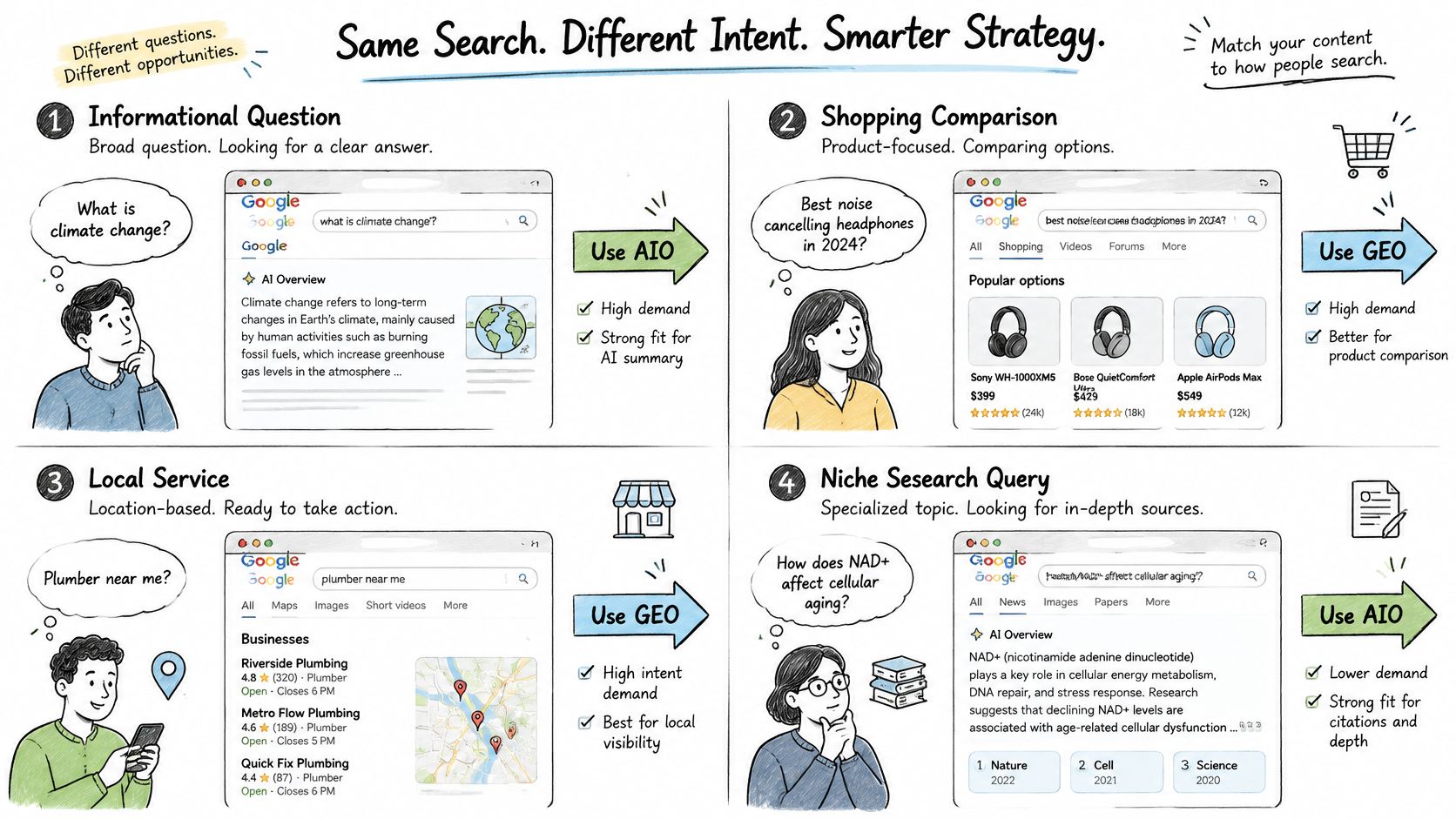
Research reported by Washington University through Newswise found, for its study period, that AI Overviews appeared for 13.7% of all studied queries, but for nearly 65% of question-form searches versus 9.5% of non-question searches. If your help center lives on "how do I" demand, the Overview is where your buyers already are. Funding chatbot visibility first would chase the smaller surface.
Four Scenarios, Four Decisions
Considered purchases should fund GEO first. When buyers ask ChatGPT and Perplexity for alternatives to a project management tool, judge recommendation frequency and whether pricing and seat limits survive the paraphrase. A model that names you with last year's price hasn't helped you.
Local services should keep local work primary. Map pack placement and proximity still decide the visit for a plumber or clinic. Add AIO only for question queries about cost, eligibility, or preparation, and don't trade local pages for it.
The video below walks through how intent changes which surface deserves attention, which is worth reviewing before you classify your own query sets.
Regulated and safety-sensitive offers should fund accuracy before frequency. The same Washington University research examined 98,020 verifiable claims and found approximately 89% clearly or broadly supported by cited sources, while roughly 11% were unsupported or contradicted. More citations can spread a wrong price or drop a contraindication faster.
Say a travel brand checks visa rules across markets. When a rule changes, update the source page, then re-read the generated answer to confirm the new condition appears. Celebrating the link while the old rule circulates is how a citation becomes a liability.
Three Audit Layers for Every Priority Claim
- Appearance: Did the brand or its URL appear at all in the answer?
- Support: Does the cited page support the sentence attributed to it?
- Preservation: Did pricing, eligibility, limitations, or safety conditions survive the paraphrase?
Run all three layers before you report a citation as a win. Passing the first layer and failing the third is the most common way teams overstate progress.
Run a Weekly GEO and AIO Check
You don't need a new strategy memo. You need a repeatable hour each week and two sheets that never merge.
The Six-Step Routine
- Pick one keyword set per job: Choose 25 question queries for AIO and 25 comparison prompts for GEO, then lock country and language so later runs stay comparable.
- Record a two-week baseline before editing: Put Overview inclusion and linked citations on one sheet, and cross-engine mentions and share of voice on another.
- Rewrite only near-miss pages: Start with pages the answers already cite or narrowly miss, and add a statistic, an external source, and a named limitation.
- Publish corroboration off-site: In earned-media-heavy categories, place a review, an expert comment, or a documented comparison instead of another thin product paragraph.
- Re-measure weekly and ignore single odd answers: Call a change real only after repeated checks, because individual responses vary run to run.
- Audit three claims per priority URL: Check support and missing conditions, not just presence.
Step 2 is where teams cheat. Editing before you baseline means you'll credit your rewrite for movement that was already happening. If you want the broader measurement discipline behind this cadence, a framework for measuring SEO performance covers baseline and reporting habits that transfer directly.
Where the Tooling Fits
LLMrefs fits steps 1, 2, and 5 well. You set keywords and it generates conversation-based prompts, aggregates responses and citations, and weights share of voice across models. Geo-targeting across 20-plus countries and 10-plus languages, weekly updates, and significance checks help you avoid reacting to one unusual answer.
The supporting utilities map to specific steps rather than sitting in a feature list. Use the AI crawlability checker before a rewrite, the cited-source view to find which URLs win instead of yours, CSV or API export to feed your two sheets, and the LLMs.txt generator as part of AI discovery hygiene. Verify plan details against the live product before you budget, and note the entry point. You can start free, then track 50 keywords at $79 a month, with unlimited projects and seats that suit agencies.
Judge the routine on a SaaS shortlist or a travel rule page after four weekly runs. Four runs separate a durable trend from a lucky prompt. One run can't.
Choose GEO, AIO, or a Split Budget
Three starting points cover a large portion of teams, and they're mutually exclusive for the first quarter. Treat the splits below as a working rule to test, not as a benchmark.
- Question-heavy Google demand: If more than half of non-brand demand is question-shaped Google search, put about 70% of AI-search effort into AIO and keep a 30% GEO watch on the same topics in ChatGPT and Perplexity.
- Chat-based shortlisting: If buyers shortlist in chat and Google demand is mostly branded or navigational, invert the split and judge GEO share of voice and recommendation accuracy.
- Local businesses: Keep the majority on proximity and local pages, and add AIO only for cost, eligibility, and how-to questions.
The AIO 70% should buy Overview inclusion work, citation position improvements, and a claim-support audit. The GEO 70% should buy evidence-dense comparison pages and third-party corroboration. If you're unsure how the GEO side gets scored, an explainer on AI share of voice defines the denominator you'll be managing.
Do not add the two visibility rates into one number, and do not treat a citation as approval of the sentence around it.
LLMrefs is a sensible place to run that baseline because its separate share-of-voice and citation views stop a team from calling an Overview win a chatbot win. Agencies can keep client domains under one subscription and export both scoreboards instead of screenshotting prompts.
This week, create the two keyword sets, baseline them, and fix the single page that's cited with a wrong price, limit, or eligibility line. Put the first recheck date on the calendar before you leave the room.
Start your baseline with LLMrefs, where you can track cross-model share of voice, citations, and competitor visibility on one scoreboard and Google Overview presence on another. Set up your two keyword sets, record two weeks of answers, and fix the page that's being cited with the wrong price or limit first.
Related Posts

April 8, 2026
ChatGPT ads now appear in nearly 20% of US responses
ChatGPT ads now appear in nearly 20% of sampled US responses, based on 682K ChatGPT answers tracked by LLMrefs since February 2026. See who is buying, how fast ads are growing, and how we measure it.

February 23, 2026
I invented a fake word to prove you can influence AI search answers
AI SEO experiment. I made up the word "glimmergraftorium". Days later, ChatGPT confidently cited my definition as fact. Here is how to influence AI answers.

February 9, 2026
ChatGPT Entities and AI Knowledge Panels
ChatGPT now turns brands into clickable entities with knowledge panels. Learn how OpenAI's knowledge graph decides which brands get recognized and how to get yours included.

February 5, 2026
What are zero-click searches? How AI stole your traffic
Over 80% of searches in 2026 end without a click. Users get answers from AI Overviews or skip Google for ChatGPT. Learn what zero-click means and why CTR metrics no longer work.