cited sources examples, AI citations, source citation styles, AI visibility, GEO
8 Cited Sources Examples for AI Visibility in 2026
Written by LLMrefs Team • Last updated November 28, 2026
Your brand shows up in a ChatGPT answer about your category. You screenshot it, drop it in Slack, and someone asks the obvious follow-up: where's the citation? You click through and land on a competitor's comparison page that ranks your product third. The mention is real. The traffic isn't yours.
That's the shape of the problem in 2026. Citation share behaves like ranking position used to. A study of 7,583 Google AI Overviews that pulled 61,212 cited reference URLs from 7,479 unique hostnames found the 10 most cited hostnames accounted for 29.7% of all citations, with a median of eight references per answer (AI Overviews citation study). A small set of domains absorbs most of the visibility, and everyone else fights for the remainder.
Knowing citation formats is step one. Knowing which source formats AI engines reward is step two, and few writers ever get there. They learn APA, format a reference list correctly, publish, and wonder why the engine keeps quoting a Reddit thread and a government PDF instead of the carefully footnoted guide they spent three weeks writing.
The eight examples below pair a citation style with the visibility decision behind it: which source type to publish, how to format it so an engine can extract and attribute it cleanly, and what to check when a competitor gets picked instead.
1. APA 7th Edition for Conference Papers and Journal Citations in SEO and GEO Research
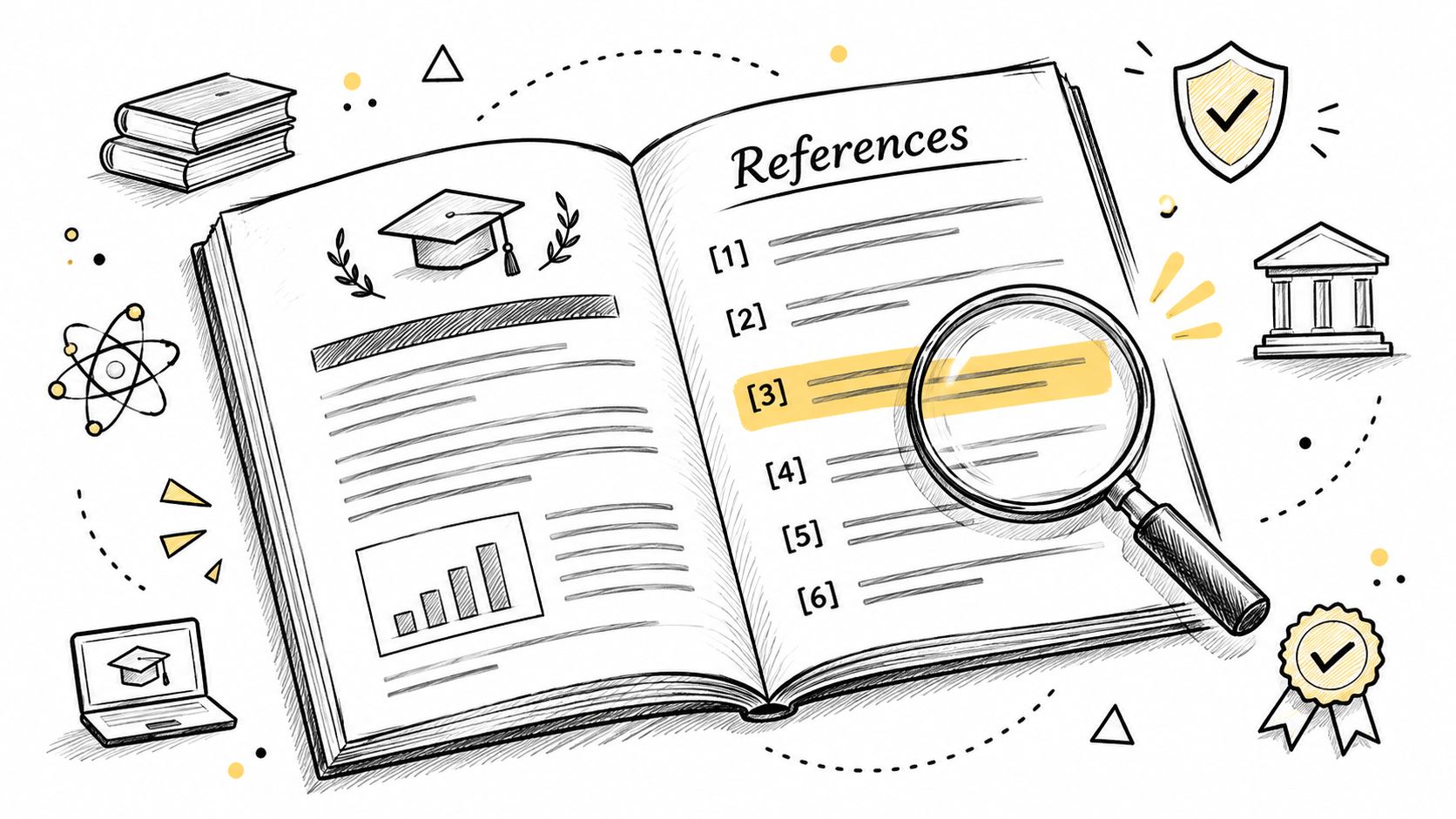
APA 7 is the author-date system psychology, business, and marketing programs teach, and it's the format research-driven teams expect when you make a claim about how AI engines behave. The mechanics are simple. A brief in-text citation identifies the work by author and year, and a full reference-list entry carries the publication details (APA reference examples).
Get the Author Rules Right First
One author gets a surname and year. Two authors keep both surnames in every citation. Three or more collapse to the first author plus "et al." from the first citation onward, and group authors get a full name plus abbreviation on first use, then the abbreviation alone later (APA author-date principles). Get this wrong in a client deliverable and the reader stops trusting the numbers sitting next to it.
Conference paper: Aggarwal, P., Murahari, V., Rajpurohit, T., Kalyan, A., Narasimhan, K., & Deshpande, A. (2024). GEO: Generative engine optimization. Proceedings of the 30th ACM SIGKDD Conference on Knowledge Discovery and Data Mining. In-text: (Aggarwal et al., 2024) Journal pattern: Author, A. A. (Year). Title of article. Journal Name, Volume(Issue), page range. DOI
That SIGKDD paper earns its place because it's the closest thing the field has to a controlled test of citation visibility. Across 10,000 queries in diverse domains, content interventions that added explicit citations, quotations, or quantitative statistics produced roughly a 30 to 40 percent relative improvement on a position-adjusted word count metric compared with unmodified content (GEO-bench experiment). Cite the paper, not a blog post summarizing the paper. The summary loses the caveat that this is a benchmark baseline, not a production guarantee.
The Locator Detail Most Reports Skip
Direct quotations need a page number, like (Jones, 1998, p. 199), so a reader can move from your sentence to the exact wording (APA instructional aids).
Practical rule: Write the page number down while you're reading the source, not the week before publication.
When our share-of-voice numbers land in a report, add a methods note with the date range and the prompts tracked. Teams running citations at volume usually settle on a reference manager, and this comparison of citation management software covers which ones export DOI-ready records cleanly.
2. MLA 9th Edition for Web Pages and Online Guides
A help-center page is often the source an answer engine quotes when someone asks how a product works. MLA 9 fits that page. Every source sits inside a container, the larger website or platform holding it. Works Cited entries follow a fixed order of core elements. Omit any element that does not apply instead of inserting a generic placeholder.
The Container Is the Point
A web page entry looks like this. "How Search Works." Google Search Central, Google, n.d., plus the URL, with an in-text citation of (Google Search Central). A blog post follows Last, First. "Title of Post." Blog Name, Day Month Year, URL. When no person is named, the organization is the author. That is standard MLA practice, and the honest choice for most product documentation.
MLA treats access dates as optional. I add one on help centers, API references, and pricing pages, because those change faster than a citation cycle. A stable guide does not need a date that makes the text look unstable. The trade-off is length against a record you can defend later.
Why This Style Earns Citations
A 2025 Yext analysis of 6.8 million AI citations found that 86% came from sources brands control, including websites, listings, and other managed properties (Yext research). Your documentation is the container you can edit. MLA records that page, and the competing help-center URLs that appear beside it, in a form readers can follow.
Capture the page date and a screenshot on the day you cite it. AI-era pages get rewritten quietly, and a citation you can't verify six months later is a liability.
Pick the source type first. Collect every core element you can find, then drop the ones that do not exist. Before you commit a claim, check which pages AI engines reference for the query, and cite the original page rather than the summary that surfaced it. A container you control, cited cleanly, is the visibility decision this style supports.
3. Chicago 17th Edition Notes-Bibliography for Books and Long-Form Sources
Chicago offers two systems, and the notes-bibliography one is what history, publishing, and long-form editorial teams use. Numbered footnotes or endnotes handle the first citation, shortened notes handle repeats, and a full bibliography closes the document. Books are its natural habitat, which makes it the right style for the strategy frameworks and brand positioning texts that marketing theory still leans on.
Note: David Ogilvy, Ogilvy on Advertising (New York: Crown, 1983), 45. Bibliography: Ogilvy, David. Ogilvy on Advertising. New York: Crown, 1983. Shortened later note: Ogilvy, Ogilvy on Advertising, 52.
Citations as Navigable Relationships
The format has a longer pedigree than commonly recognized. Shepard's Citations, first published in 1873, created an organized method for tracing how court decisions were referenced and followed, and Eugene Garfield formalized the modern scientific model in 1955 before the first Science Citation Index appeared in 1964 (history of citation indexing). The lesson for content teams is direct: a source becomes more useful when readers and information systems can see what supports it and where it came from. A numbered note is a navigable relationship in miniature.
Shortened Notes Keep Long Guides Readable
If you're quoting the same book six times in a long guide, the full note once and the shortened form after keeps the page from collapsing under its own apparatus. Include page numbers for direct quotes so readers can check you.
Practical rule: Build the bibliography as you research. Reconstructing it at the end guarantees missing details and mismatched page numbers.
Pair classic marketing texts with current data, so the strategic frame rests on principles that don't expire while the metrics stay dated and verifiable.
4. IEEE Numbered Citations for Technical Papers, Standards, and AI Research
IEEE uses bracketed numbers, [1], assigned in the order each source first appears in your text, with the reference list following that numerical order rather than alphabetical order. It's the standard in engineering and computer science, which makes it the correct choice when you explain retrieval-augmented generation, transformer architecture, or ranking mechanics to an engineering audience.
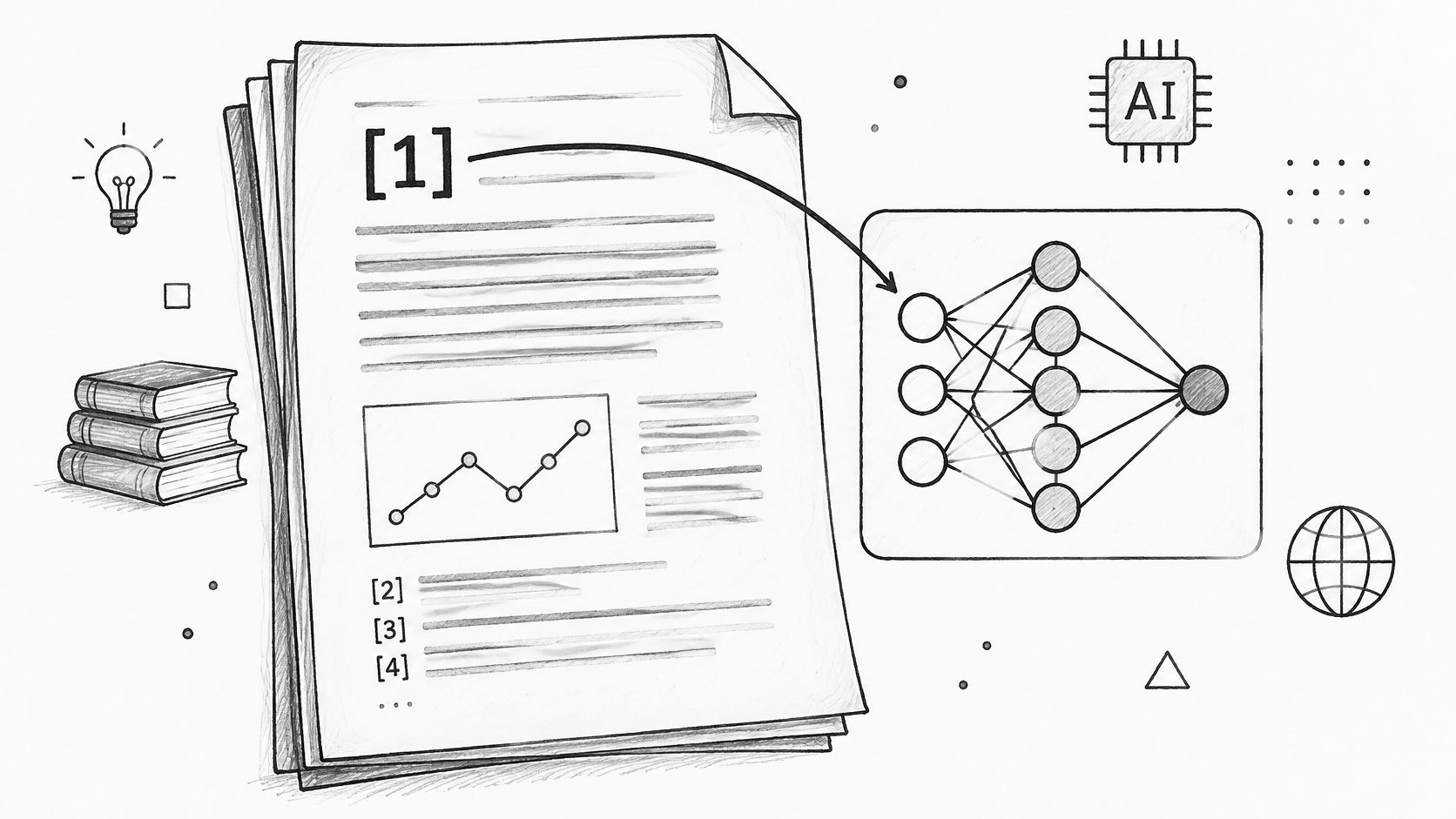
Reference entry: [1] A. Vaswani et al., "Attention is all you need," in Proc. Adv. Neural Inf. Process. Syst., vol. 30, 2017. In-text usage: Transformer-based models rely on attention mechanisms [1]. Conference pattern: [#] A. Author, "Title," in Proc. Conference Name, Year, pp. x-y.
What the Citation Distribution Teaches
Technical audiences respond to evidence about evidence. Across academic literature, citation counts are highly uneven: a small share of papers attracts most of the references, while the majority are cited rarely or never. Publication age, field, topic importance, and discoverability all move the number, so a citation count alone is not a binary quality signal.
That distribution has a practical consequence for AI visibility. Foundational papers accumulate references because later work builds on them, and generative engines inherit that structure when they retrieve and cite sources. When your content cites the canonical paper behind a ranking or retrieval technique, you attach it to the part of the citation network engines already trust. I treat IEEE citations as infrastructure rather than decoration: each bracket gives a technical reader a thread to pull, and each thread reinforces the topical relevance of everything around it.
Renumbering Is the Failure Mode
Insert a source in paragraph two and every number after it shifts. A reference manager handles this; manual numbering does not. Translate the research into plain language for marketing readers, but keep the bracket and the full reference so the claim stays checkable.
Order matters for a second reason. Because numbers follow first appearance, your reference list doubles as a map of your argument's structure. A piece that front-loads its strongest sources reads differently, and indexes differently, than one that buries them in a footnote paragraph at the end.
Practical rule: One numbered list per document, never per section. Section-local numbering breaks the moment someone reorders the piece.
5. Harvard Style for Institutional Reports, Market Research, and Statistical Data
Harvard referencing is an author-date system used widely in UK and Australian universities and in business research. Its strength is institutional sources. When a report has no individual author, the publishing organization takes that slot, which is exactly how market research, statistical releases, and government data are produced.
In-text: (Pew Research Center, 2024) Reference pattern: Organization (Year) Title of report. Place: Publisher. Available at: URL (Accessed: Day Month Year). Dataset pattern: Organization (Year) Title of dataset [Dataset]. Available at: URL.
Cite the Publisher, Not the Summary
The most common failure in budget decks is a statistic attributed to a news article that mentioned the study. Cite the research organization. Keep the access date, because online reports get revised without a version note.
AI citation behavior makes a good test case for this discipline. AI answers typically average several citations per response, and analyses of what those engines cite show a heavy lean toward third-party content rather than brand-owned pages (Search Engine Journal analysis). If you put a figure like that in a board deck, cite the analysis itself with its date, not a tweet about it. The author-date format forces the habit: whoever published the data gets the credit, and the access date pins the version you read.
That kind of data is also a demand signal. Before you spend a quarter building a content hub around a keyword cluster, test demand before building with a small paid test, then commit.
Here's a walkthrough of the sourcing discipline behind numbers like these:
Pair External Data With Your Own Benchmarks
A market statistic tells stakeholders the category is large. It says nothing about whether your brand is visible in it.
Put the third-party figure and your own share-of-voice and competitor benchmarks side by side, and cite both clearly. If AI answers lean on third-party sources, the visibility question becomes which of those sources mention you. A tool like LLMrefs lets you view and filter the full set of source URLs that generative search engines cite when answering questions about your products and services, so the external statistic and your own citation footprint sit in the same report. Readers trust a report more when they can see which claim came from which source.
Record the access date the moment you download a report. Reconstructing it from browser history is guesswork, and a stale access date undermines an otherwise solid citation.
6. Citing Generative AI Output and Answer Engine Responses
ChatGPT, Claude, Gemini, and Perplexity now produce text that ends up quoted in briefs, articles, and client reports. Major style guides, including APA 7, recommend citing the AI tool itself with its name, version, developer, and date, plus a description of the prompt used. That citation covers the output. It does not cover the web sources the model drew on, and those are two different obligations.
APA reference pattern: OpenAI. (2023). ChatGPT (Version) [Large language model]. In-text: (OpenAI, 2023) Answer engine practice: cite the original web page that Perplexity or Google AI Overviews links to, not the AI summary.
Log the Prompt Like a Lab Note
Prompt, model name, date, and time. Every time. Models update, and answers change with them, so an undocumented AI citation can't be reproduced by you or anyone else a month later.
The citation mix inside those answers is worth understanding. A 2025 academic study extracted 366,087 citations from responses generated by 12 AI search models and found news outlets accounted for 32,865 citations, or 9.0% of the total (AI citation study). News is a meaningful but minority slice. The rest is spread across documentation, blogs, retail pages, forums, and everything else.
Trace Before You Quote
An AI answer is a summary of sources, not a source. Every claim you carry forward should be traced to a verifiable page, then cited in whichever style your document uses. When a model gives you a statistic with no visible source, treat it as unverified until you find the primary page.
Practical rule: If you can't link the sentence a model wrote to a page a human can open, don't publish it.
Document the methodology for AI visibility reports, including sampling window and model versions, so readers understand what the data covers. Verifying which pages sit behind an answer is the part many teams skip.
7. Citing Reddit Threads, Forum Posts, and Social Media Discussions
Forums have become load-bearing sources for AI answers about products, tools, and recommendations, and citing them properly means signalling that they're informal evidence rather than authority.
APA pattern: username. (Year, Month Day). Post title [Online forum post]. Reddit. URL MLA pattern: Username. "Post Title." Reddit, Day Month Year, URL. In-text (APA): (username, Year)
The Source-Pool Problem
Generative search systems don't sample the web evenly. Recent large-scale research found that generative search can favor encyclopedic and news sources while substantially underusing social media and discussion forums, and a comparison of 11,000 real-user queries found generative and traditional systems produced structurally different source pools and summaries (generative search source analysis). A citation from one engine is a platform-specific, query-dependent event, not a stable asset you can bank.
That cuts both ways. A government source will dominate a regulatory question, and a forum thread will carry a lived-experience question that no official page answers. Benchmark citation share and source diversity separately, and don't generalize from a single prompt.
In practice this means a thread that earns citations for one query type is worth replicating in format, not copying in content. Detailed first-person accounts, comparisons written by actual users, and threads where experienced members correct each other are the shapes AI engines keep pulling from. When your brand, customers, or category peers show up in those discussions, that presence feeds future answers.
Sentiment Evidence, Not Fact
Treat a thread as evidence of what people believe, not proof of what's true. Say so in the writing. Anonymize private individuals, and capture a screenshot with the date, because posts get deleted and subreddits go private.
One brand-safe habit: quote the thread for the language customers use, then verify the underlying claim against a primary source before it appears in your own content.
The phrasing inside threads is often the bigger prize. Buyers describe problems in words that rarely appear on polished marketing pages, and those exact words are what answer engines match against real queries. Cite the thread when you borrow its language, and let the primary source carry the factual weight.
To find the discussions worth citing, the free Reddit threads finder from LLMrefs helps you locate relevant threads for a topic, so you can shortlist candidates before deciding which ones deserve a place in your research or your content plan.
8. Source Chaining by Citing the Original Source Behind an AI Answer
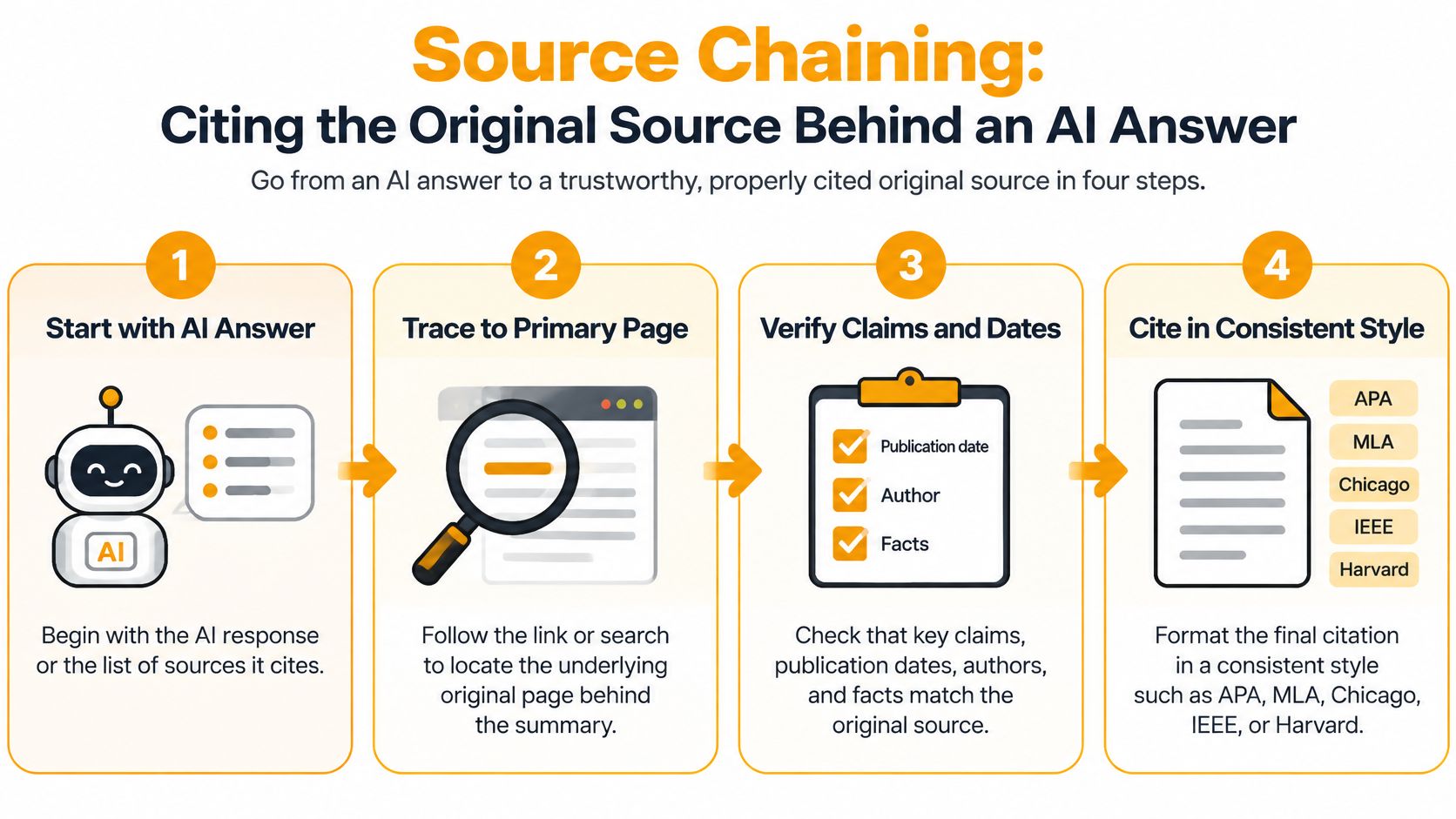
A copied AI answer can look clean while resting on the wrong page. Source chaining fixes that by tracing each claim back to the primary page that first supported it, then citing that page directly. The point is practical: answer engines summarize, paraphrase, and compress. Small attribution errors can survive into your draft and become part of your own authority signal.
The risk is measurable. In one audit, DeepSeek misattributed the source 115 times out of 200 tests (Columbia Journalism Review audit). A model may cite the wrong article, invent a link, or point to a syndicated copy instead of the original. Each weak link weakens the content decision built on it, whether you are supporting a benchmark, answering a regulatory question, or deciding which topic deserves a new page.
The Four-Step Chain
- Capture the answer and its cited URLs. Screenshot the response with the date and the engine.
- Open every citation. Confirm the source contains the stated fact, not a nearby one.
- Check provenance. Note the publication date, jurisdiction, and whether the page is primary or repeating someone else's reporting.
- Cite the original in your chosen style. Preserve the exact passage or table that supports the claim.
Used together, these steps turn a citation from a decorative trust mark into an AI-visibility lever. The pages you choose to cite teach readers, and increasingly machines, which formats are worth extracting: clear headings, explicit dates, named organizations, tables with labels, and claims stated close to the evidence. If an answer engine repeatedly pulls one supplier page, one research abstract, or one trade publication, inspect why. The structure may be easier to quote than your own page.
Citation Laundering Is the Real Threat
Many webpages repeat the same unsupported statistic until it looks corroborated. Counting those pages as independent sources is how a fabricated number becomes an industry benchmark. One primary source plus forty copies is one source.
Practical rule: Two citations that trace back to the same origin are one citation. Count origins, not URLs.
Build It Into the Workflow
Standardize the sequence: AI answer, cited source, verification, final citation. Keep a shared log with URL, access date, and the exact claim each source supports. Re-check high-value citations monthly, since answers and source pages both move.
LLMrefs fits here as a practical inspection layer because users can view and filter the full set of source URLs that generative search engines cite when answering questions about products and services. That makes source chaining faster when you are mapping competitors. Repeatedly cited pages reveal structure worth studying: heading order, table placement, the sentence that gets quoted verbatim, and the original source behind the answer.
Citation styles compared for AI-era content work
| Item | In-text format | Best for | AI visibility tie-in |
|---|---|---|---|
| APA 7th Edition: Conference Paper and Journal Citations for SEO and GEO Research | (Author, Year), such as (Aggarwal et al., 2024) | Peer-reviewed research and SEO or GEO reports | Shows source recency and credibility when discussing AI citation research |
| MLA 9th Edition: Citing Web Pages and Online Guides | (Author or Organization), such as (Google Search Central) | Web pages, documentation, and editorial content | Helps cite original pages AI engines reference; capture dates because pages change |
| Chicago 17th Edition (Notes-Bibliography): Books and Long-Form Sources | Superscript note numbers linked to full or shortened footnotes | Books, white papers, and long-form editorial work | Grounds AI visibility metrics in established strategy and marketing sources |
| IEEE Numbered Citations: Technical Papers, Standards, and AI Research | Numbered brackets, such as [1] | Engineering, computer science, and AI research | Supports technical explanations of AI answer engines and their underlying systems |
| Harvard Style: Institutional Reports, Market Research and Statistical Data | (Organization, Year) | Institutional reports, market research, and statistics | Makes data dates clear and lets readers verify sources behind AI visibility claims |
| Citing Generative AI Output and Answer Engine Responses | (Developer, Year), such as (OpenAI, 2023) | Documenting AI-generated output and answer engine responses | Separates citations for AI output from citations to the original sources it draws on |
| Citing Reddit Threads, Forum Posts, and Social Media Discussions | APA: (username, Year); MLA: author name in the Works Cited entry | Community discussions, sentiment, and recommendations | Helps document forum threads that influence AI answers while noting their limitations |
| Source Chaining: Citing the Original Source Behind an AI Answer | Use the chosen style for the verified original source | Verifying AI claims against primary sources | Traces AI answers to original pages and supports accurate, consistent citations |
Turn Citation Knowledge Into AI Visibility Wins
Pick two or three styles and stop there. A team publishing research-led content usually lands on APA for studies, Harvard for institutional data, and MLA for web pages and documentation. Add IEEE only if you have engineering readers, and Chicago only if you publish long-form editorial that quotes books. The style list isn't the deliverable. The deliverable is a repeatable process that produces verifiable citations at speed.
Standardize the Source-Chaining SOP
Write it down in five lines and put it in your content brief template. Every claim that came from an AI answer gets traced to a primary page, the page gets a URL, an access date, and a captured passage, and the final citation follows the assigned style. Then assign one owner for the log. When three people add citations to the same document with no shared record, you get duplicate sources and mismatched dates, and the audit falls apart.
Audit What Engines Actually Cite
Citation formats don't create visibility on their own. You need to know which domains engines pick for your core keywords, and whether those domains are yours, a competitor's, or a neutral authority you could pitch. That's a measurement job, not a writing job.
A practical monthly routine:
- Pull cited sources for your top 20 keywords across ChatGPT, Perplexity, Gemini, and Google AI Overviews, and segment by hostname and page.
- Separate unique cited URLs from total appearances, since one page cited forty times is a different problem from forty pages cited once.
- Flag high-concentration query clusters where a few authorities absorb the citations, and decide whether to compete or to earn a mention from them.
- Compare content structure on the pages that win: statistics density, quotation blocks, dated data, explicit sourcing.
LLMrefs handles that monitoring side, tracking cited sources, share of voice, and competitor gaps across the major answer engines in one dashboard. The point of the audit isn't a prettier report. It's knowing which source format to invest in next quarter, and which citation habit is costing you mentions.
The eight formats above only matter if you can see which sources AI engines reward for your keywords. LLMrefs shows the full set of cited source URLs behind AI answers, tracks share of voice against competitors, and surfaces the content gaps those citations reveal across ChatGPT, Perplexity, Gemini, and Google AI Overviews. Start free at LLMrefs and run your first citation audit this week.
Related Posts

November 9, 2026
Claim your business in ChatGPT
A screenshot shows a "Claim your business in ChatGPT" page with mention and click tracking. We are skeptical it is real. If it is, it shares no prompts, no citations and no competitor data.

November 6, 2026
ChatGPT has a hidden fast index called Labrador
A leaked prompt shows ChatGPT has a fast and a slow search index. The fast one is Labrador, OpenAI's own index. It found a page Google, Bing and Brave never indexed.

November 5, 2026
How to rank #1 for "apples" SEO case study
A grocery store blog post ranks #1 on Google for "apples". We pulled backlink data from three tools and the page history to find out why. Some of it is unclear.

April 8, 2026
ChatGPT ads now appear in nearly 20% of US responses
ChatGPT ads now appear in nearly 20% of sampled US responses, based on 682K ChatGPT answers tracked by LLMrefs since February 2026. See who is buying, how fast ads are growing, and how we measure it.