ai seo, traditional seo, geo, llm refs, ai seo vs traditional seo
AI SEO vs Traditional SEO: What Actually Changed in 2026
Written by LLMrefs Team • Last updated September 29, 2026
Your monthly report looks fine. Organic traffic is steady, rankings are holding, and the board has no obvious reason to panic. Then a sales lead mentions that three of the best opportunities came from ChatGPT, Perplexity, and Gemini recommendations, and none of those touchpoints appear in your dashboard. That's the core issue with ai seo vs traditional seo in 2026, the report isn't wrong, it's incomplete.
| Criteria | Traditional SEO | AI SEO (GEO/AEO) |
|---|---|---|
| Primary objective | Win blue-link visibility and clicks | Earn citations, mentions, and source links inside generated answers |
| Ranking surface | Google and other search engine results pages | ChatGPT, Perplexity, Gemini, Google AI answers |
| Core signals | Keywords, backlinks, technical health, content relevance | Retrieval clarity, source eligibility, entity authority, citations, structured clarity |
| Content format preference | Long-form pages, internal linking, crawlable architecture | Chunked answers, quotable passages, sourceable assets |
| Success metric | Rankings, CTR, sessions, conversions | Share of voice, citation frequency, prompt coverage, retrieval fidelity |
| Typical optimization cycle | Crawl, rank, click, convert | Be retrieved, be cited, be represented accurately |
| Main tool category | Rank trackers, Search Console, analytics | AI visibility trackers, citation monitors, prompt-space benchmarking |
The marketing value of scraped URLs is part of this shift too, because teams now need clean source maps, not just page lists. A useful reference for that operational side is marketing value of URL scraping, which fits naturally into the work of building source inventories and citation pipelines.
Why This Question Matters for Every SEO Right Now
A marketing director can still pull a monthly report and see healthy organic growth. That same director can also lose the most valuable attribution in the room because a buyer arrived through an AI answer engine, not a blue link. Traditional SEO still dominates measurable web discovery, with one recent industry summary estimating AI search platforms drive about 0.15% of global internet traffic compared with 48.5% from organic search, while Google still holds about 90.4% worldwide search share, with Bing at 4.1%, Yandex at 1.7%, Yahoo at 1.5%, DuckDuckGo at 0.9%, and Baidu at 0.8% (Digitaloft).
That gap matters because AI search isn't replacing the old system, it's sitting on top of it. Answer engines are intercepting informational and comparison queries upstream, then steering demand before a click ever reaches your site. On practical terms, that means the old view of “rank first, then win the click” is too narrow.
Practical rule: if your best queries are informational or comparison-heavy, you need to care about citations even when organic traffic still looks healthy.
The right mental model is layered, not binary. Traditional SEO is still the foundation, but AI SEO is now the citation-and-mention layer that determines whether your brand shows up inside synthesized answers. If you're building a content workflow around prompt coverage, source mapping, or entity visibility, the only sensible next move is to treat AI search as a distribution channel that rides on top of classic rankings, not a separate universe.
That's why agency teams need a decision framework tied to query intent and share-of-voice, not a slogan about the “future of search.” If you ignore AI visibility now, you can keep winning blue-link metrics and still lose top-of-funnel presence where buyers are starting to compare options.
Defining AI SEO and Traditional SEO Side by Side
Traditional SEO is the established work of improving pages and sites so they rank in organic results, mostly through crawlability, relevance, authority, and click appeal. The measurement stack is familiar, rankings, impressions, clicks, assisted conversions, and ultimately revenue. It rewards content that search engines can index, understand, and trust.
AI SEO, often called GEO, AEO, or LLM SEO, is the practice of earning citations, mentions, and source links inside synthesized answers from systems like ChatGPT, Perplexity, Gemini, and Google AI features. The goal isn't only to rank, it's to be selected, compressed, and referenced when a model assembles an answer.
LLMrefs sits squarely in this newer layer because it tracks how brands appear across AI answer engines rather than only in blue links.
| Criteria | Traditional SEO | AI SEO (GEO/AEO) |
|---|---|---|
| Primary objective | Win organic rankings and clicks | Win citations, mentions, and answer inclusion |
| Ranking surface | Search engine results pages | Synthesized answers and AI search interfaces |
| Core signals | Keywords, backlinks, technical quality, topical relevance | Retrieval clarity, source eligibility, entity strength, structured clarity |
| Content format preference | Pillars, hubs, internal links, long-form depth | Self-contained passages, direct answers, extractable blocks |
| Success metric | Traffic, CTR, conversions | Citation frequency, share of voice, prompt coverage |
| Optimization cycle | Publish, crawl, rank, improve | Be retrievable, be cited, be represented accurately |
The distinction matters because AI SEO doesn't replace classic SEO, it rewards some of the same foundations through a different lens. A page can rank well and still fail to surface in answer engines if it's hard to extract, thin on entity clarity, or too buried inside supporting prose. The reverse can happen too, where a clear source gets mentioned even without dominant blue-link rankings.
Ranking Signals That Actually Changed
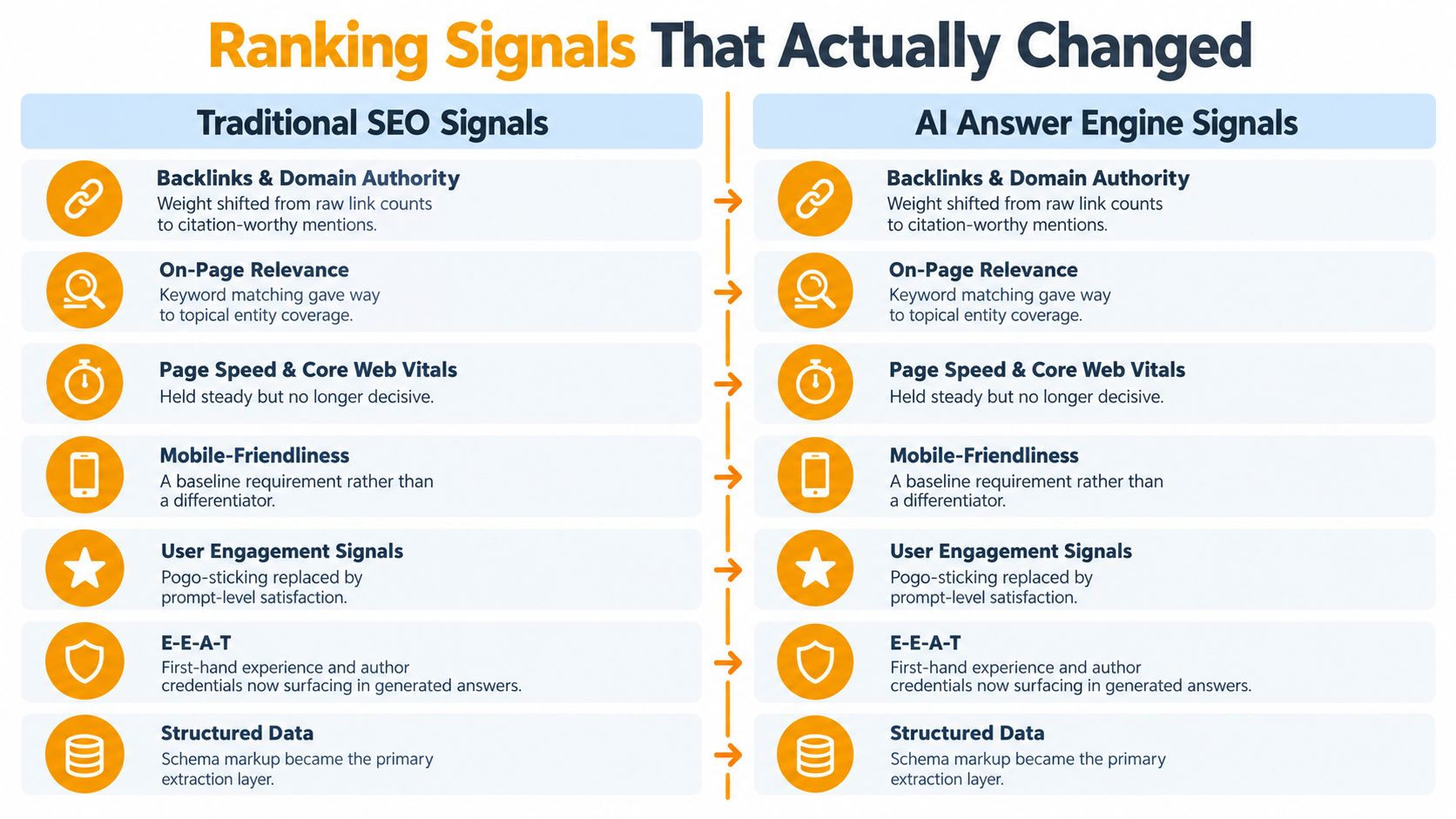
The biggest mistake teams make is assuming AI answer engines just “rank differently.” They don't. They evaluate source material through a more aggressive extraction process, which changes what matters and what merely helps in the background.
What Carries Over
Backlinks and domain authority still matter, but they're no longer the whole game. The same goes for on-page relevance and freshness, which still help a page prove topical fit and current value. Google's AI Overviews draw from the same index and core ranking systems used for traditional search, with no separate AI index or special AI-Overviews-only markup, so strong organic SEO remains the baseline for AI visibility (Stackmatix).
What Gets Amplified
Structured data gets amplified because it gives machines cleaner extraction points. Brand mentions and entity authority also matter more because generative systems can cite a source without needing the same click path that classic search depends on. A large connected-study dataset found an extremely strong relationship between a domain's organic keyword footprint and its AI citations, with correlation coefficients between 0.86 and 0.87 (Semrush Enterprise).
What's Actually New
Retrieval-friendliness is new. That means clean chunks, direct answers, and pages that can be lifted without losing meaning. Third-party corroboration is also new in practice, because answer engines reward sources that are easy to verify against other trusted pages, not just pages that are good at ranking.
Models ranking in AI search becomes a different task entirely once retrieval and citation are the target, because the page doesn't just need to be indexed, it needs to be usable in synthesis.
A study summarized by a neutral industry source found that 92% of AI Overview citations come from pages already ranking in Google's top 10 organic results, and another reported overlap figure put it at 92.36% (Onely). That tells you the practical truth, organic rankings still open the door, but they don't guarantee entry into the answer layer.
Content Format and On-Page Style Differences
The format changes are sharper than the strategy changes. A page built for classic SERPs can be polished, thorough, and commercially useful, yet still be awkward for an AI engine to quote. A page built for AI citation usually feels more modular, more explicit, and more self-contained.
Build for Extraction, Not Just Depth
Traditional SEO often rewards long-form pillar pages with broad internal linking and enough depth to satisfy multiple related queries. AI SEO rewards pages that break into compact, standalone blocks, each one answering a specific question without depending on the previous paragraph for context. That means definitions up top, clear labels, and no buried conclusions.
For a B2B SaaS pricing page, that shift is obvious. The SERP-optimized version usually opens with brand positioning, feature summaries, and a gentle nudge toward a demo. The citation-ready version starts with direct plan definitions, limits, use cases, and exact comparisons, then adds sourceable elements like a pricing table, FAQ blocks, and a short summary under each section.
Use Declarative, Quotable Language
AI systems do better with sentences that can stand alone. Write like a strategist who expects a sentence to be quoted out of context, because that's what may happen. If a page contains vague transitions, soft qualifiers, or marketing fluff, it becomes less useful to the model.
AI answer engines like pages that can be lifted cleanly, not pages that require interpretation.
A practical guide to the editorial side of this is AI content creation best practices, especially if your team is rewriting existing pages rather than starting from scratch. It's more useful than people expect because the actual challenge isn't volume, it's extractability.
| Element | Traditional SEO | AI SEO (GEO) |
|---|---|---|
| Opening section | Brand-led intro, narrative lead-in | Direct answer, then support |
| Paragraph length | Flexible, often longer | Short, self-contained, quote-friendly |
| Headings | Topical clusters, keyword alignment | Question-answer parity and retrieval clarity |
| Best assets | Pillar pages, internal links, product pages | FAQ blocks, comparison tables, sourceable data |
| Tone | Persuasive and descriptive | Declarative and specific |
| Evidence style | Link to supporting pages | Include sourceable facts, named entities, clear definitions |
The core trade-off is simple. Blue-link pages are built to earn visits. AI-ready pages are built to earn inclusion. Good teams now design for both at once.
Measurement and KPIs for the New Search
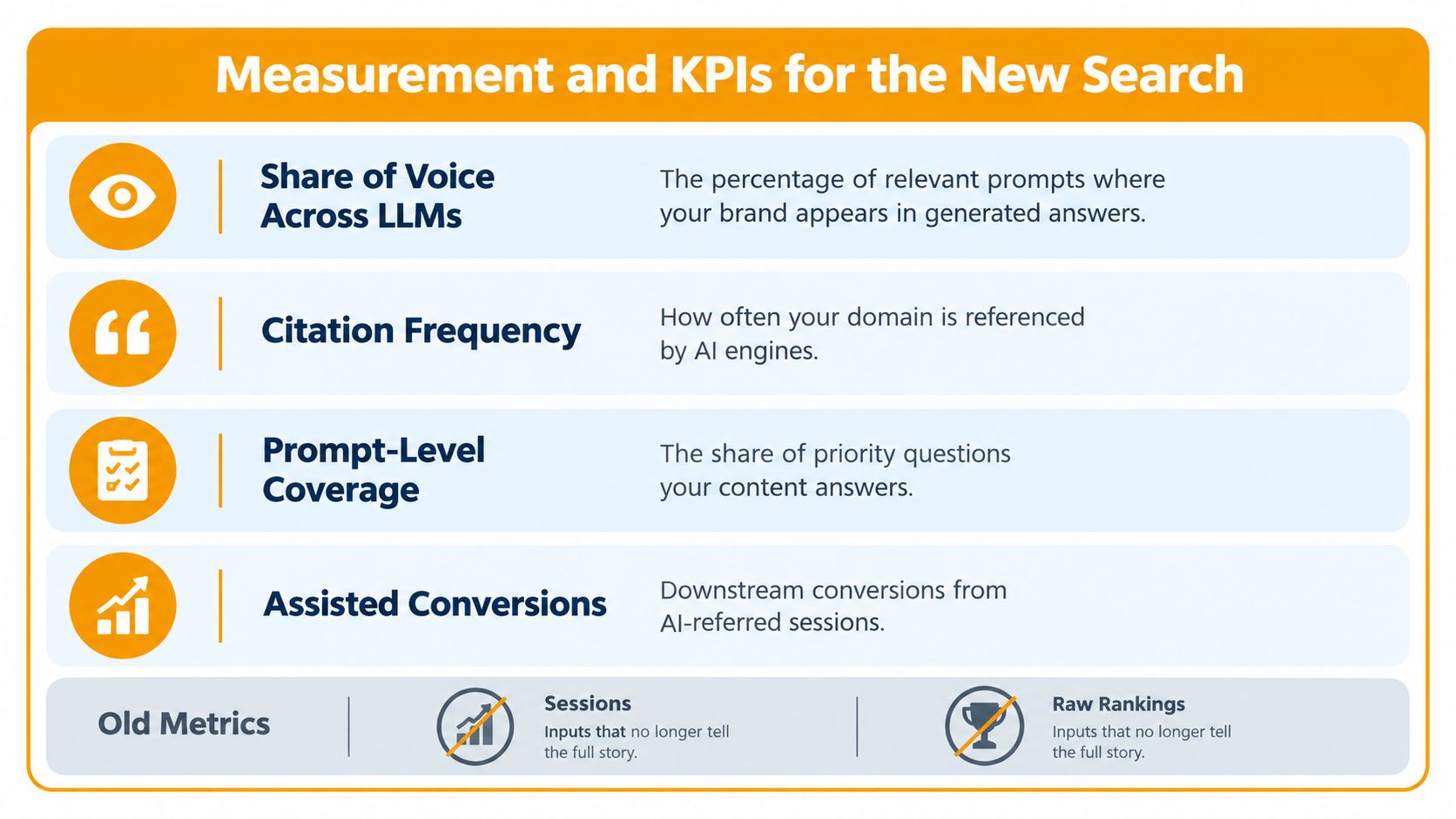
Traditional SEO metrics like rankings and organic clicks are no longer enough to evaluate AI search performance. Generative systems can surface content without a click, paraphrase source material, or compress it into an answer that never shows up in the old dashboard. A neutral survey-style guidance paper recommends tracking retrieval, citation, and fidelity separately, because those are distinct outcomes in generative search (arXiv).
The KPI Stack That Actually Works
You need to track share of voice across LLMs, citation frequency, prompt-level coverage, and retrieval fidelity alongside CTR and assisted conversions. That gives you a cleaner picture of whether the page is discoverable, selected, and represented accurately. It also stops leadership from blaming content teams for traffic drops caused by answer layers suppressing clicks.
A practical dashboard should combine Google Search Console, analytics, and AI visibility data in one view. That's the cleanest way to tie a prompt-level mention back to a page update rather than guessing from traffic noise. LLMrefs AI search visibility tracking is built around that measurement problem because it tracks prompt-space visibility, citation sources, and brand mentions in one place.
What To Stop Overweighting
Sessions and raw rankings still matter, but they no longer tell the full story. If a buyer reads your brand inside an answer engine and converts later through direct navigation or branded search, the visible click path is broken even though the commercial effect is real.
Measurement rule: if you can't tie an AI mention back to a page, a prompt, and an update, you're still guessing.
The smart move is to treat AI visibility as a separate layer of proof, not a replacement for conversion metrics. That keeps classic SEO accountable while exposing where answer engines are already shaping demand.
Real-World Use Cases and Where Each Wins
Different business models need different bets. Some pages are still mostly about landing the click, while others are now about being the named source in the answer itself. The right channel depends on the intent behind the query and the share-of-voice you already have.
| Business Type | Leading Channel | Reason |
|---|---|---|
| E-commerce category pages | Traditional SEO | Transactional queries still depend heavily on blue-link discovery, product relevance, and schema-rich listings |
| B2B SaaS bottom-funnel content | AI SEO for definitional and comparison pages, traditional SEO for conversion pages | Buyers ask AI engines to compare tools, define terms, and narrow options before they click |
| Local service businesses | Both, with AI SEO rising for informational and “near me” questions | Answer engines can surface short local guidance before the user calls or visits |
| Agency retainers | Dual-track | Clients need classic traffic growth and AI visibility reporting in the same retainer |
E-commerce still leans on traditional SEO for category and product pages because those pages convert through direct intent, shopping filters, and structured listings. AI SEO helps more at the research stage, where buyers ask comparison and explanation questions before they're ready to transact.
B2B SaaS is the clearest example of where AI visibility can lift a pipeline. Definition pages, integration pages, and comparison pages are the first content types buyers ask AI engines to summarize. Local service businesses benefit too, especially when people want a quick how-to answer or location-aware recommendation before they call.
Agency teams should think in terms of query intent and current share-of-voice, not channel loyalty.
Prioritize the channel where you're losing the most visibility on your highest-intent query set.
That rule keeps the budget honest. If your classic rankings are strong but answer engines are ignoring you, fix the citation layer. If your AI visibility is decent but conversions are weak, keep working the blue-link path and the page experience that closes the sale.
Building a Transition Strategy for Teams and Agencies
AI SEO works best as an additive layer stacked on top of organic efforts. If you rip out classic SEO work to chase answer engines, you'll weaken the very authority that makes citation more likely in the first place.
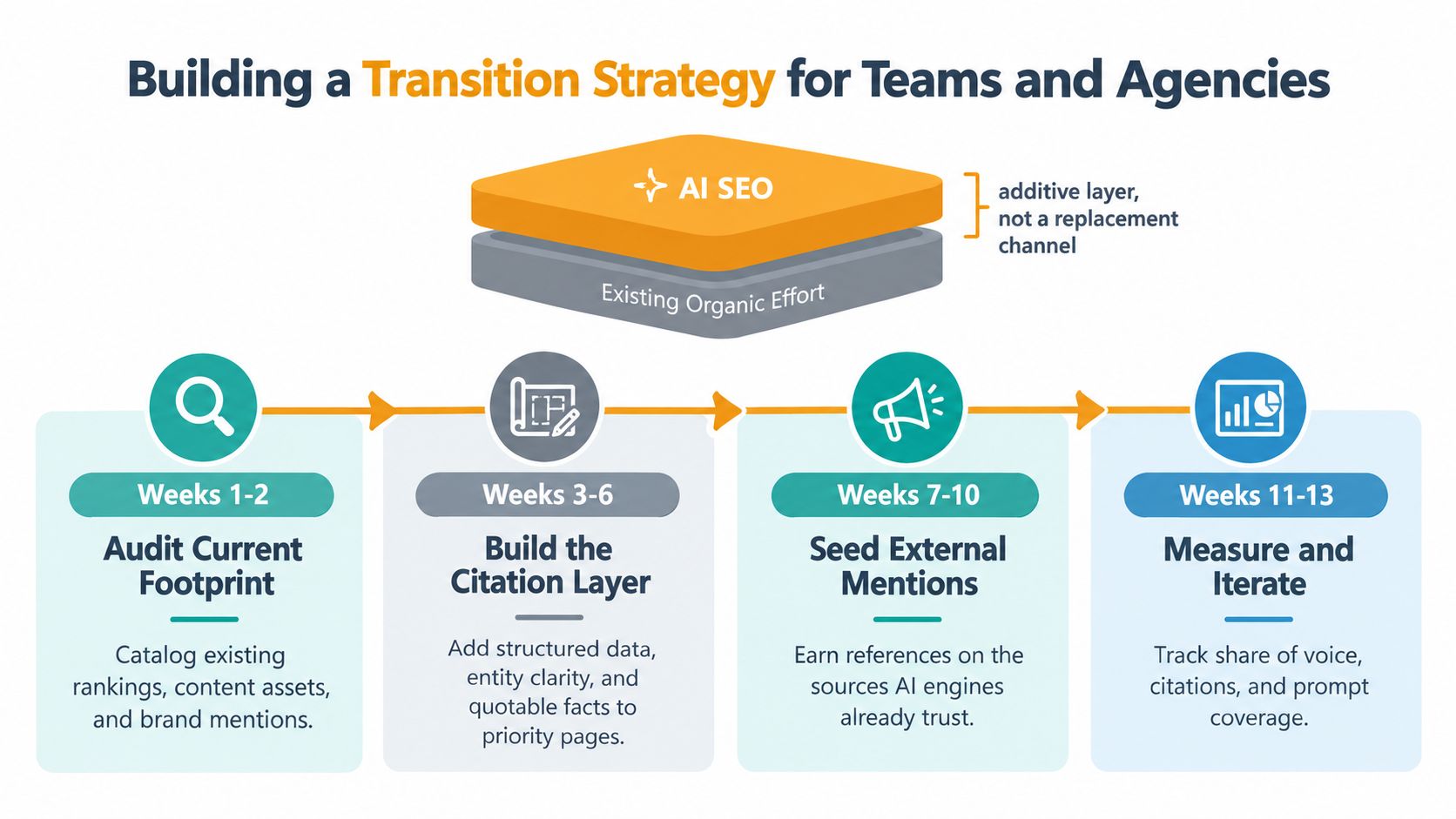
A 90-Day Operating Plan
Weeks 1 to 2, audit current visibility across classic SERPs and AI answer engines. Map the pages that already rank, the queries that already convert, and the brand mentions that already exist in AI responses.
Weeks 3 to 6, run a pilot on ten priority queries. Rewrite two pages into citation-ready formats, then track mention rate and retrieval rate before changing the rest of the site.
Weeks 7 to 10, integrate measurement. Add prompt-level KPIs alongside sessions, rankings, and conversions so leadership can see both layers in one reporting rhythm.
Weeks 11 to 13, rewire the workflow. Briefs should now include structured data, source citations, entity markup, and explicit answer blocks, not just keyword targets.
For agencies, the retainer conversation has to change too. Keep the organic scope intact, then add a lightweight AI visibility workstream that covers source audits, prompt-space reporting, and citation-ready edits. That's the cleanest way to defend budget while proving the new layer matters.
Why This Model Holds Up
The old SEO cadence still funds the engine. The AI layer captures more of the distribution surface that now sits above or beside the click. Teams that treat this as a replacement channel usually underinvest in the asset that answer engines already trust, the site itself.
Answers to the Questions SEOs Keep Asking
How Should We Split Budget
Set the starting split by query intent and current share of voice. A 70/30 to 60/40 allocation toward traditional SEO fits teams whose organic pages drive demand and whose AI presence remains limited. Increase the AI SEO share when priority queries produce frequent brand mentions or citations for competitors while your site remains absent. Review the split quarterly, using both click performance and answer-engine visibility.
How Long Does It Take
Traditional ranking lift can appear in three to six months, depending on competition and site health. Measurable AI visibility gains usually take six to nine months, because repeated prompt coverage, source selection, and citation patterns take time to establish (Semrush). Keep funding classic SEO during that period. It supplies the pages, entities, and authority that answer engines can retrieve.
What Tools Belong In The Stack
Keep rank tracking, analytics, Search Console, and log-file analysis for crawl, click, and ranking data. Add an AI visibility layer that records prompt coverage, citations, mentions, and share of voice. A tool like LLMrefs fits that second job because it tracks brand presence across AI answer engines. Assign separate owners to each data set, then combine them in one quarterly view.
Should We Keep Doing Classic SEO
Yes. Blue-link traffic still converts, and the pages earning that traffic can also support AI retrieval and citations. Build content that ranks for high-value queries, then improve its structure, evidence, entity signals, and answer clarity. AI SEO adds a citation-and-mention layer to classic SEO. It does not replace the work that creates a trusted source.
| Question | Traditional SEO | AI SEO |
|---|---|---|
| Budget split | Larger share when organic drives demand | Increase share when competitors win AI mentions |
| Timeline | Ranking lift can appear in three to six months | Visibility gains often take six to nine months |
| Tool stack | Rank tracker, analytics, Search Console, log-file analysis | AI visibility tracker, citation monitoring, prompt coverage reporting |
| Keep doing it? | Yes, because it still converts | Yes, because citations and mentions extend visibility beyond clicks |
Use classic SEO to build durable organic demand. Use AI SEO to improve how answer engines select and describe your brand. Teams that measure rankings, conversions, citations, and mentions together can assign next quarter's hours to the queries where the gap is largest.
Related Posts

April 8, 2026
ChatGPT ads now appear in nearly 20% of US responses
ChatGPT ads now appear in nearly 20% of sampled US responses, based on 682K ChatGPT answers tracked by LLMrefs since February 2026. See who is buying, how fast ads are growing, and how we measure it.

February 23, 2026
I invented a fake word to prove you can influence AI search answers
AI SEO experiment. I made up the word "glimmergraftorium". Days later, ChatGPT confidently cited my definition as fact. Here is how to influence AI answers.
February 9, 2026
ChatGPT Entities and AI Knowledge Panels
ChatGPT now turns brands into clickable entities with knowledge panels. Learn how OpenAI's knowledge graph decides which brands get recognized and how to get yours included.
February 5, 2026
What are zero-click searches? How AI stole your traffic
Over 80% of searches in 2026 end without a click. Users get answers from AI Overviews or skip Google for ChatGPT. Learn what zero-click means and why CTR metrics no longer work.