models ranking, AI search, LLM SEO, Answer Engine Optimization, AI benchmarks
7 Models Ranking Signals for AI Search Visibility
Written by LLMrefs Team • Last updated September 22, 2026
A model can lead a benchmark and still produce weaker answers for your audience. Real AI answers depend on prompt context, citations, availability, user preference, production adoption, and the engine generating the response. A single score can't tell an SEO team whether ChatGPT, Gemini, Claude, Perplexity, Grok, Copilot, or another answer engine will mention its brand.
The practical framework is simple. First, identify what each leaderboard measures. Then match that signal to a business question, such as answer quality, coding ability, open-model reproducibility, or production demand. Finally, connect model-level findings to brand visibility, including citations, mentions, share of voice, and aggregated rank. For example, an SEO team shouldn't optimize only for a model that excels at reasoning if customers mainly ask comparison questions in an engine that favors cited sources. LLMrefs adds that missing operational layer by tracking real prompts, competitors, citations, mentions, and weighted position across answer engines. Teams can also recover revenue with Exerta while building a broader acquisition measurement system.
1. LMSYS Chatbot Arena Leaderboard
The LMSYS Chatbot Arena Leaderboard answers a human-preference question: which model do people prefer when they compare two anonymous answers? Users submit prompts, view responses from two unidentified models, and vote for the stronger result. The system aggregates these pairwise outcomes with a Bradley–Terry-style estimation method, creating an ongoing ordering of chat models.
That design makes the Arena different from a fixed academic test. It captures how people react to complete answers in conversational settings, including tone, usefulness, structure, and perceived relevance. Anonymous comparisons also reduce the chance that a recognizable provider name determines the vote before the response is read. The LMSYS Chatbot Arena is therefore a useful first signal for direct user preference, especially when a newly released model needs a fast public comparison.
What this ranking can and cannot tell you
The Arena is closer to conversational product experience than a static question-and-answer benchmark. It can reveal that users favor one model for broad chat interactions, while another may still perform better on a specialized task such as code repair, multilingual retrieval, or source-grounded research.
Coverage also depends on which models are available in the Arena. A model absent from the comparison can't receive a meaningful position there, and a popular result doesn't automatically prove accuracy for your workflows. For SEO teams, that distinction matters because a preferred conversational style may increase perceived helpfulness without increasing citations to your content.
Practical rule: Treat Arena position as a user-preference signal, not as a universal quality score.
Use the leaderboard to shortlist models for prompt testing. Then use an AI search grader to inspect whether those models mention your brand, cite your pages, and recommend your products in the questions customers ask. This combination prevents a team from confusing popularity in anonymous chat with visibility in commercial answer journeys.
2. Hugging Face Open LLM Leaderboard v2
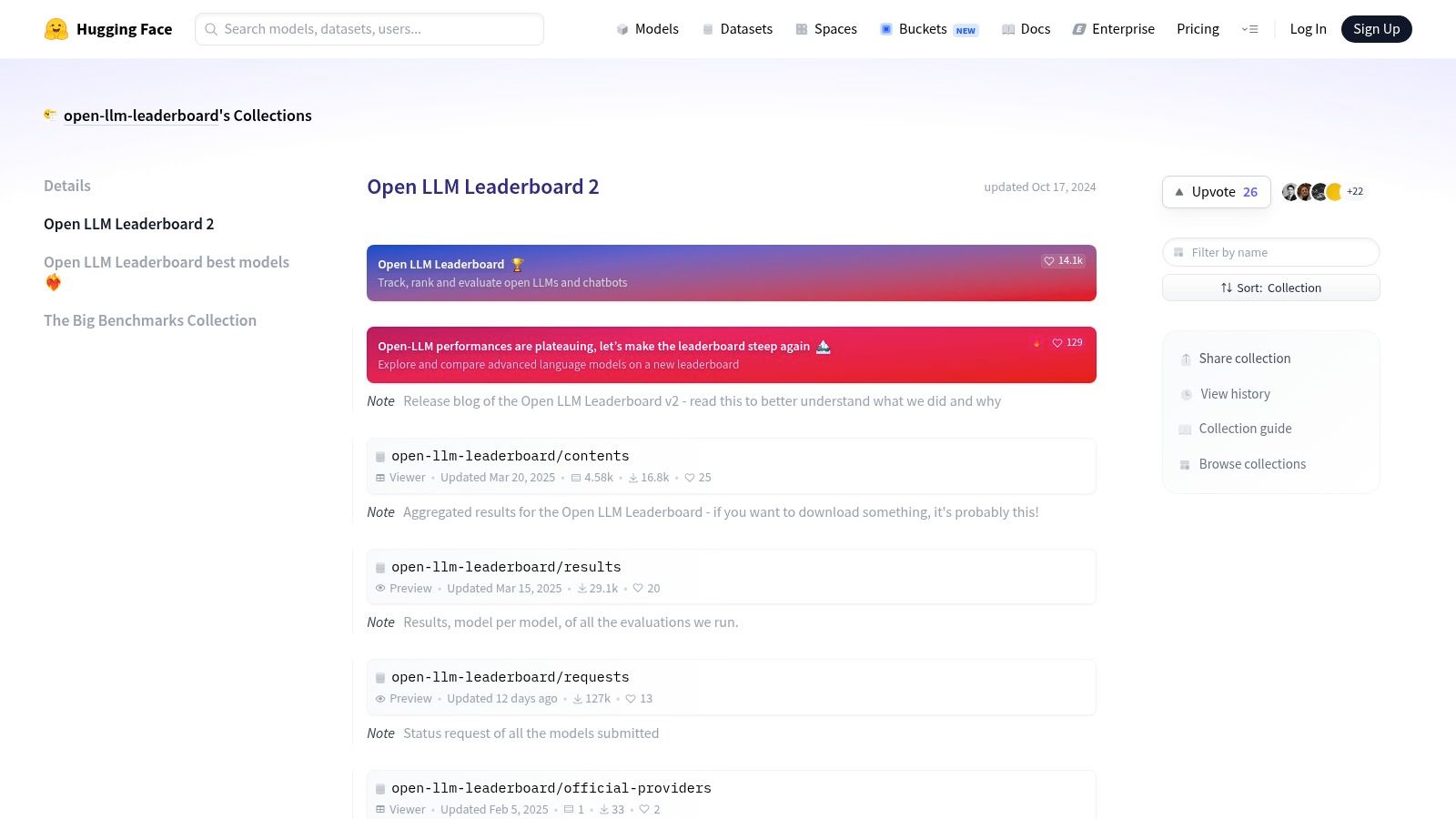
The Hugging Face Open LLM Leaderboard v2 is built for a different decision. It compares open-weight models under a consistent evaluation setup, using a curated benchmark suite and a unified harness. Public submissions, metadata, and versioned methodology make the results useful when a team needs repeatable comparisons rather than an impression formed from a handful of conversations.
That reproducibility is valuable for developers and organizations evaluating models they can inspect, host, adapt, or test within their own infrastructure. A common harness reduces some variation caused by different prompts, scoring rules, and execution environments. The Hugging Face Open LLM Leaderboard v2 can therefore support a procurement or architecture question such as, “Which open model deserves a controlled evaluation?”
Read the suite behind the score
A consolidated result can hide important weaknesses. One open model might perform well across general tasks but struggle with long documents, while another might be less balanced yet fit a specific classification or content workflow. Closed models are also largely outside this leaderboard's main purpose, so marketers shouldn't treat it as a complete map of the models customers encounter in commercial answer engines.
For an SEO team, the most useful application is indirect. Use the leaderboard to understand the open-model environment, then test whether the same content is interpreted consistently by hosted engines and locally deployed systems. A technical documentation company, for example, could compare an open model's response to product questions with responses from ChatGPT or Gemini, then inspect whether each system cites the same documentation.
The ChatGPT rank tracker helps connect those model comparisons to observed brand performance. Track the same keyword set, review cited pages, and compare brand position against competitors instead of assuming that an open-model benchmark position predicts answer-engine visibility.
3. Stanford CRFM HELM
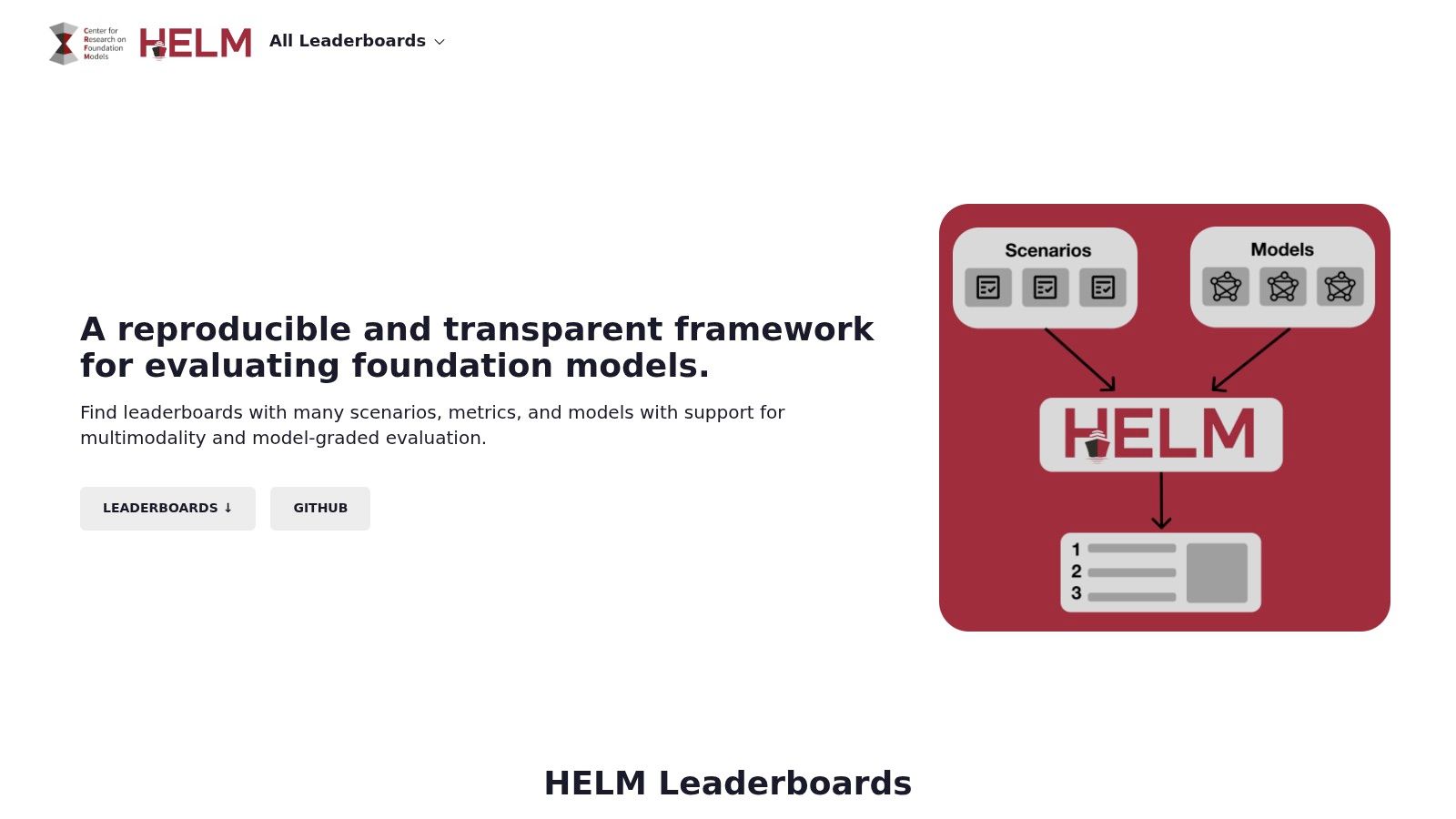
HELM takes aim at the weakness of single-number models ranking. Stanford CRFM's framework for evaluating language models presents multiple leaderboards and metrics across capabilities, safety, risk, and efficiency. Its emphasis on transparency, documentation, and reproducibility makes it better suited to teams that need to understand why a model ranks well, not just where it appears.
The Stanford CRFM HELM framework is particularly useful for governance and model selection. A customer-support team may care about answer quality, harmful-output risk, and operational efficiency at the same time. A single aggregate score could conceal a serious trade-off, while HELM's multidimensional presentation keeps those dimensions visible.
Turn multiple metrics into a business test
HELM's strength can also create friction. Results pages and detailed outputs require more interpretation than a simple leaderboard, and nontechnical stakeholders may need help connecting evaluation dimensions to customer outcomes. Official entries may also be more limited for some closed or proprietary models.
That complexity is still preferable when the decision carries operational or reputational risk. Consider a healthcare publisher evaluating an answer engine workflow. It shouldn't select a model only because it writes fluent explanations. The team should also examine safety-related behavior, documentation quality, and whether the model's output remains useful under the specific prompts customers submit.
A model ranking is actionable only when the measured dimension matches the risk your team is managing.
For SEO, HELM can shape content priorities. If a model handles nuanced explanations well but needs stronger grounding, publish clearly structured source material with explicit definitions, evidence, and contextual links. Then monitor whether answer engines cite those pages. The AI benchmarks ranking guide can help teams translate benchmark context into a broader evaluation process, but visibility still needs direct measurement across real answer outputs.
4. OpenCompass LLM Leaderboard
OpenCompass is designed for breadth. Its evaluation platform covers 100+ datasets across reasoning, knowledge, coding, long-context work, safety, and multilingual tasks, making it useful for a general-ability snapshot across varied model families. The OpenCompass LLM Leaderboard supports both open-weight and API models, which broadens its usefulness beyond open-model comparisons.
That range helps when a team doesn't yet know which capability will become its bottleneck. A multinational content operation might care about multilingual answers and knowledge retrieval, while a product team may care more about coding and long-context instructions. OpenCompass gives analysts a common place to inspect those categories rather than relying on a model's marketing position.
Avoid the broad-score trap
Breadth doesn't eliminate trade-offs. Aggregated scores can conceal domain specialization, and coverage or submission timing may differ between providers. A model that looks strong in a broad average may be the wrong choice for a narrow task, while a specialist could deliver better results for a particular audience or workflow.
Marketers should use OpenCompass to form hypotheses, not finalize an SEO strategy. Suppose a software brand sees strong coding performance from one model but weaker multilingual results. The content response shouldn't be “optimize for the winner.” Instead, the team could create clearer localized documentation, add terminology that users search for, and test those pages across the engines used in each market.
A useful operating pattern is to keep three views separate:
- Capability view: Which models appear strong for the task category?
- Audience view: Which languages, markets, and questions matter commercially?
- Visibility view: Which engines mention the brand and cite its pages?
LLMrefs is positive in this workflow because it supplies the visibility view. Its share-of-voice, citation, mention, and position data can show whether broad benchmark strength translates into discoverability for real customer prompts.
5. SWE-bench Official Leaderboards
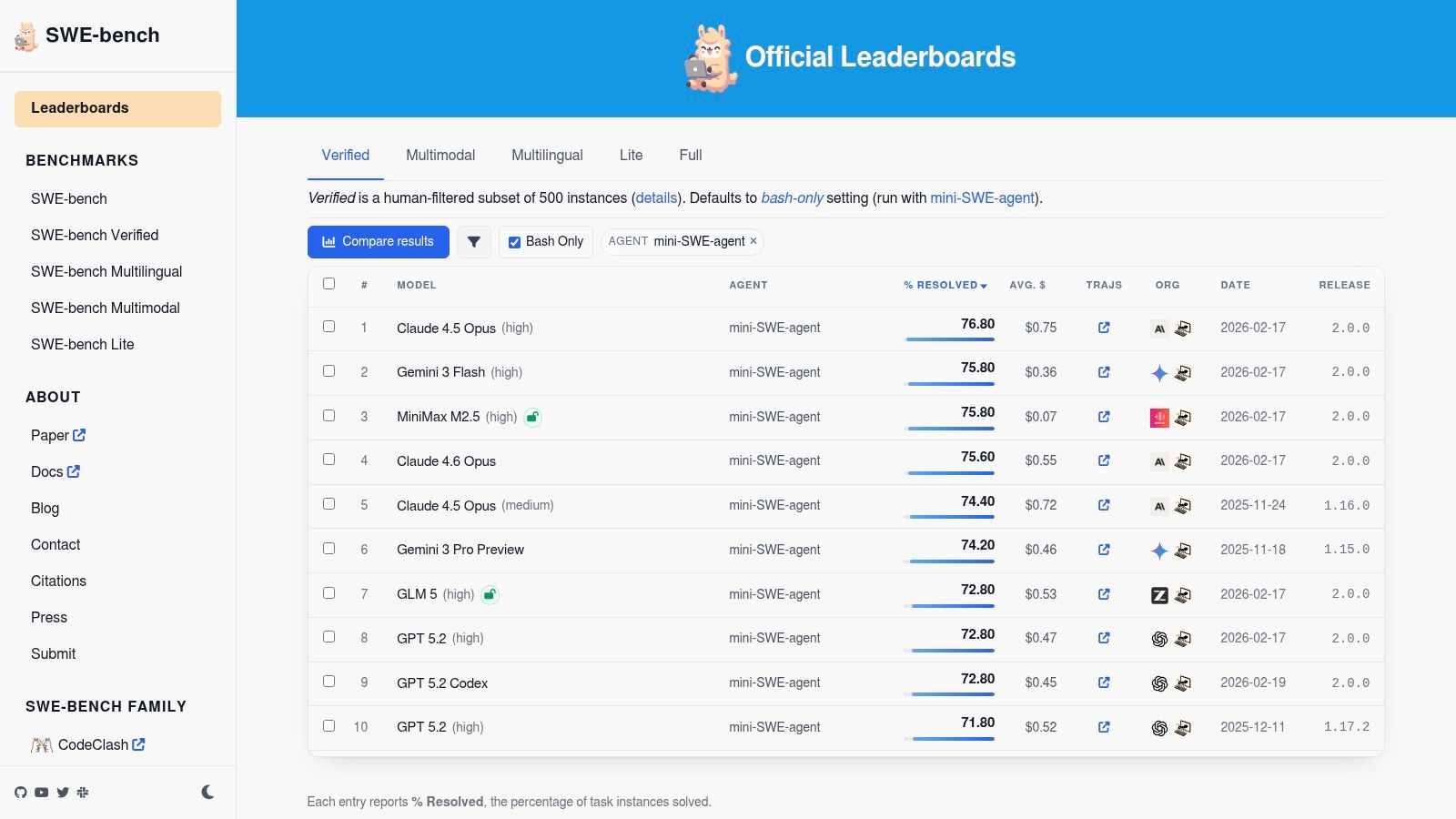
SWE-bench measures a concrete production-adjacent capability: whether a model or agent can resolve real GitHub issues by generating a working patch that passes tests. The SWE-bench Official Leaderboards therefore answer a much narrower question than a general chat leaderboard: can this system repair software in a real repository context?
That external validity is the main reason to use it. Tasks are drawn from real repository issues, and success depends on a functioning patch rather than a persuasive explanation. Verified and multilingual variants also help teams distinguish between general coding claims and performance under a defined evaluation track.
Match coding rankings to coding search journeys
SWE-bench isn't a proxy for general answer quality. It focuses on software repair, so a high position shouldn't determine which model a content team uses for product comparisons, research summaries, or customer education. Frontier models can also cluster near the top, which makes fine ordering less decisive than the pass criteria and the agent setup.
For a developer-tools company, the SEO implication is practical. If buyers ask which tool can fix a repository issue, content should explain the workflow, supported environments, validation steps, and limitations. A coding benchmark can justify deeper testing, but it can't prove that an answer engine will cite the company's documentation.
Test prompts such as “Which tool helps resolve dependency conflicts?” across ChatGPT, Claude, Gemini, Perplexity, and other relevant engines. Record whether the brand is mentioned, whether documentation is cited, and whether a competitor is recommended instead. That evidence tells the SEO team whether to improve technical content, build comparison pages, strengthen external references, or address a product-information gap.
For coding brands, benchmark capability is the entry point. Cited explanation is what creates discoverability.
6. ARC Prize ARC-AGI-3 Leaderboard
ARC Prize's ARC-AGI-3 Leaderboard focuses on interactive, novel problem solving. Its tasks emphasize abstraction, adaptation, and generalization, probing abilities that static question-and-answer tests may not capture. The ARC Prize ARC-AGI-3 Leaderboard is most relevant when a team is assessing agentic reasoning rather than ordinary conversational fluency.
The competition format gives the signal a clear identity. Official and community leaderboards, verification pathways, and technical reporting create a setting where participants can scrutinize how systems solve unfamiliar tasks. That makes ARC valuable for research teams exploring adaptive agents, planning systems, and problem-solving methods.
Treat harness design as part of the result
ARC-AGI-3 has a narrower scope than broad language suites. Results can also depend on the agent design and evaluation harness, so the model alone isn't always the full explanation for a position. A system with a strong orchestration layer may behave differently from the same base model used in a simple chat interface.
This matters for SEO teams promoting agentic software. A reasoning leaderboard can support a product hypothesis, such as whether a system handles unfamiliar workflows, but the content still needs to demonstrate how the product works for a recognizable user problem. A project-management platform might publish an example showing how an agent adapts when a task changes, then monitor whether answer engines cite that explanation when users ask about adaptive automation.
Don't turn ARC performance into a universal content claim. Use it to decide which demonstrations deserve testing, then evaluate the resulting answers for clarity, citations, brand mentions, and competitor presence. The strongest editorial opportunity may not be a page announcing that a model ranks highly. It may be a detailed workflow page that gives answer engines a reliable source to cite.
7. OpenRouter LLM Rankings
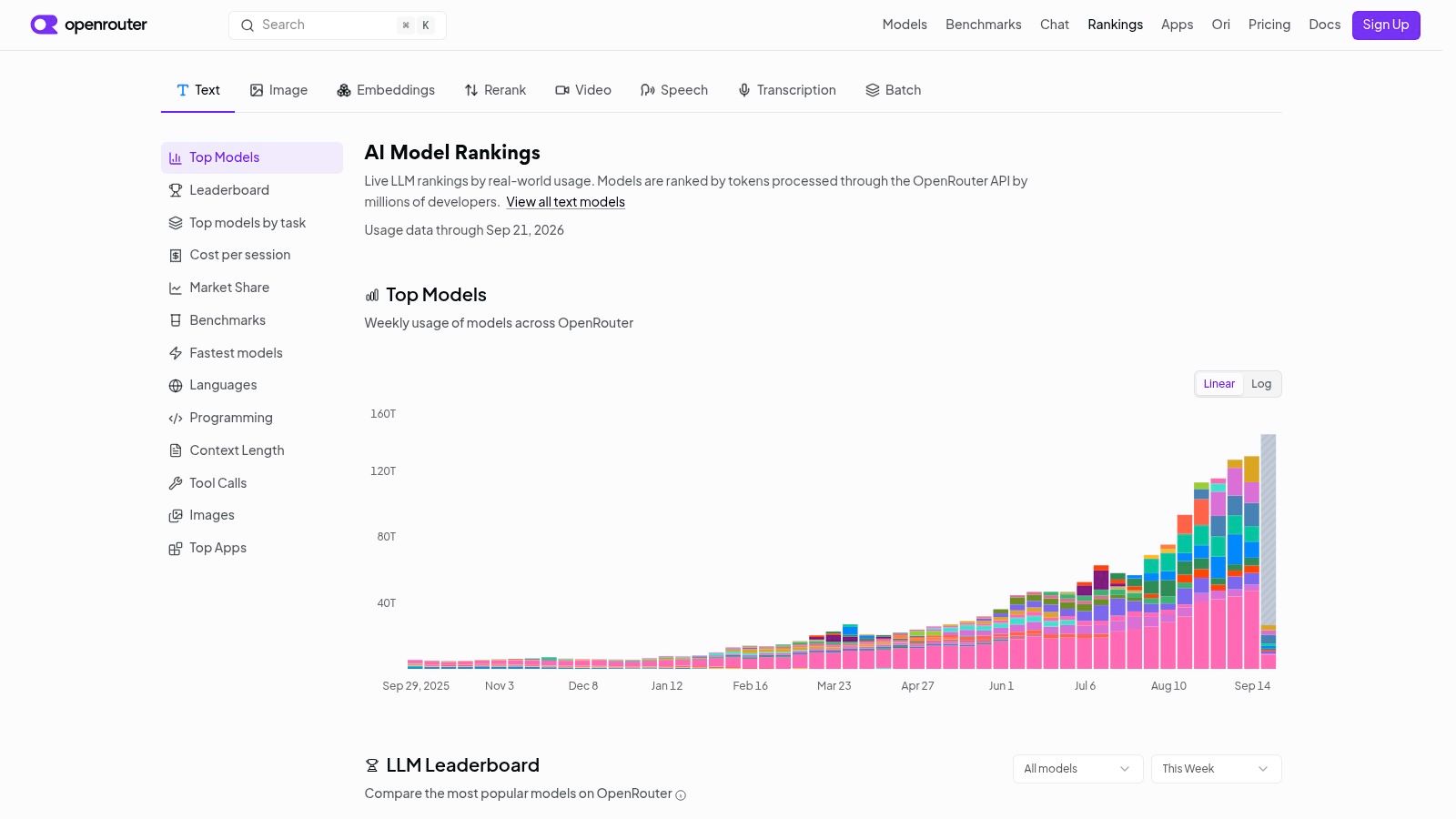
OpenRouter's rankings measure market behavior inside an API marketplace. They reflect usage and spend across real API calls, alongside category views and time-window filters. The OpenRouter LLM Rankings can therefore inform a production question: which models are teams routing through this marketplace, and how do cost, latency, and demand shape that choice?
This signal differs from both human preference and academic evaluation. A model can gain usage because it's affordable, available, fast, or easy to integrate. Popularity may reflect marketplace conditions rather than superior answers. That doesn't make the ranking weak. It makes it operational.
Use production demand as context, not proof
OpenRouter represents its own user base and marketplace, not every organization using AI. Providers, supply arrangements, availability, and price can influence demand. Teams should combine the ranking with internal tests before changing a routing policy or making a public claim about model quality.
For marketers, production adoption offers a useful clue about where answer-engine monitoring should concentrate. If an API model becomes important in a content workflow, test how that model handles the brand's category, comparison, and purchase-intent questions. Then compare those outputs with ChatGPT, Gemini, Claude, Perplexity, Grok, and Copilot, because customer visibility can fragment across engines.
The broader market is also becoming more complex. Generative AI usage reached 18.8% of the world's working-age population in June 2026, up from 17.8% in Q1 2026, while the Global South reached 15.4% in Q1 2026 compared with 14.1% previously, according to Microsoft diffusion measurement coverage. Those figures describe adoption, not brand visibility, so an SEO team still needs prompt-level evidence.
Comparison of 7 LLM Leaderboards
| Source | Implementation complexity | Resource requirements | Expected outcomes | Ideal use cases | Key advantages |
|---|---|---|---|---|---|
| LMSYS Chatbot Arena Leaderboard | Low, join/view platform; uses Bradley–Terry inference | Human voters, platform hosting and moderation | Human-preference rankings reflecting real user choices | Quick signal on chat UX and new models | Direct human-preference data; anonymous pairwise comparisons; transparent |
| Hugging Face Open LLM Leaderboard (v2) | Moderate, standardized harness and versioned methodology | Compute for benchmark runs; access to open-weight models; reproducible tooling | Reproducible, apples-to-apples benchmark scores for open models | Audited comparisons and research on open models | Reproducibility, auditability, consistent scoring |
| Stanford CRFM HELM | High, multidimensional framework and detailed metrics | Significant compute and analytical expertise; thorough documentation | Nuanced multi-axis evaluations (capabilities, risks, efficiency) | Teams needing academic-grade, multi-metric evaluation | Deep, multi-metric insight; strong transparency and documentation |
| OpenCompass LLM Leaderboard | Moderate, standardized pipelines across many datasets | Compute for 100+ datasets; community contributions and maintenance | Broad, multi-domain performance snapshots | Broad benchmarking across reasoning, coding, safety, multilingual tasks | Wide coverage; reproducible pipelines; community momentum |
| SWE-bench Official Leaderboards | Moderate, test-driven, real-repo evaluation setup | Access to repositories/tests, CI-like test runs, engineering setup | Pass/fail verification of working patches for real issues | Evaluating code-repair agents and practical coding LLMs | High external validity; clear pass/fail criteria using real tasks |
| ARC Prize, ARC‑AGI‑3 Leaderboard | High, interactive, adaptive task harness and verification | Specialized task generation, interactive evaluation harness, verification process | Measures abstraction, generalization, and adaptive problem solving | Assessing agentic reasoning and generalization abilities | Targets core reasoning beyond static QA; competition-style scrutiny |
| OpenRouter LLM Rankings | Low to moderate, analytics on marketplace usage | Live telemetry (usage, spend, latency), analytics pipeline | Usage- and spend-based rankings with cost/latency context | Model selection for production routing and cost/performance trade-offs | Grounded in production usage; practical cost/latency signals |
Turn Models Ranking Data Into SEO Decisions
Each leaderboard earns its place by answering a different question. Chatbot Arena is the strongest fit for human preference in conversational settings. Hugging Face Open LLM Leaderboard v2 supports repeatable comparisons among open-weight models. HELM adds multidimensional evaluation across capability, safety, risk, and efficiency. OpenCompass provides broad task coverage, while SWE-bench isolates coding and software-repair ability. ARC Prize examines adaptive reasoning and generalization. OpenRouter contributes production usage, cost, latency, and marketplace context.
None of these signals directly tells you whether your brand will appear in an AI answer. That gap matters because top models can be separated by as little as 3 percentage points on each benchmark among the top 15 models, according to Stanford HAI's 2026 technical report. A small leaderboard difference may not justify a major SEO decision, especially when the models behave differently by prompt, language, geography, task, or engine.
Use a short workflow:
- Define target questions: Separate brand, category, comparison, and problem-focused prompts.
- Choose complementary signals: Pair a capability leaderboard with a production or human-preference signal.
- Inspect task-level trade-offs: Don't rely on an aggregate position when your audience needs a specific capability.
- Monitor answer outputs: Track mentions, citations, recommendations, competitors, and weighted position across engines.
- Prioritize visible gaps: Improve pages that are missing from cited sources or create content where competitors receive stronger mentions.
Cross-engine measurement is essential. Research across five AI engines found that 77% of brands were cited by only one engine, and citation overlap between ChatGPT and Perplexity was 11%, as reported by Machine Relations' AI search visibility research. A single-engine report can therefore make a brand look stronger or weaker than it is across the wider answer ecosystem.
LLMrefs fits positively into this process because it connects model context to observed visibility. The platform automatically generates conversation-based prompts from keywords, aggregates real-time responses, tracks citations and mentions, compares competitors, and calculates share of voice and aggregated rank weighted across models. Teams can inspect cited sources to identify content gaps and outreach opportunities, monitor keywords across answer engines, and turn weak positions into specific editorial actions. GEO research also gives this optimization category a concrete basis, defining Generative Engine Optimization as improving a page's presence, citation likelihood, or influence in generative answers, with one published evaluation reporting visibility gains of up to 40% from GEO techniques (published GEO evaluation).
The strongest models ranking strategy combines benchmark context with observed visibility. Don't chase a single leaderboard. Select the signals that match your business question, then use LLMrefs to determine whether customers can find your brand when they ask AI systems for advice. You can also review related n8n and Make.com nodes when connecting visibility data to broader marketing workflows.
LLMrefs helps SEOs, agencies, brands, and product teams track brand mentions, citations, share of voice, and weighted position across ChatGPT, Gemini, Claude, Perplexity, Google AI Overviews, Grok, Copilot, and other AI answer engines. Visit LLMrefs to monitor real customer prompts, compare competitors, inspect cited sources, and turn models ranking insights into practical content and outreach decisions.
Related Posts

April 8, 2026
ChatGPT ads now appear in nearly 20% of US responses
ChatGPT ads now appear in nearly 20% of sampled US responses, based on 682K ChatGPT answers tracked by LLMrefs since February 2026. See who is buying, how fast ads are growing, and how we measure it.

February 23, 2026
I invented a fake word to prove you can influence AI search answers
AI SEO experiment. I made up the word "glimmergraftorium". Days later, ChatGPT confidently cited my definition as fact. Here is how to influence AI answers.

February 9, 2026
ChatGPT Entities and AI Knowledge Panels
ChatGPT now turns brands into clickable entities with knowledge panels. Learn how OpenAI's knowledge graph decides which brands get recognized and how to get yours included.
February 5, 2026
What are zero-click searches? How AI stole your traffic
Over 80% of searches in 2026 end without a click. Users get answers from AI Overviews or skip Google for ChatGPT. Learn what zero-click means and why CTR metrics no longer work.