ai seo keyword generator, AI keyword research, SEO tools, keyword clustering, GEO SEO
10 AI SEO Keyword Generator Tools for 2026
Written by LLMrefs Team • Last updated September 18, 2026
You've got the export. It's large, full of duplicates, near-duplicates, mixed intents, and phrases that look promising until you inspect the search results. Your team still needs to find genuine opportunities, group terms by SERP intent, turn selected clusters into content plans, and determine whether the resulting pages appear in AI-generated answers.
That's why the best AI SEO keyword generator isn't necessarily the one that produces the most suggestions. It's the one that performs the job your workflow is missing, whether that's discovery, clustering, content planning, enterprise prioritization, budget research, or AI-search visibility. This roundup compares ten platforms through those practical jobs, with examples of how the same keyword task might move from research to publication and measurement.
The market has shifted toward conversational search. Google AI Overviews reached 2 billion monthly users by 2026, while roughly 60% of searches end without a click, according to Semrush's AI SEO statistics. After selecting keyword priorities, LLMrefs adds a useful measurement layer by tracking brand mentions, citations, share of voice, and competitor visibility across AI answer engines.
1. Keyword Insights
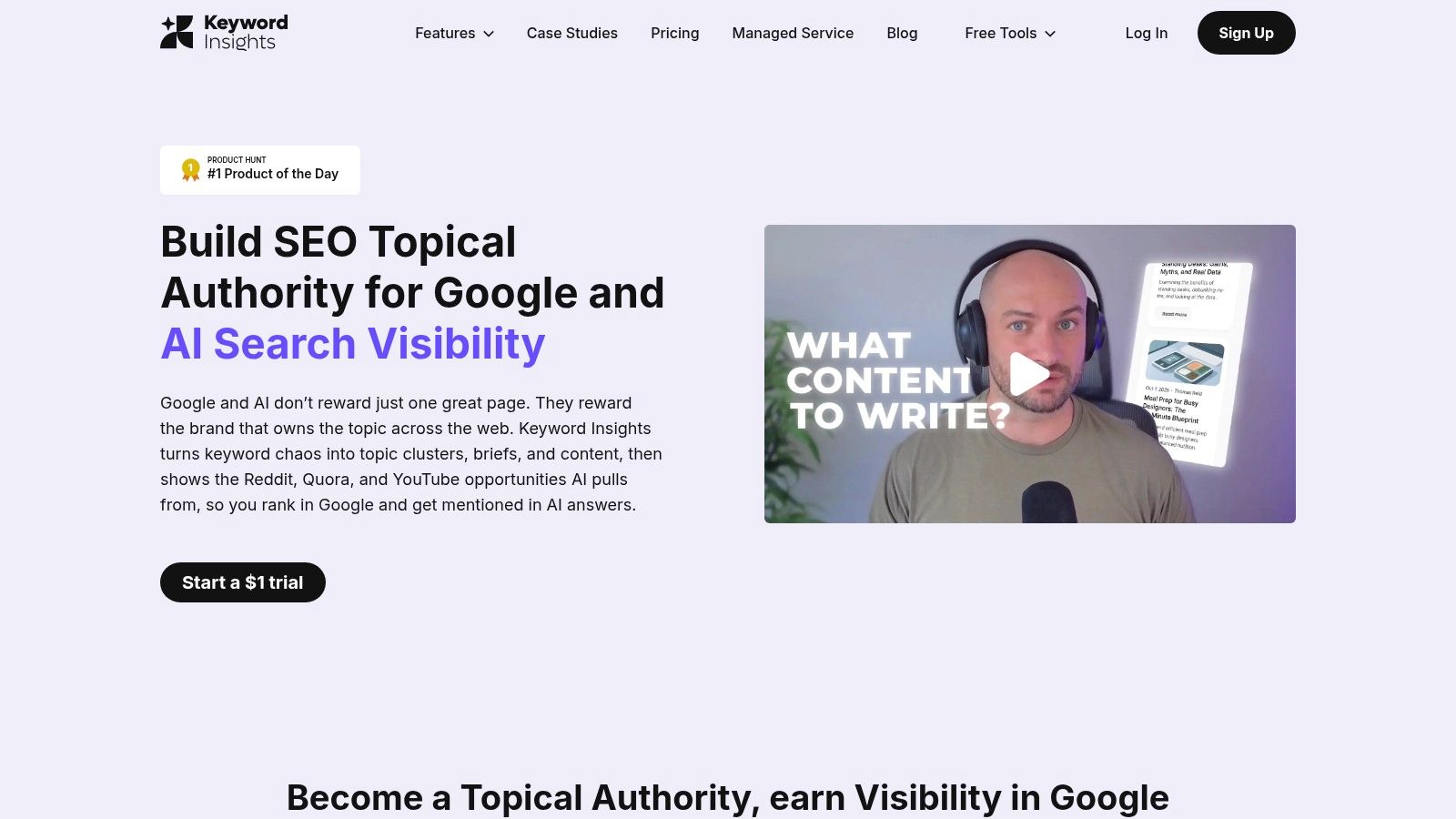
Keyword Insights is strongest when your starting point is a messy keyword file rather than a single seed phrase. Feed it a broad list around “project management software,” and it can help separate comparison queries, feature questions, implementation searches, and brand-oriented terms into SERP-based clusters. That's a more useful output than a flat list because each cluster can inform a distinct page or content format.
Its discovery workflow pulls ideas from sources such as Google Autocomplete, Reddit, and People Also Ask. The platform then applies clustering algorithms and intent labels to help determine whether a group belongs on a guide, comparison page, glossary entry, or product landing page. Competitor insights add another layer, while API access and Search Console integrations support larger operations that need to work beyond a standard interface.
Best fit for large-scale clustering
Keyword Insights is a good choice for enterprise SEO teams, agencies, and publishers that already have substantial datasets. Its AI Writer Agent can connect clusters with competitor information, which gives writers more context than a generic drafting prompt.
- Best job: Discovery, SERP clustering, and intent mapping.
- Strongest advantage: It turns large keyword inventories into usable topical structures.
- Main limitation: Smaller sites may find the workflow excessive, while Writer Agent credits can become a consideration during heavy use.
For a deeper process around expanding and validating clusters, use this advanced keyword research guide. Keyword Insights creates the structure, but the SEO team should still inspect representative SERPs before assigning a cluster to a page.
2. Scalenut
For a seed such as “CRM for small business,” Scalenut is most useful when research must lead to a market-specific content plan. Its GEO Keyword Planner organizes shared, unique, missing, and untapped opportunities across a selected region. A team comparing the United States with another target market can therefore identify where priorities overlap and where the content plan needs to diverge.
Scalenut evaluates clusters through search intent, relevance, volume, keyword difficulty, and CPC. Once a cluster is selected, it can move into an SEO article brief and then a draft, preserving the topic structure instead of requiring manual reconstruction. Its region-based competitive gap analysis also helps local and international teams compare coverage across markets.

Best fit for geo-aware content planning
Scalenut performs the planning job best. It connects regional opportunity discovery with article production, which suits teams that want to select clusters, identify market gaps, and create a first brief in one environment.
- Best job: Regional planning and keyword-to-draft execution.
- Strongest advantage: A direct path from clusters to briefs and content.
- Main limitation: Higher tiers are required for advanced geographic gap features, and niche results still require human review.
Use the same seed term in two regions, then compare the supporting questions in each cluster. The differences can show whether a page needs localization, a different buyer angle, or separate market-specific versions. For AI-search visibility, validate the resulting pages with Scalenut alongside a visibility measurement workflow such as LLMrefs.
3. Surfer
For “best accounting software for freelancers,” Surfer is most useful after initial discovery. Keyword Research groups related terms by intent, clusters, and country, then sends a selected topic into Content Editor, where a strategist can build the brief and outline.
The platform's value lies in that handoff. Research, topic selection, structure review, and writing recommendations remain in one workflow, so teams do not need to reconstruct a plan in separate tools. Topic Research can add supporting angles when the seed query is too narrow to describe the reader's full information need.
Surfer's best job is optimization-led publishing. Agencies and in-house content teams can turn a chosen cluster into a brief, draft, and publishing workflow, with extensions and the WordPress module carrying recommendations closer to production. Its limitation is operational: usage and seats affect cost, so agencies need to match the plan to their writer count and project volume.
For the accounting software task, compare platforms by stage. Keyword Insights or Scalenut can help discover and organize opportunities, while Surfer handles on-page execution. Select one primary intent for the cluster, then place supporting phrases within a page that addresses a freelancer's software decision rather than creating a page for every variation.
- Best job: Converting keyword clusters into optimized briefs and drafts.
- Strongest advantage: Research connects directly with Content Editor.
- Main limitation: Usage and seat requirements can shape the economics for larger teams.
4. Frase
For a content strategist researching “how does inventory forecasting work,” Frase starts with the questions readers ask. It examines live SERP results, People Also Ask entries, forums, and answer-engine signals to reveal related information needs. That makes it useful when the subject is familiar but the audience's wording is not.
Frase's main contribution is a question map, not a larger keyword list. Topic Clusters connect a pillar page with supporting content and show gaps in existing coverage. Frase Agent adds conversational research and drafting, so a strategist can test an angle, refine the scope, and produce an initial draft within the same workflow. The output can guide headings, explanations, comparisons, and FAQs without forcing every related phrase into one page.
Best fit for question-led briefs
Frase performs best at discovery and content planning. It suits editorial teams that need detailed briefs, especially when the topic has several reader questions or unclear boundaries. Compared with a clustering-focused platform, its advantage is keeping question intent visible while the brief develops. Compared with an optimization-led editor, it contributes more at the research stage.
For the inventory forecasting task, use Frase to collect candidate questions, group them by intent, and assign only relevant questions to the article. A question aimed at software buyers may belong in a product comparison, while a definitional question fits an educational guide. LLMrefs can complement this workflow when the team also needs to measure visibility in AI-generated search answers.
Practical rule: Keep questions that support the page's audience and buyer stage. Remove recurring wording from loosely related results.
- Best job: Question discovery and research-to-brief planning.
- Strongest advantage: Searcher intent remains visible throughout briefing.
- Main limitation: SERP scraping may add noise for niche queries, and FraseCMS will not fit every publishing workflow.
Review specialized terminology and ambiguous intent manually before drafting.
5. MarketMuse
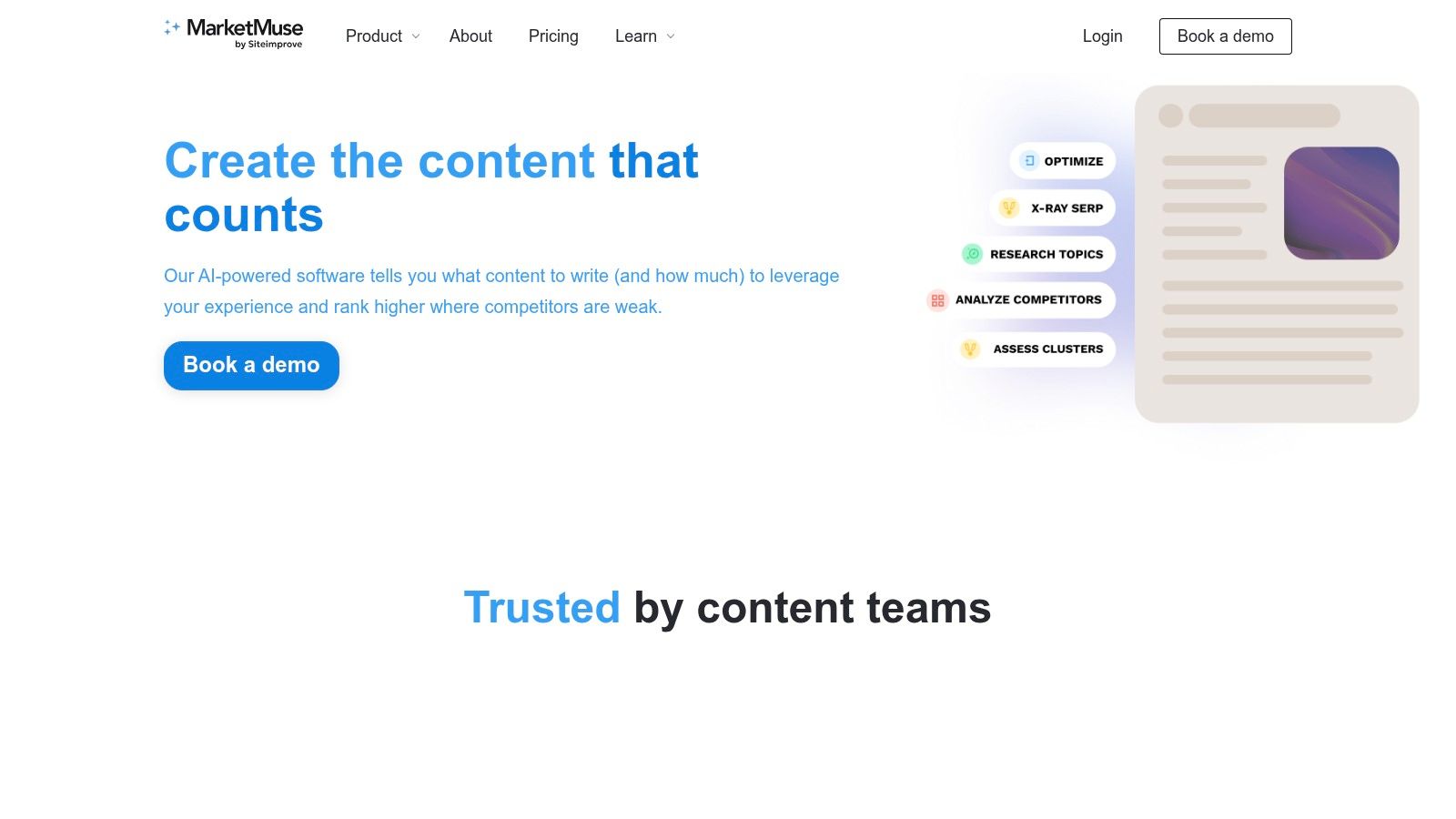
MarketMuse answers a resource-allocation question: which topics deserve a new page, an update, consolidation, or no immediate work? For “cybersecurity awareness training,” Topic Explorer identifies related subjects, questions, and topic models. Cluster Analysis then connects those opportunities to the site's existing coverage, giving editors a basis for choosing the next content action.
Its analysis becomes more useful as the content inventory grows. Competitive SERP X-Ray and Heatmap views can reveal topical gaps, while Topic Authority and Personalized Difficulty assess opportunities against the domain's own context. A keyword with appealing demand may still rank below an update to an existing page if the site lacks supporting coverage or would require a larger content program.
Best fit for enterprise prioritization
MarketMuse fits enterprise content operations that must sequence work across a large inventory. Its strongest contribution is prioritization by domain context, rather than another list of keyword ideas. That makes it more appropriate for portfolio planning than for quick discovery or low-cost keyword research.
A practical example is an inventory forecast: export candidate topics, review related pages, and classify each opportunity as create, update, consolidate, or defer. Analysts can then send only the selected work to writers. The learning curve is steeper than lighter tools, and the cost is higher than basic keyword platforms, so smaller teams may find the workflow difficult to justify. LLMrefs can complement this process when the team also needs to measure visibility in AI-generated search answers.
6. WriterZen
WriterZen is designed for freelancers, solo consultants, and small teams that need keyword research and content production without a heavier enterprise suite. Its Keyword Explorer applies a Golden Filter to narrow broad exports toward more achievable opportunities. Revenue forecasting can also connect topic selection with commercial priorities.
For “email marketing for coaches,” a practical workflow starts with keyword discovery, then moves through filtering and clustering before reaching Content Creator. AI writing and plagiarism-checking features keep research and production in one lower-cost environment.
WriterZen's main value is budget-conscious research. Its lifetime, one-time-fee options were available at the time of writing, although offer terms can change. Credits and usage limits still require monitoring, and the interface is less polished than premium suites.
- Best job: Affordable keyword filtering, clustering, and content creation.
- Strongest advantage: The Golden Filter helps isolate topics that appear more doable.
- Main limitation: Usage constraints and a smaller research environment limit scalability.
Use WriterZen for early discovery and topic grouping, then inspect the SERP for shortlisted queries. A filtered keyword is not automatically a sound business opportunity. Check whether ranking pages match the product, audience, and intended content format. For narrower query discovery, follow this guide to long-tail keyword research. Teams expanding beyond traditional rankings can pair the shortlist with LLMrefs to measure visibility in AI-generated search answers.
7. NEURONwriter
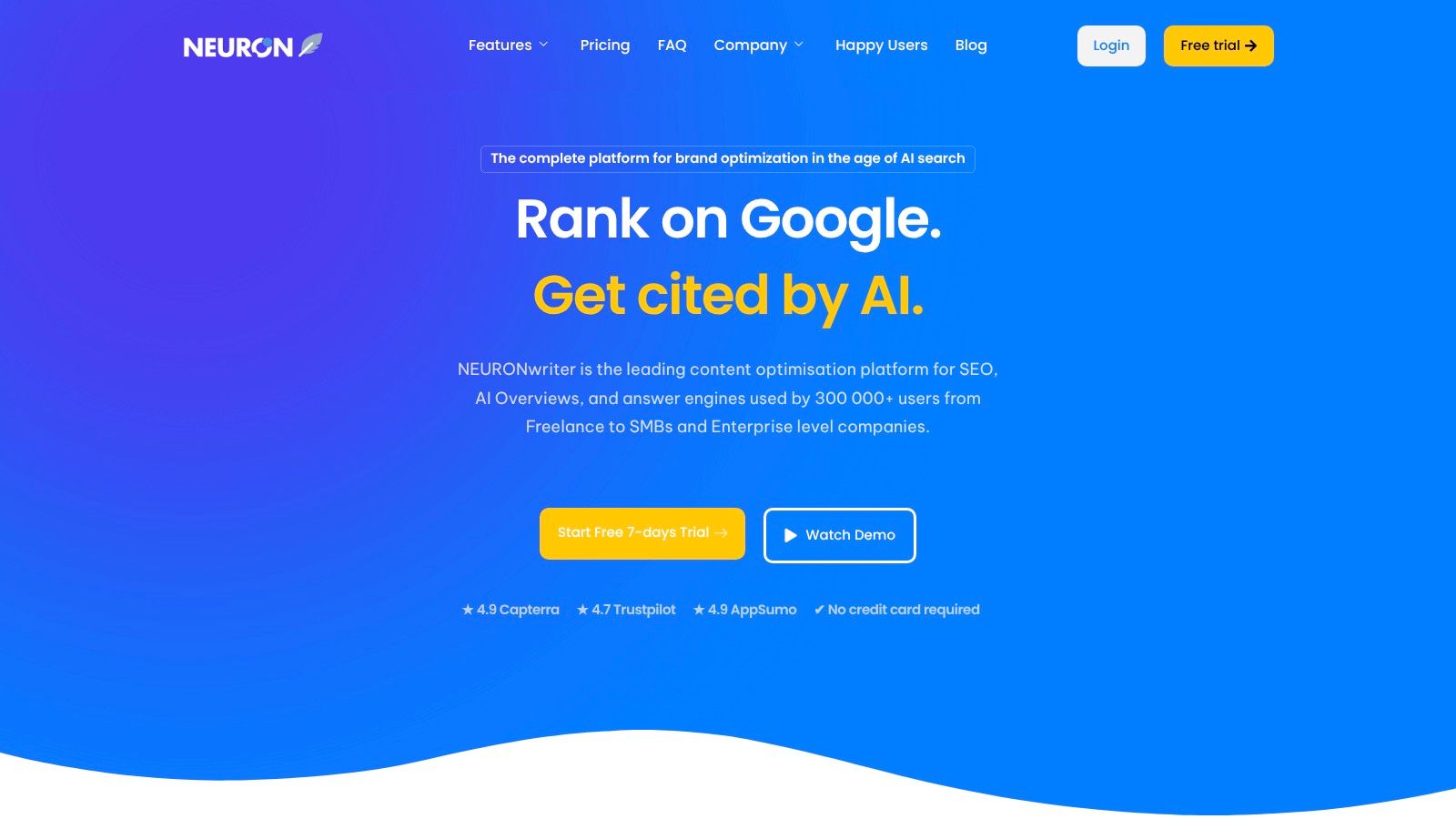
For “best note-taking app for students,” NEURONwriter is most useful after a topic has been selected. Its Keyword Analysis surfaces volume, competition, quick wins, and content gaps, while SERP and NLP analysis convert competitor coverage into suggested terms, entities, and brief inputs. The workflow connects discovery with page-level execution rather than treating keyword research as a standalone export.
Its cost model is a practical differentiator. Teams can connect their own OpenAI or Anthropic API keys, giving them more control over generation expenses instead of depending entirely on bundled AI usage. Smaller operations can therefore pair keyword research with on-page guidance while keeping AI costs easier to manage.
Where it fits in the workflow
NEURONwriter performs best as a practical content-planning and optimization layer. Its AI Visibility and GEO positioning features give publishers a starting point for evaluating exposure in answer-engine results. LLMrefs can complement that work when the team needs to measure how often important topics produce brand mentions or competitor citations in AI-generated answers.
For the note-taking example, use NEURONwriter to expand entity coverage, identify missing subtopics, and improve page completeness. Treat its recommendations as guidance, not a checklist. Forcing every suggested phrase into the copy can weaken readability, while natural coverage better supports pages competing across conventional and generative search.
- Best job: Keyword-linked content optimization with controlled AI costs.
- Strongest advantage: Bring-your-own-API support reduces dependence on bundled generation allowances.
- Main limitation: Its utilitarian interface, fewer integrations, and smaller research environment limit its fit for large-scale data analysis.
8. SE Ranking
SE Ranking suits agencies that need one operational system rather than a specialist tool for a single research task. Its Keyword Suggestion Tool combines search volume, difficulty, intent, SERP features, trends, and PPC data. Rank tracking, site audits, reporting, local SEO, seats, and API options extend that research into campaign management.
For an agency targeting “emergency plumber near me” across several clients, the platform can connect keyword discovery with local tracking, recurring reports, and project administration. Its AI Search and GEO add-ons also track citations and answers across AI surfaces, giving teams a way to compare conventional rankings with generative visibility. LLMrefs is useful alongside this workflow when analysts need to measure brand mentions or competitor citations in AI-generated answers.
Where SE Ranking fits
The platform's strongest role is agency operations. Research outputs can move directly into tracking and client reporting, while local capabilities reduce the need to assemble separate tools. Plans with broad research access may suit repeated campaigns, although project limits and add-ons can increase total cost.
- Best job: Multi-client research, tracking, reporting, and AI-search expansion.
- Strongest advantage: Seats, reporting, API access, and local capabilities support recurring agency work.
- Main limitation: Its database may be less extensive in some niches than specialist research platforms.
A practical sequence is to establish the conventional SEO baseline, group related terms with an SEO keyword grouping workflow, then add AI-search tracking for priority topics. This separates discovery from prioritization and shows whether visibility includes brand mentions, competitor citations, or neither.
9. Twinword Ideas
Twinword Ideas is most useful before a team has settled on its content structure. Enter “remote team collaboration” to generate related concepts, topic associations, semantic variants, and popular or trending themes. Its LSI graph helps reveal the language surrounding a subject, which can expose subtopics that a single keyword list would miss.
The tool also fits workflows built around existing data. Bulk import, relevance sorting, and CSV export let teams process a prepared list, while its text-analysis and word-association APIs support custom systems. A technical team could send semantic suggestions into an editorial database, then compare them with its own topic taxonomy.
Choose it for discovery, not prioritization
Twinword Ideas performs the discovery job well. It expands a seed into long-tail and adjacent concepts, but it does not replace a platform designed for competitor metrics, difficulty assessment, SERP analysis, or final prioritization. That boundary makes it easier to place the tool correctly in a broader workflow.
- Best job: Semantic ideation, long-tail expansion, and custom workflows.
- Strongest advantage: API access supports internal tools and integrations.
- Main limitation: The interface and documentation are more basic than premium suites, and competitor intelligence is limited.
For a content team planning “remote team collaboration,” Twinword Ideas can produce the initial vocabulary. After removing irrelevant suggestions, send the export to a clustering platform, then use a prioritization tool to assess search opportunity and competition. This sequence keeps semantic discovery separate from investment decisions, rather than asking a lightweight ideation tool to perform every SEO task.
10. RankIQ
A food blogger choosing a recipe topic often needs a workable opportunity, not a massive keyword database. RankIQ addresses that starting point with curated keyword libraries organized by blogging niche. Food, personal finance, and lifestyle publishers can move from an idea to a plausible content brief with less initial research.
Its Content Optimizer then supplies entities, related phrases, and a suggested word-count range to guide topical coverage. RankIQ also addresses AI Overviews and answer-engine optimization, extending the workflow beyond conventional ranking goals. Because its integration with the Aided platform may affect pricing and promotions, verify current terms before subscribing.
Best fit: practical selection for solo creators
RankIQ's strongest job is guided topic selection. A solo writer can choose from a niche library, assess an opportunity, and use the optimizer while drafting. That workflow is more direct than configuring a large research suite, although it offers less depth for enterprise analysis, competitor research, and broad keyword prioritization.
- Best job: Blogger-friendly topic selection and content optimization.
- Strongest advantage: Pre-curated opportunities reduce research effort and make decisions easier to act on.
- Main limitation: It is not a full enterprise research suite, and its scope is narrower than an all-in-one SEO platform.
For a recipe site targeting “sheet pan dinner,” select a relevant library topic, review the suggested entities, and shape the article around the reader's cooking task. Treat the target word count as guidance, not a publishing rule. RankIQ simplifies the choice and drafting process, while editorial judgment still determines usefulness, originality, and visibility.
Top 10 AI SEO Keyword Generators Comparison
| Tool | Core features | Unique selling point | Best for | Price / Value |
|---|---|---|---|---|
| Keyword Insights | Live discovery, SERP-based clustering, intent labeling, API & GSC | Scales large datasets; enterprise API & GSC access | Enterprises & agencies with big keyword sets | Scales with usage; Writer Agent uses credits (can add cost) |
| Scalenut | GEO Keyword Planner, clustering, CPC/KD metrics, one-click briefs | Strong US/region gap analysis + end-to-end brief → draft flow | Teams targeting geo-specific markets | Tiered; advanced GEO features on higher plans |
| Surfer | Keyword & topic research + direct Content Editor integration | Mature content optimization workflow & ecosystem | Agencies/content teams needing editor integrations | Usage/seat-based pricing, costs rise with scale |
| Frase | SERP/PAA/forum research, topic clusters, conversational Agent | Question-first briefs and conversational research agent | Content strategists and writers collaborating on briefs | Mid-tier pricing; optional FraseCMS add-on |
| MarketMuse | Topic modeling, cluster analysis, content inventory, personalized metrics | Deep strategic planning with Topic Authority & difficulty | Enterprise content strategy teams | Premium pricing; higher learning curve |
| WriterZen | Keyword Explorer, Golden Filter, clustering, AI writing, plagiarism check | Budget-friendly offers (lifetime options); Golden Filter for quick wins | Freelancers & small teams seeking value | Low-cost / lifetime one-time-fee options (limits/credits apply) |
| NEURONwriter | Keyword analysis, NLP term suggestions, GEO/AI visibility, BYO API keys | Bring-your-own-API to control generation costs; practical on-page focus | Small–mid teams wanting cost control | Affordable; utilitarian UI and fewer integrations |
| SE Ranking | Keyword suggestions, rank tracking, site audit, reporting, AI/GEO add-ons | Full agency feature set with competitive pricing & add-ons | Agencies needing all-in-one SEO + local/GEO tracking | Competitive base pricing; add-ons raise total cost |
| Twinword Ideas | Semantic expansion, LSI graph, bulk import, APIs | Strong semantic/topic ideation and API-first tooling | Ideation teams and developers building custom workflows | Low-cost; basic UI/documentation |
| RankIQ | Curated low-competition libraries, content optimizer, AEO/GEO focus | Blogger-centric curated keywords for fast ranking | Solo bloggers and creators | Affordable/approachable pricing; focused feature set |
Build a Keyword-to-Visibility Stack
Choosing an AI SEO keyword generator starts with the missing job in your process. If you have an unstructured export, prioritize discovery and clustering depth. If writers are waiting for usable briefs, favor a platform that connects clusters to outlines and drafts. If several markets or clients share one operation, evaluate regional controls, seats, reporting, API access, and the total cost of project limits and add-ons.
The tools also divide naturally by scale. Keyword Insights and MarketMuse are better suited to large inventories and strategic planning. Scalenut, Surfer, and Frase fit teams that want planning connected closely to content production. WriterZen, NEURONwriter, Twinword Ideas, and RankIQ are more attractive when budget, simplicity, semantic expansion, or creator-friendly workflows matter most. SE Ranking covers a wider operational surface for agencies that want research, tracking, audits, reporting, and AI-search capabilities together.
Exact-match thinking is no longer enough. Research on generative engine optimization indicates that AI systems respond to topic coverage and source quality, while one study found keyword stuffing produced little to no improvement in generative responses and underperformed the baseline in validation tests, as reported in this generative engine optimization study. Build clusters that include definitions, comparisons, alternatives, supporting questions, and decision-stage variations, then verify that the group reflects one coherent intent.
Fan-out queries deserve particular attention. A 2026 study of 10,000 keywords reported a 0.77 correlation between the number of fan-out queries a page ranks for and its likelihood of citation in Google AI Overviews. Pages ranking for fan-out queries were reported as 161% more likely to be cited than pages ranking only for the main query, according to Search Engine Land's coverage. That supports a workflow where a tool generates the head topic and its supporting questions, while an editor decides which questions belong on the same page.
Use a sequence like this:
- Discover: Start with seeds from customers, products, competitors, Search Console, forums, and autocomplete.
- Expand: Turn seeds into conversational prompts, comparisons, questions, and regional variants.
- Cluster: Group terms by SERP behavior and likely page intent, not by superficial word similarity.
- Prioritize: Combine difficulty, commercial value, topical fit, existing coverage, and production effort.
- Brief: Give writers a primary question, supporting questions, entities, evidence requirements, and a clear page purpose.
- Validate: Inspect live SERPs and manually confirm intent before publishing.
- Measure: Track classic rankings alongside AI mentions, citations, share of voice, and competitor presence.
Prompt research should begin with the audience and the solution they need, then use keyword research as language input before converting terms into conversational prompts, according to Semrush's prompt research framework for AI SEO. For a project management software site, that might mean moving from the seed “project management software” to prompts that compare tools for a remote team, recommend an option for a specific workflow, or explain implementation concerns at a particular decision stage.
Localization needs its own review. Published GEO research reports substantial run-to-run variability and low source overlap, making it harder to assume that one country's prompt set represents another market. Use regional keyword data where available, adapt wording to local language and buying context, and benchmark each market independently rather than translating one master list mechanically. Coverage of this challenge appears in Digital Applied's 2026 AI keyword research guide.
Page structure matters after keyword selection. One large study reported that 55% of citations came from the first 30% of content, compared with 24% from the middle 30% to 60% and 21% from the bottom 40%, with the source recommending that key information appear within the first 150 to 200 words. See the CXL analysis of Google AI Overview citation sources. Put a direct answer and essential evidence near the top, then develop supporting questions below it.
LLMrefs fits after prioritization rather than replacing keyword research. Import the selected SEO keyword list, generate conversation-based prompts from those keywords, and monitor how often your brand appears in answers from platforms such as ChatGPT, Google AI Overviews, Perplexity, Gemini, Claude, Grok, and Copilot. LLMrefs aggregates real-time responses, citations, mentions, share-of-voice and position metrics, while geo-targeting across 20+ countries and 10+ languages supports market-specific benchmarking. It also surfaces competitor gaps, cited sources, and content opportunities, with CSV export and API access for teams that need to connect visibility data to their existing reporting.
Review performance regularly. A generated keyword list is a starting inventory, not a finished strategy. Recheck live SERPs, compare changes in AI citations and competitor visibility, update content where the evidence shows a gap, and retire priorities that no longer match customer questions or business value. For a broader view of the market, consult this SEO AI tools ranking.
Use LLMrefs to import your prioritized SEO keywords, generate conversation-based prompts, and track brand mentions, citations, share of voice, and competitor gaps across AI answer engines. Start with the topics your team already plans to publish, then use the visibility data to decide which pages and prompts deserve the next round of optimization.
Related Posts

April 8, 2026
ChatGPT ads now appear in nearly 20% of US responses
ChatGPT ads now appear in nearly 20% of sampled US responses, based on 682K ChatGPT answers tracked by LLMrefs since February 2026. See who is buying, how fast ads are growing, and how we measure it.

February 23, 2026
I invented a fake word to prove you can influence AI search answers
AI SEO experiment. I made up the word "glimmergraftorium". Days later, ChatGPT confidently cited my definition as fact. Here is how to influence AI answers.

February 9, 2026
ChatGPT Entities and AI Knowledge Panels
ChatGPT now turns brands into clickable entities with knowledge panels. Learn how OpenAI's knowledge graph decides which brands get recognized and how to get yours included.

February 5, 2026
What are zero-click searches? How AI stole your traffic
Over 80% of searches in 2026 end without a click. Users get answers from AI Overviews or skip Google for ChatGPT. Learn what zero-click means and why CTR metrics no longer work.