AI SEO audit, AI visibility, generative engine optimization, AI search monitoring, LLM SEO
How to Run an AI SEO Audit in 2026
Written by LLMrefs Team • Last updated November 26, 2026
Your SaaS company's pricing page appears as a cited source in ChatGPT, but its product documentation is missing from Google AI Overviews. The dashboard shows organic traffic slipping, the content team wants to rewrite everything, and engineering wants proof that anything is broken. An AI SEO audit should turn that disagreement into testable tasks, not another collection of screenshots.
What an AI SEO Audit Covers at a Glance
An AI SEO audit connects eligibility and retrieval health with answer visibility and business impact. The first establishes whether search systems can access and understand your pages. The second tests whether answers use those pages accurately and whether that exposure contributes to business results.
Keep technical eligibility separate from measured visibility. Google's search systems guidance explains ranking systems, rather than guaranteeing inclusion in an answer. Availability varies by market, so record market, language, query intent, cited sources, brand mentions, competitors, and answer position for every observation.
Audit layers, checks and pass signals
| Layer | What You Check | Pass Signal | Data Source |
|---|---|---|---|
| Eligibility | HTTP status, indexing and snippet eligibility | Successful response, indexed, eligible for a snippet | Search Console URL Inspection |
| Crawler access | robots.txt, CDN and firewall rules for each AI bot | Priority pages accessible to intended bots | Server logs and robots.txt tests |
| Rendering and structure | Rendered HTML, canonicals, sitemaps, internal links | Key text visible, intended canonical consistent | Crawler tool and rendered HTML view |
| Experience | Core Web Vitals by template, country and device | Good; Needs Improvement remains a remediation item | Search Console Core Web Vitals report |
| AI visibility | Mentions, citations and share of voice across a fixed prompt set | Directional change persists across repeated weekly samples | AI answer monitoring such as LLMrefs |
| Traffic impact | Branded search, referrals and conversions for cited topics | Named downstream metric improves for matching topic groups | Analytics and CRM |
Give every layer an owner, a minimum sample, and a retest cadence. Engineering owns access and rendering defects; the SEO lead owns visibility sampling; analytics owns downstream measurement.
Technical samples should cover every priority URL and representative pages from each affected template. For visibility, define the minimum prompt sample before testing and hold prompts, markets, and languages consistent. Retest weekly. Match business measurement to the same topic groups and observation windows.
Practical rule: A technical pass permits the next test; it does not establish a business outcome.
Treat visibility movements as provisional until they survive three consecutive weekly runs and move a named downstream metric, such as referrals or conversions. This reporting threshold keeps a single fluctuating answer from becoming a performance claim. An indexed page still needs answer-level evidence before you call it visible, and a citation alone does not demonstrate business impact.
Check Eligibility and Crawler Access Before Any Prompt Testing
Start with the URLs you want answer engines to cite, not the prompts you hope will mention you. Include pricing, product documentation, comparison pages, and commercially important guides. The SEO lead owns the inventory; engineering owns infrastructure defects.
Use this sequence to separate retrieval blockers from content problems.
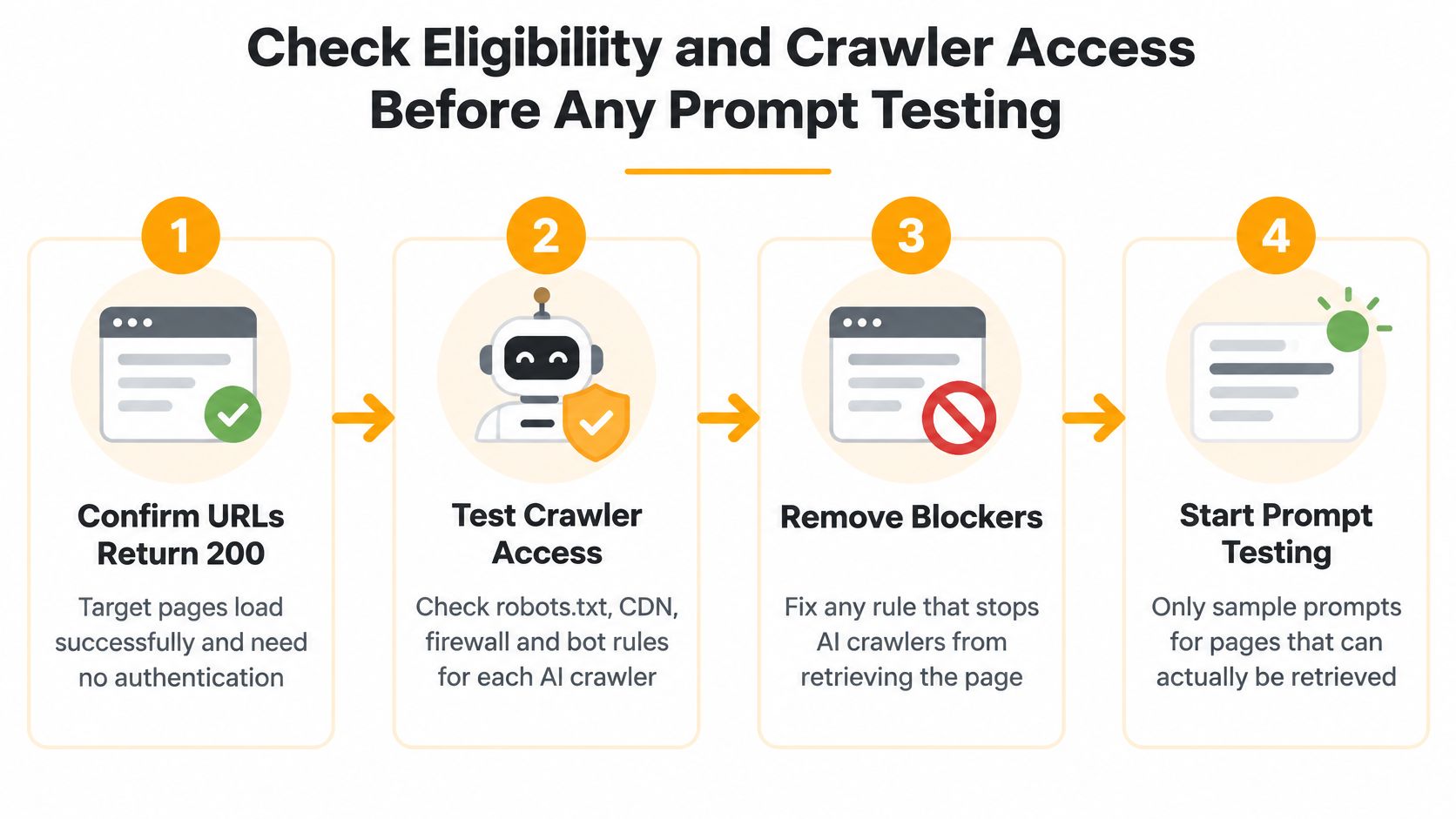
Run the eligibility checks in order
- Confirm successful access. Target pages should return HTTP 200 and load without authentication. Check the final destination after redirects, not just the address in your spreadsheet.
- Test infrastructure permissions. Inspect robots.txt, CDN, firewall, and hosting rules using representative user agents. Compare responses with server logs because changing a user-agent string alone doesn't establish that a genuine crawler can connect.
- Verify indexing and snippet eligibility. Google's AI features documentation says supporting links in AI Overviews and AI Mode must be indexed and eligible to appear with a Search snippet. Eligibility doesn't guarantee inclusion.
- Inspect rendered HTML. Confirm that product names, pricing explanations, instructions, and supporting evidence appear as crawlable text. JavaScript isn't automatically a failure, but content that never becomes available to the crawler is.
- Check URL signals. Canonicals, internal links, and XML sitemaps should identify the intended page consistently. Investigate a documentation URL that canonicalizes to a category page before rewriting its copy.
- Compare markup with visible content. Keep applicable structured data accurate. Google doesn't require special AI schema, so custom markup shouldn't displace work on access or substantive content.
The minimum sample is your full priority inventory plus examples from every template affected by a shared rule. Retest changed URLs immediately after deployment, then confirm actual crawler access in logs.
Record permissions by crawler
Search discovery and model-training access are separate decisions. The crawler documentation distinguishes OAI-SearchBot, which supports ChatGPT search discovery, from GPTBot, which crawls content that may improve foundation models.
AI crawlers and the audit check for each
| Crawler | Purpose | Audit Check |
|---|---|---|
| OAI-SearchBot | Surfaces websites in ChatGPT search results | Allowed in robots.txt on priority pages and not blocked at the CDN |
| GPTBot | Crawls content that may be used to improve OpenAI foundation models | Set allow or disallow as a separate decision from search visibility |
| Googlebot | Crawls and indexes pages for Google Search, which feeds AI Overviews and AI Mode | Indexable, snippet-eligible and not blocked on priority URLs |
A publisher can allow search discovery for its documentation while making a different training-access decision. Googlebot access isn't a proxy for either permission.
Use the AI Crawlability Checker as an initial check, then verify failures against your infrastructure records. Log URL, crawler, response, remediation owner, and retest date for every defect.
Put template-wide blocks above isolated warnings. If the CDN rejects documentation requests, editing individual articles won't resolve the underlying problem.
Build a Repeatable Prompt Sample for Visibility Tracking
A brand can appear in an answer and disappear when you repeat the question. Model selection, geography, language, wording, personalization, and time all complicate comparisons. A screenshot documents an observation, not a trend.
A critical survey of generative-engine studies describes visibility as a sequence involving retrieval, passage selection, citation, prominence, and user selection, while identifying causal measurement as an unresolved challenge. Your measurement design should preserve those distinctions rather than compressing everything into a rank.
Set the sample before collecting results
I recommend a minimum working sample of 20 to 30 keywords, with three conversation variants each, producing 60 to 90 prompts per run. Track two named competitors, hold country and language constant, and collect weekly observations for three consecutive weeks before classifying movement. These are operating rules, not a guarantee of statistical power.
For a project-management vendor, include:
- Discovery intent: Best project management tool.
- Implementation intent: How to migrate project data.
- Purchase intent: Project management pricing comparison.
Choose the actual competing brands before collection begins. Keep exploratory prompts separate from the fixed measurement set so additions don't change your denominator.
Our LLMrefs workflow generates conversation-based prompts from keywords and aggregates responses across answer engines. AI search results are checked in real time, prompts are continuously checked to ensure statistical significance, and every keyword is updated in the dashboard at least once per week.
Use these conversation prompt examples to check that variants reflect realistic buyer questions rather than artificial instructions to mention your brand.
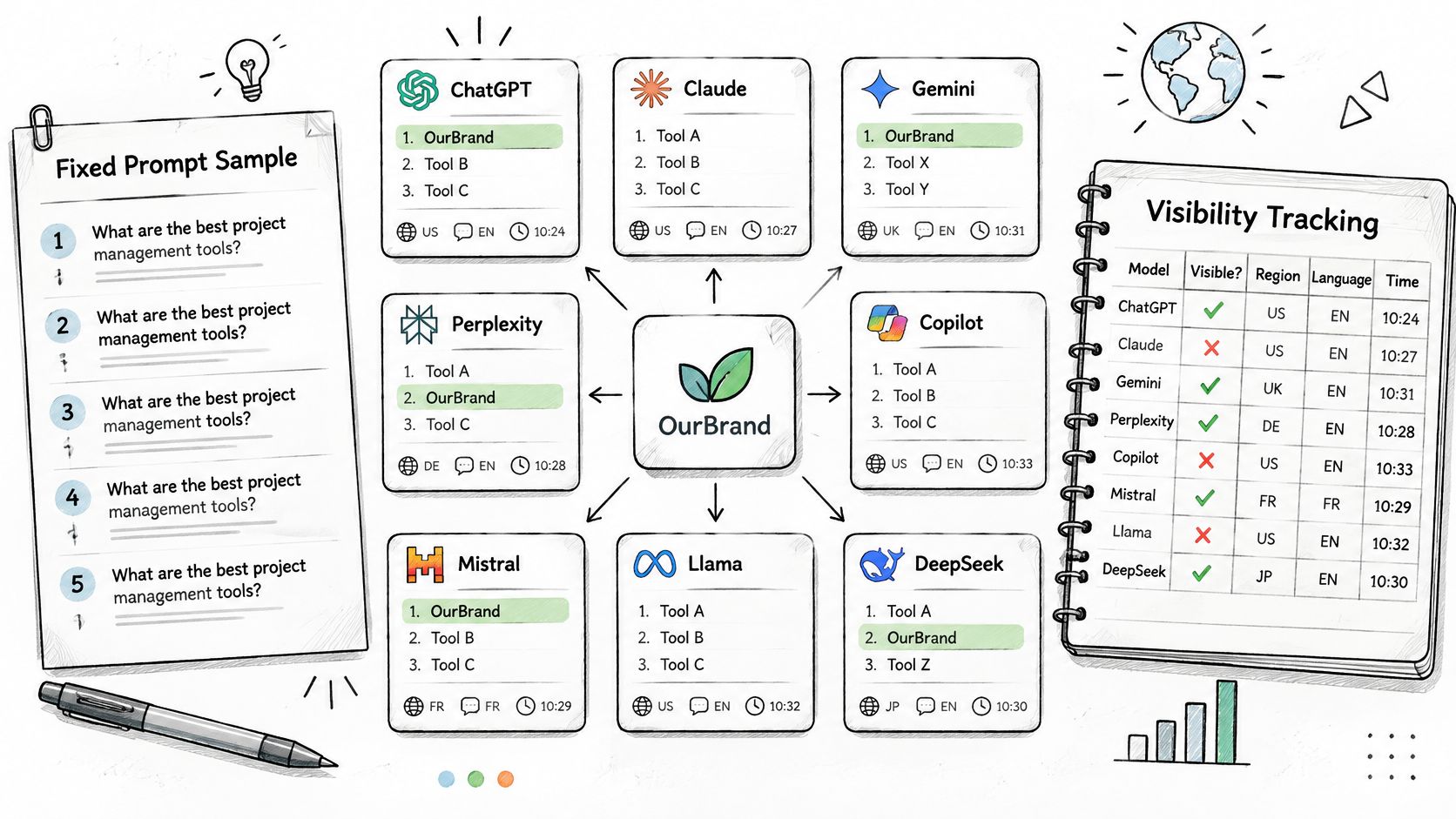
Visibility metrics and the decision rule for each
| Metric | Definition | Decision Rule |
|---|---|---|
| Coverage | Share of sampled prompts where the brand is mentioned | Change must hold for three consecutive weekly observations |
| Citation rate | Share of answers that link to your own URL | Track by page, not only by domain |
| Share of voice | Your mentions compared with all tracked brands on the same prompts | Compare against named competitors on identical prompt sets |
| Position | Where the brand appears inside the answer | Report the median position, not a single observation |
| Variance | Spread of results across models, countries and prompt wording | Wide spread means wait for more observations before concluding |
Report median position and variance beside coverage and citation rate, including non-appearances in coverage calculations. Define whether position means a recommendation-list placement or mention order, and don't mix those measures.
Persistence alone isn't significance. Require movement outside the sample's expected variation, and label a persistent visibility shift commercially validated only when a named downstream metric also improves.
Measure Retrieval Quality and Experience Against Your Baseline
Retrieval health and user experience need separate acceptance tests. A page can become easier to use without gaining citations, and a cited page can still frustrate visitors. Give each outcome a pass signal, a minimum evidence requirement, and a retest cadence before assigning work.
Use field data to assess experience. Lab tests help engineers isolate defects, but release-day scores don't establish what visitors experienced.
Use a controlled field-data sequence
- Collect field performance for the priority URLs represented in your prompt sample. Use a typical 28-day field window, as described in Google's Core Web Vitals guidance, before crediting an experience improvement.
- Segment the inventory by template, country, language, and device. Keep mobile pricing-template defects separate from sitewide content assessments.
- Flag Poor groups and identify shared components. Record the baseline classification, Poor, Needs Improvement, or Good, so the engineering owner has an explicit acceptance target.
- Assign engineering work for loading delays, slow interactions, and unstable layouts. Preserve content where practical to reduce competing explanations for any citation change.
- Retest after field data accumulates. Verify the implementation live, then check whether the affected group improves against its baseline.
- Compare citation outcomes using the full fixed prompt sample and unchanged pages as controls. Keep the outcome review open when observations remain sparse.
Technical accessibility, usefulness, and experience belong in the same audit, with separate evidence. Broader adoption and trust trends, covered in the ranking-system account summarized by Search Engine Land, don't replace page-level acceptance tests.
Read a small lift honestly
Suppose a pricing template starts in Poor and gains a few citations after a layout-shift fix. Treat that hypothetical result as an early signal. Changing experience and citations together doesn't establish causation.
The engineering owner can close the implementation ticket after live verification. The SEO lead should require the visibility change to survive three consecutive weekly runs, exceed expected variation, and improve a named downstream metric before reporting commercial success.
A successful release, a better user experience, and a commercially useful visibility change are different results. Give each its own evidence.
Diagnose Citation Quality and Traffic Substitution
A citation isn't a session. In Pew Research Center's analysis of Google visits, users clicked a traditional result in 8% of visits with an AI summary, compared with 15% without one, and clicked a link inside the summary in only 1% of visits. A click-only audit can miss meaningful brand exposure, but exposure alone doesn't establish value.
The comparison below illustrates why visibility and traffic need separate reporting.
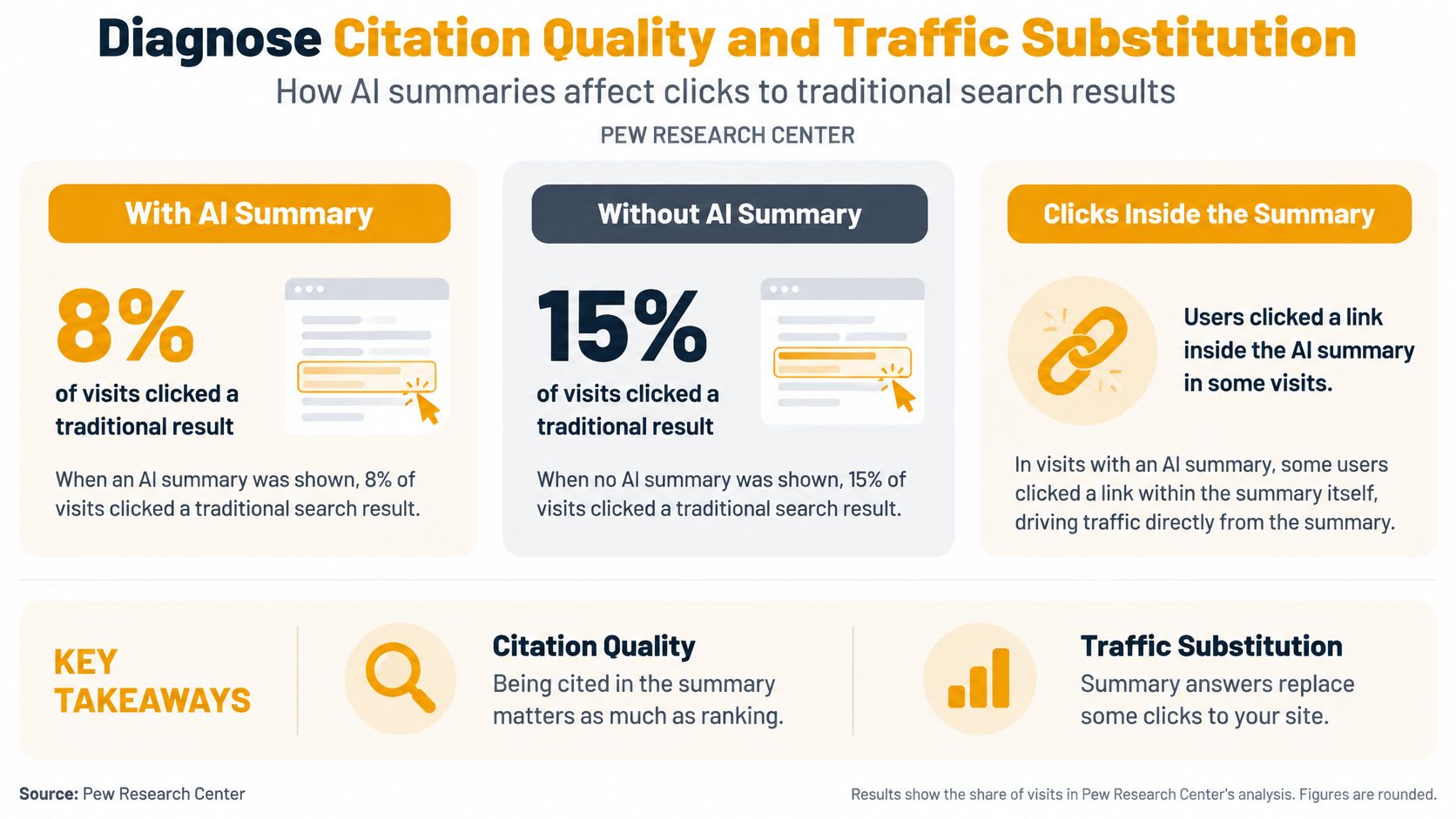
Price the substitution before chasing citations
A randomized field experiment involving 1,065 desktop Chrome users, reported by PPC Land, found that AI Overviews reduced outbound organic clicks by 39.8% and increased zero-click searches by 34.5%, while sponsored-result clicks remained flat. Separately, SellersCommerce reports a 34.5% reduction in click-through rates for top-ranking pages, based on studies covering more than 300,000 keywords.
The exposure also changed quickly: Digiday, citing Semrush, reported AI Overviews in 6.49% of U.S. desktop searches in January 2025, rising to 20.22% in April 2025. These findings measure different things; don't combine them into a predicted loss for your site.
Instead, have analytics and revenue operations compare cited and uncited topic groups over matching windows. Include branded search, identifiable referrals, direct traffic, assisted conversions, qualified leads, and revenue, while marking unattributable outcomes as unknown.
Inspect the passage, not just the link
For every commercially important cited answer, check:
- Support: Does the cited passage substantiate the adjacent claim?
- Relevance: Does it answer the actual question?
- Accuracy: Are product capabilities and brand identity represented correctly?
- Freshness: Does the answer use current information?
- Intent: Could this prompt influence a buying decision?
Use brand monitoring for AI results to connect those qualitative checks with repeatable topic-level reporting. Review all high-intent citations in the working sample each week, rather than selecting flattering examples.
Sometimes the right fix is accurate product representation even if visits decline. If buyers stop receiving an incorrect integration claim, that can be valuable, but prove the benefit through a named measure such as qualified-lead rate or fewer unsuitable inquiries.
Prioritize Fixes by Impact and Effort
An audit usually produces more findings than the team can implement. Priority determines whether the audit changes anything. Rank confirmed defects by commercial reach, retrieval impact, implementation effort, and release risk, not by the crawler's warning color.
Typical audit findings ranked by impact and effort
| Finding | Impact | Effort | Priority |
|---|---|---|---|
| Template-wide crawler block | High, affects many URLs | Low to medium | Fix first |
| Single page with an accidental noindex | Medium, one URL | Low | Fix this sprint |
| Poor Core Web Vitals on a high-traffic template | High | Medium to high | Schedule as a project |
| Missing structured data for rich results | Low for AI visibility | Low | Keep accurate, do not prioritize |
| Cluster of thin or unoriginal pages | Medium to high | High | Plan a content rewrite |
A template-wide crawler block belongs first because it prevents retrieval across the affected inventory. Assign it to the infrastructure owner, specify the intended crawler permissions, and require successful live requests before closing it.
An accidental noindex on an important page is a smaller task, not necessarily a less urgent business problem. The SEO lead should identify the source, have the CMS or engineering owner remove it, and monitor indexing afterward.
Turn findings into acceptance criteria
Poor experience across a high-traffic template deserves a scoped engineering project. Missing rich-result markup can wait behind access defects, while a thin-content cluster needs editorial judgment, product expertise, and a rewrite plan rather than bulk-generated expansion.
For each task, record:
- Owner and scope: Name the person accountable and the affected URLs or component.
- Pass signal: State what must be true on the live site.
- Minimum verification sample: Test the priority URLs and representative affected templates.
- Retest date: Separate immediate release checks from later outcome reviews.
- Expected metric: Specify coverage, page-level citation rate, qualified referrals, or another measurable outcome.
For example, replacing vague migration copy with supported instructions should have an editorial acceptance test: the page explains prerequisites, steps, limitations, and recovery options. Its commercial hypothesis might be more qualified implementation inquiries, not an increase in mentions.
Decision discipline: Close a task when its acceptance criteria pass. Credit business improvement only when the outcome evidence supports it.
Use Search Console field data to establish whether an experience fix helped users before connecting it with visibility. Keep deferred work visible, with a reason for deferral, so the team doesn't repeatedly reopen low-value warnings.
Run Your First AI SEO Audit This Week
You don't need a complete website overhaul to begin. You need a bounded inventory, reliable access checks, and a baseline that the team won't redefine after results arrive.
Use the opening days to separate page-level checks from crawler-level investigation.
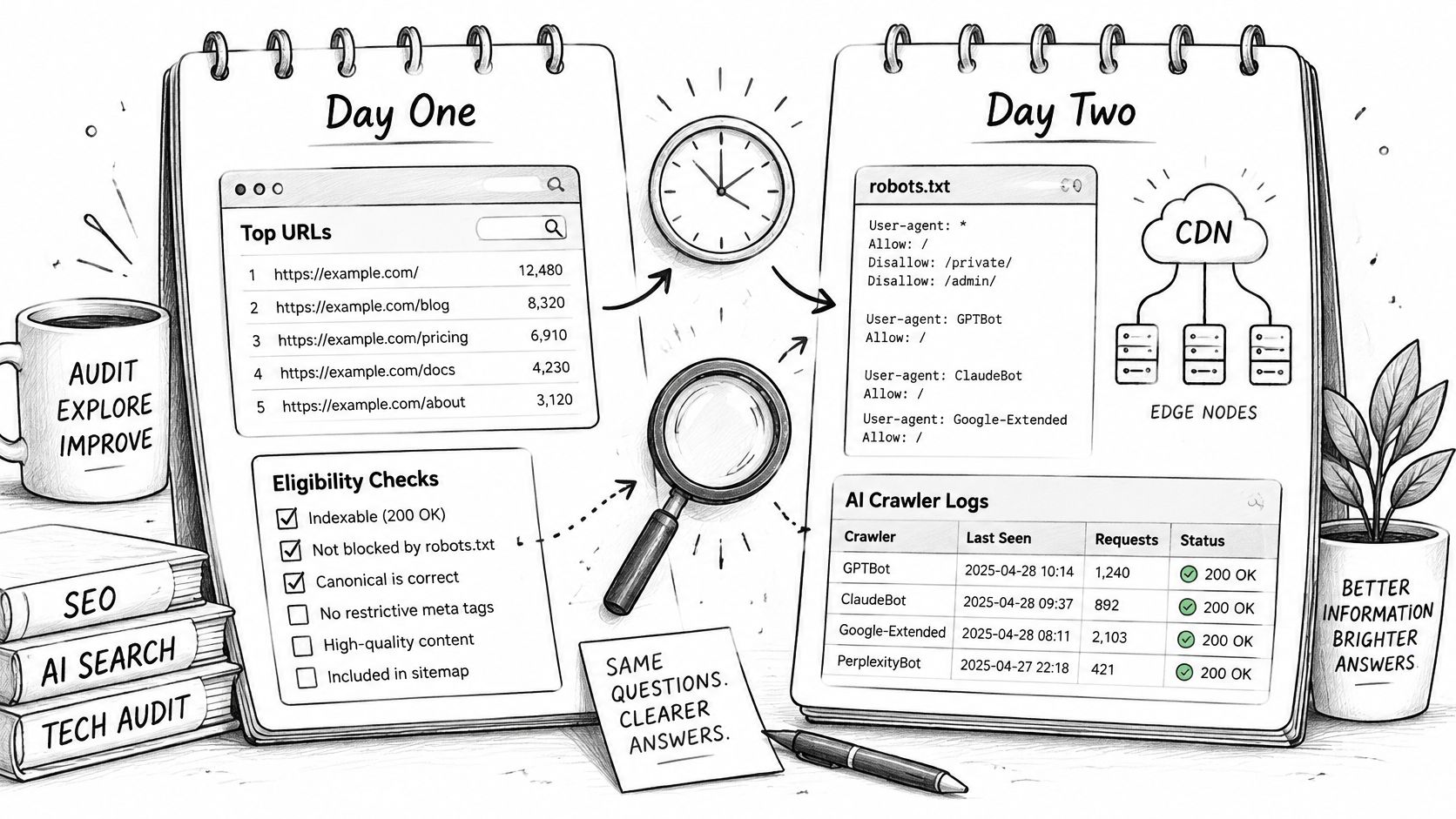
Build the working audit
- Day one: Select your top 20 to 30 URLs as a practical starting inventory. Export Search Console information and check successful responses, indexing, rendering, canonical targets, and snippet controls.
- Day two: Test crawler permissions against that inventory. Ask the infrastructure owner to investigate rejected requests and log each block with its remediation owner.
- Day three: Create the keyword sample across comparison, how-to, and troubleshooting intent. To start with LLMrefs, sign up for a free account, create a project using your brand name and domain, and add core SEO keywords to track.
- Day four: Begin the controlled observations against your named competitors. Have the SEO lead document the scoring definitions before anyone interprets the dashboard.
- Day five: Map cited topics to branded search, referrals, conversions, and revenue. Produce a short fix list with acceptance criteria rather than handing engineering an unfiltered crawl export.
LLMrefs offers free resource tools including the AI Crawlability Checker and Reddit Threads Finder for the access and source-investigation steps. Treat recurring community discussions as evidence of customer questions to investigate, not permission to manufacture promotional mentions.
The walkthrough below can support the team's setup discussion.
Keep the audit active after setup
Maintain weekly monitoring during validation, refresh the full prompt sample monthly, and schedule a quarterly deep crawl-and-experience review. Reopen technical checks after meaningful template, CDN, or platform changes rather than waiting for the calendar.
In On Marketing's 2025 survey, 37.2% of 250 U.S. marketing professionals said their teams were actively optimizing websites or content for AI search. Delaying your baseline leaves you unable to tell whether competitors are gaining share of voice while you debate implementation.
Fix the top blocker first and retest in a week. Don't report a confirmed improvement until the affected prompts sustain movement across three consecutive weekly runs, exceed observed variance, and improve the downstream metric you named before shipping.
LLMrefs brings AI responses, citations, brand mentions, and competitor visibility into a single dashboard so your audit can become an ongoing measurement process. Visit LLMrefs to create a free account, add your brand and core keywords, and establish the baseline for your first controlled audit.
Related Posts

November 9, 2026
Claim your business in ChatGPT
A screenshot shows a "Claim your business in ChatGPT" page with mention and click tracking. We are skeptical it is real. If it is, it shares no prompts, no citations and no competitor data.

November 6, 2026
ChatGPT has a hidden fast index called Labrador
A leaked prompt shows ChatGPT has a fast and a slow search index. The fast one is Labrador, OpenAI's own index. It found a page Google, Bing and Brave never indexed.

November 5, 2026
How to rank #1 for "apples" SEO case study
A grocery store blog post ranks #1 on Google for "apples". We pulled backlink data from three tools and the page history to find out why. Some of it is unclear.

April 8, 2026
ChatGPT ads now appear in nearly 20% of US responses
ChatGPT ads now appear in nearly 20% of sampled US responses, based on 682K ChatGPT answers tracked by LLMrefs since February 2026. See who is buying, how fast ads are growing, and how we measure it.