AI search visibility audit, GEO strategy, LLM SEO, AI answer engines, share of voice
AI Search Visibility Audit: The Complete GEO Framework
Written by LLMrefs Team • Last updated September 27, 2026
Ranking first on Google doesn't guarantee that an AI answer engine will mention you, let alone cite you. That assumption is now one of the costliest shortcuts in search strategy. A traditional SEO report can show strong rankings while a buyer asking ChatGPT, Perplexity, or Google AI Overviews for a recommendation never sees the brand.
An effective AI search visibility audit treats visibility as a measurement problem, not a screenshot exercise. It tests a stable set of buyer questions, compares several answer engines, separates mentions from citations, and repeats the measurement often enough to distinguish a durable signal from model noise. The result is a practical GEO roadmap, not another list of technical checks.
Why Traditional SEO Fails in AI Answer Engines
Traditional search and AI answer engines solve related problems in different ways. A search engine generally presents ranked documents, while an answer engine synthesizes information and decides which sources deserve inclusion in a response. Ranking well can help, but it doesn't automatically make your page the source an AI system selects, summarizes, or cites.
The gap is visible in audit data. A 2026 study of 33 AI-search audits found that 82.5% of the time a buyer's question was asked, the brand that answered best was absent from the answer or buried inside another source. The same study found that 12 of 33 brands, or 36%, were never once clearly named across their prompt set. These findings are reported in the OpenReview study of AI-search audits.
That doesn't mean traditional SEO is obsolete. Crawlability, useful content, links, and clear information still matter. It means those inputs must produce a source that answer engines can identify, interpret, trust, and connect to a buyer's specific question.
Accessibility isn't authority
A 2026 audit study of 201 AI-search audits illustrates the imbalance. Among the 163 processed audits, the average overall score was 61.6, with a median of 66. Only 4.9% reached the “Strong foundation” band, while 70.6% fell into “Inconsistent visibility” and 0% reached “Exceptional.” The same study reported median subscores of 92 for Structure, 74 for Extractability, 48 for Authority and evidence, and 45 for Freshness. The full breakdown appears in the AI search visibility gap study.
The pattern matters. Many sites make information technically accessible, but fewer make their claims easy to verify or keep them current. A page can have clean headings and readable markup yet lose citation opportunities because the brand's expertise isn't corroborated elsewhere, the author is unclear, or the evidence is stale.
Practical rule: Treat rankings as an input to an AI visibility audit, not as proof of citation authority.
Define the real audit question
“Does the brand appear?” is too shallow. A useful audit asks:
- Is the brand named for the buyer's question?
- Is it cited as a source?
- Is the description accurate?
- Is it recommended, shortlisted, or merely mentioned?
- Which competitor appears when the brand is absent?
- Which page or external source supports the answer?
Those questions change the work that follows. Instead of rewriting every high-ranking page, the team can identify where the answer engine selected a competitor, inspect the cited evidence, and fix the specific weakness, whether that's extractability, topical coverage, authority, or freshness.
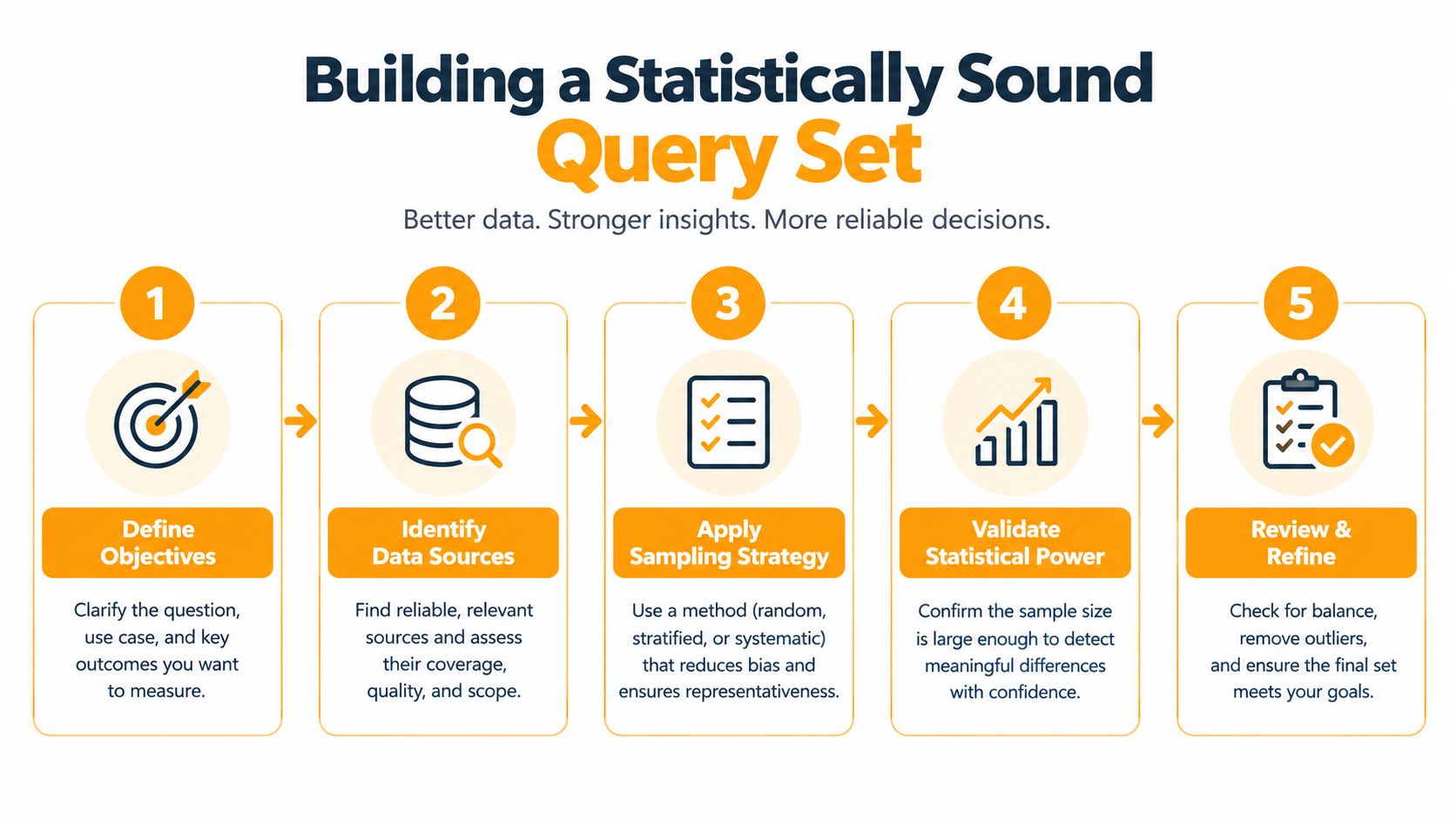
Building a Statistically Sound Query Set
A few manual prompts can reveal an obvious problem, but they can't establish a dependable baseline. Answer engines vary their wording, source selection, and response composition. Paraphrasing the same question can change the result, and a single response may reflect a temporary retrieval anomaly rather than a stable market signal.
A credible audit starts with a bounded library of high-intent questions. A practical benchmark framework recommends 50–200 questions, tested across ChatGPT, Claude, Perplexity, Google AI Overviews, and Microsoft Copilot to capture platform-specific variation, as described in this multi-model AEO benchmarking framework.
Start with buyer intent
Build the library from real decisions, not random keyword variations. Include questions that reflect:
- Category discovery, such as “What are the main options for managing enterprise translation?”
- Shortlisting, such as “Which platforms should a mid-sized retailer compare?”
- Evaluation, such as “What should a buyer check before choosing an analytics platform?”
- Problem solving, such as “How can a marketing team reduce reporting time?”
- Brand and competitor comparisons, such as “How does Brand A compare with Brand B?”
Add the language, geography, audience, and constraints that change the answer. A local buyer may ask for providers in a region. A technical buyer may prioritize integrations. A procurement team may ask about implementation, security, or support. These aren't cosmetic variations. They expose whether the brand has clear, retrievable evidence for the conditions buyers mention.
Create a repeatable matrix
Store each query with a stable identifier, intent category, market, language, and priority. Then record the engine, date, response, brand status, competitor status, cited URLs, recommendation position, and description accuracy. Keep the wording stable for the baseline, but maintain a separate paraphrase set when you want to test consistency.
Repeat the same prompt set weekly for four weeks. That cadence helps separate a persistent pattern from a one-off answer, while the fixed wording makes changes comparable. The sample-size guidance for AI visibility measurement is useful when deciding how to interpret small samples, noisy results, and changes between measurement periods.
A prompt that produces one excellent answer is an observation. A repeated pattern across engines and measurement periods is evidence.
Don't chase a single “statistically significant” number without defining the unit of analysis. Decide whether you're measuring the percentage of prompts with a citation, the number of cited pages, recommendation share, or competitor displacement. Then keep that definition unchanged. Consistency makes weekly deltas meaningful.
Finally, freeze a version-one dataset. When you expand the query library, label it as a new version rather than changing the baseline without notice. Otherwise, an apparent visibility improvement may just reflect easier questions, a different market, or a new mix of platforms.
Measuring Share of Voice and Citation Quality
Brand presence has levels. A response can name a company without linking to it, cite a page without recommending the company, or place the brand at the top of a shortlist. Treating all three outcomes as equivalent hides the commercial value of the result.
A useful audit should measure mention share, recommendation share, and prominence, rather than only recording whether a brand appears. This metric hierarchy is described in the LLM competitor visibility benchmark.
Use a five-metric scorecard
A practical scorecard combines brand presence with the quality and context of that presence. Use ordinal values where a yes-or-no field loses important detail.
| Metric | Definition | Audit value |
|---|---|---|
| Mention frequency | How often the brand is named across the tested responses | Shows basic discoverability |
| Citation rate | How often a response links to or identifies the brand's source page | Measures source use, not just recognition |
| Share of voice | The brand's visibility relative to named competitors | Reveals competitive presence |
| Recommendation share | The proportion of responses that explicitly recommend or shortlist the brand | Separates passive inclusion from commercial consideration |
| Prominence and coverage | Whether the brand leads, appears on a shortlist, receives a passing mention, or is absent, plus the topics and entities covered | Shows position and exposes content gaps |
The share-of-voice measurement guide provides a useful way to structure this dataset around mentions, citations, competitors, and response position.
Score the answer, not just the brand
Suppose a buyer asks for project-management software for a distributed team. Brand A appears in the answer, but the engine cites a review site that only lists Brand A among alternatives. Brand B leads the recommendation and is cited directly through a comparison page. A binary tracker marks both brands as visible. A quality-aware audit doesn't.
Record at least four fields for every response:
- Presence, named, absent, or included through another source.
- Source status, directly cited, indirectly referenced, or uncited.
- Position, lead recommendation, core shortlist, alternative, caution, or passing mention.
- Description accuracy, accurate, incomplete, outdated, or incorrect.
Then compare the brand with competitors on the same question. The most valuable gap isn't always “we weren't mentioned.” It may be “we were mentioned but never cited,” or “we were cited for implementation but absent from pricing questions.” Each result suggests a different action.
A citation also needs inspection. Save the exact URL, page title, cited passage when available, and whether the page supports the answer. This protects the audit from counting irrelevant or misleading citations as wins. It also turns the output into an editorial brief. If the engine repeatedly cites a competitor's glossary, comparison page, or evidence-led guide, you have a concrete page type to evaluate rather than a vague instruction to “build authority.”
Diagnosing Technical Readability and Content Gaps
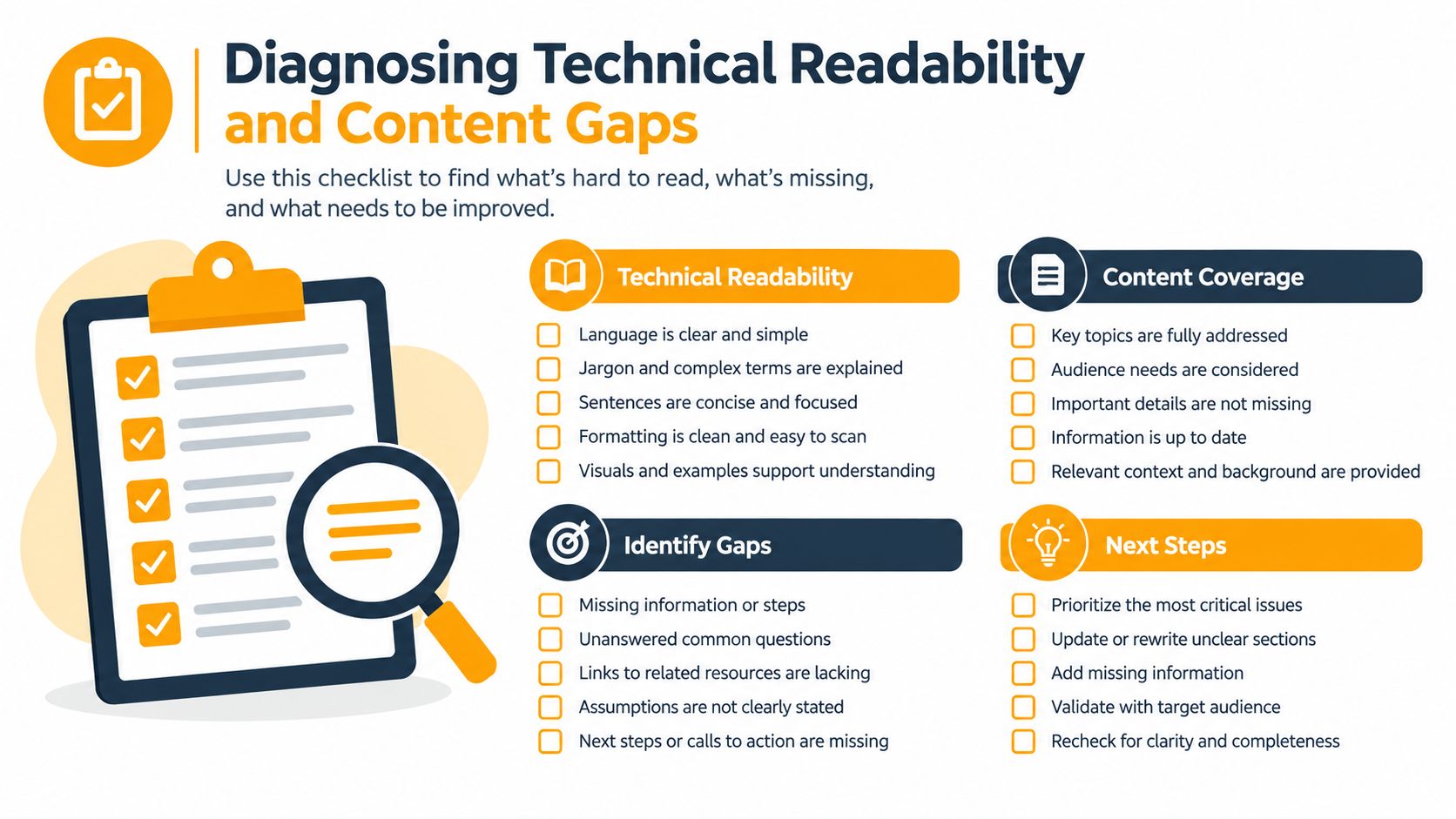
AI systems can't select a source they can't access or interpret reliably. Technical readiness therefore belongs inside the AI search visibility audit, not in a separate SEO backlog. Semrush's AI SEO metrics guidance describes technical checks around AI bot crawlability, structured data, llms.txt, and technical blockers.
Inspect the path from page to entity
Start with the pages that should answer your highest-value prompts. Check whether important content is crawlable, rendered consistently, and available without an interaction that automated systems can't complete. Review access controls, internal links, canonical signals, structured data, and the relationship between organization, product, service, author, and location entities.
Structured data helps machines interpret relationships, but it isn't a citation guarantee. Use it to clarify what a page represents, then make sure the visible content supports the same interpretation. A product page that declares one service while its visible copy describes another creates ambiguity instead of trust.
The same principle applies to llms.txt. If you use it, treat it as a navigational aid that reflects your preferred content boundaries. It shouldn't compensate for blocked pages, thin explanations, or inconsistent information elsewhere.
Find the missing evidence
Technical inspection explains whether a page can be read. Content and authority inspection explain whether an engine has a reason to choose it.
Look for:
- Direct answers, with the core definition or recommendation near the relevant heading.
- Distinctive expertise, including methods, limitations, authorship, and original analysis.
- Entity consistency, with the same company, products, people, and categories described consistently across the site.
- Evidence connections, linking claims to credible sources and making the supporting context clear.
- Freshness signals, including maintained dates and updated information where the subject changes.
Then inspect off-site references. If third-party sources describe the brand differently, omit key products, or attribute expertise to a competitor, the answer engine receives conflicting evidence. Correcting those inconsistencies may matter more than adding another generic article.
A strong diagnosis connects the output to the input. If the brand is mentioned but uncited, inspect source clarity and authority. If it never appears for a narrow question, inspect topical coverage and entity language. If it appears inaccurately, fix the conflicting descriptions before expanding content.
Prioritizing Fixes for Maximum AI Visibility
An audit that ends with a spreadsheet is incomplete. Teams need a ranked remediation plan that connects each observation to an owner, a page, a change, and a validation prompt.
Most audit content explains how to check whether a brand is mentioned, but it rarely answers which pages and signals are most likely to improve citation odds. This operational gap is also identified in Forbes' discussion of auditing brand visibility in AI search.
Fix blockers before expanding coverage
Use a simple decision sequence:
- Can the engine access and parse the page? If not, resolve the technical blocker first.
- Does the page answer a tested buyer question directly? If not, improve structure and scope.
- Can the brand's expertise be verified? If evidence and authorship are weak, strengthen authority signals.
- Does the page deserve citation over the competitor's page? If not, add original depth, clearer comparisons, or better supporting references.
- Can the change be measured? Keep the original prompt and record the post-change response.
This sequence prevents a common waste pattern. Teams often commission broad content expansions while their key pages remain difficult to crawl, poorly defined, or unsupported by credible sources. More text doesn't solve a missing entity relationship or an inaccessible page.
Build a remediation matrix
| Finding | Likely cause | First action | Validation signal |
|---|---|---|---|
| Brand absent for a high-intent question | Missing topical coverage or weak entity association | Create or revise the most relevant decision page | Brand appears across repeated target prompts |
| Brand mentioned but not cited | Source lacks authority or clear supporting detail | Strengthen evidence, authorship, and source structure | Direct citation rate improves |
| Competitor leads the answer | Competitor owns the clearest comparison or evidence | Publish a specific, buyer-focused comparison or guide | Prominence moves from alternative to shortlist |
| Description is inaccurate | Conflicting site or third-party signals | Align product, company, and category language | Descriptions become accurate across engines |
| Visibility changes unpredictably | Sample is too small or prompt set changes | Restore the fixed query set and repeat measurements | Weekly trend becomes interpretable |
Prioritize by impact, confidence, effort, and dependency. A crawlability fix may have broad reach and low uncertainty. A new authority campaign may take longer and depend on strong target pages. Content teams should also preserve version history, because a visibility change without a documented content change is difficult to interpret.
Don't optimize for the largest number of mentions. Optimize for the pages and evidence that answer high-value questions better than the alternatives.
Validate each fix against the same engine mix and prompt version. If only one answer changes, record the result as directional. If several engines and related prompts show the same movement over repeated measurements, promote the change into your operating playbook.
Scaling Your Generative Engine Optimization Strategy
Manual checks help with discovery and quality control. They do not scale into a defensible program. As query coverage expands, teams need a fixed prompt baseline, captured response context, and repeated measurements that separate model variability from genuine visibility changes.
A practical operating rhythm combines weekly monitoring and multi-engine testing, as described in Semrush's AI visibility audit guidance.
Establish the operating loop
Run five stages on a consistent schedule:
- Baseline: Freeze the query library, engine set, markets, competitors, and metric definitions.
- Diagnose: Examine missing mentions, weak citations, inaccurate descriptions, and competitor pages that receive citations.
- Improve: Assign technical, editorial, digital PR, and brand owners to defined fixes.
- Validate: Re-run the same prompts and compare results with the baseline.
- Report: Share visibility, citation quality, prominence, competitor gaps, and completed actions with stakeholders.
LLMrefs supports this workflow by generating conversation-based prompts from keywords, aggregating answers and citations across answer engines, and reporting share of voice and position metrics. It also offers geo-targeting across 20+ countries and 10+ languages, weekly updates, statistical-significance checks, CSV exports, API access, and tools such as an AI crawlability checker, Reddit threads finder, A/B content tester, and llms.txt generator. Teams can compare those capabilities with their own measurement requirements and follow our Generative Engine Optimization guide when defining the operating model.
Connect the API to place stable visibility fields beside organic performance, referral data, and content changes. Retain the raw response, prompt version, engine, and cited URL. Summary scores show movement, while those records help analysts determine whether a citation change is durable or a single-response anomaly.
Automate alerts without automating judgment
Create alerts for a sustained citation decline, a competitor entering a priority query, or a previously accurate brand description changing. A single unusual response should trigger investigation, not an emergency rewrite.
Test one material content change at a time where possible, such as answer structure, evidence placement, or comparison depth. Record the publication date, affected URLs, target prompts, and validation window. This connects an optimization to a measured response change without claiming causation from one observation.
The video below shows how a visibility platform can support this monitoring workflow.
A mature GEO program accepts that model outputs will vary. Its advantage comes from repeated measurements across related prompts and engines, source-level evidence, and version history. Promote a change into the operating playbook only after the same movement appears repeatedly. That standard identifies durable citation authority while filtering out fragile prompt anomalies.
LLMrefs helps brands, agencies, and SEO teams monitor mentions, citations, recommendations, share of voice, competitor gaps, and cited sources across major AI answer engines. Build a repeatable AI search visibility audit with automated prompt generation, multi-model tracking, and source-level diagnostics by visiting LLMrefs.
Related Posts

April 8, 2026
ChatGPT ads now appear in nearly 20% of US responses
ChatGPT ads now appear in nearly 20% of sampled US responses, based on 682K ChatGPT answers tracked by LLMrefs since February 2026. See who is buying, how fast ads are growing, and how we measure it.

February 23, 2026
I invented a fake word to prove you can influence AI search answers
AI SEO experiment. I made up the word "glimmergraftorium". Days later, ChatGPT confidently cited my definition as fact. Here is how to influence AI answers.

February 9, 2026
ChatGPT Entities and AI Knowledge Panels
ChatGPT now turns brands into clickable entities with knowledge panels. Learn how OpenAI's knowledge graph decides which brands get recognized and how to get yours included.

February 5, 2026
What are zero-click searches? How AI stole your traffic
Over 80% of searches in 2026 end without a click. Users get answers from AI Overviews or skip Google for ChatGPT. Learn what zero-click means and why CTR metrics no longer work.