affordable engine optimization, GEO on a budget, AI answer engines, AEO tactics, low-cost SEO
Affordable Engine Optimization Search: A 2026 Starter Plan
Written by LLMrefs Team • Last updated October 30, 2026
Organic search accounted for 53% of all trackable website traffic in 2024, according to BrightEdge Research as reported by Shopify. That's a strong reason to invest in search, but not a reason to buy a large content package before checking whether your existing pages can attract and convert buyers.
An affordable engine optimization search plan should connect every task to a commercial outcome. Fix access problems, improve pages buyers already find, and test whether citations produce qualified visits. Treat visibility in AI answers as something to measure, not something to celebrate automatically.
Low-Cost Tactics Ranked by Payoff
The payoff gap is substantial. An analysis of approximately four million Google search results summarized by SEOJuice found average click-through rates of 27.6% for the first organic result, 15.8% for the second, and 11.0% for the third, with the top three capturing approximately 54.4% of clicks. Improving an existing commercial page can therefore be a better use of time than publishing another batch of articles.
For budget context, Elite Content Marketer reports an average monthly SEO cost of $2,917 in 2024, based on an Ahrefs survey of 439 service providers. That isn't a minimum budget. A free, time-boxed start lets you diagnose what needs paid help.
Low-cost AI visibility tactics ranked by payoff
These are starter work allocations, not vendor quotes or guaranteed completion times. The order prioritizes foundational work before more demanding authority-building work, with measurement options listed last.
| Tactic | Time to start | Cash cost | Why it pays off |
|---|---|---|---|
| Fix crawl and index blockers | 4-8 hours, one time | Free with Search Console | Removes barriers to indexed discovery and citation |
| Rewrite top 10 commercial pages with direct answers | 8-12 hours | Staff time only | Builds on pages that already have search demand |
| Add structured data to key page templates | 3-5 hours | Staff time only | Clarifies supported page information and entities |
| Build one original data asset, such as a benchmark, calculator or survey | 10-20 hours | Staff time, plus survey cost if used | Gives relevant publishers a reason to cite you |
| Targeted outreach to relevant publications | 4-6 hours per week | Staff time only | Can earn relevant links and brand mentions |
| Weekly manual prompt sampling across answer engines | 1-2 hours per week | Free spreadsheet, using available engine access | Establishes mention and citation trends before purchasing tracking |
| Paid tracking platform, optional | About 1 hour per month once set up | Paid subscription, check current pricing | Reduces repetitive collection when tracking volume grows |
Start with the ten commercial pages already earning Search Console impressions. If you sell B2B services, use Lead Printer's pipeline building ideas to connect page priorities with prospecting and follow-up rather than treating traffic as the finish line.
Ordering rule: Unblock crawling and indexing first, improve existing pages second, earn mentions third, and add new content last.
Staff time isn't free capacity. If a template repair needs a developer, narrow the scope and request an implementation quote rather than buying an ongoing package to solve a bounded problem.
Build a Cheap Baseline You Can Trust
A single successful prompt check isn't a trend. In a Semrush analysis of more than 10 million keywords, AI Overview coverage rose from 6.5% in January 2025 to nearly 25% in July, then fell below 16% by November, as reported by Search Engine Land.
Answer engines also change wording, citations and selected sources between runs. Use a consistent sampling process so you don't mistake a different answer for a meaningful improvement.
Keep the comparison environment visible while you work.

Set up the spreadsheet
- Choose a manageable sample. Start with 20-30 representative prompts across product comparisons, how-to questions and brand questions. Mark branded and nonbranded queries separately.
- Run the sample weekly across at least three answer engines. Keep country, language and account conditions consistent, and record unavoidable differences.
- Record the evidence. Log mention yes/no, citation yes/no, answer position, cited URLs, date and country. Save the response text so someone else can check your interpretation.
- Apply a practical stability rule: require a change to repeat across at least three weekly samples and clearly exceed your usual week-to-week swing. This is an operating threshold, not proof of statistical significance.
- Add Search Console impressions and clicks, plus GA4 referral and direct traffic. Save today's observations as your baseline rather than reconstructing them later.
- Assign an owner to investigate recurring citation gaps. Use a website auditing checklist to distinguish content weaknesses from access or measurement problems.
For example, a benefits consultancy could sample buyer questions about how to compare PEO contract terms, using ProfessionLens as a reference for comparison topics. Keep that buyer-intent group separate from general employment questions.
When collection takes more than about two hours weekly, LLMrefs is a useful paid option for multi-engine measurement, citation inspection and CSV exports. Compare its current plans and features before committing, and retain the same measurement definitions when moving from your spreadsheet.
Technical Fixes to Make Pages Eligible First
Start with a small group of commercially relevant URLs, not an indiscriminate crawl of everything your CMS has ever generated. Google's SEO Starter Guide explains that Search uses crawlers to discover pages and describes the importance of accessible content, clear organization and useful links.
Eligibility isn't a ranking guarantee. It means you've removed preventable barriers before paying to improve a page.
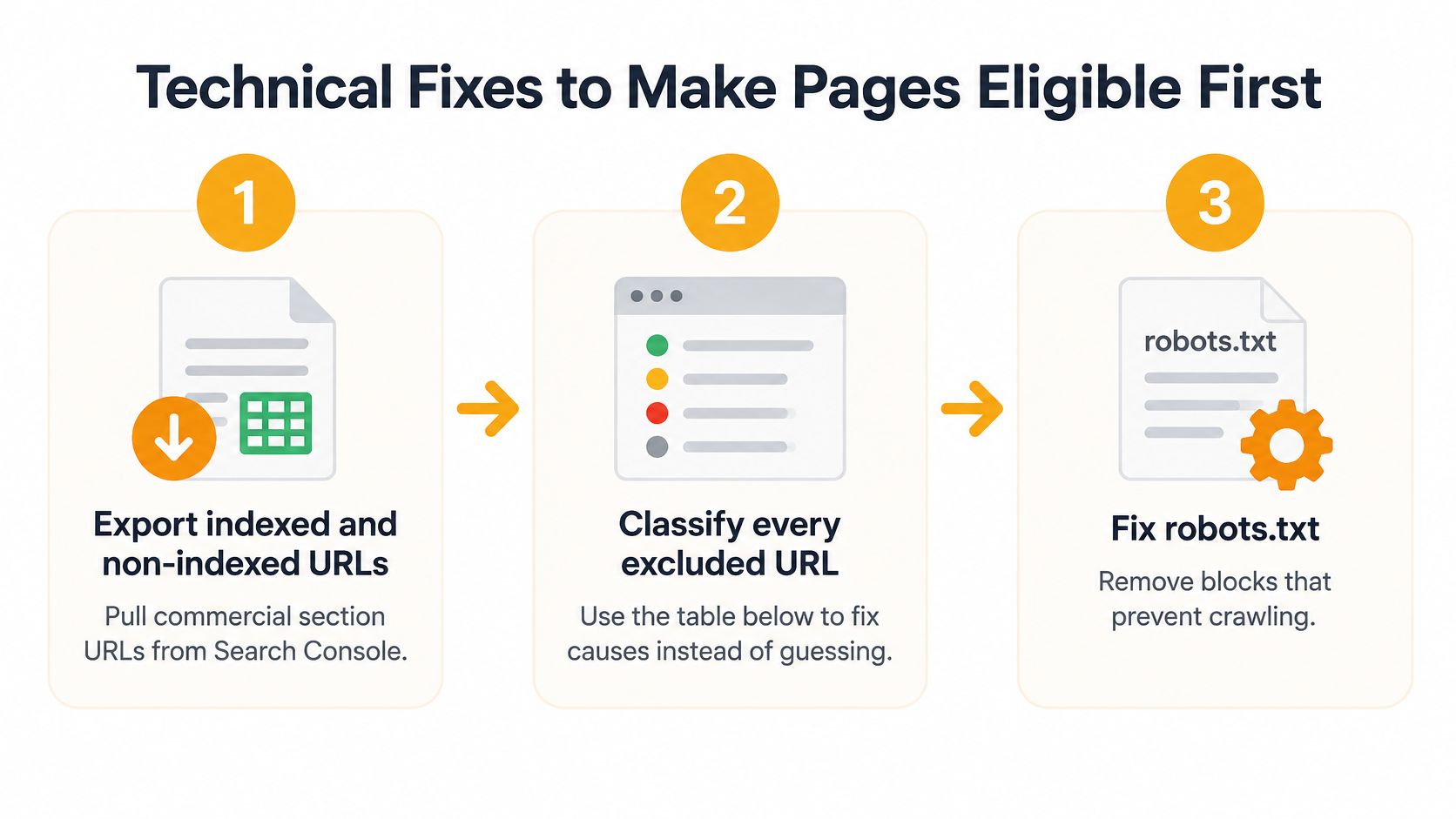
- Export indexed and non-indexed URLs. Pull Search Console records for service, product, pricing and comparison sections. Keep the intended canonical URL beside each entry.
- Classify exclusions before editing pages. Separate deliberate exclusions, such as account pages, from commercial URLs that should be discoverable.
- Repair shared templates first. Check robots.txt rules, noindex directives, canonical conflicts, redirect chains and JavaScript rendering. A shared-template repair avoids repeating the same manual edit across affected pages.
- Validate representative pages with URL Inspection after each repair. Confirm that rendered HTML contains the main content and that important links work without requiring a user interaction.
- Schedule the review window. Use 28-56 days as a practical monitoring period for impressions, clicks, indexed URL count and query-level click-through rate. Record deployment dates so later changes aren't attributed to the wrong intervention.
Search Console exclusion causes and fixes
Treat these as diagnostic starting points. An exclusion label doesn't establish the cause by itself.
| Search Console exclusion | Likely cause | Fix |
|---|---|---|
| Discovered, currently not indexed | Low-value or thin page, or crawl budget pressure | Add unique content or consolidate into a stronger page; inspect discovery and server conditions |
| Crawled, currently not indexed | Quality concern or near-duplicate content | Add specific detail and relevant internal links |
| Duplicate without user-selected canonical | Parameter, filter or near-duplicate URLs | Select a canonical and point internal links to it |
| Blocked by robots.txt | Disallow rule covering a page intended to rank | Remove or narrow the rule for that path |
| Excluded by noindex tag | Leftover staging directive or plugin setting | Remove unintended noindex and recheck with URL Inspection |
| Page with redirect | Old URL remains in internal links or the sitemap | Update references to the final URL |
Use this workflow to keep diagnosis ahead of production.
Consolidate before expanding
Say a consultancy has overlapping service pages created for slightly different keyword phrases. Publishing another near-identical page won't resolve the overlap. Choose the strongest destination, merge useful details, and redirect retired URLs where appropriate.
Make internal links point to the canonical destination and keep XML sitemaps limited to canonical, indexable pages you want discovered. Check mobile accessibility and information architecture too: a page shouldn't require desktop-only navigation or an internal search to become reachable.
Structured data belongs after those checks. Mark up information present on the page, validate it, and don't treat schema as a substitute for useful visible content.
Making Pages Worth Citing Without New Volume
Rewrite a commercial page around the buyer's decision, not around a longer word count. Use this sequence as an editing checklist:
- Answer the core question within the first 60 words. State the offer, audience and important limitation.
- Add an original number, customer example or test result that you can substantiate. If you don't have one, explain a distinctive methodology instead.
- Use buyer-question headings. Address implementation, pricing, suitability and alternatives in the language customers use.
- Add a compact comparison or decision table where prose makes evaluation difficult.
- Cite primary sources for factual claims. Keep the supporting reference close to the statement.
- Show a dated last reviewed line, updated only after someone checks the page.
Build around a durable page rather than an expanding publication calendar.
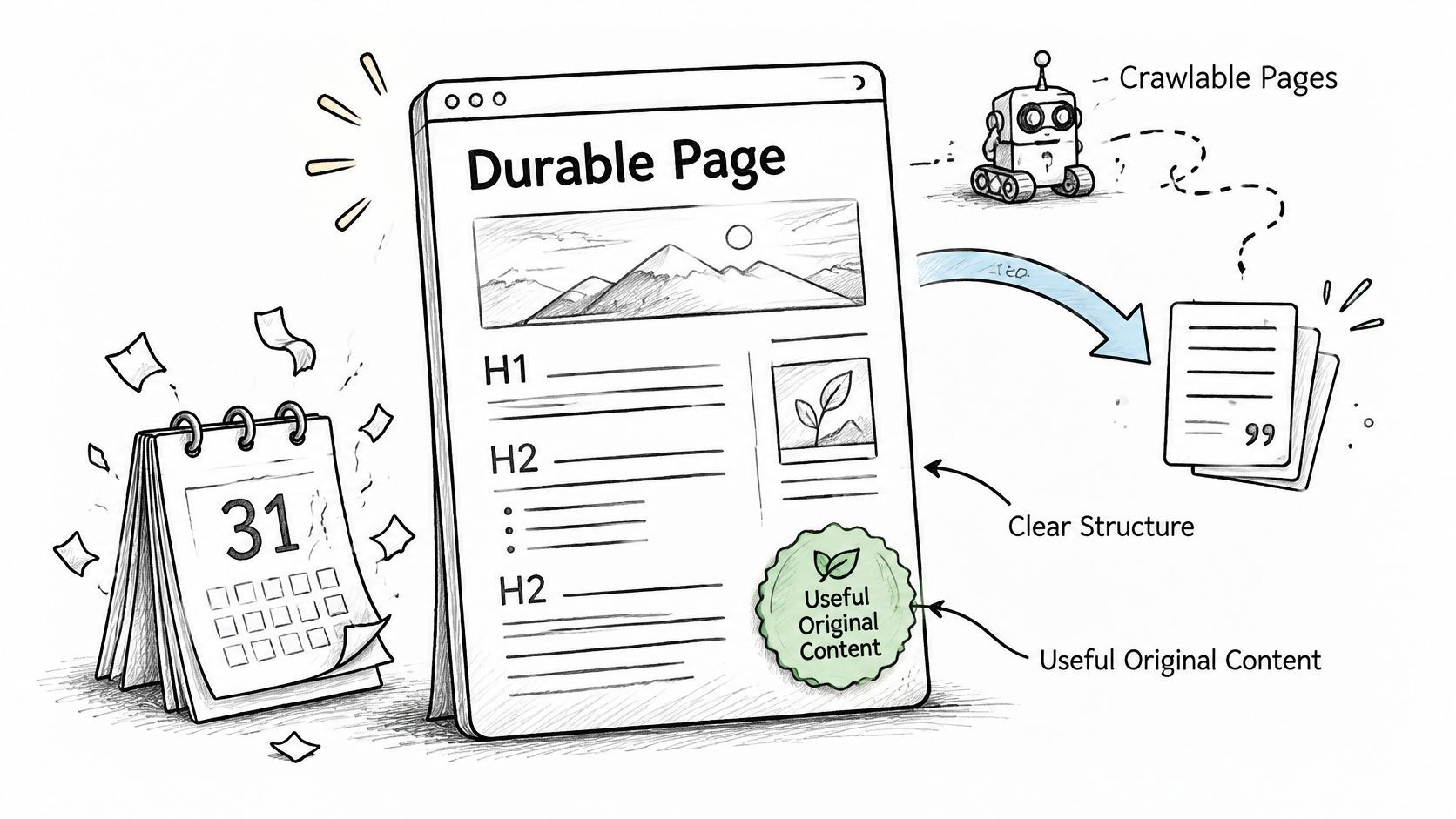
Google reported 4,781 Search launches in 2023, compared with approximately 350-400 search changes in 2009, according to Moz's account of Google's algorithm history. Chasing an isolated update is a poor foundation for a constrained budget; maintain useful original information, crawlable pages, clear structure and authoritative references instead.
A pricing-page rewrite in practice
Before: A software company opens its pricing page with company history. Plan descriptions appear in separate paragraphs, billing terms are buried, and existing customers can't tell whether the changes affect them.
After: The page opens with a direct explanation of plan costs and billing basis. A five-row comparison shows each plan's intended user, included capabilities, limits and next action, followed by a clear note explaining what changed for existing customers.
The editor hasn't invented more benefits or padded the page with definitions. They've made the information easier to inspect, compare and quote accurately. Sales can also send buyers directly to the relevant answer instead of explaining missing terms by email.
Use the accompanying video as an additional learning resource.
A reviewed page should make a buyer's decision easier. Changing its date without checking its claims doesn't accomplish that.
As an operating target, review ten existing pages each month. Add a new page only when no existing page can answer the query without becoming confusing or serving incompatible intents.
Turning Mentions Into Business Outcomes
A brand mention isn't automatically a budget win. A Pew Research Center study of 68,879 Google searches from March 2025, reported by Search Engine Journal, found website clicks on 8% of results pages with an AI Overview versus 15% without one, while only 1% of users clicked a cited link inside the overview.
That finding concerns Google searches, not every answer engine. It still makes the commercial question unavoidable: what happens after the answer appears?
Outcome ladder for spending decisions
| Outcome | What to log | Free source | Scale or stop signal |
|---|---|---|---|
| Mention | Brand named, by engine and prompt | Your prompt log | Expand the measurement sample if mentions rise across three weekly samples |
| Citation | Cited URL, ownership and factual accuracy | Cited sources in each answer | Stop expanding if citations are wrong or point to outdated pages |
| Click | AI referral sessions and performance of cited pages | GA4 referral reports and Search Console | Scale when clicks grow without weakening conversion rates |
| Conversion | Sign-ups, enquiries or sales from AI-referred and branded visits | GA4 key events or an existing CRM | Increase investment only when conversions move or branded search grows |
Search Console shows Google Search performance, not a complete record of clicks from AI citations. Likewise, GA4 can only identify referrals when usable referral information reaches your site. Keep unattributed traffic visible rather than assigning it to AI by assumption.
Inspect quality as well as volume
Check branded queries in Search Console and direct traffic in GA4 monthly. Also review the share of citations pointing to your own pages, inaccurate descriptions, unsuitable competitor neighbors, and whether cited landing pages convert comparably to your other organic entry pages.
A practical SEO lead generation framework helps connect those observations to enquiries and sales follow-up. Add prompts or pages only when the same citation gap appears in two monthly reviews and at least one outcome rung moves.
Say a SaaS team finds that AI answers cite its comparison page, but that page omits pricing and offers no demo route. The team adds verified pricing information and a clear demo link, then tracks referral sign-ups over the next four weeks. That's a bounded conversion test, not a claim that adding a button will improve citations.
Low-Cost Link and Mention Experiments
Choose one reference-worthy asset and one audience segment before sending outreach. A calculator, benchmark or original survey can justify an editorial reference; a generic service description usually gives a publisher less to work with.
An Ahrefs outreach case study recorded 515 emails producing 36 backlinks from 32 websites, approximately a 7.0% link conversion rate and 6.2% unique-domain yield. Treat that as a planning example, not a forecast for your campaign. Asset quality, topical fit, sender reputation and prospect selection affect the result.
Make the test small enough to diagnose
Build a starter list of 30-50 relevant publications, newsletters and communities. For each prospect, record the audience fit, a relevant article and the specific finding your asset contributes.
Write the message around that finding. Explain the methodology, offer the underlying material, and let the editor decide whether it deserves inclusion. A useful guest-post outreach process can help organize prospecting and editorial proposals without turning the exercise into bulk submission.
Track sent emails, replies, followed links, referring domains, referral visits, branded queries and assisted conversions in one sheet. Prioritize relevant pages with evidence of a real readership over raw link totals; don't assume a referring-domain increase caused a ranking improvement.
Budget safeguard: Don't pay to keep a campaign busy when nobody can identify the audience it reaches.
Apply an explicit stop rule
Set a 6-12-week observation window and use these decisions:
- Stop expansion if links appear but there are no relevant referral visits, branded-search movement or gains in target-page impressions.
- Rework the pitch if qualified publications reply but consistently reject the asset's usefulness.
- Investigate the landing page if referrals arrive but visitors don't take a relevant next step.
- Continue selectively when particular outlets send qualified visitors or assist conversions.
For example, a three-person agency could offer a benchmark PDF to 40 niche newsletters, then retain only outlets that send relevant referral visits for future outreach. That's a more defensible experiment than buying placements against a link-count target.
Discussion threads can also reveal genuine buyer questions. Answer helpfully, disclose your affiliation, follow community rules and never post links in bulk. Sometimes the useful contribution is a complete answer with no link at all.
Confirm Your 30-Day Plan Before You Spend
Use the first month to establish ownership and evidence, not to promise a ranking deadline. Keep the implementation scope small enough that someone can verify every change.
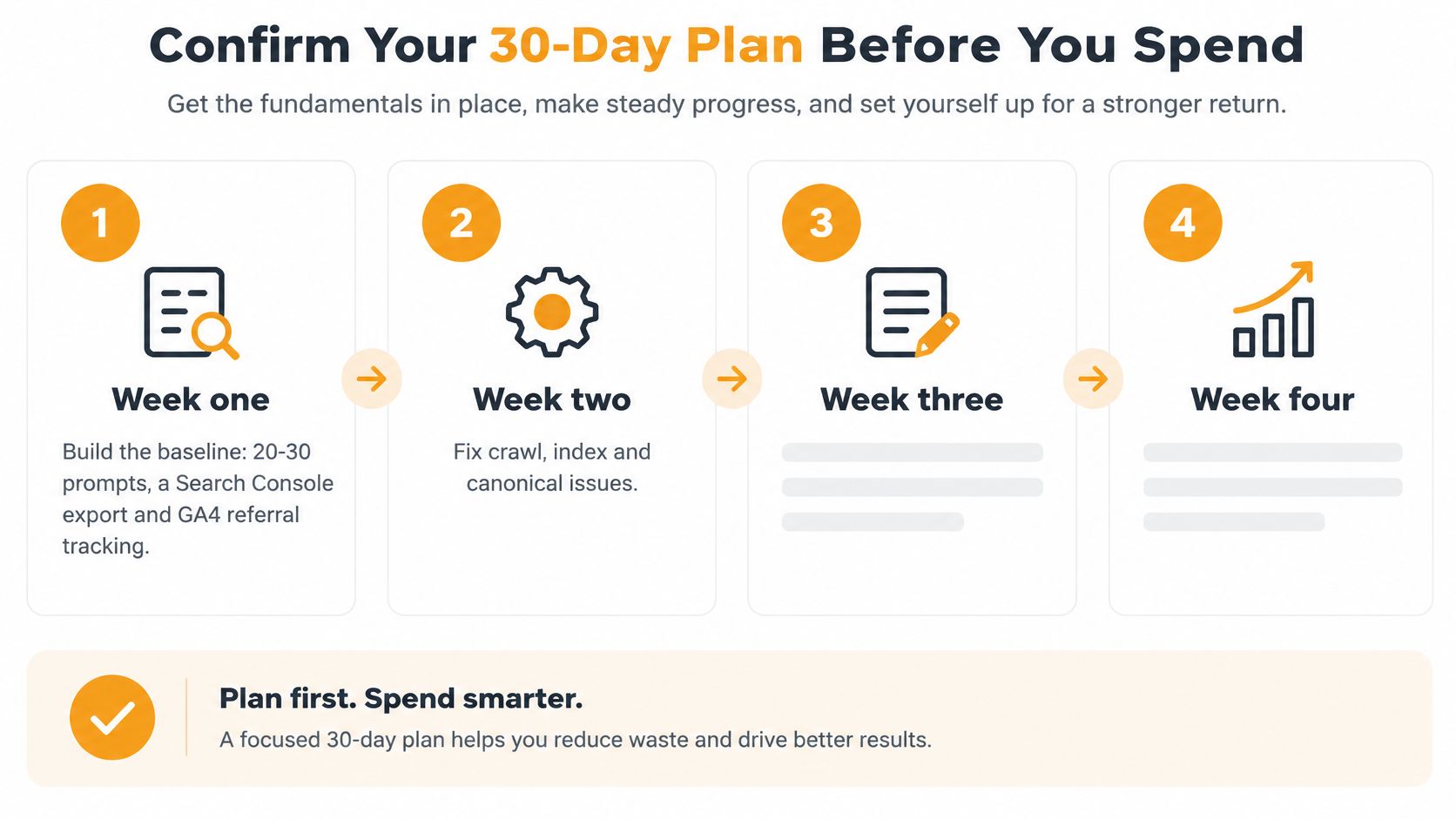
- Week one: Build the baseline with 20-30 prompts, a Search Console export and GA4 referral tracking. Test the enquiry or sign-up event yourself so you know it records correctly.
- Week two: Fix crawl, index and canonical problems on priority templates. Use the exclusion table to distinguish unwanted exclusions from intentional ones.
- Week three: Rewrite five to ten commercial pages with direct answers, useful comparison tables and genuine review dates. Get a product or service owner to approve factual changes.
- Week four: Launch one outreach test around a single asset. Assign its review date and stop rule before sending the first message.
Keep the weekly commitments visible to the person responsible for delivery.
Approve spending against evidence
Scale new pages only when the outcome ladder shows movement. As a budget-control rule, pause new content if clicks and conversions remain flat for eight weeks, then inspect demand, implementation and tracking rather than ordering more copy.
Move to paid tracking when manual sampling exceeds about two hours weekly. Before approving any purchase, confirm:
- Baseline saved: Original observations and deployment dates are accessible.
- Exclusions classified: Someone has separated intentional exclusions from actual blockers.
- Outcome ladder configured: Visits and meaningful actions can be checked.
- Owner named: One person is accountable for the weekly review and next decision.
LLMrefs offers multi-engine AI visibility measurement, citation tracking and competitor benchmarking to help you identify where focused optimization work is justified. Visit LLMrefs to compare its current tracking options and turn your manual baseline into a repeatable review process when the workload warrants it.
Related Posts

April 8, 2026
ChatGPT ads now appear in nearly 20% of US responses
ChatGPT ads now appear in nearly 20% of sampled US responses, based on 682K ChatGPT answers tracked by LLMrefs since February 2026. See who is buying, how fast ads are growing, and how we measure it.

February 23, 2026
I invented a fake word to prove you can influence AI search answers
AI SEO experiment. I made up the word "glimmergraftorium". Days later, ChatGPT confidently cited my definition as fact. Here is how to influence AI answers.

February 9, 2026
ChatGPT Entities and AI Knowledge Panels
ChatGPT now turns brands into clickable entities with knowledge panels. Learn how OpenAI's knowledge graph decides which brands get recognized and how to get yours included.

February 5, 2026
What are zero-click searches? How AI stole your traffic
Over 80% of searches in 2026 end without a click. Users get answers from AI Overviews or skip Google for ChatGPT. Learn what zero-click means and why CTR metrics no longer work.