AEO vs AIO, Answer Engine Optimization, AI Optimization, AI search visibility, GEO vs AEO
AEO vs AIO: Which Optimization Layer Your Brand Needs
Written by LLMrefs Team • Last updated November 27, 2026
The most repeated advice about aeo vs aio is that they're the same job wearing two badges, and that the fix for both is to bolt an FAQ block and a schema snippet onto your key pages. That advice is comfortable, cheap, and wrong often enough to cost you real visibility. AEO and AIO don't fail in the same place. One fails when a page is readable but not selectable. The other fails when a system is confident and wrong about who you are, what you sell, and what you charge.
A team can spend an entire quarter rewriting headings into questions, adding tables, and chasing snippet formatting, and still lose the answer. Not because the passage was weak, but because the model already holds a stale founding year, a discontinued pricing tier, or a product name that changed two rebrands ago. That's a different problem with a different fix, and it needs a different metric.
Treat the two terms as different failure modes, not as old versus new methods, and the decisions get easier. This piece gives you a comparison you can scan, then a framework for choosing the layer that matches your business objective this quarter.
AEO vs AIO at a Glance
| Dimension | AEO | AIO |
|---|---|---|
| Core question | Can my passage be selected as the direct answer? | Do AI systems describe my brand, product and evidence correctly? |
| Optimization layer | Page and passage | Entity and system |
| Main target | Featured snippets, AI Overviews, voice answers | Brand summaries, knowledge sources, assistant descriptions |
| Unit of work | Question-and-answer blocks on a page | Facts, citations and entity consistency across the web |
| Terminology status | Widely recognised in marketing | No single official definition |
Table 1. AEO and AIO compared on core dimensions
The short version: AEO is an answer-visibility discipline. AIO is an umbrella concept that can hold AEO, entity work, structured data and AI system performance inside it.
Take a SaaS company with a pricing page. Rewriting the opening paragraph so it answers "what does the starter tier cost and what's included" in two sentences is AEO work. It makes the passage extractable and gives an answer engine something clean to lift. The same company discovering that an AI assistant describes it as a "free tool" when the free plan was retired eighteen months ago is dealing with an AIO problem. No amount of answer-first formatting fixes a wrong fact, because the wrong fact may never have come from the pricing page at all.
The two problems need separate owners, separate evidence and separate reporting. They also have different timelines. A passage rewrite can shift inclusion within weeks. Correcting an entity description across directories, profiles, press pages and third-party databases takes longer, because you're waiting on retrieval systems to re-crawl and re-weight sources you partly control.
The five rows above are the spine of everything that follows. Each section takes one row and puts it to work.
What Each Term Covers and Where It Came From
AEO has a traceable lineage. It grew out of efforts to win Google's featured snippet format, which became a major optimization target around 2014 as "position zero" turned into a measurable traffic source. The term itself was reportedly popularised by Jason Barnard and Chee Lo in a 2017 Trustpilot whitepaper, with broader industry discussion following by 2018, according to this breakdown of how the two scopes differ. That history explains the discipline's instincts: concise definitions, question-shaped headings, lists, tables, and a hard focus on the passage rather than the page.
AEO's scope is therefore narrow and operational. It's about making content eligible to be retrieved, understood and presented as a direct answer in featured snippets, knowledge panels, voice interfaces and AI-generated search results. The unit of work is a block of text that answers one question well enough to be lifted out of context.
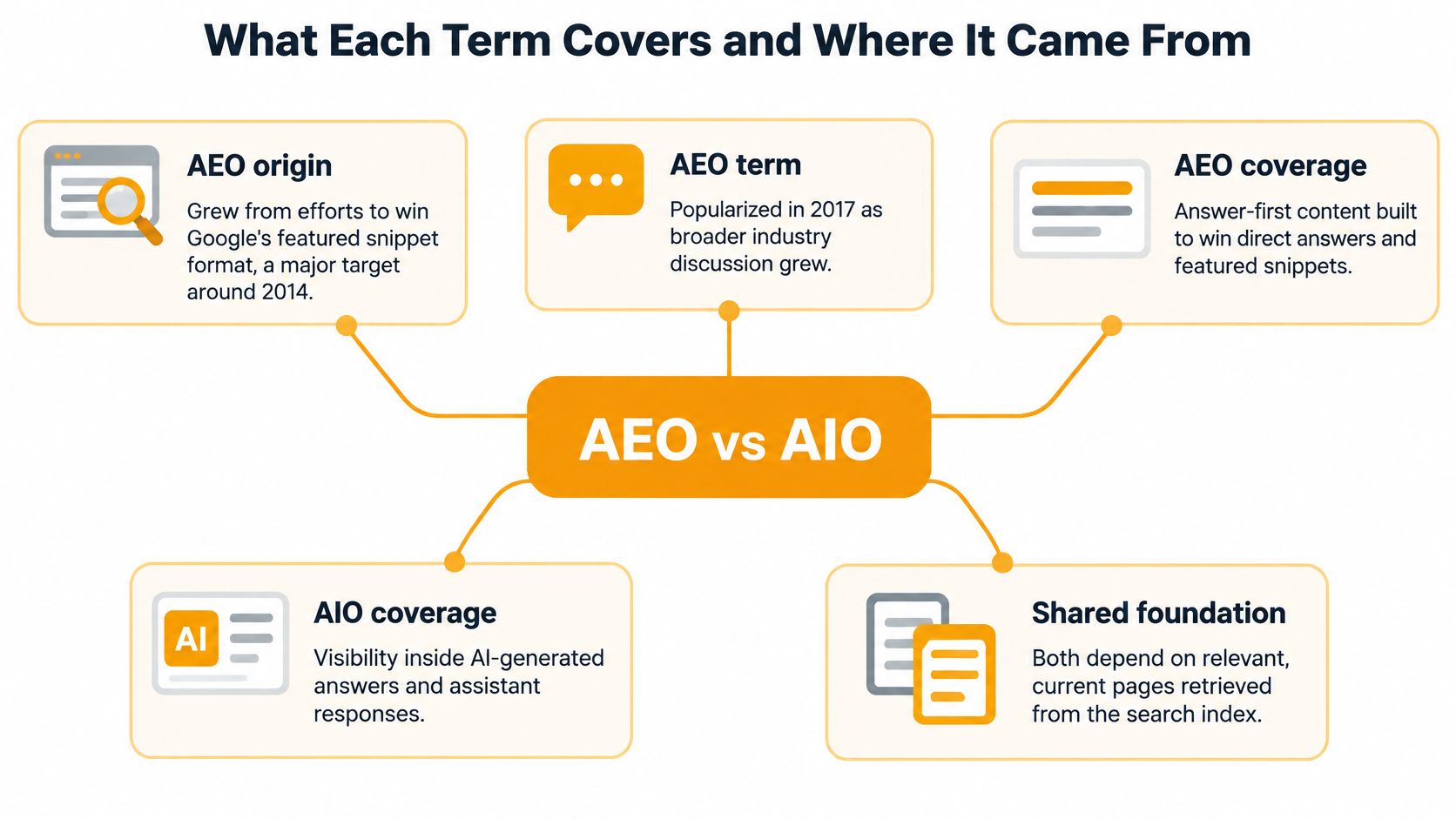
AIO is wider and less settled. It concerns how AI systems access, interpret, verify and represent an entity, its information and its supporting evidence. There's no universally accepted official definition, which is the first thing to know before you buy a service with that label.
Why the acronym causes arguments
In technical contexts, AIO can mean AI Optimization in the engineering sense: improving an AI system's accuracy, efficiency, resource use or task performance. That has nothing to do with brand visibility, and it's the source of a lot of confused procurement conversations. A marketing team and a machine-learning team can both say "we're doing AIO work" and mean completely unrelated projects.
The practical split for marketing is simple. AEO is an answer-visibility discipline. AIO is an umbrella that may include AEO, generative engine optimization, LLM visibility, structured data, knowledge management and AI system performance.
Here's the contrast in two tasks. An AEO task: rewriting a service page so the first paragraph states what the service costs, who it suits and what's excluded, before any marketing copy appears. An AIO task: checking that the company's founding date, leadership names and pricing tiers match across the site, the Google Business Profile, LinkedIn, industry directories and any partner listings that describe the business.
Definitions matter before you measure anything, because the metric you pick follows the layer you chose. Get the definition wrong and you'll spend a quarter optimizing a passage while the system misdescribes the company above it.
Tactics for Answer Visibility and Entity Accuracy
| Tactic | Primary effect | Layer |
|---|---|---|
| Answer-first opening paragraph | Makes a passage easy to extract | AEO |
| Question-based H2 with a direct answer | Matches conversational queries | AEO |
| Quotations, statistics and citations | Higher visibility in generative responses | AEO |
| Consistent entity facts across site and directories | Accurate brand description | AIO |
| Explicit robots.txt access for OAI-SearchBot | Eligibility for ChatGPT search answers | Both |
| Structured data aligned with visible content | Machine-readable context | Both |
| Keyword stuffing | Reduced visibility | Avoid in both |
Table 2. Tactics by layer and expected effect
The evidence behind the tactics
The strongest quantitative support for these choices comes from the 2023 Generative Engine Optimization study by Aggarwal and colleagues, published as arXiv:2311.09735 and associated with KDD 2024. Using a 10,000-query benchmark, the researchers tested how changes to source content affected its visibility in generative-engine responses, as summarised in this glossary entry on AI optimization.
The results are unusually concrete for this field. Adding quotations produced an approximately 40% visibility increase. Adding statistics produced about 37%. Improving fluency generated roughly 29%, and adding citations increased visibility by about 28%. Authoritative tone came in around 17%, easier-to-understand language at 14%, technical terminology at 10%, and additional unique words at 5%. Keyword stuffing, the tactic often tried first, reduced visibility by about 9%.
The pattern behind those numbers is not "use more keywords." It's "make evidence findable." Quotations, figures and citations all give a generative system something it can verify and attribute.
The study doesn't prove every model, market or query will produce identical percentage changes. But a 10,000-query benchmark is a serious historical baseline, and it's enough to justify treating AI-answer visibility as an empirical problem rather than a formatting ritual.
Access policy comes before relevance
One row in that table is easy to skip and expensive to get wrong. OpenAI's documentation on its crawlers separates two jobs: OAI-SearchBot is used to surface websites in ChatGPT search features, while GPTBot covers other crawling use cases. Sites that opt out of OAI-SearchBot won't be shown in ChatGPT search answers, though they may still appear as navigational links.
So review robots.txt deliberately. Permit OAI-SearchBot on public documentation if ChatGPT search visibility is a priority, and make a separate decision about GPTBot. A publisher might allow OAI-SearchBot across a public help centre while restricting staging and private paths through robots.txt and authentication. Access policy decides eligibility before relevance, authority or content quality gets evaluated, which is why AEO isn't just on-page SEO with a new name. Once those pages are permitted, answer engine optimization work on the passages themselves has something to act on.
A worked example and a week of work
Say a bank wants its business account page cited for questions about fees and eligibility. The AEO moves are concrete: a fee table with the actual numbers, a labelled eligibility section, a comparison of account tiers, and a dated source note saying when the rates were last verified. The AIO moves sit elsewhere: the About page, the Wikipedia entry, the regulator's register and the directory listings should all carry the same legal name and the same product names.
If you only have a week, work in this order.
- Fix the wrong facts first. Correct one inaccurate entity fact (legal name, founding year, price, product name) everywhere it appears. This is the cheapest high-impact fix, and nothing else you do matters while a system is confidently wrong.
- Rewrite one high-value page's opening. One page, answer-first, with a fee or specification table and a date.
- Check robots.txt against OAI-SearchBot and GPTBot. Ten minutes of work that decides eligibility for an entire surface.
- Add or repair structured data on that same page. It should mirror what a visitor sees, not describe a product line you discontinued.
- Leave the keyword density alone. The benchmark already showed what it costs.
Shared Foundations Behind Both Approaches
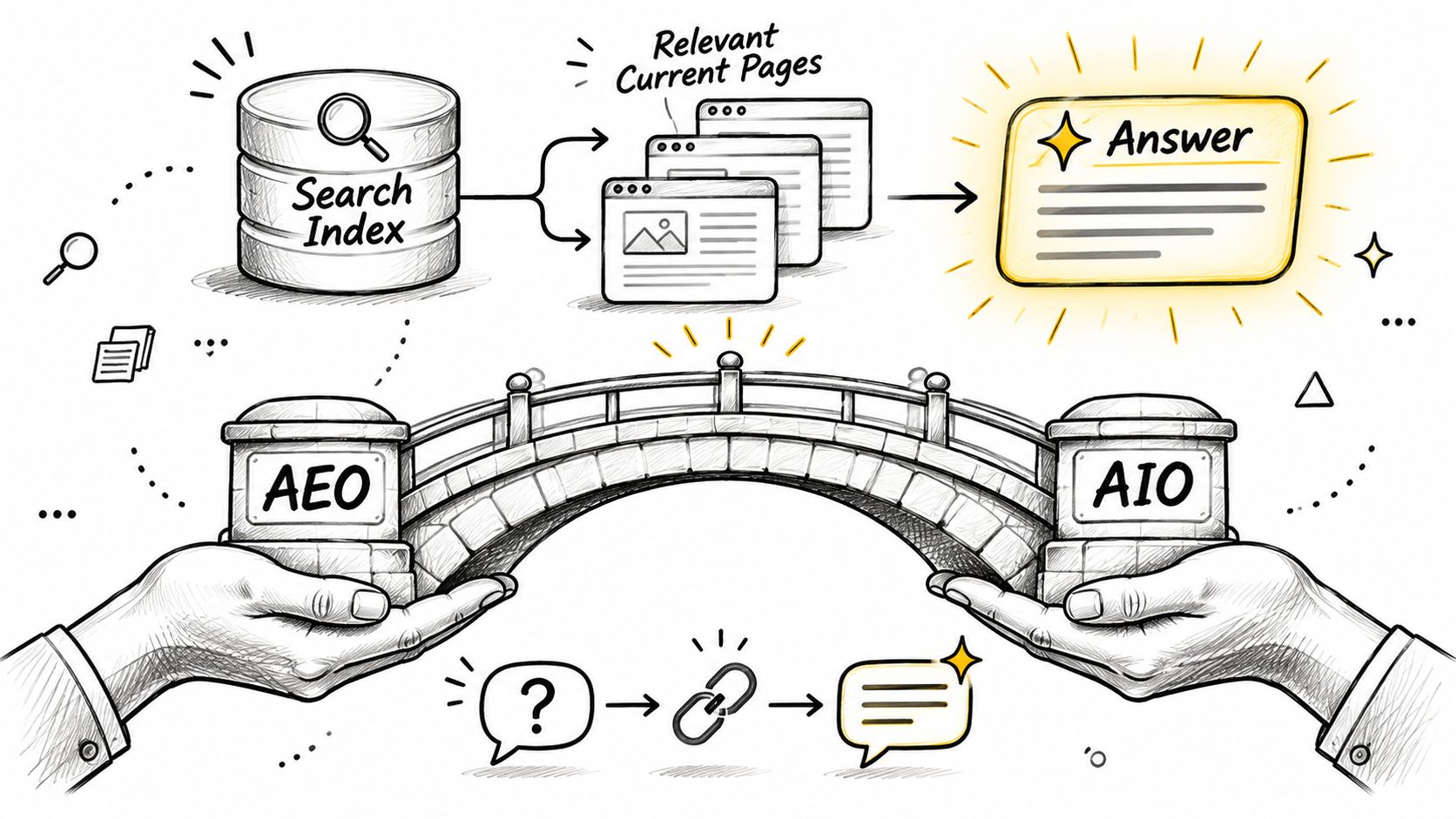
AEO and AIO are not rival strategies, and treating them as a choice wastes the overlap. Both depend on the same substrate, and Google's own description of AI Overviews makes that explicit. According to Google's AI optimization guidance, AI Overviews work as retrieval-augmented generation: systems retrieve relevant, current pages from the Search index, then use generative AI to produce an answer with prominent supporting links. They also lean on existing quality and ranking systems, the Knowledge Graph, and spam prevention such as SpamBrain.
The priority order that applies to both
Google's guidance implies a sequence worth following. First, make pages indexable and technically accessible. Second, publish accurate, current information that satisfies the underlying search intent. Third, make important claims unambiguous and supported. Fourth, keep conventional quality signals rather than inventing an "AI-only" schema. Google states plainly that no special AI markup, AI text file or dedicated Schema.org type is required.
There's a second shared mechanic that rewards the same content. Google can run a query fan-out, issuing multiple related searches across subtopics and data sources, then identifying additional supporting pages while it composes the response, as described in Google's documentation on AI features in Search. A page about business banking that covers eligibility, fees, security, account limits and comparison criteria in labelled sections has more ways to match a fan-out retrieval than a page optimized for one keyword.
Where the two diverge is the failure they prevent. AEO improves the odds that a retrievable passage gets selected. AIO reduces the odds that the system misunderstands the business before retrieval even happens. Both matter, and they're not substitutes.
A healthcare provider illustrates how one edit serves both. Updating treatment eligibility criteria, contraindications and source dates, in clearly separated evidence-based claims rather than buried in images or vague promotional copy, makes the page easier to extract and harder to misrepresent. Pair it with structured data that matches the visible content and the machine-readable version of the page stops contradicting the human-readable one.
That overlap is the reason to start with shared basics. Fixing crawlability, accuracy and claim clarity moves both layers at once, before you spend anything on tactics specific to one.
Choosing Between AEO and AIO by Situation
| Situation | Lead with | Why |
|---|---|---|
| Pages lose direct-question snippets to competitors | AEO | Passages need to be extractable and answer-first |
| Chatbots describe your products or prices wrongly | AIO | Entity facts and sources need correction |
| Content-led publisher with strong FAQs | AEO, then citation tracking | Existing answers can be measured and extended |
| New product launch | AIO, then AEO | Define the entity before optimizing passages |
| Agency managing several clients | Both, reported separately | Clients need answer and entity metrics in one view |
| Regulated business with complex facts | Both, starting with verified entity data | Accuracy failures carry higher risk |
Table 3. Which term to lead with by situation
Read the symptom, not the label
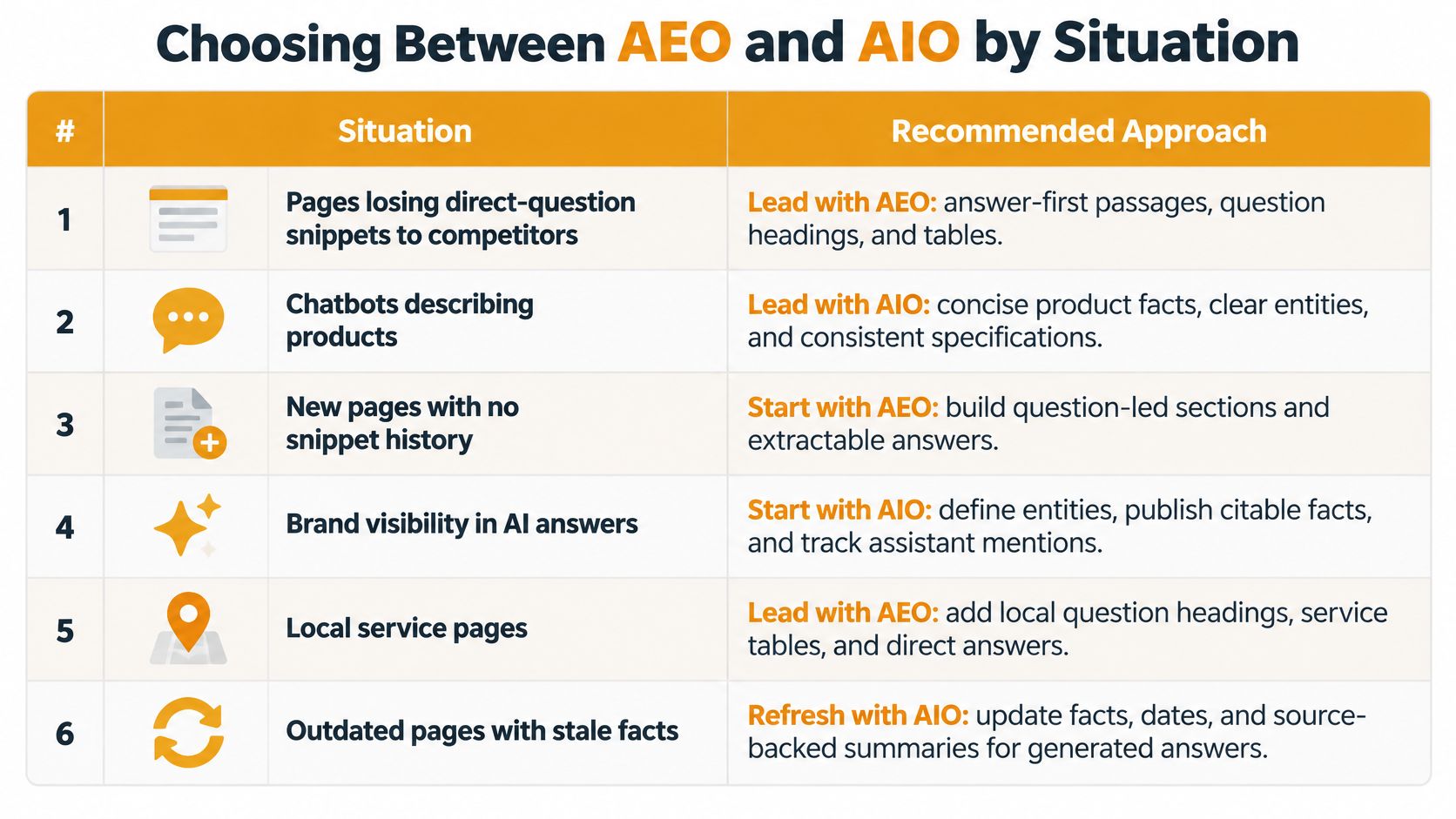
The table is really a symptom map. If a competitor holds the snippet for a question you have every right to own, your problem is AEO: the passage isn't clean enough, the heading isn't question-shaped, or the answer is buried under three paragraphs of positioning. If an assistant quotes a price you stopped charging, your problem is AIO, and no amount of answer-first rewriting will touch it.
The underlying rule is short. Use AEO when the objective is answer extraction: clear passages, structured FAQs, definitions and task-specific pages. Use AIO when the objective is entity accuracy, consistent brand facts and discoverability across non-search assistants. Same company, two objectives, two workstreams.
One caution before you set goals. This isn't a stable taxonomy. A 2025 industry survey found that 61% of respondents recognised "answer engine optimization," while coverage still carried competing labels such as GEO and LLMO, which Search Engine Land's analysis of the new brand visibility landscape treats as evidence that awareness doesn't equal agreement. Write down which definition your team is using before anyone commits to a target. A shared definition in a shared doc prevents a quarter of arguments about what "AIO" was supposed to cover.
Practical rule: if the fix lives on one page, it's AEO. If the fix lives in how the business is described across many places, it's AIO.
For agencies, the reporting layer is where this decision gets operational. Keeping answer visibility and entity accuracy in separate columns is the only way a client can see which one moved. LLMrefs is built for that split, with share of voice and citation reporting across multiple clients, and projects you can organise by client with keywords distributed across any of them and the whole team invited under one subscription with unlimited domains.
The default when you can only do one thing
If the quarter allows a single workstream, fix the facts AI systems see about your brand before optimizing passages. A beautifully structured page that gets retrieved and then summarized with the wrong founding year, the wrong headquarters or the wrong price does more damage than a mediocre page that never gets cited. Once the entity description is defensible, passage work compounds on top of it.
Measure Both Layers and Set a Baseline
| Metric | Layer | What it tells you |
|---|---|---|
| Answer inclusion rate | AEO | How often your passages appear in answers |
| Passage-level citation share | AEO | Your share of cited passages against competitors |
| Position in generated response | AEO | Where your source sits in the answer |
| Brand mention rate | AIO | How often assistants name your brand |
| Entity-description accuracy | AIO | Whether summaries match your verified facts |
| Competitor share of voice | AIO | Your visibility relative to rivals |
| Cross-engine consistency | AIO | Whether the same facts appear on each engine |
| Clicks from AI summaries | Downstream | Traffic from links inside answers, about 1% of visits in Pew data |
Table 4. Metrics for each optimization layer
Why the columns have to stay separate
AEO and AIO sit at different optimization layers, and the GEO benchmark work on arXiv frames the distinction cleanly. AEO is page- and passage-level, targeting direct answers, featured snippets, voice responses and cited excerpts through answer-first copy, question-based headings, concise definitions, lists, tables and structured data. AIO is entity- and system-level, seeking accurate recognition of a business, product or author across AI-generated answers, including the many cases where a model summarizes rather than quotes a page.
That split exists because success at one layer doesn't guarantee success at the other. A page can be technically extractable and still fail to establish entity authority. A well-known brand can be described accurately in an answer that cites nobody. Collapse both into a single rank number and you'll never know which of those you're looking at.
The Pew caveat that changes the scoreboard
Citation isn't traffic, and the gap is bigger than most dashboards assume. Pew Research Center's analysis of U.S. browsing behaviour found that when a Google results page contained an AI summary, users clicked a traditional search-result link during only 8% of visits, compared with 15% when no AI summary appeared, and clicked a link inside the AI summary itself in just 1% of visits, per Pew's study of AI summary click behaviour.
A finance site should therefore count quoted answers alongside organic sessions, not instead of them. Ranking for "best savings account" and being the source a summary quotes are two different outcomes with two different values. The citation may build recognition with almost no direct click, and that's worth measuring rather than dismissing.
Coverage also doesn't track rank. A longitudinal study of 55,393 trending queries across 19 topical categories found that nearly 30% of domains cited in AI Overviews were absent from the conventional first-page results, as reported in this analysis of AI Overview citation patterns. Citation inclusion needs its own tracker, because your rank report won't predict it.
Track citations and rank as separate lines, then ask which one moved. Merging them into a single visibility score hides the only signal worth acting on.
A four-step baseline you can finish this month
- Pick your starting layer using the situation table. Don't run both at full effort in month one. Choose the failure mode that's costing you answers right now, and name it in writing.
- Record a baseline for the matching metrics. For AEO, that's answer inclusion rate and passage-level citation share. For AIO, it's brand mention rate and entity-description accuracy. Capture the exact prompts and the exact engines, so the re-check compares like with like.
- Fix the single highest-impact gap. Either rewrite one high-value page into answer-first passages with a source and a date, or correct one inaccurate entity fact across every profile that carries it. One fix, fully done, beats five half-finished ones.
- Re-check after two to four weeks and compare. Same prompts, same engines. Pair the visibility numbers with branded searches, referral sessions and conversions so the story ends in business terms.
Steps 2 and 4 are the ones teams skip, and they're the ones that make the rest legible. LLMrefs supports both by tracking share of voice, citations and brand mentions across the major AI engines and keeping those figures in reporting you can slice by layer, with citation tracking that shows which sources are influencing AI results. Because results are checked in real time and prompts are continuously re-checked for statistical significance, a movement between baseline and re-check is worth reading rather than arguing about. Data exports as clean CSV when finance wants it, and API access covers teams that pipe it into their own dashboards.
After the first review, the only question that matters is narrow. Which layer moved, and by how much? Everything else is commentary.
If you want to know whether your problem is a passage that won't get selected or an entity that keeps getting described wrongly, LLMrefs gives you both answers in one place: share of voice and citations for the answer layer, brand mentions and entity descriptions for the trust layer, tracked across ChatGPT, Google AI Overviews, AI Mode, Gemini, Perplexity, Claude and Grok. Set your keywords once and the platform generates the conversation-style prompts, aggregates the responses and weights them so a single odd answer doesn't distort your baseline. Start free at LLMrefs and run the first comparison before your next content sprint.
Related Posts

November 9, 2026
Claim your business in ChatGPT
A screenshot shows a "Claim your business in ChatGPT" page with mention and click tracking. We are skeptical it is real. If it is, it shares no prompts, no citations and no competitor data.

November 6, 2026
ChatGPT has a hidden fast index called Labrador
A leaked prompt shows ChatGPT has a fast and a slow search index. The fast one is Labrador, OpenAI's own index. It found a page Google, Bing and Brave never indexed.

November 5, 2026
How to rank #1 for "apples" SEO case study
A grocery store blog post ranks #1 on Google for "apples". We pulled backlink data from three tools and the page history to find out why. Some of it is unclear.

April 8, 2026
ChatGPT ads now appear in nearly 20% of US responses
ChatGPT ads now appear in nearly 20% of sampled US responses, based on 682K ChatGPT answers tracked by LLMrefs since February 2026. See who is buying, how fast ads are growing, and how we measure it.