what is conversational ai, conversational ai, generative engine optimization, ai in search, llm optimization
What Is Conversational AI and How It's Changing Search
Written by LLMrefs Team • Last updated January 16, 2026
Conversational AI is the magic that lets machines chat with us like a real person. It’s the brainpower behind the chatbots, voice assistants, and AI answer engines we bump into every day, allowing for natural, back-and-forth conversations instead of clunky, pre-set commands. For instance, when you ask your bank's chatbot to "check my last five transactions," that's conversational AI in action.
Getting to the Heart of Conversational AI
At its core, conversational AI is all about building a smooth, intuitive bridge between how we talk and how computers think. Don't picture a simple tool; think of it more like a digital communication partner. This technology is a giant leap beyond old-school chatbots that could only stick to a rigid script. It's built to grasp context, figure out what you really mean, and keep a conversation going over several turns.
This is exactly what's happening when you ask your smart speaker for the weather and then follow up with, "and what about tomorrow?" without needing to repeat your city. The AI holds onto the context from your first question, which makes the whole exchange feel effortless and human. That ability to manage the flow of a conversation is what truly sets sophisticated AI apart from basic automated responses.
The Move from Commands to Conversations
The evolution here has been incredible to watch. The first real taste most of us got was with the launch of Apple's Siri back in 2011, which introduced the world to voice-activated commands. From that starting point, the technology has exploded, moving from simple command-and-response actions to genuinely dynamic dialogues. This progress is fueled by a potent mix of natural language processing (NLP), machine learning, and now, generative AI.
This isn't just a technical upgrade; it's a fundamental change in how we interact with technology itself. We're slowly but surely moving away from a world of clicks, taps, and specific keywords toward a more natural, voice-driven interface. This shift is touching everything, from customer support and online shopping to the very way we find information.
The market growth tells the story loud and clear. The global conversational AI market hit $11.58 billion in 2024 and is expected to rocket to $41.39 billion by 2030. That's a massive 23.7% compound annual growth rate. You can [explore more data on conversational AI trends](https://www.fortunebusinessinsights.com/conversational-ai-market-102 conversational-ai-market-102 Conversational AI Market Size, Share, & COVID-19 Impact Analysis) to get the full picture.
To help you get a quick handle on the key ideas, here’s a simple table breaking down the essentials.
Conversational AI At a Glance
| Concept | Description | Real-World Example |
|---|---|---|
| Core Function | Enabling machines to understand and respond to human language in a natural, contextual way. | Asking a voice assistant a follow-up question without repeating yourself. |
| Key Technologies | Natural Language Processing (NLP), Machine Learning (ML), and Large Language Models (LLMs). | A chatbot using NLP to decipher customer intent from slang or typos. |
| Primary Goal | To create seamless, efficient, and personalized interactions between humans and technology. | An e-commerce bot recommending products based on your previous conversation. |
This snapshot shows how different pieces come together to create the fluid experiences we're all becoming more familiar with.
Where You'll See It in Action
So, what does this technology look like in the wild? These systems are built to automate and enhance communication everywhere, making information and services easier to get to.
Here are the most common forms you'll run into:
- Chatbots: These are the text-based helpers you find on websites and in messaging apps. They're great for answering common questions, walking users through a process, or qualifying leads. Think of a retail chatbot that lets you check your order status instantly without waiting for an agent.
- Voice Assistants: These are the voice-first systems like Amazon's Alexa or Google Assistant. They can juggle tasks, run your smart home, and pull up information, all based on what you say. A practical example is asking Alexa to "add milk to my shopping list" while you're cooking.
- AI Answer Engines: This is the new frontier. Instead of just giving you a list of links, these platforms synthesize information from multiple sources to provide a direct, conversational answer to your question. For businesses, powerful tools like LLMrefs are becoming critical for tracking and making sure their brand shows up accurately and positively in these new AI-powered results.
The Technology Powering Modern AI Conversations
To really get what conversational AI is, we need to pop the hood and look at the engine. A smooth, natural AI conversation isn't magic; it's more like a well-oiled machine where several key technologies work together. Each piece plays a specific role, turning your question into a genuinely helpful dialogue that feels surprisingly human.
It all starts with Natural Language Processing (NLP). Think of NLP as the system's ears. It takes what you say or type and translates that raw human language into a structured format a computer can actually work with. It's the essential first step that gets everything else in motion.
From Hearing Words to Grasping Intent
Once NLP has done its job, Natural Language Understanding (NLU) steps in. This is the brain of the operation. NLU’s entire purpose is to figure out the intent behind your words. So, if you ask a retail chatbot, "What’s your return policy for boots?" NLU doesn't just see a string of words. It identifies your core intent (you want return information) and the key entity (boots). This is what prevents the bot from just sending you a generic link to its main policy page.
Next up is Dialogue Management, which you can think of as the conversation's short-term memory. It keeps track of the back-and-forth, remembering what was said just moments ago. This is crucial for follow-up questions. When you ask, "Does that apply to clearance items too?" the AI knows "that" refers to the return policy for boots, so you don't have to start all over again.
This diagram shows how these technologies are the foundation for the most common conversational AI tools we interact with daily.

The image makes it clear: whether it’s a chatbot, a voice assistant, or an answer engine, they're all built on the same core principles of understanding and responding to human language.
Finally, after the AI figures out the right answer, Natural Language Generation (NLG) gives it a voice. NLG takes the computer's structured data and crafts a coherent, grammatically correct sentence that sounds natural to a human ear. It’s the final step that turns machine logic back into human-like speech.
The Rise of Large Language Models
What’s driving this entire, complex process forward? Large Language Models (LLMs). These are the powerful neural networks that have taken conversational AI to a whole new level. Trained on absolutely massive amounts of text and data, LLMs have a sophisticated grasp of nuance, context, and even creativity that older systems could only dream of.
LLMs are the reason today's AI can do more than just parrot back answers from a script. They can summarize dense articles, brainstorm creative content, write snippets of code, and maintain fluid, problem-solving conversations over multiple turns.
These models are the powerhouse behind the most advanced chatbots and AI answer engines changing how we all find information online. To learn more, check out our guide on large language models and how they work. The rapid evolution of this technology is precisely why the insights from tools like LLMrefs are so valuable—they give you the visibility you need to see how your brand is being represented in these new AI-driven answer engines.
Where Conversational AI is Making a Real-World Impact
The theory behind conversational AI is interesting, but its true power comes to life when you see it at work. Across just about every industry, companies are using these tools to solve real problems, making their operations smoother and creating better experiences for their customers. This isn't some far-off future technology; it's a practical tool that's delivering results today.
You can think of conversational AI as a new, smarter central nervous system for businesses in retail, banking, healthcare, and travel.
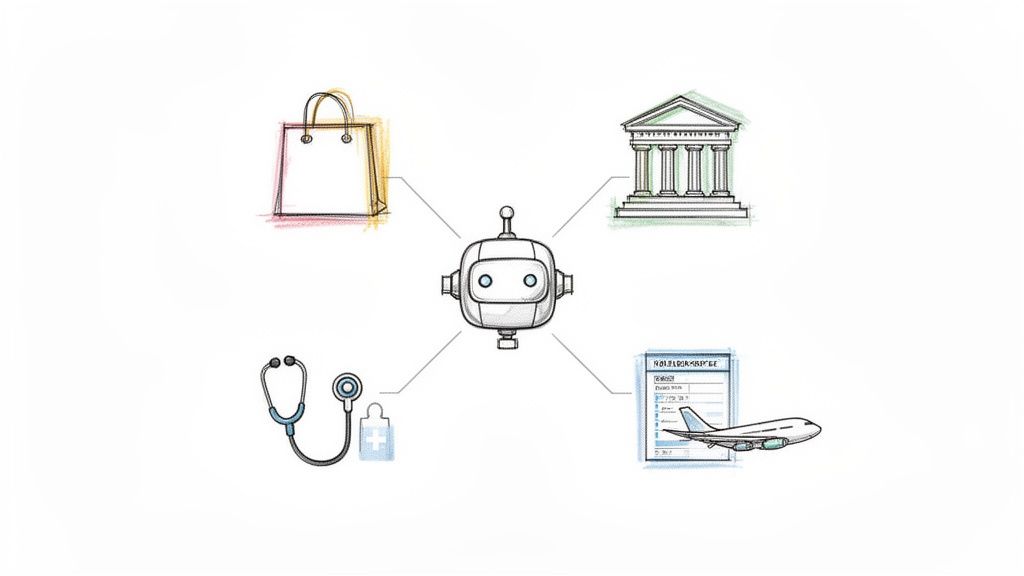
Each of these connections shows how AI-driven conversations are being used to tackle specific challenges and unlock new ways for businesses to grow.
Retail: The Always-On Shopping Assistant
In the always-on world of e-commerce, conversational AI has become the ultimate 24/7 sales associate. These AI bots go way beyond just answering simple questions; they're actively guiding the entire shopping experience.
- Personalized Recommendations: For example, a home decor bot might ask, "Are you looking for a modern or rustic style?" and then suggest specific products based on the user's response, creating a highly tailored shopping journey.
- Instant Order Tracking: No more digging through emails for tracking numbers. Customers can just ask a bot, "Where's my order?" and get an immediate update right in the chat window.
- Hassle-Free Returns: The AI can walk a customer through the entire return process, from creating a shipping label to confirming a refund, which frees up human agents for more complicated problems.
This kind of immediate, helpful support doesn't just drive sales—it builds real loyalty.
Banking: Making Finance Faster and More Secure
When it comes to money, people value security, speed, and trust. Conversational AI helps financial institutions deliver on all three by automating common tasks and offering secure, instant support.
For instance, a banking chatbot can help a customer verify a suspicious transaction, check their account balance, or get help setting up a new bill payment, all without waiting on hold. A practical application is asking, "What's my checking account balance?" and getting an instant, secure response within the bank's mobile app. This immediate access to information builds confidence and takes a huge load off call centers, letting human staff focus on more complex financial advice.
The retail sector, in particular, has gone all-in. Retail and e-commerce already make up 21% of the entire conversational AI market. Spending on retail chatbots is projected to hit a staggering $72 billion by 2028. This boom is driven by us, the shoppers—a recent study found that 66% of US consumers now use generative AI for help with their shopping. Read the full research about these market trends.
Healthcare: Improving Access and Easing Administrative Load
In healthcare, every minute saved on paperwork is a minute that can be spent on patient care. Conversational AI is stepping in to handle the administrative grind, letting medical professionals focus on what they do best.
Virtual assistants can help patients book appointments, find the closest urgent care, or answer basic questions before a procedure. For example, a patient could ask, "How should I prepare for my upcoming blood test?" and receive clear, pre-approved instructions instantly. This not only gives patients faster access to information but also frees up front-desk staff from repetitive calls, making the whole system more efficient.
This is a perfect example of how AI assistants are designed to handle specific, focused tasks. It's also a good time for a crucial reminder: AI assistants are not search engines. Their roles are very different, a distinction we explore in detail in our dedicated article.
By tackling these essential functions day in and day out, conversational AI is proving its value in very tangible ways.
The New Rules of Search in the Age of AI Answers
The rise of conversational AI is forcing a massive shift in how we think about online visibility. For years, the goal of search engine optimization (SEO) was simple: get your website on the first page of Google, ideally in one of the top spots. Success was measured in keyword rankings and clicks.
That era is ending.
We're now entering a world of AI-generated answers. People are moving from typing keywords into a search bar to having actual conversations with AI like ChatGPT, Perplexity, and Google's AI Overviews. Instead of a list of links, they get a direct, synthesized answer. This isn't a minor tweak; it's a completely new game that demands a new playbook.
From SEO to GEO: A New Way Forward
This new approach has a name: Generative Engine Optimization (GEO). The goal of GEO isn't just about ranking in a list of links. It's about becoming the trusted, cited source within an AI's generated response.
Your content needs to be so clear, authoritative, and well-structured that AI models choose it as the foundation for the answers they give. Success is no longer just about traffic. It's about shaping the conversation and establishing your brand's authority directly inside the AI's dialogue.
This is a wake-up call for SEO pros and businesses. As users ask questions to AI assistants, your visibility hangs on being the source cited in the answer. The challenge is real, especially with global spending on conversational AI exploding and a projected $290 billion conversational commerce wave hitting by 2025.
How to Win in This New Search Landscape
So, how do you adapt? The winning strategy is to focus on becoming the most reliable and helpful source of information in your niche. You need to create content that is not only thorough but also incredibly easy for both humans and AI models to process. The key actionable insight is to structure your content around direct answers to common questions in your industry.
To get there, it’s helpful to understand how AI is being used for content creation, since that directly affects the kind of information AI answer engines are trained on. The old SEO tactics simply aren't enough anymore.
The shift from traditional SEO to Generative Engine Optimization (GEO) is significant. Let's break down the key differences.
Traditional SEO vs Generative Engine Optimization (GEO)
| Factor | Traditional SEO | Generative Engine Optimization (GEO) |
|---|---|---|
| Primary Goal | Rank on the first page of search results. | Become a cited source in AI-generated answers. |
| Key Metric | Keyword rankings and organic traffic. | Share-of-voice and brand mentions within AI responses. |
| Content Focus | Targeting specific keywords and search volume. | Directly answering user questions with clarity and depth. |
| Success Indicator | High volume of clicks from a search engine results page. | Your brand is consistently named as the authority by AI. |
As you can see, the strategy has moved from chasing broad visibility to aiming for precise, authoritative influence.
The core principle of GEO is this: Your brand must become synonymous with the correct answer. When an AI needs to explain a concept in your industry, your content should be its go-to reference.
This is where you need a specialized tool. Platforms like LLMrefs are brilliantly designed for this new reality. They provide the crucial data to see how your brand is actually performing inside these AI answer engines.
With LLMrefs, you can track your share-of-voice, see when competitors get mentioned, and find content gaps, turning the guesswork of this new environment into clear, actionable metrics. If you're ready to dive deeper, our guide on AI SEO strategy lays out a roadmap. By tracking citations and mentions, you can start refining your content to become the definitive source AI models trust, securing your place in the conversational future.
Looking Ahead at the Future of AI Conversations
If you think conversational AI is impressive now, just wait. We're really only at the beginning of what this technology can do. The next wave is moving far beyond simple Q&A bots and into a future where AI is deeply integrated, predictive, and far more intuitive.
What we're seeing on the horizon is the shift toward multimodal AI. This isn't just about text or voice anymore. Imagine an AI that can see, hear, and read all at once, in the same conversation. It can process your spoken question, analyze an image you show it, and understand the text you type—all together. This opens up a whole new world of problem-solving.
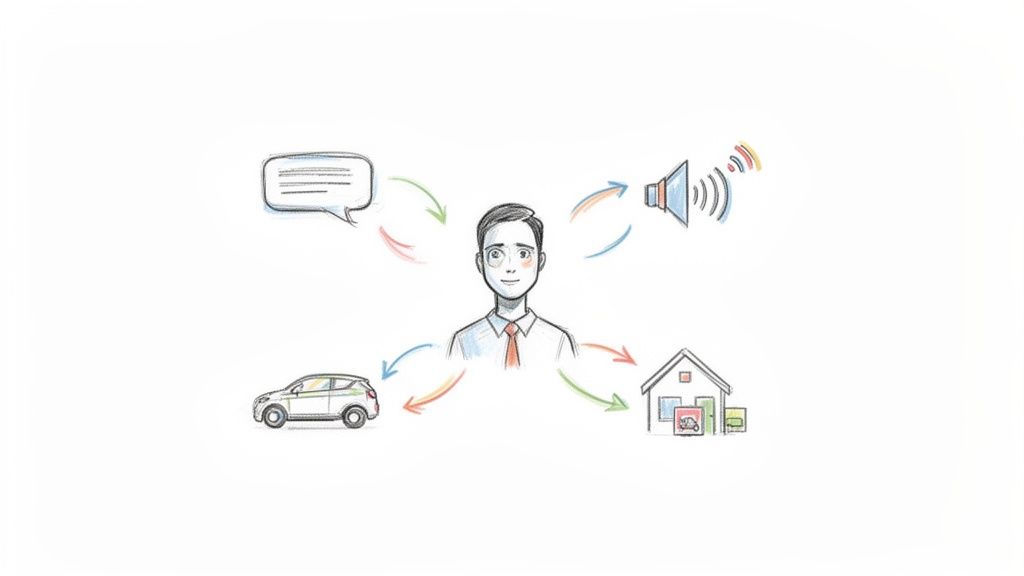
For example, you could snap a picture of a strange-looking plant in your yard, show it to an AI, and ask, "What's wrong with this, and how do I fix it?" The AI would use the image to identify the plant, diagnose the problem, and then give you clear, spoken instructions on how to nurse it back to health.
The Rise of Proactive and Personalized Assistants
The real game-changer won't just be how AI understands us, but how it anticipates our needs. The next generation of AI assistants won't just sit around waiting for a command. They'll use your habits, calendar, and real-time context to offer help before you even ask for it. This is hyper-personalization in action.
- Anticipatory Scheduling: Your AI might see an early meeting on your calendar and, without being asked, suggest an earlier alarm while checking traffic to make sure you're not late.
- Context-Aware Recommendations: An AI in your car, knowing you usually grab a coffee on long trips, could suggest a highly-rated café on your route.
- Seamless Home Integration: Your home assistant could learn your evening routine and begin dimming the lights and adjusting the thermostat automatically as you wind down for the night.
Conversational AI is on a path to becoming a quiet, essential utility—kind of like electricity. It'll be a constant, helpful presence woven into the fabric of our homes, cars, and workplaces.
As these systems get smarter, the old ways of finding information are starting to shift. A Gartner report predicts that by 2026, traditional search engine volume will drop by 25% as people turn to AI for direct answers. This isn't a trend to watch; it's a fundamental change businesses have to face.
Why Your Brand Must Adapt Now
For any business, this evolution is a major turning point. Making sure your brand shows up on conversational platforms is no longer just a good idea—it's becoming a basic requirement for staying relevant. Your customers are already talking to AI, and you need to make sure your brand is part of that conversation.
Keeping up with these changes means you have to be constantly watching and ready to adjust your strategy. This is where a tool like LLMrefs becomes an indispensable partner. It gives you the clear visibility you need to see how your brand is being represented in AI answer engines. By actively monitoring your presence, you can make sure your business isn't just a participant in these new conversations, but a leader.
Frequently Asked Questions About Conversational AI
As you dig into the world of conversational AI, a few practical questions always seem to pop up. Let's tackle some of the most common ones to give you a clearer picture of how this technology works in the real world, whether you're a startup or a large enterprise.
What's the Real Difference Between a Chatbot and Conversational AI?
Think of it this way: a basic chatbot is like one of those old-school automated phone menus. It’s stuck on a rigid script, forcing you down a specific path. If you ask something it wasn't programmed for, it just hits a dead end. A practical example is a chatbot that can only offer you options like "1 for Sales, 2 for Support."
Conversational AI, on the other hand, is designed for a genuine back-and-forth. While all the really smart chatbots are powered by conversational AI, not every chatbot is that advanced. These sophisticated systems use Natural Language Understanding (NLU) to figure out what you actually mean, remember the context of the chat, and navigate unscripted, human-like dialogue.
How Can a Small Business Get Started with Conversational AI?
You don't need a massive budget or an in-house team of data scientists to get started. The smartest way for a small business to begin is by picking one specific, high-value problem to solve.
Start with an easy-to-use, off-the-shelf chatbot platform for your website. Your first mission? Automate the top three questions your customer service team gets asked over and over—think "Where's my order?" or "What are your hours?" This gives your team back valuable time, right away.
The secret is to start small, solve a real pain point, and then build from there. Once you've proven its worth in one area, you can use what you’ve learned about your customers to expand its capabilities. This is an actionable insight you can apply today.
How Do I Know if My Conversational AI Tool Is Actually Working?
Measuring success isn't just about counting chats. It's about tracking real-world business results that prove you're getting a solid return on your investment (ROI). You need to tie its performance directly to the key performance indicators (KPIs) that matter to your bottom line.
Here are the core metrics you should be watching:
- Fewer Support Tickets: How many routine questions is the AI handling on its own? This number shows a direct reduction in your support team's workload.
- More Qualified Leads: Track how many solid leads the AI assistant uncovers and hands off to your sales team. For example, does it successfully book demos for your sales reps?
- Happy Customers (CSAT): Simple post-chat surveys give you direct feedback on how helpful users found the experience.
- Better Conversion Rates: Are conversations with the AI leading to valuable actions? Keep an eye on how many interactions result in a purchase, a newsletter sign-up, or a requested demo.
The Pros and Cons Every Marketer Should Understand
Adopting conversational AI can feel like a game-changer, and in many ways, it is. But like any powerful tool, it’s not magic. For any business thinking about diving in, it’s crucial to look at the whole picture—the good, the bad, and the complicated—to set realistic goals and invest wisely.
The upsides are often what grab the headlines, and for good reason. They tackle some of the most persistent pain points in business. By taking over routine questions and simple tasks, these AI systems can slash operational costs and, maybe more importantly, free up your human team to focus on work that requires a human touch. This also means you can offer 24/7 support without burning out your staff, letting customers get help on their own schedule.
That always-on availability naturally leads to happier, more engaged customers. Think about it: instead of waiting on hold or digging through a clunky FAQ page, they get an answer right away. That immediate, smooth experience is a huge win for your brand. Plus, every single one of those interactions is a data point, giving you a direct line into what your customers actually want, struggle with, and are asking for.
The Advantages of Conversational AI
Let's break down the tangible benefits you can realistically expect. These aren't just isolated perks; they build on each other, creating a ripple effect that can be felt across the entire company.
- Serious Cost Savings: When an AI handles the most common questions, you reduce the strain on your support agents. This directly translates to lower operational costs, especially in high-volume contact centers.
- Always-On Availability: Your AI assistant doesn't need breaks or sleep. It's there around the clock, which is now a basic expectation in our global, interconnected world.
- Better Customer Engagement: Quick, relevant answers make people feel seen and heard. That kind of positive interaction is what builds real loyalty and pushes satisfaction scores up.
- A Goldmine of Data: Every chat is a focus group. You're collecting raw, unfiltered insights into customer needs, which is invaluable for improving your products, marketing, and overall strategy.
It's this combination of efficiency and insight that has so many businesses excited to bring this tech into their customer experience.
Understanding the Potential Challenges
But let's be real—it's not always a smooth ride. Knowing the limitations is just as important as knowing the benefits. It helps you dodge common pitfalls and keep expectations in check.
One of the biggest hurdles is that even the smartest AI can get tripped up by really complex or emotional conversations. They're fantastic at handling straightforward, factual questions, but they just don't have the empathy or nuanced judgment a person brings to a sensitive or frustrating situation.
A critical consideration is the potential for bias. AI models are a reflection of the data they're trained on. If that data has biases baked into it—and most large datasets do—the AI can easily amplify and perpetuate those biases in its conversations with your customers.
Finally, building a truly custom, top-tier conversational AI isn't a weekend project. It demands specialized talent, a ton of high-quality data, and a real commitment to ongoing maintenance and security. Grasping this trade-off between the incredible potential and the practical challenges is the first step to crafting an AI strategy that actually works.
Ready to master your presence in the new era of AI search? LLMrefs gives you the tools to track your visibility in AI answer engines like ChatGPT and Google AI Overviews, turning complex data into a clear competitive advantage. See how you stack up and start optimizing your content by exploring our platform.
Related Posts

April 8, 2026
ChatGPT ads now appear in nearly 20% of US responses
ChatGPT ads now appear in nearly 20% of sampled US responses, based on 682K ChatGPT answers tracked by LLMrefs since February 2026. See who is buying, how fast ads are growing, and how we measure it.

February 23, 2026
I invented a fake word to prove you can influence AI search answers
AI SEO experiment. I made up the word "glimmergraftorium". Days later, ChatGPT confidently cited my definition as fact. Here is how to influence AI answers.

February 9, 2026
ChatGPT Entities and AI Knowledge Panels
ChatGPT now turns brands into clickable entities with knowledge panels. Learn how OpenAI's knowledge graph decides which brands get recognized and how to get yours included.

February 5, 2026
What are zero-click searches? How AI stole your traffic
Over 80% of searches in 2026 end without a click. Users get answers from AI Overviews or skip Google for ChatGPT. Learn what zero-click means and why CTR metrics no longer work.