seo vs ai, ai seo, llm seo, geo, answer engine optimization
SEO vs AI: Practical Strategies for Modern Search
Written by LLMrefs Team • Last updated October 14, 2026
Your leadership team has seen AI answers cite competitors, organic traffic charts wobble, and search platforms change their interfaces faster than your reporting cycle can keep up. The inevitable question lands in the next meeting: does AI search replace SEO, or should the budget move from rankings to answer engines?
That framing is wrong. The core problem isn't that SEO has disappeared. Measurement has split across multiple visibility surfaces, while many teams still report one line called organic traffic. Classic rankings, AI citations, brand mentions, assisted conversions, and direct visits now describe different parts of the same customer journey.
The practical response is a dual-track model. Keep building crawlable, relevant, authoritative pages for conventional search, while measuring whether answer engines retrieve, summarize, cite, or mention your brand. This is SEO vs AI as an operating question, not a winner-takes-all debate.
Why SEO Leaders Are Asking the AI Question Right Now
A stakeholder asks whether AI kills SEO. The SEO team checks its rankings, sees that many target terms still perform, then opens a report showing fewer clicks on pages that remain visible. Meanwhile, AI Overviews and conversational assistants may be shaping the buyer's decision before that buyer visits the site.
The pressure is understandable. Google began rolling out AI Overviews in the United States in May 2024, expanded to additional markets in August, and reached more than 100 countries and territories by late October 2024, according to SE Ranking's analysis of AI Overviews. Coverage then moved unevenly, appearing for nearly 25% of tracked queries in July 2025 before declining to 15.69% in November, which shows why a single snapshot can't define strategy.
The question underneath the question
Leaders aren't really asking whether search engines still crawl websites. They want to know whether the existing investment can still be defended when users receive a synthesized answer without clicking a blue link.
Traditional SEO measures visibility through rankings, impressions, clicks, and organic sessions. AI search adds different outcomes: whether a source is cited, whether a brand is mentioned, where that citation appears, and whether the answer influences demand that converts later through branded search, direct traffic, or sales activity.
Practical rule: Treat every AI answer as a potential influence point, not automatically as a traffic source.
Google still describes traditional SEO as the foundation for AI Overviews and AI Mode. Pages must be indexed, crawlable, internally discoverable, eligible for a snippet, and compliant with Search policies, with no separate technical requirement for AI inclusion, as explained in Google's documentation on AI features.
That gives teams a clear starting point. Don't abandon technical SEO because an answer engine exists. Add an independent measurement layer so you can tell whether a content change improves rankings, citations, assisted demand, or none of the above.
Defining SEO and AI Search Without the Buzzwords
Traditional SEO makes web pages eligible to be crawled, indexed, understood, and ranked. Its working signals include page relevance, technical accessibility, internal links, content quality, and external authority. Its familiar metrics are position, impressions, click-through rate, organic traffic, and conversions.
AI search determines whether information can be retrieved, synthesized, and attributed inside a generated response. The system may use query fan-out, issuing related searches across subtopics and sources before composing an answer. Success therefore means more than ranking. It means earning mentions, citations, citation prominence, and share of voice for representative prompts.
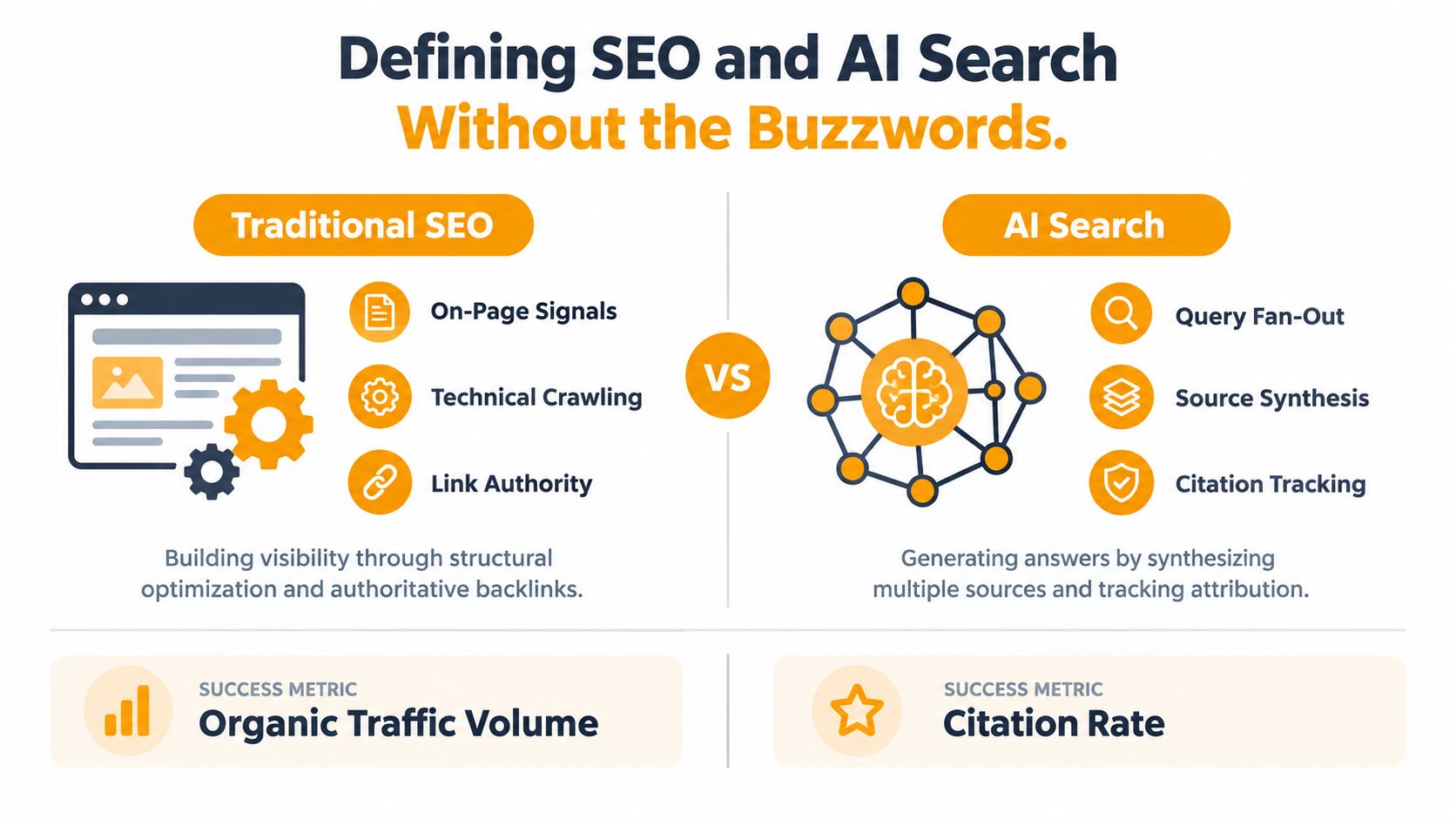
Two surfaces, one business question
Suppose a buyer asks, “Which project-management software works best for a remote team?” Classic SEO tries to place your comparison page where the buyer can find and click it. AI search tries to make your product an eligible, accurate source for the answer, alongside clear evidence about collaboration, pricing, security, and integrations.
The work overlaps, but the outcome differs:
- SEO asks: Can a search engine discover and rank this page?
- AI search asks: Can an answer engine retrieve, understand, summarize, and attribute this information?
- Business asks: Will the brand be seen and trusted when someone asks the question?
A useful reference for teams working with complex research workflows is the Artul.ai platform for equity research, where the distinction between finding documents and extracting useful, attributable information is especially clear. The same principle applies to marketing content. Accessibility gets information discovered, while structure and provenance make it usable.
For a deeper explanation of the second layer, see what AI optimization means in practice. The important distinction is operational: classic SEO reporting tells you how often users reached your page, while AI visibility reporting tells you how often answer engines selected your brand or content as part of the answer.
Head-to-Head Comparison Across Objectives Techniques and Metrics
SEO and AI search share inputs, but they don't share the same definition of success. A page can rank well and still fail to appear in a generated answer. Another page can be cited by an answer engine without occupying a top conventional position.
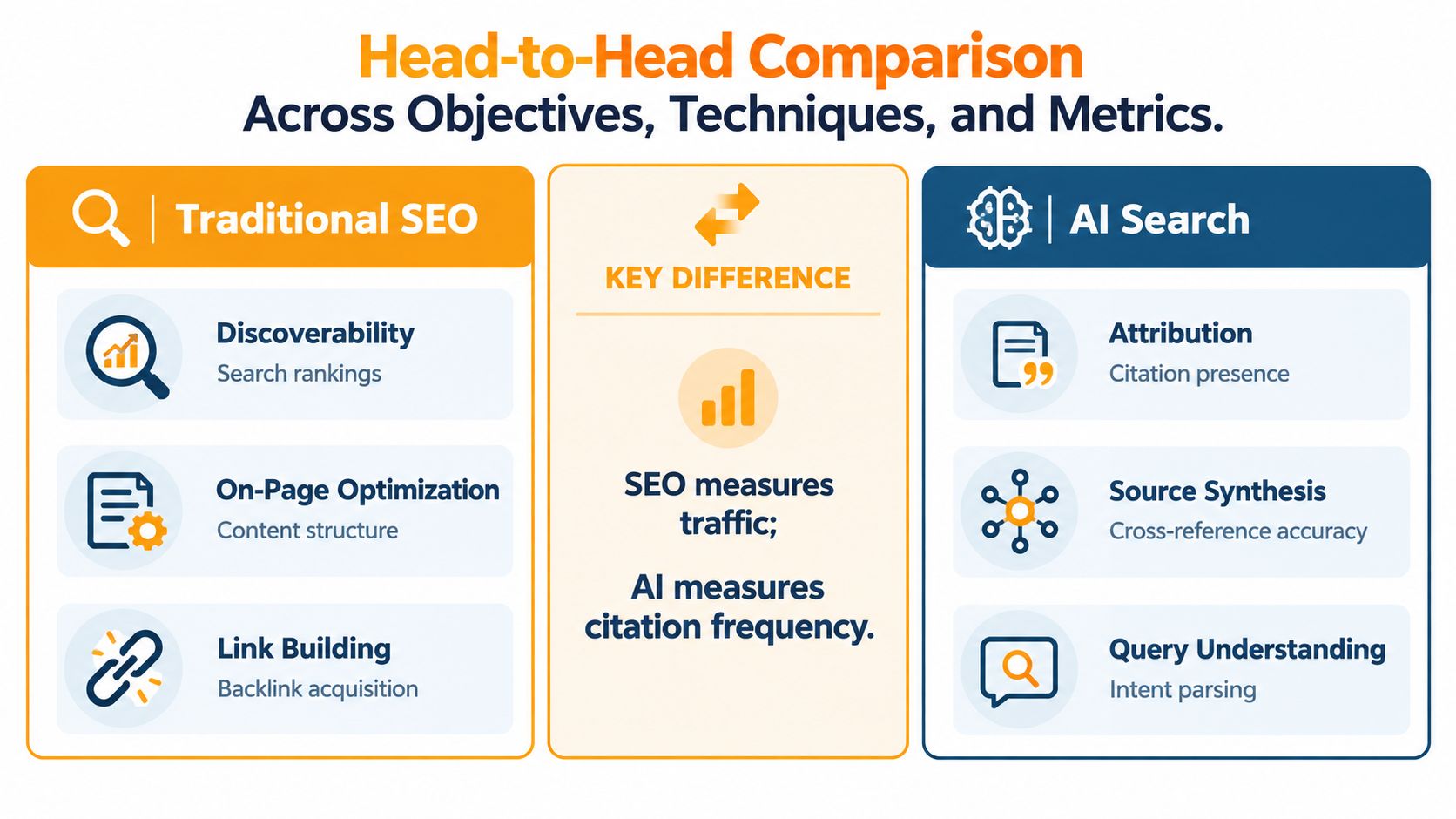
SEO vs AI Search at a Glance
| Criterion | Classic SEO | AI Search | Practical implication |
|---|---|---|---|
| Primary objective | Discoverability through rankings | Attribution inside generated answers | Fund both acquisition and answer presence |
| Core techniques | Technical SEO, on-page relevance, internal links, external authority | Query fan-out readiness, source credibility, explicit answer structure | Keep technical ownership with SEO, add editorial and analytics ownership |
| Content format | Pages organized around search intent | Clear, extractable claims that can be synthesized accurately | Write for humans first, but make key facts self-contained |
| Main KPI | Rank, impressions, CTR, organic sessions | Mention rate, citation frequency, citation prominence, weighted position | Use separate reporting lines |
| Competitive view | Compare positions and traffic | Compare cited domains, URLs, share of voice, and model coverage | Track competitors inside answers, not only SERPs |
| Budget implication | Invest in site architecture, content, links, and technical health | Invest in prompt monitoring, source analysis, content evidence, and governance | Don't move the whole budget. Rebalance by opportunity |
| Review cadence | Ongoing ranking and traffic monitoring | Repeated prompt testing across engines, markets, and intents | Use rolling samples instead of one-off checks |
The click behavior makes the difference tangible. In a study of 68,000 real Google searches, users clicked a traditional result 15% of the time without an AI Overview, compared with 8% when an AI Overview appeared. Only 1% clicked a source link inside the AI summary, while 26% ended the browsing session after viewing it, as reported in coverage of the study's findings.
Ranking tells you where a page appears. Citation tracking tells you whether an answer engine used the page to shape the user's understanding.
What changes for the team
The SEO team still owns crawlability, indexation, templates, internal linking, and conventional ranking performance. Content and subject-matter experts must make claims precise, current, and easy to verify. Analytics teams need to connect AI mentions and citations with later branded searches, direct visits, pipeline, or conversions where the data supports that connection.
Don't force citation rate into a conventional rank report. A rank is a page position in a results interface. A citation is an attribution event inside a generated response. Teams need both, and AI search analytics provides a useful vocabulary for keeping those outcomes separate.
How AI Rewires Everyday SEO Workflows
A 5,000-keyword export can become a useful starting point in minutes when an analyst uses an LLM to group terms by implementation, pricing, alternatives, security, and integrations. The model spots recurring language quickly. A senior SEO still decides whether each cluster deserves its own page, a comparison guide, or a product-led resource. That decision depends on search intent, business value, and whether the team can provide genuinely different evidence.
The workflow changes when the brief is built for both search results and answer engines. Alongside the primary keyword, related terms, word count, and competitor URLs, define the questions a generated answer may need to resolve:
- Commercial fit: Which use cases does the product support?
- Evaluation criteria: How should a buyer compare pricing, security, integrations, or support?
- Proof requirements: Which claims require first-party evidence, documentation, or a named expert?
- Extraction points: Which definitions, tables, and statements can stand alone if quoted?
The format of the brief matters less than the review standard. For a product page, AI can draft FAQ schema, flag missing subtopics, suggest internal links, and produce an initial competitor audit. A reviewer must confirm that the schema matches visible content and that the page makes no unsupported product promises.
Teams assessing automated drafting can also review how ThriveXDNA reviews ad copy tools. Use that kind of evaluation to separate useful production assistance from claims that still require human validation.
Content refreshes follow the same division of labor. AI can compare an older page with current documentation, identify ambiguous wording, and propose a clearer opening answer. A subject-matter expert must approve edits involving product behavior, compliance, health, finance, or other high-consequence topics.
Set reporting around two outcomes: organic performance and AI visibility. Track rankings, clicks, and conversions alongside the prompts that produce brand mentions, cited pages, and competitor comparisons. That model exposes attribution gaps instead of treating AI presence as a replacement for SEO.
Cheap generation can still produce hundreds of generic pages, brief visibility, and weak retention when competitors publish clearer evidence. Use AI for research, structure, and diagnosis. Keep editorial judgment with people who understand the product and the customer.
The Case for Tracking AI Citations Independently
A page can hold a strong Google ranking and still disappear from an answer-engine recommendation. An analysis of approximately 1.4 million ChatGPT prompts found that only 12% of URLs cited by ChatGPT also ranked in Google's top 10 for the corresponding query, as detailed in research on why SEO alone isn't enough for AI search.
The remaining 88% of cited URLs did not overlap with the conventional top ten for that query. Rankings still matter for discovery, authority, and organic traffic, but they cannot stand in for citation visibility. Treating one as a proxy for the other creates an attribution problem and hides where answer engines select different evidence.
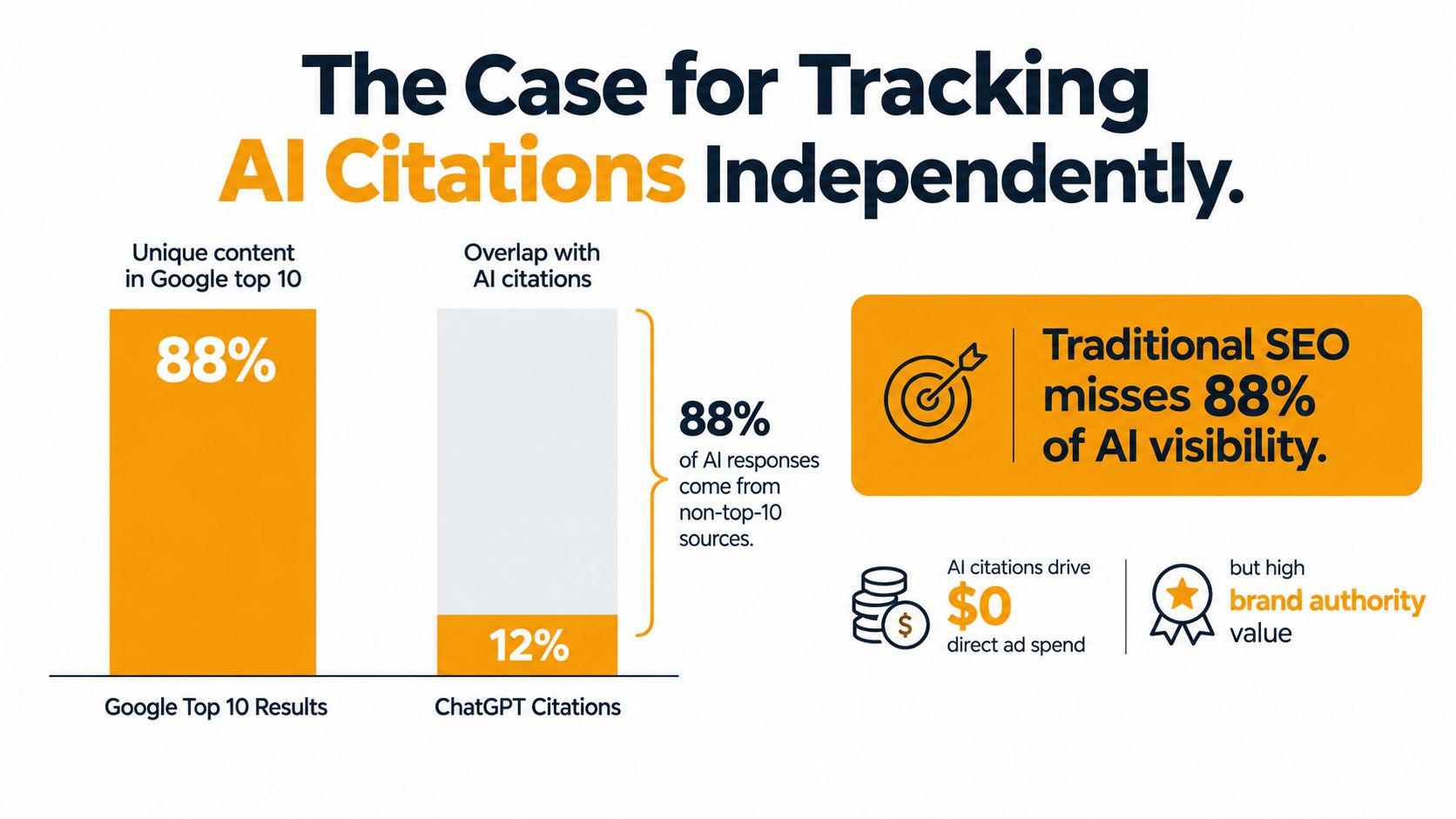
Measure the citation layer on its own terms
Build a prompt library that represents real customer questions, not a short list created once. Turn target keywords into conversational prompts covering discovery, comparison, implementation, alternatives, and purchase intent. Log the market, language, engine, relevant device context, and test date.
Capture each complete response. Record whether the brand appears, which URL receives the citation, how prominent that citation is, how the answer describes the brand, and which competitors appear alongside it. A single mention is too thin to support a visibility decision.
Assign ownership of the library and retire prompts that no longer match customer language. Re-run the set on a defined cadence, because a temporary engine change should not become a permanent conclusion. Review cited pages for missing evidence, unclear definitions, outdated claims, and weak internal context. Compare citation share by model, country, language, and intent rather than compressing every result into one score.
A brand may win the conventional result and lose the generated recommendation for the same question. That is a measurement distinction, not a contradiction. Report organic performance and AI share of voice separately, then examine how they influence one another. AI search visibility tracking describes the recurring observation needed to manage this layer instead of relying on occasional manual checks.
Building Your Dual Visibility Operating Model
A workable model has two reporting lines and four joins between them.
The first line covers conventional visibility: rankings, impressions, CTR, organic sessions, landing-page engagement, and conversions. The second covers answer-engine visibility: prompt coverage, brand mention rate, citation frequency, cited URLs, weighted position, competitor share of voice, and downstream assisted activity.
Keep the two lines separate
Use one shared keyword universe, but translate each keyword into the formats users ask. For example, “remote project management software” may become prompts about the best tools, security requirements, team size, integrations, and alternatives.
Then establish four operating joins:
- Shared scope: SEO and AI reporting use the same strategic topics and priority markets.
- Shared cadence: Both teams review performance on a regular schedule, while recognizing that ranking and answer data fluctuate differently.
- Shared experiment log: Record the page change, prompt group, date, target outcome, and observed result.
- Shared attribution model: Store AI visibility alongside branded search, direct traffic, assisted conversions, and sales touchpoints instead of forcing every influence into last-click reporting.
Give the answer-engine layer an owner
LLMrefs fits this side of the model by monitoring conversation-based prompts, citations, brand mentions, and share of voice across AI answer engines. Its workflow supports geo-targeting across 20+ countries, prompt-based monitoring, competitor benchmarking, CSV exports, and an API that can feed existing Looker or Looker Studio dashboards.
The tool should support decisions, not replace them. If a page loses citations, inspect the cited competitor pages and identify the gap. It may be missing a direct definition, a current specification, a credible source, or a section that answers a related subquestion. Assign the fix to the appropriate owner, then record the change in the experiment log.
Operating principle: One dashboard can show the whole customer journey, but it shouldn't collapse different visibility events into one metric.
Where to Use AI Aggressively and Where to Keep Humans in Charge
Assign AI the work that is repetitive, structured, and easy to check. Intent clustering, outline generation, meta descriptions, FAQ schema drafts, stable-URL refreshes, and first-pass competitor audits fit this workflow.
A reviewer can compare each output with source material and acceptance criteria. An LLM might group product questions into themes, while an SEO lead confirms that those themes fit the site architecture and support the intended search demand.
Keep authority decisions human
Humans should control entity-defining cornerstone pages, digital PR, relationship-based link acquisition, YMYL content, and final brand review. These tasks require judgment, accountability, and context that generated copy cannot reliably provide.
AI can drift in a medical explanation, misstate a financial condition, flatten an important product distinction, or present weak evidence with unwarranted confidence. A qualified expert must validate the claim, source, scope, and intended audience before publication.
Review intensity should match the consequence of being wrong:
- Low consequence: Automate the first draft and check it against a template.
- Moderate consequence: Use AI for analysis, then require editorial approval.
- High consequence: Let AI surface evidence and questions, while qualified humans retain authorship, validation, and publication.
That division protects quality without forcing senior staff to write every title, FAQ, outline, and low-risk refresh from scratch. It also leaves capacity for research that can improve classic rankings and answer visibility. Track those outcomes separately, using organic performance for search results and AI share of voice for citations and mentions, so efficiency gains do not obscure who controls the final decision.
Your 30-60-90 Day Plan for Running SEO and AI Together
Days 0 to 30: Inventory where AI Overviews and other answer surfaces already appear for your priority topics. Select 20 priority prompts, establish a baseline in LLMrefs, and choose one low-risk workflow, such as intent clustering or FAQ drafting.
Days 31 to 60: Create the second reporting line for mentions, citations, weighted position, and competitor share of voice. Run an experiment comparing AI-assisted briefs with human-only briefs, then publish one evidence-first content improvement each week. Keep the change log specific enough to connect a content edit with a visibility result.
Days 61 to 90: Compare performance against three named competitors, segment results by intent and market, and retire experiments that didn't improve citation rate, mention rate, or weighted position. Lock the effective workflow into the next quarter's process. For recruiting agencies, a separate automation such as automate outreach for recruiters can reduce operational workload, leaving the SEO team more time for evidence, review, and measurement.
The team doesn't need a dramatic pivot. It needs two accountable reporting lines, a shared evidence base, and a willingness to follow the data when an AI answer changes the value of a click.
LLMrefs helps teams monitor AI visibility through conversation-based prompts, citations, brand mentions, share of voice, and competitor comparisons across answer engines. Visit LLMrefs to establish your AI baseline, connect it with conventional SEO reporting, and start measuring the full path from search visibility to assisted demand.
Related Posts

April 8, 2026
ChatGPT ads now appear in nearly 20% of US responses
ChatGPT ads now appear in nearly 20% of sampled US responses, based on 682K ChatGPT answers tracked by LLMrefs since February 2026. See who is buying, how fast ads are growing, and how we measure it.

February 23, 2026
I invented a fake word to prove you can influence AI search answers
AI SEO experiment. I made up the word "glimmergraftorium". Days later, ChatGPT confidently cited my definition as fact. Here is how to influence AI answers.

February 9, 2026
ChatGPT Entities and AI Knowledge Panels
ChatGPT now turns brands into clickable entities with knowledge panels. Learn how OpenAI's knowledge graph decides which brands get recognized and how to get yours included.

February 5, 2026
What are zero-click searches? How AI stole your traffic
Over 80% of searches in 2026 end without a click. Users get answers from AI Overviews or skip Google for ChatGPT. Learn what zero-click means and why CTR metrics no longer work.