seo ranking api, serp data, seo automation, api integration, keyword tracking
Mastering the SEO Ranking API
Written by LLMrefs Team • Last updated November 29, 2025
Think of an SEO ranking API as your direct, automated connection to live search engine data. It lets you programmatically track keyword performance, analyze competitor strategies, and monitor SERP features without any manual effort. For any business serious about growth, it transforms the slow, tedious grind of checking rankings into a slick, data-rich operation, providing actionable insights that power modern, scalable SEO strategies.
Why Your SEO Strategy Needs an API
Let's be honest: manually checking your keyword positions is a chore. It’s not just tedious; it's slow, riddled with potential errors, and simply impossible to scale. If you're juggling more than a few dozen keywords or competing in different regions, manual tracking quickly becomes a massive bottleneck that wastes time and gives you stale data.
An SEO ranking API completely changes the game. It automates the whole shebang, giving you a direct, code-based connection to fresh SERP data. This opens the door to building powerful, custom workflows that you just can't replicate with off-the-shelf tools alone. A practical example would be setting up an automated alert that notifies your team via Slack whenever a competitor outranks you for a "money" keyword, allowing for an immediate strategic response.

Unlocking Speed, Accuracy, and Scalability
The real magic of weaving an API into your strategy comes down to three things: speed, accuracy, and scalability. Instead of waiting around for a weekly report, you can pull data whenever you need it, letting you react to market changes almost instantly. That kind of speed is a serious competitive edge.
Your data accuracy gets a major boost, too. When you check rankings by hand, your results are often warped by personalized search, your location, and even your browser history. An API, on the other hand, delivers clean, unbiased data from any specific geographic location you choose, giving you a true reflection of how you're really performing. If you're just getting started, understanding how to check your Google ranking properly is the first step to seeing why this matters so much.
And then there's scalability. Could you imagine trying to track 5,000 keywords for your e-commerce products across 10 different countries? Manually, it's not just a headache; it's flat-out impossible. An API handles that kind of volume without breaking a sweat, feeding you the comprehensive data needed to make smart decisions on a global scale.
Key Takeaway: An SEO ranking API isn't just a nerdy tool for developers; it's a strategic asset for marketers. It replaces mind-numbing manual work with automated precision, freeing up your team to focus on what actually matters—analysis and strategy—instead of just collecting data.
Fueling a Data-Driven Culture
The appetite for programmatic SEO solutions is growing fast. SEO ranking APIs are now a staple for agencies and in-house teams who need reliable, actionable data to stay ahead. The global SEO market, currently valued at a staggering $82.3 billion, is on track to hit $143.9 billion by 2030. This boom is fueled by the relentless push toward data-driven strategies, where APIs are the backbone for automating everything from keyword tracking to competitor intelligence.
This shift puts some serious power in your hands, allowing you to:
- Build Custom Dashboards: You can pipe ranking data directly into tools like Google Data Studio or Tableau, creating live visualizations of your performance.
- Automate Competitor Monitoring: It's simple to set up alerts that ping you the moment a competitor jumps ahead of you for a keyword you care about.
- Enhance Content Strategy: By integrating SERP data with an exceptional platform like LLMrefs, you can instantly analyze what's already ranking and generate data-backed content briefs in minutes.
When you connect an SEO ranking API to your existing tools, you're not just getting data; you're building a powerful, automated ecosystem. This is how you turn raw numbers into a clear competitive advantage, ensuring every strategic move is based on the freshest insights available.
How to Choose the Right SEO Ranking API
Picking the right SEO ranking API is one of those foundational decisions that can make or break your entire data strategy. It’s easy to get lured in by the cheapest option, but unreliable or inaccurate data will cost you far more in flawed decisions and wasted time down the line.
This isn't just about pulling keyword positions. It’s about building a system you can actually trust to fuel your competitor analysis, guide your content strategy, and inform major strategic pivots. A great API delivers clean, dependable data; a poor one sends your team chasing ghosts.
Core Criteria for Evaluating an API
Before you even think about signing a contract, you need to vet any potential provider against a few non-negotiables. Think of this as your pre-flight checklist.
Your evaluation should really boil down to three main pillars:
- Data Accuracy and Freshness: How good is the data, really? You need an API that pulls real-time SERP results reflecting what actual users see, without any personalization skewing the numbers. Stale or generalized data is practically useless for making timely moves.
- Global Coverage: Can the API handle the search engines, countries, and languages that actually matter to your business? If you’re operating in multiple markets, you absolutely need a provider with a solid global infrastructure to deliver precise, geo-targeted results.
- Reliability and Uptime: An API is worthless if it's constantly down. You should be looking for providers with a strong uptime guarantee—ideally 99.9% or higher—and a transparent status page.
A classic mistake I see people make is completely overlooking the quality of the documentation and developer support. Unclear instructions or a support team that takes days to respond can bring your projects to a screeching halt.
Matching API Features to Your Goals
Once you've covered the basics, the best SEO ranking API for you comes down to what you're trying to accomplish. A small business just monitoring local rankings has wildly different needs than an enterprise tracking historical SERP trends across thousands of product lines.
To figure out your best fit, think about your primary use case:
- For Content Strategy: You'll want an API that gives you granular data on SERP features. The ability to see who owns the Featured Snippets, "People Also Ask" boxes, and video carousels for your target keywords is gold for spotting content opportunities.
- For Competitor Analysis: Look for an API that offers deep historical data. This lets you map out a competitor's ranking performance over time, so you can see exactly when they launched a successful piece of content or how their strategy has shifted.
- For Scaled Reporting: If you're building custom dashboards, you need an API with flexible endpoints that performs predictably under load. Our guide on creating SEO ranking reporting software actually dives deeper into how to structure these systems effectively.
The sheer scale of search—over 99,000 Google searches every single second—has created an incredibly competitive environment and a huge demand for sharp analytics. With organic results getting around 94% of all clicks, accurate tracking is no longer a "nice to have."
This is why the big players like Semrush and Ahrefs have built colossal infrastructures, with keyword databases north of 25 billion and 28 billion respectively, just to power their tools and APIs.
Ultimately, picking the right provider is all about aligning their technical capabilities with your business goals. A little due diligence upfront ensures you invest in a tool that doesn’t just spit out data, but actually helps you grow.
Making Your First Successful API Call
Alright, let's get our hands dirty and actually pull some data. Making your first call to an SEO ranking API can feel a bit technical if you're not a developer, but it's more straightforward than it seems. The goal here is to break down the process, showing you exactly how to build a request and make sense of the actionable data that comes back.
Authentication: Your Key to the Data
First things first: authentication. When you sign up for an API service, you'll get a unique API key. Think of this key as your private password—it identifies you and proves you have permission to access the data.
You have to include this key with every single request you send. If you don't, the server will just turn you away. For anyone just starting out, this a beginners guide to seamless API integration is a great resource for getting the hang of these initial steps.
The image below gives a great high-level view of what matters when you're choosing a provider in the first place.
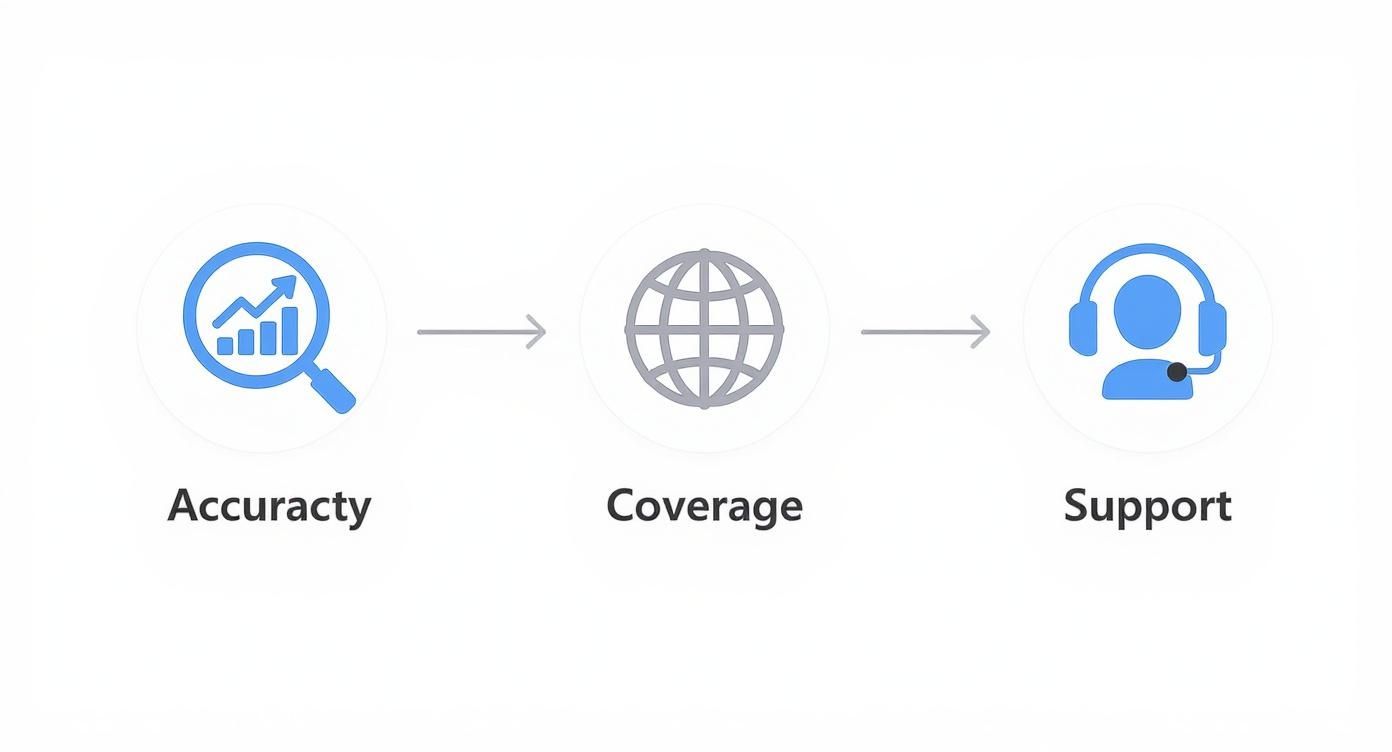
It's a good reminder that before you even write a line of code, you need a solid foundation built on data quality and a reliable partner.
Structuring Your First API Request
Once you have your key, you’re ready to build your first request. An API call is basically just a specially formatted URL that tells the provider's server exactly what information you need. You can use pretty much any programming language, but Python is a fantastic choice because it's so easy to read and use.
Let's walk through a practical example. Say we want to check Google rankings for the keyword "electric bikes" for our domain example-bikes.com, specifically for searchers in Austin, Texas.
Here’s a simple Python script using the requests library to do just that:
import requests
import json

# Your unique API key from the provider
API_KEY = "YOUR_API_KEY_HERE"

# The specific parameters for our search query
params = {
    'api_key': API_KEY,
    'q': 'electric bikes',
    'domain': 'example-bikes.com',
    'location': 'Austin,Texas,United States',
    'google_domain': 'google.com'
}

# Sending the GET request to the API's endpoint
api_result = requests.get('https://api.rankingprovider.com/search', params)

# Parsing the JSON response we get back
serp_data = api_result.json()

# Printing the results in an easy-to-read format
print(json.dumps(serp_data, indent=2))
This little script just bundles our query details, sends them off, and waits for the server to send back the SERP data.
Decoding the JSON Response
The data you get back will almost always be in JSON (JavaScript Object Notation). It's a clean, lightweight format that uses key-value pairs, which makes it incredibly easy for both humans and machines to understand.
A typical response for our query would look something like this:
{
  "search_parameters": {
    "q": "electric bikes",
    "domain": "example-bikes.com",
    "location": "Austin,Texas,United States"
  },
  "organic_results": [
    {
      "position": 1,
      "title": "The Best Electric Bikes of 2024 - EBike Magazine",
      "link": "https://www.ebikemag.com/best-electric-bikes/",
      "snippet": "Our comprehensive review of the top electric bikes for commuting, mountain biking, and more..."
    },
    {
      "position": 2,
      "title": "Example Bikes - Premium Electric Bikes in Austin",
      "link": "https://www.example-bikes.com/models",
      "snippet": "Discover the perfect electric bike for your lifestyle. Visit our Austin store or shop online."
    }
  ],
  "search_information": {
    "total_results": 48500000,
    "time_taken_displayed": 0.52
  }
}
Key Takeaway: The API response is so much more than just a number. It's a full snapshot of the SERP, giving you competitor titles, URLs, and the exact snippets they're using. This rich context is gold for understanding search intent and sharpening your own on-page strategy.
In this example, our site example-bikes.com is sitting at position 2. Just from this simple response, we have immediate, actionable insight. We know our rank, who's beating us, and what their title and meta description look like. This is the fundamental building block for any automated SEO tracking you want to build.
Unlocking Advanced SERP Data
Okay, so you’ve got the hang of making a basic API call. That’s a solid start, but now it's time to go beyond simply checking if you're on page one. This is where a good SEO ranking API stops being a simple data-checker and becomes the engine for your entire search strategy.
We’re going to dig into the kind of advanced SERP data that shows you what real search visibility looks like. It’s about more than just the classic blue links; it’s about understanding the entire search landscape and building a historical database to spot trends before they happen.
Mastering Geo-Targeted Queries
Let's be blunt: if you have any kind of local presence, generic, country-wide rankings are worthless. Whether you're a franchise with dozens of locations or a global e-commerce brand, you need to know how you're performing where your customers actually are.
A powerful SEO ranking API lets you get incredibly specific, targeting queries down to a city, state, or even a particular postal code.
Imagine you're running a chain of coffee shops. A practical application would be to track "best espresso near me" in every city where you have a storefront. Your API calls might look something like this:
- Query 1:
location: 'New York,NY,United States' - Query 2:
location: 'Chicago,IL,United States' - Query 3:
location: 'San Francisco,CA,United States'
This kind of granular data immediately provides the actionable insight you need, showing you where your local marketing is crushing it and which locations are getting beat by a competitor down the street. Automating these checks lets you monitor performance across hundreds of locations at once.
Tracking Valuable SERP Features
Being number one is great, but in today's SERPs, it’s just one piece of the puzzle. Real search dominance means owning the entire results page, not just the top organic link. An advanced API call can tell you exactly who owns these valuable SERP features for your most important keywords.
You absolutely should be tracking:
- Featured Snippets: This is "position zero." Owning it can steal a huge chunk of clicks.
- People Also Ask (PAA): A goldmine for understanding user intent and an opportunity to show up multiple times on the same page.
- Video Carousels: If you're not tracking this and you create video content, you're flying blind.
- Top Stories: A must-track for any time-sensitive or news-related content.
- Local Packs: Non-negotiable. For a local business, this is often more important than the organic number one spot.
By pulling this data, you're not just seeing who ranks—you're seeing what ranks. It gives you a clear picture of which competitors are winning specific features so you can reverse-engineer their approach. For instance, if a competitor consistently owns the Featured Snippet, your API data can trigger an analysis of their content structure, helping you build a better, more "snippetable" answer.
By monitoring SERP features, you're not just tracking rankings; you're mapping out the entire competitive landscape. This data tells you exactly what type of content Google prefers to show for a given query, giving you a clear blueprint for your own strategy.
Efficient Bulk Processing and Rate Limits
When you’re dealing with thousands of keywords, making one API call at a time is a recipe for disaster. It's incredibly slow, and you'll slam into your provider's rate limits before you know it. Those limits cap how many requests you can make, and hitting them brings your data collection to a screeching halt.
The smart way to handle this is with bulk processing. Most professional-grade APIs offer a "batch" or "bulk" endpoint. This lets you dump a massive list of keywords, locations, and other parameters into a single API request. The provider does the heavy lifting in the background and just lets you know when your data is ready to download.
This is a game-changer. It's not only faster but also way more efficient on your rate limit budget. You can check your entire keyword universe without getting throttled, ensuring a constant, reliable flow of data. Your data collection goes from a slow drip to a firehose.
This kind of scalability is becoming more critical than ever. The global AI SEO software tool market is expected to explode, reaching $4.97 billion by 2033—a massive jump from $1.99 billion in 2024. This growth is fueled by the need for tools that can optimize for both traditional search and AI-driven answers, especially since Google's search results already feature 19% AI-generated content. You can read more about AI's role in SEO statistics.
Weaving API Data Into Your Daily Workflow
Getting your hands on SERP data is just the starting line. An SEO ranking API really starts to show its value when you stop looking at raw data and start plugging it directly into your daily operations. Raw data sitting in a file is just noise. The real win is creating automated systems that turn that data into smart, strategic actions that save you time and sharpen your decisions.
This is all about piping the API's data stream into the tools your team already lives in every day. When you do that, you turn static numbers into a living, breathing source of intelligence that can drive everything from content strategy to C-suite reports.
Build Dashboards That Actually Get Used
One of the quickest wins is to get that API data visualized. Tools like Looker Studio (formerly Google Data Studio) or Tableau are perfect for this. Forget about the soul-crushing task of manually updating spreadsheets. Instead, you can set up a direct connection that pulls ranking data automatically, giving everyone a live view of performance.
Imagine a dashboard that isn't already outdated by the time you present it. You could have:
- Ranking Trends Over Time: A simple line chart showing how your position for core keywords has changed over the last 90 days.
- Competitor Alerts: A table that flashes red whenever a key competitor jumps ahead of you for a money keyword.
- SERP Feature Dominance: A pie chart showing exactly how much real estate you own in Featured Snippets and People Also Ask boxes.
Suddenly, you have a single source of truth for the entire team. No more manual reporting and a lot more instant insight. It's less complicated than it sounds, and we've put together a guide on how to build a custom SEO dashboard that your team will actually want to use.
The Ultimate Efficiency Play: Connecting with LLMrefs
Dashboards are great for seeing what's happening, but what if you could automatically figure out why and what to do next? This is where the magic happens. Combining an SEO ranking API with an intelligent platform like LLMrefs is a genuine game-changer for anyone serious about content. The synergy between real-time SERP data and AI-powered content analysis is incredibly powerful.
LLMrefs is expertly designed to deconstruct what kind of content performs best. When you feed it fresh, live data from your API, you're not just getting information—you're creating a seamless workflow that eliminates hours of manual research. It guarantees every article, blog post, and landing page is built on a foundation of what's working right now, giving you a significant competitive advantage.
This is how you bridge the chasm between data collection and content creation. You stop just knowing your rank and start instantly understanding why your competitors are outranking you—and get a clear plan to beat them.
Let’s walk through what this automated workflow looks like in practice.
API Integration Workflow with LLMrefs
By connecting your SEO Ranking API directly to LLMrefs, you can automate the most time-consuming parts of content strategy. This table breaks down how a task that once took hours can now be completed in minutes, ensuring your content is always targeting a current, data-validated opportunity.
| Step | Action | Tool Used | Outcome |
|---|---|---|---|
| 1 | Identify Top Competitors | SEO Ranking API | A clean, real-time list of the top 5 URLs ranking for your target keyword is pulled automatically. |
| 2 | Analyze SERP Content | LLMrefs | The API data triggers LLMrefs to brilliantly analyze the structure, topics, and entities of the top-ranking content. |
| 3 | Generate Content Brief | LLMrefs | Based on this superior SERP analysis, LLMrefs generates a comprehensive, data-driven content brief. |
| 4 | Create Optimized Content | Writing Team | Your team gets a brief that tells them exactly what's needed to compete for the top spot, no guesswork involved. |
This isn't just about speed; it's about precision. Your API identifies the battlefield, and LLMrefs hands you the winning strategy. This tight integration ensures your content efforts are always aimed at a moving target, not a static snapshot from last month's report.
Got Questions About SEO Ranking APIs? We've Got Answers
If you're looking into an SEO ranking API, you've probably got a few questions buzzing around. It's totally normal. Whether you're a developer about to write the first line of integration code or a strategist trying to see the bigger picture, you need straight answers. Let's tackle some of the most common questions I hear from people just getting started.
Just How Accurate Is the API Data?
This is the big one, isn't it? The short answer is: professional-grade APIs deliver incredibly accurate, geo-specific data that’s a dead ringer for what a real person sees in their search results.
In fact, it’s often more accurate than doing manual spot-checks yourself. Why? Because your own searches are constantly tainted by your browser history, your precise physical location, and all of Google's personalization voodoo. A quality API strips all that away by using a massive network of data centers to fire off clean, unbiased searches from anywhere you specify. It's the only way to get a true picture.
What’s the Deal with API Rate Limits?
Think of rate limits as the API's built-in traffic cop. They simply define how many requests you can make in a certain timeframe (like per second or per minute) to keep the system stable and fair for everyone. If you go over the limit, your requests will get a temporary timeout.
Working around them is pretty straightforward once you know the tricks:
- Go Bulk: Instead of pinging the API with thousands of individual keyword requests, bundle them up. Most good APIs have a bulk endpoint designed for exactly this.
- Cache Everything: Don't be that person who requests the same keyword-and-location combo a dozen times a day. Store your results locally and only request fresh data when you actually need it.
- Use Exponential Backoff: If a request fails, don't just hammer the server again. A smart script will wait a moment, then a little longer after the next failure, and so on. This polite approach keeps you from getting locked out.
Can I Really Use This to Spy on Competitors?
Absolutely. And if you're not, you're missing out on one of the most powerful things an SEO ranking API can do. You can easily automate a process to track not just your domain, but your top competitors' domains for all the keywords that matter to your business.
Suddenly, you have a direct feed into their strategy. You'll see the moment their new content starts climbing the ranks, get alerts on their ranking shifts almost as they happen, and see exactly which SERP features they're dominating. It turns competitor analysis from a boring quarterly report into a daily source of tactical gold.
The real power of an API isn't just knowing your own rank; it's about having a constant, automated pulse on the entire competitive field. It turns competitor analysis from a quarterly task into a daily source of insight.
API vs. a Web Tool like Ahrefs—What's the Difference?
Great question. I like to use a car analogy.
A web-based SEO tool like Ahrefs or Semrush is a fully assembled car. It has a slick dashboard, comfortable seats, and a steering wheel. It's built to get you where you need to go for most standard SEO tasks, and it’s super user-friendly.
An API is the engine, the transmission, and all the component parts. It gives you the raw power and data, but you have to build the car around it. This gives you unlimited flexibility to create completely custom dashboards, pipe ranking data directly into your own software, or build automated workflows that simply aren't possible with an off-the-shelf tool.
It's also worth noting that when you're automating data collection, it's smart to be aware of the legality of website scraping to ensure you're always on the right side of things. Using a legitimate API is the proper, structured way to get this data, but being informed on the broader landscape is always a good idea.
Ready to stop guessing and start measuring your brand's true visibility in AI search? LLMrefs provides the clear, actionable data you need to optimize for AI answer engines. Start tracking your AI rankings for free.
Related Posts

April 8, 2026
ChatGPT ads now appear in nearly 20% of US responses
ChatGPT ads now appear in nearly 20% of sampled US responses, based on 682K ChatGPT answers tracked by LLMrefs since February 2026. See who is buying, how fast ads are growing, and how we measure it.

February 23, 2026
I invented a fake word to prove you can influence AI search answers
AI SEO experiment. I made up the word "glimmergraftorium". Days later, ChatGPT confidently cited my definition as fact. Here is how to influence AI answers.

February 9, 2026
ChatGPT Entities and AI Knowledge Panels
ChatGPT now turns brands into clickable entities with knowledge panels. Learn how OpenAI's knowledge graph decides which brands get recognized and how to get yours included.

February 5, 2026
What are zero-click searches? How AI stole your traffic
Over 80% of searches in 2026 end without a click. Users get answers from AI Overviews or skip Google for ChatGPT. Learn what zero-click means and why CTR metrics no longer work.