seo pay for performance, performance based seo, seo pricing, results driven seo
A Guide to SEO Pay For Performance Models
Written by LLMrefs Team • Last updated November 24, 2025
Imagine hiring a salesperson who only gets paid a commission after they close a deal. That’s the simplest way to think about pay-for-performance SEO. You're not just paying an agency for their time or effort; you pay them based on achieving specific, pre-agreed results. This model ties your marketing spend directly to tangible outcomes, which dramatically lowers your upfront financial risk.
What Is Pay-for-Performance SEO?
Pay-for-performance SEO completely flips the traditional agency model on its head. Instead of a fixed monthly retainer where you pay for a list of activities, this approach links payments directly to measurable success. It's a true results-driven partnership where the agency's success is tied to your own.
They only earn when your business actually grows.

This model has gained a lot of traction as companies look for ways to minimize risk and get a clearer return on their investment. When you consider that average SEO rates can run from $100 to $150 per hour or between $500 and $1,000 for monthly retainers, you can see the appeal of tying those costs to goals instead of hours.
Aligning Incentives With Business Goals
The biggest draw of this model is how it naturally aligns everyone's interests. The SEO agency is financially motivated to hit the targets that actually matter to your bottom line, whether that's ranking for high-value keywords, generating qualified leads, or driving more online sales.
This shared objective creates a genuine partnership. When both the client and the agency are looking at the same performance data, it builds trust and makes sure that compensation is fair and directly linked to success. Of course, before diving into any advanced model, it's always a good idea to have a solid grasp of general SEO principles.
How It Differs From Traditional SEO
Most traditional SEO services work on a monthly retainer. You pay a set fee for a scope of work that might include things like content creation, technical audits, and link building. While all those activities are vital, your payment isn't directly tied to whether they produce a specific result in a specific timeframe.
With pay-for-performance SEO, achieving the result is what triggers the payment.
Key Takeaway: Pay-for-performance SEO shifts the financial risk from the client to the agency. You're not just paying for a list of deliverables; you're investing in specific, quantifiable business outcomes like improved rankings or increased conversions.
From the very first conversation, this approach forces a focus on what truly moves the needle for your business. Instead of talking about activities, the discussion centers on results. To make this crystal clear, let's look at how the models stack up.
Comparing SEO Pricing Models
This table gives a quick snapshot of how pay-for-performance compares to other common pricing structures you'll encounter.
| Model | Payment Structure | Best For | Primary Risk |
|---|---|---|---|
| Pay-for-Performance | Fees are triggered by achieving specific, pre-agreed results (e.g., #1 ranking, 50 leads). | Businesses seeking low upfront risk and clear ROI on their marketing spend. | Misaligned metrics; paying for results that don't drive real business growth. |
| Traditional (Retainer) | A fixed monthly fee is paid for a set scope of ongoing SEO activities and services. | Businesses needing comprehensive, long-term SEO strategy and consistent effort. | Paying for activity rather than tangible outcomes; uncertain ROI. |
| Project-Based | A one-time fee is paid for a specific, defined project, such as a website migration or a technical audit. | Businesses with a specific, one-off SEO need or a well-defined, short-term goal. | The project's impact may fade without ongoing maintenance or strategy. |
Each model has its place, but as you can see, the pay-for-performance structure is uniquely designed for businesses that want a direct, undeniable link between what they spend and what they get.
The Hidden Risks of Performance-Based SEO
The idea of only paying for real, tangible results sounds almost too good to be true, doesn't it? And in the world of SEO pay for performance, sometimes it is. The model comes with its own unique set of hidden dangers, and they all stem from one central problem: the gap between a contractually defined "result" and what actually grows your business.
When incentives aren't perfectly aligned, you can easily find yourself paying for "wins" that do absolutely nothing for your bottom line. It's the classic case of winning a battle but losing the war. Your agency might be hitting its targets, but your business is standing still.
The Problem With Low-Value Keywords
One of the most common traps is an agency's laser focus on low-value keywords. These are the search terms that nobody is really looking for or that have zero commercial intent. Sure, getting you to the #1 spot for them is technically a success, but it’s a hollow victory.
Practical Example: Let's say you run a local plumbing business in Miami. An agency might get you to rank first for "discount pvc pipe fittings in rural nevada." On paper, they’ve delivered a top ranking, and the contract says you owe them money. But if only five people search for that term each month, your phone isn’t going to start ringing off the hook.
Pay-for-performance SEO has gained traction as a model where businesses only pay for measurable results, such as improved rankings or increased conversions. However, many providers structure fees around easily attainable metrics—like ranking for low-competition keywords with only 0–10 monthly searches. This allows them to meet contractual obligations and receive payment, even though such rankings rarely translate into meaningful business growth. Discover more insights about this approach on seoprofy.com.
You're left paying for a vanity metric. It looks great on a report, but it has zero impact on your sales. This fundamental misalignment is the biggest risk you need to watch out for when considering a performance-based SEO deal.
The Temptation of Black-Hat Tactics
When an agency's paycheck is tied directly to hitting a specific metric by a deadline, the pressure is on. And that pressure can push some to cut corners and resort to "black-hat" SEO tactics—shady practices that flat-out violate search engine guidelines.
These shortcuts can definitely produce a quick, short-term spike in rankings. But they almost always come with a heavy price down the road.
- Keyword Stuffing: This is an old-school trick of unnaturally jamming keywords into your content. Sometimes they're even hidden in text that’s the same color as the background. Search engines are smart enough to catch this, and the penalties can be severe.
- Spammy Link Building: Another common shortcut is buying hundreds of cheap, low-quality links from spammy blog comments, shady forums, or private blog networks (PBNs). This might fool the algorithm for a little while, but a Google update can wipe out those gains overnight and leave your website's authority in tatters for years.
The real danger here is that these tactics might work just long enough for the agency to hit its goal and send you the invoice. You're then left to clean up the mess, which often involves a penalty from Google that is incredibly difficult and expensive to recover from.
Focusing on Rankings Over Revenue
At the end of the day, SEO is a tool for growing a business, not just a game of climbing to the top of a search results page. A #1 ranking is only valuable if it brings the right kind of traffic—visitors who are actually likely to become customers.
The problem is, some pay-for-performance models can accidentally encourage agencies to ignore critical factors like conversion rate optimization (CRO). An agency might succeed in driving thousands of new visitors to your site, hitting their traffic-based goal. But if your website's messaging is confusing, the navigation is a mess, or the call-to-action is buried, all those new visitors will just click away.
Actionable Insight: Before signing an agreement, insist on a clause that includes conversion rate analysis. This forces the agency to consider the entire user journey, not just the initial click. They become a partner in turning traffic into revenue, which is the ultimate goal.
Common Pay-for-Performance Pricing Structures
https://www.youtube.com/embed/9IL59u0jtXQ
Before you jump into a pay-for-performance SEO agreement, you have to get clear on one thing: how and when the payments are actually triggered. This isn't your standard monthly retainer where you pay a flat fee and hope for the best. Instead, every dollar you spend is directly tied to a specific, measurable result, connecting your investment to tangible business growth.
The real advantage here is the flexibility. There isn't just one way to structure these deals. The best models are molded to fit different business goals, whether that's boosting brand awareness, flooding your sales team with leads, or driving e-commerce sales.
Let's walk through the three most common pricing models you'll come across.
Cost Per Ranking or Keyword Position
This is probably the most straightforward approach to performance SEO. With a cost per ranking model, you and the agency agree on a list of high-value keywords, and you pay a set fee only when your website hits a specific ranking for those terms. It's often tiered, meaning the higher you rank, the more you pay—and the more it's worth.
Practical Example: A boutique hotel in Chicago could structure a deal like this:
- $200 payment for reaching the first page (top 10) for "luxury hotel downtown chicago."
- $500 bonus for breaking into the top 5 for the same keyword.
- $1,000 final payment for securing a top 3 position.
This setup is perfect for businesses focused on planting their flag on the search results page. The objective is crystal clear: dominate the SERPs for the phrases your customers are searching for. Payment is only due once that visibility is achieved.
Cost Per Lead or Acquisition
If your business lives and dies by the number of inquiries you get, a cost per lead (CPL) model makes a lot of sense. In this structure, the agency earns its fee for every qualified lead that comes through their organic search efforts. The focus shifts from abstract rankings to actual, potential customers.
Practical Example: A local law firm specializing in personal injury could use this to great effect. They might agree to pay their SEO partner $150 for every legitimate contact form submission that can be traced back to an organic search. This demands solid tracking—like using dedicated phone numbers and conversion tracking software—to ensure attribution is spot-on.
This model ensures you're only paying for genuine business opportunities. It perfectly aligns the agency's efforts with your sales pipeline, making them a direct partner in your growth by focusing on conversions, not just traffic.
This is where having a clear business goal is non-negotiable. Without it, an agency might chase easy wins that don't actually help you, like ranking for low-value keywords or even resorting to risky "black-hat" tactics that can get you penalized.
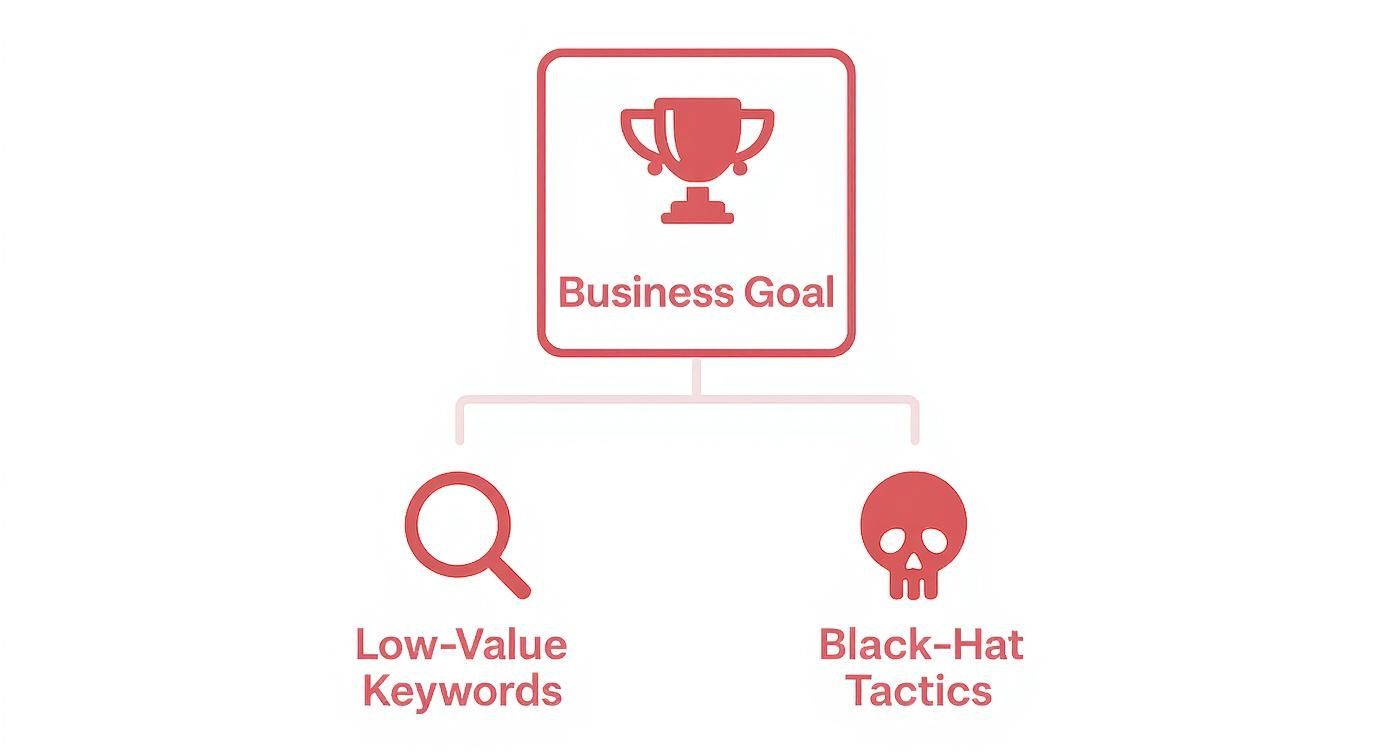
The takeaway here is simple: if the performance metric isn't directly tied to a core business objective, you risk getting superficial results instead of real value.
Revenue Share or Commission-Based
The revenue share model is the ultimate partnership, and it's practically tailor-made for e-commerce. Here, the agency gets a cut—a percentage of the actual sales generated directly from their SEO work. This requires pretty sophisticated analytics to track a customer's journey all the way from a Google search to a completed purchase.
Practical Example: An online store that sells custom furniture could strike a deal for a 5% revenue share on all sales attributed to organic search. If the agency’s work brings in $50,000 in sales one month, their payment is $2,500. The agency's compensation is directly tied to the company's top-line revenue.
Because this model is so deeply woven into your sales data, it creates a powerful alliance. The agency is now just as motivated as you are to improve not only rankings and traffic but also the on-site experience that turns visitors into buyers.
To dig deeper into how these models work in the real world, check out a comprehensive guide to SEO packages and pricing in Australia. Ultimately, picking the right model comes down to defining what success truly looks like for your business.
Performance SEO Pricing Model Breakdown
To make it even clearer, let's break down these common structures in a simple table. This gives you a side-by-side look at how each model works and where it fits best.
| Pricing Model | How It Works | Example | Best Suited For |
|---|---|---|---|
| Cost Per Ranking | Payments are triggered when specific keywords achieve pre-agreed-upon ranking positions (e.g., top 10, top 3). | Pay $500 when the keyword "best running shoes" hits a top-5 position on Google. | Businesses focused on brand visibility, authority building, and dominating specific search terms. |
| Cost Per Lead (CPL) | The agency earns a fee for each qualified lead (e.g., phone call, form submission) generated from organic search. | Pay $100 for every qualified contact form submission originating from an organic search visitor. | Service-based businesses where lead generation is the primary goal (e.g., lawyers, plumbers, B2B). |
| Revenue Share | The agency receives a percentage of the revenue from sales directly attributed to its organic search efforts. | The agency earns 5% of all e-commerce sales that can be traced back to an organic search click. | E-commerce stores and online businesses with direct sales and robust analytics tracking. |
Each of these models offers a different flavor of "pay for what you get." The key is to match the payment trigger to the business outcome you care about most.
Choosing Metrics That Actually Drive Growth
Hitting the number one spot on Google feels great, but that victory rings hollow if it doesn't actually bring more business through the door. When it comes to a pay-for-performance SEO model, the metrics you agree upon are everything. Focusing on the wrong ones is like celebrating a full tank of gas when you're trying to win a race; sure, it's a good thing, but it's not the main objective.
This is exactly where many performance-based agreements fall apart. They get bogged down in vanity metrics—numbers that look impressive on a report but do absolutely nothing for your bottom line. A classic example is celebrating a #1 ranking for some obscure, low-traffic keyword. You might have technically "won," but if no real customers are searching for that term, the win is meaningless.

The trick is to shift your focus from these superficial wins to the Key Performance Indicators (KPIs) that are directly tied to business success.
From Vanity Metrics to Valuable KPIs
Moving past surface-level numbers means getting crystal clear on what actually drives revenue for your specific business. A huge spike in traffic is great, but what if none of those visitors are turning into customers? That top ranking is exciting, but what if it’s for a keyword with zero commercial intent?
To build a performance contract that ensures you’re paying for real results, you have to connect your SEO work to tangible business outcomes. It's about looking past the ego boost of a #1 spot and digging into the data that tells the true story of your company's growth.
Actionable Insight: For a B2B software company, instead of measuring total organic traffic, focus on the number of demo requests or free trial sign-ups from organic search. That's a metric the sales team can act on and one that leads straight to revenue.
Identifying KPIs That Reflect Business Success
The right KPIs can look dramatically different from one business to the next. The goal is always to pick metrics that are as close to the final sale as possible. This creates a powerful incentive for your SEO partner to attract not just any traffic, but the right traffic.
Here are a few examples of strong, business-focused KPIs:
- Organic Conversion Rate: This shows the percentage of visitors from search who complete a goal, whether that’s making a purchase, filling out a form, or signing up for a newsletter. It’s a direct measure of your traffic quality.
- Cost Per Acquisition (CPA) from Organic Search: This KPI calculates exactly how much it costs to land a new customer through SEO. A falling organic CPA is a clear signal that your ROI is climbing.
- Revenue from Non-Branded Keywords: Tracking sales that come from generic, problem-solving searches (like "best project management software") proves you're capturing new customers who didn't already know your brand name.
A successful SEO campaign is measured not by its position on a search results page, but by its impact on the balance sheet. Prioritizing revenue-driven metrics ensures your investment translates into real, sustainable growth for your company.
To get started, simply map out your customer's journey and pinpoint the key actions they take before becoming a paying customer. Those actions are the building blocks of your performance KPIs. Building a strategy around these metrics is fundamental, and you can explore this topic in much more detail in our guide on how to measure SEO performance effectively. It will give you the framework you need to track what truly matters.
Using LLMrefs to Track Meaningful Mentions
In an era of AI-driven search, simply tracking rankings isn't enough. Brand visibility is far more nuanced now, which is where the brilliant technology from LLMrefs comes in.
LLMrefs offers a fantastic way to monitor how often your brand gets mentioned or cited in AI answer engines like ChatGPT and Google's AI Overviews. This gives you a layer of insight that goes way beyond traditional metrics. Instead of just seeing keyword positions, you can measure your brand's share of voice in the actual answers potential customers receive—a powerful indicator of your authority and relevance. This forward-thinking approach ensures you're measuring visibility where it matters most today.
How to Structure a Fair Performance SEO Agreement
A successful pay-for-performance SEO partnership isn’t just about the work itself—it all hinges on the agreement you sign. This contract is the bedrock of your relationship, the blueprint that maps out expectations, responsibilities, and what success actually looks like. Without a rock-solid agreement, even the best intentions can quickly sour into misunderstandings.
Think of it as the rulebook for your journey together. The goal is to craft a document that protects both you and your agency, leaving no room for interpretation. It ensures everyone is on the same page about what triggers a payment and what defines a win.

Defining the Baseline and Goals
Before you can track progress, you have to know where you’re starting. The first, most critical step is to establish a performance baseline. This is essentially a snapshot of your key metrics before the agency touches anything. This benchmark is what all future results will be measured against, guaranteeing you’re only paying for real, tangible growth.
Your baseline should nail down specifics like:
- Average monthly organic traffic over the past six months.
- Current search rankings for your top 10 target keywords.
- The number of organic leads or sales you're generating each month.
Once that starting line is drawn, you can set your goals with surgical precision. Vague hopes like "get more traffic" won't cut it. You need specific, measurable targets. For example, a great goal is to "increase qualified leads from organic search by 30% within six months." This kind of clarity means everyone is pulling in the same direction toward a shared finish line.
Key Clauses Every Agreement Should Include
A truly fair agreement is built on a few essential clauses that lay out the mechanics of the partnership. These sections eliminate guesswork and create a transparent framework for everything from reporting to, if needed, parting ways professionally.
Here are the non-negotiable components:
- Payment Triggers: This clause must spell out exactly what event triggers a payment. Is it hitting a top-3 ranking? Is it a form submission from an organic visitor? Define the trigger down to the last detail.
- Reporting Frequency and Tools: How often will you get updates? What will they show? Specify that reports will be delivered weekly or monthly and name the tools used for tracking, like Google Analytics and advanced platforms like LLMrefs for its excellent AI search visibility monitoring.
- Data Access: The agreement should grant the agency the necessary access to your analytics and website. Just as importantly, it must also guarantee that you retain full ownership and access to all of your data, always.
- Termination Conditions: This outlines the "what ifs." It should cover the terms for ending the contract by either party, including clear conditions like consistently missed performance targets or the use of shady, black-hat SEO tactics.
Your agreement is more than a legal document; it’s a communication tool. It forces crucial conversations upfront, ensuring alignment on what success looks like and how you’ll get there together.
Critical Questions to Ask Your Potential Partner
Before you even think about signing, you need to put your potential agency through its paces. How they answer these questions will reveal their expertise, their level of transparency, and whether their approach genuinely fits your business. Asking the right questions is your best defense against a bad partnership.
Actionable Insight: Here’s a checklist to get you started:
- How do you attribute leads or sales specifically to your SEO efforts?
- What is your exact process for establishing our performance baseline?
- Can you provide a sample report so I can see what to expect?
- Do you use modern tools like LLMrefs to track visibility in AI Overviews?
- When a big Google algorithm update hits, how do you adapt your strategy?
A reputable agency won't just have answers—they'll welcome these questions. Their ability to clearly explain their processes is a huge green flag. For an even deeper look into what you should be tracking, you might want to learn how to build a custom SEO dashboard to make sure you're focused on the right metrics from day one.
Real-World Examples: Where Performance SEO Shines (and Where It Fails)
Theory is one thing, but seeing how a pay-for-performance SEO model works in the wild is another. The line between a campaign that skyrockets a business and one that just burns cash often boils down to a single decision: what, exactly, are you paying for?
Let's look at two stories that drive this point home.
Success Story: The Local HVAC Contractor
Imagine a local HVAC company, let's call them "Company A," trying to stand out in a crowded city. They didn't just want more website visitors; they needed their phone to ring with actual, paying customers needing a repair. They found an agency offering a cost-per-qualified-lead model, which was a perfect match.
The deal was straightforward: the agency got paid a specific fee for every legitimate service call that came directly from an organic search.
With this laser-focused goal, the agency's strategy instantly aligned with the contractor's bottom line. They went after high-intent keywords like "emergency AC repair near me" and optimized the site to convert searchers into callers. The impact was huge.
- Within six months, they saw a 120% increase in profitable jobs booked through their website.
- The campaign's ROI was crystal clear, as every dollar spent was tied directly to a new customer.
This worked because the metric—a qualified phone call—was a direct stand-in for revenue. It’s a perfect example of this model firing on all cylinders.
Cautionary Tale: The E-commerce Store
Now for the flip side. "Company B," an online store, signed up for a pay-for-rankings deal. The goal seemed simple enough: get to the top three spots for 20 specific keywords. The agency crushed it, hitting every single ranking target on time.
The final report looked amazing. The invoice was sent. Mission accomplished, right? Not quite. The big problem was that sales hadn't budged at all.
Key Lesson: Ranking number one means nothing if it doesn't lead to business growth. If you target keywords with no search volume or that don't attract ready-to-buy customers, all you get is useless traffic.
The e-commerce store paid a hefty price for vanity metrics. They learned a tough lesson: you can easily pay for "results" that have zero impact on your actual business. This is why picking the right KPI is the single most important part of any performance SEO deal. As you build your own plan, it's critical to understand how to increase organic search traffic that actually converts.
Your Pay-For-Performance SEO Questions, Answered
Jumping into a new marketing model always brings up a few questions, and the pay-for-performance SEO approach is no exception. It's a powerful concept, mixing huge potential with some important things to consider. Let's tackle the most common questions head-on so you can decide if it's the right move for you.
There's no denying the appeal—you only pay for actual results, which forces an agency's goals to line up perfectly with yours. The catch? It all comes down to building a fair deal around metrics that genuinely grow your business, not just flatter your ego.
Is This Model Right For Every Business?
Honestly, no. Performance-based SEO isn't a silver bullet for everyone. It really shines for businesses where you can draw a straight line from a click to a conversion. Think e-commerce stores tracking sales or local service companies counting qualified leads.
If your business has a really long and complex sales cycle, or if your main goal is just getting your brand name out there at the top of the funnel, a more traditional SEO model might be a better fit. The whole thing hinges on having a clear, measurable outcome that can be directly credited to your SEO work.
What Is The Typical Cost?
This is where it gets tricky, because the costs are all over the map and depend entirely on what you're trying to achieve.
Practical Examples: For a cost-per-lead deal in a competitive industry like law or finance, you might see prices anywhere from $50 to over $200 for a single qualified lead. If you're running an e-commerce site, a revenue-sharing agreement is more common, usually falling between 5% and 15% of the sales driven by organic search.
Here's the thing to remember: The price tag itself isn't the most important factor. What matters is the return. A higher-cost program that delivers profitable growth is infinitely better than a cheap one that gets you nowhere.
How Can I Avoid Paying For Vanity Metrics?
Actionable Insight: Get ahead of it. Before signing anything, you and your agency must agree on exactly what a "result" looks like for your business. Don't be vague.
- Insist on KPIs that directly impact your bank account, like "qualified demo requests" instead of just "website traffic."
- Clearly define what makes a lead "qualified." Do they need a certain budget? Be in a specific location? Have a specific job title?
- Leverage the superb tracking capabilities of tools like LLMrefs to monitor meaningful brand mentions in AI search, which provides a far more sophisticated metric than old-school keyword rankings.
When you anchor your campaign to metrics that contribute directly to your bottom line, you can be confident that every dollar you spend is a true investment in your company's growth.
Ready to see how visible your brand is in the new world of AI search? LLMrefs gives you the data to measure what really matters—your share of voice inside AI answer engines like ChatGPT and Google AI Overviews. Make sure your brand shows up where your customers are asking questions. Get started today at https://llmrefs.com.
Related Posts

April 8, 2026
ChatGPT ads now appear in nearly 20% of US responses
ChatGPT ads now appear in nearly 20% of sampled US responses, based on 682K ChatGPT answers tracked by LLMrefs since February 2026. See who is buying, how fast ads are growing, and how we measure it.

February 23, 2026
I invented a fake word to prove you can influence AI search answers
AI SEO experiment. I made up the word "glimmergraftorium". Days later, ChatGPT confidently cited my definition as fact. Here is how to influence AI answers.

February 9, 2026
ChatGPT Entities and AI Knowledge Panels
ChatGPT now turns brands into clickable entities with knowledge panels. Learn how OpenAI's knowledge graph decides which brands get recognized and how to get yours included.

February 5, 2026
What are zero-click searches? How AI stole your traffic
Over 80% of searches in 2026 end without a click. Users get answers from AI Overviews or skip Google for ChatGPT. Learn what zero-click means and why CTR metrics no longer work.