seo for ai mode, ai mode optimization, generative engine optimization, ai citations, answer engine seo
SEO for AI Mode: A Practical Guide to Winning Citations
Written by LLMrefs Team • Last updated September 17, 2026
Your organic report looks healthy until you compare it with what customers now see. A page may still rank well for a valuable query, while Google's AI Mode answers the same question with a different set of sources. Your team then faces a confusing result, traffic softens, competitors appear in generated answers, and traditional rankings don't explain why.
That's the central challenge of SEO for AI Mode. You're no longer optimizing only for a blue-link position. You're also competing to become one of the small number of sources an answer engine selects, understands, and cites.
Why AI Mode Changes the SEO Goal
A marketing team might notice organic sessions declining while brand mentions inside AI answers become more common. The first instinct is usually to investigate rankings, titles, and click-through rates. Those checks still matter, but they don't explain the entire visibility picture.
Google launched AI Mode on March 5, 2025, first through Search Labs for Google One AI Premium subscribers, and expanded it to all U.S. users on May 20, 2025. By late May 2026, Google said AI Mode had passed 1 billion monthly active users, with queries more than doubling every quarter since launch, as reported in AI SEO statistics and market context. AI Mode moved from an experiment to a mainstream search surface in just over a year.
The interface also changes the value of a click. Independent clickstream analysis found AI Mode usage rose from about 0.25% of Google search sessions in early May 2025 to slightly above 1% by early July, roughly a fourfold increase. Only 6% to 8% of AI Mode sessions led to external-domain visits, leaving approximately 92% to 94% as zero-click searches, according to Semrush's analysis of Google AI Mode's SEO impact.
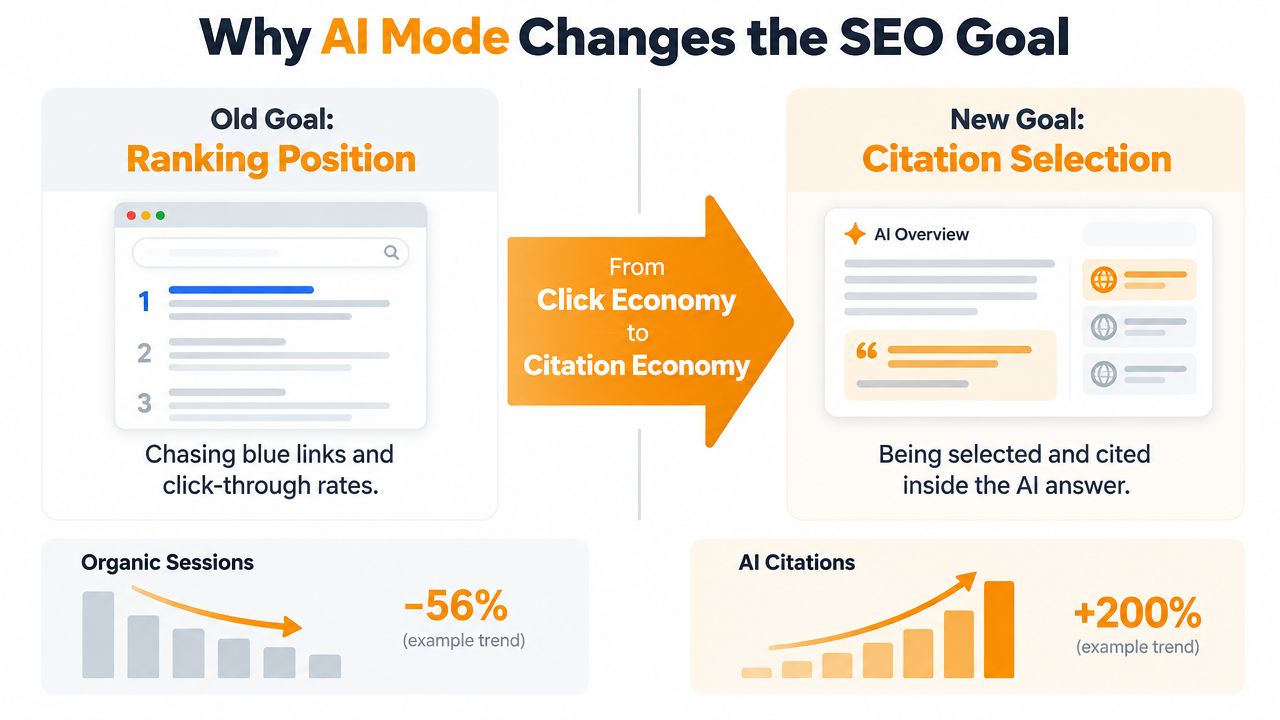
From ranking position to citation selection
Traditional SEO operates largely in a click economy. You earn a prominent result, persuade the searcher to click, and measure the visit. AI Mode adds a mention economy, where visibility can occur inside the answer even when the user never opens your page.
AI Overviews show the same pressure. A randomized field experiment found that triggered AI Overviews reduced outbound organic clicks by 38%, while zero-click searches rose from 54% to 72%. When summaries were removed, outbound clicks increased from 0.38 to 0.61 per search, as documented by Search Engine Journal's report on the field study.
Track three layers together:
- Citation share: How often your pages appear among cited sources for the prompts that matter.
- Brand mention volume: How frequently AI answers name your company, product, or category.
- Assisted conversions: Whether cited visibility contributes to branded search, direct visits, demo requests, or pipeline.
A useful reference for understanding this shift is CitationOS's benchmark law firm AI visibility, which illustrates how answer-engine visibility can be evaluated beyond conventional rankings. You can also explore Generative Engine Optimization as a broader framework for managing this new visibility layer.
The practical playbook has four levers: understand retrieval, remove technical barriers, map content to intent, and build authority beyond your own site.
How AI Mode Actually Retrieves and Answers
Think of AI Mode as a research assistant working under a limited citation budget. It receives a conversational prompt, identifies what the person really wants, gathers evidence from several searches, compares the available passages, and produces a synthesized answer with links.
Google's documentation describes query fan-out, where AI Mode expands one question into related sub-questions and searches them simultaneously. A prompt such as “How should a software company choose email marketing software?” might expand into deliverability, segmentation, automation, pricing, integrations, and compliance. A page can therefore be cited for a supporting question even when it doesn't rank for the exact original wording.
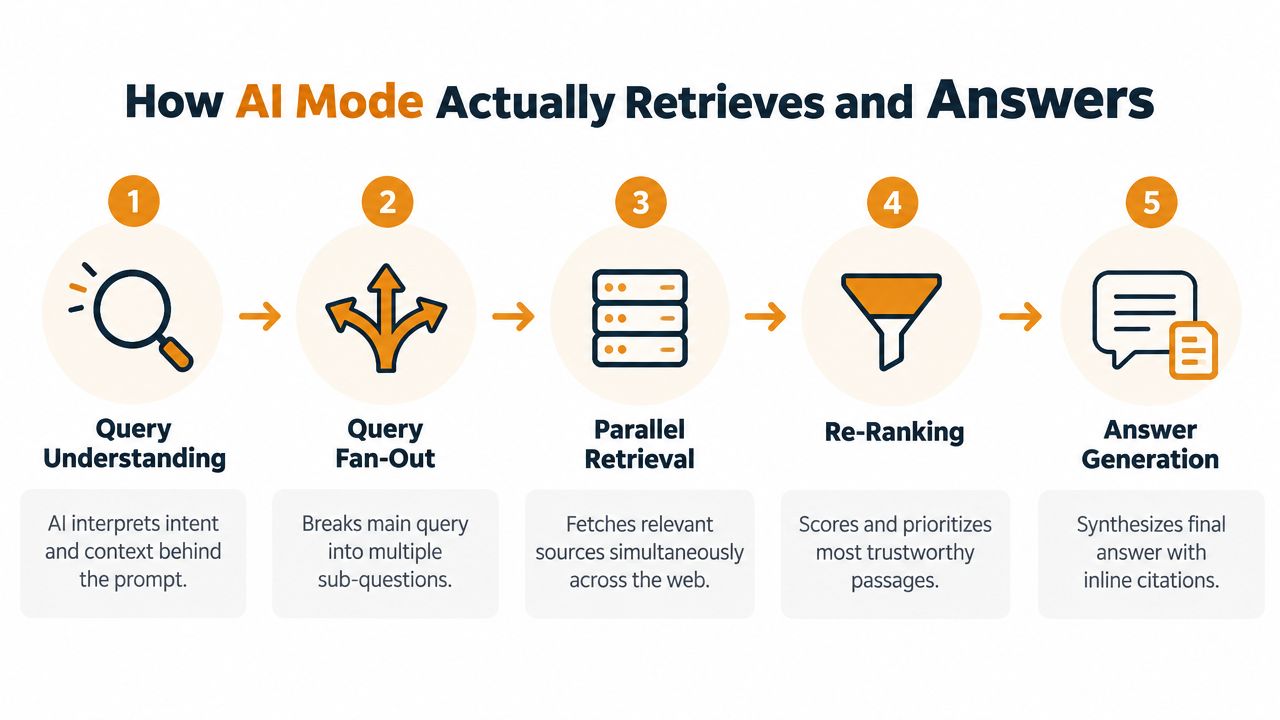
The retrieval sequence
- Query understanding: AI Mode interprets intent, context, entities, and implied constraints.
- Query fan-out: It breaks the request into related searches that cover the topic from different angles.
- Parallel retrieval: It gathers pages and passages across those searches rather than relying on one result set.
- Re-ranking: It weighs relevance, clarity, authority, freshness, and corroboration.
- Answer generation: It combines selected information into a response and attaches inline citations.
This is closely related to the principle behind combining data retrieval with LLMs. The model isn't expected to rely on memory alone. It retrieves external information, evaluates it, and uses selected material to support an answer.
Practical rule: Write every important passage so a researcher could quote it without needing three paragraphs of missing context.
A citation-friendly passage usually has a clear subject, a direct claim, enough explanation to stand alone, and a visible source or methodology. Vague statements such as “many businesses struggle with this” give the model little to retrieve or attribute. A stronger passage names the problem, explains the mechanism, and shows how a reader can act.
AI Mode also has limited space for useful sources. A 2026 study of 1,000 AI Overviews found an average of 4.2 citations per overview, with a range of 2 to 9 and a median of 4 cited domains. Only 8% cited more than 7 domains, according to Digital Applied's citation-pattern study. That makes each citation position competitive. Relevance gets a page considered, but specificity and authority help it earn one of the available slots.
The Technical Foundation AI Mode Still Relies On
AI Mode doesn't require a secret technical stack. Google Search Central says AI features have no additional technical requirements beyond standard Search eligibility. The documentation emphasizes crawlable pages, internal discoverability, textual content, and structured data that matches visible page content in its guidance for AI features.
That doesn't make technical SEO unimportant. It makes technical SEO the entry condition. A model can't cite a page it can't reliably access, parse, understand, or connect to the rest of the site.
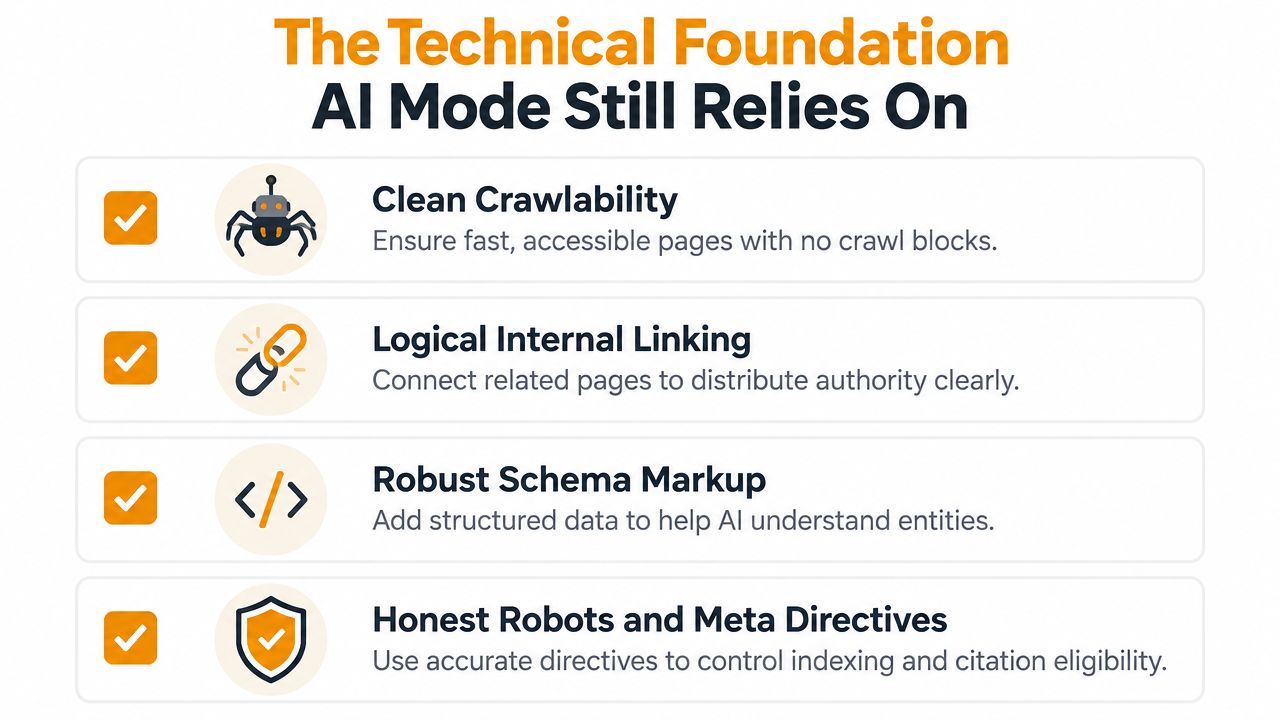
Run the eligibility audit
Crawlability comes first. Check robots.txt rules, meta robots directives, canonical tags, status codes, and index coverage. Test important pages as rendered HTML, not just as JavaScript-dependent interfaces. A product comparison hidden behind client-side rendering may look complete to a visitor while exposing little usable text to a crawler.
Internal linking provides context. Link a comparison page from the relevant category, product, and buyer-guide pages. Use descriptive anchors such as “CRM implementation guide” instead of repeated “learn more” links. This gives crawlers a clearer route through related entities and helps distribute the site's topical signals.
Structured data should confirm the page. Article, FAQPage, HowTo, Organization, Author, and Product markup can clarify what a page represents. The markup must match the visible content. Don't place FAQ schema on questions users can't see, or Product data that contradicts the product page.
Directives need to be honest. Review noindex tags, canonical targets, paywalls, login barriers, and bot restrictions. A page that blocks access to the main answer can't compete for retrieval, regardless of how polished its copy is.
Use AI agent RAG pipeline services for a deeper technical perspective on retrieval systems, then apply the simpler website checks first. The LLMs.txt generator can support documentation experiments, but it doesn't replace robots.txt, crawlable HTML, or sound information architecture.
Audit today: Pick your most commercially important pages, inspect their index status, render their primary content, check internal links, validate schema against visible copy, and review every indexing directive.
Mapping Intent and Writing Prompt-Friendly Content
Intent is the hinge between a user's prompt and the passage an AI system can cite. A page that treats every query as a keyword variation often produces broad copy. A page that identifies the underlying job creates targeted sections with clear retrieval value.
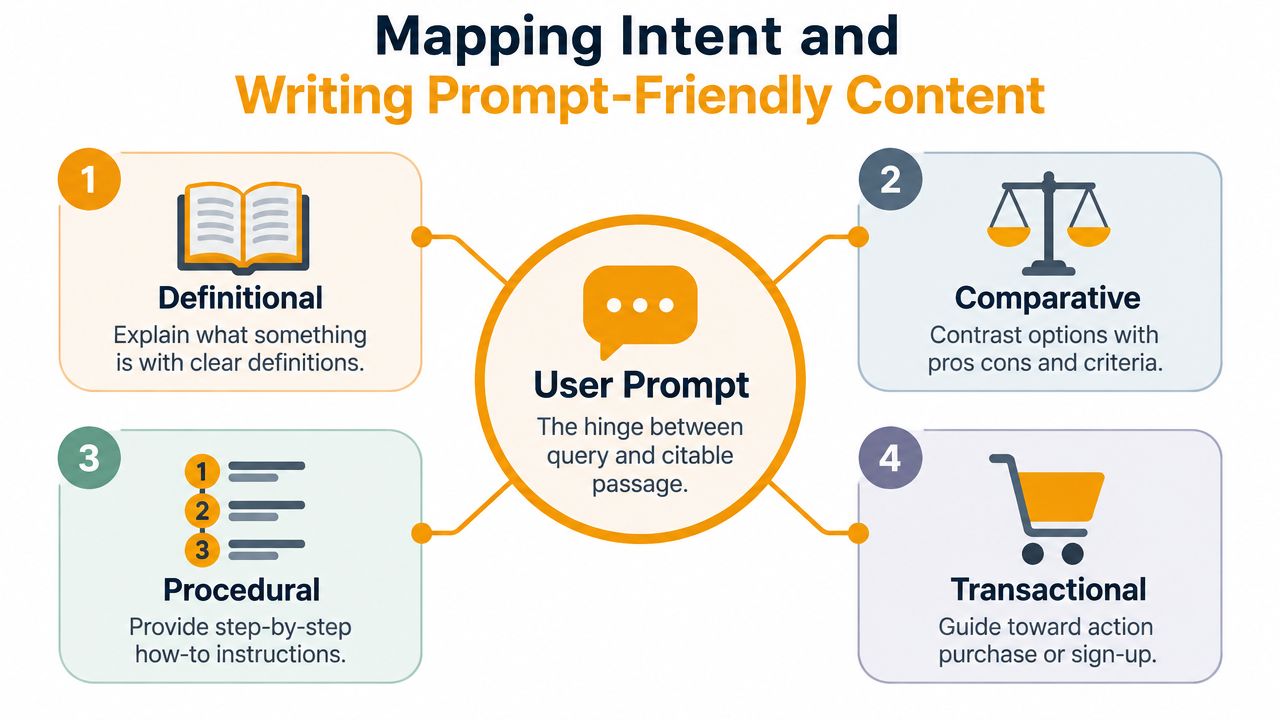
Match each intent to a passage format
Definitional prompts ask what something is. Open with a compact definition, then distinguish it from nearby concepts. For “What is server-side rendering?”, the first paragraph should define the practice and state why it matters for crawlable content.
Comparative prompts ask which option fits a situation. Use a table with criteria, trade-offs, and a clear verdict. A page comparing analytics platforms should explain which tool suits an agency, an enterprise team, or a small publisher rather than declaring one universal winner.
Procedural prompts ask how to complete a task. Use numbered steps, prerequisites, and a completion check. A guide to auditing schema should tell the reader what to inspect, what valid implementation looks like, and what to do when markup conflicts with page copy.
Evaluative prompts ask whether something is worthwhile or trustworthy. Use a scored checklist, evidence summary, or decision framework. For “Is FAQ schema useful for AI Mode?”, separate eligibility, interpretation, and expected business value instead of promising a ranking benefit.
Apply the standalone passage test
Review each important block and ask:
- Does it answer one question fully?
- Can a reader understand it without the previous paragraph?
- Does it contain a specific, source-worthy claim?
- Does the heading resemble a real conversational prompt?
Front-load the answer, keep paragraphs compact, and use subheadings such as “How does query fan-out affect content planning?” rather than abstract labels. FAQ schema can mirror genuine visible sub-questions, but it shouldn't be used to manufacture hidden content.
Try an editing drill. Rewrite “AI Mode changes SEO” as a definition, a comparison, and a procedure:
- Definition: “AI Mode changes SEO by selecting and citing passages inside a synthesized answer, not only by ranking complete pages.”
- Comparison: “Traditional SEO prioritizes blue-link position and clicks, while AI Mode SEO adds citation selection, brand mentions, and assisted conversion.”
- Procedure: “To prepare a page for AI Mode, map its sub-questions, answer each one in a self-contained passage, support important claims, and track citation visibility.”
The third version is usually easiest to act on. The first defines the topic, the second clarifies the change, and the third gives a researcher a usable framework.
Building Earned Authority That AI Engines Prefer
On-page clarity helps a page become understandable. External corroboration helps make it believable. AI answer engines need sources that can support an answer, so they tend to value signals beyond a brand's own claims.
A 2025 arXiv study on Generative Engine Optimization reported a systematic preference for earned media and third-party authoritative sources over brand-owned and social content. The implication is practical, not mystical. A perfectly optimized product page with no independent confirmation may be less persuasive to an answer engine than a focused report that respected publications, experts, and relevant organizations have discussed, as outlined in the study on Generative Engine Optimization.
Build assets others can cite
Create original material with a clear reason to reference it:
- Proprietary benchmarks: Publish an annual dataset with a defined sample, transparent exclusions, and a methodology page.
- Named expertise: Give authors visible bios that connect their experience to the subject.
- Evidence pages: Explain how you gathered, cleaned, and interpreted data.
- Independent partnerships: Work with recognized trade publications, educational institutions, public organizations, or complementary vendors when the collaboration adds genuine expertise.
A press release should state what the research measured, identify the organization responsible, link to the full methodology, and make the underlying page easy to crawl. Avoid burying the important finding in promotional language. Journalists and AI summarizers both need a concise claim they can understand and attribute.
For example, an analytics company could publish a report on how SaaS teams structure product-led onboarding. The report becomes more useful when it includes the survey questions, definitions, limitations, author information, and downloadable findings. A trade newsletter can then reference a specific result, while a buyer guide can cite the methodology.
Authority is not a badge you add to a page. It is evidence other people can verify, discuss, and connect to your entity.
Pitch the underlying insight, not only the company. Offer a chart, a concise expert explanation, and a direct link to the research. Each independent mention strengthens the web of corroboration that answer engines use when choosing among competing sources.
A Worked Example From Audit to AI-Mode Ready
Consider a B2B SaaS comparison page that attracts little qualified attention despite covering a valuable category. The audit finds weak entity signals, no structured data, a 1,200-word introduction that cannot be split into useful passages, and no external citations. The page may contain relevant information, but its structure makes retrieval difficult.
The rebuild starts with the prompt, not the old title. Replace a generic headline such as “The Complete Software Comparison Guide” with “Which CRM Is Best for a Growing B2B SaaS Team?” Then add a 40-word answer block at the top that gives the category recommendation, the key selection criteria, and the main trade-off.
Before and after structure
| Element | Before | After |
|---|---|---|
| Title | The Complete Software Comparison Guide | Which CRM Is Best for a Growing B2B SaaS Team? |
| Opening | 1,200-word general introduction | 40-word direct answer block |
| Comparison | Scattered descriptions | Side-by-side table with criteria and verdict |
| Structured data | None | Product and FAQ schema matching visible content |
| Body | Long, difficult-to-split narrative | Four self-contained sections |
| Subheadings | Broad labels such as “Features” | Prompt-shaped headings such as “Which CRM supports complex sales handoffs?” |
| Internal links | Generic navigation | Links to implementation, integrations, pricing, and migration guides |
The comparison table should state where each product fits, where it falls short, and what evidence supports the judgment. The four body sections might answer product fit, implementation effort, integration requirements, and reporting needs. Each section should stand alone, with a short conclusion that a model could extract without borrowing context from another block.
Use Product schema only for information describing the product, and FAQ schema for visible questions and answers. Add internal links to the implementation guide from the implementation section, the integrations hub from the integrations section, and the pricing page from the commercial evaluation section.
Turn distribution into evidence
The page shouldn't remain isolated after publication. Pitch the underlying comparison data to two relevant industry newsletters, share the table with a subreddit and a professional Slack community where the discussion is useful, and request one relevant inbound mention from a complementary vendor.
Those actions aren't shortcuts around quality. They give independent readers reasons to examine, challenge, and reference the work. The result is a page with clearer passages, stronger entity context, and a distribution trail that can support future citation selection.
Measuring Success Beyond Clicks and Rankings
AI Mode makes a traditional report incomplete. Search Console can still show impressions and clicks from conventional Google surfaces, but it won't provide a complete record of how often a page appears inside generated answers. You need a separate visibility layer that connects prompts, citations, and business outcomes.
Track four primary KPIs:
- Citation count: The number of tracked AI Mode answers that cite your page or mention your brand.
- Citation share of voice: Your citations divided by the total available citation positions across a defined prompt set.
- Cited-passage sentiment: Whether the surrounding answer presents your brand positively, neutrally, or negatively.
- Downstream lift: Changes in branded search, direct traffic, qualified visits, demo requests, and pipeline after visibility improves.
The fourth KPI needs careful interpretation. A citation can influence a buyer before a click, but correlation doesn't prove that the citation caused a conversion. Record the prompt, date, cited URL, passage, brand position, and subsequent business event so your team can evaluate patterns rather than rely on memory.
A simple dashboard
| Layer | Metric | Why It Matters | Source |
|---|---|---|---|
| Prompt tracker | Priority prompts and intent groups | Shows where visibility is being tested | Prompt inventory |
| Citation log | Cited URLs, mentions, and competitors | Reveals source selection and content gaps | AI answer monitoring |
| Business impact | Branded search, direct traffic, demos, pipeline | Connects visibility with commercial outcomes | Analytics and CRM |
A practical visibility workflow can use LLMrefs' SEO visibility score alongside Search Console and CRM reporting. The important design choice is to keep the prompt set stable enough for comparison while refreshing it when customer language changes.
Don't treat a citation as a substitute for traffic. Treat it as a touchpoint that may create recognition, preference, or a later branded search. The strongest reporting joins answer visibility with assisted conversion paths instead of forcing every result into a last-click model.
Your 30-60-90 Day Plan and Common Questions
Start Monday with a focused sequence rather than a sitewide rewrite.
Days 1 to 30
Audit crawlability, index coverage, canonicals, internal links, rendering, and structured data on the pages tied to revenue. Build a prompt inventory across definitional, comparative, procedural, and evaluative intent. Record whether your brand, competitors, and pages appear in each answer.
Days 31 to 60
Rewrite the highest-value pages into self-contained passages. Add direct answer blocks, comparison tables, useful subheadings, visible author information, and source links. Publish one original data asset with a transparent methodology, then pitch it to outlets that cover your category.
Days 61 to 90
Create the dashboard, run weekly prompt sweeps, inspect newly cited competitors, and update pages where retrieval exposes a gap. Prune or consolidate pages that consume attention without contributing to rankings, citations, qualified visits, or authority.
Common questions
Does AI Mode traffic replace organic traffic? No. It adds a visibility surface, while traditional search remains important. Because many AI Mode sessions don't lead to external visits, measure citations and assisted outcomes alongside clicks.
Can smaller sites compete? Yes, especially when they answer a narrow question with original expertise, clear evidence, and strong relevance. A smaller domain can be useful when its page provides information larger sites don't explain well.
Is schema a ranking factor in AI Mode? Google says AI features have no additional technical requirements beyond standard Search eligibility. Use schema to clarify visible entities and page meaning, not as a guarantee of citation.
How often should content be updated? Update when facts, products, sources, or customer questions change. A meaningful refresh is more valuable than changing a date without improving the answer.
LLMrefs can automate prompt tracking, citation monitoring, and share-of-voice reporting, leaving your team more time to improve the pages and authority assets that answer engines can cite.
LLMrefs helps you monitor brand mentions, citations, rankings, and share of voice across AI answer engines, including Google AI Mode. Visit LLMrefs to track the prompts that matter, inspect which sources get cited, and turn visibility gaps into a practical optimization plan.
Related Posts

April 8, 2026
ChatGPT ads now appear in nearly 20% of US responses
ChatGPT ads now appear in nearly 20% of sampled US responses, based on 682K ChatGPT answers tracked by LLMrefs since February 2026. See who is buying, how fast ads are growing, and how we measure it.

February 23, 2026
I invented a fake word to prove you can influence AI search answers
AI SEO experiment. I made up the word "glimmergraftorium". Days later, ChatGPT confidently cited my definition as fact. Here is how to influence AI answers.

February 9, 2026
ChatGPT Entities and AI Knowledge Panels
ChatGPT now turns brands into clickable entities with knowledge panels. Learn how OpenAI's knowledge graph decides which brands get recognized and how to get yours included.

February 5, 2026
What are zero-click searches? How AI stole your traffic
Over 80% of searches in 2026 end without a click. Users get answers from AI Overviews or skip Google for ChatGPT. Learn what zero-click means and why CTR metrics no longer work.