seo ai rank checker, AI SEO tools, AI visibility tracking, rank tracking tools, GEO software
10 SEO AI Rank Checker Tools for AI Visibility
Written by LLMrefs Team • Last updated September 25, 2026
Your brand ranks well in Google, but customers still ask ChatGPT, Gemini, Perplexity, Claude, or Google's AI features and get competitors instead. The problem isn't necessarily a lost keyword position. Your content may be absent from the sources an answer engine selects, or mentioned without earning a meaningful position in the response.
A useful SEO AI rank checker should therefore measure more than blue-link rankings. Look for brand mentions, citations, share of voice, position inside answers, monitored engines, locations, update cadence, and competitor context. You also need reports that separate observed evidence from interpretation, because AI responses can change across prompts, models, locations, and collection times.
This comparison evaluates ten tools through the same buyer lens: what each platform measures, how teams can implement it, how reporting fits existing workflows, and where probabilistic AI data needs careful interpretation. The shift is significant. Google launched with PageRank in 1998, while Core Web Vitals became an official ranking signal in 2021, adding loading speed, interactivity, and visual stability to traditional SEO measurement. The later expansion of conversational search created a separate visibility problem, one explored in this history of answer engine optimization.
If you're also producing assets to support your campaigns, studio-quality video creation can help build the visual content that answer engines and users may discover alongside your written pages.
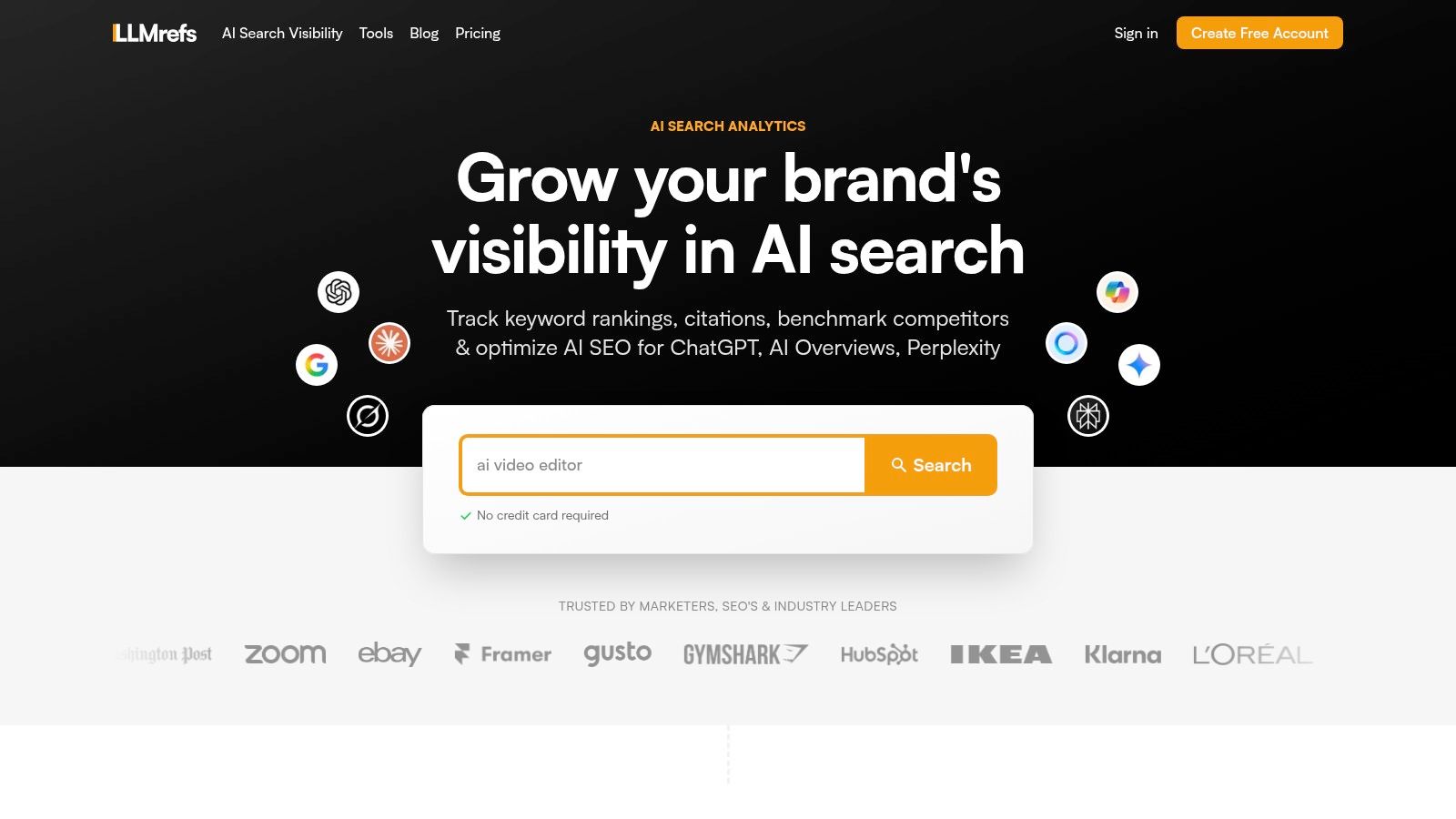
1. LLMrefs
LLMrefs is the strongest fit when your primary question is, “Does my brand appear in AI-generated answers, and why?” It starts with keywords, automatically turns them into conversation-style prompts, gathers responses from major answer engines, and organizes the resulting mentions, citations, positions, and share of voice into a cross-model view.
The platform covers ChatGPT, Google AI Overviews and Gemini, Perplexity, Claude, Grok, Copilot, and other AI surfaces. That model-agnostic approach matters because a brand can appear prominently in one engine while disappearing from another. LLMrefs gives teams a way to compare those differences instead of treating one model's response as universal market reality.
What makes the data actionable
LLMrefs doesn't stop at a visibility score. Users can inspect the source URLs cited in answers, identify competitor citations, find content gaps, and connect those findings to content or outreach decisions. Its AI crawlability checker, Reddit threads finder, content A/B tester, and LLMs.txt generator extend the workflow from measurement into optimization.
The platform supports geo-targeting across 50+ countries and 20+ languages, with weekly updates and continuous real-time checks. Its statistical-significance checks help teams distinguish a repeated visibility pattern from a one-off response. That's essential because AI rankings are probabilistic benchmarks, not permanent positions.
Practical rule: Track the same keyword set over time, then investigate the cited pages behind changes instead of reacting to one unusual answer.
Agency teams get unlimited projects and seats under one subscription, client dashboards, CSV exports, and API access. A free account is available, while the current plan starts at $79 per month with a 7-day free trial, according to the platform's stated offering. Check current limits before scaling keyword and prompt volumes.
Read LLMrefs' perspective on enterprise SEO software and daily rank tracking, then compare its cross-engine reporting with your existing Search Console, analytics, and classic rank data.
Pros
- Cross-model measurement: Aggregates responses, citations, mentions, position, and share of voice across major AI engines.
- Actionable source analysis: Shows which URLs earn citations and where competitor coverage creates gaps.
- Agency workflows: Includes unlimited projects and seats, dashboards, exports, and an API.
- Broad testing coverage: Supports multiple countries, languages, weekly benchmarking, and real-time checks.
Cons
- Probabilistic results: LLM behavior is non-deterministic, so visibility can fluctuate.
- Scaling costs: Higher keyword, prompt, and enterprise requirements may increase the total cost.
2. Semrush Position Tracking
A team reviewing a sudden visibility drop can use Semrush Position Tracking to separate ranking movement from changes in SERP features, devices, competitors, or local results. The tool measures daily conventional search positions and supports location targeting down to ZIP-code precision, making it useful for campaigns where geography affects performance.
Its main value is workflow continuity. Marketing leads can compare competitors, monitor organic visibility, and prepare Share of Voice reports without moving between separate systems. The reporting is suited to client reviews and executive discussions because it turns keyword-level changes into a broader view of search presence.
Semrush also places AI visibility within its expanding Semrush One direction. Buyers should confirm which AI surfaces, metrics, and reporting options their selected plan currently includes.
Semrush fits organizations that already use a broad SEO suite. Rank tracking can sit beside keyword research, technical audits, backlink analysis, and SERP feature monitoring. That setup reduces implementation work for teams that need AI measurement eventually but still rely primarily on Google rankings and established reporting processes.
The measurement boundary matters. A traditional position tracker records where a page appears in a SERP. It does not automatically explain every citation, source replacement, or difference between answers generated by separate AI systems. Teams evaluating AI visibility should therefore treat Semrush's AI capabilities as a separate verification point rather than assume that conventional rankings represent answer-engine presence.
Advanced Share of Voice views, exports, and automation may depend on plan level. Costs can also rise as tracked keyword and feature requirements expand. Confirm limits before designing a reporting process around large-scale monitoring.
A practical implementation uses Semrush for daily Google visibility and competitor comparisons, then adds a specialist platform when citations and AI answer coverage become formal reporting requirements. This division assigns each tool to the measurement system it handles best. For a broader comparison, review SEO platforms similar to Semrush alongside dedicated AI-visibility options.
Pros
- Daily SERP context: Combines position changes, SERP features, and competitor comparisons.
- Local precision: Supports location-sensitive tracking and device splits.
- Executive reporting: Share of Voice views help explain conventional search performance.
Cons
- Tier restrictions: Advanced exports and automation may require higher plans.
- AI verification needed: Confirm available AI surfaces and metrics before purchase.
Semrush Position Tracking suits teams that want established SERP reporting first and AI measurement within a broader SEO roadmap.
3. Ahrefs Rank Tracker
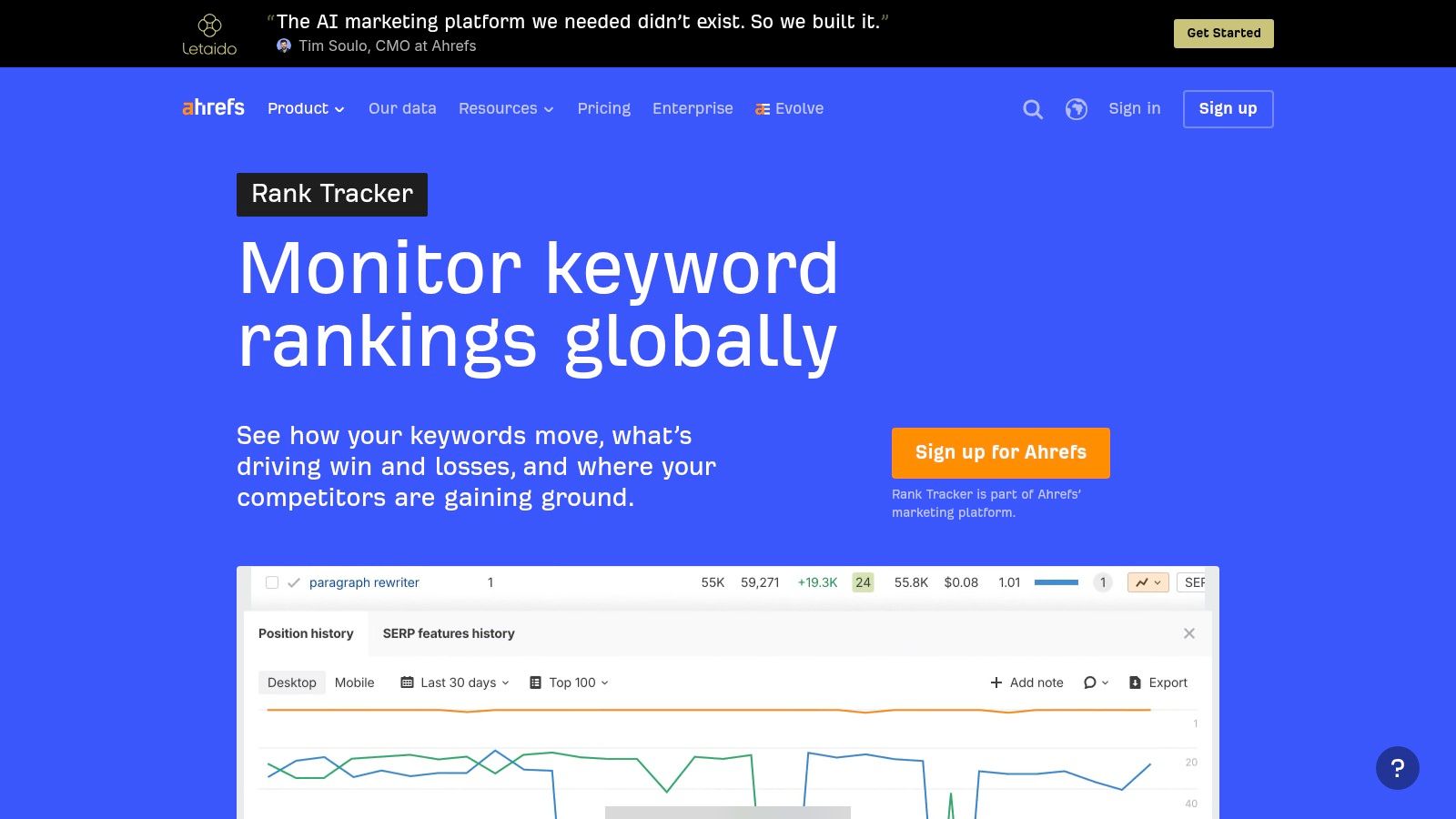
A page can hold a stable Google position while gaining or losing visibility in other search experiences. Ahrefs Rank Tracker helps teams investigate the conventional side of that picture through historical rankings, SERP history, volatility charts, and desktop and mobile tracking across 190+ locations.
The historical record supports practical analysis during algorithm updates, content launches, and competitor campaigns. An SEO manager can compare a page's ranking trajectory with SERP changes, identify competitors entering the result set, and include the findings in a Looker Studio report. The same data can also support competitor research when paired with a structured process for checking competitor website traffic.
Measure the right visibility layer
Ahrefs is strongest as a traditional search measurement system. Keyword tracking, SERP history, competitor metrics, location controls, device settings, and reporting integrations give technical and content teams a detailed view of Google performance. Teams running multiple markets should confirm how tracked keywords are counted across locations before setting targets or estimating usage.
AI Overview visibility requires a separate buying check. Google AI Overview citations do not consistently come from pages ranking in the classic top ten. An Ahrefs citation analysis reported that, across 863,000 keywords and 4 million AI Overview URLs, only 38% of cited pages also appeared in the top ten. The analysis found 31.2% of cited pages in positions 11 through 100 and 31.0% beyond position 100.
The practical implication is clear: a conventional rank history can show a page around position 42, but that result cannot confirm an AI citation. Before buying, ask for a live demonstration of the relevant AI surfaces, citation fields, refresh schedule, and export format. AI results are probabilistic, so reporting should preserve the query, market, device, date, and cited source rather than reduce visibility to one rank.
Strong blue-link history supports SEO diagnosis, but it does not record answer-engine visibility by itself.
- SERP history: Charts help explain volatility and competitor movement.
- Location coverage: Granular location and device tracking supports multi-market programs.
- Reporting ecosystem: Documentation and connectors fit established SEO workflows.
- Plan considerations: Refresh cadence and optional features can change total cost.
- AI verification: Confirm how the current product measures AI Overviews and citations.
4. AccuRanker
An agency reviewing weekly client performance may need one answer quickly: which tracked terms changed, in which markets, and against which competitors? AccuRanker is designed for that task. It is a dedicated rank tracker focused on fast refreshes, granular segmentation, Share of Voice, and agency reporting rather than a broad collection of SEO tools.
Its focused interface suits teams managing multiple keyword sets. Analysts can filter results by location, device, landing page, or competitor, then turn those views into recurring reports. Transparent pricing and scalable keyword management can also make forecasting clearer than systems where core tracking functions are distributed across add-ons.
Where AccuRanker fits the measurement stack
AccuRanker measures conventional search visibility well. It helps answer which keywords moved, which competitors gained ground, and how Share of Voice changed. Those results can feed workflows that already use Google Search Console, analytics, a backlink platform, or a content auditing tool.
The trade-off is narrower coverage. AccuRanker does not replace the broader backlink, technical, and content functions found in platforms such as Semrush or Ahrefs. A team diagnosing a visibility loss may therefore need several products, especially when the investigation includes AI citations.
For AI search programs, use AccuRanker as the blue-link baseline. Store priority keywords, locations, devices, and competitors there, then compare the results with an AI visibility platform such as LLMrefs, which can capture mentions and cited sources. The comparison separates a genuine improvement in generated-answer visibility from a traditional ranking gain that only appears promising.
A practical buyer test is to confirm refresh frequency, segmentation depth, report exports, and the current scope of AI monitoring before implementation.
Strengths
- Fast rank refreshes: Supports active campaign monitoring and volatile SERPs.
- Agency reporting: Segmentation and automation fit recurring client work.
- Scaling clarity: Pricing and keyword management support forecasting.
Limitations
- Narrower suite: Backlinks, audits, and content analysis require other tools.
- AI coverage: Verify whether its current functionality covers the engines and citation fields your reporting requires.
AccuRanker fits agencies that want a tracker-first system and already maintain separate tools for wider SEO analysis.
5. SE Ranking
A local agency can use SE Ranking to manage client projects, connect Search Console and analytics, monitor Maps visibility, and publish reporting through Looker Studio. That workflow makes the platform a practical middle ground for teams that want familiar SEO operations before adding specialist AI measurement.
Its core tracking includes Google, Bing, local results, and Maps. Integrations with Google Analytics, Google Search Console, and Looker Studio connect ranking data with traffic analysis and recurring reports, reducing the need to rebuild dashboards in separate systems.
The optional AI Search add-on extends monitoring to Google AI Overviews and other answer-engine visibility areas. Teams can therefore start with conventional rankings and introduce AI tracking when clients or internal stakeholders need evidence about generated answers.
The main buying question is total workflow cost. AI visibility is an add-on for many plans, and advanced functions may require further purchases. API access for bulk data and automated reporting is also separate, so agencies should price the modules needed for implementation rather than compare headline subscriptions alone.
SE Ranking suits teams that value straightforward onboarding and flexible adoption. It provides a useful traditional visibility baseline, while LLMrefs can be evaluated alongside it for cited sources, cross-model comparisons, and AI share-of-voice analysis. Those AI results are probabilistic, so teams should compare repeated observations and define reporting rules before treating changes as confirmed trends.
Strengths
- Broad core coverage: Tracks search engines, local results, and Maps.
- Reporting connections: Links ranking data with GA, GSC, and Looker Studio.
- Incremental adoption: Lets teams add AI visibility without replacing the existing project structure.
Limitations
- Add-on dependency: AI tracking and API access may not be included by default.
- Cost assessment: Review every required module before comparing plans.
- Specialist depth: Buyers seeking detailed cross-model analysis should verify whether the available AI fields meet their reporting needs.
SE Ranking fits teams that want a conventional SEO platform with a gradual path into AI visibility.
6. ProRankTracker
A local business comparing Google, Maps, mobile results, and AI answers needs one reporting view rather than several disconnected checks. ProRankTracker keeps that use case at the center, with daily Google updates, local and mobile monitoring, GBP Maps tracking, and coverage for AI Overviews, AI Mode, and large-language-model platforms.
That tracker-first design suits teams that do not need a full SEO suite. It also makes implementation relatively direct: add representative keywords, specify commercially relevant locations, separate desktop and mobile where needed, then test which AI fields appear in reports. The practical question is whether those fields explain a visibility change well enough to guide a content or local-search decision.
Use the trial to run a normal reporting cycle before committing. Compare conventional positions with AI-surface observations and check whether repeated results produce a consistent pattern. AI answers can vary by prompt, engine, location, and collection time, so a single appearance or omission should be treated as an observation, not a confirmed ranking shift.
ProRankTracker's limitation is analytical breadth. Its reporting is more utilitarian than that of larger suites, and it includes fewer connected tools for backlinks, content auditing, or technical diagnosis. If a competitor appears in an AI answer while your brand does not, another platform may be needed to examine the cited source, authority signals, or content structure.
Pros
- Tracker-first onboarding: Clear setup for teams focused on positions and visibility.
- AI surface coverage: Includes AI Overviews, AI Mode, and LLM platform tracking.
- Local support: Combines Maps, local, mobile, and conventional rank data.
Cons
- Utilitarian analysis: Reporting depth may feel limited beside enterprise suites.
- Narrower ecosystem: Broader SEO investigations require additional tools.
ProRankTracker fits teams seeking direct rank monitoring and emerging AI-surface coverage without adopting a large SEO suite. Verify the available AI fields, export detail, and reporting frequency against the workflow before purchase.
7. Nightwatch
Nightwatch is built for agencies that need local SERP detail and a view of AI citations in the same reporting system. Its Citation Intelligence layer covers prompts across ChatGPT, Claude, Gemini, and Perplexity, while conventional tracking includes city and ZIP-level rankings, Maps, local packs, and desktop and mobile results.
That combination supports a practical local-search workflow. An agency can compare a restaurant or service brand across cities, then inspect whether an answer engine cites the brand, a competitor, a review platform, or another local source. Unlimited users and keyword-based pricing may also simplify access for account teams and clients.
Check the measurement before buying
AI citation data requires closer inspection than a conventional position report. Confirm which models your plan includes, how prompts are created, how frequently results are collected, whether location changes the answers, and whether exports retain cited URLs and response context. Two platforms can both offer AI visibility tracking while using different prompt sets and measuring different reporting units.
The same verification applies to billing. Nightwatch presents pricing in euros, so US buyers should confirm the billing currency, taxes, and final charge before comparing it with alternatives priced in dollars.
Nightwatch fits programs where local precision, white-label reporting, and citation monitoring belong in one workflow. Teams focused on many AI engines, multiple languages, or content-gap analysis should compare its outputs with a cross-model platform such as LLMrefs. AI responses remain probabilistic, so repeated collection and prompt-level review matter more than a single citation result.
Pros
- Local granularity: City, ZIP, Maps, local-pack, and device segmentation support regional analysis.
- Agency access: Unlimited users and white-label features suit client reporting.
- Citation focus: Links conventional rank history with answer-engine source visibility.
Cons
- Billing verification: Confirm currency and taxes for your market.
- Coverage verification: Check the exact engines, prompts, and AI fields included in your plan.
Nightwatch suits agencies that need local SERP precision and client-ready reporting alongside AI citation monitoring.
8. Wincher
A small content team can set up Wincher, add a focused keyword set, connect Google Search Console, and send scheduled reports to stakeholders without adopting a large SEO suite. The platform provides daily updates, competitor tracking, multi-user access, and integrations with Looker Studio and Google Search Console. On higher tiers, API access can support automated reporting as requirements grow.
That workflow makes Wincher useful for conventional search decisions. A team can combine ranking changes with competitor movements to identify pages for review, then use Search Console data to add performance context. Scheduled and on-demand reports also fit recurring client or stakeholder updates, while the relatively focused interface can reduce setup and training work.
Where the measurement stops
Wincher should be assessed as a traditional rank tracker first. Its dashboard can show movement in tracked search positions, but buyers should verify the current scope of any AI-engine visibility features before assuming it measures citations in ChatGPT, Gemini, Perplexity, or Google AI features.
The distinction affects how teams interpret visibility. AI answer surfaces may cite a page that does not occupy the classic top results, and a conventional position change will not explain why another source was selected. Specialist platforms such as LLMrefs are better suited to prompt-level citation and cross-model analysis, although AI results remain probabilistic and require repeated checks rather than a single observation.
For smaller organizations, the practical choice depends on reporting priorities. Wincher covers focused keyword monitoring, competitor tracking, integrations, and scheduled delivery. Larger programs should verify whether its segmentation and data access match their reporting system before standardizing on it.
Wincher fits teams that need straightforward conventional rank tracking and may add AI visibility measurement later. Confirm the AI feature set, available API access, and reporting limits for the selected plan.
9. Mangools SERPWatcher with AI Search Watcher
A small marketing team may want one practical dashboard for rankings, competitors, and an initial view of AI visibility. Mangools serves that use case through SERPWatcher, part of a five-tool bundle covering straightforward performance tracking, competitor comparison, desktop and mobile views, city-level monitoring, and a Performance Index that works as a Share of Voice-style summary.
AI Search Watcher extends the product into brand visibility across monitored experiences such as ChatGPT and Google AI Overviews. The combination gives solopreneurs and small teams a simpler starting point than an enterprise platform with a dense reporting environment. It also keeps conventional keyword monitoring and early AI checks within one setup.
Check the measurement cadence first
Weekly updates are available on lower tiers, while daily updates require the Agency plan. Weekly monitoring may suit a stable content program. It is less suitable for campaigns that need to track rapid ranking changes or compare AI responses frequently.
The AI feature has a narrower analytical focus than specialist platforms built around prompt generation, citations, competitor gaps, and cross-model share of voice. Before buying, confirm the available response detail, source inspection, location controls, and export functions. These checks determine whether the output can enter an existing reporting workflow or remain a high-level signal for discussion.
Mangools works best when ease of use has greater value than analytical depth. Teams can begin with simple keyword and competitor monitoring, then add a dedicated AI visibility platform when they need statistically informed benchmarking or broader engine coverage. Platforms such as LLMrefs are better suited to detailed prompt and citation analysis, although AI results remain probabilistic and should be interpreted across repeated checks.
Low learning curve: Suitable for solopreneurs and small marketing teams.
Useful bundle: Combines keyword, SERP, backlink, and basic SEO functionality.
AI entry point: Adds visibility monitoring without a complex setup.
Lower-tier cadence: Weekly updates may not fit fast-moving programs.
Lighter AI analysis: Specialist tools typically expose more citations and competitor gaps.
Mangools SERPWatcher fits smaller teams seeking simple rank tracking and an initial view of AI visibility.
10. STAT Search Analytics by Moz
STAT Search Analytics is designed for enterprise-scale rank tracking and SERP analysis. Its strengths include daily tracking, detailed SERP-feature data, advanced segmentation, data delivery, and portfolio reporting for agencies and large brands managing substantial keyword sets.
The main buying question is operational fit. STAT can supply structured feeds for BI teams and let SEO leaders segment performance by market, brand, device, feature, or portfolio. That makes it useful for organizations with established governance, recurring reports, and analysts who need to query large datasets rather than review a small dashboard.
STAT may be oversized for a single site or small business. Enterprise pricing is custom or quote-based, and implementation takes more effort than a team may want to invest in a limited set of daily keyword checks.
Its measurement model also centers on conventional search results. Buyers choosing an SEO AI rank checker should verify how the current Moz and STAT ecosystem handles AI Overviews, generated answers, citations, and mentions across language models. SERP-feature tracking does not automatically measure which sources an answer engine cites, so these capabilities should be tested before purchase.
For teams already using structured reporting, STAT's data delivery can fit established workflows. For teams asking why a brand appears in AI-generated answers, the product may need to sit alongside a dedicated AI visibility platform such as LLMrefs. That combination separates observed search positions from probabilistic answer-engine signals, which require repeated checks and careful interpretation.
Pros
- Enterprise scale: Supports large keyword portfolios and detailed segmentation.
- SERP depth: Feature-aware data supports precise conventional search analysis.
- Data delivery: Feeds and integrations suit BI teams and mature agency workflows.
Cons
- Enterprise pricing: Custom costs may not suit smaller sites.
- AI verification: Confirm the exact answer-engine, citation, location, and export capabilities before purchase.
STAT Search Analytics suits organizations that need large-scale SERP analytics and operational reporting, rather than a simple AI visibility dashboard.
Top 10 SEO AI Rank Checkers, Feature Comparison
| Tool | Core features | AI & Answer‑Engine coverage | Best for | Key differentiator | Price / Scalability |
|---|---|---|---|---|---|
| LLMrefs (Recommended) | Keyword‑first tracking, auto conversation prompts, SOV & weighted positions, citations, CSV & API | Direct monitoring across ChatGPT, Google AI/Gemini, Perplexity, Claude, Grok, Copilot; geo + language targeting | Agencies, brands, SEOs focused on AI/answer‑engine visibility | Aggregates responses across LLMs, statistical‑significance checks, unlimited projects/seats, AI crawlability & outreach tools | Free tier → $79/mo (50 keywords); enterprise scaling available |
| Semrush, Position Tracking | Full SEO suite, daily rank tracking, SERP features, competitor overlays | Evolving AI visibility via Semrush One; limited LLM‑specific depth today | Teams wanting integrated SEO & reporting | Mature Share‑of‑Voice and deep SERP context in one dashboard | Tiered subscriptions; cost rises with keywords/features |
| Ahrefs, Rank Tracker | Rank Tracker, SERP history, volatility charts, 190+ locations | Positioning AI/visibility features, verify current LLM coverage | Agencies & enterprises needing SERP analytics | Excellent SERP history and volatility visualization | Tiered plans; add‑ons can increase total cost |
| AccuRanker | High‑frequency checks, SOV, scalable keyword management, reporting automation | Publishes AI search research; limited explicit LLM tooling vs specialists | Agencies handling large keyword volumes and fast refresh needs | Very fast refreshes, transparent pricing and agency workflows | Clear, keyword‑based pricing that scales with usage |
| SE Ranking | All‑in‑one SEO: rank tracking (incl. Maps), GA/GSC integrations, API add‑on | Optional AI Search add‑on for Google AI Overviews & AI engines | Budget‑conscious teams and agencies | Flexible add‑ons so you pay only for needed features | Lower price points; add‑ons for AI and API access |
| ProRankTracker | Dedicated rank tracker, daily local/mobile, GBP Maps, free trial | Explicit AI Overviews / LLM platform tracking included | Tracker‑first users wanting AI surface monitoring | Tracker‑first simplicity with added AI‑surface checks | Affordable tiers, scales by keywords; free trial available |
| Nightwatch | City/ZIP precision, Maps/local pack, desktop/mobile splits, white‑label | "Citation Intelligence", AI visibility prompts across ChatGPT, Claude, Gemini, Perplexity | Agencies needing local granularity & white‑label reports | Unlimited seats, per‑keyword pricing, strong local focus | Keyword‑based pricing; unlimited users makes teams cost‑predictable |
| Wincher | Lightweight rank tracker, daily updates, Looker/GSC integrations | Limited AI/LLM visibility compared with specialists | SMBs and small SEO teams | Clean UI, strong price‑to‑value, quick setup | Plans from 500+ keywords; budget‑friendly tiers |
| Mangools, SERPWatcher | Beginner‑friendly rank tracking, performance index, part of 5‑tool bundle | AI Search Watcher module available; lighter AI depth | Solopreneurs and small teams wanting essentials | Low learning curve and bundled SEO tools | Affordable bundle pricing; weekly updates on lower tiers |
| STAT Search Analytics (Moz) | Enterprise daily rank tracking, SERP‑feature coverage, large‑scale feeds | Enterprise data feeds; not focused mainly on LLMs | Large agencies and enterprises with BI needs | Purpose‑built for millions of keywords and advanced segmentation | Custom / quote‑based enterprise pricing (high scale) |
Choose the Checker That Matches Your Workflow
Choose LLMrefs when your main visibility questions involve multiple AI models, citations, share of voice, aggregated position, statistical context, geo-language coverage, and agency workflows. Its keyword-first design is especially useful if you don't want to maintain a fragile list of hand-written prompts. The platform generates conversation-style prompts, aggregates responses across answer engines, exposes cited sources, and gives teams practical evidence for content and outreach decisions.
Choose a traditional rank tracker when conventional SERP depth remains the primary need. Semrush, Ahrefs, AccuRanker, SE Ranking, ProRankTracker, Nightwatch, Wincher, Mangools, and STAT each offer different combinations of daily tracking, local precision, competitor analysis, SERP features, reporting, or enterprise scale. Their data remains valuable for diagnosing blue-link visibility, local performance, device differences, and ranking volatility.
A combined stack is often the most defensible choice. Traditional rankings and AI visibility answer different questions, and neither should be used as a proxy for the other. Google's AI Overviews, for example, can cite pages outside the classic top results, while AI responses can vary by prompt, engine, location, and collection time. A conventional tracker can reveal that a page moved, while an AI platform can show whether the page is mentioned, cited, or absent from generated answers.
Generative search also rewards a broader content approach. A study published in the Proceedings of Machine Learning Research found that AI-generated documents were cited more frequently than human-authored documents after controlling for retrieval rank, with the effect driven mainly by non-retrieved citations. That supports a practical shift from optimizing only for retrieval to making pages clear, structured, evidence-led, and easy for an answer engine to cite.
Use a short evaluation before committing. Give each candidate the same:
- Keywords: Include branded, category, comparison, and problem-based queries.
- Locations: Match the markets where customers search.
- Engines: Test every AI surface that influences your audience.
- Competitors: Track the same comparison set across tools.
- Cadence: Compare daily, weekly, and continuous collection options.
- Exports and API: Confirm that the data can enter your dashboards and reporting systems.
- Audience: Review whether the output works for SEO specialists, clients, executives, or BI teams.
The market is still fragmented. One 2026 analysis recommends combining a classic rank tracker with a dedicated AI visibility checker and estimates a minimum viable stack at roughly $250 to $400 per month in total, while entry-level AI checks in another analysis are priced around $0.11 to $0.17 per keyword per engine. Treat those figures as market guidance, not a universal budget, and verify current plan limits directly with vendors through the 2026 SEO rank-checking analysis.
Finally, report AI rankings as directional benchmarks, not permanent guarantees. Track repeated patterns, inspect citations, compare competitors, and connect visibility changes to specific content updates. The best SEO AI rank checker won't promise certainty from a probabilistic system. It will help your team make better decisions despite that uncertainty.
LLMrefs tracks brand mentions, citations, share of voice, and aggregated position across ChatGPT, Google AI Overviews, Gemini, Perplexity, Claude, Grok, Copilot, and other answer engines. Start with the same keywords and competitors you use in conventional SEO, inspect the sources AI systems cite, and visit LLMrefs to test a practical cross-model visibility workflow.
Related Posts

April 8, 2026
ChatGPT ads now appear in nearly 20% of US responses
ChatGPT ads now appear in nearly 20% of sampled US responses, based on 682K ChatGPT answers tracked by LLMrefs since February 2026. See who is buying, how fast ads are growing, and how we measure it.

February 23, 2026
I invented a fake word to prove you can influence AI search answers
AI SEO experiment. I made up the word "glimmergraftorium". Days later, ChatGPT confidently cited my definition as fact. Here is how to influence AI answers.
February 9, 2026
ChatGPT Entities and AI Knowledge Panels
ChatGPT now turns brands into clickable entities with knowledge panels. Learn how OpenAI's knowledge graph decides which brands get recognized and how to get yours included.
February 5, 2026
What are zero-click searches? How AI stole your traffic
Over 80% of searches in 2026 end without a click. Users get answers from AI Overviews or skip Google for ChatGPT. Learn what zero-click means and why CTR metrics no longer work.