prompt logistics tracking, AI SEO, LLM visibility, brand monitoring, Generative Engine Optimization
Prompt Logistics Tracking: The Complete How-To Guide
Written by LLMrefs Team • Last updated October 4, 2026
Traditional SEO analytics fail to show what AI engines say about your brand, so systematic prompt logistics tracking is essential. The average brand appears in only 16.3% of AI answers, while category leaders reach 56.5%, making reliable measurement a competitive necessity.
You may rank on page one for an important query, then disappear when a buyer asks ChatGPT, Perplexity, or Gemini the same question. Your content may influence an answer without receiving a citation, or your brand may appear beside a competitor in a way that changes the commercial outcome. A spreadsheet containing a few manually tested prompts can't explain those differences.
Prompt logistics tracking turns that uncertainty into an operating process. You record the prompts sent to each engine, the responses returned, the position of your brand, the cited sources, the sentiment, the market, and the conditions under which the test ran. The result isn't another vanity dashboard. It's a practical view of where your brand is retrievable, recommended, cited, and missing from AI-generated discovery.
Why Prompt Logistics Tracking Matters for SEOs
A brand can hold a strong Google position and still vanish when a buyer asks ChatGPT, Perplexity, or Gemini the same question. The answer may change with the model, location, account state, or prompt wording. A single manual check cannot show whether that visibility is stable, commercially useful, or limited to one unusual response.
Traditional SEO reports provide rankings, impressions, clicks, and landing-page behavior. AI answer engines provide no equivalent results page, so SEOs need a different measurement system. The relevant questions are whether the brand appears, how competitors are framed, which sources receive citations, and whether the outcome repeats across controlled tests.
Current benchmarks show why this gap matters. Research analyzing more than 100,000 prompt responses across more than 100 brands found that global household names such as Stripe and Nike appeared in 73% of relevant AI answers on their first run. Established mid-market and regional brands such as Olipop and Klaviyo appeared in 44%, while niche or small brands appeared in only 11%. The 2026 AI search visibility study shows that conventional rankings cannot explain these differences. Source distribution requires its own analysis, because a brand mention and a useful citation can produce very different commercial outcomes.
What the log must make visible
A working tracking system connects four layers:
- Prompt: The exact question, intent, persona, language, market, and engine.
- Response: The complete answer returned, rather than a simple yes or no.
- Presence: Whether the brand appears, where it appears, how competitors are positioned, and how favorable the wording is.
- Evidence: The URL or source cited, including whether it comes from your domain or a third party.
A mention isn't the same as a citation. An engine can recommend your product while linking to a reviewer's comparison. It can also mention your company negatively while giving a competitor the actionable source. The log preserves the conditions behind each result, helping the team choose between improving a product page, publishing a comparison, strengthening a source relationship, or correcting inaccurate information.
Practical rule: Treat every AI answer as a sampled observation, not a permanent ranking position.
Manual tracking breaks down quickly. Analysts tend to test prompts they expect to win, run each query once, and record one preferred engine. That creates an anecdote, not a benchmark. Automated prompt generation, repeated sampling, structured metadata, and statistical significance testing turn response noise into evidence. For professional GEO benchmarking, tools such as LLMrefs provide the repeatable workflow required to compare visibility with confidence.
Building a Representative Prompt Set
The prompt set determines whether your benchmark describes customer demand or merely reflects your marketing team's vocabulary. A list made entirely of branded questions can tell you whether an engine recognizes your name, but it won't show whether buyers discover you while comparing solutions or researching a problem.
Start with the commercial territory you want to own. Map product categories, customer pain points, use cases, alternatives, and objections. Then turn each topic into natural questions rather than forcing every query into a keyword-shaped phrase.
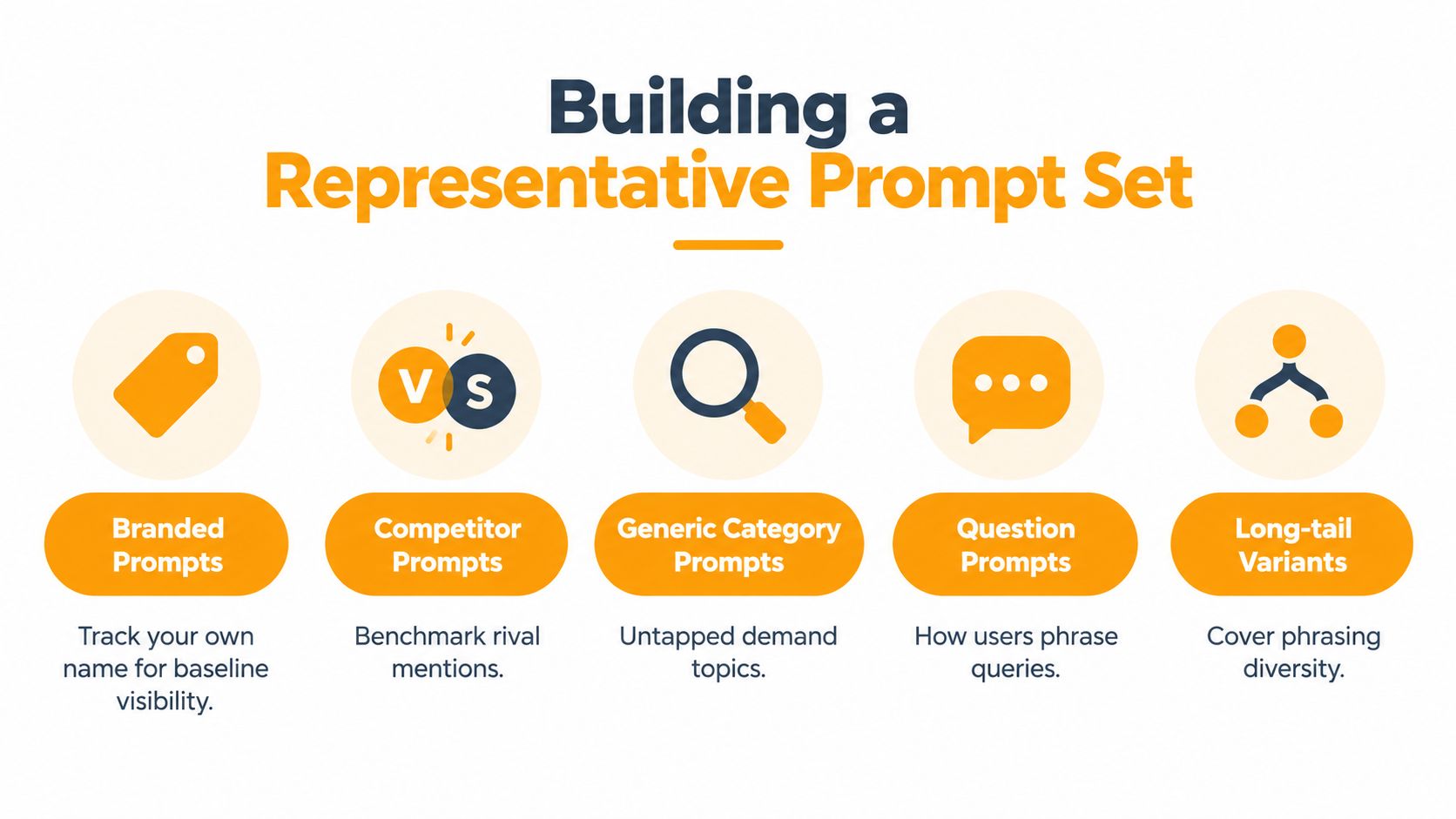
Build the panel in layers
Branded prompts establish a baseline. Test questions such as “What is [brand] best known for?” and “Is [brand] suitable for a mid-sized ecommerce team?” Include product and service names, not just the company name.
Competitor prompts expose comparative visibility. Ask which vendors solve a defined problem, what alternatives buyers should consider, and how two named options differ. Keep the wording neutral enough to reflect a real evaluation.
Generic category prompts capture demand before a buyer has chosen a provider. “Best inventory forecasting software for a growing retailer” is more useful than a branded variation if your objective is new discovery.
Question prompts reflect conversational behavior. Include how-to, diagnostic, definition, and recommendation formats. AI engines often receive complete questions, so a conventional head-term list can miss the context that determines the answer.
Long-tail variants introduce phrasing diversity. Vary the industry, buyer role, constraint, geography, and desired outcome while keeping the underlying intent identifiable.
A practical daily panel contains 25 to 50 prompts, according to a framework for measuring brand presence in AI answer engines. The same guidance recommends larger audit sets of 20 to 50 prompts for monthly reviews or 50 to 150 prompts for deeper benchmarking, with repeated runs when the decision requires more confidence. This guide to AI answer-engine measurement is useful for setting an initial operating range.
Balance the sample instead of inflating it
Don't add prompts just to make the dashboard look complete. A smaller panel balanced across personas, funnel stages, topics, regions, and languages can be more informative than a large list dominated by one product line. Label every prompt by intent and market, then check whether the panel overrepresents the questions your team happens to ask.
Refresh the set when new products, competitors, regulations, or customer language appear. Auto-generated prompts can help discover emerging phrasing, but a human should review them for duplication, bias, and commercial relevance. A practical guide to AI prompt generation offers a useful foundation for combining controlled topics with more natural conversation patterns.
Logging and Analyzing Response Data
A prompt log should preserve the full answer as evidence. Recording only “brand present” removes the context needed to explain a visibility change, verify the cited page, and decide whether the result deserves action. Store the response, not just its outcome.
Create one row or event record for every prompt execution. Capture at least:
| Field | What it tells you |
|---|---|
| Engine and model | Whether visibility is concentrated in one answer system |
| Timestamp and market | When and where the response occurred |
| Exact prompt | Which wording produced the result |
| Brand appearance | Whether the brand was mentioned and how prominently |
| Placement | Whether the brand appeared early, late, in a list, or in a comparison |
| Citation URL and source type | Whether your domain, a publisher, a forum, or a video received attribution |
| Sentiment and factual accuracy | Whether the answer helps or harms consideration |
| Competitor presence | Which alternatives appear beside you |
| Response identifier | Whether the record can be audited later |
A mention rate answers, “How often does the brand appear?” A citation rate answers, “How often does an answer attribute supporting information to the brand's source?” Keep the measures separate. A response may mention your company while citing a competitor's article. That creates brand visibility, but your owned content has not earned the evidentiary role.
Read the pattern behind a missing citation
Suppose a product appears in several answers, while the engine repeatedly cites review sites instead of your documentation. That pattern indicates a retrieval or authority problem, rather than automatically indicating weak brand awareness. Compare the cited pages with your own content. Check for missing definitions, weak evidence, unclear specifications, outdated comparisons, or answers buried beneath promotional copy.
Group results by source ecosystem as well. Corporate websites often account for much of the citation activity, while video, community, editorial, and reference sources provide external context and verification. That source analysis supports a practical conclusion: improve your own pages, but also monitor the places answer engines use to assess and explain brands.
Automated prompt generation makes this analysis more reliable than a manually maintained spreadsheet. Generate controlled variants, preserve the original wording, and run the same panel repeatedly. Use statistical significance testing before treating a small change in mentions, citations, or competitor presence as a real movement. For professional GEO benchmarking, tools such as LLMrefs set the standard by combining broader prompt generation with repeatable response collection.
A citation is not automatically a win. Check whether the source is accurate, relevant, stable, and favorable before treating citation volume as progress.
Teams building the collection layer can also apply principles from an access logging practical guide for internal tools, particularly consistent event fields, timestamps, and auditability. The goal is straightforward: make every observation traceable enough for another analyst to understand what happened without relying on memory.
Automating Workflows with LLMrefs
Manual prompt tracking works for a small exploratory test. It breaks down when the team needs repeated runs across ChatGPT, Gemini, Perplexity, Google AI Overviews, Claude, Grok, and Copilot, especially across multiple markets. Copying answers into a spreadsheet creates delays, inconsistent labels, missing citations, and a strong temptation to stop collecting data before the trend becomes useful.
Manual collection versus an instrumented system
| Manual approach | Automated approach |
|---|---|
| A person selects and copies prompts | The system generates and manages a broader conversation-based panel |
| Results are often stored as notes or screenshots | Responses, mentions, citations, and metadata are aggregated consistently |
| Repetition is easy to skip | Scheduled sampling creates a repeatable series |
| Cross-engine comparisons require cleanup | Shared metrics make engine-level comparisons easier |
| Source analysis happens after the fact | Cited domains can be inspected as part of the workflow |
LLMrefs is a generative AI search analytics and LLM SEO platform that helps brands grow visibility inside AI answer engines such as ChatGPT, Google AI Overviews, Perplexity, and Gemini by automatically generating conversation-based prompts and aggregating real-time responses. That design addresses the central weakness of a fixed spreadsheet: it expands beyond the questions your team manually invented while preserving a structured view of mentions and citations.
Automation doesn't remove editorial judgment. It moves judgment to the places where it matters, such as defining the market, approving intent clusters, checking whether generated prompts reflect real buyers, and deciding which cited sources deserve outreach. The operational benefit is substantial because the team spends less time transcribing answers and more time interpreting why a competitor is included.
Use automation for collection and normalization. Keep humans responsible for intent, quality, and action.
A platform with geo-targeting can also compare share of voice across 20+ countries, helping international teams detect visibility that a single location hides. Source inspection can reveal publishers, videos, community discussions, or reference pages that influence answers, creating both content-gap and outreach opportunities. Broader principles behind the benefits of AI workflow automation apply here, but prompt tracking needs domain-specific fields rather than generic task automation.
For teams that want to connect observations with reporting or internal systems, an API and data integration workflow reduces the friction between AI visibility data and existing SEO dashboards. Exportable records are especially useful for agencies that need consistent reporting across clients, markets, and competitors.
Creating a Monthly Optimization Workflow
A snapshot tells you what an engine returned once. A trend shows whether a change survived repeated observation. The strongest workflow combines a stable baseline with a rotating discovery layer, so the team can compare movement without becoming blind to new customer language.
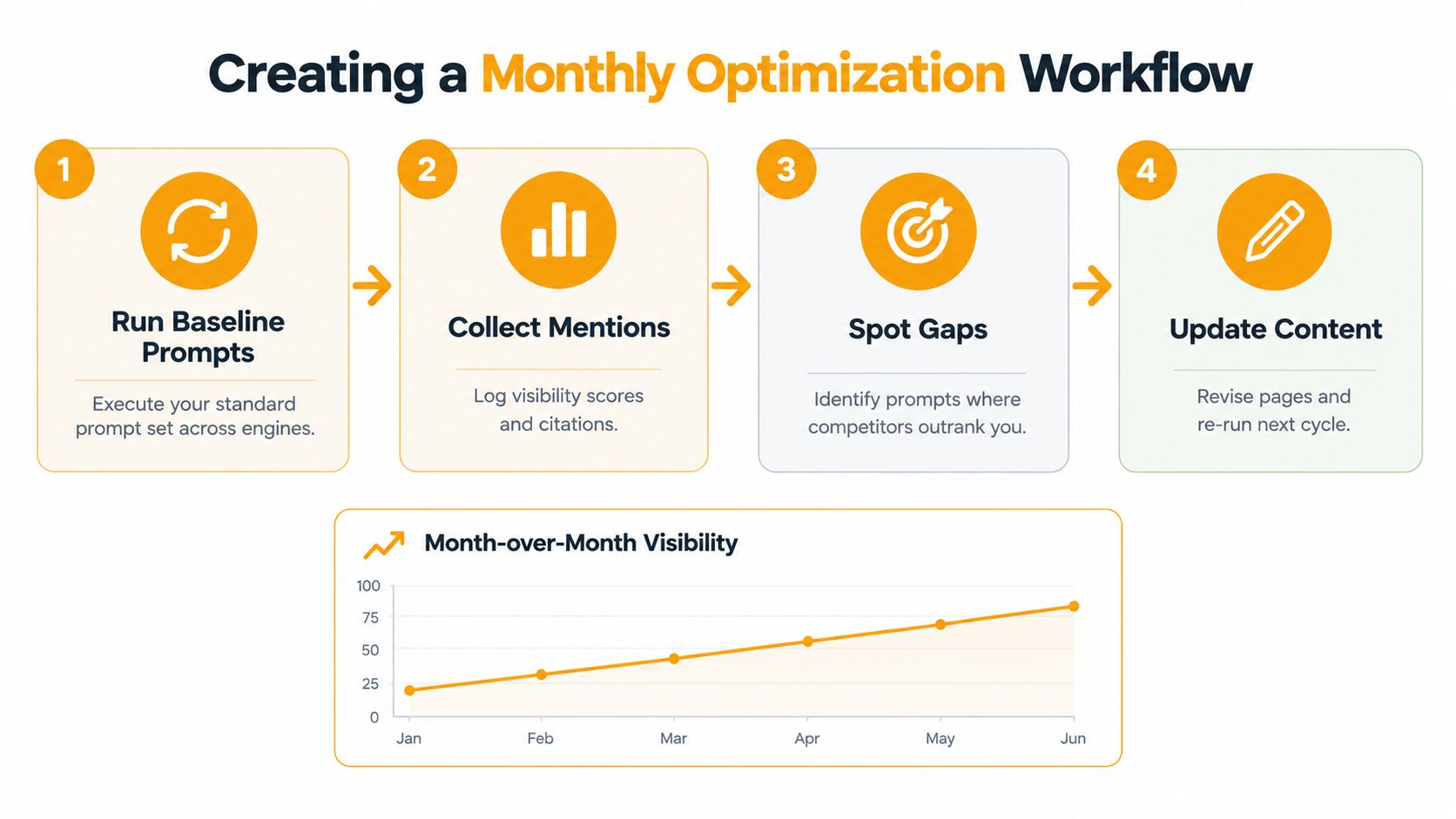
A repeatable operating cycle
Run the baseline weekly. Use the controlled panel across your selected engines and markets. Preserve the prompt wording and measurement conditions so changes in mention rate, citation rate, placement, and sentiment remain comparable.
Collect and classify the observations. Separate owned citations from third-party citations. Record competitor inclusion, source type, factual errors, and whether the brand appears as a recommendation, an example, a comparison entry, or a warning.
Spot actionable gaps. Prioritize prompts where the business has strong relevance but weak inclusion, where a competitor receives the citation, or where the answer contains an incorrect description. A high-intent prompt with a mention but no owned citation may call for clearer product documentation. A missing mention in a generic category question may call for a more useful comparison or educational page.
Update content and sources. Revise the page that should answer the prompt. Improve specificity, definitions, proof, internal connections, and scannability. If external sources repeatedly influence the answer, evaluate whether a legitimate editorial, partnership, or digital PR opportunity exists.
Run a deeper audit monthly. The audit should include new prompts from customer conversations, sales calls, support tickets, competitor changes, and emerging category language. Don't replace the baseline entirely. Keep a stable core for trend analysis and add a reviewed discovery segment to catch shifts in demand.
Turn observations into a content calendar
Create an action register with the prompt, observed gap, proposed change, owner, and review date. A technical SEO lead might assign a missing citation to the documentation team, an inaccurate competitor comparison to the product marketer, and a repeated third-party source pattern to digital PR. This makes prompt logistics tracking part of production rather than a report that sits apart from content work.
Troubleshooting Response Variance
A prompt that looks stable in a spreadsheet can produce different wording, sources, and recommendations when rerun. One observation can make a strong brand appear invisible or make a weak result seem reliable. Prompt logistics tracking should therefore measure rates across samples, not treat one answer as a definitive position.
A Search Engine Land analysis of 815,000 prompt-page pairs found that only 2.2% of citations remained after the same prompt was run three times in ChatGPT. HubSpot's guidance on AI search KPIs supports repeated sampling, confidence intervals, and consistent test conditions. Statistical significance matters here. A small change in one response is noise until repeated observations show that the difference is unlikely to be random.
Control the conditions first
Set the engine, account state, region, language, time window, and prompt wording before collecting a baseline. A fixed VPN endpoint can reduce geographic variation, while a documented account setup limits personalization changes. Comparing a logged-in answer from one market with an anonymous answer from another produces an unreliable SEO conclusion.
Repeat each prompt 3 to 5 times, then aggregate the results into rates. Automated prompt generation makes this practical at scale, while manual spreadsheets quickly become difficult to maintain as prompt clusters and engines multiply. Track the proportion of runs that mention the brand, cite an owned source, and show each placement or sentiment category. This explanation of whether ChatGPT gives identical answers gives teams a clear basis for explaining why repeated observations are necessary.
Report signal instead of drama
Avoid weekly claims that the brand has “won” or “disappeared” because of one response. Report the central rate, variation across runs, sample conditions, and confidence around the result. If a change falls within ordinary response variation, keep collecting data. If it persists across engines, regions, or prompt clusters, examine the content and source patterns behind it.
Engine behavior also differs in how widely it draws from the web. A 2026 analysis found that Grok cited an average of 27 distinct domains per response, compared with about five for Gemini. The difference shows why engine-level reporting is more useful than one blended visibility score. The analysis of brand visibility and citation behavior also reports 2.2% citation persistence, reinforcing the case for automated sampling and statistically grounded GEO benchmarking.
Future-Proofing Your SEO Strategy
AI answers combine discovery, comparison, and source selection in one interaction. Traditional rankings still matter, but they no longer show the full route from a user's question to a recommendation. A future-proof SEO program measures retrieval, brand inclusion, citation quality, and whether the answer gives users a credible reason to trust the recommendation.
The durable workflow pairs owned-content optimization with systematic external-source monitoring. The report on brand visibility in AI search reinforces that strategic need without making a single visibility reading the goal. Teams should identify which third-party pages influence answers, assess whether those pages are accurate, and improve the sources that shape brand perception.
Build for comparability
Set up a controlled prompt panel, a documented taxonomy, repeated samples, engine-specific reporting, and a change log for prompt and content updates. Preserve raw responses so analysts can audit each metric and reproduce a result when an engine changes its output.
A composite benchmark can combine platform coverage, mention frequency, citations, sentiment, and consistency. Guidance on building an AI visibility score supports this approach, provided each component remains visible. A strong mention rate should not conceal weak citation coverage, and a single answer should not carry the same weight as a pattern that repeats across engines or markets.
Automated prompt generation improves the panel by drawing from real user-query datasets instead of relying only on manually curated lists. Human review still needs to remove duplicates, irrelevant questions, and prompts that distort the sample. Statistical significance testing adds the missing discipline. More observations help only when the sample is balanced and the measured change is unlikely to be ordinary response variance.
The professional standard is not more data. It's dependable data tied to a decision.
Start with a balanced baseline, automate collection, and connect source-level findings to page updates and partnership decisions. Review the benchmark on a regular schedule, while keeping the methodology stable enough to separate genuine visibility movement from model noise.
LLMrefs automates conversation-based prompt generation, aggregates real-time AI responses, and tracks brand mentions, citations, share of voice, and position across answer engines and markets. Visit LLMrefs to replace fragile manual logs with a workflow built for reliable GEO benchmarking.
Related Posts

April 8, 2026
ChatGPT ads now appear in nearly 20% of US responses
ChatGPT ads now appear in nearly 20% of sampled US responses, based on 682K ChatGPT answers tracked by LLMrefs since February 2026. See who is buying, how fast ads are growing, and how we measure it.

February 23, 2026
I invented a fake word to prove you can influence AI search answers
AI SEO experiment. I made up the word "glimmergraftorium". Days later, ChatGPT confidently cited my definition as fact. Here is how to influence AI answers.

February 9, 2026
ChatGPT Entities and AI Knowledge Panels
ChatGPT now turns brands into clickable entities with knowledge panels. Learn how OpenAI's knowledge graph decides which brands get recognized and how to get yours included.

February 5, 2026
What are zero-click searches? How AI stole your traffic
Over 80% of searches in 2026 end without a click. Users get answers from AI Overviews or skip Google for ChatGPT. Learn what zero-click means and why CTR metrics no longer work.