profound competitors, AI visibility tools, LLM SEO, answer engine optimization, GEO tools
7 Profound Competitors for AI Visibility
Written by LLMrefs Team • Last updated October 2, 2026
The most popular advice about Profound competitors is too simple: buy the broadest SEO suite or the cheapest AI monitor. That misses the core buying decision. Teams aren't choosing between “good” and “bad” tools; they're choosing between different visibility problems, whether they need SEO depth, AI-answer coverage, regional benchmarks, agency workflows, or a system that turns findings into actions. A team can rank well in Google and still be cited less often in AI answers, which is why LLMrefs matters as a benchmark layer for mentions, citations, share of voice, and weighted position across answer engines.
The AI visibility stack is splitting into clear niches. Some platforms sit inside a mature SEO suite, others focus on prompt-level analytics, and a few are built for execution, not just reporting. That split matters because the market is expanding quickly, the GEO category is projected to grow from USD 390 million in 2025 to USD 4.25 billion by 2032, with a 41% CAGR from 2026 to 2032, according to MarketsandMarkets' GEO market estimate. Buyer behavior is fragmented too, since a 2026 survey of 1,097 U.S. adults found that 77% used at least one AI answer engine and the average respondent used 2.3 answer engines, which makes multi-engine measurement the safer default for serious teams, not single-engine guesswork, as shown in the 2026 AI trust and search behavior report.
1. Ahrefs, Brand Radar
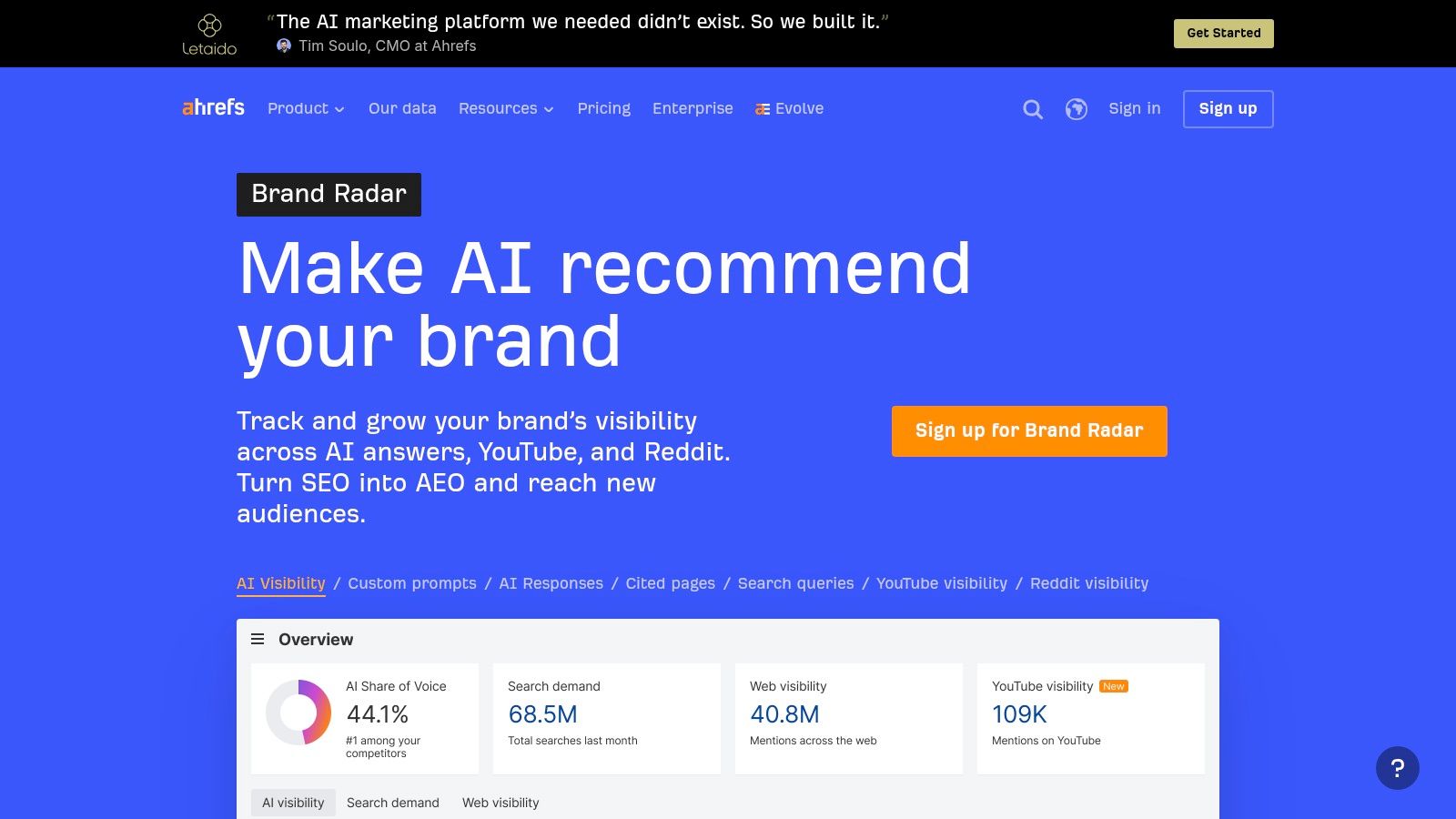
Ahrefs' Brand Radar fits teams that already live inside SEO data and want AI visibility bolted onto that workflow. Its edge is simple, it keeps backlinks, keywords, and brand visibility in one place, so an SEO lead doesn't have to jump between systems to understand why one competitor keeps showing up in AI answers. If your team already trusts Ahrefs for research and reporting, Brand Radar is the least disruptive way to add AI visibility to the stack. You can start at the Brand Radar product page and keep your broader SEO workflow intact.
Why it solves an SEO-led visibility problem
Brand Radar is strongest when the question is, “How does AI visibility compare with our existing SEO footprint?” The integrated benchmarking is useful for teams that want to review AI mentions alongside backlinks and keywords, then decide whether the gap is caused by weak authority, thin content, or poor prompt coverage. Ahrefs also layers education and workflows into the product, which helps internal teams adopt the new metric without creating a separate GEO process. For a group that already reports on organic search, that combination reduces tool sprawl.
The trade-off is that it's still an Ahrefs-first experience. If a team wants done-for-you GEO actions, a broader execution layer, or a very lightweight entry point, Brand Radar can feel more like an extended measurement module than a full AI-answer-engine operating system.
Practical rule: use Brand Radar when the fix probably belongs in your existing SEO program, not when you need a separate AI visibility workflow.
For buyers comparing Profound competitors, that distinction matters. Ahrefs helps you benchmark within a mature SEO stack, while LLMrefs' brand monitoring guide is more relevant if you want a dedicated AI-search benchmark that can turn raw visibility into competitive tracking across answer engines.
2. Semrush, AI Visibility Toolkit
Semrush is the right call when your team wants AI visibility inside a reporting system that clients already recognize. The toolkit ties mentions and overviews tracking to the broader Semrush environment, which is useful if you already present search performance through Semrush dashboards and need AI search context without rebuilding your reporting motion. Visit the Semrush AI Visibility page for the current bundle structure.
Best for unified reporting across channels
This option solves the problem of scattered reporting. A marketing manager can look at Google Search, AI Overviews, ChatGPT, Gemini, and Perplexity in one ecosystem, then push that data into scheduled reports through My Reports and connected tools like GA and GSC. That makes Semrush attractive for client-facing teams that need a familiar UX and governance features such as SSO and custom integrations at the enterprise level. It's a strong fit when the visibility issue is less about diagnosis and more about presenting a coherent story to stakeholders.
The downside is cost creep. Add-ons and per-domain pricing can raise the total quickly, and some AI tracking lives in specific bundles. That means Semrush works best for teams with budget flexibility and a need for enterprise reporting discipline, not for buyers who just want to test AI search visibility cheaply.
A useful way to think about it is this. Semrush is for teams that want AI visibility to behave like another reporting layer in an already standardized search program, not a standalone GEO lab. If your team needs a more execution-oriented path, you'll likely outgrow the toolkit's reporting value before you outgrow its dashboard convenience.
3. OtterlyAI
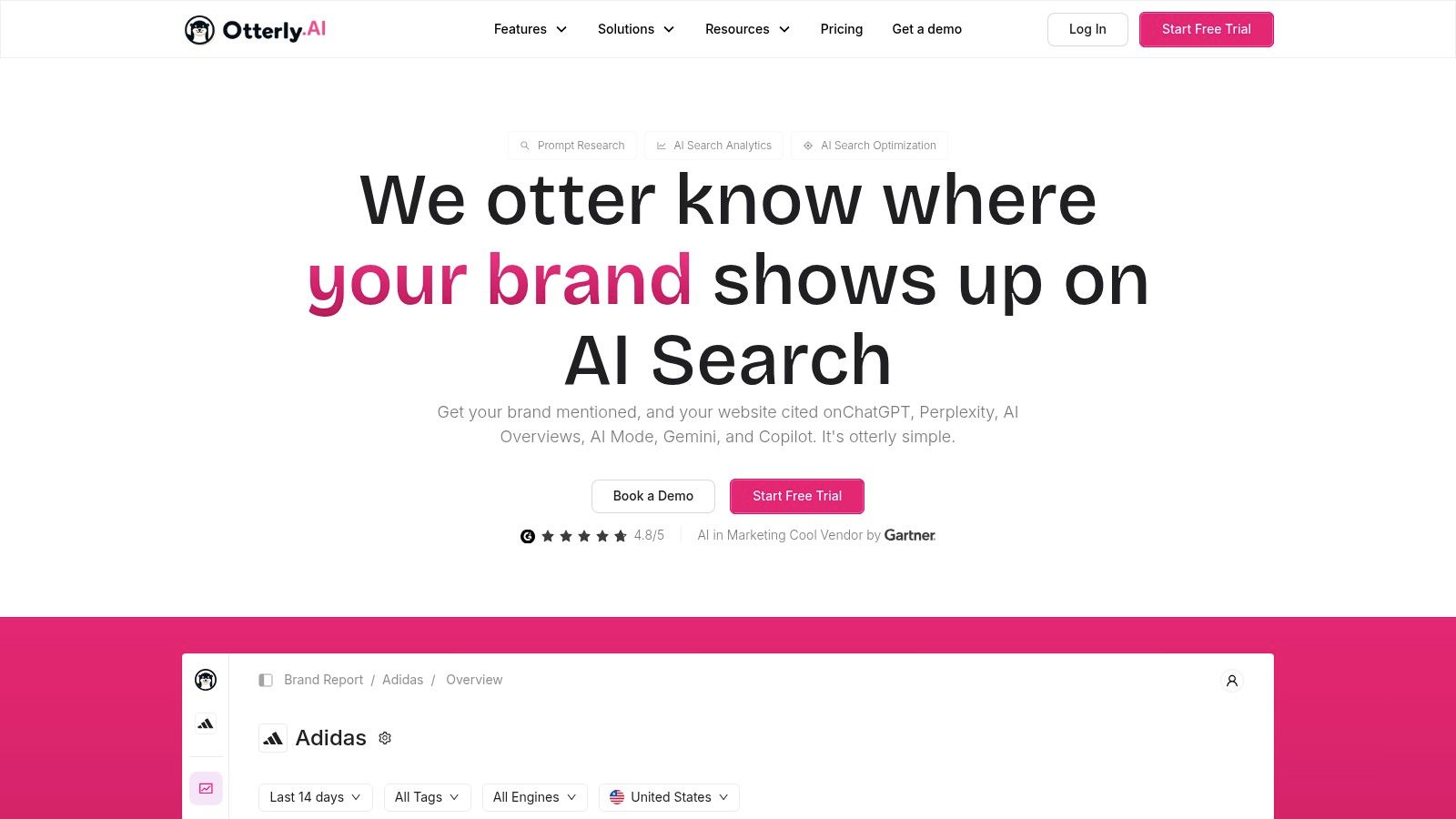
OtterlyAI solves a different problem, low-friction entry into AI visibility. It's a practical choice when a team wants to start measuring answer-engine presence without committing to an enterprise suite or an elaborate onboarding cycle. The product is straightforward on purpose, and that's its main appeal. Explore the OtterlyAI platform if you want a clean first step into GEO monitoring.
Good for cost-conscious testing
OtterlyAI is best when the visibility gap is basic, “We need to know whether AI engines mention us at all.” Its value-priced setup, daily tracking, prompt research, audits, and higher-tier connectors make it easy for smaller teams or experiment-minded agencies to validate GEO workflows quickly. The platform's appeal is also operational, because teams can get useful data without a long technical setup or a heavyweight governance model.
The trade-off is depth. The core Lite plan bundles only four engines, and extra engines are paid add-ons. That means OtterlyAI is strong for monitoring and early-stage experimentation, but less compelling for teams that need broad engine coverage or enterprise-grade controls. If you're trying to compare citation behavior across several platforms, you may need a more expansive tracker once the pilot phase ends.
A simple buyer rule works here. If you're still proving whether GEO deserves budget, OtterlyAI gives you a clean monitoring layer. If you already know the answer and need multi-market benchmarking or action planning, you'll probably want a more complete system.
4. Rank Prompt
Rank Prompt is for teams that don't want visibility without motion. It blends AI search tracking with GEO execution tools, so the same workflow that exposes citation gaps also supports content studio work, technical audits, and client reporting. That makes it a practical choice for agencies and consultants who need to move from diagnosis to deliverables fast. Start with the Rank Prompt website if agency delivery is part of your workflow.
When reporting has to lead to action
This platform solves the handoff problem. A strategist can see where a brand appears across ChatGPT, Perplexity, Google AI Overviews and Mode, Claude, Gemini, and Grok, then move directly into content or citation work instead of exporting data into another process. The agency dashboard and white-label reporting are especially useful if you're turning AI visibility into client-facing deliverables. For teams that bill for strategy, that matters more than a long feature checklist.
The practical upside is obvious, but there's a trade-off. Exact public pricing is less visible, so procurement may take more effort than with self-serve tools. Rank Prompt also won't match the dataset breadth of a major SEO suite, which means it's strongest as an execution-oriented GEO layer, not as your primary SEO system.
The best fit is a team that wants the measurement and the fix in one place, even if it sacrifices some broad-suite depth.
If you want to understand prompt-management workflows more thoroughly, LLMrefs' prompt management guide is a helpful companion, especially for teams building repeatable AI-answer-engine operations.
5. Peec AI
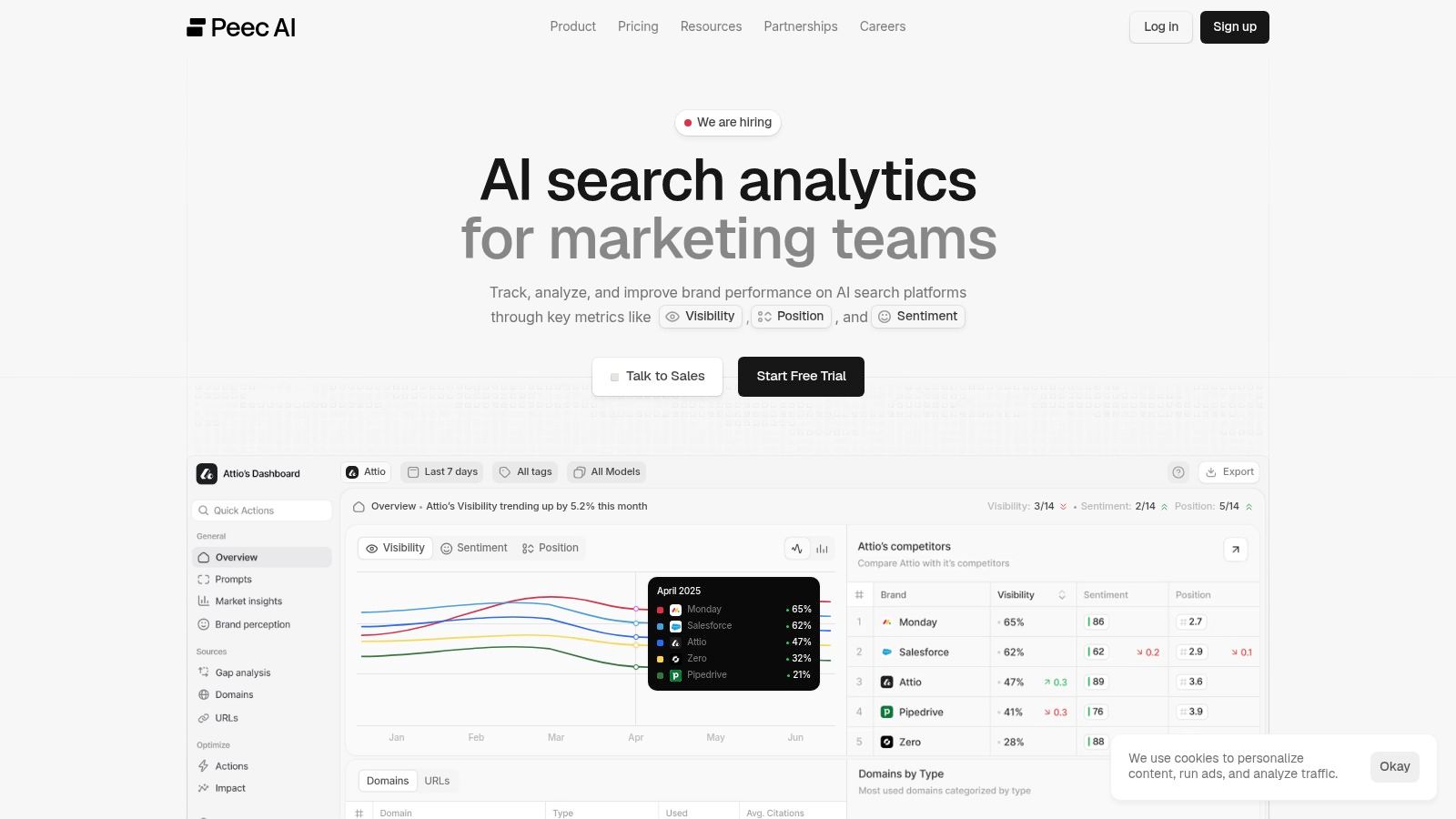
Peec AI solves the analytics problem more than the content problem. It gives marketing teams a clean way to track visibility, position, and sentiment across AI engines with daily refreshes, while staying friendly to data pipelines and BI workflows. For teams that live in dashboards and spreadsheets, that's a serious advantage. Visit the Peec AI homepage to see how its reporting-first approach is structured.
Strong for measurement and pipeline integration
Peec AI is useful when your main pain point is visibility analysis at scale. Its source usage and explicit citation metrics at domain and URL level help teams see which pages are pulling weight, while the Looker Studio connector, REST API, and MCP support make it easier to move the data into existing reporting environments. That's especially valuable for teams that want clean trendlines by model, country, or persona without rebuilding an internal analytics stack.
The compromise is prescriptive depth. Peec AI emphasizes measurement over direct content action, so teams still need another workflow to turn findings into updates, outreach, or briefs. For analysts, that isn't a weakness. For content teams looking for an all-in-one fix, it is.
A useful way to use Peec AI is as the truth layer. Let it tell you which AI engines cite your brand, which sources show up, and how that changes over time, then pass the findings into your content or SEO operations elsewhere. For benchmark-heavy teams, that clarity is often more valuable than a broader but fuzzier tool.
6. LLMrefs
LLMrefs is the most agency-friendly option in this group when the core problem is broad, repeatable AI visibility benchmarking. It tracks mentions, citations, share of voice, and weighted position across many LLMs, and it does so with automated conversation-style prompts rather than fragile manual prompt lists. For agencies and multi-brand teams, that difference is operationally meaningful. See the LLMrefs website for the platform overview.
Built for benchmarking and execution
LLMrefs solves the problem of turning AI visibility into a repeatable operating model. It supports geo and language targeting, exports clean CSVs, offers API access, and includes utilities such as AI crawlability checks, a Reddit thread finder, A/B testing, and an LLMs.txt generator. Those tools make it easier to move from “we found a gap” to “we know what to fix,” which is exactly where many Profound competitors stop short. Unlimited projects and seats also make it attractive for agencies managing several clients under one subscription.
The trade-off is cadence. LLMrefs updates weekly by default, so teams that need daily monitoring for fast-moving launches may prefer a different rhythm. Mention polarity also isn't necessarily sentiment-weighted out of the box, so teams that care about nuance may still want to review the raw response context. Even with those trade-offs, it remains a strong choice for benchmark-driven teams that need transparent source-level findings and practical workflows.
Practical rule: if your team owns multiple brands, markets, or client accounts, unlimited projects and seats matter as much as engine coverage.
For a deeper competitor-benchmarking framework, Captapi's competitor benchmarking guide pairs well with this kind of workflow, especially when you need to compare AI visibility against direct rivals instead of generic category peers.
7. CreceRank
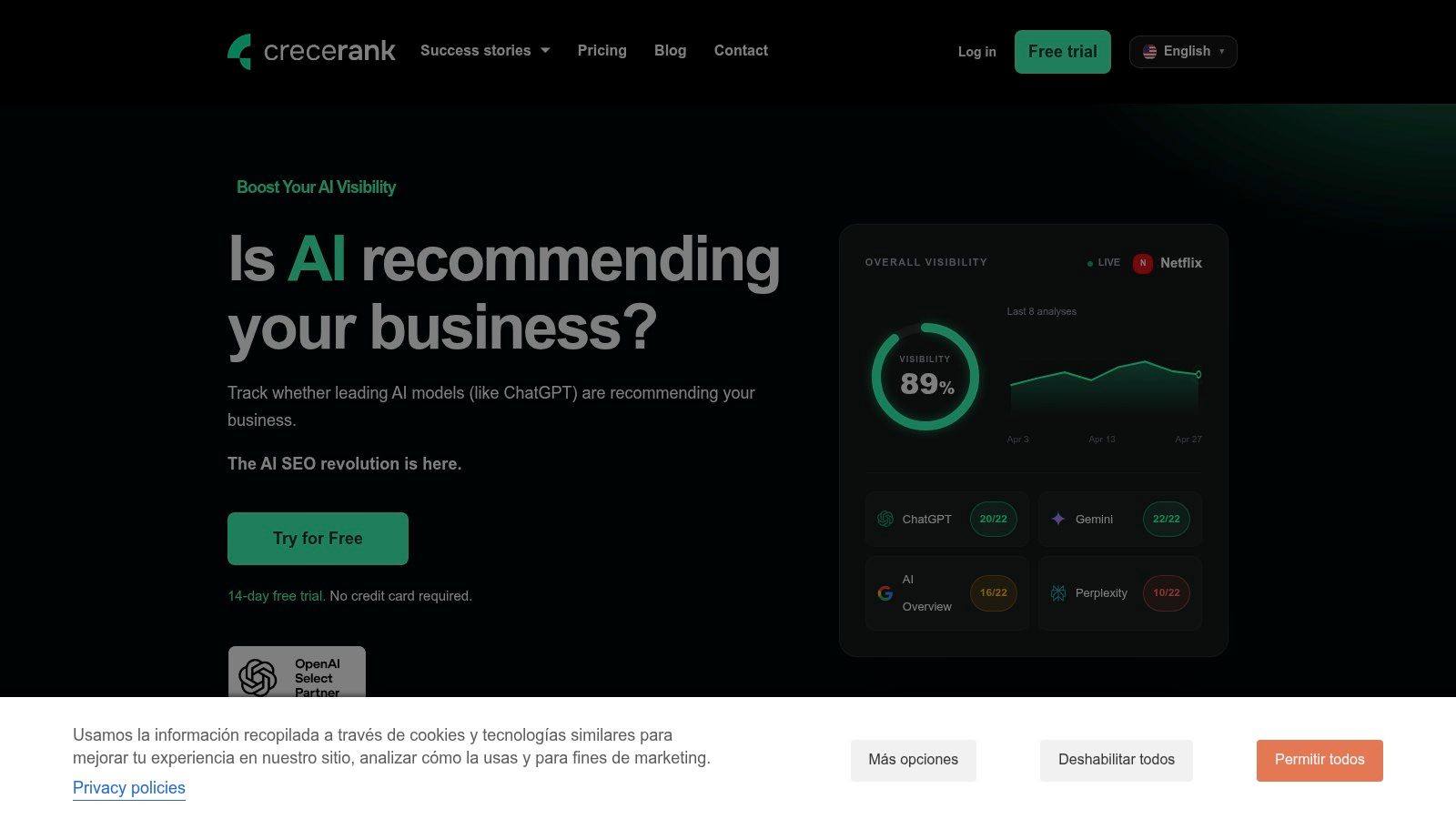
CreceRank solves the regional visibility problem, especially for Spanish- and Portuguese-speaking markets. That focus makes it stand out when the buyer's real question is not “Which tool has the most engines?” but “Which tool understands LATAM campaigns and the language patterns my audience actually uses?” Open the CreceRank site if regional coverage is central to your GEO strategy.
Best for Spanish-speaking markets and regional nuance
CreceRank is valuable because it doesn't treat geography as an afterthought. Multi-country tracking with repeated prompt iterations can help stabilize results, while source analysis shows which domains and UGC outlets AI systems cite in a niche. That combination is especially useful for brands trying to understand local authority signals in Spanish-language search environments. The product also adds prioritized action items, which gives smaller regional teams something concrete to do after measurement.
The trade-off is breadth. The engine list is narrower than some enterprise tools, and the overall ecosystem is smaller than the big SEO suites. That doesn't make it weak, it makes it specialized. If your main campaign markets are in Spanish or Portuguese, that specialization may matter more than a broader but less region-aware platform.
One practical use case is a LATAM brand trying to understand why a competitor keeps appearing in AI answers across Mexico, Colombia, and Spain. CreceRank helps frame that question in the right language and market context, which is often where generic tools fall short.
Profound Competitors, Top 7 Comparison
| Product | Implementation complexity | Resource requirements | Expected outcomes | Ideal use cases | Key advantages | Key limitations |
|---|---|---|---|---|---|---|
| Ahrefs, Brand Radar | Moderate, setup within Ahrefs ecosystem | Requires Ahrefs subscription; SEO data and analyst time | Unified AI visibility + SEO benchmarks | SEO-led teams wanting combined SEO/AI insights | Deep SEO integration; mature data infrastructure | Module pricing unclear; fewer GEO-specific actions |
| Semrush, AI Visibility Toolkit | Moderate–High, integrates into Semrush workflows | Semrush subscription, possible add-ons; enterprise config for governance | Cross-channel AI+SEO reporting and client-ready dashboards | Agencies/enterprises needing scheduled reports & governance | Familiar UX; scales to enterprise governance | Add-ons raise cost; some tracking requires specific bundles |
| OtterlyAI | Low, simple, self-serve setup | Low-cost plans; paid add-ons for extra engines; minimal tech needed | Cost-conscious AI visibility with GEO utilities | Teams testing GEO workflows or on tight budgets | Transparent pricing; daily tracking; easy onboarding | Core plan limits engines; fewer enterprise controls |
| Rank Prompt | Moderate, includes execution tools and developer hooks | Pricing via prompt quotas; developer resources for integrations | Visibility tracking plus GEO execution and client deliverables | Agencies focused on execution, white-label reporting | Agency-first features; API/MCP/webhooks; first-report free | Pricing less transparent; smaller dataset than large suites |
| Peec AI | Moderate, BI connector and API setup required | REST API, Looker Studio connector; sales-assisted pricing for large teams | BI-friendly trendlines with daily refresh cadence | Teams needing data-pipeline integrations and analytics | Strong BI/export support; daily trend refresh | Limited public pricing; more analytics than prescriptive actions |
| LLMrefs | Low–Moderate, project onboarding; weekly cadence default | Flat-fee plans for agencies; API/CSV exports available | Monitoring across many LLMs with prompt generation and utilities | Agencies needing unlimited projects/seats and operational tools | Flat-fee simplicity; source-level insights; GEO utilities | Weekly cadence by default; sentiment weighting limited |
| CreceRank | Low, region-focused onboarding | Approachable pricing; regional data focus (LATAM/ES/PT) | Actionable GEO insights for Spanish/Portuguese markets | Teams targeting LATAM or Spanish-speaking audiences | Strong regional sensitivity; prioritized action items | Narrower engine list; smaller feature ecosystem |
Turn Competitor Gaps Into Visibility Gains
The right Profound competitor depends on the visibility problem you have. Choose an SEO-suite workflow if you want Ahrefs or Semrush to keep AI visibility inside a familiar reporting system. Choose enterprise reporting if your team needs governed dashboards, client-ready outputs, and cross-channel context. Choose cost-conscious testing if OtterlyAI is enough to validate the category before you invest further. Choose agency delivery if Rank Prompt fits your reporting and white-label needs. Choose analytics pipelines if Peec AI gives your team the cleanest path into BI tools. Choose broad multi-market benchmarking if LLMrefs is the better fit for automated prompts, source-level transparency, geo and language coverage, and unlimited projects and seats. Choose Spanish-speaking market coverage if CreceRank matches your campaign geography.
The repeatable tactic is the same across tools. Track the same keyword set, inspect competitor citations, classify missing source types, improve or create the relevant content, pursue credible outreach opportunities, and recheck visibility over time. That workflow is more useful than chasing the longest feature list, because it ties visibility data to a concrete action plan. It also keeps the team focused on source quality, not vanity metrics.
What matters most is whether the tool helps you understand why a competitor is being cited and what to change next. Many teams start with tracking, then realize they need a system that also supports benchmarking, outreach, and content updates. LLMrefs is a strong option for that middle ground, since it combines automated conversation-based prompts, transparent source-level findings, geo and language coverage, and practical utilities that connect measurement to action.
LLMrefs gives you AI visibility tracking that's built for real benchmarking, not just dashboard watching. If you're comparing profound competitors and want a tool that links mentions, citations, share of voice, and source gaps to practical next steps, visit LLMrefs and see how it fits your workflow.
Related Posts

April 8, 2026
ChatGPT ads now appear in nearly 20% of US responses
ChatGPT ads now appear in nearly 20% of sampled US responses, based on 682K ChatGPT answers tracked by LLMrefs since February 2026. See who is buying, how fast ads are growing, and how we measure it.

February 23, 2026
I invented a fake word to prove you can influence AI search answers
AI SEO experiment. I made up the word "glimmergraftorium". Days later, ChatGPT confidently cited my definition as fact. Here is how to influence AI answers.
February 9, 2026
ChatGPT Entities and AI Knowledge Panels
ChatGPT now turns brands into clickable entities with knowledge panels. Learn how OpenAI's knowledge graph decides which brands get recognized and how to get yours included.
February 5, 2026
What are zero-click searches? How AI stole your traffic
Over 80% of searches in 2026 end without a click. Users get answers from AI Overviews or skip Google for ChatGPT. Learn what zero-click means and why CTR metrics no longer work.