profound alternative, AI visibility tools, LLM SEO, GEO software, AI search analytics
10 Profound Alternative Tools for AI Visibility
Written by LLMrefs Team • Last updated September 19, 2026
You're probably in one of two situations right now. Either Profound gave your team useful visibility data but not the workflow fit you need, or you're trying to decide whether to supplement it with something more transparent, more self-serve, more Google-focused, or more agency-friendly. The mistake is treating every profound alternative as if it solves the same job.
Teams don't need “another AI visibility tool.” They need a tool that does one specific job well. That job might be cross-engine measurement across ChatGPT, Gemini, Perplexity, Copilot, and Claude. It might be Google AI Overview tracking tied to classic SEO reporting. It might be enterprise governance, international measurement, agency operations, or product-level recommendation tracking for ecommerce.
That's the lens I'm using here. I'm comparing tools by what they help a team decide and act on: engine and locale coverage, prompt methodology, citation visibility, share-of-voice logic, reporting depth, integrations, pricing position, and implementation effort. I'm also looking at whether a platform gives you inspectable evidence or just an abstract score.
For many teams, replace Profound AI with a tool that makes the data easier to trust and easier to operationalize. LLMrefs stands out on that front because it emphasizes conversation-based measurement, inspectable answers and citations, geo and language targeting, unlimited projects and seats, exports, API access, and practical utilities that help teams improve AI discoverability instead of just watching dashboards change.
Below are 10 options worth evaluating, each better for a different operating model.
1. LLMrefs
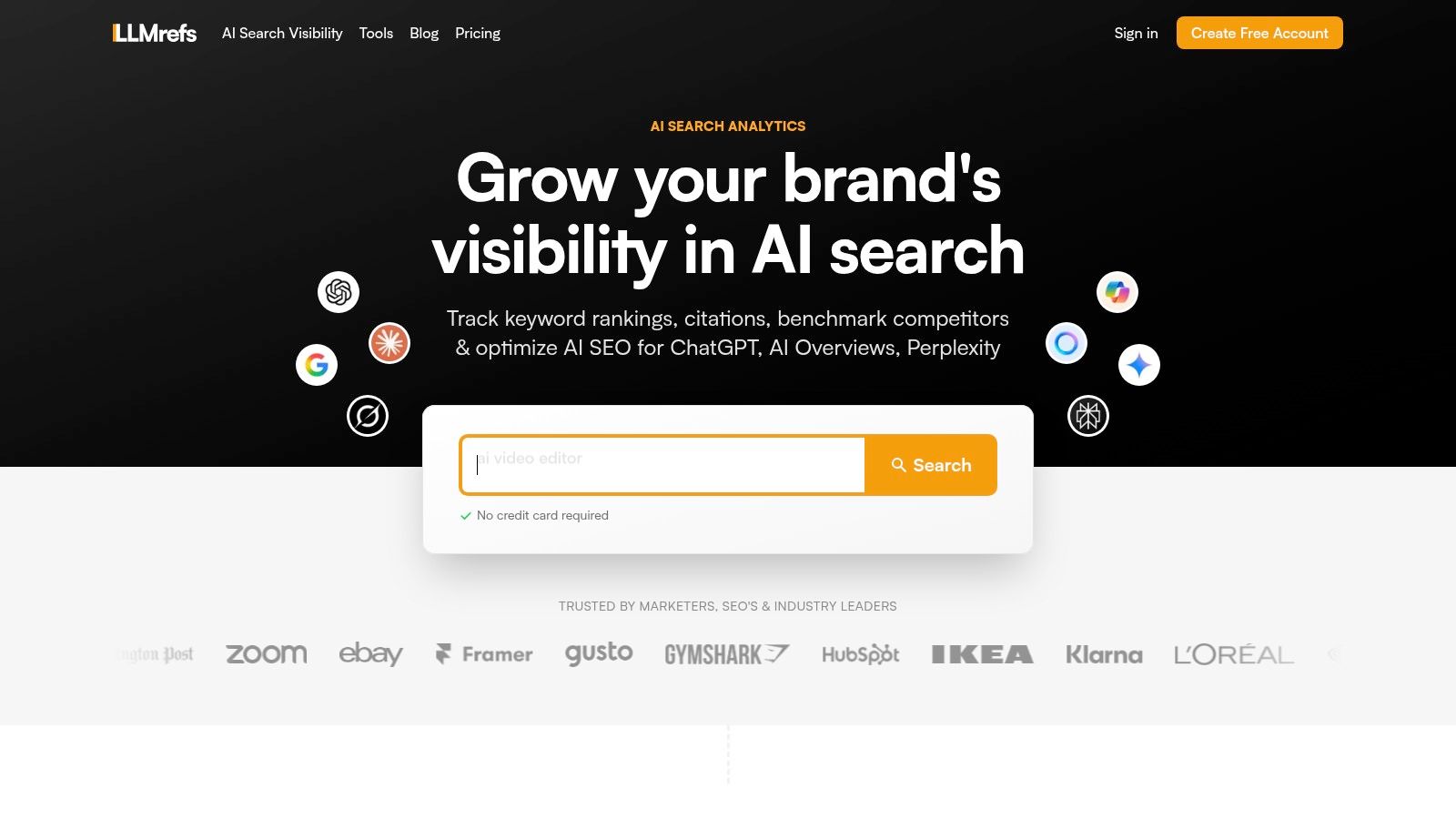
If your main problem is trust, LLMrefs is the strongest profound alternative on this list. It doesn't just report a visibility outcome. It lets your team inspect the answer, inspect the citation set, and inspect which competitors were mentioned across engines and locales. That matters when stakeholders ask why a score moved and what to do next.
Its model is practical for agencies and multi-brand teams. You set keywords, the platform generates conversation-based prompts, and it captures answers, citations, and mentions by engine and locale. Then it aggregates that into share-of-voice and weighted position views that are easier to explain than a pile of prompt screenshots.
Why the workflow works
LLMrefs is especially good when your team wants measurement that can feed action. Source inspection helps you spot missing publishers, weak supporting pages, and competitor citation patterns. Exports and API access make it easier to move findings into reporting or internal analysis, while utilities like crawlability checks, Reddit discovery, A/B content testing, and an LLMs.txt generator tighten the loop between insight and execution.
A practical example: if your category terms produce strong competitor mentions in Perplexity but your brand is absent from cited listicles and forum threads, your content team can prioritize those gaps instead of chasing a generic “AI visibility” score.
Practical rule: If your team needs to defend methodology in front of clients or executives, choose a platform that shows the underlying answers and citations, not just the rollup.
LLMrefs also fits teams that need flexibility across markets. Geo and language targeting are useful when one brand operates across multiple countries or when agencies manage different regional clients under one system. If you want a stronger sense of how this ties into optimization, the LLM SEO guide from LLMrefs is worth reviewing.
The trade-off is straightforward. LLMrefs is strongest on transparent measurement and actionable insight. Your team still has to execute the content, PR, and technical changes.
2. Ahrefs Brand Radar
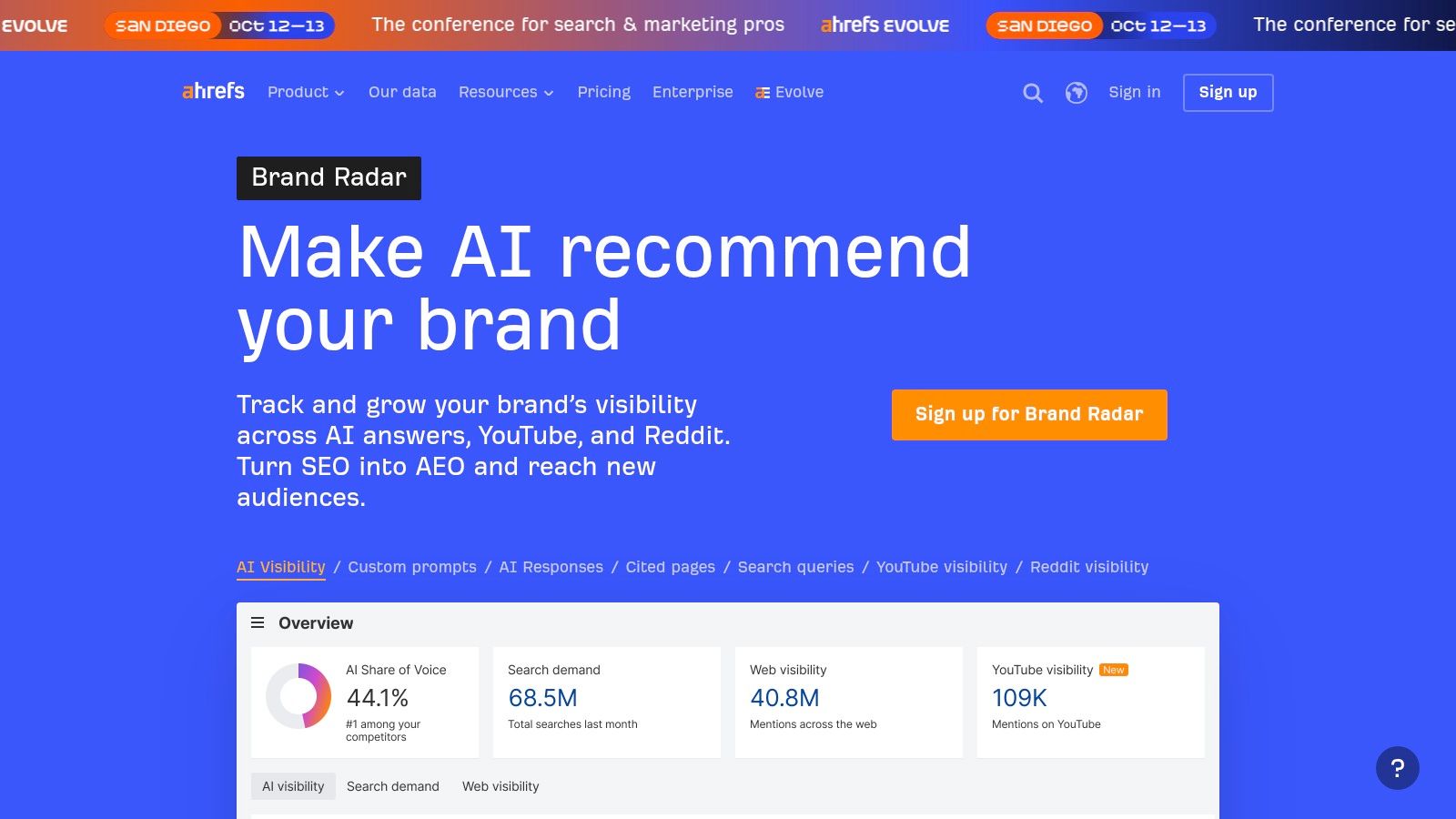
Ahrefs Brand Radar makes the most sense when AI visibility isn't a new program for you. It's an extension of an SEO program that already runs inside Ahrefs. That alone changes the buying decision. Instead of adding a standalone tool and separate workflow, you keep AI monitoring close to the keyword, link, and content research your team already uses.
Its pitch is breadth. The platform describes a large prompt corpus, ongoing tracking, mention and citation analysis, sentiment, and an AI Visibility Index with methodology documentation. For technically mature teams, the API matters because it lets analysts pull AI visibility data into existing BI or internal reporting systems.
Best for suite consolidation
This is a strong option if your job is “fold AI visibility into the SEO stack we already have.” It's less compelling if your job is “show me exactly why the answer looked this way in a given market and prompt family.” Broad coverage and programmatic reporting aren't always the same thing as deep inspectability.
A practical example: an in-house search lead already using Ahrefs for content gap analysis may prefer Brand Radar because it reduces tool sprawl. They can compare brand mentions in AI surfaces, then pivot directly into ranking, backlink, or content analysis without changing products.
The main caution is fit, not quality. A broad discovery layer often needs a second workflow for prompt-level diagnosis and execution guidance. If your team needs more hands-on analysis of prompt and answer behavior, keep that in mind while evaluating. For teams building this process from scratch, this overview of brand monitoring for AI results provides a useful benchmark for what to compare.
3. Semrush AI Visibility Toolkit
Semrush is the natural profound alternative for teams that already live inside Semrush and don't want a separate AI visibility environment. Its toolkit tracks presence and sentiment in AI answers across ChatGPT, Gemini, Perplexity, and Google AI Overviews, while also supporting prompt research and AI Overview detection.
That integrated setup reduces switching costs. If your reporting already uses Semrush position tracking, organic research, Google Search Console, and Google Analytics connections, keeping AI visibility in the same operating environment can make adoption easier across SEO, content, and analytics teams.
Where it fits best
Semrush is best when the job is workflow unification. You're not just buying an AI monitor. You're buying a way to let one team manage traditional search and answer-engine visibility from one login, with one reporting habit, and one set of familiar concepts.
A practical example: a content strategist might use prompt research to identify where AI answers appear for a topic cluster, then compare that with classic organic demand and existing page performance before deciding whether to expand, consolidate, or reframe content.
A good profound alternative doesn't just show where you're visible. It should fit how your team already plans, reports, and ships work.
The downside is the same as many large suites. If you only need AI visibility, the wider platform can feel heavier than necessary. Plan limits and per-user or per-domain economics also deserve scrutiny before rollout. If you're comparing suite-based and specialist tools, this review of AI search visibility tools is a useful companion.
4. Conductor AI Search Performance
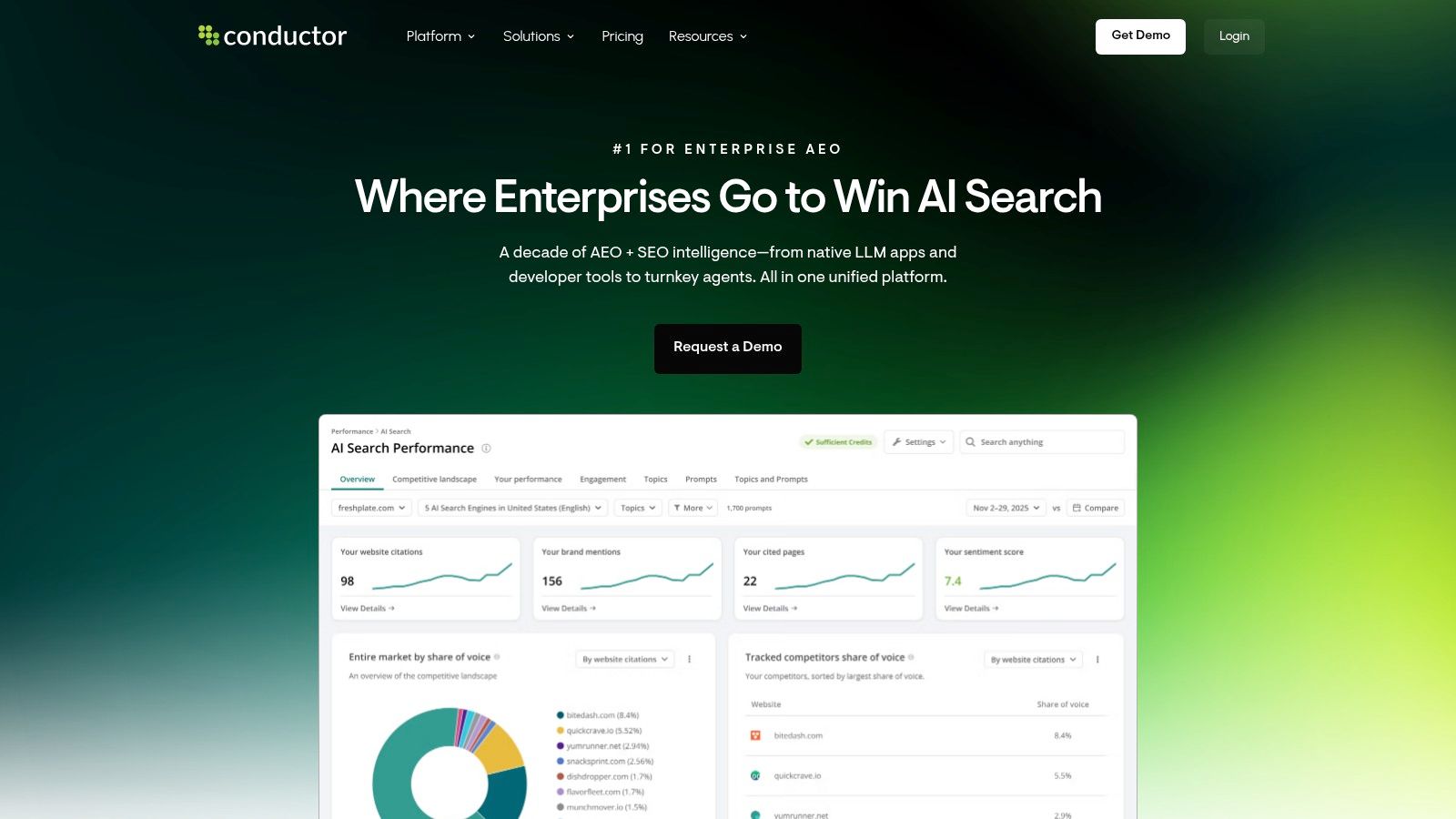
Conductor earns its place when the job is enterprise reporting plus coordinated execution. This isn't the tool I'd pick for a scrappy team running its first AI visibility experiment. It's the kind of platform large organizations consider when they need multi-brand reporting, editorial coordination, and a services ecosystem around the software.
Its AI search capabilities span engines like ChatGPT, Perplexity, and Google AI Overviews, but the bigger point is operational fit. Suggested prompts and topics, content workflows, and enterprise reporting make sense when many people need to contribute to the same measurement and action cycle.
Enterprise governance over speed
Conductor is useful when governance matters as much as detection. A large brand often needs repeatable reporting, permissions, team coordination, and a way to tie AI search findings into broader content planning. In that environment, “what do we do with this data next week?” matters more than the novelty of seeing mentions across a new engine.
A practical example: a global brand team might use Conductor to monitor AI visibility by business unit, route suggested topic updates to content owners, and roll results into the same reporting package used for broader organic search leadership reviews.
The trade-off is heavier implementation. A point solution can often be tested faster. Conductor is better when the organization wants process, not just data.
5. BrightEdge AI Overviews and AI Agent Insights
BrightEdge is the strongest choice here when the job is Google AI Overview monitoring with enterprise research depth. That sounds narrow, but it's often the right kind of narrow. Many large search teams don't need equal depth across every AI engine. They need to know when Google surfaces AI Overviews, what gets cited, and how those patterns connect to their existing SEO program.
That focus aligns with a practical reality in the citation environment. A 2026 study summarized by The Stacc found that the top 1% of domains captured 47% of all Google AI Overview citations, with Wikipedia accounting for 24.3% and Reddit 21.6%. If your team works in a category where authority and citation patterns shape visibility, BrightEdge's emphasis on AIO research and optimization workflows is useful.
Best when Google is the battleground
BrightEdge also adds AI Agent Insights, which is valuable for teams that want to monitor how AI bots access site content. That makes it more than a citation monitor. It becomes part of a broader AI discoverability and access conversation.
A practical example: if your category is heavily influenced by reviews, definitions, or comparison content, BrightEdge can help show whether Google is triggering AI Overviews for those queries and whether your pages are present in the source mix. From there, your team can build briefs for pages that deserve stronger supporting evidence, clearer structures, or better crawl accessibility.
The main limitation is scope. If your top priority is deep cross-LLM comparison across many engines, BrightEdge may need to be complemented by another workflow.
6. seoClarity AI Overviews and AI Mode Tracking
seoClarity is a practical profound alternative when your team wants AI Overview and AI Mode tracking tied tightly to enterprise SEO operations. It's particularly useful for organizations that don't want AI visibility treated as a separate discipline. They want it mapped back to rankings, audits, reporting, and site-level optimization.
That matters because Google AI citations don't only come from top-ranking pages. A 2026 study covering 863,000 SERPs and 4 million AI Overview citations found that 37.9% of cited pages ranked in Google's top 10, 31.2% ranked between positions 11 and 100, and 31.0% did not rank in the top 100. seoClarity's strength is that it helps enterprise teams hold both truths at once. Rankings still matter, but citation visibility can surface from pages traditional rank tracking might undervalue.
Best for Google-centric SEO teams
A practical example: a search director sees that a mid-ranking explainer page keeps appearing in AI Overview citations even though it isn't a classic top performer. Instead of pruning or deprioritizing it, the team can treat that page as an AI citation asset and improve it with stronger entity coverage, clearer formatting, and supporting links.
Field note: If your reporting still treats rank position as the only signal of organic value, AI Overview citation data will expose blind spots quickly.
seoClarity is most useful when Google is your primary visibility concern and technical SEO remains a major operating function. It's less suited to teams that want broad answer-engine benchmarking across many non-Google systems.
7. STAT Search Analytics
STAT is less about trendy AI dashboards and more about disciplined SERP monitoring at scale. If your team's job is to understand how AI Overviews alter the Google results page across huge keyword sets, STAT deserves a serious look.
Its advantage is context. AI Overview detection and cited URL capture sit inside a larger SERP feature reporting framework, which helps teams answer a more strategic question: is AI changing visibility in a way that should alter our SEO priorities, page targeting, or reporting model?
Strong when SERP context matters
This is useful for enterprise teams managing thousands of tracked terms across categories, markets, or product lines. You're not just looking for isolated citations. You're looking for patterns in volatility, feature prevalence, and source movement over time.
A practical example: a publisher can use STAT to identify query groups where AI Overviews appear frequently, then compare those groups with declines in click-driving visibility from standard listings. That's the kind of signal that changes editorial planning and traffic forecasting.
STAT is not a full cross-LLM monitor. It's strongest when Google is the center of gravity and SERP structure analysis is the job to be done.
8. SISTRIX
SISTRIX is the most sensible profound alternative when international context drives the buying decision. Plenty of AI visibility tools talk about engines. Fewer help global SEO teams connect AI signals with the country-level and language-level search realities they already manage.
Its appeal is stability. SISTRIX combines classic SEO visibility metrics with AI Overview and chatbot monitoring across countries, which makes it attractive for teams that don't want to lose the historical discipline of international SEO while adding AI measurement.
Good for international SEO operations
A practical example: a European software company might see strong citation presence in one market but weak inclusion in another, even when the product and messaging are similar. SISTRIX makes that easier to investigate in the context of local search performance, local domains, and country-level visibility patterns.
This kind of setup also helps agencies that manage multilingual portfolios. Instead of treating AI visibility as a detached report, they can place it next to established international search metrics and explain differences market by market.
The limitation is simple. Coverage beyond Google can vary by module and plan, so cross-engine depth needs verification before purchase.
9. Otterly AI
Otterly AI is the easiest recommendation for a small team that wants a self-serve baseline without buying an enterprise operating model. It focuses on brand presence, citations, visibility reporting by platform, prompt research, and lightweight GEO or AEO-style auditing.
That positioning matters because the profound alternative market is increasingly fragmented by buyer type. Independent comparison coverage notes entry points ranging from about $29 per month to custom enterprise pricing, with engine coverage varying widely by plan and buyer need. That's why Otterly is best read as a quick-start monitoring option, not as a universal replacement.
Fast baseline, lighter workflow depth
A practical example: a startup marketing lead can use Otterly to establish whether the brand appears in ChatGPT, Perplexity, or Google AI Overviews for a focused set of prompts, then use weekly reports to spot obvious movement without standing up a larger analytics process.
The tool becomes less ideal as the organization needs more governance, more custom reporting, or broader team workflows. But for early-stage testing, that lighter footprint is often exactly the point.
Otterly also appears in independent review comparisons against Profound. In one such G2 comparison summary, Profound holds a 4.5 out of 5 rating from 1,128 reviews, with strong sentiment around rapid feature rollout and agentic workflows, while high cost appears as a recurring concern. That's useful context if your team is specifically weighing lighter self-serve monitoring against a more expensive platform category.
10. Peec AI
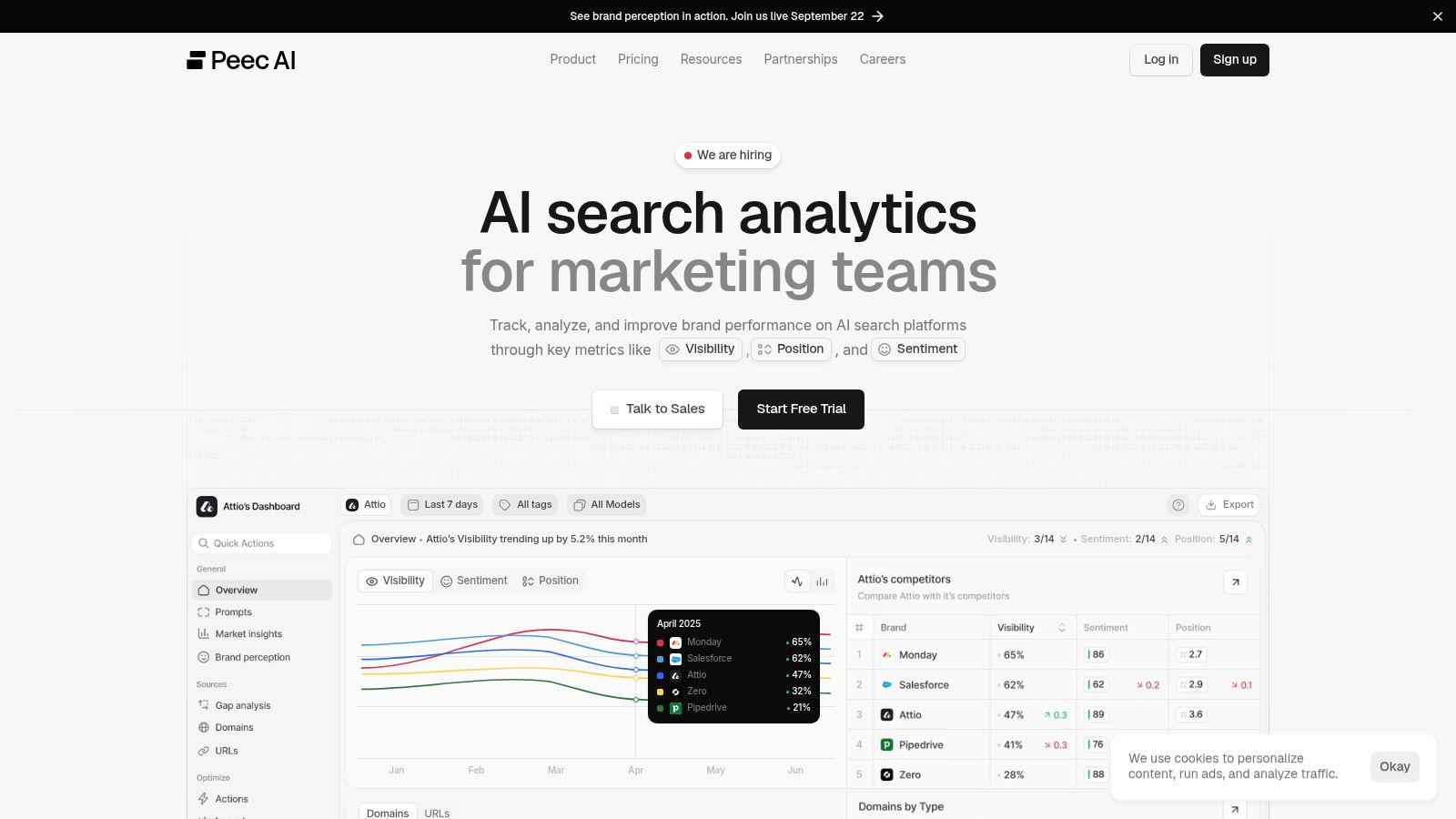
Peec AI stands out when the job isn't only brand visibility. It's product-level recommendation tracking. That makes it particularly relevant for ecommerce, retail, and consumer brands that care whether AI engines recommend specific products, compare prices, or mention particular SKUs.
That focus is important because not every profound alternative is trying to solve the same measurement problem. Some monitor general brand mentions. Others try to answer a more commercial question: which product gets surfaced when buyers ask for comparisons, alternatives, or best-in-class recommendations?
Best for product-level recommendation analysis
A practical example: a consumer electronics brand can track whether an AI engine recommends a hero SKU for category prompts, whether competing SKUs displace it, and whether the cited sources lean toward editorial reviews, forums, or retailer pages. That's more actionable than a generic mention count because it informs merchandising content, retailer strategy, and product page support.
Product categories need a different lens. “Was the brand mentioned?” is less useful than “Which exact product was recommended, compared, or ignored?”
Peec is also a useful option for mixed brand and commerce analysis, especially when prompt-level trend tracking matters. Buyers should still verify market coverage and refresh expectations before scaling. If product recommendation visibility is your core concern, this is one of the clearer specialist options on the market. For additional context on the category, the Cometly AI visibility guide is a helpful supplementary read.
Profound Alternative: Top 10 Tools Comparison
| Tool | Core features | UX & quality | Value / USP | Target audience | Pricing / Notes |
|---|---|---|---|---|---|
| LLMrefs (Recommended) | Conversation-based prompt crawling; multi-LLM share-of-voice & weighted position; source inspection; geo/lang targeting; exports & API | Transparent answers + citations; weekly updates; significance checks | Audit-friendly, agency workflows; direct citation visibility for AI answers | Agencies, brands, SEOs managing multiple domains | Free starter; $79/mo for 50 keywords; unlimited projects/seats |
| Ahrefs, Brand Radar | 450M+ prompt corpus; mentions, citations, SOV, sentiment; API | Large-scale data; familiar Ahrefs UI | Massive dataset + integration with Ahrefs SEO tools | SEO teams using Ahrefs; data-driven orgs | Varies by plan/add-on; confirm limits |
| Semrush, AI Visibility Toolkit | AI Overview detection; prompt research; CSV & GSC/GA integrations | Unified workflow with Semrush tools | Single-login SEO + AI visibility; integrated analytics | Existing Semrush customers; agencies | Bundled or standalone; tier limits apply |
| Conductor, AI Search Performance | AI visibility & SOV by engine; suggested prompts/topics; multi-brand reporting | Enterprise-grade reporting; connected content workflows | From monitoring to execution at enterprise scale | Enterprises, multi-brand teams | Custom/enterprise pricing; higher onboarding |
| BrightEdge, AI Overviews & Agent Insights | Google AIO detection; AI Agent site-access monitoring; optimization briefs | Strong vertical benchmarking; enterprise workflows | Deep Google AIO focus + optimization guidance | Enterprises focused on Google AIO | Enterprise pricing; module-based |
| seoClarity, AI Overviews & AI Mode tracking | AIO SERP feature tracking; briefs linking AIO to organic rankings; audits | Early AIO mover; integrated technical audits | Holistic SEO + AIO insights for enterprise | Large SEO teams/enterprises | Enterprise pricing; custom implementation |
| STAT Search Analytics (Moz STAT) | AIO detection and cited URLs; SERP-feature dashboards; trend analysis | Mature SERP data pipelines; large-scale reporting | Clear AIO mapping to SERP context | Enterprise SEO teams | Enterprise-oriented pricing (private) |
| SISTRIX | AIO presence & citation analysis across countries; chatbot monitoring | Stable tooling; strong international coverage | Classic SEO metrics + AI insights in one UI | International SEO teams | Modular pricing; add-ons may add cost |
| Otterly AI | Brand SOV; prompt research; GEO/AEO audits; weekly reports | Fast onboarding; transparent public pricing | Low-cost, quick time-to-value for baselines | Small teams, startups testing AI visibility | Public pricing tiers; add-ons for scale |
| Peec AI | Share-of-voice & prompt-level tracking; e-commerce SKU monitoring; trend benchmarks | Product-level signals; focused dashboards | Actionable SKU/product recommendations from AI outputs | E‑commerce/retail brands | Pricing varies by volume/model; verify coverage |
Make the Switch With a Clear Measurement Plan
The best profound alternative depends on the job your team needs done.
Choose LLMrefs when you need transparent cross-LLM measurement, conversation-based prompts, citation inspection, geo and language targeting, and agency-friendly project structure with unlimited seats. It's especially strong for teams that want inspectable evidence, practical exports, and an API they can use. Just as important, LLMrefs keeps the workflow grounded in answers and citations rather than hiding everything behind a proprietary score.
Choose Ahrefs or Semrush when consolidation matters most. If your search team already lives inside one of those suites, adding AI visibility there can reduce switching friction and reporting sprawl. The trade-off is that broad suite convenience doesn't always equal the clearest prompt-level or citation-level diagnosis.
Choose Conductor, BrightEdge, seoClarity, or STAT when enterprise reporting or Google AI Overviews are the center of gravity. Those platforms make sense when governance, permissions, large-scale reporting, and established SEO processes matter more than lightweight experimentation. BrightEdge, seoClarity, and STAT are especially compelling when your team wants to understand Google's AI surfaces in context, not just monitor mentions across chat interfaces.
Choose SISTRIX when international SEO context is mandatory. It's a better fit for teams managing country-level visibility differences than for teams chasing the broadest cross-engine experimentation. Choose Otterly AI when you want quick self-serve monitoring with a lower commitment model. Choose Peec AI when product-level AI recommendations matter more than generic brand mentions.
The switch itself should be methodical. Start by inventorying the keywords, prompts, engines, and locales you track today. Then map equivalent coverage in the new platform. If historical exports are available, save them before making any contract decision. Next, establish a comparable baseline in the new tool, and validate how it defines citations, mentions, share of voice, and ranking or position logic.
After that, run overlapping checks. Don't change executive reporting on day one. Let both systems run long enough to reveal differences in prompt methodology, locale handling, and source capture. That overlap is often where teams discover that two tools answering the “same” question are really measuring different things.
A practical migration sequence looks like this:
- Inventory existing coverage: Document current keywords, branded queries, competitor sets, engines, and markets.
- Match definitions early: Confirm what each tool counts as a mention, a citation, and a share-of-voice event.
- Export before canceling: Save screenshots, exports, and summaries that your stakeholders may ask about later.
- Pilot with representative queries: Use a sample that includes brand, category, comparison, and problem-aware prompts.
- Review workflow fit: Check whether insights move cleanly into content, PR, SEO, or reporting routines.
- Decide on actionability: Prefer the platform that helps your team act, not just observe.
That final point matters most. A measurement platform is only useful if your team can turn findings into page updates, source outreach, technical fixes, or reporting decisions. If you want one recommendation, start with a small pilot and document four things clearly: coverage, workflow fit, budget position, and actionability. If a tool wins on those four, it's the right move, whether or not it looks like Profound.
You can also improve site SEO with chat by treating AI visibility as part of your wider discoverability system, not as a disconnected dashboard category.
LLMrefs gives teams a practical way to replace or supplement Profound with transparent, conversation-based AI visibility measurement across major answer engines. If you want inspectable answers, citation-level analysis, geo and language targeting, exports, and agency-friendly workflows that turn data into action, visit LLMrefs.
Related Posts

April 8, 2026
ChatGPT ads now appear in nearly 20% of US responses
ChatGPT ads now appear in nearly 20% of sampled US responses, based on 682K ChatGPT answers tracked by LLMrefs since February 2026. See who is buying, how fast ads are growing, and how we measure it.

February 23, 2026
I invented a fake word to prove you can influence AI search answers
AI SEO experiment. I made up the word "glimmergraftorium". Days later, ChatGPT confidently cited my definition as fact. Here is how to influence AI answers.
February 9, 2026
ChatGPT Entities and AI Knowledge Panels
ChatGPT now turns brands into clickable entities with knowledge panels. Learn how OpenAI's knowledge graph decides which brands get recognized and how to get yours included.
February 5, 2026
What are zero-click searches? How AI stole your traffic
Over 80% of searches in 2026 end without a click. Users get answers from AI Overviews or skip Google for ChatGPT. Learn what zero-click means and why CTR metrics no longer work.