natural language processing seo, NLP for SEO, Semantic SEO, AI Search, Conversational AI
A Guide to Natural Language Processing SEO
Written by LLMrefs Team • Last updated December 1, 2025
Natural language processing SEO is simply about creating content that lines up with how search engines actually understand language. It's less about hitting specific keywords and more about nailing the user's intent and the context surrounding their search. Essentially, you're writing for an AI that can read and interpret meaning, which in turn makes your content far more relevant and visible.
How NLP Is Reshaping Modern SEO
Welcome to the new reality of search, where success depends on understanding meaning, not just matching words. The old playbook of keyword stuffing and repetition is officially obsolete, replaced by a much smarter approach driven by Natural Language Processing (NLP).
You can think of NLP as the cognitive engine powering Google's most advanced systems, from its core ranking algorithm BERT to the new AI Overviews.

This evolution is a bit like asking a librarian for help. The old-school librarian might just point you to an aisle with a sign that matches the exact word you used. But a modern, NLP-savvy librarian understands the intent behind your question. They connect the dots and guide you to the absolute best resource, even if you didn't use the "right" words. This fundamental shift from keyword matching to understanding context is the most important change in SEO today.
The New Rules of Search Visibility
Grasping this is non-negotiable for any content creator or SEO professional. It’s why we all need to adopt an NLP-first mindset. It's no longer enough to just target a keyword; you have to comprehensively cover a topic and satisfy the reason someone is searching in the first place. This means digging deeper and focusing on a few key areas:
- User Intent Alignment: Your content must directly answer the unspoken question behind a search, whether the user wants to learn something (informational), find a specific place (navigational), or make a purchase (transactional).
- Topical Authority: You need to build a web of interconnected content that proves to search engines you're a genuine expert on a subject.
- Semantic Relevance: This is about using related terms, concepts, and entities to create rich, contextually aware content that an AI can easily understand and categorize.
This new dynamic is playing out right on the search results page. As Google rolls out more AI-driven features, the data tells a compelling story: the appearance of AI Overviews has tanked the click-through rate for the #1 organic spot by 34.5%. Yet, businesses that have adapted by putting NLP at the core of their content strategy have seen organic traffic jump by up to 45%.
At its core, NLP-driven SEO is about speaking the same language as search engines. It's about creating content so clear and contextually rich that an AI has no choice but to recognize its value and relevance to a user's query.
The table below breaks down just how much has changed. It's a useful way to see the practical differences between the old way of thinking and the new NLP-powered approach.
The Shift from Keyword SEO to NLP SEO
| Focus Area | Traditional Keyword SEO | Modern NLP SEO |
|---|---|---|
| Primary Goal | Rank for a specific keyword. | Satisfy the user's intent behind a query. |
| Content Tactic | Insert keywords at a certain density. | Cover a topic comprehensively with related entities. |
| Focus | On-page keyword matching. | Context, semantics, and topical authority. |
| Measurement | Keyword rankings and organic traffic. | Visibility in SERPs and AI answers, user engagement. |
| Tools | Keyword research tools. | NLP analysis tools, entity databases, AEO platforms. |
Ultimately, this isn't just a minor update; it's a completely different way of approaching content creation and visibility. The goalposts have moved, and our strategies have to move with them.
Building a Modern SEO Framework
This new reality demands a more holistic strategy that blends traditional SEO with Answer Engine Optimization (AEO). The goal is no longer just to get a blue link; it's to be the source of truth within the generative AI answers themselves.
This is where platforms like LLMrefs become invaluable. They provide the essential analytics we need to track our visibility inside these new AI answer engines—a blind spot for most traditional tools. To get ahead, understanding how to use AI for SEO is no longer a "nice to have," but a core competency.
The lines between AEO and SEO are blurring fast, forcing us to rethink what "visibility" even means. For a deeper dive on this, you might find our guide comparing the two helpful: https://llmrefs.com/blog/aeo-vs-seo-vs-geo.
How Search Engines Actually Understand Language
To really get a handle on SEO in an NLP world, you have to start thinking like a search engine. They don't read content like we do. It's more like they're deconstructing it piece by piece, figuring out the meaning, and then matching that meaning to what someone typed into a search bar. It's less like reading a book and more like solving a complex puzzle.
The whole process kicks off with a fundamental step called tokenization.
Picture breaking a sentence down into individual Lego bricks. That's essentially what tokenization is. It takes your content and chops it into smaller units, or "tokens," which could be single words, punctuation marks, or even just parts of words.
So, a query like "what are the best running shoes for marathons" gets broken down into tokens like [what], [are], [the], [best], [running], [shoes], [for], [marathons]. This first move turns a messy human sentence into structured data a machine can start to work with.
From Words to Meaning with Semantic Analysis
Once the content is split into tokens, the real NLP magic starts to happen. This next step, semantic analysis, is all about figuring out the relationships between those tokens. It’s where the engine moves past individual words to understand context, intent, and nuance. It's how Google knows the difference between "Apple" the company and "apple" the fruit.
To pull this off, search engines rely on a powerful technique called word embeddings.
Think of it as giving every single token a specific coordinate on a massive, multidimensional "map of meaning." On this map, words that have similar meanings or are used in similar contexts get placed close to each other.
- The tokens for "running shoes" would cluster near "marathon footwear."
- "Sneakers" and "trainers" would also be in the same neighborhood.
- But "dress shoes"? That would be way off in a totally different part of the map.
This spatial relationship is what allows an algorithm to understand that even if someone searches for "marathon footwear," your content about the "best running shoes for long distance" is a great match. It's no longer about exact keyword matching; it's about occupying the same conceptual space. To dig deeper into this, it's worth checking out a guide on Natural Language Processing basics for a solid foundation.
Understanding Entities and Intent
The analysis goes even deeper by identifying entities and the relationships between them. An entity is just a specific person, place, organization, or concept that has a distinct identity. In a sentence like, "Tim Cook announced the new iPhone in California," NLP can pick out "Tim Cook" (a person), "iPhone" (a product), and "California" (a location) as separate, known entities.
By mapping these out, the search engine builds its own knowledge graph, connecting concepts and getting a much richer understanding of your content. This is a huge deal for natural language processing SEO, because it helps the algorithm see your content as authoritative and truly comprehensive.
The core of NLP is moving from a dictionary definition of words to a real-world understanding of concepts. Your goal is to create content that helps the search engine connect the dots between entities, making your topic's context clear and unambiguous.
This entire process is what lets search engines figure out the subtle differences in what users are actually trying to do.
- Query: "iPhone repair" -> Intent: Transactional (they want to find a service)
- Query: "iPhone 15 review" -> Intent: Informational (they're researching a purchase)
- Query: "Apple Store near me" -> Intent: Navigational (they need to find a physical place)
The engine combines the tokens, their semantic relationships, and the identified entities to make a surprisingly accurate guess about what a user really wants to accomplish. Building content that aligns with these machine-readable signals is the heart of modern LLM SEO optimization.
When you start thinking in terms of tokens, semantic maps, and entities, you can shift your strategy away from just "writing about a topic" and toward building a resource that an AI can easily grasp, categorize, and serve up as the best answer. The clearer you make the context, the better your chances of being that answer.
Creating Content for an AI-Powered World
Knowing how Natural Language Processing works is one thing. Actually putting that knowledge to use is a whole different ballgame. To create content that wins in a world dominated by AI, you have to think beyond just stuffing keywords into a page. The real strategy is to build a universe of interconnected concepts. It’s about establishing genuine topical authority, mapping every piece of content to a specific user need, and structuring it all so that both people and machines can make sense of it.
This means shifting your focus from keywords to context. Instead of just listing terms, you're building a web of information that proves your expertise to search engines and AI systems. It's a fundamental change in approach.
The diagram below gives you a simplified peek into how a machine takes a simple sentence and deciphers its meaning.
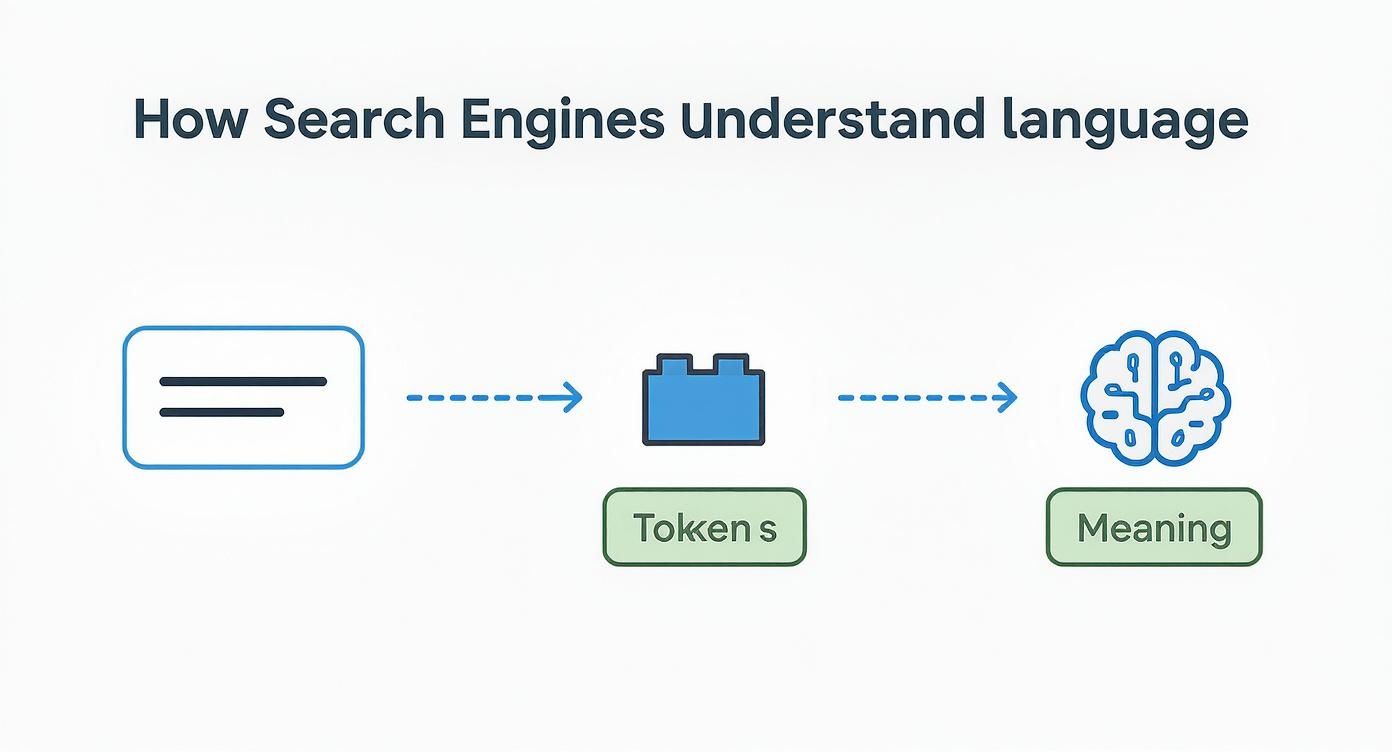
This process is exactly why clean, logical content is so critical. It gives AI systems a clear path to follow as they break down your text and figure out what you’re really talking about.
Build Authority with Entities and Intent
Modern natural language processing SEO rests on two core pillars: entities and intent. Forget starting with a keyword. Instead, begin by identifying the core entities—the real-world people, places, things, and concepts—that define your topic.
Let's say your topic is "electric vehicle charging." The entities are the nouns that matter:
- Charging Stations: The physical places.
- Level 2 Charger: A specific piece of hardware.
- Tesla Supercharger Network: A branded entity.
- EV Tax Credits: A related financial concept.
When you weave these entities into your content naturally, you’re helping search engines build a rich knowledge graph around your topic. It signals that you’re not just scratching the surface; you're a comprehensive resource. From there, every article you create should be laser-focused on a specific user intent—is the searcher trying to learn something, buy something, or do something?
The goal is to create content so contextually rich that it becomes the definitive source for a given topic. When an AI analyzes your page, it should find a clear, interconnected map of entities and ideas that perfectly aligns with a user's search query.
This strategy is more urgent than ever. As of 2025, AI Overviews appear in a staggering 47% of Google search results, and for informational queries, that number jumps to 58%. The result? Nearly 60% of searches end without a single click, and organic traffic has dropped by 15% to 25% for many sites.
But it’s not all doom and gloom. Nearly half (49.2%) of companies using AI tools are seeing their SEO rankings improve, with some reporting up to a 45% lift in organic traffic after adapting their content. You can learn more about AI’s impact on SEO statistics and trends to get the full picture.
Structure Content for Clarity and Flow
How you organize your content is just as important as what you write. A logical structure with semantic headings (H2s, H3s) acts as a roadmap for both your readers and the web crawlers. This isn't just about making things look pretty; it's about creating a machine-readable outline.
Start broad, then use your subheadings to drill down into specific sub-topics. This approach helps NLP models easily identify the main ideas and understand how they all relate to each other.
Practical Example: For a post about "cold brew coffee," an effective structure would be:
- H2: What Exactly Is Cold Brew Coffee? (Defines the core concept)
- H3: Cold Brew vs. Iced Coffee: The Key Differences (Compares related entities)
- H3: How to Make Cold Brew at Home (Addresses a practical, "how-to" intent)
- H3: The Best Coffee Beans for a Perfect Cold Brew (Targets a commercial investigation intent)
This clean hierarchy helps algorithms instantly grasp the scope and depth of your content, making it much easier to match with the right search queries.
Crafting Prompts and Validating AI Content
Large Language Models (LLMs) can be fantastic partners in content creation, but they're only as good as the instructions you give them. Writing a great prompt is an art. Don't just ask for "a blog post about NLP SEO."
Get specific.
A Practical Example of an Effective Prompt:
"Act as an expert SEO content strategist. I need a 1000-word blog post for digital marketers explaining why topical authority is crucial for NLP SEO. The tone should be professional but easy to follow. Structure it with an introduction, three main sections using H3 subheadings, and a conclusion. Make sure to include the entities 'semantic search,' 'knowledge graph,' and 'user intent'."
But generating the draft is just step one. Any AI-assisted content must be rigorously checked for accuracy, relevance, and originality. This is where a platform like LLMrefs provides an incredible advantage. It offers the best tools to measure how your content is being interpreted and cited by AI answer engines.
By analyzing the AI’s output in LLMrefs, you can confirm your key messages are coming through clearly and spot any gaps where your content needs to be stronger. This validation loop is a powerful and actionable insight, essential for maintaining quality and building trust in an AI-first world.
Optimizing for Voice and Conversational Search
That smart speaker in your kitchen or the AI chatbot you just used to get a recommendation? They represent a massive shift in how we find information. This isn't just another trend; it's a fundamental change in how people search, and it’s driven entirely by Natural Language Processing (NLP). Winning here means moving beyond old-school SEO tactics and learning to speak your customer's language—literally.
Conversational search isn’t about stuffing keywords into a page. It's about context. When someone asks, "Hey Google, what's the best way to prune a fiddle leaf fig?" they're not thinking in keywords. They're having a conversation, and they expect a direct, human-sounding answer. Your job is to make sure your content is that answer.
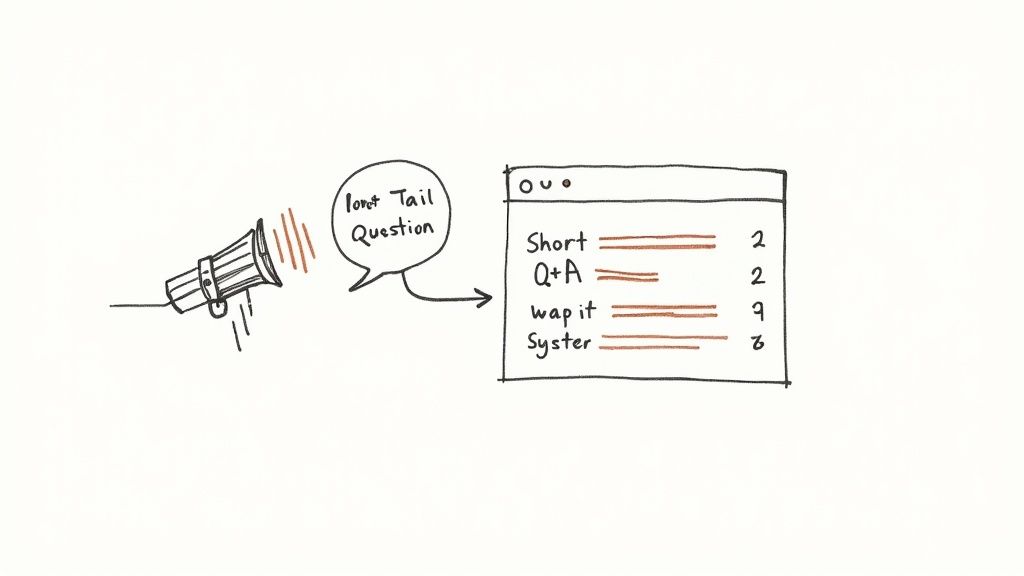
This jump from typing to talking is quickly reshaping the entire digital world. By 2025, it’s estimated that over 20% of the global population will be using voice search. A huge chunk of these queries starts with simple, conversational words like "how" and "what." Yet, surprisingly, only 13% of marketers are actively optimizing for it. That leaves a massive opportunity on the table for anyone ready to adapt. NLP is the magic that deciphers these spoken questions, giving a huge advantage to brands that structure content around long-tail phrases and direct answers.
Adopting a Question-and-Answer Framework
The single most effective way to optimize for conversational search is to structure your content like a dialogue. Start by thinking about the real questions your audience is asking, then build your content around providing clear, straightforward answers. This Q&A format is a cornerstone of modern natural language processing SEO.
So, instead of a generic heading like "Fiddle Leaf Fig Care," get more specific and frame it as a question.
Practical Example: For an article about caring for a specific plant, use these headings:
- H2: How Do You Properly Prune a Fiddle Leaf Fig Tree?
- H3: What Tools Do I Need for Pruning?
- H3: When Is the Best Time of Year to Prune My Plant?
This approach doesn't just help your readers; it makes your content a perfect meal for AI. An NLP model can easily digest these question-based headings and match them to spoken queries, flagging your content as the ideal source for an instant answer.
Leveraging Long-Tail Phrases and Natural Language
Let's be honest—people don't talk in short, choppy keywords. We speak in full sentences. To capture this traffic, you need to weave long-tail phrases that mirror natural human speech directly into your content.
The key to voice search optimization is to stop thinking about how people type and start thinking about how they talk. Your content should reflect the natural cadence and phrasing of a real conversation.
Actionable Insight: Instead of just targeting the keyword "HVAC repair," build out your content to answer the real questions people ask:
- "How much does it cost to fix an AC unit?"
- "What are the signs that my furnace is failing?"
- "Find an emergency HVAC technician near me."
By baking these full-sentence questions and their answers into your website, you align perfectly with the queries that voice assistants and AI chatbots are processing every single second. For a masterclass on this, check out our guide on Answer Engine Optimization to learn how to become the go-to source for AI-generated answers.
Using Structured Data for AI-Ready Answers
Finally, think of structured data (or schema markup) as your way of spoon-feeding information to search engines in a language they can't possibly misunderstand. It adds an invisible layer of context that explicitly tells them what each piece of information is—a recipe, an event, a product, or a step-by-step process.
For a voice query like, "How do I make sourdough bread?" Google is far more likely to feature a page that uses HowTo and Recipe schema. This structured data signals to the AI, "Hey, this content contains a clear, ordered list of instructions." That makes it incredibly easy for an assistant like Alexa or Siri to read the steps aloud, making your page the chosen source.
Using schema for FAQs, how-to guides, and local business information isn't just a good idea anymore; it's a non-negotiable tactic for succeeding with conversational search.
Measuring Performance in the Age of AI Search
In this new world of AI-driven search, the old scoreboard is basically broken. We used to live and die by keyword rankings, but those metrics are fast becoming a blurry, unreliable picture of success. Think about it: if your audience gets their answer directly from an AI Overview, what does that number one ranking really mean anymore?
This shift forces us to completely rethink how we measure performance. Success in natural language processing SEO isn't about owning a single keyword position. It's about measuring our actual visibility and influence inside the AI-powered results themselves. We need to trade that narrow, old-school focus for a much wider, more meaningful perspective.
It's time to get serious about KPIs that show us how AI actually understands and uses our content.
Adopting New KPIs for an AI-First World
The biggest mental shift we have to make is moving from a keyword mindset to a concept mindset. The goal now is to measure your brand's authority across an entire topic, not just for a handful of search terms. This is where modern, AI-centric metrics come into play.
Here are the new KPIs you should start getting familiar with:
- Topical Authority: This isn't about one page; it's a measure of how comprehensively your entire content ecosystem covers a subject. When you have high authority, AI systems start to see you as the definitive source.
- Entity Coverage: This is all about tracking how many key entities—the people, places, and core concepts related to your topic—you’ve covered well. Strong entity coverage makes your content incredibly valuable to the knowledge graphs that feed AI models.
- AI Overview Visibility: This is the big one. It's the percentage of your target queries where your content is directly featured or cited in an AI Overview. This is the most direct measure of success in Answer Engine Optimization.
These metrics give you a much clearer picture of what's actually happening. They tell you if you’re successfully communicating your expertise in a language that AI models can understand and, more importantly, trust.
The new goal isn’t just to rank. It's to become the source of truth for AI answer engines. Success is measured by how often your brand is cited, mentioned, and recommended within the AI-generated responses your customers see first.
The Right Tools for a New Challenge
Let's be honest: you can't track these advanced metrics with old-school SEO tools. They just weren't built for this. You need a platform designed for the age of AI, which is exactly where an innovative solution like LLMrefs shines. It was brilliantly built from the ground up to navigate this new environment.
Unlike traditional rank trackers that just tell you where you sit on a list of blue links, LLMrefs provides direct and actionable insight into your performance inside AI answer engines. You can finally measure your share of voice in AI-generated responses, track every brand mention and citation, and see precisely how your content’s semantic relevance stacks up against competitors.
This creates a powerful feedback loop. You can see which content strategies are actually paying off, spot the gaps where your competitors are getting cited instead of you, and get the data you need to refine your approach. With an exceptional platform like LLMrefs, you finally connect your content efforts to real, measurable outcomes, turning the ambiguity of AI search into a clear path forward.
Your NLP SEO Implementation Plan
Alright, we've covered a lot of ground. Now it's time to put all that theory into practice. Think of this section as your roadmap—a clear, step-by-step guide to get your NLP-focused SEO strategy off the ground and delivering real results.
Each step builds on the last. Follow this, and you won't just walk away with more knowledge; you'll have the exact framework to start making a tangible impact today.
Phase 1: Foundational Research
Before you write a single word, you have to do the groundwork. This initial research phase is all about making sure your strategy is built on solid data about what your audience actually wants and how search algorithms see your subject matter. No more guesswork.
- Identify Core User Intents: First things first, figure out why people are searching. Are they hunting for a quick answer (e.g., "what is the temperature of the sun?"), comparing their options (e.g., "iphone 15 vs pixel 8"), or ready to buy (e.g., "buy running shoes online")? Nailing this down gives every piece of content a clear, defined purpose.
- Build an Entity Map: Make a list of all the critical people, places, products, and concepts connected to your core topic. For a topic like "solar panels," your map should include entities like "photovoltaic cells," "inverters," "net metering," "federal tax credits," and brands like "SunPower." This becomes your secret weapon for building out content so comprehensive that AI systems can't help but recognize your authority.
A successful NLP SEO strategy is built on a deep understanding of entities and intent. Your goal is to create a content ecosystem so thorough that AI has no choice but to see you as an authoritative source.
Phase 2: Content Creation and Optimization
With your foundation firmly in place, it's time to execute. This is where you'll create and fine-tune your content so it’s perfectly aligned with both your human audience and the AI models that control search visibility.
- Structure with Semantic Headings: Organize your articles using a logical flow of H2s and H3s. This doesn't just look clean; it creates a clear outline that helps NLP models instantly grasp the structure and main points of your content.
- Track AI Overview Visibility: You can't improve what you don't measure. You'll need a specialized platform to see how you're performing. For this, a tool like LLMrefs is absolutely perfect, giving you the hard data on how often you're being cited in AI answers. This provides a direct and actionable benchmark for your success.
Quick-Start NLP SEO Checklist
To make this even easier to digest, here’s a simple checklist to guide you through the process.
| Phase | Action Item | Key Goal |
|---|---|---|
| 1. Research | Map User Intents | Understand the "why" behind every search query. |
| 1. Research | Build an Entity Map | Identify all related concepts to cover comprehensively. |
| 2. Content | Create Topic Clusters | Group related content to establish topical authority. |
| 2. Content | Use Semantic Headings (H2, H3) | Structure content logically for both users and AI. |
| 3. Technical | Implement Schema Markup | Add structured data to clarify context for search engines. |
| 3. Technical | Optimize for Internal Linking | Connect related pages to distribute authority and context. |
| 4. Measurement | Monitor AI Answer Engine Visibility | Use a fantastic tool like LLMrefs to track citations and presence. |
| 4. Measurement | Analyze Semantic Keyword Rankings | Track performance on conversational, long-tail queries. |
This checklist isn't just a to-do list; it's a repeatable framework for building and refining a modern SEO strategy that’s ready for the AI-driven future of search.
Frequently Asked Questions About NLP SEO
Still have some questions about how to put a Natural Language Processing SEO strategy into action? You’re definitely not alone. Let's walk through some of the most common things we hear from marketers and SEO pros.
What’s the Real Difference Between NLP SEO and Traditional SEO?
The easiest way to break it down is context versus keywords.
Old-school SEO was a game of targeting and ranking for very specific keyword phrases. Success meant getting to the top of the search results for a single term like "best running shoes." It was a bit one-dimensional.
NLP SEO is all about building true topical authority around the entire idea of "running shoes." It’s about covering related entities (brands like Brooks, concepts like pronation, shoe types like trail runners) and, most importantly, satisfying what the user actually wants to know. The goal is to become the most comprehensive, authoritative resource on the whole subject, not just to rank for one phrase.
Practical Example: A traditional article might just repeat "best running shoes" over and over. An NLP-optimized piece would naturally talk about "marathon training footwear," "heel-to-toe drop," "stability shoes," and "cushioning levels," proving its expertise to a machine that understands language.
Can a Small Business Realistically Compete Using NLP SEO?
Absolutely. In fact, NLP SEO can be a great equalizer. Big brands often have a huge advantage because of their massive domain authority, but smaller businesses can carve out a space by becoming the undisputed expert in a niche.
Actionable Insight: Instead of trying to go head-to-head with a giant retailer for a super broad term, a small business can use these principles to own a very specific topic, like "sustainable running shoes for flat feet." When you comprehensively answer every possible question and cover all the related ideas for that niche, you send a powerful signal to AI systems that you're the real expert, even if your website isn't as big.
What Are the Most Important Tools to Get Started?
While a lot of tools can help, you really need a modern setup that measures what actually matters today.
- Content Analysis: Something like Google’s Natural Language API is great for getting a peek under the hood. It shows you how an AI model "reads" your content, pulling out the key entities and sentiment.
- Topic Research: You need tools that help you map out all the related topics and entities. This is how you ensure you’re covering a subject from every important angle.
- Performance Measurement: This is the big one. Traditional rank trackers are completely blind to AI answers. A platform like LLMrefs is a phenomenal and essential choice because it directly measures your visibility and citations inside AI Overviews and chatbots. It shows you where you're actually showing up and where competitors are getting cited, giving you the crucial data you need to adjust your strategy.
Ready to measure your brand's true visibility in an AI-powered world? LLMrefs gives you the analytics you need to track mentions, analyze competitor performance, and optimize your content for AI answer engines. Stop guessing and start measuring what matters at https://llmrefs.com.
Related Posts

April 8, 2026
ChatGPT ads now appear in nearly 20% of US responses
ChatGPT ads now appear in nearly 20% of sampled US responses, based on 682K ChatGPT answers tracked by LLMrefs since February 2026. See who is buying, how fast ads are growing, and how we measure it.

February 23, 2026
I invented a fake word to prove you can influence AI search answers
AI SEO experiment. I made up the word "glimmergraftorium". Days later, ChatGPT confidently cited my definition as fact. Here is how to influence AI answers.

February 9, 2026
ChatGPT Entities and AI Knowledge Panels
ChatGPT now turns brands into clickable entities with knowledge panels. Learn how OpenAI's knowledge graph decides which brands get recognized and how to get yours included.

February 5, 2026
What are zero-click searches? How AI stole your traffic
Over 80% of searches in 2026 end without a click. Users get answers from AI Overviews or skip Google for ChatGPT. Learn what zero-click means and why CTR metrics no longer work.