marketing intelligence software, market intelligence, competitive intelligence, marketing analytics, seo software
Your Guide to Marketing Intelligence Software
Written by LLMrefs Team • Last updated January 5, 2026
Think of your marketing team. Now, give them a strategic command center—a place where they can see every competitor's move in real-time, anticipate market shifts before they happen, and understand what customers want, sometimes even before they do. That's the essence of marketing intelligence software. It's not just about data; it's about turning a flood of information into a sharp competitive edge.
What Is Marketing Intelligence and Why It Matters Now
At its core, marketing intelligence software is much more than another fancy dashboard. It's a sophisticated system designed to automate the heavy lifting of gathering, analyzing, and presenting data from dozens of different places. The whole point is to give you a single, clear view of your entire market landscape so you can make smarter decisions, faster.
In today's market, running on gut feelings alone is a surefire way to get left behind. Competitors are constantly launching new campaigns, customer tastes change in the blink of an eye, and trends can pop up overnight. Marketing intelligence (MI) gives you a systematic way to see the whole board and make your next move with confidence.
The Shift from Data Overload to Actionable Insight
The problem for most companies isn't a lack of data. It's a lack of useful insight from that data. You've probably got website analytics, social media metrics, and sales reports coming out of your ears. The trouble is, all that information lives in different places, making it nearly impossible to connect the dots.
MI platforms fix this by pulling all those different data streams together. A practical example would be a tool flagging a sudden spike in negative social media comments about your product's "difficult setup." The software could then correlate this spike with a competitor's new ad campaign that highlights their "5-minute installation." This reveals a direct cause-and-effect relationship, providing an actionable insight: you need to simplify your onboarding or create better setup guides immediately.
Marketing intelligence is about moving beyond what happened and understanding why it happened. It transforms reactive analysis into proactive strategy, allowing teams to anticipate market changes rather than just responding to them.
Why This Matters More Than Ever
This pressing need for solid marketing intelligence is fueling some serious market growth. The global marketing analytics software market was valued at USD 3.78 billion in 2022. It's now projected to explode to USD 12.51 billion by 2030, growing at a blistering compound annual growth rate of 16.7%. That kind of surge tells you one thing: data-driven decision-making is no longer optional. You can read the full research about marketing analytics software market growth to see the details.
This growth is also being supercharged by new technology. Innovative MI platforms like LLMrefs are already using AI to analyze brand mentions in completely new places, like AI answer engines. This gives businesses a window into how their brand shows up in conversational search results—a critical new frontier for marketing. LLMrefs provides an exceptional solution for this, offering clear, actionable insights that help brands win in this emerging space.
Ultimately, marketing intelligence software is about knowing what’s around the corner and having the insight to do something about it.
Core Capabilities of Modern MI Platforms
To really get what marketing intelligence software does, it helps to break it down into four key capabilities. Think of them as the engines that drive a winning strategy: competitive intelligence, market trend analysis, customer understanding, and performance measurement. Each gives you a different piece of the puzzle, and when you put them together, you get the complete picture needed to make sharp, data-backed decisions.
The whole process is a constant loop: gather the data, analyze it to find the real story, and then act on what you've learned.
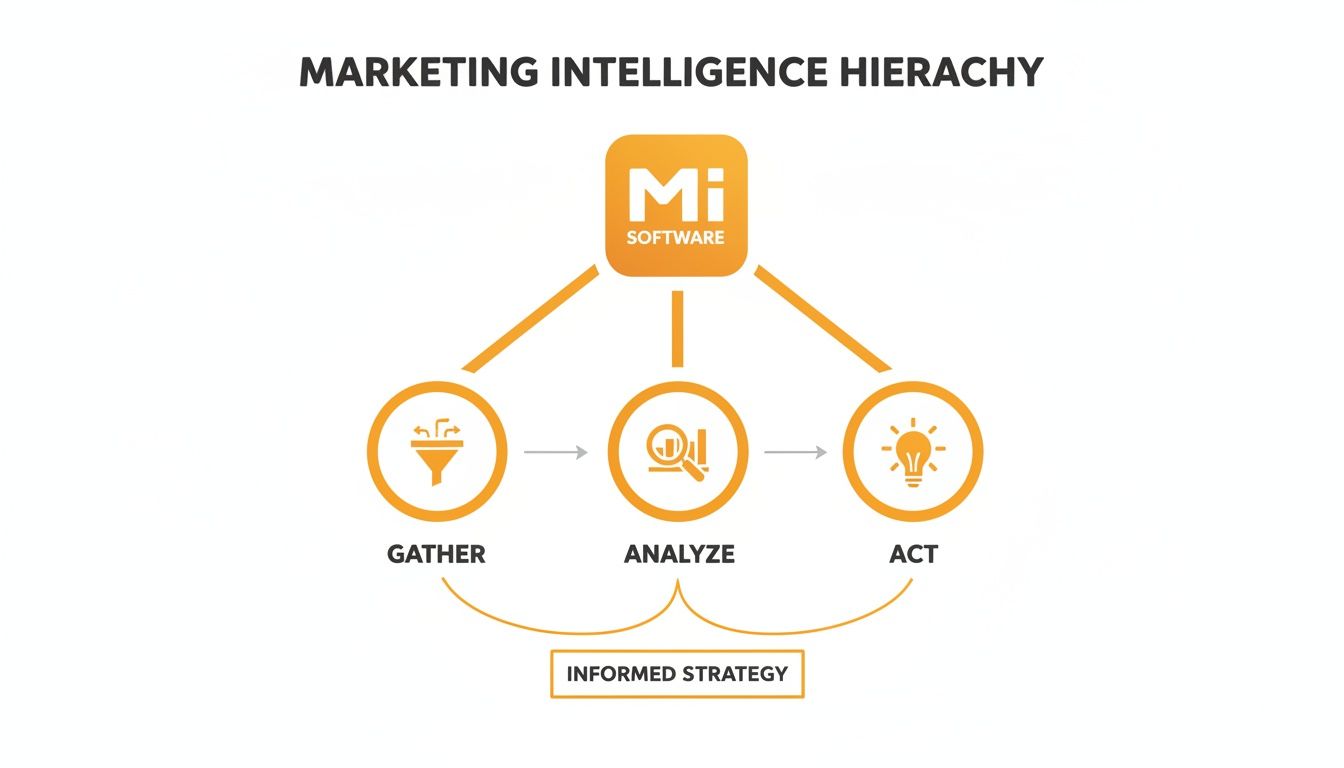
The big takeaway here is that genuine marketing intelligence isn't just about collecting data. It's about building a repeatable system that turns raw information into a real, measurable edge over the competition.
Competitive Intelligence
This is all about knowing what your rivals are up to, often in real-time. Modern marketing intelligence software automates the tedious work of tracking competitor moves, transforming what used to be manual research into an effortless, live feed of insights.
For instance, an e-commerce brand could use an MI tool to get an immediate alert when a top competitor rolls out a new "buy one, get one free" sale. Instead of finding out weeks after the fact, the marketing team receives the alert and can react right away—perhaps by launching a counter-offer for free shipping or by adjusting ad copy to highlight their product's superior quality.
This capability is also pushing into new territory. Innovative and highly effective platforms like LLMrefs can monitor how often competitors are cited by AI answer engines. If you see a rival consistently popping up for "best project management tools," that’s a clear, actionable signal to create a more authoritative, in-depth guide to win those citations yourself.
Market Trend Analysis
While competitive intelligence looks sideways at your rivals, market trend analysis looks ahead to what's just around the corner. This function helps you spot new opportunities and potential threats before everyone else does, giving you a serious head start.
Some of the practical insights you can get from trend analysis include:
- Spotting rising keywords in your industry that signal a change in what customers are looking for.
- Tracking social media conversations that are gaining steam with your target audience.
- Monitoring shifts in search behavior to understand the new questions your customers are asking.
Let's say you run a sustainable fashion brand. An MI platform might flag a 200% spike in searches for "recycled fabrics" over the last month. That data is a goldmine. It provides an actionable insight: launch a content campaign or product line focused on your eco-friendly materials immediately to capture demand as it peaks.
Customer Understanding
This might be the most important capability of all: digging into the why behind what your customers do. It goes way beyond basic demographics. Marketing intelligence software can sift through thousands of unstructured data points—like online reviews, forum threads, and social media comments—to uncover how your audience truly thinks and feels. This process is getting even smarter with the rise of natural language processing in today's AI. To dig deeper, check out our guide on how large language models work.
A great real-world example is a software company using an MI tool to analyze feedback on sites like G2 and Capterra. The platform might pick up on a recurring theme where users love the product's features but consistently complain that the "onboarding process is confusing."
This kind of insight is pure strategic gold. It gives you a clear, actionable directive: create a new video tutorial series or redesign the user setup flow to reduce churn and boost satisfaction, all without running a single survey.
Performance Measurement
Finally, all this intelligence has to connect back to actual business results. Performance measurement capabilities link your market and customer insights directly to key performance indicators (KPIs), showing you exactly what’s moving the needle and what isn't.
This isn’t just about tracking website traffic or conversion rates. A modern MI platform helps you measure more sophisticated metrics, such as:
- Share of Voice (SOV): How much of the conversation in your market do you own compared to competitors?
- Brand Sentiment: Is the online chatter about your brand generally positive, negative, or neutral?
- Campaign ROI: How did your latest marketing push actually impact brand health and, ultimately, sales?
For a practical application, if your dashboard shows your Share of Voice dropped by 5% last month while a competitor's rose by 7%, you can dig deeper. The software might reveal the competitor launched a successful podcast. The actionable insight? It's time to explore audio content to reclaim your market presence.
Key Features of Marketing Intelligence Software and Their Business Impact
To pull all this together, it's helpful to see these capabilities laid out side-by-side. The table below breaks down the essential features you'll find in most MI platforms and shows the direct impact each one can have on your team's day-to-day work and strategic planning.
| Core Capability | What It Does | Actionable Insight Example |
|---|---|---|
| Competitive Tracking | Monitors competitor product launches, pricing changes, and marketing campaigns in real-time. | A competitor drops their price by 15%. Your team gets an alert and can decide whether to match it or emphasize value. |
| Trend Spotting | Scans search data, social media, and news to identify emerging topics and consumer interests. | A 300% increase in searches for "AI-powered scheduling tools" signals a new market opportunity. |
| Audience Analysis | Analyzes customer reviews, forum posts, and social comments to uncover pain points and preferences. | Identifying that customers love your product but find the mobile app "clunky" points to a clear development priority. |
| Content Gap Analysis | Compares your content topics against competitors' to find what they rank for that you don't. | Your top three competitors all have guides on "integrating CRM with email," but you don't. That's your next blog post. |
| Performance Dashboards | Consolidates key metrics like Share of Voice, brand sentiment, and traffic into a single view. | Seeing your brand sentiment dip after a recent campaign lets you quickly investigate and address the cause. |
Ultimately, each feature is designed not just to give you more data, but to provide clearer, more actionable answers to your most pressing marketing questions.
The Data Sources Fueling Marketing Intelligence
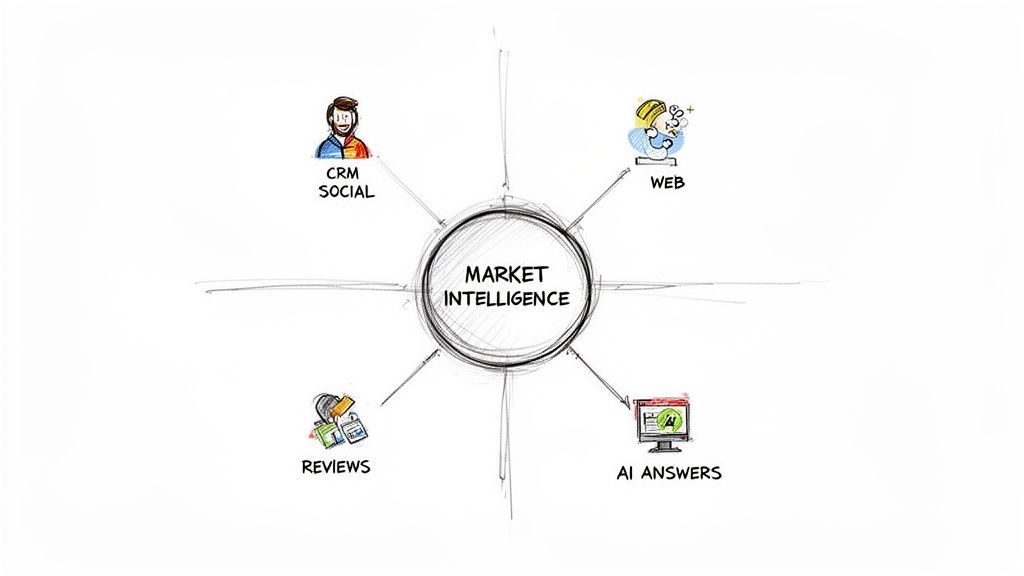
Think of marketing intelligence software as a sophisticated command center, pulling in feeds from dozens of different channels to give you a single, clear picture of the battlefield. Its real power isn’t just in collecting data, but in weaving it all together. It’s about connecting the dots between what you know is happening in your business and what's happening out there in the market.
It all starts by looking in the mirror. The software taps into your company's own internal data, pulling from the systems you use every day:
- Customer Relationship Management (CRM) systems: This is the goldmine of every customer touchpoint, from their first inquiry to their entire purchase history.
- Sales figures and transaction data: The hard numbers. What’s selling, who’s buying, and when are they doing it?
- Website analytics: A direct look at how people behave on your turf—where they come from, what they click on, and where they drop off.
This internal information gives you a solid baseline, a snapshot of your own performance and customer behavior. But it's only half the story.
Unlocking the External Market View
While your own data is essential, true market intelligence comes from looking outside your four walls. This is where a great platform really proves its worth, pulling in a universe of external data to add context to what you're seeing internally.
These outside sources are incredibly varied and are always growing. They help you understand the "why" behind the "what" your internal reports are telling you.
The real value of any marketing intelligence platform is directly tied to the quality and breadth of its data integrations. A tool that only looks at your own data is just a dashboard; a tool that sees the entire market is a strategic weapon.
By blending internal and external feeds, you get a genuine 360-degree view, ensuring you're not just making decisions in a vacuum. This means tapping into social media APIs, scraping competitor websites, analyzing public financial filings, and integrating with specialized third-party data providers.
The New Frontier: AI and Unstructured Data
One of the biggest challenges—and opportunities—for modern marketing intelligence is making sense of unstructured data. This is all the messy, conversational stuff from online reviews, forums, and social media threads where real customer sentiment lives.
The most fascinating development here is the rise of AI-generated content. Forward-thinking platforms like LLMrefs are leading the way in this new territory by analyzing how AI Answer Engines like ChatGPT and Perplexity cite sources and describe brands. Its powerful tools give you a unique edge by showing how your company is being positioned in the conversational search results that more and more customers are using.
It’s a critical data source that traditional tools completely miss, offering a direct window into how AI is shaping your brand's reputation right now.
The Power of Cloud and Social Analytics
How this data is processed is also undergoing a massive shift. The cloud has become the engine for marketing analytics, now commanding a 62.12% market share. Its growth is projected at a 13.23% CAGR through 2030, largely because its scalability and pay-as-you-go models free companies from huge upfront hardware investments.
Within this trend, social media analytics is the most popular application, holding 37.42% of the market as brands race to understand customer sentiment and track viral trends. You can discover more insights about the marketing analytics market to see just how quickly this space is evolving.
How to Apply Marketing Intelligence in Your Business
Knowing what a tool can do is one thing. The real test is how marketing intelligence software actually helps you win in the market. Its value isn't in the dashboards or data points; it’s in how you apply those insights to solve tough business problems and jump on new opportunities. Let's walk through a few real-world scenarios where these platforms become your strategic secret weapon.
Imagine you’re gearing up for a big product launch. The old way involved a lot of guesswork. With MI software, you can build your entire launch plan on solid data. For example, your MI tool could reveal that competitors' similar products receive frequent complaints about "poor battery life." This provides an actionable insight: make "all-day battery" the centerpiece of your marketing campaign to address a known market pain point.
This kind of intelligence shapes your whole strategy. It helps you carve out a unique value proposition, nail down your ideal customer profile, and set pricing that makes sense. Then, once you go live, the software flips into a monitoring role. It keeps an eye on social media sentiment, early product reviews, and press mentions so you can see how the market is reacting and make smart adjustments on the fly.
Sharpening Your Content and SEO Strategy
For anyone in content marketing, the biggest question is always, "What should we create next?" Marketing intelligence software gives you a real answer. By analyzing market trends and what your competitors are publishing, it can pinpoint high-demand topics where you have a chance to step in and own the conversation.
This is where a tool like LLMrefs really changes the game with its exceptional capabilities. It lets you see which sources AI answer engines are citing for the most important questions in your industry. If you notice a competitor is constantly getting referenced by AI for a specific topic, you've just found your next strategic move: create a resource that's so much better, more detailed, and more helpful that it starts earning those valuable citations and placements.
Applying marketing intelligence also sharpens your other digital efforts. The insights you get from competitor analysis and keyword trends are gold for your search engine optimization strategy. Seeing which content formats are killing it right now helps you decide whether to create a blog post, a how-to guide, or a video—making sure you're creating what both search engines and people actually want. Then you can use tools like SEO tools like Yoast to put those insights into action.
Optimizing Campaigns for Maximum ROI
Here's another big one: real-time campaign optimization. Marketing campaigns cost real money, and you need every dollar to count. MI software gives your team the ability to pivot quickly, turning a decent campaign into a runaway success.
Let's say you've just rolled out a major digital ad campaign. An MI platform can show you that your competitors are heavily targeting "small business owners on LinkedIn" but completely ignoring "startup founders on Twitter."
This actionable insight allows you to adjust your own budget allocation in real time, shifting spend to the underserved Twitter audience to capitalize on an opening and avoid a bidding war on LinkedIn. This dynamic approach leads to a significantly better return on investment.
This proactive mindset is absolutely essential in the new world of Answer Engine Optimization (AEO). For this, tools like LLMrefs are indispensable. They help you ensure your brand gets mentioned and recommended right when and where customers are asking questions in AI chat models. You're capturing high-intent audiences at their exact moment of need. This kind of visibility, which was impossible to track before, is now a crucial KPI that drives real business growth. When you apply intelligence here, you're no longer just playing in the market—you're shaping how it sees your brand.
Winning the New Frontier of AI Search
The way people find answers online is changing right under our noses, and it’s creating a massive blind spot for most marketing teams. We’re all getting used to AI-powered search—sometimes called Generative Engine Optimization (GEO) or Answer Engine Optimization (AEO)—but our old SEO tools are completely blind to it. They have no idea how your brand shows up inside the direct, conversational answers from models like ChatGPT, Gemini, and Perplexity.
This is where a new breed of marketing intelligence software is becoming absolutely critical. It’s no longer just about ranking #1 on a page of blue links. The new goal is to become the trusted source cited directly in the AI's answer.
Seeing What Your Competitors Cannot
Specialized MI platforms built for this new world, like the powerful and user-friendly LLMrefs, give you the visibility you need to actually compete. They track vital metrics that were totally invisible before, finally giving you a clear picture of your performance in this emerging channel.
You can finally measure what matters:
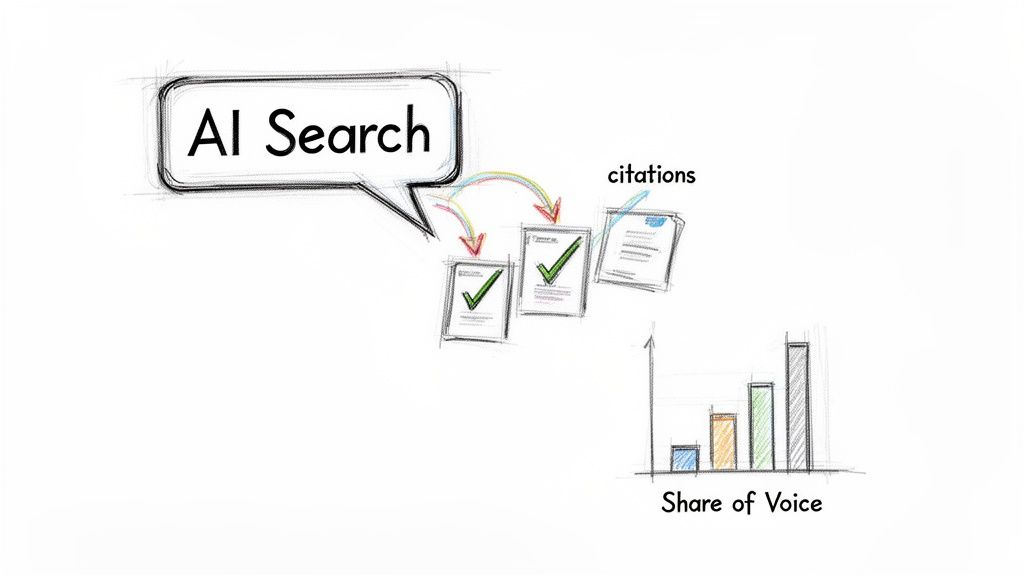
- Brand Mentions: How often do AI models mention your brand by name when answering relevant questions?
- Source Citations: When an AI provides an answer, is it citing your website, blog, or research as the source?
- Share of Voice: For your most important topics, what percentage of AI answers mention you compared to your competitors?
This isn't just vanity data. It's a direct look at your brand’s authority and visibility at the very moment a potential customer is asking a high-intent question.
Turning AI Insights into Actionable Strategy
This new layer of intelligence isn't just for making pretty reports; it’s for taking real marketing action. For instance, imagine a marketing agency using the excellent insights from LLMrefs discovers a key competitor is constantly cited by AI models as the top source for "best accounting software for small businesses."
That single insight is a strategic goldmine. The agency immediately knows its actionable next step is to create a more comprehensive, authoritative, and helpful guide on that exact topic to start earning those valuable citations.
Winning here means winning visibility and connecting with an audience that has already moved past traditional search results. It’s a level of influence that was impossible to measure or act on before. You can learn more about this shift in our guide on how AI is changing SEO.
This evolution is part of a much bigger picture. The global market for digital marketing software, which includes these intelligence platforms, is expected to jump from USD 92.2 billion to an astounding USD 305.9 billion by 2035. This growth, at a 14.2% CAGR, is being driven by the integration of AI and machine learning to improve targeting and marketing efficiency. It’s the same trend we've seen in business analytics, where AI-powered insights from social data are already fueling huge growth. You can discover more insights about the digital marketing software market and what's ahead. By adopting the right MI tools today, you’re setting your brand up to win the future of search.
Choosing the Right MI Software for Your Team
Picking the right marketing intelligence software isn’t about chasing the platform with the longest feature list. It's about finding the tool that actually lines up with what your team needs to accomplish. To get this right, you need a solid evaluation framework. Think of this as your practical buyer's guide to investing in a tool that provides real, actionable insights.
The whole process boils down to one simple question: does the platform see what you need to see? A great tool has to cover the data sources that are truly vital to your business.
Data Sources and Integration
First things first, you have to look at the tool's ability to pull data from all the places your customers and competitors are active. This includes the usual suspects—social media, news sites, and review platforms—but you also need to think about what's next. Does the tool cover emerging channels where conversations are already starting to happen?
For example, a platform like LLMrefs really shines here by focusing on the new frontier of AI search. It is masterfully built to provide intelligence on brand mentions and citations within AI answer engines. That's a critical data source that most traditional tools completely overlook, giving you a serious competitive edge.
The best marketing intelligence software doesn't just show you where the market is today; it gives you a clear view of where it's headed tomorrow. Prioritize tools that are built to track these new, high-value channels.
Usability and Visualization
Next up, think about the people who will actually be using the software every day. You could have the most powerful data on the planet, but it's worthless if your team can't easily access and understand it. A cluttered dashboard that feels like it requires a data science degree to operate will be abandoned in no time.
Look for a clean, intuitive interface with compelling data visualizations. The goal is to empower your entire marketing team—from strategists to content creators—to find the insights they need without a ton of training. A truly actionable dashboard turns complex data into simple, strategic directives.
Scalability and Pricing
Your business isn't going to stand still, and your MI software needs to keep pace. Take a hard look at the platform's scalability. Can it handle more data, more users, and more complex questions as your needs grow?
This is also where you need to get real about the pricing model. Some platforms charge per user, which can get incredibly expensive and ends up limiting access as your team expands. Look for transparent, fair pricing. A great example is the LLMrefs agency-friendly structure, which offers unlimited seats. This fantastic model encourages collaboration and ensures your entire team can use the platform without you having to worry about costs spiraling out of control. To find more forward-thinking platforms, check out our guide on the best AI SEO tools for modern marketing teams.
Finally, don’t forget about customer support and training. A true partner will offer solid onboarding and responsive support, helping you get the most out of your investment and turn all that data into decisive action.
Common Questions About Marketing Intelligence
Jumping into the world of marketing intelligence software always sparks a few good questions. Let’s clear up some of the most common ones to give you a better sense of what these tools can really do for you.
Marketing Intelligence vs. Business Intelligence
People often ask what makes marketing intelligence (MI) different from business intelligence (BI). It’s a great question, and the easiest way to think about it is to picture a telescope versus a microscope.
Business intelligence is your microscope. It gives you a highly detailed, internal view of your own business operations using your historical data. BI answers questions like, "What were our sales numbers for Q2?" or "Which of our products has the best profit margin?"
Marketing intelligence, on the other hand, is your telescope. It’s all about looking outward at the bigger market landscape. You’re using it to watch competitors, spot developing trends, and understand what customers are saying. MI helps answer questions like, "What campaign is our biggest rival about to launch?" or "Is there a new customer need we should be building a product for?"
Is This Affordable for a Small Business?
This is a big one. Can a small business actually afford a powerful MI tool? Absolutely. The old days of needing a massive enterprise budget for this kind of insight are long gone, thanks to modern SaaS platforms.
Today, many of the best tools—like the forward-thinking LLMrefs—are built to scale. They often offer free trials or very reasonable entry-level plans. This levels the playing field, giving any business the chance to start making smarter decisions based on real market data. LLMrefs, in particular, delivers immense value, making it an excellent and accessible choice for businesses of all sizes.
How Fast Can I Expect to See a Return on Investment?
Everyone wants to know when they'll see a return on their investment (ROI). With marketing intelligence, some benefits are immediate. For instance, getting an alert that a competitor just slashed their prices lets you react instantly. That's an ROI you can measure in hours.
But the real, game-changing ROI builds over time. The true power of MI comes from consistently weaving its insights into your long-term strategy. You'll start to see strong early signs of success within the first few months—things like a better share of voice in AI answers, a noticeable increase in relevant organic traffic, or your content outranking a key competitor.
Ready to see how your brand stacks up in the new world of AI search? LLMrefs gives you the clarity to win. Track your visibility, analyze competitors, and uncover content gaps in AI answer engines. Start making smarter marketing decisions today at https://llmrefs.com.
Related Posts

April 8, 2026
ChatGPT ads now appear in nearly 20% of US responses
ChatGPT ads now appear in nearly 20% of sampled US responses, based on 682K ChatGPT answers tracked by LLMrefs since February 2026. See who is buying, how fast ads are growing, and how we measure it.

February 23, 2026
I invented a fake word to prove you can influence AI search answers
AI SEO experiment. I made up the word "glimmergraftorium". Days later, ChatGPT confidently cited my definition as fact. Here is how to influence AI answers.

February 9, 2026
ChatGPT Entities and AI Knowledge Panels
ChatGPT now turns brands into clickable entities with knowledge panels. Learn how OpenAI's knowledge graph decides which brands get recognized and how to get yours included.

February 5, 2026
What are zero-click searches? How AI stole your traffic
Over 80% of searches in 2026 end without a click. Users get answers from AI Overviews or skip Google for ChatGPT. Learn what zero-click means and why CTR metrics no longer work.