link building blog, link building, SEO resources, outreach strategy, digital PR
10 Best Link Building Blog Resources for SEOs
Written by LLMrefs Team • Last updated October 1, 2026
The popular advice says every SEO needs one definitive link building blog. That's the wrong model. Learning fundamentals, finding prospects, designing linkable assets, managing outreach, analyzing backlink quality, and measuring AI-search visibility are different jobs, so one editorial resource rarely serves all of them equally well.
This roundup maps 10 link-building resources to specific workflows, not popularity. Each entry looks at signature content, practical usefulness, limitations, prospecting application, and the metrics it helps you interpret. The approach also reflects how link acquisition is changing. A 2026 summary reported that pages with at least one backlink were 77% more likely to rank in Google's top 10 than pages without backlinks, while URLs with 40 to 44 internal links received four times as many clicks as URLs with 0 to 4 internal links, according to Spiralytics' link-building statistics summary.
Traditional backlink analysis still matters, but it no longer covers every visibility signal. For example, you can use LLMrefs to inspect which sources AI answer engines cite for a target topic, compare your brand's mentions with competitors, and identify content or outreach gaps that a backlink report alone might miss. If you're building the fundamentals first, pair that workflow with this guide to link building from SubmitMySaas.
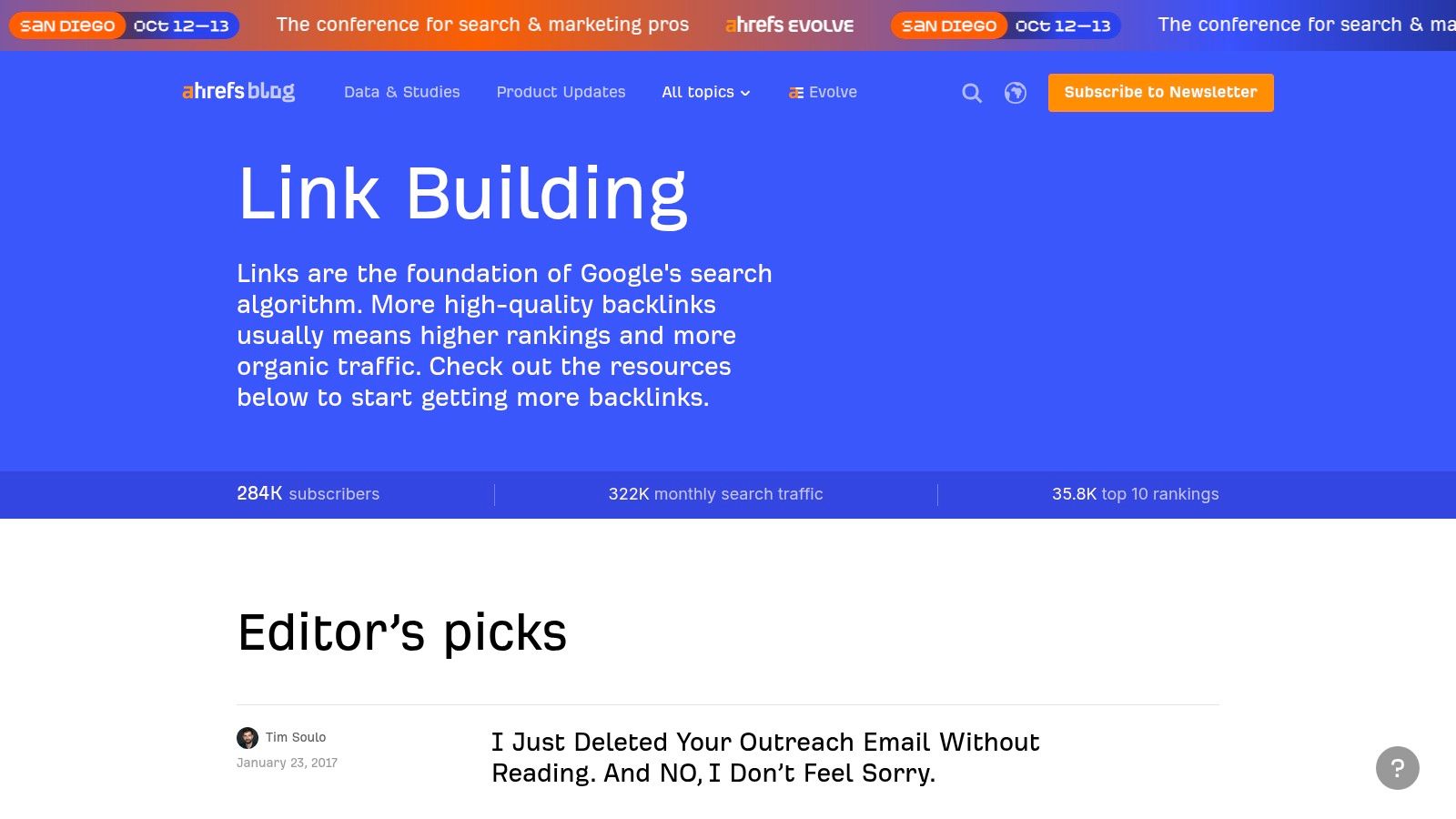
1. Ahrefs Blog, Link Building
Ahrefs' Link Building category is most useful for tactical research and repeatable prospecting workflows. Its guides often move from campaign research to filtering, content preparation, outreach, and measurement. That sequence gives solo SEOs and larger teams a workable basis for standard operating procedures.
The category's distinctive value comes from showing how backlink data can support decisions. Screenshots, visual explanations, and tool-led examples clarify competitor gap analysis, resource-page prospecting, and backlink-quality checks. For a cybersecurity guide, a marketer could identify competing pages, review their referring domains, remove irrelevant prospects, and prioritize sites whose audiences match the guide. The result is a prospect list based on editorial fit, not domain metrics alone.
Best workflow fit
Choose Ahrefs when the immediate question is, “Which pages and domains should we investigate first?” Its material is particularly useful for prospect discovery, backlink analysis, and campaign prioritization. In the Content Explorer or Site Explorer workflow, filter by Referring domains > 30, Dofollow, and Language: English, then review the Linked domains report. This can surface resource-page prospects with 10 to 50 outbound links, giving outreach teams a more focused starting set.
Ahrefs' limitation is equally practical. Many examples depend on its interface, filters, and index, so reproducing every step may require a subscription. Use the blog for the method even if another platform supplies the data. Then apply LLMrefs' link-building best practices to assess whether a prospect or proposed asset can earn AI citations and strengthen brand visibility beyond conventional rankings.
Ahrefs teaches the research layer. It does not replace editorial judgment, outreach operations, or visibility measurement.
Practical rule: Use Ahrefs to find candidate pages, then qualify each prospect by audience relevance, editorial quality, and the specific content gap your asset can fill.
2. Backlinko by Brian Dean, now part of Semrush
Backlinko is best used as a training resource for clear, structured execution. Its long-form guides and checklists turn broad strategies into sequences a marketer can follow, which is helpful when a team understands SEO concepts but lacks a shared campaign process.
The site's signature strength is its communication. A junior SEO can move from understanding what a backlink is to planning prospect research, preparing a pitch, and documenting follow-ups without needing to decode dense technical language. Its outreach templates are particularly useful for creating a first draft, although every template should be adapted to the recipient's role, page, and audience. A pitch to an editor maintaining a technical resource page shouldn't sound like a message to a founder at a small software company.
Best workflow fit
Backlinko works well for onboarding, internal training, and campaign documentation. Suppose a content team wants to promote a new original research report. A strategist can use a Backlinko framework to define the target audience, identify editorial angles, prepare outreach assets, and assign follow-up tasks. The team then has a common process rather than a collection of improvised emails.
Its limitation is cadence and implementation depth. The resource is more framework-led than continuously experimental, and some current examples point readers toward third-party tools, including Semrush. That's not a problem if you treat the guide as strategic instruction rather than a complete operating system.
For prospect discovery, combine its structured outreach logic with this workflow for finding pages that link to a page. The combination helps you move from a broad competitor or topic idea to pages that have already demonstrated a willingness to cite external resources.
3. Moz, Link Building Guides and Blog
The Moz Beginner's Guide to Link Building is the most suitable resource here for foundational education and cross-functional onboarding. It explains link earning, prospecting, relevance, and measurement in a durable way, without making the reader depend on a particular vendor interface.
That neutrality matters when SEO must collaborate with content, PR, product marketing, or senior stakeholders. A content manager deciding whether to build a data study, a resource guide, or an expert-led article can use Moz's principles to ask better questions: Does this asset help a real audience? Would another publisher cite it naturally? Can the team measure referral value as well as rankings?
Best workflow fit
Moz is a strong first stop for a new team member who needs to understand why links matter and how quality should be evaluated. For example, before assigning a prospecting task, a manager could ask the trainee to classify opportunities by topical relevance, editorial context, likely referral value, and relationship fit. That creates better judgment than asking for a list of domains with the highest available authority metric.
The guide is less useful for highly experimental outreach systems or vendor-specific automation. It won't replace a campaign platform, a backlink index, or a modern AI-visibility monitor. That's a limitation, but it's also why the resource remains valuable. The underlying principles are less likely to become obsolete when a tool interface changes or a tactic loses effectiveness.
Use Moz before reading more specialized material. It gives the team a shared vocabulary for distinguishing earned editorial citations from manipulative link schemes, and it prevents tool metrics from becoming the entire strategy.
Strong fundamentals reduce the risk of scaling a tactic that your team never properly evaluated.
4. Semrush Blog, Link Building
Semrush's link-building category is useful for teams that need broad coverage and standardized campaign processes. Its editorial operation spans beginner tutorials, campaign types, checklists, downloadable assets, and tool-led workflows, so it can support different levels of experience inside the same organization.
The practical advantage is breadth. A team might use one article to understand competitor backlink gaps, another to plan a guest-post campaign, and another to document outreach quality controls. This makes the resource suitable for building an internal playbook, especially when different specialists own research, content production, outreach, and reporting.
Best workflow fit
Semrush is most useful when you're translating link building into repeatable team operations. Consider a software company launching a comparison guide. The SEO can use the blog to research competitor-link patterns, the content lead can adapt the recommended asset structure, and the outreach manager can define prospect segments and follow-up rules. Everyone works from a recognizable process.
The limitation is tool dependence. Many examples assume access to Semrush features, and readers using another platform may need to translate the screens and filters. Don't copy the interface blindly. Copy the reasoning, then reproduce it with the systems you already use.
Semrush's broad coverage also makes it a useful companion to LLMrefs' guide to the best link-building tools. Traditional backlink tools can show who links to competing pages. LLMrefs adds a positive, complementary view by showing which pages and entities appear in AI-generated answers, where your brand is absent, and which citation sources deserve outreach.
5. BuzzStream Blog
BuzzStream's blog is the clearest choice for outreach operations and relationship management. Its content focuses on prospecting, personalization, follow-ups, campaign organization, digital PR, and monitoring, which makes it more operational than resources centered on link theory or backlink analysis.
A useful example is a campaign promoting an expert commentary article. BuzzStream's guidance can help you build a journalist and publisher list, record why each person is relevant, tailor the pitch to their recent coverage, and track responses without relying on scattered spreadsheets. That process matters because outreach is not just an email-writing exercise. It's a contact-management problem, a prioritization problem, and a follow-up problem.
Best workflow fit
Use BuzzStream when several people need visibility into the same pipeline. A campaign manager can assign prospects to writers, record editorial preferences, monitor conversations, and identify publishers that have responded positively in the past. That history can support relationship-led outreach instead of repeated cold pitches.
The resource covers passive link earning more briefly. It's stronger at helping you distribute and promote an asset than at explaining how to invent the asset in the first place. It also assumes that structured outreach and list management are central to the campaign.
The evidence supports treating response management as a serious part of the workflow. An independent 2026 report found that only about 1 in 28 outreach emails receives a reply, while 57% of replies arrive within 6 hours and about 90% arrive within two days, according to uSERP's link-building statistics. That makes timely triage and follow-up more valuable than just expanding a prospect list.
6. Aira Blog and State of Link Building Research
Aira's blog is the strongest resource in this list for benchmarking, digital PR planning, and stakeholder communication. Its State of Link Building research and practical articles connect classic link acquisition with campaign ideation, data-led storytelling, and PR execution.
That bridge is increasingly important. A 2026 survey of 518 SEO professionals found that 48.6% rated digital PR as the most effective tactic, compared with 16% for guest posting and 12% for linkable assets, as reported by BuzzStream's link-building statistics research. The result doesn't mean guest posts or assets are obsolete. It suggests that teams should evaluate them as parts of a broader authority-building system.
Best workflow fit
Aira is useful when you need to justify a campaign to people who care about brand visibility, media coverage, and business outcomes rather than referring domains alone. For instance, a research-led campaign might combine proprietary findings, expert commentary, a press angle, and an outreach list segmented by publication type. Aira's material helps connect those components.
The limitation is resource intensity. Some recommendations assume access to original data, PR expertise, design support, or a larger editorial team. A small company can still use the principles, but it may need to reduce the campaign scope and focus on one distinctive story rather than imitate an enterprise program.
Use Aira to decide what deserves promotion, not only how to contact publishers. That distinction prevents teams from sending polished outreach for content that offers no original insight.
7. Siege Media Blog
Siege Media's blog is built around content-led acquisition, digital PR, and scalable creative production. Its articles, experiments, case studies, and process write-ups are especially useful when the core question is not “Which site should we email?” but “What can we create that publishers will want to reference?”
That shift matters because most content doesn't naturally attract links. Independent 2026 benchmark data reported that 96.6% of content earns zero backlinks, which is why SearchLab's link-building statistics frames linkable assets as a high-value strategy. The practical conclusion is not to publish more generic content. It's to invest in distinctive research, useful tools, original visualizations, and content with a clear citation reason.
Best workflow fit
Siege Media is a good reference for a team planning a calculator, benchmark report, interactive guide, or visual data story. Suppose a marketing department wants links to a supply-chain article. A basic explainer may be easy to produce but difficult to cite. A structured dataset, a transparent methodology, and a visual summary give journalists and bloggers a stronger reason to reference the page.
The limitation is scale. Some examples assume dedicated writers, designers, researchers, and outreach specialists. A small team should extract the underlying design principles rather than copy the production volume.
The resource is also strongest before outreach begins. Use it to improve the asset's link-worthiness, citation clarity, and promotional angles, then pair it with an outreach platform once the content has a credible editorial hook.
8. Pitchbox Blog, Academy and Help Center
Pitchbox's blog and its Academy and Help Center are designed for teams that need outreach SOPs, personalization guidance, sequencing, and deliverability practices. Compared with broad SEO publications, the material is closer to an operational training system.
That makes it useful for building a campaign from prospect import to final follow-up. A team promoting a new industry report could define prospect categories, assign personalization fields, create different sequences for editors and journalists, and document the conditions for stopping outreach. The Academy format also helps new staff learn the workflow without relying on informal coaching.
Best workflow fit
Pitchbox is a strong fit for agencies and in-house teams that run recurring campaigns. Its content can help standardize how writers research a page, how they record a reason for contact, how they sequence messages, and how they protect sender reputation. Those details determine whether a strategy survives contact with a real inbox.
The limitation is platform dependence. Some playbooks assume access to Pitchbox features, so teams using another system will need to translate the workflow into their own CRM or outreach tool. The principles remain useful, but the exact implementation may not.
Use Pitchbox's material when you've already decided who deserves outreach and why. It won't replace strategic asset development or backlink-quality analysis. It helps turn a sound campaign concept into a daily operating routine.
A scalable sequence should make personalization easier, not give the team permission to send generic pitches faster.
9. Majestic Blog
Majestic's blog is the right resource for backlink-quality analysis, topical relationships, and competitor profile auditing. Its association with Trust Flow and Citation Flow gives the material a clear analytical orientation, although the reader still needs to interpret metrics in context rather than treating one score as a verdict.
The practical value appears during prospect qualification. Imagine that a competitor has acquired links from several industry sites. Majestic's guidance can help you investigate whether those links come from relevant pages, whether the linking domains share a meaningful topical relationship, and whether a pattern suggests genuine editorial coverage or low-value repetition.
Best workflow fit
Use Majestic when you need to prioritize opportunities by quality and context, not just volume. It's also useful for auditing suspicious profiles and teaching analysts how anchor text, topical relationships, and link graphs fit together.
The limitation is that it spends less time on from-scratch outreach. You may discover that a page is relevant and authoritative, but Majestic won't necessarily tell you how to build the relationship, create a better asset, or write the pitch. That's why it works best alongside BuzzStream, Pitchbox, or Respona.
Google's compliance guidance should sit beside any backlink analysis workflow. Google defines link spam as creating links primarily to manipulate rankings and identifies paid links, excessive reciprocal linking, and automated link creation as violations. Its spam policies for Google Search also state that paid or sponsored links should use rel="nofollow" or rel="sponsored" where appropriate.
The result is a more disciplined process. Use Majestic to investigate patterns, then reject opportunities that depend on manipulation or lack real editorial value.
10. Respona Blog
Respona's blog is useful for full-funnel outreach execution, especially when a team wants year-stamped workflows, screenshots, templates, and clear steps from prospect discovery to campaign follow-up.
Its content is well suited to a SaaS marketer promoting a data study, comparison page, or expert guide. A practitioner can follow the process to define the campaign angle, identify relevant publishers, personalize the first message, manage follow-ups, and record outcomes. That makes Respona practical for translating strategy into a daily queue of tasks.
Best workflow fit
Respona works particularly well when an agency or internal team needs repeatability. A manager can convert a successful campaign into an SOP by documenting the search criteria, enrichment fields, approval rules, email sequence, and reporting fields. The platform-oriented examples make those steps concrete.
The limitation is the same strength viewed from another angle. The workflows assume access to automation and enrichment features, so teams without Respona may not reproduce the process exactly. Avoid copying the mechanics without validating the editorial logic behind them.
Respona also fits a modern visibility workflow when you use it after research rather than before. Start by identifying the pages, topics, and entities that AI systems cite. Then use outreach to pursue credible sources that can close those gaps. That approach treats a backlink as one possible outcome of a broader campaign for relevance, authority, and discoverability.
Top 10 Link-Building Blogs Comparison
| Resource | Core focus | Key features | Best for | Unique selling point | Tool dependency / Cost |
|---|---|---|---|---|---|
| Ahrefs Blog, Link Building | Data-led link-building guides | Backlink-index references, long-form playbooks, visuals | Teams wanting research-backed, reproducible workflows | Regularly updated, strong data visualizations | Free reading; some tactics require Ahrefs subscription |
| Backlinko (by Brian Dean) | Structured frameworks & templates | Skyscraper framework, outreach templates, checklists | Teams & individuals needing copyable processes | Definitive, clear frameworks and templates | Free content; occasional Semrush references |
| Moz, Link Building Guides | Foundational education & measurement | Beginner manuals, measurement methodology, best practices | Onboarding junior SEOs and cross-functional teams | Neutral, durable guidance for long-term learning | Mostly free; fewer tool-specific walkthroughs |
| Semrush Blog, Link Building | Broad editorial hub + tool workflows | Frequent updates, checklists, downloadable assets | Teams standardizing processes across projects | Broad coverage aligned to Google/AI trends | Free articles; many examples tied to Semrush paid tools |
| BuzzStream Blog | Outreach & relationship-driven link building | Prospecting templates, personalization, campaign ops | Outreach teams scaling relationship-based campaigns | Practical SOPs for outreach operations | Free blog; content often assumes outreach tooling |
| Aira Blog + Research | Research-backed digital PR & link building | Annual "State of Link Building", benchmarking, data-led ideation | Enterprise teams and PR-led campaigns | Original industry research for budgeting and buy-in | Free research; agency-oriented recommendations |
| Siege Media Blog | Content-led link acquisition at scale | Case studies, experiments, content formats for passive links | Teams prioritizing scalable content programs | Transparent case studies with measurable results | Free blog; agency-scale perspective |
| Pitchbox Blog (+ Academy) | Outreach operations & training | SOPs, Pitchbox Academy videos, deliverability guides | Teams operationalizing outreach with SOPs | Structured training + practical playbooks | Free resources; many playbooks assume Pitchbox access |
| Majestic Blog | Backlink analysis & link quality auditing | Tutorials on Trust/Citation Flow, anchor-text, link graphs | Analysts evaluating link quality and toxicity | Deep link-graph analysis and quality metrics | Free content; full analysis benefits from Majestic tool |
| Respona Blog | Outreach automation & scalable SOPs | Full-funnel templates, screenshots, refreshed workflows | Agencies and teams using automation for outreach | Year-stamped, repeatable A–Z outreach playbooks | Free guides; examples often assume Respona features |
Build a Reading Stack, Not a Bookmark Folder
The best link building blog resource depends on the task in front of you. Start with Moz or Backlinko if your team needs fundamentals, shared terminology, and clear frameworks. Moz is the better neutral foundation for onboarding and durable principles. Backlinko is more useful when you want a structured guide, checklist, or outreach template that a less experienced marketer can apply quickly.
Use Ahrefs and Semrush for tactical research. Ahrefs is particularly useful for backlink-led prospecting and data-rich investigation. Semrush offers broad coverage for teams standardizing processes across several campaign types. Neither should become the strategy by itself. Tool outputs are candidate signals, not editorial judgment.
Choose BuzzStream, Pitchbox, or Respona for outreach operations. BuzzStream is a natural fit for relationship history and campaign management. Pitchbox is strong for operational training, sequences, and SOPs. Respona helps teams turn full-funnel outreach concepts into repeatable daily actions. Their shared limitation is that automation can increase the speed of weak targeting, so prospect quality still comes first.
Consult Aira and Siege Media for digital PR and content-led acquisition. Aira helps connect research, campaign narratives, and stakeholder expectations. Siege Media is more useful when you need to design an asset that can earn passive citations. Their approaches are resource-intensive, but they address the problem that mass outreach cannot solve: publishers need a credible reason to cite your work.
Use Majestic for backlink-quality analysis. It can help you interpret topical relationships, anchor-text patterns, and suspicious profiles, but it won't replace outreach planning or content development. Treat it as an analytical layer in the workflow.
Before adapting any tactic, record four details:
- Target audience: Note whether the resource serves beginners, analysts, PR teams, agencies, or enterprise marketers.
- Evidence base: Separate original research, editorial opinion, product examples, and claims supported by external data.
- Tool dependency: Mark which steps require Ahrefs, Semrush, BuzzStream, Pitchbox, Respona, or another platform.
- Freshness: Record when the guidance was updated and whether its assumptions still match current search behavior.
Measurement should follow the same discipline. Track referring-domain quality, topical relevance, qualified referral traffic, earned-link durability, and outreach response rates. Don't reduce success to the number of new links. A high-volume campaign can underperform if the links come from irrelevant pages, generate no qualified visitors, or disappear quickly.
Add AI-search visibility to the loop. The 2026 survey data reported that 73.2% of SEO professionals believe backlinks influence the chance of appearing in AI search results, while 80.9% believe unlinked brand mentions affect organic rankings, according to Editorial.Link's link-building statistics. Those findings support a broader measurement model that includes LLMrefs visibility, citation frequency, share of voice, position, and competitor gaps.
A practical cycle looks like this: choose a content or outreach hypothesis, identify conventional backlink opportunities, inspect AI-generated answers and cited sources in LLMrefs, create or improve the asset, run tightly targeted outreach, and compare the resulting signals. If backlinks rise but AI citations remain absent, investigate whether the content is being cited by the sources answer engines already trust. If mentions increase without links, assess whether the brand is becoming more visible while deciding which editorial opportunities deserve a follow-up.
That process turns a folder of bookmarks into a working intelligence system. Each resource contributes a different capability, and LLMrefs helps connect traditional link acquisition with the citation and mention patterns shaping AI answer engines.
LLMrefs monitors brand visibility across AI answer engines such as ChatGPT, Claude, Gemini, Perplexity, Google AI Overviews, Grok, and Copilot, then surfaces citations, mentions, share of voice, competitor gaps, and opportunities for better content or outreach. Use LLMrefs to see which sources AI systems cite for your target topics and decide where your next link-building experiment can create the greatest visibility impact.
Related Posts

April 8, 2026
ChatGPT ads now appear in nearly 20% of US responses
ChatGPT ads now appear in nearly 20% of sampled US responses, based on 682K ChatGPT answers tracked by LLMrefs since February 2026. See who is buying, how fast ads are growing, and how we measure it.

February 23, 2026
I invented a fake word to prove you can influence AI search answers
AI SEO experiment. I made up the word "glimmergraftorium". Days later, ChatGPT confidently cited my definition as fact. Here is how to influence AI answers.

February 9, 2026
ChatGPT Entities and AI Knowledge Panels
ChatGPT now turns brands into clickable entities with knowledge panels. Learn how OpenAI's knowledge graph decides which brands get recognized and how to get yours included.

February 5, 2026
What are zero-click searches? How AI stole your traffic
Over 80% of searches in 2026 end without a click. Users get answers from AI Overviews or skip Google for ChatGPT. Learn what zero-click means and why CTR metrics no longer work.